



Lyophilization Equipment Market
Lyophilization Equipment Market Size, Share, Insights, Competitive Landscape, and Forecast 2026 to 2033
Lyophilization Equipment Market
Lyophilization Equipment Market Size and Trend Analysis
How Fast Is the Lyophilization Equipment Market Growing?
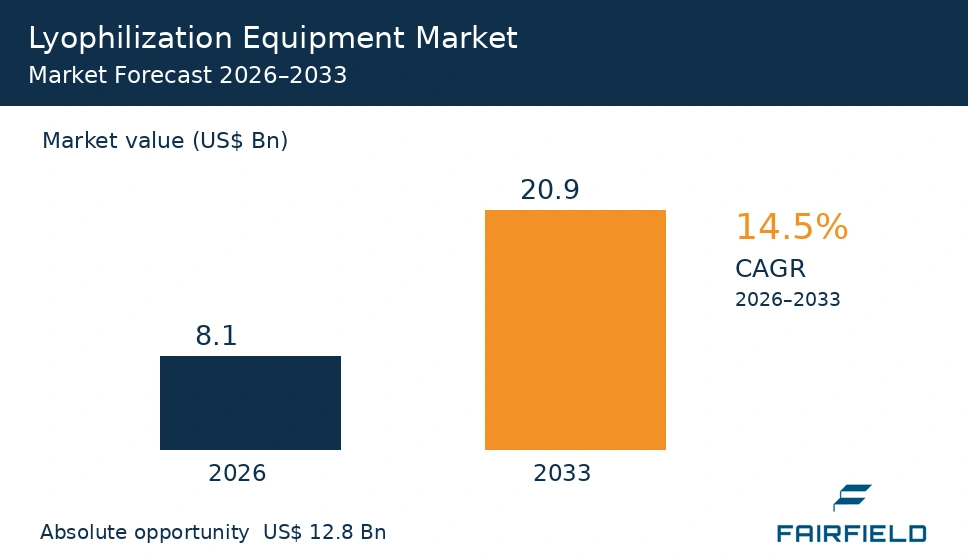
The global lyophilization equipment market size is expected to be valued at US$ 8.1 billion in 2026 and projected to reach US$ 20.9 billion by 2033, growing at a CAGR of 14.5% between 2026 and 2033.
Between 2020 and 2025, the market grew at a CAGR of about 8.0%, rising from roughly US$ 4.8 billion to about US$ 7.1 billion, as vaccine production scaled up during the pandemic, biologics and injectable drug pipelines expanded, and contract manufacturers invested in new aseptic fill-finish lines with freeze-drying capacity. The lyophilization equipment market covers freeze dryers and related systems that remove water from frozen products by sublimation under vacuum, producing stable dry powders or cakes that can be stored and shipped without refrigeration. Products include tray-style, manifold, and rotary freeze dryers, along with automatic loading and unloading systems. Equipment ranges from laboratory and pilot units to large industrial systems used in pharmaceutical and biotech manufacturing, vaccines, diagnostics, food processing, and medical applications. In September 2026, IMA Life opened a new freeze dryer factory in New York.
Key Report Takeaways
-
By Modality: Tray-Style Freeze Dryers held about 55% share in 2025, while Rotary Freeze Dryers are projected to expand at a 16.0% CAGR through 2033, driven by continuous and spin freeze-drying technologies that shorten cycle times, improve product uniformity, and support high-volume biologics production.
-
By Scale of Operation: Industrial Scale held about 60% share in 2025, while Pilot Scale is projected to expand at a 16.5% CAGR through 2033, driven by growing numbers of biologics, mRNA, cell and gene therapy candidates moving into clinical trials that need small-batch production.
-
By Application: Pharmaceutical and Biotechnology held about 65% share in 2025, while Food Processing and Packaging is projected to expand at a 15.5% CAGR through 2033, driven by demand for freeze-dried fruits, coffee, ready meals, pet food, and probiotics with long shelf life.
-
By Region: North America held about 38% share in 2025, while Asia Pacific is projected to expand at a 16.5% CAGR through 2033, driven by biopharmaceutical manufacturing growth in China, India, and South Korea, rising vaccine production, and expanding contract manufacturing capacity.
Global Lyophilization Equipment Market Trends and Insights
Drivers Impact Analysis
Two drivers carry the strongest influence on lyophilization equipment market demand during the forecast period.
| Driver | Impact on CAGR Forecast | Geographic Relevance | Impact Timeline |
| Growth of biologics, injectables, and vaccines | High | Global | Long term (≥4 years) |
| Expansion of contract manufacturing and fill-finish capacity | High | North America, Europe, Asia Pacific | Medium term (2-4 years) |
Biologics and Vaccine Growth Is Driving the Lyophilization Equipment Market
Growth of biologics, injectables, and vaccines is the strongest driver of the lyophilization equipment market. Many modern medicines need freeze-drying.
The mechanism is that monoclonal antibodies, antibody-drug conjugates, peptides, vaccines, enzymes, and many injectable drugs are unstable in liquid form, so manufacturers freeze-dry them to extend shelf life, improve stability, and allow storage and transport at normal temperatures. A large share of new biologic drug approvals use lyophilized formats. Vaccine makers use freeze-drying to support global distribution, especially to regions with weak cold chains. New modalities such as mRNA, viral vectors, and cell therapies are also exploring lyophilization to improve stability. As pharmaceutical companies invest heavily in biologics pipelines and new production plants, demand for industrial freeze dryers, loading systems, and process control equipment continues to rise across all regions.
Contract Manufacturing Expansion Is Expanding the Lyophilization Equipment Market
Expansion of contract manufacturing and fill-finish capacity is expanding the lyophilization equipment market. Many drug makers outsource production.
The cause is that biotech companies and large pharmaceutical firms increasingly rely on contract development and manufacturing organizations for sterile fill-finish and freeze-drying, and these CDMOs are adding new lines to meet demand. In March 2026, Lyocontract announced that Syntegon would equip its new facility with a complete filling and lyophilization line, and in October 2026, Spanish CDMO 53Biologics announced a more than €2 million investment in new lyophilization infrastructure. Governments in the United States, Europe, and India are encouraging domestic drug manufacturing to strengthen supply security. Reshoring of sterile injectable production adds further demand. These investments create strong orders for freeze dryers and integrated aseptic lines.
Restraints Impact Analysis
Two restraints limit how quickly the lyophilization equipment market grows.
| Restraint | Impact on CAGR Forecast | Geographic Relevance | Impact Timeline |
| High capital and operating costs | High | Global | Medium term (2-4 years) |
| Long cycle times and complex validation | Medium | Global | Long term (≥4 years) |
High Costs Slow the Lyophilization Equipment Market
High capital and operating costs slow the lyophilization equipment market. Industrial freeze dryers are expensive.
The problem is that a large pharmaceutical freeze dryer with automatic loading, clean-in-place, sterilization-in-place, and isolator integration can cost several million dollars, and complete aseptic fill-finish lines cost much more. Freeze-drying also uses large amounts of energy for refrigeration, vacuum, and heating, and cycles can run for days, raising operating costs. Facility construction, cleanroom requirements, and qualified staff add further costs. Small biotech companies and manufacturers in emerging markets may struggle to afford new equipment and often rely on contract manufacturers instead. Supply chain constraints have also lengthened delivery times for some systems. These factors slow purchases and push some users to delay investments or seek alternative stabilization methods.
Long Cycles and Validation Restrict the Lyophilization Equipment Market
Long cycle times and complex validation restrict the lyophilization equipment market. Freeze-drying processes are slow and highly regulated.
The constraint is that conventional batch freeze-drying cycles can take from one day to more than a week, limiting throughput and making it difficult to respond quickly to demand changes. Each product requires careful cycle development to avoid collapse, cracking, or poor reconstitution. Regulators require extensive validation, documentation, and quality control for sterile lyophilized products, and any equipment change can require revalidation. Scaling processes from laboratory to commercial equipment is technically challenging. Some manufacturers explore alternatives such as spray drying or liquid formulations with improved stability. These challenges lengthen project timelines and restrict faster adoption of new freeze-drying equipment in some applications, although they also create demand for advanced process monitoring and cycle development tools.
Market Opportunities
Continuous, Automated, and Smart Freeze-Drying Open a Premium Revenue Pool
Continuous, automated, and smart freeze-drying open a premium revenue pool. Manufacturers want faster, more efficient processes.
The opportunity comes from new continuous and spin freeze-drying technologies that can cut cycle times dramatically, along with process analytical technology, wireless temperature sensors, controlled nucleation, and digital twins that improve process control and reduce development time. In December 2025, Dec Group and Kobelco Eco Solutions launched the RHEOFREED mixer-type freeze dryer, which showed drying time reductions of up to 80% for linear peptides. Automatic loading and unloading systems reduce contamination risk, and natural refrigerants such as air and carbon dioxide lower environmental impact. Suppliers that combine advanced technology, automation, and validation support can earn premium prices and long-term service contracts, since customers value reliable performance and proven validation packages for regulated products.
New Capacity and Asia Pacific Growth Create a Growth Revenue Pool
New manufacturing capacity and Asia Pacific growth create a growth revenue pool. Equipment makers are expanding to meet demand.
The opportunity reflects strong investment in new freeze dryer production capacity and fast growth of biopharmaceutical manufacturing in China, India, South Korea, Japan, and Singapore. In February 2026, GEA opened a new technology center for pharmaceutical freeze-drying systems in Elsdorf, Germany, and in September 2026, IMA Life held the grand opening of a new 120,000-square-foot facility in Tonawanda, New York. Biosimilar, vaccine, and generic injectable makers in Asia Pacific are building new sterile plants. Companies with local service, competitive pricing, and fast delivery can capture this growth and build long-term relationships with fast-growing regional drug makers and contract manufacturers.
Segment Analysis
By Modality: Tray-Style Freeze Dryers Lead While Rotary Freeze Dryers Grow Fastest
Tray-Style Freeze Dryers held about 55% share in 2025. Tray-style or shelf freeze dryers hold vials, trays, or bulk product on temperature-controlled shelves inside a vacuum chamber, and they are the standard equipment for pharmaceutical vial freeze-drying, vaccines, and many food applications. Their proven performance, regulatory acceptance, and wide range of sizes from laboratory to production scale give them the largest share, and most new aseptic fill-finish lines include tray-style systems with automatic loading.
Rotary Freeze Dryers are the fastest-growing modality, expanding at a 16.0% CAGR through 2033. Rotary, spin, and mixer-type freeze dryers keep product moving during drying, improving heat transfer, shortening cycle times, and producing more uniform powders. They support continuous manufacturing approaches and bulk drying of biologics and peptides. Manifold Freeze Dryers and Accessories form other segments. For the market, rotary growth supports faster, more efficient production.
By Scale of Operation: Industrial Scale Leads While Pilot Scale Grows Fastest
Industrial Scale held about 60% share in 2025. Large production freeze dryers with shelf areas of up to 60 square meters serve commercial manufacturing of biologics, vaccines, antibiotics, and food. High equipment value, long project lead times, and strong investment by large pharmaceutical companies and CDMOs in new commercial fill-finish lines give this segment the largest share.
Pilot Scale is the fastest-growing scale, expanding at a 16.5% CAGR through 2033. Pilot freeze dryers support process development, clinical trial supplies, and small-batch production of advanced therapies. Laboratory Scale forms another segment, serving research and formulation work. Laboratory freeze dryers from Labconco, Martin Christ, and SP Scientific are widely used in universities and research labs. For the market, pilot growth reflects strong biologics pipelines.
By Application: Pharmaceutical and Biotechnology Leads While Food Processing and Packaging Grows Fastest
Pharmaceutical and Biotechnology held about 65% share in 2025. Freeze-dried biologics, vaccines, antibiotics, and injectables require strict aseptic processing. Strong investment in biologics, vaccine, and injectable drug manufacturing, together with strict quality and sterility requirements, gives this application the largest share.
Food Processing and Packaging is the fastest-growing application, expanding at a 15.5% CAGR through 2033. Freeze-dried fruits, coffee, ready meals, pet food, and probiotics are popular for their long shelf life, light weight, and fresh flavor, and food processors are adding large industrial freeze-drying tunnels. Medical Applications and Others form other segments. Medical applications include freeze-dried skin, tissues, bone grafts, diagnostic reagents, and plasma products. For the market, food growth broadens demand.
Geography Analysis
Which Region Is Leading the Lyophilization Equipment Market?
North America is leading the lyophilization equipment market with about 38% share in 2025. The United States has the world's largest biopharmaceutical industry, with major producers of biologics, vaccines, and injectable drugs, and a large network of contract manufacturers. SP Industries, part of ATS Corporation, Millrock Technology, and Labconco are based in the region, and IMA Life opened a new freeze dryer production facility in New York in September 2026. Reshoring of sterile drug manufacturing adds demand. Canada contributes vaccine and biologics production. Key barriers include high costs. One change shaping the region is rising CDMO investment.
Europe Shapes the Lyophilization Equipment Market Through Engineering Leadership
Europe is a major lyophilization equipment market. Germany, Italy, Switzerland, Belgium, Ireland, and Spain have strong pharmaceutical and biotech industries, and GEA, Syntegon, Telstar, IMA Life, Optima, Martin Christ, and BUCHI are based in the region. European companies lead in freeze dryer technology and integrated fill-finish lines. Strict EU GMP rules drive demand for automated, contamination-free systems. Key barriers include high energy costs. One opportunity is sustainable freeze dryers using natural refrigerants, supported by EU rules on fluorinated gases and strong demand from vaccine and biologics plants in Ireland, Belgium, and Switzerland.
Which Region Is Growing Fastest in the Lyophilization Equipment Market?
Asia Pacific is the fastest-growing lyophilization equipment market, expanding at a 16.5% CAGR through 2033. China has a fast-growing biologics and vaccine industry and local freeze dryer makers such as Tofflon. India is a major producer of generic injectables, vaccines, and biosimilars, while South Korea hosts large biologics CDMOs. Japan and Singapore have advanced pharmaceutical industries and attract new biologics plants from global drug makers. Key barriers include price competition from local suppliers. One change shaping the region is rapid expansion of biosimilar and vaccine plants, along with growing CDMO capacity in South Korea and India serving global drug makers.
Latin America Grows the Lyophilization Equipment Market Through Vaccine and Pharmaceutical Production
Latin America is a growing lyophilization equipment market with rising demand from vaccine and food producers. Brazil, Mexico, Argentina, Colombia, and Chile have growing pharmaceutical, vaccine, and food industries, and Brazil's public vaccine producers are expanding local manufacturing capacity. Food processors are adopting freeze-drying for fruit, coffee, and specialty food exports to North America and Europe. Key barriers include high equipment costs, currency swings, import duties, and limited local technical service. One opportunity is lyophilization for vaccines and biosimilars, supported by government programs to strengthen regional pharmaceutical self-sufficiency and growing food export industries.
Middle East & Africa Builds the Lyophilization Equipment Market Through Local Manufacturing
Middle East & Africa is an emerging lyophilization equipment market with growing interest in local drug production. Saudi Arabia and the United Arab Emirates are investing in local pharmaceutical and vaccine manufacturing under national healthcare strategies, while Egypt, South Africa, and Senegal are developing vaccine production capacity with support from international partners and development banks. International partnerships are supporting technology transfer for vaccine production in the region. Key barriers include limited expertise, high costs, and reliance on imported equipment. One opportunity is freeze dryers for new vaccine plants and pharmaceutical manufacturing facilities built under regional health security programs.
Competitive Landscape
The lyophilization equipment market is moderately consolidated. GEA, SP Industries, part of ATS Corporation, IMA Life, Syntegon with its Telstar business, and Optima are leading players, while Millrock Technology, Martin Christ, Labconco, Thermo Fisher Scientific, Tofflon, BUCHI, and HOF Sonderanlagenbau compete strongly. Industrial pharmaceutical freeze dryers are concentrated among a small group of suppliers with deep aseptic engineering expertise, while laboratory and pilot freeze dryers are more fragmented, with many specialist and regional makers. Chinese suppliers are gaining share in Asia Pacific with competitively priced systems.
Companies compete on process performance, cycle efficiency, automation and loading systems, isolator integration, regulatory compliance, validation support, energy efficiency, delivery time, global service networks, and total cost of ownership. Suppliers that offer complete filling, loading, and freeze-drying lines from a single source have an advantage with CDMOs and large drug makers, because integrated lines simplify validation and reduce project risk.
Strategic moves show how competition is changing. Syntegon acquired Telstar from Azbil to offer complete lyophilized vial filling lines. In February 2026, GEA opened a new freeze-drying technology center in Germany, and in September 2026, IMA Life opened an expanded factory in New York. In March 2026, Lyocontract selected Syntegon for a new filling and lyophilization line.
Three themes shape vendor strategy. First, suppliers are expanding production capacity. Second, they are integrating filling, loading, and freeze-drying. Third, they are developing continuous and energy-efficient technologies with digital process control.
Lyophilization Equipment Market Industry Leaders
- GEA Group AG
- SP Industries (ATS Corporation)
- IMA Life
- Syntegon (Telstar)
- OPTIMA packaging group GmbH
Recent Industry Developments
-
September 2026: IMA Life North America held a grand opening ceremony for its new 120,000-square-foot facility in Tonawanda, New York, built to increase production of freeze-drying equipment for the pharmaceutical industry - its largest investment outside Italy, at about US$ 30 million.
-
March 2026: Lyocontract announced that partner Syntegon will equip its new facility with a complete line for filling and lyophilization, including a filling machine with integrated isolator, loading and unloading system, and freeze-dryer, with delivery planned for summer 2027 - expands CDMO freeze-drying capacity.
-
February 2026: GEA opened a new technology center for pharmaceutical freeze-drying systems in Elsdorf, Germany, with more than 260 employees, replacing its plant in Hürth where capacity had reached its limits - strengthens its production capacity.
-
December 2025: Dec Group and Kobelco Eco Solutions launched the RHEOFREED mixer-type freeze dryer, showing drying time reductions of 80% for linear peptides and 75% for cyclic peptides - advances dynamic freeze-drying technology.
Companies Covered in the Report
-
GEA Group AG
-
SP Industries (ATS Corporation)
-
IMA Life
-
Syntegon (Telstar)
-
OPTIMA packaging group GmbH
-
Millrock Technology, Inc.
-
Martin Christ Gefriertrocknungsanlagen GmbH
-
Labconco Corporation
-
Thermo Fisher Scientific Inc.
-
Tofflon Science and Technology Group
-
BUCHI Labortechnik AG
-
HOF Sonderanlagenbau GmbH
Lyophilization Equipment Market Report Scope
This report covers the lyophilization equipment market, including tray-style, manifold, and rotary freeze dryers and accessories, in laboratory, pilot, and industrial scales, used in pharmaceutical and biotechnology, food processing and packaging, medical applications, and other uses. The base year is 2025, and the forecast period runs from 2026 to 2033. All values are expressed in US$ Billion.
| Modality | Tray-Style Freeze Dryers, Manifold Freeze Dryers, Rotary Freeze Dryers, Accessories |
| Scale of Operation | Laboratory Scale, Pilot Scale, Industrial Scale |
| Application | Pharmaceutical and Biotechnology, Food Processing and Packaging, Medical Applications, Others |
| Regions | North America, Europe, Asia Pacific, Latin America, Middle East & Africa |
1. Executive Summary
1.1 Lyophilization Equipment Market Snapshot
1.2 Future Projections
1.3 Key Market Trends
1.4 Regional Snapshot
2. Market Overview
2.1 Market Definition and Report Scope
2.2 Historical Market Trends
2.3 Market Dynamics
2.3.1 Drivers
2.3.1.1 Biologics and Vaccine Growth Is Driving the Lyophilization Equipment Market
2.3.1.2 Contract Manufacturing Expansion Is Expanding the Lyophilization Equipment Market
2.3.2 Restraints
2.3.2.1 High Costs Slow the Lyophilization Equipment Market
2.3.2.2 Long Cycles and Validation Restrict the Lyophilization Equipment Market
2.3.3 Market Opportunities
2.3.3.1 Continuous, Automated, and Smart Freeze-Drying Open a Premium Revenue Pool
2.3.3.2 New Capacity and Asia Pacific Growth Create a Growth Revenue Pool
3. Global Lyophilization Equipment Market Outlook, 2020–2033
3.1 Global Lyophilization Equipment Market Outlook, by Modality, Value (US$ Billion), 2020–2033
3.1.1 Tray-Style Freeze Dryers
3.1.2 Manifold Freeze Dryers
3.1.3 Rotary Freeze Dryers
3.1.4 Accessories
3.2 Global Lyophilization Equipment Market Outlook, by Scale of Operation, Value (US$ Billion), 2020–2033
3.2.1 Laboratory Scale
3.2.2 Pilot Scale
3.2.3 Industrial Scale
3.3 Global Lyophilization Equipment Market Outlook, by Application, Value (US$ Billion), 2020–2033
3.3.1 Pharmaceutical and Biotechnology
3.3.2 Food Processing and Packaging
3.3.3 Medical Applications
3.3.4 Others
3.4 Global Lyophilization Equipment Market Outlook, by Region, Value (US$ Billion), 2020–2033
3.4.1 North America
3.4.2 Europe
3.4.3 Asia Pacific
3.4.4 Latin America
3.4.5 Middle East & Africa
4. North America Lyophilization Equipment Market Outlook, 2020–2033
4.1 North America Lyophilization Equipment Market Outlook, by Modality, Value (US$ Billion), 2020–2033
4.1.1 Tray-Style Freeze Dryers
4.1.2 Manifold Freeze Dryers
4.1.3 Rotary Freeze Dryers
4.1.4 Accessories
4.2 North America Lyophilization Equipment Market Outlook, by Scale of Operation, Value (US$ Billion), 2020–2033
4.2.1 Laboratory Scale
4.2.2 Pilot Scale
4.2.3 Industrial Scale
4.3 North America Lyophilization Equipment Market Outlook, by Application, Value (US$ Billion), 2020–2033
4.3.1 Pharmaceutical and Biotechnology
4.3.2 Food Processing and Packaging
4.3.3 Medical Applications
4.3.4 Others
4.4 North America Lyophilization Equipment Market Outlook, by Country, Value (US$ Billion), 2020–2033
4.4.1 United States Lyophilization Equipment Market Outlook, by Modality, 2020–2033
4.4.2 United States Lyophilization Equipment Market Outlook, by Scale of Operation, 2020–2033
4.4.3 United States Lyophilization Equipment Market Outlook, by Application, 2020–2033
4.4.4 Canada Lyophilization Equipment Market Outlook, by Modality, 2020–2033
4.4.5 Canada Lyophilization Equipment Market Outlook, by Scale of Operation, 2020–2033
4.4.6 Canada Lyophilization Equipment Market Outlook, by Application, 2020–2033
5. Europe Lyophilization Equipment Market Outlook, 2020–2033
5.1 Europe Lyophilization Equipment Market Outlook, by Modality, Value (US$ Billion), 2020–2033
5.1.1 Tray-Style Freeze Dryers
5.1.2 Manifold Freeze Dryers
5.1.3 Rotary Freeze Dryers
5.1.4 Accessories
5.2 Europe Lyophilization Equipment Market Outlook, by Scale of Operation, Value (US$ Billion), 2020–2033
5.2.1 Laboratory Scale
5.2.2 Pilot Scale
5.2.3 Industrial Scale
5.3 Europe Lyophilization Equipment Market Outlook, by Application, Value (US$ Billion), 2020–2033
5.3.1 Pharmaceutical and Biotechnology
5.3.2 Food Processing and Packaging
5.3.3 Medical Applications
5.3.4 Others
5.4 Europe Lyophilization Equipment Market Outlook, by Country, Value (US$ Billion), 2020–2033
5.4.1 Germany Lyophilization Equipment Market Outlook, by Modality, 2020–2033
5.4.2 Germany Lyophilization Equipment Market Outlook, by Scale of Operation, 2020–2033
5.4.3 Germany Lyophilization Equipment Market Outlook, by Application, 2020–2033
5.4.4 Italy Lyophilization Equipment Market Outlook, by Modality, 2020–2033
5.4.5 Italy Lyophilization Equipment Market Outlook, by Scale of Operation, 2020–2033
5.4.6 Italy Lyophilization Equipment Market Outlook, by Application, 2020–2033
5.4.7 Switzerland Lyophilization Equipment Market Outlook, by Modality, 2020–2033
5.4.8 Switzerland Lyophilization Equipment Market Outlook, by Scale of Operation, 2020–2033
5.4.9 Switzerland Lyophilization Equipment Market Outlook, by Application, 2020–2033
5.4.10 Belgium Lyophilization Equipment Market Outlook, by Modality, 2020–2033
5.4.11 Belgium Lyophilization Equipment Market Outlook, by Scale of Operation, 2020–2033
5.4.12 Belgium Lyophilization Equipment Market Outlook, by Application, 2020–2033
5.4.13 Ireland Lyophilization Equipment Market Outlook, by Modality, 2020–2033
5.4.14 Ireland Lyophilization Equipment Market Outlook, by Scale of Operation, 2020–2033
5.4.15 Ireland Lyophilization Equipment Market Outlook, by Application, 2020–2033
5.4.16 Spain Lyophilization Equipment Market Outlook, by Modality, 2020–2033
5.4.17 Spain Lyophilization Equipment Market Outlook, by Scale of Operation, 2020–2033
5.4.18 Spain Lyophilization Equipment Market Outlook, by Application, 2020–2033
6. Asia Pacific Lyophilization Equipment Market Outlook, 2020–2033
6.1 Asia Pacific Lyophilization Equipment Market Outlook, by Modality, Value (US$ Billion), 2020–2033
6.1.1 Tray-Style Freeze Dryers
6.1.2 Manifold Freeze Dryers
6.1.3 Rotary Freeze Dryers
6.1.4 Accessories
6.2 Asia Pacific Lyophilization Equipment Market Outlook, by Scale of Operation, Value (US$ Billion), 2020–2033
6.2.1 Laboratory Scale
6.2.2 Pilot Scale
6.2.3 Industrial Scale
6.3 Asia Pacific Lyophilization Equipment Market Outlook, by Application, Value (US$ Billion), 2020–2033
6.3.1 Pharmaceutical and Biotechnology
6.3.2 Food Processing and Packaging
6.3.3 Medical Applications
6.3.4 Others
6.4 Asia Pacific Lyophilization Equipment Market Outlook, by Country, Value (US$ Billion), 2020–2033
6.4.1 China Lyophilization Equipment Market Outlook, by Modality, 2020–2033
6.4.2 China Lyophilization Equipment Market Outlook, by Scale of Operation, 2020–2033
6.4.3 China Lyophilization Equipment Market Outlook, by Application, 2020–2033
6.4.4 India Lyophilization Equipment Market Outlook, by Modality, 2020–2033
6.4.5 India Lyophilization Equipment Market Outlook, by Scale of Operation, 2020–2033
6.4.6 India Lyophilization Equipment Market Outlook, by Application, 2020–2033
6.4.7 South Korea Lyophilization Equipment Market Outlook, by Modality, 2020–2033
6.4.8 South Korea Lyophilization Equipment Market Outlook, by Scale of Operation, 2020–2033
6.4.9 South Korea Lyophilization Equipment Market Outlook, by Application, 2020–2033
6.4.10 Japan Lyophilization Equipment Market Outlook, by Modality, 2020–2033
6.4.11 Japan Lyophilization Equipment Market Outlook, by Scale of Operation, 2020–2033
6.4.12 Japan Lyophilization Equipment Market Outlook, by Application, 2020–2033
6.4.13 Singapore Lyophilization Equipment Market Outlook, by Modality, 2020–2033
6.4.14 Singapore Lyophilization Equipment Market Outlook, by Scale of Operation, 2020–2033
6.4.15 Singapore Lyophilization Equipment Market Outlook, by Application, 2020–2033
7. Latin America Lyophilization Equipment Market Outlook, 2020–2033
7.1 Latin America Lyophilization Equipment Market Outlook, by Modality, Value (US$ Billion), 2020–2033
7.1.1 Tray-Style Freeze Dryers
7.1.2 Manifold Freeze Dryers
7.1.3 Rotary Freeze Dryers
7.1.4 Accessories
7.2 Latin America Lyophilization Equipment Market Outlook, by Scale of Operation, Value (US$ Billion), 2020–2033
7.2.1 Laboratory Scale
7.2.2 Pilot Scale
7.2.3 Industrial Scale
7.3 Latin America Lyophilization Equipment Market Outlook, by Application, Value (US$ Billion), 2020–2033
7.3.1 Pharmaceutical and Biotechnology
7.3.2 Food Processing and Packaging
7.3.3 Medical Applications
7.3.4 Others
7.4 Latin America Lyophilization Equipment Market Outlook, by Country, Value (US$ Billion), 2020–2033
7.4.1 Brazil Lyophilization Equipment Market Outlook, by Modality, 2020–2033
7.4.2 Brazil Lyophilization Equipment Market Outlook, by Scale of Operation, 2020–2033
7.4.3 Brazil Lyophilization Equipment Market Outlook, by Application, 2020–2033
7.4.4 Mexico Lyophilization Equipment Market Outlook, by Modality, 2020–2033
7.4.5 Mexico Lyophilization Equipment Market Outlook, by Scale of Operation, 2020–2033
7.4.6 Mexico Lyophilization Equipment Market Outlook, by Application, 2020–2033
7.4.7 Argentina Lyophilization Equipment Market Outlook, by Modality, 2020–2033
7.4.8 Argentina Lyophilization Equipment Market Outlook, by Scale of Operation, 2020–2033
7.4.9 Argentina Lyophilization Equipment Market Outlook, by Application, 2020–2033
7.4.10 Colombia Lyophilization Equipment Market Outlook, by Modality, 2020–2033
7.4.11 Colombia Lyophilization Equipment Market Outlook, by Scale of Operation, 2020–2033
7.4.12 Colombia Lyophilization Equipment Market Outlook, by Application, 2020–2033
7.4.13 Chile Lyophilization Equipment Market Outlook, by Modality, 2020–2033
7.4.14 Chile Lyophilization Equipment Market Outlook, by Scale of Operation, 2020–2033
7.4.15 Chile Lyophilization Equipment Market Outlook, by Application, 2020–2033
8. Middle East & Africa Lyophilization Equipment Market Outlook, 2020–2033
8.1 Middle East & Africa Lyophilization Equipment Market Outlook, by Modality, Value (US$ Billion), 2020–2033
8.1.1 Tray-Style Freeze Dryers
8.1.2 Manifold Freeze Dryers
8.1.3 Rotary Freeze Dryers
8.1.4 Accessories
8.2 Middle East & Africa Lyophilization Equipment Market Outlook, by Scale of Operation, Value (US$ Billion), 2020–2033
8.2.1 Laboratory Scale
8.2.2 Pilot Scale
8.2.3 Industrial Scale
8.3 Middle East & Africa Lyophilization Equipment Market Outlook, by Application, Value (US$ Billion), 2020–2033
8.3.1 Pharmaceutical and Biotechnology
8.3.2 Food Processing and Packaging
8.3.3 Medical Applications
8.3.4 Others
8.4 Middle East & Africa Lyophilization Equipment Market Outlook, by Country, Value (US$ Billion), 2020–2033
8.4.1 Saudi Arabia Lyophilization Equipment Market Outlook, by Modality, 2020–2033
8.4.2 Saudi Arabia Lyophilization Equipment Market Outlook, by Scale of Operation, 2020–2033
8.4.3 Saudi Arabia Lyophilization Equipment Market Outlook, by Application, 2020–2033
8.4.4 United Arab Emirates Lyophilization Equipment Market Outlook, by Modality, 2020–2033
8.4.5 United Arab Emirates Lyophilization Equipment Market Outlook, by Scale of Operation, 2020–2033
8.4.6 United Arab Emirates Lyophilization Equipment Market Outlook, by Application, 2020–2033
8.4.7 Egypt Lyophilization Equipment Market Outlook, by Modality, 2020–2033
8.4.8 Egypt Lyophilization Equipment Market Outlook, by Scale of Operation, 2020–2033
8.4.9 Egypt Lyophilization Equipment Market Outlook, by Application, 2020–2033
8.4.10 South Africa Lyophilization Equipment Market Outlook, by Modality, 2020–2033
8.4.11 South Africa Lyophilization Equipment Market Outlook, by Scale of Operation, 2020–2033
8.4.12 South Africa Lyophilization Equipment Market Outlook, by Application, 2020–2033
9. Competitive Landscape
9.1 Lyophilization Equipment Market Industry Leaders
9.2 Recent Industry Developments
9.3 Company Profiles
9.3.1 GEA Group AG
9.3.2 SP Industries (ATS Corporation)
9.3.3 IMA Life
9.3.4 Syntegon (Telstar)
9.3.5 OPTIMA packaging group GmbH
9.3.6 Millrock Technology, Inc.
9.3.7 Martin Christ Gefriertrocknungsanlagen GmbH
9.3.8 Labconco Corporation
9.3.9 Thermo Fisher Scientific Inc.
9.3.10 Tofflon Science and Technology Group
9.3.11 BUCHI Labortechnik AG
9.3.12 HOF Sonderanlagenbau GmbH
10. Appendix
10.1 Research Methodology
10.2 Report Assumptions
10.3 Acronyms and Abbreviations
| Modality | Tray-Style Freeze Dryers, Manifold Freeze Dryers, Rotary Freeze Dryers, Accessories |
| Scale of Operation | Laboratory Scale, Pilot Scale, Industrial Scale |
| Application | Pharmaceutical and Biotechnology, Food Processing and Packaging, Medical Applications, Others |
| Regions | North America, Europe, Asia Pacific, Latin America, Middle East & Africa |
Our Research Methodology
Considering the volatility of business today, traditional approaches to strategizing a game plan can be unfruitful if not detrimental. True ambiguity is no way to determine a forecast. A myriad of predetermined factors must be accounted for such as the degree of risk involved, the magnitude of circumstances, as well as conditions or consequences that are not known or unpredictable. To circumvent binary views that cast uncertainty, the application of market research intelligence to strategically posture, move, and enable actionable outcomes is necessary.
View Methodology
Quality Assured
Rigorous Validation Process

Confidentiality Assured
End-to-end Data Security

Custom Research Services
Tailored To Your Objectives
FAQs
The global lyophilization equipment market is expected to be valued at US$ 8.1 billion in 2026, driven by biologics, vaccine, and injectable drug demand.
The market is projected to grow at a 14.5% CAGR from 2026 to 2033, reaching about US$ 20.9 billion by 2033.
North America leads with about 38% share, supported by a large biopharmaceutical industry and strong contract manufacturing in the United States.
Asia Pacific is growing fastest at a 16.5% CAGR, driven by biologics, vaccine, and biosimilar manufacturing growth in China and India.
Key players include GEA, SP Industries, IMA Life, Syntegon, and Optima, competing on technology, automation, reliability, service, and price.
Related Reports
Urinary Incontinence Devices Market Size, Share, Insights, Competitive Landscape, and Forecast 2026 to 2033
The global urinary incontinence devices market is valued at US$4.8 billion in 2026, reaching US$9.24 billion by 2033, growing at a 9.8% CAGR
Health and Wellness Devices Market Size, Share, Insights, Competitive Landscape, and Forecast 2026 to 2033
Explore the Health and Wellness Devices Market, valued at US$38.8 billion in 2026 and forecast at US$70.47 billion by 2033, growing at an 8.9% CAGR.
Antimicrobial Susceptibility Testing Market Size, Share, Insights, Competitive Landscape, and Forecast 2026 to 2033
Explore the Antimicrobial Susceptibility Testing Market, valued at US$6.6 billion in 2026 and forecast at US$10.46 billion by 2033, with a 6.8% CAGR.
Neurothrombectomy Devices Market Size, Share, Insights, Competitive Landscape, and Forecast 2026 to 2033
Neurothrombectomy devices market is forecast to grow from US$892.4 million in 2026 to US$1,891.8 million by 2033, expanding at an 11.3% CAGR.
Spine Biologics Market Size, Share, Insights, Competitive Landscape, and Forecast 2026 to 2033
The spine biologics market is projected to reach US$ 5.70 billion by 2033, growing at 5.1% CAGR from US$ 4.02 billion in 2026.
Disposable Medical Sensors Market Size, Share, Insights, Competitive Landscape, and Forecast 2026 to 2033
The disposable medical sensors market is projected to reach US$ 18.31 billion by 2033, growing at 6.4% CAGR from US$ 11.86 billion in 2026.