



Safety Syringe Market
Global Safety Syringe Industry Analysis, Size, Share, Growth, Trends, and Forecast 2025-2032 – (By Product ,By Application,By Distribution channel,By End-user, By Geographic Coverage and By Company)
Global Safety Syringe Market: Comprehensive Strategic Analysis
Executive Summary & Key Highlights
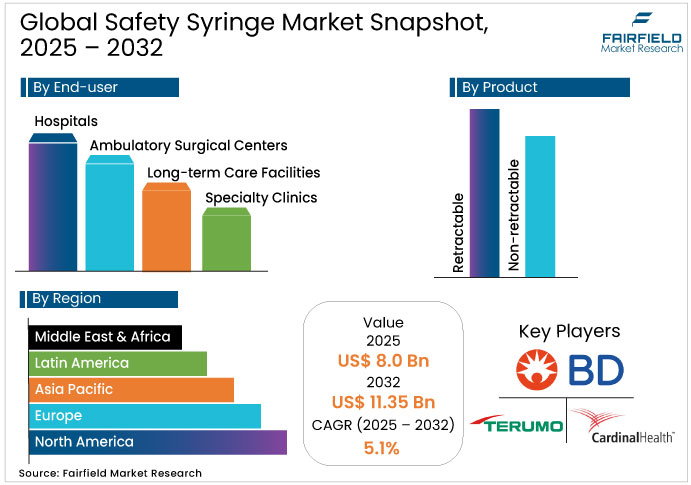
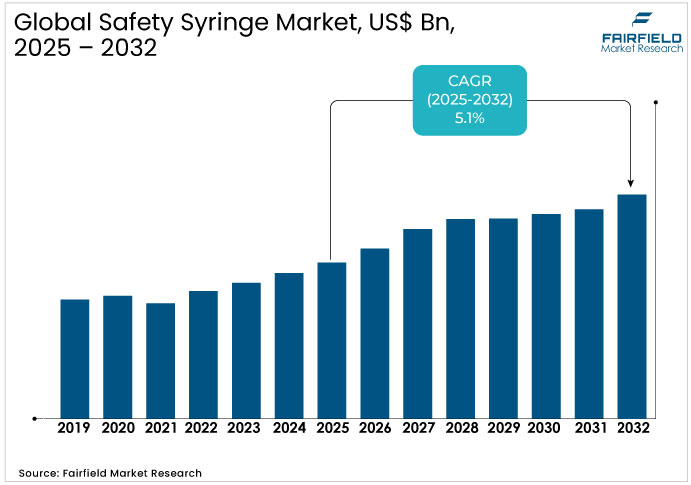
- The global Safety Syringe Market reached US$8 billion in 2025, with projected expansion to US$11.35 billion by 2032, representing a 5.1% CAGR through the forecast period, reflecting steady consolidation of safety device adoption across healthcare systems.
- Retractable safety syringes lead the market with over 65% share, driven by dominant subcutaneous use across retail sales networks and hospital procurement in North America and Europe.
- Expanding immunization programs in Asia-Pacific strengthen demand for both subcutaneous and intramuscular safety syringes distributed through retail and DTC channels.
- Sustainability-focused procurement creates new opportunities for eco-designed retractable and non-retractable products preferred by hospital and retail buyers in Europe and North America.
- Hospitals retain leadership with about 30% share, driven by high-volume subcutaneous and intramuscular usage and compliance-driven adoption of retractable syringes across major regions.
- Asia-Pacific is the fastest-growing region, with China contributing 35–40% of regional share across hospitals, ambulatory surgical centers, and expanding DTC and online pharmacy channels.
Market Dynamics: Drivers, Restraints, and Opportunities Analysis
Market Drivers
- Regulatory Mandate for Occupational Safety:
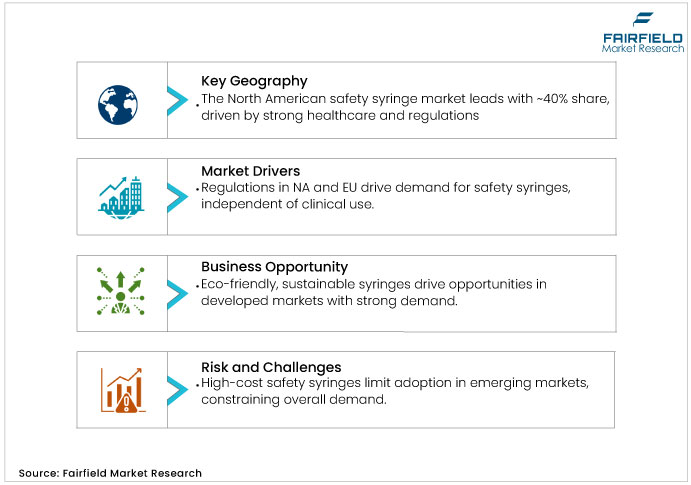
Regulatory mandates across North America and Europe are driving strong institutional demand for engineered sharps injury protection devices. OSHA’s 2024 updated sharps safety guidelines require widespread adoption of safety solutions in hospitals and outpatient facilities, while the EU MDR classifies retractable safety syringes as Class IIa devices with mandatory notified body assessment and ongoing post-market surveillance. These regulations create structural market demand that operates independently of clinical performance factors.
Non-compliance exposes healthcare institutions to legal and reputational risk, turning regulatory directives into firm procurement obligations. Industry research shows that 35–40% of institutional purchasing decisions are driven directly by these compliance requirements, raising the bar for manufacturers. Companies offering integrated compliance documentation and streamlined regulatory pathways gain clear competitive advantages and stronger institutional penetration.
- Immunization Program Expansion and Government Healthcare Investments
Large-scale vaccination initiatives including routine immunization, pandemic preparedness, and new vaccine rollouts are generating sustained demand for injection devices. Government healthcare investments in emerging safety syringe markets, especially across Asia-Pacific, are prioritizing safety-engineered syringes as essential health infrastructure. India’s expanded immunization programs and China’s healthcare modernization efforts are directing capital toward advanced syringe procurement.
These government-led vaccination strategies reduce price elasticity and enable multi-year procurement contracts, ensuring stable revenue streams for manufacturers. The long-term strength of this driver depends on political commitment to immunization funding and the epidemiological need for continued vaccination. Ongoing monitoring is required as policy shifts could influence the sustainability of syringe demand.
Market Restraints
- Cost Barriers and Price Sensitivity in Emerging Markets
Safety-engineered syringes command price premiums of 40-60% relative to conventional devices, creating affordability constraints in price-constrained healthcare systems. Emerging market procurement decisions remain materially influenced by acquisition costs, notwithstanding regulatory preferences for safety devices. This dynamic suppresses market growth in regions with developing healthcare infrastructure and limited procurement budgets. Safety syringe market suggests that cost-related challenges represent a major share of purchasing barriers in emerging markets, creating noticeable downward pressure on overall demand and constraining the sector’s full growth potential.
- Supply Chain Vulnerabilities and Manufacturing Concentration
Safety syringe manufacturing is concentrated among established medical device manufacturers with significant capital requirements and regulatory expertise. Supply chain disruptions—including raw material constraints, manufacturing capacity limitations, and logistics challenges—create intermittent availability pressures. Recent pandemic-related supply chain disruptions demonstrated market vulnerability to external shocks. Manufacturers with diversified production capacity and supply chain resilience achieve competitive advantages during constrained supply periods.
Market Opportunities
- Sustainability and Environmental Product Development
Healthcare system emphasis on environmental sustainability is creating market opportunities for eco-friendly syringe designs utilizing biodegradable materials and recyclable components. Manufacturers developing sustainable product lines aligned with institutional sustainability commitments and regulatory incentives can differentiate offerings and access price-insensitive institutional procurement channels. This opportunity is concentrated in developed markets with established environmental compliance requirements and mature sustainability commitments. The addressable landscape for sustainable safety syringes reflects substantial potential, supported by steady annual expansion and strong institutional interest in partnering with environmentally responsible suppliers.
- Geographic Expansion in Emerging Markets with Healthcare Modernization
Asia-Pacific, Latin America, and sub-Saharan Africa represent high-growth opportunity regions characterized by expanding healthcare infrastructure investments and increasing government emphasis on occupational safety standards. These regions are expected to see substantial ongoing healthcare capital investments through the forecast period, creating large addressable opportunities for safety-engineered medical devices. Early-market positioning and localized manufacturing capabilities provide competitive advantages as regulatory standards progressively align with developed market requirements.
Regional Market Assessment: Strategic Geography Analysis
- North America
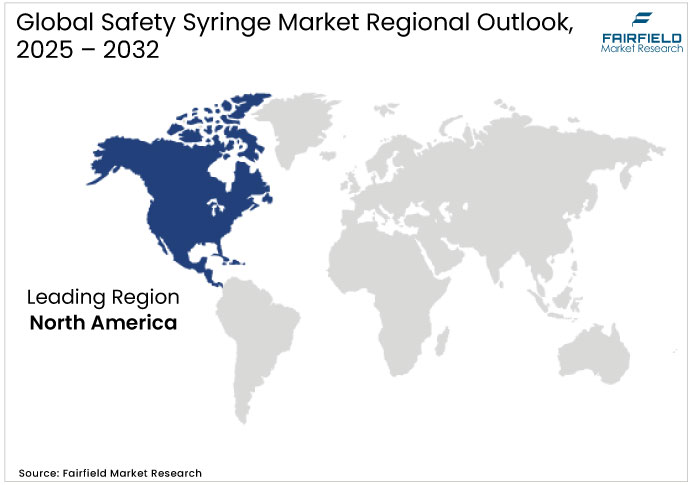
The North American market, led by the United States, holds the largest regional share at approximately 40% of global safety syringe market value, estimated at US$3.2 billion in 2025. This maturity reflects advanced healthcare infrastructure, strong regulatory frameworks, and higher procurement costs. OSHA mandates and expanding healthcare spending continue to anchor demand for safety syringes across institutional buyers.
Growth is further shaped by FDA- and OSHA-driven compliance requirements that reinforce standardized safety device adoption. A concentrated innovation ecosystem spanning major medical device clusters and research institutions sustains product development momentum. To succeed in this competitive region, companies must prioritize regulatory intelligence, institutional partnerships, and differentiated safety-mechanism technologies.
- Europe
The European safety syringe market shows marked geographic variation driven by differing regulatory frameworks and healthcare structures. Germany accounts for 20–25% of regional value and the United Kingdom for 15–20%, each following distinct growth trajectories shaped by national priorities and procurement models. EU Medical Device Regulation creates a harmonized yet nationally differentiated compliance environment that influences market participation.
Sustainability mandates and technology adoption requirements under EU regulatory instruments are reshaping competitive dynamics and raising investment needs for long-term manufacturers. Europe’s projected expansion to approximately US$3.9 billion by 2032 underscores regulatory acceleration and institutional procurement consolidation. Successful regional strategies require country-specific competitive and regulatory analysis, with close attention to sustainability obligations and notified body assessment timelines.
- Asia-Pacific
The Asia-Pacific region is the fastest-growing safety syringe market, expanding annually with a projected value of approximately US$2.8 billion by 2032. China contributes 35–40% of regional market value, supported by healthcare modernization, expanding immunization programs, and growing manufacturing capacity. India and ASEAN markets are progressing rapidly, supported by expanding healthcare infrastructure and intensified vaccination programs. These improvements are strengthening medical device adoption across both public and private healthcare systems.
Japan’s safety syringe market landscape contrasts with emerging Asia, showing slower growth but higher technology adoption rates. Regional manufacturing strength, supply-chain expansion, and innovation are reshaping global competitive positioning and enabling nearshoring advantages for global producers. Market participants must evaluate country-specific growth drivers, regulatory landscapes, competitive intensity, and manufacturing partnership opportunities to build effective Asia-Pacific strategies.
Segmentation Analysis: Category-Wise Strategic Assessment
- By Product Type
Retractable safety syringes account for over 65% of global safety syringe market value, driven by regulatory acceleration and institutional procurement consolidation. Automatic retractable variants dominate due to superior safety efficacy and lower training requirements, supported by clinical evidence showing reduced needlestick injury prevalence. Market competition is highly consolidated, with leading multinational manufacturers prioritizing regulatory alignment and institutional partnerships.
The non-retractable safety syringe segment represents 20–25% of safety syringe market share but is expanding rapidly in emerging markets were cost efficiency influences adoption. Growth is supported by rising safety compliance mandates in previously unconstrained markets and competitive offerings from regional manufacturers with simplified mechanisms. Companies targeting this segment must assess customer requirements, cost-structure expectations, and barrier-to-entry challenges in this high-growth yet margin-constrained category.
- By Application
Subcutaneous applications hold over 65% of safety syringe market share driven by extensive use in insulin administration, biologic drug delivery, and routine immunization programs. This dominance is reinforced by established clinical practices, patient familiarity with subcutaneous techniques, and integrated disease-management protocols. Competitive positioning centers on clinical reliability, ease of use, and strong regulatory compliance across institutional procurement markets.
The intramuscular injection segment represents 20–25% market share and is expanding at elevated growth rates due to increasing vaccine utilization, therapeutic drug development, and regional vaccination programs prioritizing intramuscular routes. Its trajectory suggests potential market-share convergence with subcutaneous applications by 2032. Companies targeting growth should prioritize intramuscular-focused product development and strategic positioning to capture this rapidly advancing segment.
- By Distribution Channel
Retail sales channels hold approximately 40% of safety syringe market share, supported by institutional pharmacy roles, mature retail distribution networks, and broad consumer accessibility. Competitive success in this segment depends on supply-chain efficiency, strong retail partnerships, and consistent product availability. Retail remains the primary procurement pathway for both institutional buyers and individual consumers.
Direct-to-consumer (DTC) channels represent 20–25% of market value but are expanding the fastest annually, driven by home-based chronic disease management, telemedicine integration, and the rise of e-commerce medical procurement. Growth is reinforced by consumer preference for convenient, home-delivered healthcare solutions. Companies targeting this segment must build telemedicine partnerships, DTC marketing capabilities, and home-health logistics infrastructure.
- By End-User
Hospitals are the largest end-user segment, holding approximately 30% of safety syringe market value, driven by high-volume injection procedures, strict regulatory compliance mandates, and centralized large-scale procurement. Their dominance is reinforced by long-standing manufacturer relationships and institutional emphasis on standardized safety protocols. Competitive success requires regulatory alignment, system integration, and efficient large-volume procurement support.
Ambulatory surgical centers account for 15–20% market share and are growing annually, supported by the shift toward outpatient surgical care, cost-efficiency advantages, and an expanding procedural scope. Their rapid growth reflects structural transformation in healthcare delivery and signals increasing long-term strategic importance. Manufacturers must prioritize tailored engagement and operational alignment to capture this high-expansion segment.
Competitive Landscape: Market Structure and Strategic Positioning
The safety syringe market is moderately consolidated, with major multinational manufacturers dominating while regional specialists hold niche positions. Market concentration is reinforced by high capital requirements for regulatory compliance, manufacturing infrastructure, and institutional relationship development. Competitive differentiation is driven by retractable mechanism innovation, regulatory compliance acceleration, geographic specialization, and vertical integration.
Barriers to entry remain substantial, including regulatory compliance costs of US$2–5 million per product approval, manufacturing capital needs, entrenched institutional relationships, and controlled patent portfolios. These constraints protect established players and limit participation to well-capitalized manufacturers with regulatory expertise. Consolidation trends continue as acquisitions target technology platform expansion, geographic entry, and manufacturing capability integration for supply-chain optimization.
Key Players
- Becton, Dickinson and Company (BD)
- Cardinal Health, Inc.
- Terumo Corporation
- Smiths Medical
- Unilife Corporation
- Retractable Technologies, Inc.
- Owen Mumford Ltd.
- Medline Industries, L.P.
- AdvaCare Pharma, LLC
- Gerresheimer AG
- Hindustan Syringes & Medical Devices Ltd
- UltiMed, Inc.
- Sol‑Millennium Medical Group
- Axel Bio Corporation
- DMC Medical Limited
- Other
Recent Developments
- In June 2025, Sharps Technology, Inc. announced the commencement of shipments for its SecureGard™ and SoloGard™ smart safety syringes from its upgraded manufacturing facility in Hungary.
- In January 2025, BD increased its U.S. production of safety-engineered syringes and conventional syringes by over 40–50%, adding hundreds of millions of units annually and expanding its workforce across key manufacturing sites. The company is also investing over $30 million in 2025 to scale IV-line production in Utah, reinforcing domestic supply chain resilience. These expansions strengthen BD’s role as the primary U.S. manufacturer of critical injection and catheter devices.
Global Safety Syringe Market Segmentation-
By Product
- Retractable
- Non-retractable
By Application
- Subcutaneous
- Intramuscular
By Distribution Channel
- Direct to Customer (DTC)
- Retail Sales
- Online Pharmacies
By End-user
- Hospitals
- Ambulatory Surgical Centers
- Long-term Care Facilities
- Specialty Clinics
- Others
By Region
- North America
- Europe
- Asia Pacific
- Latin America
- Middle East & Africa
1. Executive Summary
1.1. Global Safety Syringe Market Snapshot
1.2. Future Projections
1.3. Key Market Trends
1.4. Regional Snapshot, by Value, 2025
1.5. Analyst Recommendations
2. Market Overview
2.1. Market Definitions and Segmentations
2.2. Market Dynamics
2.2.1. Drivers
2.2.2. Restraints
2.2.3. Market Opportunities
2.3. Value Chain Analysis
2.4. COVID-19 Impact Analysis
2.5. Porter's Fiver Forces Analysis
2.6. Impact of Russia-Ukraine Conflict
2.7. PESTLE Analysis
2.8. Regulatory Analysis
2.9. Price Trend Analysis
2.9.1. Current Prices and Future Projections, 2024-2032
2.9.2. Price Impact Factors
3. Global Safety Syringe Market Outlook, 2019 - 2032
3.1. Global Safety Syringe Market Outlook, by Product, Value (US$ Bn), 2019-2032
3.1.1. Retractable
3.1.2. Non-retractable
3.2. Global Safety Syringe Market Outlook, by Application, Value (US$ Bn), 2019-2032
3.2.1. Subcutaneous
3.2.2. Intramuscular
3.3. Global Safety Syringe Market Outlook, by Distribution Channel, Value (US$ Bn), 2019-2032
3.3.1. Direct to Customer (DTC)
3.3.2. Retail Sales
3.3.3. Online Pharmacies
3.4. Global Safety Syringe Market Outlook, by End-user, Value (US$ Bn), 2019-2032
3.4.1. Hospitals
3.4.2. Ambulatory Surgical Centers
3.4.3. Long-term Care Facilities
3.4.4. Specialty Clinics
3.4.5. Others
3.5. Global Safety Syringe Market Outlook, by Region, Value (US$ Bn), 2019-2032
3.5.1. North America
3.5.2. Europe
3.5.3. Asia Pacific
3.5.4. Latin America
3.5.5. Middle East & Africa
4. North America Safety Syringe Market Outlook, 2019 - 2032
4.1. North America Safety Syringe Market Outlook, by Product, Value (US$ Bn), 2019-2032
4.1.1. Retractable
4.1.2. Non-retractable
4.2. North America Safety Syringe Market Outlook, by Application, Value (US$ Bn), 2019-2032
4.2.1. Subcutaneous
4.2.2. Intramuscular
4.3. North America Safety Syringe Market Outlook, by Distribution Channel, Value (US$ Bn), 2019-2032
4.3.1. Direct to Customer (DTC)
4.3.2. Retail Sales
4.3.3. Online Pharmacies
4.4. North America Safety Syringe Market Outlook, by End-user, Value (US$ Bn), 2019-2032
4.4.1. Hospitals
4.4.2. Ambulatory Surgical Centers
4.4.3. Long-term Care Facilities
4.4.4. Specialty Clinics
4.4.5. Others
4.5. North America Safety Syringe Market Outlook, by Country, Value (US$ Bn), 2019-2032
4.5.1. U.S. Safety Syringe Market Outlook, by Product, 2019-2032
4.5.2. U.S. Safety Syringe Market Outlook, by Application, 2019-2032
4.5.3. U.S. Safety Syringe Market Outlook, by Distribution Channel, 2019-2032
4.5.4. U.S. Safety Syringe Market Outlook, by End-user, 2019-2032
4.5.5. Canada Safety Syringe Market Outlook, by Product, 2019-2032
4.5.6. Canada Safety Syringe Market Outlook, by Application, 2019-2032
4.5.7. Canada Safety Syringe Market Outlook, by Distribution Channel, 2019-2032
4.5.8. Canada Safety Syringe Market Outlook, by End-user, 2019-2032
4.6. BPS Analysis/Market Attractiveness Analysis
5. Europe Safety Syringe Market Outlook, 2019 - 2032
5.1. Europe Safety Syringe Market Outlook, by Product, Value (US$ Bn), 2019-2032
5.1.1. Retractable
5.1.2. Non-retractable
5.2. Europe Safety Syringe Market Outlook, by Application, Value (US$ Bn), 2019-2032
5.2.1. Subcutaneous
5.2.2. Intramuscular
5.3. Europe Safety Syringe Market Outlook, by Distribution Channel, Value (US$ Bn), 2019-2032
5.3.1. Direct to Customer (DTC)
5.3.2. Retail Sales
5.3.3. Online Pharmacies
5.4. Europe Safety Syringe Market Outlook, by End-user, Value (US$ Bn), 2019-2032
5.4.1. Hospitals
5.4.2. Ambulatory Surgical Centers
5.4.3. Long-term Care Facilities
5.4.4. Specialty Clinics
5.4.5. Others
5.5. Europe Safety Syringe Market Outlook, by Country, Value (US$ Bn), 2019-2032
5.5.1. Germany Safety Syringe Market Outlook, by Product, 2019-2032
5.5.2. Germany Safety Syringe Market Outlook, by Application, 2019-2032
5.5.3. Germany Safety Syringe Market Outlook, by Distribution Channel, 2019-2032
5.5.4. Germany Safety Syringe Market Outlook, by End-user, 2019-2032
5.5.5. Italy Safety Syringe Market Outlook, by Product, 2019-2032
5.5.6. Italy Safety Syringe Market Outlook, by Application, 2019-2032
5.5.7. Italy Safety Syringe Market Outlook, by Distribution Channel, 2019-2032
5.5.8. Italy Safety Syringe Market Outlook, by End-user, 2019-2032
5.5.9. France Safety Syringe Market Outlook, by Product, 2019-2032
5.5.10. France Safety Syringe Market Outlook, by Application, 2019-2032
5.5.11. France Safety Syringe Market Outlook, by Distribution Channel, 2019-2032
5.5.12. France Safety Syringe Market Outlook, by End-user, 2019-2032
5.5.13. U.K. Safety Syringe Market Outlook, by Product, 2019-2032
5.5.14. U.K. Safety Syringe Market Outlook, by Application, 2019-2032
5.5.15. U.K. Safety Syringe Market Outlook, by Distribution Channel, 2019-2032
5.5.16. U.K. Safety Syringe Market Outlook, by End-user, 2019-2032
5.5.17. Spain Safety Syringe Market Outlook, by Product, 2019-2032
5.5.18. Spain Safety Syringe Market Outlook, by Application, 2019-2032
5.5.19. Spain Safety Syringe Market Outlook, by Distribution Channel, 2019-2032
5.5.20. Spain Safety Syringe Market Outlook, by End-user, 2019-2032
5.5.21. Russia Safety Syringe Market Outlook, by Product, 2019-2032
5.5.22. Russia Safety Syringe Market Outlook, by Application, 2019-2032
5.5.23. Russia Safety Syringe Market Outlook, by Distribution Channel, 2019-2032
5.5.24. Russia Safety Syringe Market Outlook, by End-user, 2019-2032
5.5.25. Rest of Europe Safety Syringe Market Outlook, by Product, 2019-2032
5.5.26. Rest of Europe Safety Syringe Market Outlook, by Application, 2019-2032
5.5.27. Rest of Europe Safety Syringe Market Outlook, by Distribution Channel, 2019-2032
5.5.28. Rest of Europe Safety Syringe Market Outlook, by End-user, 2019-2032
5.6. BPS Analysis/Market Attractiveness Analysis
6. Asia Pacific Safety Syringe Market Outlook, 2019 - 2032
6.1. Asia Pacific Safety Syringe Market Outlook, by Product, Value (US$ Bn), 2019-2032
6.1.1. Retractable
6.1.2. Non-retractable
6.2. Asia Pacific Safety Syringe Market Outlook, by Application, Value (US$ Bn), 2019-2032
6.2.1. Subcutaneous
6.2.2. Intramuscular
6.3. Asia Pacific Safety Syringe Market Outlook, by Distribution Channel, Value (US$ Bn), 2019-2032
6.3.1. Direct to Customer (DTC)
6.3.2. Retail Sales
6.3.3. Online Pharmacies
6.4. Asia Pacific Safety Syringe Market Outlook, by End-user, Value (US$ Bn), 2019-2032
6.4.1. Hospitals
6.4.2. Ambulatory Surgical Centers
6.4.3. Long-term Care Facilities
6.4.4. Specialty Clinics
6.4.5. Others
6.5. Asia Pacific Safety Syringe Market Outlook, by Country, Value (US$ Bn), 2019-2032
6.5.1. China Safety Syringe Market Outlook, by Product, 2019-2032
6.5.2. China Safety Syringe Market Outlook, by Application, 2019-2032
6.5.3. China Safety Syringe Market Outlook, by Distribution Channel, 2019-2032
6.5.4. China Safety Syringe Market Outlook, by End-user, 2019-2032
6.5.5. Japan Safety Syringe Market Outlook, by Product, 2019-2032
6.5.6. Japan Safety Syringe Market Outlook, by Application, 2019-2032
6.5.7. Japan Safety Syringe Market Outlook, by Distribution Channel, 2019-2032
6.5.8. Japan Safety Syringe Market Outlook, by End-user, 2019-2032
6.5.9. South Korea Safety Syringe Market Outlook, by Product, 2019-2032
6.5.10. South Korea Safety Syringe Market Outlook, by Application, 2019-2032
6.5.11. South Korea Safety Syringe Market Outlook, by Distribution Channel, 2019-2032
6.5.12. South Korea Safety Syringe Market Outlook, by End-user, 2019-2032
6.5.13. India Safety Syringe Market Outlook, by Product, 2019-2032
6.5.14. India Safety Syringe Market Outlook, by Application, 2019-2032
6.5.15. India Safety Syringe Market Outlook, by Distribution Channel, 2019-2032
6.5.16. India Safety Syringe Market Outlook, by End-user, 2019-2032
6.5.17. Southeast Asia Safety Syringe Market Outlook, by Product, 2019-2032
6.5.18. Southeast Asia Safety Syringe Market Outlook, by Application, 2019-2032
6.5.19. Southeast Asia Safety Syringe Market Outlook, by Distribution Channel, 2019-2032
6.5.20. Southeast Asia Safety Syringe Market Outlook, by End-user, 2019-2032
6.5.21. Rest of SAO Safety Syringe Market Outlook, by Product, 2019-2032
6.5.22. Rest of SAO Safety Syringe Market Outlook, by Application, 2019-2032
6.5.23. Rest of SAO Safety Syringe Market Outlook, by Distribution Channel, 2019-2032
6.5.24. Rest of SAO Safety Syringe Market Outlook, by End-user, 2019-2032
6.6. BPS Analysis/Market Attractiveness Analysis
7. Latin America Safety Syringe Market Outlook, 2019 - 2032
7.1. Latin America Safety Syringe Market Outlook, by Product, Value (US$ Bn), 2019-2032
7.1.1. Retractable
7.1.2. Non-retractable
7.2. Latin America Safety Syringe Market Outlook, by Application, Value (US$ Bn), 2019-2032
7.2.1. Subcutaneous
7.2.2. Intramuscular
7.3. Latin America Safety Syringe Market Outlook, by Distribution Channel, Value (US$ Bn), 2019-2032
7.3.1. Direct to Customer (DTC)
7.3.2. Retail Sales
7.3.3. Online Pharmacies
7.4. Latin America Safety Syringe Market Outlook, by End-user, Value (US$ Bn), 2019-2032
7.4.1. Hospitals
7.4.2. Ambulatory Surgical Centers
7.4.3. Long-term Care Facilities
7.4.4. Specialty Clinics
7.4.5. Others
7.5. Latin America Safety Syringe Market Outlook, by Country, Value (US$ Bn), 2019-2032
7.5.1. Brazil Safety Syringe Market Outlook, by Product, 2019-2032
7.5.2. Brazil Safety Syringe Market Outlook, by Application, 2019-2032
7.5.3. Brazil Safety Syringe Market Outlook, by Distribution Channel, 2019-2032
7.5.4. Brazil Safety Syringe Market Outlook, by End-user, 2019-2032
7.5.5. Mexico Safety Syringe Market Outlook, by Product, 2019-2032
7.5.6. Mexico Safety Syringe Market Outlook, by Application, 2019-2032
7.5.7. Mexico Safety Syringe Market Outlook, by Distribution Channel, 2019-2032
7.5.8. Mexico Safety Syringe Market Outlook, by End-user, 2019-2032
7.5.9. Argentina Safety Syringe Market Outlook, by Product, 2019-2032
7.5.10. Argentina Safety Syringe Market Outlook, by Application, 2019-2032
7.5.11. Argentina Safety Syringe Market Outlook, by Distribution Channel, 2019-2032
7.5.12. Argentina Safety Syringe Market Outlook, by End-user, 2019-2032
7.5.13. Rest of LATAM Safety Syringe Market Outlook, by Product, 2019-2032
7.5.14. Rest of LATAM Safety Syringe Market Outlook, by Application, 2019-2032
7.5.15. Rest of LATAM Safety Syringe Market Outlook, by Distribution Channel, 2019-2032
7.5.16. Rest of LATAM Safety Syringe Market Outlook, by End-user, 2019-2032
7.6. BPS Analysis/Market Attractiveness Analysis
8. Middle East & Africa Safety Syringe Market Outlook, 2019 - 2032
8.1. Middle East & Africa Safety Syringe Market Outlook, by Product, Value (US$ Bn), 2019-2032
8.1.1. Retractable
8.1.2. Non-retractable
8.2. Middle East & Africa Safety Syringe Market Outlook, by Application, Value (US$ Bn), 2019-2032
8.2.1. Subcutaneous
8.2.2. Intramuscular
8.3. Middle East & Africa Safety Syringe Market Outlook, by Distribution Channel, Value (US$ Bn), 2019-2032
8.3.1. Direct to Customer (DTC)
8.3.2. Retail Sales
8.3.3. Online Pharmacies
8.4. Middle East & Africa Safety Syringe Market Outlook, by End-user, Value (US$ Bn), 2019-2032
8.4.1. Hospitals
8.4.2. Ambulatory Surgical Centers
8.4.3. Long-term Care Facilities
8.4.4. Specialty Clinics
8.4.5. Others
8.5. Middle East & Africa Safety Syringe Market Outlook, by Country, Value (US$ Bn), 2019-2032
8.5.1. GCC Safety Syringe Market Outlook, by Product, 2019-2032
8.5.2. GCC Safety Syringe Market Outlook, by Application, 2019-2032
8.5.3. GCC Safety Syringe Market Outlook, by Distribution Channel, 2019-2032
8.5.4. GCC Safety Syringe Market Outlook, by End-user, 2019-2032
8.5.5. South Africa Safety Syringe Market Outlook, by Product, 2019-2032
8.5.6. South Africa Safety Syringe Market Outlook, by Application, 2019-2032
8.5.7. South Africa Safety Syringe Market Outlook, by Distribution Channel, 2019-2032
8.5.8. South Africa Safety Syringe Market Outlook, by End-user, 2019-2032
8.5.9. Egypt Safety Syringe Market Outlook, by Product, 2019-2032
8.5.10. Egypt Safety Syringe Market Outlook, by Application, 2019-2032
8.5.11. Egypt Safety Syringe Market Outlook, by Distribution Channel, 2019-2032
8.5.12. Egypt Safety Syringe Market Outlook, by End-user, 2019-2032
8.5.13. Nigeria Safety Syringe Market Outlook, by Product, 2019-2032
8.5.14. Nigeria Safety Syringe Market Outlook, by Application, 2019-2032
8.5.15. Nigeria Safety Syringe Market Outlook, by Distribution Channel, 2019-2032
8.5.16. Nigeria Safety Syringe Market Outlook, by End-user, 2019-2032
8.5.17. Rest of Middle East Safety Syringe Market Outlook, by Product, 2019-2032
8.5.18. Rest of Middle East Safety Syringe Market Outlook, by Application, 2019-2032
8.5.19. Rest of Middle East Safety Syringe Market Outlook, by Distribution Channel, 2019-2032
8.5.20. Rest of Middle East Safety Syringe Market Outlook, by End-user, 2019-2032
8.6. BPS Analysis/Market Attractiveness Analysis
9. Competitive Landscape
9.1. Company Vs Segment Heatmap
9.2. Company Market Share Analysis, 2024
9.3. Competitive Dashboard
9.4. Company Profiles
9.4.1. Becton, Dickinson and Company (BD)
9.4.1.1. Company Overview
9.4.1.2. Product Portfolio
9.4.1.3. Financial Overview
9.4.1.4. Business Strategies and Developments
9.4.2. Cardinal Health, Inc.
9.4.2.1. Company Overview
9.4.2.2. Product Portfolio
9.4.2.3. Financial Overview
9.4.2.4. Business Strategies and Developments
9.4.3. Terumo Corporation
9.4.3.1. Company Overview
9.4.3.2. Product Portfolio
9.4.3.3. Financial Overview
9.4.3.4. Business Strategies and Developments
9.4.4. Smiths Medical
9.4.4.1. Company Overview
9.4.4.2. Product Portfolio
9.4.4.3. Financial Overview
9.4.4.4. Business Strategies and Developments
9.4.5. Unilife Corporation
9.4.5.1. Company Overview
9.4.5.2. Product Portfolio
9.4.5.3. Financial Overview
9.4.5.4. Business Strategies and Developments
9.4.6. Retractable Technologies, Inc.
9.4.6.1. Company Overview
9.4.6.2. Product Portfolio
9.4.6.3. Financial Overview
9.4.6.4. Business Strategies and Developments
9.4.7. Owen Mumford Ltd.
9.4.7.1. Company Overview
9.4.7.2. Product Portfolio
9.4.7.3. Financial Overview
9.4.7.4. Business Strategies and Developments
9.4.8. Medline Industries, L.P.
9.4.8.1. Company Overview
9.4.8.2. Product Portfolio
9.4.8.3. Financial Overview
9.4.8.4. Business Strategies and Developments
9.4.9. AdvaCare Pharma, LLC
9.4.9.1. Company Overview
9.4.9.2. Product Portfolio
9.4.9.3. Financial Overview
9.4.9.4. Business Strategies and Developments
9.4.10. Gerresheimer AG
9.4.10.1. Company Overview
9.4.10.2. Product Portfolio
9.4.10.3. Financial Overview
9.4.10.4. Business Strategies and Developments
10. Appendix
10.1. Research Methodology
10.2. Report Assumptions
10.3. Acronyms and Abbreviations
|
BASE YEAR |
HISTORICAL DATA |
FORECAST PERIOD |
UNITS |
|||
 |
2024 |
 |
2019 - 2024 |
 |
2025 - 2032 |
Value: US$ Billion |
|
REPORT FEATURES |
DETAILS |
|
By Product Coverage |
|
|
By Application Coverage |
|
|
By Distribution Channel Coverage |
|
|
By End-user Coverage |
|
|
Geographical Coverage |
|
|
Leading Companies |
|
|
Report Highlights |
Key Market Indicators, Macro-micro economic impact analysis, Technological Roadmap, Key Trends, Driver, Restraints, and Future Opportunities & Revenue Pockets, Porter’s 5 Forces Analysis, Historical Trend (2019-2024), Market Estimates and Forecast, Market Dynamics, Industry Trends, Competition Landscape, Category, Region, Country-wise Trends & Analysis, COVID-19 Impact Analysis (Demand and Supply Chain) |
Our Research Methodology
Considering the volatility of business today, traditional approaches to strategizing a game plan can be unfruitful if not detrimental. True ambiguity is no way to determine a forecast. A myriad of predetermined factors must be accounted for such as the degree of risk involved, the magnitude of circumstances, as well as conditions or consequences that are not known or unpredictable. To circumvent binary views that cast uncertainty, the application of market research intelligence to strategically posture, move, and enable actionable outcomes is necessary.
View Methodology
Quality Assured
Rigorous Validation Process

Confidentiality Assured
End-to-end Data Security

Custom Research Services
Tailored To Your Objectives
FAQs
The safety syringe market size is US$8 billion in 2025.
The safety syringe market is projected 5.1% CAGR by 2032.
The safety syringe market growth drivers include regulatory mandates for sharps safety, expanding immunization programs, and supply-chain/resilience investments.
North America is a dominating region for safety syringe market.
BD, Terumo, Cardinal Health, Smiths Medical, and Owen Mumford are some leading industry players in the safety syringe market.
Related Reports
Hematology Analyzer Market Size, Share, Insights, Competitive Landscape, and Forecast 2026 to 2033
Explore the hematology analyzer market, projected to reach US$3.70 billion by 2033 at 4.60% CAGR, with segment, regional and company insights.
Zirconia Based Dental Materials Market Size, Share, Insights, Competitive Landscape, and Forecast 2026 to 2033
The global zirconia based dental materials market is valued at US$1.6 billion in 2026, reaching US$2.8 billion by 2033, growing at an 8.3% CAGR
Wheelchair Market Size, Share, Insights, Competitive Landscape, and Forecast 2026 to 2033
The global wheelchair market is valued at US$6.4 billion in 2026, reaching US$9.8 billion by 2033, growing at a 6.3% CAGR
3D Bioprinting Market Size, Share, Insights, Competitive Landscape, and Forecast 2026 to 2033
The global 3D bioprinting market is valued at US$2.81 billion in 2026, reaching US$10.11 billion by 2033, growing at a 20.1% CAGR
3D Bioengineered Skin Grafts Market Size, Share, Insights, Competitive Landscape, and Forecast 2026 to 2033
The global 3D bioengineered skin grafts market is valued at US$2.50 billion in 2026, reaching US$4.45 billion by 2033, growing at an 8.6% CAGR
Respiratory Diagnostics Market Size, Share, Insights, Competitive Landscape, and Forecast 2026 to 2033
The global respiratory diagnostics market is valued at US$9.66 billion in 2026, reaching US$14.69 billion by 2033, growing at a 6.2% CAGR