



Intumescent Coating Market
Intumescent Coating Market Size, Share, Insights, Competitive Landscape, and Forecast 2026 to 2033
Intumescent Coating Market Size and Trend Analysis
How Fast Will the Intumescent Coating Market Grow?
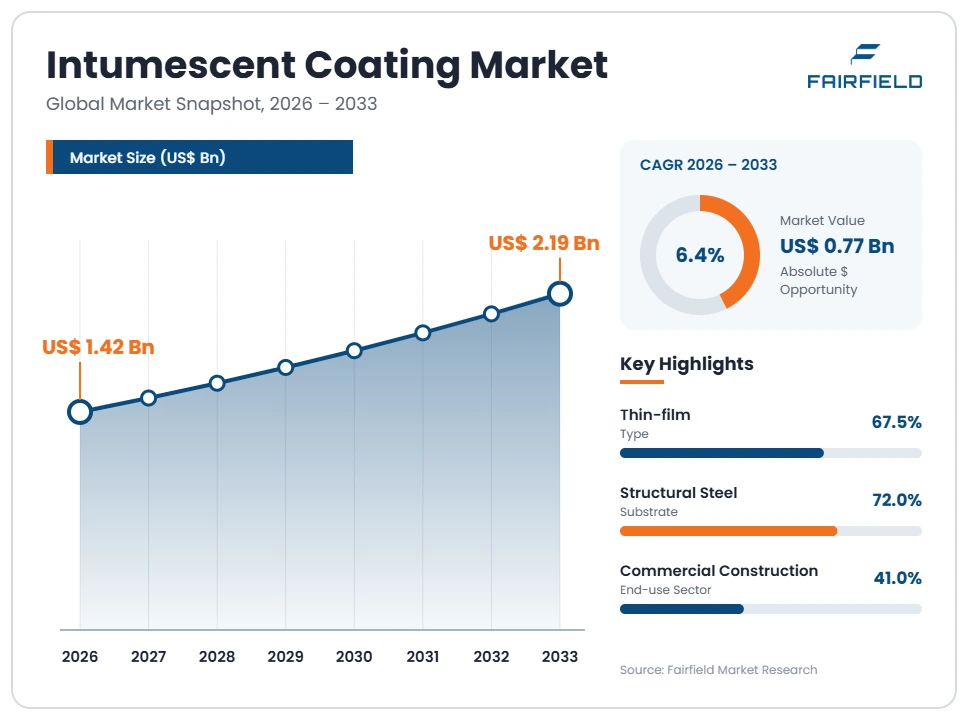
The global Intumescent Coating market size is expected to be valued at US$ 1.42 billion in 2026 and projected to reach US$ 2.19 billion by 2033, growing at a CAGR of 6.4% between 2026 and 2033. Growth tracks steel-framed construction, refinery maintenance cycles and tighter enforcement of passive fire protection rules in national building codes. The market expanded at a 4.9% CAGR between 2020 and 2025, held back by construction delays. An absolute dollar opportunity of US$ 0.77 billion is created over the forecast period, with demand shifting toward water-borne and epoxy chemistries. Owners increasingly treat certified applicator capacity as a project scheduling constraint.
Key Report Takeaways
- By Type: Thin-film systems led with 67.5% share in 2026, while thick-film systems are projected to expand at a 7.3% CAGR through 2033, supported by capital spending on offshore platforms, petrochemical complexes and heavy industrial process plants.
- By Technology: Solvent-borne products led with 46.0% share in 2026, while water-borne systems are projected to grow at a 7.6% CAGR through 2033, driven by volatile organic compound limits and rising demand for shop-applied coatings in enclosed fabrication facilities.
- By Substrate: Structural steel led with 72.0% share in 2026, while timber substrates are projected to advance at a 7.9% CAGR through 2033, reflecting the spread of mass timber and engineered wood framing in mid-rise buildings.
- By End-use Sector: Commercial construction led with 41.0% share in 2026, while infrastructure is projected to grow at a 7.4% CAGR through 2033, as metro systems, tunnels, airports and transport hubs enter long renovation and expansion cycles.
- By Region: North America led with 31.5% share in 2026 across North America, Europe, Asia Pacific, Latin America and Middle East & Africa, while Asia Pacific is projected to grow fastest at an 8.1% CAGR through 2033, supported by high-rise construction.
Global Intumescent Coating Market Trends and Insights
Market Growth Drivers
Stricter Enforcement of Passive Fire Protection in Building Codes
Tighter code enforcement is lifting coated steel tonnage across commercial and institutional projects. National and municipal authorities have steadily extended passive fire protection requirements to building types that once sat outside them, including mid-rise residential, logistics and data centre facilities. Approval bodies now examine product documentation more closely at handover, which pushes specifiers toward certified systems rather than generic alternatives.
The underlying trend is institutional. Building control regimes in several markets were rebuilt around documented product conformity, third-party certification and traceable installation records. UL Solutions, FM Approvals and European technical assessment bodies anchor this structure, giving manufacturers a recognised route to demonstrate conformity. Insurers and lenders increasingly ask for the same evidence before releasing funds. Coating suppliers have answered by expanding certification portfolios and technical documentation teams, which raises the practical cost of entry for smaller formulators.
Expansion of Steel-Framed Construction and Industrial Capital Projects
Steel-intensive building activity is the single largest demand lever for intumescent coatings. Warehouses, data centres, airports, stadiums and hospitals all favour exposed or semi-exposed steel frames for speed and span. Every tonne of protected steel converts into coating volume, so order books follow construction starts with a short lag. Industrial operators add a second stream through refinery, liquefied natural gas and chemical plant turnarounds.
Behind this sits a structural shift in how buildings are procured. Developers increasingly prefer off-site fabrication, so coatings are applied in controlled shop environments before steel reaches site. That shift favours suppliers able to serve fabricators with consistent supply, colour matching and logistics. Capacity additions in steel fabrication across Asia Pacific and the Middle East & Africa have widened the customer base considerably. Maintenance demand on ageing industrial assets provides a steadier revenue layer than new build alone.
Market Restraints
Shortage of Qualified Applicators Constrains Project Delivery
Limited applicator capacity slows revenue conversion even where specifications already call for intumescent systems. These coatings are applied by trained crews whose qualifications are audited, and that pool grows slowly. When skilled labour is scarce, contractors reschedule work, turn to alternative protection methods or accept delays that push coating purchases into later periods. Owners in tight labour markets treat this as a recurring programme risk.
The constraint is reinforced by the nature of the product itself. A finished coating conceals the work beneath it, so defects stay invisible until the system is called upon. Third-party certification of products, formal qualification of applicators and independent verification of installed work therefore sit at the centre of market quality assurance. These checks are genuine commercial constraints rather than optional services, and they add cost, time and documentation burden to every project specifying the technology.
Raw Material Volatility and Emission Rules Compress Margins
Input cost swings and tightening emission rules squeeze formulator margins across the value chain. Intumescent formulations depend on acid sources, carbon donors, blowing agents and binder resins whose prices move with petrochemical feedstocks. Suppliers cannot reprice long-term framework agreements quickly, so cost spikes are absorbed rather than passed through. Smaller regional formulators with thin balance sheets feel this pressure most sharply.
Regulation adds a second layer. Volatile organic compound limits in North America and Europe restrict traditional solvent-borne formulations, forcing reformulation work that consumes research budgets and triggers fresh certification cycles. Each reformulated product must be re-tested and re-documented before it can be specified, which lengthens payback on development spending. Chemical registration regimes also raise compliance overhead for ingredients used in small volumes. Together these pressures favour larger manufacturers with established laboratories and regulatory affairs capability.
Market Opportunities
Water-Borne and Low-Emission Systems Unlock New Specifications
Low-emission chemistry is opening specification positions that solvent-borne products cannot reach. Owners pursuing green building certification and corporate emission targets increasingly screen coatings on environmental attributes before any other discussion begins. Water-borne intumescent systems answer that screen directly and are gaining ground in enclosed shop application, where ventilation and worker exposure limits govern daily practice.
The trend is reinforced by procurement practice. Public authorities in several markets attach environmental criteria to tender scoring, and large developers now request environmental product declarations as standard documentation. Manufacturers have responded by widening aqueous and high-solids ranges and by publishing life-cycle data. Fabricators adopting automated spray lines also favour water-borne products because solvent handling is reduced. The combined pull from regulation, procurement and fabrication practice makes this the fastest-moving technology segment in the market.
Mass Timber and Building Retrofit Programmes Create Fresh Demand
Mass timber construction and large retrofit programmes are creating demand pools that barely existed a decade ago. Engineered wood framing in mid-rise offices, schools and residential buildings needs passive protection that preserves the visible grain, which suits clear intumescent systems. Retrofit work on existing steel-framed stock adds a parallel stream as owners upgrade buildings during refurbishment.
Policy and portfolio economics drive both streams. Carbon reduction targets push developers toward timber structures, while energy efficiency retrofit schemes bring contractors into older buildings where fire protection upgrades can be bundled into the same programme. Coating suppliers are responding with clear and decorative ranges and with technical support aimed at architects rather than fabricators alone. Europe and North America lead this shift, though mass timber projects are spreading across Asia Pacific as codes adapt.
Segment Analysis
- Why Do Thin-Film Systems Still Dominate Intumescent Coating Demand?
Thin-film systems dominate because they suit the building projects that consume most coated steel. Thin-film products held 67.5% of the Intumescent Coating market in 2026, reflecting their fit with commercial and institutional steel frames. They are routinely applied in fabrication shops, accept decorative topcoats and move through established distribution networks. Thick-film systems are the fastest-growing type at a 7.3% CAGR between 2026 and 2033, pulled by offshore, refinery and petrochemical capital projects where epoxy-based formulations tolerate weathering and mechanical handling. The commercial split matters: thin-film volume delivers scale and distribution reach, while thick-film work carries higher value per project and deeper technical service content. Suppliers able to serve both streams gain balance across construction and industrial spending cycles, which smooths revenue when one cycle weakens.
- Solvent-Borne Chemistry Leads While Water-Borne Technology Gains Ground
Solvent-borne chemistry still carries the largest share of technology demand. Solvent-borne systems held 46.0% share in 2026, helped by broad certification coverage, tolerance of variable site conditions and wide applicator familiarity. Water-borne systems held 31.0% and are the fastest-growing technology at a 7.6% CAGR between 2026 and 2033, while epoxy-based systems accounted for 23.0%. Emission limits, worker exposure rules and green building procurement are the main forces behind the aqueous shift, particularly for shop application in enclosed fabrication facilities. Epoxy chemistry remains anchored to industrial and offshore work. For manufacturers, the implication is portfolio breadth: certification must be maintained across several chemistries at once, which raises fixed costs and steadily concentrates specified volume with larger suppliers that can carry duplicated laboratory and documentation overheads for many years.
- Structural Steel Anchors Demand While Timber Substrates Accelerate
Structural steel remains the substrate that defines the market. Structural steel accounted for 72.0% of demand in 2026, reflecting the dominance of steel framing in commercial, industrial and infrastructure construction. Concrete held 12.0%, timber 10.0% and other substrates 6.0%. Timber is the fastest-growing substrate at a 7.9% CAGR between 2026 and 2033, driven by mass timber and cross-laminated framing in mid-rise buildings across Europe and North America. Carbon reduction targets and prefabrication economics underpin that shift. The commercial consequence is a widening customer set: timber work brings architects and specialist contractors into specification decisions that fabricators once controlled alone, and it rewards suppliers offering clear finishes alongside conventional opaque ranges. Concrete and cable or plastic substrates remain niche but stable, usually tied to tunnel, utility and process plant programmes rather than mainstream building construction.
- Commercial Construction Leads as Infrastructure Spending Compounds
Commercial construction consumes the largest volume of intumescent coatings. Commercial construction held 41.0% share in 2026, covering offices, retail, healthcare, hospitality and the rapidly expanding data centre category. Industrial and petrochemical applications accounted for 29.0%, infrastructure for 20.0% and marine for 10.0%. Infrastructure is the fastest-growing sector at a 7.4% CAGR between 2026 and 2033, as governments fund metro systems, tunnels, airports and transport interchanges, many of which combine new build with long renovation programmes. Industrial demand is more cyclical but more repeatable, since processing assets are recoated on maintenance schedules. The balance gives suppliers two different revenue rhythms, and those serving both construction and industrial channels absorb downturns in either one more comfortably. Marine demand, though the smallest sector, sustains specialist technical capability that transfers readily into offshore energy work.
Geography Analysis
- Which Region Is Leading the Intumescent Coating Market?
North America leads the Intumescent Coating market with 31.5% share in 2026. The United States contributes most of that volume, supported by commercial office, healthcare and data centre construction alongside a large refinery and chemical plant base that drives recoating work. Canada adds demand from mining, energy and institutional projects. Code enforcement is consistent across jurisdictions and third-party certification is embedded in specification practice, which favours established manufacturers with fully documented ranges. A comparatively deep pool of qualified applicators allows large projects to proceed without extended scheduling delays. Regional growth is steady rather than rapid, tracking non-residential construction spending and the timing of industrial turnaround cycles. Mexico contributes a smaller but rising share through manufacturing and logistics build-out.
- Europe Combines Strict Conformity Rules With Heavy Retrofit Activity
Europe holds 28.0% share in 2026 and combines strict conformity requirements with unusually heavy retrofit activity. Germany, the United Kingdom and France account for the largest national shares, supported by commercial refurbishment, rail infrastructure and offshore energy work. European harmonised product rules make documented conformity assessment a precondition for specification, which raises the technical burden on suppliers and tends to concentrate volume with larger manufacturers. Tight volatile organic compound limits have accelerated the move toward water-borne and high-solids formulations earlier than in most other regions. The Nordic markets and the Netherlands contribute through marine, offshore wind and port infrastructure. Growth is moderate, with building stock upgrade programmes providing a steadier base than new construction alone.
- Which Region Is Growing Fastest in the Intumescent Coating Market?
Asia Pacific is growing fastest in the Intumescent Coating market, at an 8.1% CAGR between 2026 and 2033, from a 29.0% share in 2026. China drives the largest absolute volume through high-rise commercial construction, metro networks and petrochemical capacity additions. India is expanding quickly as airport, metro and industrial corridor projects adopt steel framing while code enforcement spreads across state authorities. Japan and South Korea contribute mature demand centred on shipbuilding, offshore structures and process plants. Regional steel fabrication capacity has grown substantially, supporting shop application and pulling coating supply closer to customers. Local manufacturing by international suppliers, combined with rising certification expectations, is shifting the market from price-led purchasing toward documented product selection.
- Latin America Builds Demand Around Energy, Mining and Urban Construction
Latin America accounts for 5.0% share in 2026, with demand concentrated in energy, mining and commercial construction. Brazil is the largest market, supported by oil and gas infrastructure, petrochemical facilities and office development in major cities. Mexico contributes through industrial parks and manufacturing plants serving export supply chains, while Chile and Peru add mining-related structural work. Code enforcement varies considerably between countries and municipalities, which slows the shift toward certified systems on smaller projects. Currency volatility and project financing constraints affect the timing of capital spending, making demand uneven year to year. Prospects improve where national authorities tighten building regulation and where international operators apply corporate standards to local assets.
- Middle East & Africa Demand Tracks Hydrocarbon and Giga-Project Build-Out
Middle East & Africa holds 6.5% share in 2026, with demand shaped by hydrocarbon processing and large-scale construction programmes. Saudi Arabia and the United Arab Emirates lead, driven by refinery and petrochemical expansion alongside commercial, hospitality and transport projects. Qatar and Kuwait add steady industrial maintenance demand. Specification in the region often follows international practice, since major operators and engineering contractors apply the same documentation standards used in Europe and North America. South Africa represents the largest sub-Saharan market through mining and industrial facilities. Applicator availability and climatic limits on application windows remain practical constraints on scheduling. Growth is tied closely to oil revenue cycles and the pace of economic diversification programmes.
Competitive Landscape
The Intumescent Coating market is moderately concentrated. A small group of multinational protective coatings manufacturers holds the majority of specified volume, supported by broad certification portfolios, technical service networks and long fabricator relationships. Regional formulators remain active in price-sensitive projects and in markets where local approval routes dominate. Consolidation has been steady rather than dramatic, usually taking the form of larger groups absorbing specialist passive fire protection businesses to add certified ranges and application expertise.
Competition centres on certification breadth, technical service and formulation chemistry rather than price alone. Suppliers invest heavily in maintaining approvals across multiple jurisdictions, because a product without the right documentation cannot be specified regardless of its merits. Water-borne and low-emission chemistries have become a competitive front as emission rules tighten. Application efficiency also matters, since fabricators judge suppliers on throughput in shop environments and on compatibility with automated spray lines.
Strategic activity concentrates on capacity localisation, laboratory investment and distribution reach. Manufacturers add regional production to shorten supply chains and meet local content expectations, particularly in Asia Pacific and the Middle East & Africa. Research spending is directed at reformulation for emission compliance and at systems suited to newer substrates such as engineered timber. Training and qualification programmes for applicators function as a competitive asset, because installed quality depends on crews the supplier has prepared.
Competitive direction favours breadth. Suppliers that combine certified product ranges, documented conformity, regional supply and applicator support are positioned for the shift toward evidence-driven specification across all five regions, where owners, insurers and approval authorities increasingly request the same underlying documentation.
Industry Leaders
- Akzo Nobel N.V.
- PPG Industries, Inc.
- The Sherwin-Williams Company
- Hempel A/S
- Jotun A/S
- Sika AG
Companies Covered in the Report
- Akzo Nobel N.V.
- PPG Industries, Inc.
- The Sherwin-Williams Company
- Hempel A/S
- Jotun A/S
- Sika AG
- RPM International Inc.
- Nippon Paint Holdings Co., Ltd.
- Kansai Paint Co., Ltd.
- Teknos Group Oy
- Rudolf Hensel GmbH
- Etex Group
- Isolatek International
- 3M Company
Intumescent Coating Market Report Scope
| Metric | Value |
| Study Period | 2020–2033 |
| Market Size 2026 | US$ 1.42 Billion |
| Market Size 2033 | US$ 2.19 Billion |
| CAGR 2026–2033 | 6.4% |
| Absolute Dollar Opportunity | US$ 0.77 Billion |
| Largest Market | North America (31.5% share in 2026) |
| Fastest-Growing Market | Asia Pacific (8.1% CAGR 2026–2033) |
| Market Concentration | Moderately Concentrated |
| Major Players | Akzo Nobel N.V., PPG Industries, Inc., The Sherwin-Williams Company, Hempel A/S, Jotun A/S |
Intumescent Coating Market Segmentation
Type
- Thin-film
- Thick-film
Technology
- Solvent-borne
- Water-borne
- Epoxy-based
Substrate
- Structural steel
- Concrete
- Timber
- Others
End-use Sector
- Commercial construction
- Industrial and petrochemical
- Infrastructure
- Marine
Region
- North America
- Europe
- Asia Pacific
- Latin America
- Middle East & Africa
- Executive Summary
- Intumescent Coating Market Snapshot
- Future Projections
- Key Market Trends
- Regional Snapshot
- Market Overview
- Market Definition and Report Scope
- Historical Market Trends
- Market Dynamics
- Drivers
- Stricter Enforcement of Passive Fire Protection in Building Codes
- Expansion of Steel-Framed Construction and Industrial Capital Projects
- Restraints
- Shortage of Qualified Applicators Constrains Project Delivery
- Raw Material Volatility and Emission Rules Compress Margins
- Market Opportunities
- Water-Borne and Low-Emission Systems Unlock New Specifications
- Mass Timber and Building Retrofit Programmes Create Fresh Demand
- Drivers
- Global Intumescent Coating Market Outlook, 2026–2033
- Global Intumescent Coating Market Outlook, by Type, Value (US$ Billion), 2026–2033
- Thin-film
- Thick-film
- Global Intumescent Coating Market Outlook, by Technology, Value (US$ Billion), 2026–2033
- Solvent-borne
- Water-borne
- Epoxy-based
- Global Intumescent Coating Market Outlook, by Substrate, Value (US$ Billion), 2026–2033
- Structural steel
- Concrete
- Timber
- Others
- Global Intumescent Coating Market Outlook, by End-use Sector, Value (US$ Billion), 2026–2033
- Commercial construction
- Industrial and petrochemical
- Infrastructure
- Marine
- Global Intumescent Coating Market Outlook, by Region, Value (US$ Billion), 2026–2033
- North America
- Europe
- Asia Pacific
- Latin America
- Middle East & Africa
- Global Intumescent Coating Market Outlook, by Type, Value (US$ Billion), 2026–2033
- North America Intumescent Coating Market Outlook, 2026–2033
- North America Intumescent Coating Market Outlook, by Type, Value (US$ Billion), 2026–2033
- Thin-film
- Thick-film
- North America Intumescent Coating Market Outlook, by Technology, Value (US$ Billion), 2026–2033
- Solvent-borne
- Water-borne
- Epoxy-based
- North America Intumescent Coating Market Outlook, by Substrate, Value (US$ Billion), 2026–2033
- Structural steel
- Concrete
- Timber
- Others
- North America Intumescent Coating Market Outlook, by End-use Sector, Value (US$ Billion), 2026–2033
- Commercial construction
- Industrial and petrochemical
- Infrastructure
- Marine
- North America Intumescent Coating Market Outlook, by Country, Value (US$ Billion), 2026–2033
- United States Intumescent Coating Market Outlook, by Type, 2026–2033
- United States Intumescent Coating Market Outlook, by Technology, 2026–2033
- United States Intumescent Coating Market Outlook, by Substrate, 2026–2033
- United States Intumescent Coating Market Outlook, by End-use Sector, 2026–2033
- Canada Intumescent Coating Market Outlook, by Type, 2026–2033
- Canada Intumescent Coating Market Outlook, by Technology, 2026–2033
- Canada Intumescent Coating Market Outlook, by Substrate, 2026–2033
- Canada Intumescent Coating Market Outlook, by End-use Sector, 2026–2033
- Mexico Intumescent Coating Market Outlook, by Type, 2026–2033
- Mexico Intumescent Coating Market Outlook, by Technology, 2026–2033
- Mexico Intumescent Coating Market Outlook, by Substrate, 2026–2033
- Mexico Intumescent Coating Market Outlook, by End-use Sector, 2026–2033
- North America Intumescent Coating Market Outlook, by Type, Value (US$ Billion), 2026–2033
- Europe Intumescent Coating Market Outlook, 2026–2033
- Europe Intumescent Coating Market Outlook, by Type, Value (US$ Billion), 2026–2033
- Thin-film
- Thick-film
- Europe Intumescent Coating Market Outlook, by Technology, Value (US$ Billion), 2026–2033
- Solvent-borne
- Water-borne
- Epoxy-based
- Europe Intumescent Coating Market Outlook, by Substrate, Value (US$ Billion), 2026–2033
- Structural steel
- Concrete
- Timber
- Others
- Europe Intumescent Coating Market Outlook, by End-use Sector, Value (US$ Billion), 2026–2033
- Commercial construction
- Industrial and petrochemical
- Infrastructure
- Marine
- Europe Intumescent Coating Market Outlook, by Country, Value (US$ Billion), 2026–2033
- Germany Intumescent Coating Market Outlook, by Type, 2026–2033
- Germany Intumescent Coating Market Outlook, by Technology, 2026–2033
- Germany Intumescent Coating Market Outlook, by Substrate, 2026–2033
- Germany Intumescent Coating Market Outlook, by End-use Sector, 2026–2033
- United Kingdom Intumescent Coating Market Outlook, by Type, 2026–2033
- United Kingdom Intumescent Coating Market Outlook, by Technology, 2026–2033
- United Kingdom Intumescent Coating Market Outlook, by Substrate, 2026–2033
- United Kingdom Intumescent Coating Market Outlook, by End-use Sector, 2026–2033
- France Intumescent Coating Market Outlook, by Type, 2026–2033
- France Intumescent Coating Market Outlook, by Technology, 2026–2033
- France Intumescent Coating Market Outlook, by Substrate, 2026–2033
- France Intumescent Coating Market Outlook, by End-use Sector, 2026–2033
- Netherlands Intumescent Coating Market Outlook, by Type, 2026–2033
- Netherlands Intumescent Coating Market Outlook, by Technology, 2026–2033
- Netherlands Intumescent Coating Market Outlook, by Substrate, 2026–2033
- Netherlands Intumescent Coating Market Outlook, by End-use Sector, 2026–2033
- Europe Intumescent Coating Market Outlook, by Type, Value (US$ Billion), 2026–2033
- Asia Pacific Intumescent Coating Market Outlook, 2026–2033
- Asia Pacific Intumescent Coating Market Outlook, by Type, Value (US$ Billion), 2026–2033
- Thin-film
- Thick-film
- Asia Pacific Intumescent Coating Market Outlook, by Technology, Value (US$ Billion), 2026–2033
- Solvent-borne
- Water-borne
- Epoxy-based
- Asia Pacific Intumescent Coating Market Outlook, by Substrate, Value (US$ Billion), 2026–2033
- Structural steel
- Concrete
- Timber
- Others
- Asia Pacific Intumescent Coating Market Outlook, by End-use Sector, Value (US$ Billion), 2026–2033
- Commercial construction
- Industrial and petrochemical
- Infrastructure
- Marine
- Asia Pacific Intumescent Coating Market Outlook, by Country, Value (US$ Billion), 2026–2033
- China Intumescent Coating Market Outlook, by Type, 2026–2033
- China Intumescent Coating Market Outlook, by Technology, 2026–2033
- China Intumescent Coating Market Outlook, by Substrate, 2026–2033
- China Intumescent Coating Market Outlook, by End-use Sector, 2026–2033
- India Intumescent Coating Market Outlook, by Type, 2026–2033
- India Intumescent Coating Market Outlook, by Technology, 2026–2033
- India Intumescent Coating Market Outlook, by Substrate, 2026–2033
- India Intumescent Coating Market Outlook, by End-use Sector, 2026–2033
- Japan Intumescent Coating Market Outlook, by Type, 2026–2033
- Japan Intumescent Coating Market Outlook, by Technology, 2026–2033
- Japan Intumescent Coating Market Outlook, by Substrate, 2026–2033
- Japan Intumescent Coating Market Outlook, by End-use Sector, 2026–2033
- South Korea Intumescent Coating Market Outlook, by Type, 2026–2033
- South Korea Intumescent Coating Market Outlook, by Technology, 2026–2033
- South Korea Intumescent Coating Market Outlook, by Substrate, 2026–2033
- South Korea Intumescent Coating Market Outlook, by End-use Sector, 2026–2033
- Asia Pacific Intumescent Coating Market Outlook, by Type, Value (US$ Billion), 2026–2033
- Latin America Intumescent Coating Market Outlook, 2026–2033
- Latin America Intumescent Coating Market Outlook, by Type, Value (US$ Billion), 2026–2033
- Thin-film
- Thick-film
- Latin America Intumescent Coating Market Outlook, by Technology, Value (US$ Billion), 2026–2033
- Solvent-borne
- Water-borne
- Epoxy-based
- Latin America Intumescent Coating Market Outlook, by Substrate, Value (US$ Billion), 2026–2033
- Structural steel
- Concrete
- Timber
- Others
- Latin America Intumescent Coating Market Outlook, by End-use Sector, Value (US$ Billion), 2026–2033
- Commercial construction
- Industrial and petrochemical
- Infrastructure
- Marine
- Latin America Intumescent Coating Market Outlook, by Country, Value (US$ Billion), 2026–2033
- Brazil Intumescent Coating Market Outlook, by Type, 2026–2033
- Brazil Intumescent Coating Market Outlook, by Technology, 2026–2033
- Brazil Intumescent Coating Market Outlook, by Substrate, 2026–2033
- Brazil Intumescent Coating Market Outlook, by End-use Sector, 2026–2033
- Mexico Intumescent Coating Market Outlook, by Type, 2026–2033
- Mexico Intumescent Coating Market Outlook, by Technology, 2026–2033
- Mexico Intumescent Coating Market Outlook, by Substrate, 2026–2033
- Mexico Intumescent Coating Market Outlook, by End-use Sector, 2026–2033
- Chile Intumescent Coating Market Outlook, by Type, 2026–2033
- Chile Intumescent Coating Market Outlook, by Technology, 2026–2033
- Chile Intumescent Coating Market Outlook, by Substrate, 2026–2033
- Chile Intumescent Coating Market Outlook, by End-use Sector, 2026–2033
- Peru Intumescent Coating Market Outlook, by Type, 2026–2033
- Peru Intumescent Coating Market Outlook, by Technology, 2026–2033
- Peru Intumescent Coating Market Outlook, by Substrate, 2026–2033
- Peru Intumescent Coating Market Outlook, by End-use Sector, 2026–2033
- Latin America Intumescent Coating Market Outlook, by Type, Value (US$ Billion), 2026–2033
- Middle East & Africa Intumescent Coating Market Outlook, 2026–2033
- Middle East & Africa Intumescent Coating Market Outlook, by Type, Value (US$ Billion), 2026–2033
- Thin-film
- Thick-film
- Middle East & Africa Intumescent Coating Market Outlook, by Technology, Value (US$ Billion), 2026–2033
- Solvent-borne
- Water-borne
- Epoxy-based
- Middle East & Africa Intumescent Coating Market Outlook, by Substrate, Value (US$ Billion), 2026–2033
- Structural steel
- Concrete
- Timber
- Others
- Middle East & Africa Intumescent Coating Market Outlook, by End-use Sector, Value (US$ Billion), 2026–2033
- Commercial construction
- Industrial and petrochemical
- Infrastructure
- Marine
- Middle East & Africa Intumescent Coating Market Outlook, by Country, Value (US$ Billion), 2026–2033
- Saudi Arabia Intumescent Coating Market Outlook, by Type, 2026–2033
- Saudi Arabia Intumescent Coating Market Outlook, by Technology, 2026–2033
- Saudi Arabia Intumescent Coating Market Outlook, by Substrate, 2026–2033
- Saudi Arabia Intumescent Coating Market Outlook, by End-use Sector, 2026–2033
- United Arab Emirates Intumescent Coating Market Outlook, by Type, 2026–2033
- United Arab Emirates Intumescent Coating Market Outlook, by Technology, 2026–2033
- United Arab Emirates Intumescent Coating Market Outlook, by Substrate, 2026–2033
- United Arab Emirates Intumescent Coating Market Outlook, by End-use Sector, 2026–2033
- Qatar Intumescent Coating Market Outlook, by Type, 2026–2033
- Qatar Intumescent Coating Market Outlook, by Technology, 2026–2033
- Qatar Intumescent Coating Market Outlook, by Substrate, 2026–2033
- Qatar Intumescent Coating Market Outlook, by End-use Sector, 2026–2033
- Kuwait Intumescent Coating Market Outlook, by Type, 2026–2033
- Kuwait Intumescent Coating Market Outlook, by Technology, 2026–2033
- Kuwait Intumescent Coating Market Outlook, by Substrate, 2026–2033
- Kuwait Intumescent Coating Market Outlook, by End-use Sector, 2026–2033
- South Africa Intumescent Coating Market Outlook, by Type, 2026–2033
- South Africa Intumescent Coating Market Outlook, by Technology, 2026–2033
- South Africa Intumescent Coating Market Outlook, by Substrate, 2026–2033
- South Africa Intumescent Coating Market Outlook, by End-use Sector, 2026–2033
- Middle East & Africa Intumescent Coating Market Outlook, by Type, Value (US$ Billion), 2026–2033
- Competitive Landscape
- Industry Leaders
- Company Profiles
- Akzo Nobel N.V.
- PPG Industries, Inc.
- The Sherwin-Williams Company
- Hempel A/S
- Jotun A/S
- Sika AG
- RPM International Inc.
- Nippon Paint Holdings Co., Ltd.
- Kansai Paint Co., Ltd.
- Teknos Group Oy
- Rudolf Hensel GmbH
- Etex Group
- Isolatek International
- 3M Company
- Appendix
- Research Methodology
- Report Assumptions
- Acronyms and Abbreviations
Type
- Thin-film
- Thick-film
Technology
- Solvent-borne
- Water-borne
- Epoxy-based
Substrate
- Structural steel
- Concrete
- Timber
- Others
End-use Sector
- Commercial construction
- Industrial and petrochemical
- Infrastructure
- Marine
Region
- North America
- Europe
- Asia Pacific
- Latin America
- Middle East & Africa
Our Research Methodology
Considering the volatility of business today, traditional approaches to strategizing a game plan can be unfruitful if not detrimental. True ambiguity is no way to determine a forecast. A myriad of predetermined factors must be accounted for such as the degree of risk involved, the magnitude of circumstances, as well as conditions or consequences that are not known or unpredictable. To circumvent binary views that cast uncertainty, the application of market research intelligence to strategically posture, move, and enable actionable outcomes is necessary.
View Methodology
Quality Assured
Rigorous Validation Process

Confidentiality Assured
End-to-end Data Security

Custom Research Services
Tailored To Your Objectives
FAQs
The global Intumescent Coating market is valued at US$ 1.42 billion in 2026, supported by steel-framed construction, industrial maintenance cycles and stricter building code enforcement.
The market is projected to grow at a 6.4% CAGR between 2026 and 2033, reaching US$ 2.19 billion and adding US$ 0.77 billion.
Thin-film systems lead the market with 67.5% share in 2026, while thick-film systems grow fastest at a 7.3% CAGR through 2033.
North America leads with 31.5% share in 2026, supported by strict code enforcement, large industrial maintenance spending and a deep certified applicator base.
Asia Pacific grows fastest at an 8.1% CAGR through 2033, driven by high-rise construction, metro expansion and new petrochemical capacity across China and India.
Related Reports
Wood Adhesives Market Size, Share, Insights, Competitive Landscape, and Forecast 2026 to 2033
The wood adhesives market is projected to grow from US$6.25 billion in 2026 to US$8.91 billion by 2033, registering a CAGR of 5.2% during the forecast period.
Steel Pails Market Size, Share, Insights, Competitive Landscape, and Forecast 2026 to 2033
Explore the Steel Pails Market, valued at US$2.9 billion in 2026 and forecast to reach US$3.87 billion by 2033, growing at a 4.2% CAGR.
Spindle Oil Market Size, Share, Insights, Competitive Landscape, and Forecast 2026 to 2033
Explore the Spindle Oil Market, valued at US$1.38 billion in 2026 and forecast to reach US$1.84 billion by 2033, growing at a 4.2% CAGR.
Molded Fiber Packaging Market Size, Share, Insights, Competitive Landscape, and Forecast 2026 to 2033
Explore the Molded Fiber Packaging Market, valued at US$5.2 billion in 2026 and forecast to reach US$8.91 billion by 2033, growing at an 8.0% CAGR.
Methanol Market Size, Share, Insights, Competitive Landscape, and Forecast 2026 to 2033
The global methanol market is valued at US$36.5 billion in 2026, reaching US$52.7 billion by 2033, growing at a 5.4% CAGR
Medical Plastics Market Size, Share, Insights, Competitive Landscape, and Forecast 2026 to 2033
The global medical plastics market is valued at US$32.4 billion in 2026, reaching US$51.4 billion by 2033, growing at a 6.8% CAGR