



Steel Pails Market
Steel Pails Market Size, Share, Insights, Competitive Landscape, and Forecast 2026 to 2033
Steel Pails Market
Steel Pails Market Size and Trend Analysis
How Fast Is the Steel Pails Market Growing?
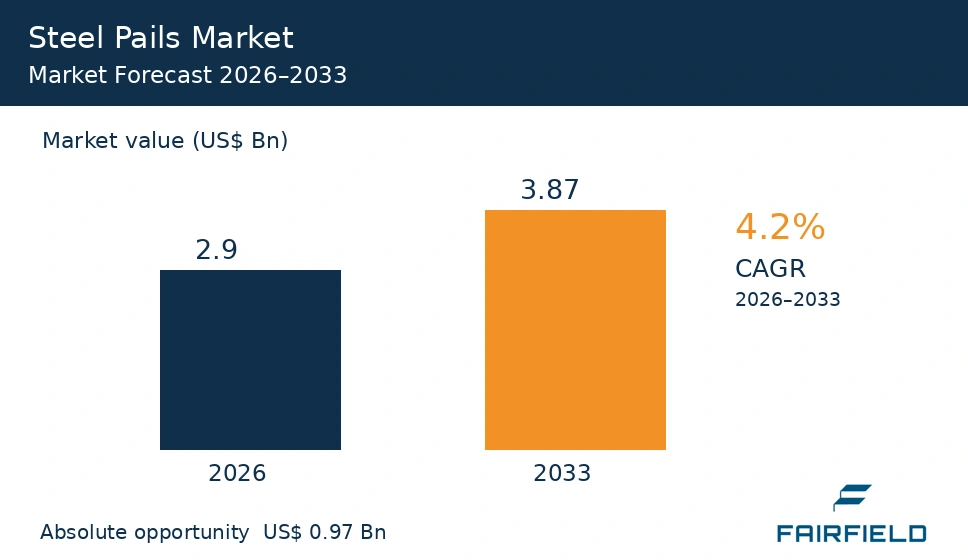
The global steel pails market size is expected to be valued at US$ 2.9 billion in 2026 and projected to reach US$ 3.87 billion by 2033, growing at a CAGR of 4.2% between 2026 and 2033.
Between 2020 and 2025, the market grew at a CAGR of about 3.4%, rising from roughly US$ 2.35 billion to about US$ 2.78 billion, as paint and coating demand rose during the home improvement boom, chemical and lubricant production recovered after the pandemic, and steel price spikes in 2021 and 2022 lifted pail prices. The steel pails market covers small metal containers, usually holding about 1 to 7 gallons, made from tinplate or cold-rolled steel with lids and handles. Products include open head pails, tight head pails, and specialty pails with liners, pour spouts, and UN certification for hazardous goods. They are used to pack paints and coatings, chemicals, lubricants and oils, adhesives, and food products. In August 2026, Cleveland Steel Container announced a 7.3% price increase for steel pails.
Key Report Takeaways
-
By Product Type: Open Head Pails held about 60% share in 2025, while Tight Head Pails are projected to expand at a 4.8% CAGR through 2033, driven by demand for leak-proof, UN-certified containers for solvents, chemicals, and hazardous liquids that need secure closures during transport.
-
By Capacity: 10-20 Liters held about 55% share in 2025, while Above 20 Liters is projected to expand at a 4.6% CAGR through 2033, driven by bulk buying of paints, lubricants, and chemicals by contractors and industrial users seeking fewer containers and lower cost per liter.
-
By End Use: Paints and Coatings held about 32% share in 2025, while Food and Beverages is projected to expand at a 4.9% CAGR through 2033, driven by bulk ingredient packaging, edible oils, sauces, and food-grade lined pails that protect products and extend shelf life.
-
By Region: North America held about 34% share in 2025, while Asia Pacific is projected to expand at a 5.2% CAGR through 2033, driven by growing paint, chemical, and lubricant production in China, India, and Vietnam and rising construction activity.
Global Steel Pails Market Trends and Insights
Drivers Impact Analysis
Two drivers carry the strongest influence on steel pails market demand during the forecast period.
| Driver | Impact on CAGR Forecast | Geographic Relevance | Impact Timeline |
| Growth of paints, coatings, and chemicals industries | High | Global | Long term (≥4 years) |
| Demand for durable, recyclable, and certified packaging | Medium | North America, Europe | Medium term (2-4 years) |
Paints, Coatings, and Chemicals Growth Is Driving the Steel Pails Market
Growth of the paints, coatings, and chemicals industries is the strongest driver of the steel pails market. These industries are the largest pail users.
The mechanism is that paints, coatings, inks, adhesives, sealants, lubricants, and specialty chemicals are commonly packed in steel pails because steel protects contents from light, air, moisture, and fire, and does not react with many solvents. Construction, infrastructure, automotive refinishing, and industrial maintenance drive demand for coatings and lubricants. Rising chemical production in Asia Pacific and steady demand in North America and Europe keep pail volumes growing. Distributors and contractors prefer strong containers that stack well and survive rough handling. As these end-use industries grow with construction and manufacturing, demand for steel pails rises steadily. Repainting and maintenance of existing buildings and machinery also provide stable demand even when new construction slows.
Durable and Recyclable Packaging Demand Is Expanding the Steel Pails Market
Demand for durable, recyclable, and certified packaging is expanding the steel pails market. Buyers want strong and sustainable containers.
The cause is that steel is one of the most recycled materials in the world and can be recycled repeatedly without losing quality, helping brand owners meet sustainability goals and plastic reduction targets. Steel pails also meet United Nations ratings for hazardous goods, strict fire codes, and food contact rules when fitted with approved liners. They resist puncture, heat, and pressure better than many plastic pails and protect flammable products. Reuse and reconditioning programs extend pail life and cut waste. Rules that limit single-use plastics and promote recycled content in Europe and some United States states support steel packaging. These advantages keep steel competitive in demanding applications where product safety matters most.
Restraints Impact Analysis
Two restraints limit how quickly the steel pails market grows.
| Restraint | Impact on CAGR Forecast | Geographic Relevance | Impact Timeline |
| Competition from plastic pails | High | Global | Long term (≥4 years) |
| Steel and energy cost volatility | Medium | North America, Europe | Medium term (2-4 years) |
Plastic Pail Competition Slows the Steel Pails Market
Competition from plastic pails slows the steel pails market. Many users have switched to plastic.
The problem is that high-density polyethylene and polypropylene pails are lighter, cheaper, rust-free, and easier to mold into different shapes, and they are widely used for water-based paints, food, construction materials, and household chemicals. Lower weight reduces shipping costs, and plastic pails do not dent. Many paint brands in North America and Asia Pacific have moved water-based products from steel to plastic containers. Plastic pails also offer more color and labeling options for retail shelves. As a result, steel pails are increasingly focused on solvent-based, flammable, and hazardous products, limiting growth in mass-market segments. Some industrial buyers are also moving to larger plastic containers and bulk systems that reduce the number of small packages they handle.
Steel and Energy Cost Volatility Restricts the Steel Pails Market
Steel and energy cost volatility restricts the steel pails market. Pail makers face rising input costs.
The constraint is that tinplate and cold-rolled steel make up a large share of pail costs, and their prices swing with global steel markets, tariffs, and trade actions. United States tariffs on steel imports raise domestic steel prices for pail makers. Energy costs for steel production and pail manufacturing are also rising; Cleveland Steel Container cited sharp increases in electricity prices in Ohio and Pennsylvania when it announced a 7.3% steel pail price increase effective October 2026. Higher prices can push buyers toward plastic alternatives. These cost pressures squeeze margins and make long-term pricing difficult. Smaller pail makers with older equipment struggle the most, and some have closed plants or sold their businesses to larger rivals.
Market Opportunities
Specialty and Hazardous Goods Pails Open a Premium Revenue Pool
Specialty and hazardous goods pails open a premium revenue pool. Demanding products need advanced steel containers.
The opportunity comes from UN-certified tight head pails, pails with phenolic and epoxy liners for corrosive chemicals and food, pails with pour spouts and tamper-evident lids, and pails designed for battery materials, specialty resins, and pharmaceutical ingredients. These products command higher prices because they must pass drop, pressure, and stacking tests and meet strict regulations for hazardous transport. Growth in specialty chemicals, adhesives for electric vehicles, battery production, and industrial coatings supports strong demand. Companies with testing capabilities, certified designs, custom printing, and technical service can capture premium margins and long-term contracts with chemical and coatings producers. Lighter-gauge steel designs can also cut material use while keeping full strength and safety.
Asia Pacific Industrial Growth Creates a Growth Revenue Pool
Asia Pacific industrial growth creates a growth revenue pool. The region is adding large paint, chemical, and lubricant capacity.
The opportunity reflects rapid growth in construction, automotive, manufacturing, and infrastructure in China, India, Indonesia, Vietnam, and Thailand, which increases demand for paints, coatings, lubricants, adhesives, and chemicals packed in steel pails. India's paint market is one of the fastest-growing in the world, and new chemical parks are opening across the region. Local pail makers are investing in automated lines and better coatings. Companies that build plants near customers, offer competitive prices, and meet export standards for UN-certified packaging can capture this growth and win business from global chemical companies. Multinational paint and chemical firms opening plants in the region also bring global packaging standards that favor quality suppliers.
Segment Analysis
By Product Type: Open Head Pails Lead While Tight Head Pails Grow Fastest
Open Head Pails held about 60% share in 2025. Open head pails have fully removable lids, making them easy to fill and empty with thick products such as paints, coatings, adhesives, greases, inks, and sealants. Their versatility and wide use in construction and industrial coatings give this product type the largest share. Lug-cover and ring-lock designs serve different sealing needs.
Tight Head Pails are the fastest-growing product type, expanding at a 4.8% CAGR through 2033. These pails have fixed tops with small openings or pour spouts, providing leak-proof sealing for solvents, flammable liquids, oils, and hazardous chemicals. UN certification and safety rules favor tight head designs for transport. Specialty Pails form another segment, including conical, lined, and food-grade pails. For the market, tight head growth supports higher-value products.
By Capacity: 10-20 Liters Lead While Above 20 Liters Grows Fastest
10-20 Liters held about 55% share in 2025. Pails in this range, including the common 5-gallon size, are the standard package for contractor paints, industrial coatings, lubricants, and chemicals. They balance capacity with manual handling and stack efficiently on pallets, giving this capacity the largest share. Retailers and distributors also stock this size widely.
Above 20 Liters is the fastest-growing capacity, expanding at a 4.6% CAGR through 2033. Larger pails serve bulk users in construction, industrial maintenance, and manufacturing who want fewer containers, less packaging waste, and lower cost per liter, especially for lubricants and chemicals. Up to 10 Liters forms another segment, used for retail paints, specialty coatings, and samples. For the market, large-pail growth raises steel use per container.
By End Use: Paints and Coatings Lead While Food and Beverages Grow Fastest
Paints and Coatings held about 32% share in 2025. Architectural, industrial, automotive, and marine coatings, especially solvent-based products, are widely packed in steel pails because steel protects against evaporation, light, and fire risk. Strong construction and industrial demand give this end use the largest share.
Food and Beverages is the fastest-growing end use, expanding at a 4.9% CAGR through 2033. Lined steel pails carry edible oils, sauces, honey, fruit pulps, and food ingredients for bakeries, restaurants, and food processors, protecting contents and meeting food safety rules. Chemicals, Lubricants and Oils, Adhesives and Sealants, and Others form other segments. Lubricants and oils are a large and steady segment served by oil companies and blenders. For the market, food growth adds new customers.
Geography Analysis
Which Region Is Leading the Steel Pails Market?
North America is leading the steel pails market with about 34% share in 2025. The United States has large paint, coatings, lubricant, adhesive, and chemical industries, and contractors and industrial users widely use 5-gallon steel pails. Mauser Packaging Solutions, Greif, Cleveland Steel Container, and Behrens Manufacturing are major regional producers. Strict hazardous materials transport rules support certified steel containers. Canada and Mexico add demand from their chemical and automotive industries. Key barriers include steel tariffs and rising energy costs. One change shaping the region is consolidation among pail and can makers and steady price increases passed on to customers.
Europe Shapes the Steel Pails Market Through Recycling and Safety Rules
Europe is a major steel pails market. Germany, France, Italy, Spain, the United Kingdom, and Poland have large paint, chemical, and lubricant industries and high steel packaging recycling rates. SCHÜTZ, Mauser, Greif, and Hirschfeld Emballages supply the region from local plants. The EU Packaging and Packaging Waste Regulation promotes recyclable and reusable packaging, supporting steel. Key barriers include high energy costs, weak industrial demand, and plastic competition. One opportunity is reusable and reconditioned steel pails, supported by circular economy rules, recycled content goals, and corporate sustainability targets at major chemical and paint companies.
Which Region Is Growing Fastest in the Steel Pails Market?
Asia Pacific is the fastest-growing steel pails market, expanding at a 5.2% CAGR through 2033. China has the world's largest paint, chemical, and lubricant industries and many local pail makers, while India has a fast-growing paint and coatings sector led by large domestic brands. Vietnam, Indonesia, and Thailand are expanding chemical and manufacturing production, and Japan and South Korea use premium high-quality pails for specialty chemicals. Key barriers include strong price competition from small local makers. One change shaping the region is investment in automated pail lines and better internal coatings for export customers.
Latin America Grows the Steel Pails Market Through Construction and Industry
Latin America is a growing steel pails market with rising construction and industrial demand. Brazil, Mexico, Argentina, Colombia, and Chile have growing paint, coatings, lubricant, and chemical industries, and Mexico serves as a manufacturing hub for North America. Agrochemical and mining industries also use steel containers. Local and regional metal packaging makers supply most demand from nearby plants. Key barriers include steel price swings, currency volatility, import duties, and competition from plastic pails. One opportunity is lined pails for food and agrochemical products, supported by expanding exports and food processing in Brazil and Mexico.
Middle East & Africa Builds the Steel Pails Market Through Petrochemical and Construction Growth
Middle East & Africa is an emerging steel pails market with growing petrochemical and construction activity. Saudi Arabia and the United Arab Emirates have large petrochemical and lubricant industries and major construction projects that need paints and coatings. South Africa, Egypt, Nigeria, and Kenya are expanding paint, chemical, and food processing industries. Lubricant blending plants across the region use large numbers of steel pails every year. Key barriers include reliance on imported tinplate and price competition from Asian suppliers. One opportunity is pails for lubricants and paints for large construction, real estate, and infrastructure projects across the region.
Competitive Landscape
The steel pails market is fragmented. Mauser Packaging Solutions, Greif, Cleveland Steel Container, Crown Holdings, and Silgan are leading players, while Sonoco, SCHÜTZ, Behrens Manufacturing, Hirschfeld Emballages, Balmer Lawrie, Kian Joo, and Envases Universales compete strongly. A few large industrial packaging groups operate across many countries, but most steel pails are made by regional and local metal packaging companies close to their customers, because pails are bulky and costly to ship empty. Many paint and chemical companies also run their own container lines or buy from captive suppliers.
Companies compete on product quality, lining and coating options, UN certification, lid and closure design, printing and decoration, delivery speed, reliability, regional plant networks, recycling and reconditioning services, and price. Long relationships with paint, chemical, and lubricant producers matter, and many buyers use several suppliers to secure supply and keep prices competitive over time.
Strategic moves show how competition is changing. In August 2025, Greif announced the closure of a steel and polymer drum plant in California as part of cost cuts. In March 2026, Cleveland Steel Container bought Falco Group's United States operations, and in August 2026, it announced a price increase.
Three themes shape vendor strategy. First, companies are consolidating plants and buying smaller rivals to gain scale. Second, they are passing on rising steel and energy costs through regular price updates. Third, they are promoting steel's recyclability and reuse to win customers with plastic reduction goals.
Steel Pails Market Industry Leaders
- Mauser Packaging Solutions
- Greif, Inc.
- Cleveland Steel Container Corporation
- Crown Holdings, Inc.
- Silgan Holdings Inc.
Recent Industry Developments
-
August 2026: Cleveland Steel Container announced a 7.3% price increase on steel pail products effective October 1, 2026, citing sharp increases in capacity prices and industrial electricity costs in Ohio and Pennsylvania, where its pail plants operate - shows rising cost pressure on steel pail makers.
-
March 2026: Cleveland Steel Container acquired the United States operations of Falco Group in Roseville, Michigan, adding gallon round, gallon F-style, and quart round can capacity to its network of four steel pail plants and two general line can plants - expands its metal packaging range.
-
August 2025: Greif announced the permanent closure of its steel and polymer drum facility in Merced, California, as part of its plan to remove US$ 100 million in costs, shifting orders to its remaining steel and polymer network - reflects consolidation in industrial steel packaging.
Companies Covered in the Report
-
Mauser Packaging Solutions
-
Greif, Inc.
-
Cleveland Steel Container Corporation
-
Crown Holdings, Inc.
-
Silgan Holdings Inc.
-
Sonoco Products Company
-
SCHÜTZ GmbH & Co. KGaA
-
Behrens Manufacturing
-
Hirschfeld Emballages
-
Balmer Lawrie & Co. Ltd.
-
Kian Joo Can Factory Berhad
-
Envases Universales
Steel Pails Market Report Scope
This report covers the steel pails market, including open head, tight head, and specialty pails, in capacities up to 10 liters, 10 to 20 liters, and above 20 liters, used for paints and coatings, chemicals, lubricants and oils, adhesives and sealants, food and beverages, and other end uses. The base year is 2025, and the forecast period runs from 2026 to 2033. All values are expressed in US$ Billion.
| Product Type | Open Head Pails, Tight Head Pails, Specialty Pails |
| Capacity | Up to 10 Liters, 10-20 Liters, Above 20 Liters |
| End Use | Paints and Coatings, Chemicals, Lubricants and Oils, Adhesives and Sealants, Food and Beverages, Others |
| Regions | North America, Europe, Asia Pacific, Latin America, Middle East & Africa |
1. Executive Summary
1.1 Steel Pails Market Snapshot
1.2 Future Projections
1.3 Key Market Trends
1.4 Regional Snapshot
2. Market Overview
2.1 Market Definition and Report Scope
2.2 Historical Market Trends
2.3 Market Dynamics
2.3.1 Drivers
2.3.1.1 Paints, Coatings, and Chemicals Growth Is Driving the Steel Pails Market
2.3.1.2 Durable and Recyclable Packaging Demand Is Expanding the Steel Pails Market
2.3.2 Restraints
2.3.2.1 Plastic Pail Competition Slows the Steel Pails Market
2.3.2.2 Steel and Energy Cost Volatility Restricts the Steel Pails Market
2.3.3 Market Opportunities
2.3.3.1 Specialty and Hazardous Goods Pails Open a Premium Revenue Pool
2.3.3.2 Asia Pacific Industrial Growth Creates a Growth Revenue Pool
3. Global Steel Pails Market Outlook, 2020–2033
3.1 Global Steel Pails Market Outlook, by Product Type, Value (US$ Billion), 2020–2033
3.1.1 Open Head Pails
3.1.2 Tight Head Pails
3.1.3 Specialty Pails
3.2 Global Steel Pails Market Outlook, by Capacity, Value (US$ Billion), 2020–2033
3.2.1 Up to 10 Liters
3.2.2 10-20 Liters
3.2.3 Above 20 Liters
3.3 Global Steel Pails Market Outlook, by End Use, Value (US$ Billion), 2020–2033
3.3.1 Paints and Coatings
3.3.2 Chemicals
3.3.3 Lubricants and Oils
3.3.4 Adhesives and Sealants
3.3.5 Food and Beverages
3.3.6 Others
3.4 Global Steel Pails Market Outlook, by Region, Value (US$ Billion), 2020–2033
3.4.1 North America
3.4.2 Europe
3.4.3 Asia Pacific
3.4.4 Latin America
3.4.5 Middle East & Africa
4. North America Steel Pails Market Outlook, 2020–2033
4.1 North America Steel Pails Market Outlook, by Product Type, Value (US$ Billion), 2020–2033
4.1.1 Open Head Pails
4.1.2 Tight Head Pails
4.1.3 Specialty Pails
4.2 North America Steel Pails Market Outlook, by Capacity, Value (US$ Billion), 2020–2033
4.2.1 Up to 10 Liters
4.2.2 10-20 Liters
4.2.3 Above 20 Liters
4.3 North America Steel Pails Market Outlook, by End Use, Value (US$ Billion), 2020–2033
4.3.1 Paints and Coatings
4.3.2 Chemicals
4.3.3 Lubricants and Oils
4.3.4 Adhesives and Sealants
4.3.5 Food and Beverages
4.3.6 Others
4.4 North America Steel Pails Market Outlook, by Country, Value (US$ Billion), 2020–2033
4.4.1 United States Steel Pails Market Outlook, by Product Type, 2020–2033
4.4.2 United States Steel Pails Market Outlook, by Capacity, 2020–2033
4.4.3 United States Steel Pails Market Outlook, by End Use, 2020–2033
4.4.4 Canada Steel Pails Market Outlook, by Product Type, 2020–2033
4.4.5 Canada Steel Pails Market Outlook, by Capacity, 2020–2033
4.4.6 Canada Steel Pails Market Outlook, by End Use, 2020–2033
4.4.7 Mexico Steel Pails Market Outlook, by Product Type, 2020–2033
4.4.8 Mexico Steel Pails Market Outlook, by Capacity, 2020–2033
4.4.9 Mexico Steel Pails Market Outlook, by End Use, 2020–2033
5. Europe Steel Pails Market Outlook, 2020–2033
5.1 Europe Steel Pails Market Outlook, by Product Type, Value (US$ Billion), 2020–2033
5.1.1 Open Head Pails
5.1.2 Tight Head Pails
5.1.3 Specialty Pails
5.2 Europe Steel Pails Market Outlook, by Capacity, Value (US$ Billion), 2020–2033
5.2.1 Up to 10 Liters
5.2.2 10-20 Liters
5.2.3 Above 20 Liters
5.3 Europe Steel Pails Market Outlook, by End Use, Value (US$ Billion), 2020–2033
5.3.1 Paints and Coatings
5.3.2 Chemicals
5.3.3 Lubricants and Oils
5.3.4 Adhesives and Sealants
5.3.5 Food and Beverages
5.3.6 Others
5.4 Europe Steel Pails Market Outlook, by Country, Value (US$ Billion), 2020–2033
5.4.1 Germany Steel Pails Market Outlook, by Product Type, 2020–2033
5.4.2 Germany Steel Pails Market Outlook, by Capacity, 2020–2033
5.4.3 Germany Steel Pails Market Outlook, by End Use, 2020–2033
5.4.4 France Steel Pails Market Outlook, by Product Type, 2020–2033
5.4.5 France Steel Pails Market Outlook, by Capacity, 2020–2033
5.4.6 France Steel Pails Market Outlook, by End Use, 2020–2033
5.4.7 Italy Steel Pails Market Outlook, by Product Type, 2020–2033
5.4.8 Italy Steel Pails Market Outlook, by Capacity, 2020–2033
5.4.9 Italy Steel Pails Market Outlook, by End Use, 2020–2033
5.4.10 Spain Steel Pails Market Outlook, by Product Type, 2020–2033
5.4.11 Spain Steel Pails Market Outlook, by Capacity, 2020–2033
5.4.12 Spain Steel Pails Market Outlook, by End Use, 2020–2033
5.4.13 United Kingdom Steel Pails Market Outlook, by Product Type, 2020–2033
5.4.14 United Kingdom Steel Pails Market Outlook, by Capacity, 2020–2033
5.4.15 United Kingdom Steel Pails Market Outlook, by End Use, 2020–2033
5.4.16 Poland Steel Pails Market Outlook, by Product Type, 2020–2033
5.4.17 Poland Steel Pails Market Outlook, by Capacity, 2020–2033
5.4.18 Poland Steel Pails Market Outlook, by End Use, 2020–2033
6. Asia Pacific Steel Pails Market Outlook, 2020–2033
6.1 Asia Pacific Steel Pails Market Outlook, by Product Type, Value (US$ Billion), 2020–2033
6.1.1 Open Head Pails
6.1.2 Tight Head Pails
6.1.3 Specialty Pails
6.2 Asia Pacific Steel Pails Market Outlook, by Capacity, Value (US$ Billion), 2020–2033
6.2.1 Up to 10 Liters
6.2.2 10-20 Liters
6.2.3 Above 20 Liters
6.3 Asia Pacific Steel Pails Market Outlook, by End Use, Value (US$ Billion), 2020–2033
6.3.1 Paints and Coatings
6.3.2 Chemicals
6.3.3 Lubricants and Oils
6.3.4 Adhesives and Sealants
6.3.5 Food and Beverages
6.3.6 Others
6.4 Asia Pacific Steel Pails Market Outlook, by Country, Value (US$ Billion), 2020–2033
6.4.1 China Steel Pails Market Outlook, by Product Type, 2020–2033
6.4.2 China Steel Pails Market Outlook, by Capacity, 2020–2033
6.4.3 China Steel Pails Market Outlook, by End Use, 2020–2033
6.4.4 India Steel Pails Market Outlook, by Product Type, 2020–2033
6.4.5 India Steel Pails Market Outlook, by Capacity, 2020–2033
6.4.6 India Steel Pails Market Outlook, by End Use, 2020–2033
6.4.7 Vietnam Steel Pails Market Outlook, by Product Type, 2020–2033
6.4.8 Vietnam Steel Pails Market Outlook, by Capacity, 2020–2033
6.4.9 Vietnam Steel Pails Market Outlook, by End Use, 2020–2033
6.4.10 Indonesia Steel Pails Market Outlook, by Product Type, 2020–2033
6.4.11 Indonesia Steel Pails Market Outlook, by Capacity, 2020–2033
6.4.12 Indonesia Steel Pails Market Outlook, by End Use, 2020–2033
6.4.13 Thailand Steel Pails Market Outlook, by Product Type, 2020–2033
6.4.14 Thailand Steel Pails Market Outlook, by Capacity, 2020–2033
6.4.15 Thailand Steel Pails Market Outlook, by End Use, 2020–2033
6.4.16 Japan Steel Pails Market Outlook, by Product Type, 2020–2033
6.4.17 Japan Steel Pails Market Outlook, by Capacity, 2020–2033
6.4.18 Japan Steel Pails Market Outlook, by End Use, 2020–2033
6.4.19 South Korea Steel Pails Market Outlook, by Product Type, 2020–2033
6.4.20 South Korea Steel Pails Market Outlook, by Capacity, 2020–2033
6.4.21 South Korea Steel Pails Market Outlook, by End Use, 2020–2033
7. Latin America Steel Pails Market Outlook, 2020–2033
7.1 Latin America Steel Pails Market Outlook, by Product Type, Value (US$ Billion), 2020–2033
7.1.1 Open Head Pails
7.1.2 Tight Head Pails
7.1.3 Specialty Pails
7.2 Latin America Steel Pails Market Outlook, by Capacity, Value (US$ Billion), 2020–2033
7.2.1 Up to 10 Liters
7.2.2 10-20 Liters
7.2.3 Above 20 Liters
7.3 Latin America Steel Pails Market Outlook, by End Use, Value (US$ Billion), 2020–2033
7.3.1 Paints and Coatings
7.3.2 Chemicals
7.3.3 Lubricants and Oils
7.3.4 Adhesives and Sealants
7.3.5 Food and Beverages
7.3.6 Others
7.4 Latin America Steel Pails Market Outlook, by Country, Value (US$ Billion), 2020–2033
7.4.1 Brazil Steel Pails Market Outlook, by Product Type, 2020–2033
7.4.2 Brazil Steel Pails Market Outlook, by Capacity, 2020–2033
7.4.3 Brazil Steel Pails Market Outlook, by End Use, 2020–2033
7.4.4 Mexico Steel Pails Market Outlook, by Product Type, 2020–2033
7.4.5 Mexico Steel Pails Market Outlook, by Capacity, 2020–2033
7.4.6 Mexico Steel Pails Market Outlook, by End Use, 2020–2033
7.4.7 Argentina Steel Pails Market Outlook, by Product Type, 2020–2033
7.4.8 Argentina Steel Pails Market Outlook, by Capacity, 2020–2033
7.4.9 Argentina Steel Pails Market Outlook, by End Use, 2020–2033
7.4.10 Colombia Steel Pails Market Outlook, by Product Type, 2020–2033
7.4.11 Colombia Steel Pails Market Outlook, by Capacity, 2020–2033
7.4.12 Colombia Steel Pails Market Outlook, by End Use, 2020–2033
7.4.13 Chile Steel Pails Market Outlook, by Product Type, 2020–2033
7.4.14 Chile Steel Pails Market Outlook, by Capacity, 2020–2033
7.4.15 Chile Steel Pails Market Outlook, by End Use, 2020–2033
8. Middle East & Africa Steel Pails Market Outlook, 2020–2033
8.1 Middle East & Africa Steel Pails Market Outlook, by Product Type, Value (US$ Billion), 2020–2033
8.1.1 Open Head Pails
8.1.2 Tight Head Pails
8.1.3 Specialty Pails
8.2 Middle East & Africa Steel Pails Market Outlook, by Capacity, Value (US$ Billion), 2020–2033
8.2.1 Up to 10 Liters
8.2.2 10-20 Liters
8.2.3 Above 20 Liters
8.3 Middle East & Africa Steel Pails Market Outlook, by End Use, Value (US$ Billion), 2020–2033
8.3.1 Paints and Coatings
8.3.2 Chemicals
8.3.3 Lubricants and Oils
8.3.4 Adhesives and Sealants
8.3.5 Food and Beverages
8.3.6 Others
8.4 Middle East & Africa Steel Pails Market Outlook, by Country, Value (US$ Billion), 2020–2033
8.4.1 Saudi Arabia Steel Pails Market Outlook, by Product Type, 2020–2033
8.4.2 Saudi Arabia Steel Pails Market Outlook, by Capacity, 2020–2033
8.4.3 Saudi Arabia Steel Pails Market Outlook, by End Use, 2020–2033
8.4.4 United Arab Emirates Steel Pails Market Outlook, by Product Type, 2020–2033
8.4.5 United Arab Emirates Steel Pails Market Outlook, by Capacity, 2020–2033
8.4.6 United Arab Emirates Steel Pails Market Outlook, by End Use, 2020–2033
8.4.7 South Africa Steel Pails Market Outlook, by Product Type, 2020–2033
8.4.8 South Africa Steel Pails Market Outlook, by Capacity, 2020–2033
8.4.9 South Africa Steel Pails Market Outlook, by End Use, 2020–2033
8.4.10 Egypt Steel Pails Market Outlook, by Product Type, 2020–2033
8.4.11 Egypt Steel Pails Market Outlook, by Capacity, 2020–2033
8.4.12 Egypt Steel Pails Market Outlook, by End Use, 2020–2033
8.4.13 Nigeria Steel Pails Market Outlook, by Product Type, 2020–2033
8.4.14 Nigeria Steel Pails Market Outlook, by Capacity, 2020–2033
8.4.15 Nigeria Steel Pails Market Outlook, by End Use, 2020–2033
8.4.16 Kenya Steel Pails Market Outlook, by Product Type, 2020–2033
8.4.17 Kenya Steel Pails Market Outlook, by Capacity, 2020–2033
8.4.18 Kenya Steel Pails Market Outlook, by End Use, 2020–2033
9. Competitive Landscape
9.1 Steel Pails Market Industry Leaders
9.2 Recent Industry Developments
9.3 Company Profiles
9.3.1 Mauser Packaging Solutions
9.3.2 Greif, Inc.
9.3.3 Cleveland Steel Container Corporation
9.3.4 Crown Holdings, Inc.
9.3.5 Silgan Holdings Inc.
9.3.6 Sonoco Products Company
9.3.7 SCHÜTZ GmbH & Co. KGaA
9.3.8 Behrens Manufacturing
9.3.9 Hirschfeld Emballages
9.3.10 Balmer Lawrie & Co. Ltd.
9.3.11 Kian Joo Can Factory Berhad
9.3.12 Envases Universales
10. Appendix
10.1 Research Methodology
10.2 Report Assumptions
10.3 Acronyms and Abbreviations
| Product Type | Open Head Pails, Tight Head Pails, Specialty Pails |
| Capacity | Up to 10 Liters, 10-20 Liters, Above 20 Liters |
| End Use | Paints and Coatings, Chemicals, Lubricants and Oils, Adhesives and Sealants, Food and Beverages, Others |
| Regions | North America, Europe, Asia Pacific, Latin America, Middle East & Africa |
Our Research Methodology
Considering the volatility of business today, traditional approaches to strategizing a game plan can be unfruitful if not detrimental. True ambiguity is no way to determine a forecast. A myriad of predetermined factors must be accounted for such as the degree of risk involved, the magnitude of circumstances, as well as conditions or consequences that are not known or unpredictable. To circumvent binary views that cast uncertainty, the application of market research intelligence to strategically posture, move, and enable actionable outcomes is necessary.
View Methodology
Quality Assured
Rigorous Validation Process

Confidentiality Assured
End-to-end Data Security

Custom Research Services
Tailored To Your Objectives
FAQs
The global steel pails market is expected to be valued at US$ 2.9 billion in 2026, driven by paints, coatings, and chemicals demand.
The market is projected to grow at a 4.2% CAGR from 2026 to 2033, reaching about US$ 3.87 billion by 2033.
North America leads with about 34% share, supported by large paint, lubricant, and chemical industries and strong pail makers in the United States.
Asia Pacific is growing fastest at a 5.2% CAGR, driven by expanding paint, chemical, and lubricant production in China and India.
Key players include Mauser Packaging Solutions, Greif, Cleveland Steel Container, Crown, and Silgan, competing on quality, certification, and price.
Related Reports
Wood Adhesives Market Size, Share, Insights, Competitive Landscape, and Forecast 2026 to 2033
The wood adhesives market is projected to grow from US$6.25 billion in 2026 to US$8.91 billion by 2033, registering a CAGR of 5.2% during the forecast period.
Spindle Oil Market Size, Share, Insights, Competitive Landscape, and Forecast 2026 to 2033
Explore the Spindle Oil Market, valued at US$1.38 billion in 2026 and forecast to reach US$1.84 billion by 2033, growing at a 4.2% CAGR.
Molded Fiber Packaging Market Size, Share, Insights, Competitive Landscape, and Forecast 2026 to 2033
Explore the Molded Fiber Packaging Market, valued at US$5.2 billion in 2026 and forecast to reach US$8.91 billion by 2033, growing at an 8.0% CAGR.
Methanol Market Size, Share, Insights, Competitive Landscape, and Forecast 2026 to 2033
The global methanol market is valued at US$36.5 billion in 2026, reaching US$52.7 billion by 2033, growing at a 5.4% CAGR
Medical Plastics Market Size, Share, Insights, Competitive Landscape, and Forecast 2026 to 2033
The global medical plastics market is valued at US$32.4 billion in 2026, reaching US$51.4 billion by 2033, growing at a 6.8% CAGR
Intumescent Coating Market Size, Share, Insights, Competitive Landscape, and Forecast 2026 to 2033
The global intumescent coating market is valued at US$1.42 billion in 2026, reaching US$2.19 billion by 2033, growing at a 6.4% CAGR