



Iodine Market
Iodine Market Insights, Competitive Landscape, and Market Forecast - 2033
Global Iodine Market Forecast
- Global Iodine Market size to reach US$ 7.1 Bn in 2033, up from US$ 4.3 Bn to be attained in 2026
- Market revenue projected to exhibit a remarkable rate of expansion, at an estimated CAGR of 8% during 2026 - 2033
Quick Report Digest
- Global iodine market set to reach US$ 7.1 Bn by 2033, with a CAGR of 8% from 2026-2033.
- Market experienced growth disruptions due to COVID-19 but shows signs of recovery, especially in Asia-Pacific.
- Key growth driven by healthcare demand, industrial applications, and rising health awareness.
- Challenges include regulatory constraints, supply chain vulnerabilities, and competition from alternatives.
- Trends include sustainability, health consciousness, and expansion into emerging markets.
- Regulations influence product quality, extraction methods, international trade, and safety standards.
- Market segmented by source type, application, and region.
- Leading companies like Iochem Corporation, Iofina Chemical, and SQM dominate with strategies like innovation and partnerships.
- Recent developments include new product launches and distribution agreements.
- Analysts foresee steady demand growth, expanding applications, and a focus on sustainability ensuring market stability and growth.
- Increasing Demand from Healthcare Sector
- Expansion in Industrial Applications
- Agricultural Applications and Soil Remediation
- Regulatory Constraints
- Supply Chain Vulnerability
- Competitive Alternatives
- Sustainable Practices
- Health and Wellness Boom:
- Expansion in Developing Markets
- Pharmaceuticals
- Nutrition
- Catalysts
- Exploring the Driving Forces and Growth Trajectories of the Asia Pacific Iodine Market
- Navigating Diverse Applications and Market Dynamics in the North American Iodine Market
- Unveiling Trends, Innovations, and Market Insights in the European Iodine Market
- Iochem Corporation
- Iofina Chemical, Inc.
- Sociedad Química y Minera (SQM)
- ISR Holding
- Qingdao Bright Moon Seaweed Group Co.,Ltd.
- Algorta Norte S.A
- ISE Chemicals Corporation
- Kanto Natural Gas Development Co., Ltd
- Godo Shigen Co., Ltd
- Nippoh Chemicals Co., Ltd
- Salvi Chemicals Industries Ltd
- Toho Earthtech Co., Ltd
- k&o iodine co. ltd
- ACF Minera S.A
- Deepwater Chemicals
- Kansar khazar co
- Agh Altin Chem Co.
- GODO SHIGEN Co., Ltd.
- Samrat Pharmachem Limited
- Calibre Chemicals Pvt. Ltd.
- Deepwater Chemicals
- Eskay Iodine Pvt Ltd
- Natural Brines
- Nitrite Ores
- Others (Seaweeds)
- X-ray Contrast Media
- Catalysts
- Biocides
- LED/LCD Polarizing Films
- Feed Additives
- Human Nutrition
- Others
- North America
- Latin America
- Europe
- Asia Pacific
- Middle East and Africa
A Look Back and a Look Forward - Comparative Analysis
The Iodine market experienced a dynamic shift between 2019 and 2024, with growth likely to continue in the coming years. While pre-pandemic years likely saw steady growth, the COVID-19 crisis disrupted supply chains and dampened overall market expansion. However, the market has shown signs of recovery, and the forecast for 2026-2033 paints a promising picture.
Several factors are expected to drive this growth. The Asia Pacific region, particularly China, is a key player due to its expanding population, rising disposable income, and favourable economic conditions. This translates to increased demand for iodine in various applications. Additionally, growing awareness about health and the importance of iodine in maintaining essential bodily functions is likely to fuel the market. Applications in animal nutrition and X-ray contrast media are also expected to contribute significantly.
The forecast suggests the iodine market will experience a decent CAGR during the 2026-2033 period. This growth will likely be driven by factors like increasing urbanisation, rising healthcare expenditure, and technological advancements in iodine production methods. However, challenges like potential environmental regulations and price fluctuations of raw materials could hinder market expansion.
Overall, the iodine market outlook for 2026-2033 is positive, with the Asia Pacific region leading the charge. A growing focus on health and expanding applications in various industries will propel market growth. Nevertheless, staying vigilant about potential roadblocks like environmental regulations is crucial for industry players to navigate the market effectively.
Key Growth Determinants
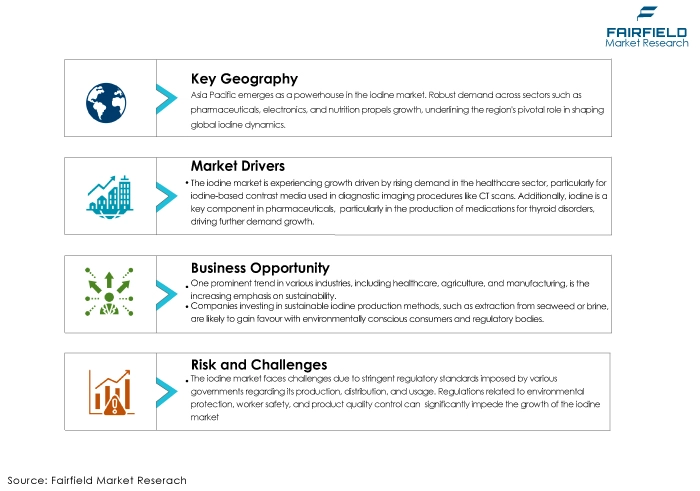
The iodine market is experiencing growth driven by rising demand in the healthcare sector, particularly for iodine-based contrast media used in diagnostic imaging procedures like CT scans. Additionally, iodine is a key component in pharmaceuticals, particularly in the production of medications for thyroid disorders, driving further demand growth.
The iodine market is expanding due to increased usage in various industrial applications such as LCD screens, LED lighting, and optical polarizing films. With the growing consumer electronics market and the shift towards energy-efficient lighting solutions, the demand for iodine in these applications is expected to rise, contributing to market growth.
Another significant growth driver for the iodine market is its use in agriculture as a soil conditioner and in animal feed supplements. Iodine deficiency in soils affects crop quality and livestock health, leading to increased adoption of iodine-containing fertilizers and feed additives. Additionally, iodine is utilised in soil remediation efforts to mitigate contamination, further fuelling market expansion.
Major Growth Barriers
The iodine market faces challenges due to stringent regulatory standards imposed by various governments regarding its production, distribution, and usage. Regulations related to environmental protection, worker safety, and product quality control can significantly impede the growth of the iodine market.
The iodine market is susceptible to disruptions in its supply chain, primarily because iodine is predominantly extracted from natural sources such as underground brines and seawater. Factors such as natural disasters, geopolitical tensions, or logistical issues can disrupt the supply of iodine, leading to market instability and hindering growth.
Alternatives to iodine, such as iodine substitutes or other methods for achieving similar outcomes, pose a challenge to market growth. Technological advancements and innovations in industries such as healthcare, pharmaceuticals, and agriculture may offer alternative solutions that compete with iodine-based products, thereby limiting the market's expansion potential.
Key Trends and Opportunities to Look at
One prominent trend in various industries, including healthcare, agriculture, and manufacturing, is the increasing emphasis on sustainability. Consumers are becoming more conscious of the environmental impact of products they use, leading companies to adopt sustainable practices throughout their supply chains. In the iodine market, this trend translates into demand for iodine extraction methods that are environmentally friendly and minimise waste generation. Companies investing in sustainable iodine production methods, such as extraction from seaweed or brine, are likely to gain favour with environmentally conscious consumers and regulatory bodies. Additionally, there is a growing market for iodine derivatives used in sustainable agriculture practices, such as organic farming and soil remediation.
Another significant trend driving market growth is the increasing focus on health and wellness worldwide. Iodine plays a crucial role in human health, particularly in thyroid function and foetal development. As awareness of iodine deficiency disorders (IDDs) grows, there is a rising demand for iodine supplements and iodised salt, especially in regions where IDD prevalence is high. Furthermore, iodine is used in various pharmaceutical and medical applications, such as contrast agents for diagnostic imaging and antiseptics for wound care. With the global health and wellness market continuing to expand, the demand for iodine-based products is expected to rise, presenting opportunities for market players to innovate and cater to evolving consumer needs.
One of the most significant opportunities for iodine market players lies in expanding their presence in emerging markets. Countries with growing populations and improving standards of living, particularly in Asia Pacific, and Latin America, present untapped markets for iodine-based products. By establishing strategic partnerships with local distributors and investing in marketing efforts tailored to regional preferences and needs, companies can capitalise on the rising demand for iodine in diverse applications, including healthcare, agriculture, and industrial processes.
How Does the Regulatory Scenario Shape this Industry?
The iodine market industry is significantly influenced by regulatory frameworks which dictate production, import, export, and usage of iodine-based products. These regulations are established by government agencies to ensure public safety, environmental protection, and fair market practices. The regulatory scenario shapes the iodine market industry in several ways.
Firstly, regulatory bodies impose quality standards on iodine products to guarantee their purity and effectiveness. This includes regulations on iodine concentration levels, impurity limits, and labelling requirements. Compliance with these standards is essential for companies operating in the iodine market to maintain consumer trust and meet legal obligations.
Secondly, regulations govern the extraction and production of iodine, particularly in the mining and chemical industries. Environmental agencies enforce laws related to waste disposal, emissions, and ecological impact assessments to mitigate the environmental footprint of iodine extraction and processing operations. Adherence to these regulations is crucial for companies to minimise their environmental liabilities and sustainably manage their operations.
Thirdly, international trade regulations play a significant role in shaping the iodine market industry. Import and export restrictions, tariffs, and trade agreements impact the global flow of iodine products. Companies must navigate these regulations to access key markets, manage supply chains, and remain competitive on a global scale. Trade disputes or geopolitical tensions can disrupt the iodine supply chain, affecting prices and market dynamics.
Moreover, regulatory agencies monitor the use of iodine in various applications, such as pharmaceuticals, nutrition, and industrial processes. Health authorities set limits on iodine intake levels in dietary supplements and pharmaceutical formulations to prevent adverse health effects such as iodine toxicity or thyroid disorders. Additionally, regulations may require fortification of certain food products with iodine to address nutritional deficiencies in specific populations.
Furthermore, safety regulations govern the handling, transportation, and storage of iodine and iodine-based products to minimise risks to human health and the environment. Compliance with these regulations reduces the likelihood of accidents, spills, or exposures that could harm workers, communities, or ecosystems.
Fairfield’s Ranking Board
Top Segments
The pharmaceutical sector continues to be a key consumer of iodine, particularly in the production of antiseptics, disinfectants, and thyroid-related medications. With the increasing prevalence of thyroid disorders globally and advancements in pharmaceutical formulations, the demand for iodine in this segment remains strong.
Iodine is essential for thyroid function and overall human health, driving steady growth in the nutrition segment. Government-led iodine fortification programs, especially in salt, and the rising popularity of dietary supplements fortified with iodine are contributing to the growth of this segment.
Iodine compounds serve as catalysts in various industrial processes, including polymer and chemical production. The expansion of the chemical industry, particularly in developing regions, is fuelling the demand for iodine catalysts, which offer advantages such as high efficiency and selectivity, across diverse industrial applications.
Regional Frontrunners
Beacon of Iodine demand Asia Pacific emerges as a powerhouse in the iodine market, fueled by nations like Japan, and China. Robust demand across sectors such as pharmaceuticals, electronics, and nutrition propels growth, underlining the region's pivotal role in shaping global iodine dynamics.
North America, led by the US, commands a significant share in the iodine market. Dynamic applications in healthcare and pharmaceuticals drive growth, with iodine's versatile use in X-ray contrast media and nutritional supplements shaping the region's market landscape.
Europe, spearheaded by industrial stalwarts like Germany, and France, presents a robust iodine market ecosystem. With growing utilisation in healthcare and nutrition sectors, including X-ray contrast media and as a vital nutrient, Europe plays a pivotal role in the global iodine market.
Fairfield’s Competitive Landscape Analysis
The iodine market's competition landscape is characterised by the presence of several key players striving for market dominance. Leading companies such as SQM, Iofina, ISE Chemicals Corporation, Godo Shigen, and Cosayach are prominent players in the global iodine market.
These companies employ various growth strategies to maintain their competitive edge, including mergers and acquisitions, product innovations, strategic partnerships, and expansions into untapped markets. For instance, some companies focus on expanding their production capacities to meet the growing demand for iodine, while others prioritise research and development to introduce new iodine-based products or enhance existing ones.
Additionally, strategic collaborations with distributors and end-users play a crucial role in strengthening market presence and enhancing distribution networks. Overall, the iodine market's leading players continuously strive to innovate and expand their market reach through strategic initiatives tailored to capitalise on emerging opportunities and address evolving customer demands.
Who are the Leaders in the Iodine Market Space?
The Global Iodine Market is Segmented as Below:
By Source Type:
By Application:
By Region:
- Executive Summary
- Global Iodine Market Snapshot
- Future Projections
- Key Market Trends
- Regional Snapshot, by Value, 2026
- Analyst Recommendations
- Market Overview
- Market Definitions and Segmentations
- Market Dynamics
- Drivers
- Restraints
- Market Opportunities
- Value Chain Analysis
- COVID-19 Impact Analysis
- Porter's Five Forces Analysis
- Impact of Russia-Ukraine Conflict
- PESTLE Analysis
- Regulatory Analysis
- Price Trend Analysis
- Current Prices and Future Projections, 2025-2033
- Price Impact Factors
- Global Iodine Market Outlook, 2020 - 2033
- Global Iodine Market Outlook, by Source Type, Value (US$ Mn), 2020-2033
- Natural Brines
- Nitrite Ores
- Others (Seaweeds)
- Global Iodine Market Outlook, by Application, Value (US$ Mn), 2020-2033
- X-ray Contrast Media
- Catalysts
- Biocides
- LED/LCD Polarizing Films
- Feed Additives
- Human Nutrition
- Others
- Global Iodine Market Outlook, by Region, Value (US$ Mn), 2020-2033
- North America
- Europe
- Asia Pacific
- Latin America
- Middle East & Africa
- Global Iodine Market Outlook, by Source Type, Value (US$ Mn), 2020-2033
- North America Iodine Market Outlook, 2020 - 2033
- North America Iodine Market Outlook, by Source Type, Value (US$ Mn), 2020-2033
- Natural Brines
- Nitrite Ores
- Others (Seaweeds)
- North America Iodine Market Outlook, by Application, Value (US$ Mn), 2020-2033
- X-ray Contrast Media
- Catalysts
- Biocides
- LED/LCD Polarizing Films
- Feed Additives
- Human Nutrition
- Others
- North America Iodine Market Outlook, by Country, Value (US$ Mn), 2020-2033
- S. Iodine Market Outlook, by Source Type, 2020-2033
- S. Iodine Market Outlook, by Application, 2020-2033
- Canada Iodine Market Outlook, by Source Type, 2020-2033
- Canada Iodine Market Outlook, by Application, 2020-2033
- BPS Analysis/Market Attractiveness Analysis
- North America Iodine Market Outlook, by Source Type, Value (US$ Mn), 2020-2033
- Europe Iodine Market Outlook, 2020 - 2033
- Europe Iodine Market Outlook, by Source Type, Value (US$ Mn), 2020-2033
- Natural Brines
- Nitrite Ores
- Others (Seaweeds)
- Europe Iodine Market Outlook, by Application, Value (US$ Mn), 2020-2033
- X-ray Contrast Media
- Catalysts
- Biocides
- LED/LCD Polarizing Films
- Feed Additives
- Human Nutrition
- Others
- Europe Iodine Market Outlook, by Country, Value (US$ Mn), 2020-2033
- Germany Iodine Market Outlook, by Source Type, 2020-2033
- Germany Iodine Market Outlook, by Application, 2020-2033
- Italy Iodine Market Outlook, by Source Type, 2020-2033
- Italy Iodine Market Outlook, by Application, 2020-2033
- France Iodine Market Outlook, by Source Type, 2020-2033
- France Iodine Market Outlook, by Application, 2020-2033
- K. Iodine Market Outlook, by Source Type, 2020-2033
- K. Iodine Market Outlook, by Application, 2020-2033
- Spain Iodine Market Outlook, by Source Type, 2020-2033
- Spain Iodine Market Outlook, by Application, 2020-2033
- Russia Iodine Market Outlook, by Source Type, 2020-2033
- Russia Iodine Market Outlook, by Application, 2020-2033
- Rest of Europe Iodine Market Outlook, by Source Type, 2020-2033
- Rest of Europe Iodine Market Outlook, by Application, 2020-2033
- BPS Analysis/Market Attractiveness Analysis
- Europe Iodine Market Outlook, by Source Type, Value (US$ Mn), 2020-2033
- Asia Pacific Iodine Market Outlook, 2020 - 2033
- Asia Pacific Iodine Market Outlook, by Source Type, Value (US$ Mn), 2020-2033
- Natural Brines
- Nitrite Ores
- Others (Seaweeds)
- Asia Pacific Iodine Market Outlook, by Application, Value (US$ Mn), 2020-2033
- X-ray Contrast Media
- Catalysts
- Biocides
- LED/LCD Polarizing Films
- Feed Additives
- Human Nutrition
- Others
- Asia Pacific Iodine Market Outlook, by Country, Value (US$ Mn), 2020-2033
- China Iodine Market Outlook, by Source Type, 2020-2033
- China Iodine Market Outlook, by Application, 2020-2033
- Japan Iodine Market Outlook, by Source Type, 2020-2033
- Japan Iodine Market Outlook, by Application, 2020-2033
- South Korea Iodine Market Outlook, by Source Type, 2020-2033
- South Korea Iodine Market Outlook, by Application, 2020-2033
- India Iodine Market Outlook, by Source Type, 2020-2033
- India Iodine Market Outlook, by Application, 2020-2033
- Southeast Asia Iodine Market Outlook, by Source Type, 2020-2033
- Southeast Asia Iodine Market Outlook, by Application, 2020-2033
- Rest of SAO Iodine Market Outlook, by Source Type, 2020-2033
- Rest of SAO Iodine Market Outlook, by Application, 2020-2033
- BPS Analysis/Market Attractiveness Analysis
- Asia Pacific Iodine Market Outlook, by Source Type, Value (US$ Mn), 2020-2033
- Latin America Iodine Market Outlook, 2020 - 2033
- Latin America Iodine Market Outlook, by Source Type, Value (US$ Mn), 2020-2033
- Natural Brines
- Nitrite Ores
- Others (Seaweeds)
- Latin America Iodine Market Outlook, by Application, Value (US$ Mn), 2020-2033
- X-ray Contrast Media
- Catalysts
- Biocides
- LED/LCD Polarizing Films
- Feed Additives
- Human Nutrition
- Others
- Latin America Iodine Market Outlook, by Country, Value (US$ Mn), 2020-2033
- Brazil Iodine Market Outlook, by Source Type, 2020-2033
- Brazil Iodine Market Outlook, by Application, 2020-2033
- Mexico Iodine Market Outlook, by Source Type, 2020-2033
- Mexico Iodine Market Outlook, by Application, 2020-2033
- Argentina Iodine Market Outlook, by Source Type, 2020-2033
- Argentina Iodine Market Outlook, by Application, 2020-2033
- Rest of LATAM Iodine Market Outlook, by Source Type, 2020-2033
- Rest of LATAM Iodine Market Outlook, by Application, 2020-2033
- BPS Analysis/Market Attractiveness Analysis
- Latin America Iodine Market Outlook, by Source Type, Value (US$ Mn), 2020-2033
- Middle East & Africa Iodine Market Outlook, 2020 - 2033
- Middle East & Africa Iodine Market Outlook, by Source Type, Value (US$ Mn), 2020-2033
- Natural Brines
- Nitrite Ores
- Others (Seaweeds)
- Middle East & Africa Iodine Market Outlook, by Application, Value (US$ Mn), 2020-2033
- X-ray Contrast Media
- Catalysts
- Biocides
- LED/LCD Polarizing Films
- Feed Additives
- Human Nutrition
- Others
- Middle East & Africa Iodine Market Outlook, by Country, Value (US$ Mn), 2020-2033
- GCC Iodine Market Outlook, by Source Type, 2020-2033
- GCC Iodine Market Outlook, by Application, 2020-2033
- South Africa Iodine Market Outlook, by Source Type, 2020-2033
- South Africa Iodine Market Outlook, by Application, 2020-2033
- Egypt Iodine Market Outlook, by Source Type, 2020-2033
- Egypt Iodine Market Outlook, by Application, 2020-2033
- Nigeria Iodine Market Outlook, by Source Type, 2020-2033
- Nigeria Iodine Market Outlook, by Application, 2020-2033
- Rest of Middle East Iodine Market Outlook, by Source Type, 2020-2033
- Rest of Middle East Iodine Market Outlook, by Application, 2020-2033
- BPS Analysis/Market Attractiveness Analysis
- Middle East & Africa Iodine Market Outlook, by Source Type, Value (US$ Mn), 2020-2033
- Competitive Landscape
- Company Vs Segment Heatmap
- Company Market Share Analysis, 2025
- Competitive Dashboard
- Company Profiles
- Iochem Corporation
- Company Overview
- Product Portfolio
- Financial Overview
- Business Strategies and Developments
- Iofina Chemical, Inc.
- Sociedad Química y Minera (SQM)
- ISR Holding
- Qingdao Bright Moon Seaweed Group Co.,Ltd.
- Algorta Norte S.A
- ISE Chemicals Corporation
- Kanto Natural Gas Development Co., Ltd
- Godo Shigen Co., Ltd
- Nippoh Chemicals Co., Ltd
- Iochem Corporation
- Appendix
- Research Methodology
- Report Assumptions
- Acronyms and Abbreviations
|
BASE YEAR |
HISTORICAL DATA |
FORECAST PERIOD |
UNITS |
|||
 |
2025 |
 |
2019 - 2024 |
 |
2026 - 2033 |
Value: US$ Billion Volume : TONS |
|
REPORT FEATURES |
DETAILS |
|
Source Coverage |
|
|
Application Coverage |
|
|
Geographical Coverage |
|
|
Leading Companies |
|
|
Report Highlights |
Key Market Indicators, Macro-micro economic impact analysis, Technological Roadmap, Key Trends, Driver, Restraints, and Future Opportunities & Revenue Pockets, Porter’s 5 Forces Analysis, Historical Trend (2019-2021), Market Estimates and Forecast, Market Dynamics, Industry Trends, Competition Landscape, Category, Region, Country-wise Trends & Analysis, COVID-19 Impact Analysis (Demand and Supply Chain) |
Our Research Methodology
Considering the volatility of business today, traditional approaches to strategizing a game plan can be unfruitful if not detrimental. True ambiguity is no way to determine a forecast. A myriad of predetermined factors must be accounted for such as the degree of risk involved, the magnitude of circumstances, as well as conditions or consequences that are not known or unpredictable. To circumvent binary views that cast uncertainty, the application of market research intelligence to strategically posture, move, and enable actionable outcomes is necessary.
View Methodology
Quality Assured
Rigorous Validation Process

Confidentiality Assured
End-to-end Data Security

Custom Research Services
Tailored To Your Objectives
FAQs
The iodine market involves the production, distribution, and sale of iodine and its derivatives, which are used in various industries including pharmaceuticals, nutrition, healthcare, and electronics.
Iodine is used in the production of pharmaceuticals, X-ray contrast media, nutritional supplements, catalysts, biocides, and in various industrial processes such as LCD displays and semiconductor manufacturing.
Factors driving demand include increasing healthcare applications such as thyroid disorders treatment and diagnostic imaging, rising demand for nutritional iodine supplements, growth in electronics manufacturing, and expanding industrial applications.
Geopolitical factors such as changes in iodine production regulations, trade policies, and geopolitical tensions in major iodine-producing regions like Chile and Japan can affect global iodine supply and prices.
Major players in the iodine market include companies such as Iofina plc, SQM, ISE Chemicals Corporation, Godo Shigen Co., Ltd., and Iochem Corporation, as well as pharmaceutical companies and chemical manufacturers that utilize iodine in their products and processes.
Related Reports
Electrical Steel Coatings Market Size, Share, Insights, Competitive Landscape, and Forecast 2026 to 2033
The electrical steel coatings market, valued at US$ 1.42 billion in 2026, and forecast to reach US$ 2.41 billion by 2033, growing at a 7.85% CAGR
Self-repairing Polymers Market Size, Share, Insights, Competitive Landscape, and Forecast 2026 to 2033
The global self-repairing polymers market is projected to grow from US$ 0.42 billion in 2026 to US$ 1.18 billion by 2033, at a CAGR of 15.90%
Biomass Coating Additives Market Size, Share, Insights, Competitive Landscape, and Forecast 2026 to 2033
The Biomass Coating Additives Market is projected to reach US$3.48 billion by 2033, growing at 9.36% CAGR from US$1.86 billion in 2026.
Oxygen-Barrier Compostable Films Market Size, Share, Insights, Competitive Landscape, and Forecast 2026 to 2033
The global oxygen-barrier compostable films market is projected to reach US$2.34 billion by 2033, growing at an 11.1% CAGR from 2026 to 2033
Dielectric Ester Fluids Market Size, Share, Insights, Competitive Landscape, and Forecast 2026 to 2033
The global Dielectric Ester Fluids market is projected to grow from US$1.62 billion in 2026 to US$3.16 billion by 2033, at a CAGR of 10.02%.
CO2-Derived Chemicals Market Size, Share, Insights, Competitive Landscape, and Forecast 2026 to 2033
The global CO2-derived chemicals market is projected to reach US$22.8 billion by 2033, growing from US$9.4 billion in 2026 at a 13.5% CAGR