



Irrigation Automation Market
Irrigation Automation Market Size, Share, Insights, Competitive Landscape, and Forecast 2026 to 2033
Irrigation Automation Market Size and Trend Analysis
How Fast Is the Irrigation Automation Market Growing?
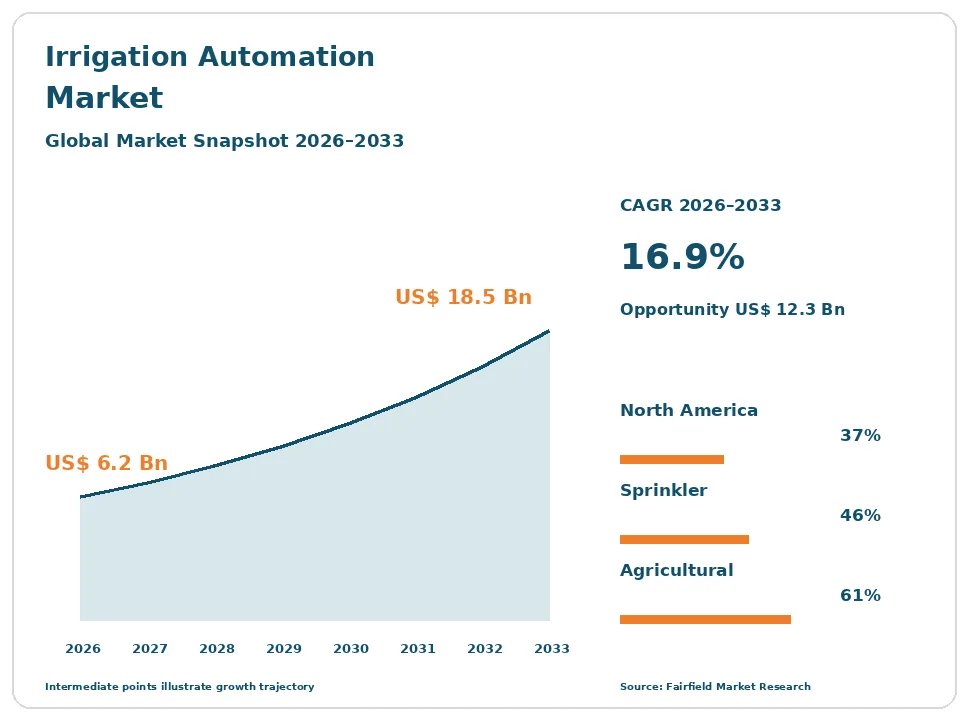
The global irrigation automation market size is expected to be valued at US$ 6.2 billion in 2026 and projected to reach US$ 18.5 billion by 2033, growing at a CAGR of 16.9% between 2026 and 2033.
Between 2020 and 2025, the market grew at a CAGR of about 13.5%, as droughts, rising water prices, and labor shortages pushed farmers, golf courses, cities, and homeowners to replace manual watering with controllers, sensors, and remote-controlled valves. Irrigation automation uses timers, soil moisture and weather sensors, flow meters, and software to decide when and how much to water, then opens and closes valves without manual work. Smart irrigation systems connect to the cloud and mobile apps, allowing growers to manage fields and landscapes remotely. Growth comes from water scarcity, government subsidies for micro irrigation, rising food demand, and the spread of precision agriculture. The market is shifting toward AI-based scheduling, wireless sensor networks, and integrated fertigation. In February 2026, Netafim launched its AI-based Dosing 5G fertigation line, showing how automation is moving into nutrient management.
Key Report Takeaways
- By Irrigation Type: Sprinkler held 46.0% share in 2026, while Drip is projected to expand at a 18.4% CAGR through 2033, driven by water-saving subsidies, high-value crops, and automated fertigation in water-scarce farming regions.
- By Component: Controllers held 38.0% share in 2026, while Sensors are projected to expand at a 19.5% CAGR through 2033, driven by low-cost soil moisture, weather, and flow sensors that enable data-driven watering decisions.
- By End User: Agricultural held 61.0% share in 2026, while Non-Agricultural is projected to expand at a 17.6% CAGR through 2033, driven by smart home controllers, municipal landscapes, golf courses, and sports turf water restrictions.
- By Region: North America held 37.0% share in 2026, while Asia Pacific is projected to expand at a 19.2% CAGR through 2033, driven by government micro irrigation programs, water stress, and farm modernization in India, China, and Australia.
Global Irrigation Automation Market Trends and Insights
Drivers Impact Analysis
| Driver | Impact on CAGR Forecast | Geographic Relevance | Impact Timeline |
| Water scarcity and efficiency regulations | High | Global | Long term (≥4 years) |
| Farm labor shortages and precision agriculture | High | North America, Asia Pacific, Europe | Medium term (2-4 years) |
Two drivers carry the strongest influence on irrigation automation demand during the forecast period.
Water Scarcity Is Driving the Irrigation Automation Market
Water scarcity and efficiency regulations are the strongest driver of the irrigation automation market. Agriculture uses most of the world’s fresh water.
The mechanism is rising pressure to do more with less water. Agriculture accounts for roughly 70% of global freshwater withdrawals, and droughts in the United States, India, Australia, Spain, and much of Middle East & Africa have tightened supplies. Governments set water allocations, raise prices, and restrict outdoor watering in cities. Automated systems apply water only when soil moisture and weather data show it is needed, cutting use by 20% to 50% compared with manual schedules. Utilities offer rebates for smart irrigation controllers certified under programs such as WaterSense. Subsidies in India and China support drip and sprinkler adoption. These pressures make automation a practical necessity for growers and landscape managers.
Precision Agriculture Is Expanding the Irrigation Automation Market
Farm labor shortages and precision agriculture are expanding the irrigation automation market. Farms need to run with fewer workers.
The cause is rising labor costs and the shift to data-driven farming. Moving pipes, opening valves, and checking fields by hand takes many hours, and farm workers are scarce in many regions. Remote-controlled center pivots and valves let one manager run large areas from a phone. Lindsay’s FieldNET and Valmont’s connected pivot platforms combine irrigation control with crop and weather data. Variable-rate irrigation applies different amounts of water across a field. Fertigation systems deliver nutrients through irrigation lines, improving yields. Growers of high-value crops such as almonds, grapes, berries, and vegetables see fast payback because small yield gains are worth a lot. Equipment dealers now bundle automation kits with new pivots and drip systems. These tools raise productivity, protect yields, and justify investment.
Restraints Impact Analysis
| Restraint | Impact on CAGR Forecast | Geographic Relevance | Impact Timeline |
| High upfront costs for small farmers | High | Asia Pacific, Latin America, Middle East & Africa | Long term (≥4 years) |
| Connectivity gaps and limited technical skills | Medium | Global | Medium term (2-4 years) |
Two restraints limit how quickly the irrigation automation market grows.
High Upfront Costs Slow the Irrigation Automation Market
High upfront costs for small farmers slow the irrigation automation market. Many farms cannot afford new systems.
The specific causes are equipment prices and limited credit. Automated drip systems, controllers, sensors, pumps, and filtration require significant investment per hectare, while smallholder farmers in India, Kenya, Nigeria, and Latin America often have low incomes and limited access to loans. Returns depend on crop prices and water costs, which vary widely. Subsidy programs help but are uneven and often slow to pay. Fragmented landholdings make large systems impractical. Many smallholders also rely on rain-fed farming or flood irrigation, which is hard to automate. Equipment financing, pay-as-you-go models, and cooperative ownership are emerging but remain limited. These barriers keep adoption low among the farmers who could benefit most.
Connectivity and Skills Gaps Restrict the Irrigation Automation Market
Connectivity gaps and limited technical skills restrict the irrigation automation market. Smart systems need data networks and trained users.
The underlying causes are weak rural infrastructure and training. Many farms lack reliable cellular coverage or power, which limits cloud-connected controllers and sensors. Farmers need training to set up, calibrate, and maintain sensors and software. Equipment from different brands may not work together. Sensor failures or clogged drippers can damage crops if not caught quickly. Data privacy concerns also slow adoption. Dealers and service technicians are scarce in remote areas, so repairs can take days. Older farmers may be reluctant to trust software decisions over their own experience. Solar-powered controllers and low-power networks such as LoRaWAN are helping, but coverage is still uneven. These gaps slow the spread of advanced automation.
Market Opportunities
AI and Sensor-Based Platforms Open a Fast-Growth Revenue Pool
AI and sensor-based platforms open a fast-growth revenue pool in the irrigation automation market. Data can unlock larger savings.
Equipment makers and software firms can capture this opportunity. Low-cost wireless soil sensors, satellite imagery, and weather forecasts feed AI models that predict crop water needs. Netafim’s Dosing 5G line uses self-learning AI to automate nutrient delivery, and AI-driven irrigation can cut water use by up to 30%. Subscription software creates recurring revenue. Integration with farm management platforms, tractors, and drones adds value. Water utilities and governments can use aggregated data to plan allocations. Remote monitoring also lets dealers offer service contracts and spot faults before crops suffer. Companies that combine hardware, software, and agronomic advice can build strong customer loyalty and higher margins.
Smart Landscapes and Golf Create a Non-Farm Revenue Pool
Smart landscapes and golf create a non-farm revenue pool in the irrigation automation market. Cities and homeowners want to save water.
Controller makers and service firms can capture this opportunity. Smart home controllers that adjust watering based on local weather are popular in North America and Australia, supported by utility rebates. Rain Bird acquired smart controller maker Rachio in October 2025. Golf courses, sports fields, parks, and campuses use central control systems to manage thousands of sprinklers. Municipal water restrictions and rising water tariffs push adoption. Landscape contractors increasingly offer smart irrigation upgrades as a paid service. Commercial property managers use central control and flow monitoring to detect leaks and cut water bills. Companies with strong brands, smart apps, and installer networks can capture this growing demand.
Segment Analysis
By Irrigation Type: Sprinkler Leads While Drip Grows Fastest
Sprinkler held 46.0% share in 2026. Sprinkler systems, including center pivots, lateral moves, and fixed sprinklers, cover large row-crop farms, golf courses, sports turf, and residential lawns. Automated pivots from Lindsay and Valmont dominate large farms in North America, Brazil, and Australia.
Drip is the fastest-growing irrigation type, expanding at a 18.4% CAGR through 2033. Drip delivers water directly to plant roots, cutting losses and enabling fertigation. Netafim, Jain Irrigation, and Rivulis lead micro irrigation. Drip systems also suit greenhouses, orchards, and vineyards, where precise watering improves quality. Surface irrigation remains common in Asia Pacific but is rarely automated. For the market, drip growth links automation directly with water and fertilizer savings.
By Component: Controllers Lead While Sensors Grow Fastest
Controllers held 38.0% share in 2026. Controllers act as the brain of the system, scheduling irrigation and operating valves and pumps. Smart controllers connect to Wi-Fi, cellular, or radio networks and adjust schedules based on weather data. Rain Bird, Toro, Hunter Industries, and Galcon offer controllers for farms and landscapes. Agricultural controllers increasingly manage pumps, filters, and fertigation from one screen.
Sensors are the fastest-growing component, expanding at a 19.5% CAGR through 2033. Soil moisture, rain, weather, and flow sensors provide data for smarter decisions. Prices for wireless sensors have fallen sharply, and many systems now bundle sensors with controllers. Valves, sprinklers, and other hardware make up remaining components, with solenoid valves essential for remote control. For the market, sensor growth enables data-driven watering.
By End User: Agricultural Leads While Non-Agricultural Grows Fastest
Agricultural held 61.0% share in 2026. Farms, orchards, vineyards, and greenhouses are the largest users, driven by water costs, labor shortages, and yield goals. Large row-crop farms use automated pivots, while fruit and vegetable growers rely on automated drip and fertigation. Government subsidies mainly target agricultural users in water-stressed regions.
Non-Agricultural is the fastest-growing end user, expanding at a 17.6% CAGR through 2033. Homes, golf courses, sports fields, parks, and commercial landscapes adopt smart controllers. Outdoor watering bans and utility rebates push homeowners toward weather-based controllers. Golf courses use central control to manage thousands of sprinklers and cut water use. For the market, non-agricultural growth adds consumer demand, recurring app services, and new retail channels.
Geography Analysis
Which Region Is Leading the Irrigation Automation Market?
North America is leading the irrigation automation market with a 37.0% share in 2026. The United States has large mechanized farms, widespread center pivot use, and strong demand from golf courses and residential landscapes. Rain Bird, Toro, Hunter Industries, Lindsay, and Valmont are based in the region. Drought in California and the western states drives water restrictions and rebates. Canada adds demand from prairie farms and greenhouse growers. Utility rebates support smart controllers for homeowners. Key barriers include high equipment costs. One change shaping the region is smart controller adoption, supported by acquisitions such as Rain Bird’s purchase of Rachio.
Europe Advances the Irrigation Automation Market Through Water Efficiency
Europe is a significant irrigation automation market. Spain, Italy, France, Greece, and the Netherlands are key markets, with drip irrigation common in orchards, vineyards, and greenhouses. Repeated droughts in southern Europe have led to water restrictions that favor efficient systems. European Union water policies and agricultural funds encourage efficiency investments. Dutch greenhouses are among the most automated in the world, and growers in Spain use automated drip widely in Almería. Key barriers include small farm sizes and an aging farmer population. One opportunity is greenhouse and orchard automation, linking irrigation with climate and nutrient control.
Which Region Is Growing Fastest in the Irrigation Automation Market?
Asia Pacific is growing fastest in the irrigation automation market at a 19.2% CAGR through 2033. India supports drip and sprinkler adoption through national subsidy programs, and Jain Irrigation is a major supplier. China invests heavily in water-saving agriculture and high-standard farmland, with drip irrigation spreading in Xinjiang cotton fields. Australia has advanced automated systems, with Rubicon Water automating irrigation canals. Rain Bird expanded its golf irrigation partnership into Malaysia and Brunei in March 2026. Key barriers include small, fragmented farms and limited credit. One change shaping the region is government subsidies for drip and sprinkler systems.
Latin America Grows the Irrigation Automation Market Through Export Agriculture
Latin America is a growing irrigation automation market. Brazil, Mexico, Chile, and Peru use automated systems for export crops such as fruit, vegetables, and sugarcane. Chile and Peru face water shortages in coastal valleys, making drip and automated systems essential for avocado, grape, and blueberry farms. Brazil is expanding center pivot irrigation for soybeans, corn, and sugarcane. Exporters must meet buyer standards for sustainable water use, which encourages metering and automation. Mexico uses drip for berries and vegetables. Key barriers include financing costs and currency swings. One opportunity is high-value crops grown for export markets in Europe and North America.
Middle East & Africa Expands the Irrigation Automation Market Through Water Security
Middle East & Africa is an expanding irrigation automation market. Israel, Saudi Arabia, the United Arab Emirates, Egypt, and South Africa invest in water-efficient farming. Netafim is based in Israel, a global leader in drip irrigation and water recycling. Desert farming in Saudi Arabia and the United Arab Emirates relies on automated drip, greenhouses, and vertical farms to improve food security. Egypt is converting flood irrigation to modern systems. South Africa and Kenya use drip for fruit and flower exports. Key barriers include costs and limited technical support. One change shaping the region is food security programs.
Competitive Landscape
The irrigation automation market is moderately consolidated. Netafim, Rain Bird, Toro, Lindsay, and Valmont are leading players, while Hunter Industries, Jain Irrigation, Rivulis, Galcon, Nelson Irrigation, Rubicon Water, and Rachio compete strongly. Many regional manufacturers in India, China, and Latin America compete on price for basic drip and sprinkler equipment, while startups offer low-cost sensors, apps, and subscription services for smallholders.
Companies compete on product reliability, software, water savings, dealer networks, and price. Large players offer complete systems from pumps and filters to controllers and apps, while specialists focus on sensors, software, or canal automation. Brand reputation matters because crop losses from system failure are costly. Strong dealer and installer networks are critical because most farmers buy through local partners who design and service systems.
Strategic moves show how competition is changing. In October 2025, Rain Bird acquired Rachio. In February 2026, Netafim launched its AI-based Dosing 5G fertigation line. In March 2026, Rain Bird and Centaur Asia Pacific expanded their golf irrigation partnership into Malaysia and Brunei. These moves show competition shifting toward smart, connected, and AI-based solutions across farm and landscape markets.
Three themes shape vendor strategy. First, companies are adding AI and sensor analytics to irrigation and fertigation. Second, they are acquiring smart controller and software firms to build connected platforms. Third, they are expanding in Asia Pacific and other high-growth regions through partnerships and local distributors.
Irrigation Automation Market Industry Leaders
- Netafim
- Rain Bird
- Toro
- Lindsay
- Valmont
Recent Industry Developments
- March 2026: Rain Bird and Centaur Asia Pacific expanded their golf irrigation partnership into Malaysia and Brunei - widens smart irrigation reach in Asia Pacific.
- February 2026: Netafim, part of Orbia, launched its Dosing 5G fertigation line with self-learning AI and GrowSphere integration - advances automated nutrient delivery in precision agriculture.
- October 2025: Rain Bird acquired Rachio, a maker of cloud-connected smart irrigation controllers for homeowners - strengthens irrigation automation in residential landscapes.
Companies Covered in the Report
- Netafim
- Rain Bird
- Toro
- Lindsay
- Valmont
- Hunter Industries
- Jain Irrigation
- Rivulis
- Galcon
- Nelson Irrigation
- Rubicon Water
- Rachio
Irrigation Automation Market Report Scope
This report covers irrigation automation systems, including automatic and semi-automatic systems for drip, sprinkler, and surface irrigation, along with controllers, sensors, valves, sprinklers, and other components, for agricultural and non-agricultural end users. The base year is 2025, and the forecast period runs from 2026 to 2033. All values are expressed in US$ Billion.
Irrigation Type
- Sprinkler
- Drip
- Surface
Component
- Controllers
- Sensors
- Valves
- Sprinklers
- Others
End User
- Agricultural
- Non-Agricultural
Regions
- North America
- Europe
- Asia Pacific
- Latin America
- Middle East & Africa
Key Questions Answered in the Report
How big is the irrigation automation market in 2026?
The irrigation automation market is valued at US$ 6.2 billion in 2026, led by sprinkler systems and North America.
What is the irrigation automation market forecast to 2033?
The market is projected to reach US$ 18.5 billion by 2033, growing at a 16.9% CAGR and adding US$ 12.3 billion.
Which component is growing fastest in the irrigation automation market?
Sensors are growing fastest at a 19.5% CAGR through 2033, driven by low-cost soil moisture, weather, and flow sensing.
Which region is growing fastest in the irrigation automation market?
Asia Pacific is growing fastest at a 19.2% CAGR through 2033, driven by micro irrigation subsidies and water stress in India and China.
Which region holds the largest irrigation automation market share?
North America holds the largest share at 37.0% in 2026, supported by mechanized farms, golf courses, and leading equipment makers.
1. Executive Summary
1.1. Global Irrigation Automation Market Snapshot
1.2. Future Projections
1.3. Key Report Takeaways
1.4. Regional Snapshot
2. Market Overview
2.1. Market Definition and Report Scope
2.2. Historical Trends 2020–2025
2.3. Market Dynamics
2.3.1. Drivers
2.3.1.1. Water Scarcity Is Driving the Irrigation Automation Market
2.3.1.2. Precision Agriculture Is Expanding the Irrigation Automation Market
2.3.2. Restraints
2.3.2.1. High Upfront Costs Slow the Irrigation Automation Market
2.3.2.2. Connectivity and Skills Gaps Restrict the Irrigation Automation Market
2.3.3. Market Opportunities
2.3.3.1. AI and Sensor-Based Platforms Open a Fast-Growth Revenue Pool
2.3.3.2. Smart Landscapes and Golf Create a Non-Farm Revenue Pool
3. Global Irrigation Automation Market Outlook, 2020-2033
3.1. Global Irrigation Automation Market Outlook, by Irrigation Type, Value (US$ Billion), 2020-2033
3.1.1. Sprinkler
3.1.2. Drip
3.1.3. Surface
3.2. Global Irrigation Automation Market Outlook, by Component, Value (US$ Billion), 2020-2033
3.2.1. Controllers
3.2.2. Sensors
3.2.3. Valves
3.2.4. Sprinklers
3.2.5. Others
3.3. Global Irrigation Automation Market Outlook, by End User, Value (US$ Billion), 2020-2033
3.3.1. Agricultural
3.3.2. Non-Agricultural
3.4. Global Irrigation Automation Market Outlook, by Region, Value (US$ Billion), 2020-2033
3.4.1. North America
3.4.2. Europe
3.4.3. Asia Pacific
3.4.4. Latin America
3.4.5. Middle East & Africa
4. North America Irrigation Automation Market Outlook, 2020-2033
4.1. North America Irrigation Automation Market Outlook, by Irrigation Type, Value (US$ Billion), 2020-2033
4.1.1. Sprinkler
4.1.2. Drip
4.1.3. Surface
4.2. North America Irrigation Automation Market Outlook, by Component, Value (US$ Billion), 2020-2033
4.2.1. Controllers
4.2.2. Sensors
4.2.3. Valves
4.2.4. Sprinklers
4.2.5. Others
4.3. North America Irrigation Automation Market Outlook, by End User, Value (US$ Billion), 2020-2033
4.3.1. Agricultural
4.3.2. Non-Agricultural
4.4. North America Irrigation Automation Market Outlook, by Country, Value (US$ Billion), 2020-2033
4.4.1. United States Irrigation Automation Market Outlook, by Irrigation Type, 2020-2033
4.4.2. United States Irrigation Automation Market Outlook, by Component, 2020-2033
4.4.3. United States Irrigation Automation Market Outlook, by End User, 2020-2033
4.4.4. Canada Irrigation Automation Market Outlook, by Irrigation Type, 2020-2033
4.4.5. Canada Irrigation Automation Market Outlook, by Component, 2020-2033
4.4.6. Canada Irrigation Automation Market Outlook, by End User, 2020-2033
5. Europe Irrigation Automation Market Outlook, 2020-2033
5.1. Europe Irrigation Automation Market Outlook, by Irrigation Type, Value (US$ Billion), 2020-2033
5.1.1. Sprinkler
5.1.2. Drip
5.1.3. Surface
5.2. Europe Irrigation Automation Market Outlook, by Component, Value (US$ Billion), 2020-2033
5.2.1. Controllers
5.2.2. Sensors
5.2.3. Valves
5.2.4. Sprinklers
5.2.5. Others
5.3. Europe Irrigation Automation Market Outlook, by End User, Value (US$ Billion), 2020-2033
5.3.1. Agricultural
5.3.2. Non-Agricultural
5.4. Europe Irrigation Automation Market Outlook, by Country, Value (US$ Billion), 2020-2033
5.4.1. Spain Irrigation Automation Market Outlook, by Irrigation Type, 2020-2033
5.4.2. Spain Irrigation Automation Market Outlook, by Component, 2020-2033
5.4.3. Spain Irrigation Automation Market Outlook, by End User, 2020-2033
5.4.4. Italy Irrigation Automation Market Outlook, by Irrigation Type, 2020-2033
5.4.5. Italy Irrigation Automation Market Outlook, by Component, 2020-2033
5.4.6. Italy Irrigation Automation Market Outlook, by End User, 2020-2033
5.4.7. France Irrigation Automation Market Outlook, by Irrigation Type, 2020-2033
5.4.8. France Irrigation Automation Market Outlook, by Component, 2020-2033
5.4.9. France Irrigation Automation Market Outlook, by End User, 2020-2033
5.4.10. Greece Irrigation Automation Market Outlook, by Irrigation Type, 2020-2033
5.4.11. Greece Irrigation Automation Market Outlook, by Component, 2020-2033
5.4.12. Greece Irrigation Automation Market Outlook, by End User, 2020-2033
5.4.13. Netherlands Irrigation Automation Market Outlook, by Irrigation Type, 2020-2033
5.4.14. Netherlands Irrigation Automation Market Outlook, by Component, 2020-2033
5.4.15. Netherlands Irrigation Automation Market Outlook, by End User, 2020-2033
6. Asia Pacific Irrigation Automation Market Outlook, 2020-2033
6.1. Asia Pacific Irrigation Automation Market Outlook, by Irrigation Type, Value (US$ Billion), 2020-2033
6.1.1. Sprinkler
6.1.2. Drip
6.1.3. Surface
6.2. Asia Pacific Irrigation Automation Market Outlook, by Component, Value (US$ Billion), 2020-2033
6.2.1. Controllers
6.2.2. Sensors
6.2.3. Valves
6.2.4. Sprinklers
6.2.5. Others
6.3. Asia Pacific Irrigation Automation Market Outlook, by End User, Value (US$ Billion), 2020-2033
6.3.1. Agricultural
6.3.2. Non-Agricultural
6.4. Asia Pacific Irrigation Automation Market Outlook, by Country, Value (US$ Billion), 2020-2033
6.4.1. India Irrigation Automation Market Outlook, by Irrigation Type, 2020-2033
6.4.2. India Irrigation Automation Market Outlook, by Component, 2020-2033
6.4.3. India Irrigation Automation Market Outlook, by End User, 2020-2033
6.4.4. China Irrigation Automation Market Outlook, by Irrigation Type, 2020-2033
6.4.5. China Irrigation Automation Market Outlook, by Component, 2020-2033
6.4.6. China Irrigation Automation Market Outlook, by End User, 2020-2033
6.4.7. Australia Irrigation Automation Market Outlook, by Irrigation Type, 2020-2033
6.4.8. Australia Irrigation Automation Market Outlook, by Component, 2020-2033
6.4.9. Australia Irrigation Automation Market Outlook, by End User, 2020-2033
6.4.10. Malaysia Irrigation Automation Market Outlook, by Irrigation Type, 2020-2033
6.4.11. Malaysia Irrigation Automation Market Outlook, by Component, 2020-2033
6.4.12. Malaysia Irrigation Automation Market Outlook, by End User, 2020-2033
6.4.13. Brunei Irrigation Automation Market Outlook, by Irrigation Type, 2020-2033
6.4.14. Brunei Irrigation Automation Market Outlook, by Component, 2020-2033
6.4.15. Brunei Irrigation Automation Market Outlook, by End User, 2020-2033
7. Latin America Irrigation Automation Market Outlook, 2020-2033
7.1. Latin America Irrigation Automation Market Outlook, by Irrigation Type, Value (US$ Billion), 2020-2033
7.1.1. Sprinkler
7.1.2. Drip
7.1.3. Surface
7.2. Latin America Irrigation Automation Market Outlook, by Component, Value (US$ Billion), 2020-2033
7.2.1. Controllers
7.2.2. Sensors
7.2.3. Valves
7.2.4. Sprinklers
7.2.5. Others
7.3. Latin America Irrigation Automation Market Outlook, by End User, Value (US$ Billion), 2020-2033
7.3.1. Agricultural
7.3.2. Non-Agricultural
7.4. Latin America Irrigation Automation Market Outlook, by Country, Value (US$ Billion), 2020-2033
7.4.1. Brazil Irrigation Automation Market Outlook, by Irrigation Type, 2020-2033
7.4.2. Brazil Irrigation Automation Market Outlook, by Component, 2020-2033
7.4.3. Brazil Irrigation Automation Market Outlook, by End User, 2020-2033
7.4.4. Mexico Irrigation Automation Market Outlook, by Irrigation Type, 2020-2033
7.4.5. Mexico Irrigation Automation Market Outlook, by Component, 2020-2033
7.4.6. Mexico Irrigation Automation Market Outlook, by End User, 2020-2033
7.4.7. Chile Irrigation Automation Market Outlook, by Irrigation Type, 2020-2033
7.4.8. Chile Irrigation Automation Market Outlook, by Component, 2020-2033
7.4.9. Chile Irrigation Automation Market Outlook, by End User, 2020-2033
7.4.10. Peru Irrigation Automation Market Outlook, by Irrigation Type, 2020-2033
7.4.11. Peru Irrigation Automation Market Outlook, by Component, 2020-2033
7.4.12. Peru Irrigation Automation Market Outlook, by End User, 2020-2033
8. Middle East & Africa Irrigation Automation Market Outlook, 2020-2033
8.1. Middle East & Africa Irrigation Automation Market Outlook, by Irrigation Type, Value (US$ Billion), 2020-2033
8.1.1. Sprinkler
8.1.2. Drip
8.1.3. Surface
8.2. Middle East & Africa Irrigation Automation Market Outlook, by Component, Value (US$ Billion), 2020-2033
8.2.1. Controllers
8.2.2. Sensors
8.2.3. Valves
8.2.4. Sprinklers
8.2.5. Others
8.3. Middle East & Africa Irrigation Automation Market Outlook, by End User, Value (US$ Billion), 2020-2033
8.3.1. Agricultural
8.3.2. Non-Agricultural
8.4. Middle East & Africa Irrigation Automation Market Outlook, by Country, Value (US$ Billion), 2020-2033
8.4.1. Israel Irrigation Automation Market Outlook, by Irrigation Type, 2020-2033
8.4.2. Israel Irrigation Automation Market Outlook, by Component, 2020-2033
8.4.3. Israel Irrigation Automation Market Outlook, by End User, 2020-2033
8.4.4. Saudi Arabia Irrigation Automation Market Outlook, by Irrigation Type, 2020-2033
8.4.5. Saudi Arabia Irrigation Automation Market Outlook, by Component, 2020-2033
8.4.6. Saudi Arabia Irrigation Automation Market Outlook, by End User, 2020-2033
8.4.7. United Arab Emirates Irrigation Automation Market Outlook, by Irrigation Type, 2020-2033
8.4.8. United Arab Emirates Irrigation Automation Market Outlook, by Component, 2020-2033
8.4.9. United Arab Emirates Irrigation Automation Market Outlook, by End User, 2020-2033
8.4.10. Egypt Irrigation Automation Market Outlook, by Irrigation Type, 2020-2033
8.4.11. Egypt Irrigation Automation Market Outlook, by Component, 2020-2033
8.4.12. Egypt Irrigation Automation Market Outlook, by End User, 2020-2033
8.4.13. South Africa Irrigation Automation Market Outlook, by Irrigation Type, 2020-2033
8.4.14. South Africa Irrigation Automation Market Outlook, by Component, 2020-2033
8.4.15. South Africa Irrigation Automation Market Outlook, by End User, 2020-2033
8.4.16. Kenya Irrigation Automation Market Outlook, by Irrigation Type, 2020-2033
8.4.17. Kenya Irrigation Automation Market Outlook, by Component, 2020-2033
8.4.18. Kenya Irrigation Automation Market Outlook, by End User, 2020-2033
9. Competitive Landscape
9.1. Market Concentration and Industry Leaders
9.2. Competitive Differentiation
9.3. Strategic Moves and Market Direction
9.4. Recent Industry Developments
9.5. Company Profiles
9.5.1. Netafim
9.5.2. Rain Bird
9.5.3. Toro
9.5.4. Lindsay
9.5.5. Valmont
9.5.6. Hunter Industries
9.5.7. Jain Irrigation
9.5.8. Rivulis
9.5.9. Galcon
9.5.10. Nelson Irrigation
9.5.11. Rubicon Water
9.5.12. Rachio
10. Appendix
10.1. Research Methodology
10.2. Report Assumptions
10.3. Acronyms and Abbreviations
| Irrigation Type | Sprinkler, Drip, Surface |
| Component | Controllers, Sensors, Valves, Sprinklers, Others |
| End User | Agricultural, Non-Agricultural |
| Regions | North America, Europe, Asia Pacific, Latin America, Middle East & Africa |
Our Research Methodology
Considering the volatility of business today, traditional approaches to strategizing a game plan can be unfruitful if not detrimental. True ambiguity is no way to determine a forecast. A myriad of predetermined factors must be accounted for such as the degree of risk involved, the magnitude of circumstances, as well as conditions or consequences that are not known or unpredictable. To circumvent binary views that cast uncertainty, the application of market research intelligence to strategically posture, move, and enable actionable outcomes is necessary.
View Methodology
Quality Assured
Rigorous Validation Process

Confidentiality Assured
End-to-end Data Security

Custom Research Services
Tailored To Your Objectives
FAQs
The irrigation automation market is valued at US$ 6.2 billion in 2026, led by sprinkler systems and North America.
The market is projected to reach US$ 18.5 billion by 2033, growing at a 16.9% CAGR and adding US$ 12.3 billion.
Sensors are growing fastest at a 19.5% CAGR through 2033, driven by low-cost soil moisture, weather, and flow sensing.
Asia Pacific is growing fastest at a 19.2% CAGR through 2033, driven by micro irrigation subsidies and water stress in India and China.
North America holds the largest share at 37.0% in 2026, supported by mechanized farms, golf courses, and leading equipment makers.
Related Reports
Plastic Transistors Market Size, Share, Insights, Competitive Landscape, and Forecast 2026 to 2033
The global plastic transistors market is valued at US$0.4 billion in 2026, reaching US$0.9 billion by 2033, growing at a 12.3% CAGR
Multi-Access Edge Computing Market Size, Share, Insights, Competitive Landscape, and Forecast 2026 to 2033
Explore the multi-access edge computing market, valued at US$ 4.2 billion in 2026 and projected to reach US$ 9.8 billion by 2033 at a 12.9% CAGR.
M-commerce Payment Market Size, Share, Insights, Competitive Landscape, and Forecast 2026 to 2033
Explore the m-commerce payment market, valued at US$ 10.05 billion in 2026 and forecast to reach US$ 22.70 billion by 2033, growing at a 12.3% CAGR.
Underwater LiDAR Market Size, Share, Insights, Competitive Landscape, and Forecast 2026 to 2033
Explore the underwater LiDAR market, projected to reach US$0.9 billion by 2033 at 12.3% CAGR, with platform, application and regional insights.
Aerial Imaging Market Size, Share, Insights, Competitive Landscape, and Forecast 2026 to 2033
The global aerial imaging market is valued at US$3.83 billion in 2026, reaching US$8.13 billion by 2033, growing at an 11.4% CAGR
Satcom Terminal Market Size, Share, Insights, Competitive Landscape, and Forecast 2026 to 2033
The satcom terminal market is projected to grow from US$8.6 billion in 2026 to US$20.6 billion by 2033, at a 13.3% CAGR. Explore segments and key trends.