



Lit Fiber Market
Lit Fiber Market Size, Share, Insights, Competitive Landscape, and Forecast 2026 to 2033
Lit Fiber Market Size and Trend Analysis
How Fast Is the Lit Fiber Market Growing?
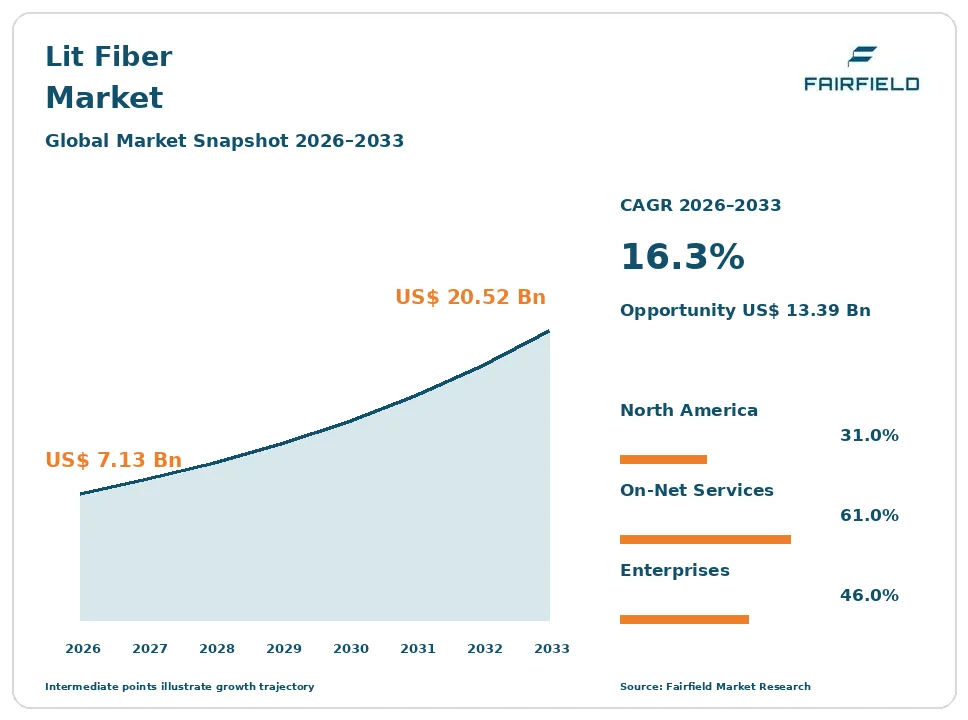
The global lit fiber market size is expected to be valued at US$ 7.13 billion in 2026 and projected to reach US$ 20.52 billion by 2033, growing at a CAGR of 16.3% between 2026 and 2033.
Between 2020 and 2025, the market grew at a CAGR of about 14.1%, as businesses, cloud providers, and telecom carriers bought more high-capacity connectivity. Lit fiber is optical fiber that a provider has equipped with active electronics and sells as a managed service, unlike dark fiber, which buyers light themselves. Three factors now drive growth: demand for data center interconnect links from AI and cloud computing, the rollout of 5G backhaul networks, and the expansion of fiber-to-the-home and business broadband. The market is shifting toward high-speed wavelength services of 400G and above, private fiber networks built for large technology firms, and consolidation among fiber owners. Large deals in 2024 and 2025, including Lumen’s AI network contracts and Zayo’s purchase of Crown Castle’s fiber business, show strong investor interest.
Key Report Takeaways
- By Network Type: On-Net held 61.0% share in 2026, while Off-Net is projected to expand at a 17.6% CAGR through 2033, driven by carriers reaching more buildings through partner networks.
- By Application: IT and Telecommunication held 35.0% share in 2026, while Networking is projected to expand at an 18.2% CAGR through 2033, driven by enterprise and cloud connectivity needs.
- By End User: Enterprises held 46.0% share in 2026, while Hyperscalers and Data Centers are projected to expand at a 19.5% CAGR through 2033, driven by AI training and inference workloads.
- By Region: North America held 31.0% share in 2026, while Asia Pacific is projected to expand at an 18.4% CAGR through 2033, driven by 5G, cloud, and broadband growth in India, China, and Indonesia.
Global Lit Fiber Market Trends and Insights
Drivers Impact Analysis
| Driver | Impact on CAGR Forecast | Geographic Relevance | Impact Timeline |
| AI and cloud data center connectivity | High | North America, Asia Pacific, Europe | Medium term (2-4 years) |
| 5G and broadband network expansion | High | Global | Long term (≥4 years) |
Two drivers carry the strongest influence on lit fiber demand during the forecast period.
AI Data Centers Are Driving the Lit Fiber Market
AI and cloud data center connectivity is the strongest driver of the lit fiber market. Data centers need huge amounts of bandwidth to connect with each other.
The mechanism is the rapid growth of AI workloads. Training large AI models requires linking thousands of processors across multiple buildings and sites, and these links need very high-capacity fiber. Data center interconnect traffic is growing fast as cloud providers build new campuses. In 2024, Lumen Technologies reported more than US$ 8 billion in private connectivity deals with Microsoft, Amazon, Google, and Meta. Zayo Group and other providers sell wavelength services of 400G and 800G between data centers. New campuses in Virginia, Texas, Ohio, and abroad need fast links to cities and other sites. These factors create long-term contracts for lit fiber providers.
5G and Broadband Expansion Is Expanding the Lit Fiber Market
5G backhaul and broadband network expansion are expanding the lit fiber market. Modern wireless and home internet services depend on fiber.
The cause is rising demand for faster, more reliable connections. Each 5G cell site needs a fiber connection to carry traffic back to the core network, and 5G networks use far more small cells than earlier technologies. Fiber-to-the-home rollouts are bringing gigabit speeds to millions of homes, and government programs such as the United States BEAD program and the EU Digital Decade targets fund new fiber in underserved areas. Businesses need dedicated fiber for cloud access, video, and remote work. AT&T agreed to buy Lumen’s consumer fiber business in 2025 to speed up its fiber expansion. These trends widen the base of lit fiber customers.
Restraints Impact Analysis
| Restraint | Impact on CAGR Forecast | Geographic Relevance | Impact Timeline |
| High deployment and construction costs | High | Global | Medium term (2-4 years) |
| Competition from dark fiber and alternative technologies | Medium | North America, Europe | Long term (≥4 years) |
Two restraints limit how quickly the lit fiber market grows.
High Deployment Costs Slow the Lit Fiber Market
High deployment and construction costs slow the lit fiber market. Laying new fiber is expensive and slow.
The specific causes are labor, permits, and materials. Digging trenches, boring under roads, and stringing fiber on poles can cost tens of thousands of dollars per mile in cities. Getting permits and rights of way from local governments can take months. Skilled fiber technicians are in short supply, and labor costs rose after 2021. Optical equipment prices also rose during supply chain disruptions. Rural areas have fewer customers per mile, making returns lower. High interest rates since 2022 have raised the cost of financing new networks. Damage from storms, construction work, and cable theft also adds repair costs. These factors slow expansion into new areas, especially outside large cities.
Alternative Options Restrict the Lit Fiber Market
Competition from dark fiber and alternative technologies restricts the lit fiber market. Some large buyers prefer to run their own networks.
The underlying causes are control and cost. Hyperscale cloud companies often lease dark fiber and install their own equipment to control capacity and lower long-term costs. Fixed wireless access from mobile carriers offers home broadband without fiber in some areas, and satellite internet from low Earth orbit constellations serves rural customers. Prices for basic lit services, such as standard Ethernet, have fallen due to competition. Some buyers switch providers when contracts end. Large buyers also negotiate hard on price because they can choose between several providers on major routes. Older copper-based services are being retired, but some small businesses resist upgrading. These factors limit pricing power for lit fiber providers.
Market Opportunities
Private AI Networks Open a High-Value Revenue Pool
Private AI networks open a high-value revenue pool in the lit fiber market. Large technology firms want dedicated high-capacity networks.
Providers with large fiber footprints and spare conduit can capture this opportunity. AI companies need private routes between data centers, often across long distances. Lumen Technologies has signed private connectivity deals with major cloud and AI firms, using spare conduit from earlier network builds. These contracts often run for many years and include build, operation, and maintenance services. Providers can also sell managed wavelength services on top of private fiber. Demand is expected to grow as AI campuses spread to new regions where power is available, such as the Midwest and South of the United States, Spain, and India. Providers that can build new long-haul routes quickly will win the largest contracts. Contract terms of ten years or more give strong revenue visibility.
Metro Network Consolidation Creates a Scale Revenue Pool
Metro network consolidation creates a scale revenue pool in the lit fiber market. Combining fiber networks lets providers reach more buildings.
Providers that buy and integrate regional networks can capture this opportunity. In 2025, Zayo Group agreed to buy Crown Castle’s fiber business, adding about 90,000 route miles and expanding its on-net locations to more than 70,000. Larger networks reduce the need to lease capacity from others and allow faster service delivery. Combined networks can offer more routes for data center interconnect and enterprise customers. Cost savings from merging operations improve margins. Private equity and infrastructure funds are investing in fiber because it offers stable, long-term cash flows. Smaller regional providers may become targets for further deals.
Segment Analysis
By Network Type: On-Net Leads While Off-Net Grows Fastest
On-Net held 61.0% share in 2026. On-net services run entirely over a provider’s own fiber, which allows faster installation, better control, and higher margins. Providers such as Zayo Group, Lumen Technologies, and AT&T focus on growing their on-net building counts in major cities. Enterprises and data centers prefer on-net connections for reliability.
Off-Net is the fastest-growing network type, expanding at a 17.6% CAGR through 2033. Off-net services use leased capacity from partner networks to reach buildings outside a provider’s own footprint. This helps carriers serve customers across many cities quickly without building new fiber. Wholesale agreements between carriers make off-net service easier to arrange. For the market, off-net growth extends reach to new customers in smaller cities.
By Application: IT and Telecommunication Lead While Networking Grows Fastest
IT and Telecommunication held 35.0% share in 2026. Telecom carriers use lit fiber for 5G backhaul, long-haul transport, and wholesale capacity, while IT firms use it to connect offices, cloud services, and data centers. Carriers often buy lit capacity from each other to fill gaps in their networks.
Networking is the fastest-growing application, expanding at an 18.2% CAGR through 2033. Enterprises, campuses, and data centers need high-speed local and wide area networks to support cloud, video, and AI tools. Industrial and aerospace and defense applications also use lit fiber for secure, low-latency links. For the market, networking growth adds steady demand.
By End User: Enterprises Lead While Hyperscalers and Data Centers Grow Fastest
Enterprises held 46.0% share in 2026. Banks, hospitals, universities, government agencies, and retailers buy lit fiber for secure, high-speed internet and private connections between sites. Managed services reduce the need for in-house network staff, and providers often bundle security, cloud access, and software-defined networking with fiber connections. Demand from hospitals and banks is steady because they need reliable, secure links.
Hyperscalers and Data Centers are the fastest-growing end user, expanding at a 19.5% CAGR through 2033. Cloud and AI companies need massive bandwidth between campuses and to internet exchange points. Hyperscalers often buy multiple diverse routes between sites to avoid outages. Telecom carriers and governments are other large buyers. For the market, this growth brings large, long-term contracts.
Geography Analysis
Which Region Is Leading the Lit Fiber Market?
North America is leading the lit fiber market with a 31.0% share in 2026. The United States has the world’s largest data center market and many fiber providers, including AT&T, Verizon Communications, Lumen Technologies, Zayo Group, Comcast, and Charter Communications. Federal broadband funding supports new fiber in rural areas. Canada is expanding fiber through Bell and Rogers. Data center campuses in Virginia, Texas, and Arizona drive demand for high-capacity links. Key barriers include high construction costs. One change shaping the region is consolidation, with Verizon buying Frontier and AT&T buying Lumen’s consumer fiber.
Europe Builds the Lit Fiber Market Through Digital Decade Targets
Europe is a major lit fiber market. The European Union’s Digital Decade program aims for gigabit connectivity for all homes by 2030. Germany, the United Kingdom, France, Spain, and Italy are investing heavily in fiber, and the Netherlands and Ireland host large data center clusters. Providers sell wavelength services between major data center hubs such as Frankfurt, London, Amsterdam, and Paris. New AI campuses in Spain, Portugal, and Sweden need long-haul routes to major cities. Key barriers include permitting delays and high labor costs. One opportunity is cross-border routes linking data center hubs across the European Union.
Which Region Is Growing Fastest in the Lit Fiber Market?
Asia Pacific is growing fastest in the lit fiber market at an 18.4% CAGR through 2033. China has the largest fiber-to-the-home network in the world, and India is expanding fiber for 5G and data centers in Mumbai, Chennai, and Hyderabad. Japan, South Korea, Singapore, and Australia have advanced networks. Indonesia, Malaysia, and Vietnam are building data centers. Subsea cables landing in Singapore, Japan, and India add demand for links to inland data centers. Key barriers include regulation and land costs in big cities. One change shaping the region is data center growth.
Latin America Grows the Lit Fiber Market Through Broadband Expansion
Latin America is a growing lit fiber market. Brazil has hundreds of small and regional fiber providers and a fast-growing data center market in São Paulo, and Mexico is attracting cloud investment near Querétaro. Chile and Colombia are expanding fiber networks and data centers, supported by government connectivity programs. Argentina and Peru are building new national fiber backbones. New subsea cables connect the region to the United States and Europe, raising demand for links to inland cities. Key barriers include economic swings and frequent theft of cables. One opportunity is data center links between major cities.
Middle East & Africa Expands the Lit Fiber Market Through Digital Investment
Middle East & Africa is an emerging lit fiber market. Saudi Arabia and the United Arab Emirates are building large data centers, AI campuses, and smart cities. South Africa, Nigeria, and Kenya are expanding national fiber backbones. New subsea cables land in Egypt, Djibouti, and other coastal countries. Qatar and Oman are investing in digital infrastructure, and global cloud providers have opened regions in Saudi Arabia and South Africa. Morocco is building data centers that serve Europe. Key barriers include limited infrastructure and high costs. One opportunity is cloud data centers linked by new fiber routes.
Competitive Landscape
The lit fiber market is moderately concentrated. AT&T, Verizon Communications, Lumen Technologies, Zayo Group, Comcast, Charter Communications, and Crown Castle are major providers in North America, along with regional players such as FiberLight and Altice USA. In other regions, national carriers such as NTT, China Telecom, and Deutsche Telekom compete with specialist fiber firms.
Companies compete on network reach, on-net building counts, capacity, speed of delivery, reliability, and price. Providers with long-haul and metro routes connecting major data center hubs have an advantage. Many carriers buy and sell capacity from each other, so the market is both competitive and cooperative. Infrastructure investors, such as EQT, own several fiber providers and fund new builds. Customer service, network monitoring, and fast repair times also matter for enterprise buyers. Providers are adding automated ordering platforms that let customers buy capacity online in minutes.
Strategic moves show how competition is changing. In November 2024, Lumen Technologies reported more than US$ 8 billion in AI network deals. In March 2025, Zayo Group agreed to buy Crown Castle’s fiber business for about US$ 4.25 billion. In June 2025, AT&T agreed to buy Lumen’s consumer fiber business for US$ 5.75 billion. These moves show competition shifting toward scale and AI.
Three themes shape vendor strategy. First, companies are buying fiber networks to gain scale. Second, they are signing AI contracts. Third, they are upgrading to 400G and 800G.
Lit Fiber Market Industry Leaders
- AT&T
- Verizon Communications
- Lumen Technologies
- Zayo Group
- Comcast
Recent Industry Developments
- June 2025: AT&T agreed to acquire Lumen Technologies’ Mass Markets fiber business for US$ 5.75 billion - speeds up fiber-to-the-home expansion.
- March 2025: Zayo Group agreed to acquire Crown Castle’s Fiber Solutions business for about US$ 4.25 billion, adding about 90,000 route miles - strengthens metro and wavelength services.
- November 2024: Lumen Technologies reported more than US$ 8 billion in private connectivity agreements with Microsoft, Amazon, Google, and Meta - shows AI-driven demand for fiber.
- September 2024: Verizon Communications agreed to acquire Frontier Communications for about US$ 20 billion - expands its fiber footprint.
Companies Covered in the Report
- AT&T
- Verizon Communications
- Lumen Technologies
- Zayo Group
- Comcast
- Charter Communications
- Crown Castle
- FiberLight
- Altice USA
- Cogent Communications
- NTT
- China Telecom
Lit Fiber Market Report Scope
This report covers lit fiber services, including on-net and off-net connectivity over single-mode and multi-mode fiber, for IT and telecommunication, networking, industrial, and aerospace and defense applications, used by enterprises, carriers, hyperscalers, and governments. It excludes dark fiber leases. The base year is 2025, and the forecast period runs from 2026 to 2033. All values are expressed in US$ Billion.
Network Type
- On-Net
- Off-Net
Application
- IT and Telecommunication
- Networking
- Industrial
- Aerospace and Defense
End User
- Enterprises
- Telecom Carriers
- Hyperscalers and Data Centers
- Government
Regions
- North America
- Europe
- Asia Pacific
- Latin America
- Middle East & Africa
Key Questions Answered in the Report
How big is the lit fiber market in 2026?
The lit fiber market is valued at US$ 7.13 billion in 2026, led by on-net services and North America.
What is the lit fiber market forecast to 2033?
The market is projected to reach US$ 20.52 billion by 2033, growing at a 16.3% CAGR and adding US$ 13.39 billion.
Which end user is growing fastest in the lit fiber market?
Hyperscalers and data centers are growing fastest at a 19.5% CAGR through 2033, driven by AI training and cloud workloads.
Which region is growing fastest in the lit fiber market?
Asia Pacific is growing fastest at an 18.4% CAGR through 2033, driven by 5G, cloud, and broadband growth in India and China.
Which region holds the largest lit fiber market share?
North America holds the largest share at 31.0% in 2026, supported by the world’s largest data center market and many fiber providers.
1. Executive Summary
1.1. Global Lit Fiber Market Snapshot
1.2. Future Projections
1.3. Key Report Takeaways
1.4. Regional Snapshot
2. Market Overview
2.1. Market Definition and Report Scope
2.2. Historical Trends 2020–2025
2.3. Market Dynamics
2.3.1. Drivers
2.3.1.1. AI Data Centers Are Driving the Lit Fiber Market
2.3.1.2. 5G and Broadband Expansion Is Expanding the Lit Fiber Market
2.3.2. Restraints
2.3.2.1. High Deployment Costs Slow the Lit Fiber Market
2.3.2.2. Alternative Options Restrict the Lit Fiber Market
2.3.3. Market Opportunities
2.3.3.1. Private AI Networks Open a High-Value Revenue Pool
2.3.3.2. Metro Network Consolidation Creates a Scale Revenue Pool
3. Global Lit Fiber Market Outlook, 2020-2033
3.1. Global Lit Fiber Market Outlook, by Network Type, Value (US$ Billion), 2020-2033
3.1.1. On-Net
3.1.2. Off-Net
3.2. Global Lit Fiber Market Outlook, by Application, Value (US$ Billion), 2020-2033
3.2.1. IT and Telecommunication
3.2.2. Networking
3.2.3. Industrial
3.2.4. Aerospace and Defense
3.3. Global Lit Fiber Market Outlook, by End User, Value (US$ Billion), 2020-2033
3.3.1. Enterprises
3.3.2. Telecom Carriers
3.3.3. Hyperscalers and Data Centers
3.3.4. Government
3.4. Global Lit Fiber Market Outlook, by Region, Value (US$ Billion), 2020-2033
3.4.1. North America
3.4.2. Europe
3.4.3. Asia Pacific
3.4.4. Latin America
3.4.5. Middle East & Africa
4. North America Lit Fiber Market Outlook, 2020-2033
4.1. North America Lit Fiber Market Outlook, by Network Type, Value (US$ Billion), 2020-2033
4.1.1. On-Net
4.1.2. Off-Net
4.2. North America Lit Fiber Market Outlook, by Application, Value (US$ Billion), 2020-2033
4.2.1. IT and Telecommunication
4.2.2. Networking
4.2.3. Industrial
4.2.4. Aerospace and Defense
4.3. North America Lit Fiber Market Outlook, by End User, Value (US$ Billion), 2020-2033
4.3.1. Enterprises
4.3.2. Telecom Carriers
4.3.3. Hyperscalers and Data Centers
4.3.4. Government
4.4. North America Lit Fiber Market Outlook, by Country, Value (US$ Billion), 2020-2033
4.4.1. United States Lit Fiber Market Outlook, by Network Type, 2020-2033
4.4.2. United States Lit Fiber Market Outlook, by Application, 2020-2033
4.4.3. United States Lit Fiber Market Outlook, by End User, 2020-2033
4.4.4. Canada Lit Fiber Market Outlook, by Network Type, 2020-2033
4.4.5. Canada Lit Fiber Market Outlook, by Application, 2020-2033
4.4.6. Canada Lit Fiber Market Outlook, by End User, 2020-2033
5. Europe Lit Fiber Market Outlook, 2020-2033
5.1. Europe Lit Fiber Market Outlook, by Network Type, Value (US$ Billion), 2020-2033
5.1.1. On-Net
5.1.2. Off-Net
5.2. Europe Lit Fiber Market Outlook, by Application, Value (US$ Billion), 2020-2033
5.2.1. IT and Telecommunication
5.2.2. Networking
5.2.3. Industrial
5.2.4. Aerospace and Defense
5.3. Europe Lit Fiber Market Outlook, by End User, Value (US$ Billion), 2020-2033
5.3.1. Enterprises
5.3.2. Telecom Carriers
5.3.3. Hyperscalers and Data Centers
5.3.4. Government
5.4. Europe Lit Fiber Market Outlook, by Country, Value (US$ Billion), 2020-2033
5.4.1. Germany Lit Fiber Market Outlook, by Network Type, 2020-2033
5.4.2. Germany Lit Fiber Market Outlook, by Application, 2020-2033
5.4.3. Germany Lit Fiber Market Outlook, by End User, 2020-2033
5.4.4. United Kingdom Lit Fiber Market Outlook, by Network Type, 2020-2033
5.4.5. United Kingdom Lit Fiber Market Outlook, by Application, 2020-2033
5.4.6. United Kingdom Lit Fiber Market Outlook, by End User, 2020-2033
5.4.7. France Lit Fiber Market Outlook, by Network Type, 2020-2033
5.4.8. France Lit Fiber Market Outlook, by Application, 2020-2033
5.4.9. France Lit Fiber Market Outlook, by End User, 2020-2033
5.4.10. Spain Lit Fiber Market Outlook, by Network Type, 2020-2033
5.4.11. Spain Lit Fiber Market Outlook, by Application, 2020-2033
5.4.12. Spain Lit Fiber Market Outlook, by End User, 2020-2033
5.4.13. Italy Lit Fiber Market Outlook, by Network Type, 2020-2033
5.4.14. Italy Lit Fiber Market Outlook, by Application, 2020-2033
5.4.15. Italy Lit Fiber Market Outlook, by End User, 2020-2033
5.4.16. Netherlands Lit Fiber Market Outlook, by Network Type, 2020-2033
5.4.17. Netherlands Lit Fiber Market Outlook, by Application, 2020-2033
5.4.18. Netherlands Lit Fiber Market Outlook, by End User, 2020-2033
5.4.19. Portugal Lit Fiber Market Outlook, by Network Type, 2020-2033
5.4.20. Portugal Lit Fiber Market Outlook, by Application, 2020-2033
5.4.21. Portugal Lit Fiber Market Outlook, by End User, 2020-2033
5.4.22. Sweden Lit Fiber Market Outlook, by Network Type, 2020-2033
5.4.23. Sweden Lit Fiber Market Outlook, by Application, 2020-2033
5.4.24. Sweden Lit Fiber Market Outlook, by End User, 2020-2033
6. Asia Pacific Lit Fiber Market Outlook, 2020-2033
6.1. Asia Pacific Lit Fiber Market Outlook, by Network Type, Value (US$ Billion), 2020-2033
6.1.1. On-Net
6.1.2. Off-Net
6.2. Asia Pacific Lit Fiber Market Outlook, by Application, Value (US$ Billion), 2020-2033
6.2.1. IT and Telecommunication
6.2.2. Networking
6.2.3. Industrial
6.2.4. Aerospace and Defense
6.3. Asia Pacific Lit Fiber Market Outlook, by End User, Value (US$ Billion), 2020-2033
6.3.1. Enterprises
6.3.2. Telecom Carriers
6.3.3. Hyperscalers and Data Centers
6.3.4. Government
6.4. Asia Pacific Lit Fiber Market Outlook, by Country, Value (US$ Billion), 2020-2033
6.4.1. China Lit Fiber Market Outlook, by Network Type, 2020-2033
6.4.2. China Lit Fiber Market Outlook, by Application, 2020-2033
6.4.3. China Lit Fiber Market Outlook, by End User, 2020-2033
6.4.4. India Lit Fiber Market Outlook, by Network Type, 2020-2033
6.4.5. India Lit Fiber Market Outlook, by Application, 2020-2033
6.4.6. India Lit Fiber Market Outlook, by End User, 2020-2033
6.4.7. Japan Lit Fiber Market Outlook, by Network Type, 2020-2033
6.4.8. Japan Lit Fiber Market Outlook, by Application, 2020-2033
6.4.9. Japan Lit Fiber Market Outlook, by End User, 2020-2033
6.4.10. South Korea Lit Fiber Market Outlook, by Network Type, 2020-2033
6.4.11. South Korea Lit Fiber Market Outlook, by Application, 2020-2033
6.4.12. South Korea Lit Fiber Market Outlook, by End User, 2020-2033
6.4.13. Singapore Lit Fiber Market Outlook, by Network Type, 2020-2033
6.4.14. Singapore Lit Fiber Market Outlook, by Application, 2020-2033
6.4.15. Singapore Lit Fiber Market Outlook, by End User, 2020-2033
6.4.16. Australia Lit Fiber Market Outlook, by Network Type, 2020-2033
6.4.17. Australia Lit Fiber Market Outlook, by Application, 2020-2033
6.4.18. Australia Lit Fiber Market Outlook, by End User, 2020-2033
6.4.19. Indonesia Lit Fiber Market Outlook, by Network Type, 2020-2033
6.4.20. Indonesia Lit Fiber Market Outlook, by Application, 2020-2033
6.4.21. Indonesia Lit Fiber Market Outlook, by End User, 2020-2033
6.4.22. Malaysia Lit Fiber Market Outlook, by Network Type, 2020-2033
6.4.23. Malaysia Lit Fiber Market Outlook, by Application, 2020-2033
6.4.24. Malaysia Lit Fiber Market Outlook, by End User, 2020-2033
6.4.25. Vietnam Lit Fiber Market Outlook, by Network Type, 2020-2033
6.4.26. Vietnam Lit Fiber Market Outlook, by Application, 2020-2033
6.4.27. Vietnam Lit Fiber Market Outlook, by End User, 2020-2033
7. Latin America Lit Fiber Market Outlook, 2020-2033
7.1. Latin America Lit Fiber Market Outlook, by Network Type, Value (US$ Billion), 2020-2033
7.1.1. On-Net
7.1.2. Off-Net
7.2. Latin America Lit Fiber Market Outlook, by Application, Value (US$ Billion), 2020-2033
7.2.1. IT and Telecommunication
7.2.2. Networking
7.2.3. Industrial
7.2.4. Aerospace and Defense
7.3. Latin America Lit Fiber Market Outlook, by End User, Value (US$ Billion), 2020-2033
7.3.1. Enterprises
7.3.2. Telecom Carriers
7.3.3. Hyperscalers and Data Centers
7.3.4. Government
7.4. Latin America Lit Fiber Market Outlook, by Country, Value (US$ Billion), 2020-2033
7.4.1. Brazil Lit Fiber Market Outlook, by Network Type, 2020-2033
7.4.2. Brazil Lit Fiber Market Outlook, by Application, 2020-2033
7.4.3. Brazil Lit Fiber Market Outlook, by End User, 2020-2033
7.4.4. Mexico Lit Fiber Market Outlook, by Network Type, 2020-2033
7.4.5. Mexico Lit Fiber Market Outlook, by Application, 2020-2033
7.4.6. Mexico Lit Fiber Market Outlook, by End User, 2020-2033
7.4.7. Chile Lit Fiber Market Outlook, by Network Type, 2020-2033
7.4.8. Chile Lit Fiber Market Outlook, by Application, 2020-2033
7.4.9. Chile Lit Fiber Market Outlook, by End User, 2020-2033
7.4.10. Colombia Lit Fiber Market Outlook, by Network Type, 2020-2033
7.4.11. Colombia Lit Fiber Market Outlook, by Application, 2020-2033
7.4.12. Colombia Lit Fiber Market Outlook, by End User, 2020-2033
7.4.13. Argentina Lit Fiber Market Outlook, by Network Type, 2020-2033
7.4.14. Argentina Lit Fiber Market Outlook, by Application, 2020-2033
7.4.15. Argentina Lit Fiber Market Outlook, by End User, 2020-2033
7.4.16. Peru Lit Fiber Market Outlook, by Network Type, 2020-2033
7.4.17. Peru Lit Fiber Market Outlook, by Application, 2020-2033
7.4.18. Peru Lit Fiber Market Outlook, by End User, 2020-2033
8. Middle East & Africa Lit Fiber Market Outlook, 2020-2033
8.1. Middle East & Africa Lit Fiber Market Outlook, by Network Type, Value (US$ Billion), 2020-2033
8.1.1. On-Net
8.1.2. Off-Net
8.2. Middle East & Africa Lit Fiber Market Outlook, by Application, Value (US$ Billion), 2020-2033
8.2.1. IT and Telecommunication
8.2.2. Networking
8.2.3. Industrial
8.2.4. Aerospace and Defense
8.3. Middle East & Africa Lit Fiber Market Outlook, by End User, Value (US$ Billion), 2020-2033
8.3.1. Enterprises
8.3.2. Telecom Carriers
8.3.3. Hyperscalers and Data Centers
8.3.4. Government
8.4. Middle East & Africa Lit Fiber Market Outlook, by Country, Value (US$ Billion), 2020-2033
8.4.1. Saudi Arabia Lit Fiber Market Outlook, by Network Type, 2020-2033
8.4.2. Saudi Arabia Lit Fiber Market Outlook, by Application, 2020-2033
8.4.3. Saudi Arabia Lit Fiber Market Outlook, by End User, 2020-2033
8.4.4. United Arab Emirates Lit Fiber Market Outlook, by Network Type, 2020-2033
8.4.5. United Arab Emirates Lit Fiber Market Outlook, by Application, 2020-2033
8.4.6. United Arab Emirates Lit Fiber Market Outlook, by End User, 2020-2033
8.4.7. South Africa Lit Fiber Market Outlook, by Network Type, 2020-2033
8.4.8. South Africa Lit Fiber Market Outlook, by Application, 2020-2033
8.4.9. South Africa Lit Fiber Market Outlook, by End User, 2020-2033
8.4.10. Nigeria Lit Fiber Market Outlook, by Network Type, 2020-2033
8.4.11. Nigeria Lit Fiber Market Outlook, by Application, 2020-2033
8.4.12. Nigeria Lit Fiber Market Outlook, by End User, 2020-2033
8.4.13. Kenya Lit Fiber Market Outlook, by Network Type, 2020-2033
8.4.14. Kenya Lit Fiber Market Outlook, by Application, 2020-2033
8.4.15. Kenya Lit Fiber Market Outlook, by End User, 2020-2033
8.4.16. Egypt Lit Fiber Market Outlook, by Network Type, 2020-2033
8.4.17. Egypt Lit Fiber Market Outlook, by Application, 2020-2033
8.4.18. Egypt Lit Fiber Market Outlook, by End User, 2020-2033
8.4.19. Djibouti Lit Fiber Market Outlook, by Network Type, 2020-2033
8.4.20. Djibouti Lit Fiber Market Outlook, by Application, 2020-2033
8.4.21. Djibouti Lit Fiber Market Outlook, by End User, 2020-2033
8.4.22. Qatar Lit Fiber Market Outlook, by Network Type, 2020-2033
8.4.23. Qatar Lit Fiber Market Outlook, by Application, 2020-2033
8.4.24. Qatar Lit Fiber Market Outlook, by End User, 2020-2033
8.4.25. Oman Lit Fiber Market Outlook, by Network Type, 2020-2033
8.4.26. Oman Lit Fiber Market Outlook, by Application, 2020-2033
8.4.27. Oman Lit Fiber Market Outlook, by End User, 2020-2033
8.4.28. Morocco Lit Fiber Market Outlook, by Network Type, 2020-2033
8.4.29. Morocco Lit Fiber Market Outlook, by Application, 2020-2033
8.4.30. Morocco Lit Fiber Market Outlook, by End User, 2020-2033
9. Competitive Landscape
9.1. Market Concentration and Industry Leaders
9.2. Competitive Differentiation
9.3. Strategic Moves and Market Direction
9.4. Recent Industry Developments
9.5. Company Profiles
9.5.1. AT&T
9.5.2. Verizon Communications
9.5.3. Lumen Technologies
9.5.4. Zayo Group
9.5.5. Comcast
9.5.6. Charter Communications
9.5.7. Crown Castle
9.5.8. FiberLight
9.5.9. Altice USA
9.5.10. Cogent Communications
9.5.11. NTT
9.5.12. China Telecom
10. Appendix
10.1. Research Methodology
10.2. Report Assumptions
10.3. Acronyms and Abbreviations
| Network Type | On-Net, Off-Net |
| Application | IT and Telecommunication, Networking, Industrial, Aerospace and Defense |
| End User | Enterprises, Telecom Carriers, Hyperscalers and Data Centers, Government |
| Regions | North America, Europe, Asia Pacific, Latin America, Middle East & Africa |
Our Research Methodology
Considering the volatility of business today, traditional approaches to strategizing a game plan can be unfruitful if not detrimental. True ambiguity is no way to determine a forecast. A myriad of predetermined factors must be accounted for such as the degree of risk involved, the magnitude of circumstances, as well as conditions or consequences that are not known or unpredictable. To circumvent binary views that cast uncertainty, the application of market research intelligence to strategically posture, move, and enable actionable outcomes is necessary.
View Methodology
Quality Assured
Rigorous Validation Process

Confidentiality Assured
End-to-end Data Security

Custom Research Services
Tailored To Your Objectives
FAQs
The lit fiber market is valued at US$ 7.13 billion in 2026, led by on-net services and North America.
The market is projected to reach US$ 20.52 billion by 2033, growing at a 16.3% CAGR and adding US$ 13.39 billion.
Hyperscalers and data centers are growing fastest at a 19.5% CAGR through 2033, driven by AI training and cloud workloads.
Asia Pacific is growing fastest at an 18.4% CAGR through 2033, driven by 5G, cloud, and broadband growth in India and China.
North America holds the largest share at 31.0% in 2026, supported by the world’s largest data center market and many fiber providers.
Related Reports
Multi-Access Edge Computing Market Size, Share, Insights, Competitive Landscape, and Forecast 2026 to 2033
Explore the multi-access edge computing market, valued at US$ 4.2 billion in 2026 and projected to reach US$ 9.8 billion by 2033 at a 12.9% CAGR.
M-commerce Payment Market Size, Share, Insights, Competitive Landscape, and Forecast 2026 to 2033
Explore the m-commerce payment market, valued at US$ 10.05 billion in 2026 and forecast to reach US$ 22.70 billion by 2033, growing at a 12.3% CAGR.
Irrigation Automation Market Size, Share, Insights, Competitive Landscape, and Forecast 2026 to 2033
Irrigation automation market to grow from US$ 6.2 billion in 2026 to US$ 18.5 billion by 2033 at a 16.9% CAGR. Explore components, end users and regional trends.
Underwater LiDAR Market Size, Share, Insights, Competitive Landscape, and Forecast 2026 to 2033
Explore the underwater LiDAR market, projected to reach US$0.9 billion by 2033 at 12.3% CAGR, with platform, application and regional insights.
Aerial Imaging Market Size, Share, Insights, Competitive Landscape, and Forecast 2026 to 2033
The global aerial imaging market is valued at US$3.83 billion in 2026, reaching US$8.13 billion by 2033, growing at an 11.4% CAGR
Satcom Terminal Market Size, Share, Insights, Competitive Landscape, and Forecast 2026 to 2033
The satcom terminal market is projected to grow from US$8.6 billion in 2026 to US$20.6 billion by 2033, at a 13.3% CAGR. Explore segments and key trends.