



Medical Device Connectivity Market
Medical Device Connectivity Market Insights, Competitive Landscape, and Market Forecast - 2033
Global Medical Device Connectivity Market Forecast
- Global medical device connectivity market size to reach USD 22 Bn in 2033, up from USD 4.9 Bn attained in 2026
- Market revenue projected to exhibit a remarkable rate of expansion, at an estimated CAGR of 24% during 2026 - 2033
Quick Report Digest
- Global medical device connectivity market to reach USD 22 Bn in 2033, from USD 4.9 Bn in 2026, with a projected CAGR of 24%.
- Growth between 2019-2024 driven by integrated healthcare systems and EHRs, with an estimated CAGR exceeding 24% until 2033.
- North America to lead due to high chronic disease prevalence and strong EHR adoption; Asia Pacific to be the fastest-growing regional market.
- Advancements in medical technology, remote patient monitoring, and wearables drive market growth.
- Regulatory compliance (e.g., FDA's UDI system, HIPAA) and data security are major concerns.
- Rise of remote monitoring and telemedicine post-COVID-19 boosts adoption.
- Integration of IoT and AI technologies transforms connectivity landscape.
- Regulatory scenario shapes industry growth, incentivising investment but posing challenges.
- Top segments include wireless connectivity solutions, integration devices, and connectivity software.
- Major players include Philips Healthcare, GE Healthcare, Medtronic, Cisco Systems, and Qualcomm Technologies.
Key Growth Determinants
- Advancements in Healthcare IT Infrastructure
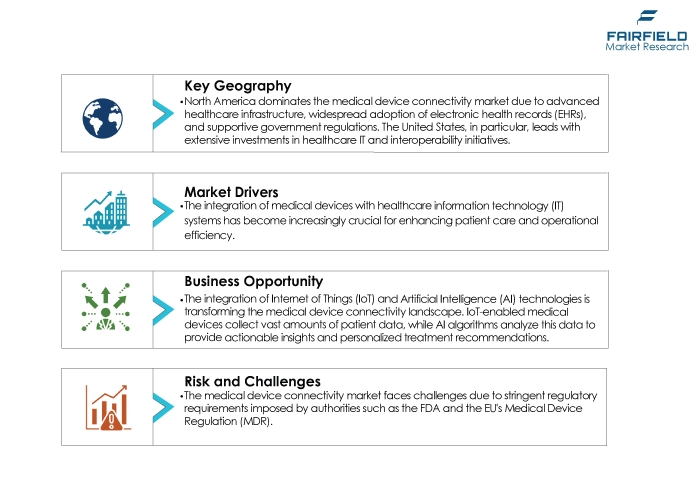
The integration of medical devices with healthcare information technology (IT) systems has become increasingly crucial for enhancing patient care and operational efficiency. As healthcare facilities adopt electronic health records (EHR), and interoperable systems, the demand for medical device connectivity solutions rises to ensure seamless data exchange between devices and centralised systems, driving market growth.
- Rising Demand for Remote Patient Monitoring
The growing prevalence of chronic diseases and the ageing population have fuelled the need for remote patient monitoring solutions. Medical device connectivity enables real-time data transmission from various devices to healthcare providers, facilitating remote monitoring of patients' vital signs and health status. This trend is expected to escalate the adoption of connectivity solutions, particularly in home healthcare settings, driving market expansion.
- Regulatory Mandates, and Standards Compliance
Stringent regulations and standards, such as the FDA's Unique Device Identification (UDI) system and Health Insurance Portability and Accountability Act (HIPAA) regulations, mandate healthcare facilities to ensure the secure and interoperable exchange of medical device data. Compliance with these standards necessitates the implementation of robust connectivity solutions, stimulating market growth as healthcare organisations invest in compliant technologies to avoid penalties and enhance patient safety and data security.
Major Growth Barriers
- Regulatory Compliance
The medical device connectivity market faces challenges due to stringent regulatory requirements imposed by authorities such as the FDA and the EU's Medical Device Regulation (MDR). Compliance with these regulations adds complexity and cost to the development and implementation of connectivity solutions, acting as a significant growth restraint.
- Data Security Concerns
With the increasing connectivity of medical devices, ensuring the security and privacy of patient data becomes paramount. The risk of data breaches, cyberattacks, and unauthorised access to sensitive health information poses a significant barrier to the widespread adoption of connected medical devices, as healthcare providers and patients alike remain wary of potential security vulnerabilities.
- Interoperability Issues
The lack of standardised protocols and interoperability among different medical devices and systems inhibits seamless data exchange and integration within healthcare environments. Without interoperability, achieving the full potential of medical device connectivity in improving patient care, clinical workflows, and efficiency becomes challenging, limiting market growth opportunities.
Key Trends and Opportunities to Look at
- Rise of Remote Monitoring and Telemedicine
The COVID-19 pandemic catalysed the adoption of remote monitoring and telemedicine technologies. With lockdowns and social distancing measures in place, healthcare providers turned to digital solutions to continue patient care remotely. This trend is likely to continue post-pandemic due to its convenience, accessibility, and potential cost savings. Medical device connectivity plays a crucial role in enabling remote monitoring by transmitting real-time patient data to healthcare professionals, facilitating timely interventions and reducing the need for in-person visits.
- Integration of IoT and AI Technologies
The integration of Internet of Things (IoT), and Artificial Intelligence (AI) technologies is transforming the medical device connectivity landscape. IoT-enabled medical devices collect vast amounts of patient data, while AI algorithms analyse this data to provide actionable insights and personalised treatment recommendations. This convergence enhances diagnostic accuracy, treatment efficacy, and patient outcomes. Medical device connectivity platforms are evolving to accommodate these advanced technologies, allowing seamless interoperability between different devices and systems.
- Data Security and Privacy Solutions
As the volume of healthcare data transmitted through connected medical devices continues to grow, ensuring data security and privacy becomes paramount. Market players have a significant opportunity to develop robust cybersecurity solutions that safeguard patient data against cyber threats and unauthorised access. Additionally, compliance with regulations such as the Health Insurance Portability and Accountability Act (HIPAA) is essential to maintain patient trust and regulatory compliance.
How Does the Regulatory Scenario Shape this Industry?
The regulatory landscape for medical device connectivity is a double-edged sword. Regulations like Meaningful Use programs incentivise investment in connected devices, fostering market growth. Additionally, data security regulations like HIPAA, and GDPR necessitate strong security protocols, building trust and encouraging adoption. However, the complex and ever-changing regulatory environment can be a burden for manufacturers, with lengthy and expensive approval processes for connected devices.
Compliance with data privacy regulations across regions adds another layer of complexity. While regulations drive security, patient safety, and even some market adoption, they can also create hurdles for innovation and market entry. The industry's challenge is to navigate this complex landscape to develop secure and effective connected devices that comply with regulations and contribute to a better healthcare system.
Fairfield’s Ranking Board
Top Segments
- Wireless Connectivity Solutions
Wireless connectivity solutions have gained significant traction due to their ability to offer flexibility, mobility, and real-time data access. With the proliferation of IoT in healthcare, wireless connectivity enables seamless integration of medical devices with hospital networks, facilitating remote patient monitoring and data analytics. The demand for wireless connectivity solutions is driven by the need for enhanced patient care, streamlined workflows, and cost-effectiveness. Additionally, advancements in wireless technologies such as Bluetooth, Wi-Fi, and Zigbee contribute to the growth of this segment by offering secure and reliable communication channels.
- Integration and Interface Devices
Integration and interface devices play a crucial role in bridging the gap between disparate medical devices and hospital information systems. These devices facilitate interoperability by standardising data formats and communication protocols, thereby enabling seamless data exchange and integration across healthcare settings. The increasing adoption of electronic health records (EHRs), and interoperability standards like HL7, and DICOM fuels the demand for integration and interface devices. Moreover, the need for efficient data management, regulatory compliance, and interoperable healthcare ecosystems further drives the growth of this segment.
- Medical Device Connectivity Software
Medical device connectivity software serves as the backbone of connected healthcare systems, enabling data aggregation, visualisation, and analysis from various medical devices. This software empowers healthcare providers to monitor patient vital signs, track treatment progress, and make informed clinical decisions in real-time. The rising emphasis on interoperability, data security, and regulatory compliance drives the adoption of medical device connectivity software.
Regional Frontrunners
North America Leads the Medical Device Connectivity Market
North America dominates the medical device connectivity market due to advanced healthcare infrastructure, widespread adoption of electronic health records (EHRs), and supportive government regulations. The US especially leads with extensive investments in healthcare IT and interoperability initiatives.
Europe Drives Innovations in Medical Device Connectivity
Europe holds a substantial share in the medical device connectivity market, propelled by robust healthcare systems and increasing focus on digitization. Countries like Germany, the UK, and France are at the forefront of adopting connected medical devices to enhance patient care and streamline healthcare operations.
Asia Pacific Emerges as the Growth Hub for Medical Device Connectivity
The Asia Pacific region presents immense growth potential in the medical device connectivity market, driven by rising healthcare expenditure, improving healthcare infrastructure, and increasing awareness about the benefits of medical device connectivity. Countries like China, Japan, and India are witnessing rapid adoption. With a larger budget being allocated to healthcare, there is more room for investment in advanced medical technologies, including medical device connectivity solutions.
Many countries in the Asia Pacific region are actively investing in upgrading their healthcare infrastructure. This includes modernising hospitals, clinics, and other healthcare facilities with state-of-the-art equipment, including connected medical devices. Improved infrastructure facilitates the seamless integration of these devices into existing healthcare systems.
Governments across Asia Pacific are also increasingly recognising the importance of digital health initiatives in improving healthcare delivery, and outcomes. They are rolling out policies, and initiatives to encourage the adoption of electronic health records, telemedicine, and medical device connectivity. These efforts create a supportive environment for the growth of the medical device connectivity market.
Fairfield’s Competitive Landscape Analysis
The medical device connectivity market's competition landscape is dynamic, characterised by several leading players vying for market share. Key players in this field include Philips Healthcare, GE Healthcare, Medtronic, Cisco Systems, and Qualcomm Technologies.
These companies employ various growth strategies to maintain their competitive edge, such as strategic partnerships, mergers and acquisitions, and product innovations. For instance, Philips Healthcare has focused on developing interoperable solutions that seamlessly integrate with existing healthcare infrastructure, while Medtronic has expanded its portfolio through strategic acquisitions of companies specialising in medical device connectivity technologies.
GE Healthcare has emphasised the development of advanced connectivity platforms that enable remote monitoring and data analytics, catering to the evolving needs of healthcare providers. Overall, competition in the Medical Device Connectivity market is intense, with players continuously innovating to offer comprehensive solutions that enhance patient care and streamline healthcare delivery processes.
Who are the Leaders in the Medical Device Connectivity Market Space?
- Capsule Technologies Inc.
- Stryker Corporation
- Philips Healthcare
- iHealth Labs Inc.
- Lantronix
- S3 Connected Health
- Cerner Corporation
- GE Healthcare
- Medtronic
- Cisco Systems
- Infosys
- Nuvon
- NantHealth
An Expert’s Eye
Technological Advancements Driving Adoption
Continuous innovations in medical device connectivity technologies, such as IoT, cloud computing, and data analytics, are significantly enhancing the functionality and efficiency of these systems. These advancements are driving increased adoption by healthcare facilities seeking to streamline patient data management and improve overall operational efficiency.
Regulatory Compliance Mandates Fuelling Growth
Stringent regulations, including HIPAA in the US, mandate compliance with standards for patient data management and interoperability. Healthcare providers are compelled to invest in medical device connectivity solutions to ensure compliance, thereby driving market growth as adoption rates rise to meet regulatory requirements.
The Global Medical Device Connectivity Market is Segmented as Below:
By Component:
- Solutions
- Interface Devices
- Medical Device Connectivity Hubs
- Medical Telemetry Solutions
- Others
- Services
- Consultation Services
- Integration and Deployment Services
- Support and Maintenance Services
By Connectivity Technology:
- Wired Connectivity
- Wireless Connectivity
By Application:
- Vital Sign Monitoring Systems
- Cardiology Devices
- ICU Systems
- Oncology Systems
- Home Healthcare Devices
- Others
By End-use Vertical:
- Hospitals & Clinics
- Diagnostic Centres
- Healthcare Research Centres
- Other End Users
By Region:
- North America
- Latin America
- Europe
- East Asia
- South Asia Pacific
- Middle East and Africa
- Executive Summary
- Global Medical Device Connectivity Market Snapshot
- Future Projections
- Key Market Trends
- Regional Snapshot, by Value, 2026
- Analyst Recommendations
- Market Overview
- Market Definitions and Segmentations
- Market Dynamics
- Drivers
- Restraints
- Market Opportunities
- Value Chain Analysis
- COVID-19 Impact Analysis
- Porter's Five Forces Analysis
- Impact of Russia-Ukraine Conflict
- PESTLE Analysis
- Regulatory Analysis
- Price Trend Analysis
- Current Prices and Future Projections, 2025-2033
- Price Impact Factors
- Global Medical Device Connectivity Market Outlook, 2020 - 2033
- Global Medical Device Connectivity Market Outlook, by Component, Value (US$ Mn), 2020-2033
- Solutions
- Interface Devices
- Medical Device Connectivity Hubs
- Medical Telemetry Solutions
- Others
- Services
- Consultation Services
- Integration and Deployment Services
- Support and Maintenance Services
- Global Medical Device Connectivity Market Outlook, by Connectivity Technology, Value (US$ Mn), 2020-2033
- Wired Connectivity
- Wireless Connectivity
- Global Medical Device Connectivity Market Outlook, by Application, Value (US$ Mn), 2020-2033
- Vital Sign Monitoring Systems
- Cardiology Devices
- ICU Systems
- Oncology Systems
- Home Healthcare Devices
- Others
- Global Medical Device Connectivity Market Outlook, by End-use Vertical, Value (US$ Mn), 2020-2033
- Hospitals & Clinics
- Diagnostic Centres
- Healthcare Research Centres
- Global Medical Device Connectivity Market Outlook, by Region, Value (US$ Mn), 2020-2033
- North America
- Europe
- Asia Pacific
- Latin America
- Middle East & Africa
- Solutions
- Global Medical Device Connectivity Market Outlook, by Component, Value (US$ Mn), 2020-2033
- North America Medical Device Connectivity Market Outlook, 2020 - 2033
- North America Medical Device Connectivity Market Outlook, by Component, Value (US$ Mn), 2020-2033
- Solutions
- Interface Devices
- Medical Device Connectivity Hubs
- Medical Telemetry Solutions
- Others
- Services
- Consultation Services
- Integration and Deployment Services
- Support and Maintenance Services
- North America Medical Device Connectivity Market Outlook, by Connectivity Technology, Value (US$ Mn), 2020-2033
- Wired Connectivity
- Wireless Connectivity
- North America Medical Device Connectivity Market Outlook, by Application, Value (US$ Mn), 2020-2033
- Vital Sign Monitoring Systems
- Cardiology Devices
- ICU Systems
- Oncology Systems
- Home Healthcare Devices
- Others
- North America Medical Device Connectivity Market Outlook, by End-use Vertical, Value (US$ Mn), 2020-2033
- Hospitals & Clinics
- Diagnostic Centres
- Healthcare Research Centres
- North America Medical Device Connectivity Market Outlook, by Country, Value (US$ Mn), 2020-2033
- U.S. Medical Device Connectivity Market Outlook, by Component, 2020-2033
- U.S. Medical Device Connectivity Market Outlook, by Connectivity Technology, 2020-2033
- U.S. Medical Device Connectivity Market Outlook, by Application, 2020-2033
- U.S. Medical Device Connectivity Market Outlook, by End-use Vertical, 2020-2033
- Canada Medical Device Connectivity Market Outlook, by Component, 2020-2033
- Canada Medical Device Connectivity Market Outlook, by Connectivity Technology, 2020-2033
- Canada Medical Device Connectivity Market Outlook, by Application, 2020-2033
- Canada Medical Device Connectivity Market Outlook, by End-use Vertical, 2020-2033
- BPS Analysis/Market Attractiveness Analysis
- Solutions
- North America Medical Device Connectivity Market Outlook, by Component, Value (US$ Mn), 2020-2033
- Europe Medical Device Connectivity Market Outlook, 2020 - 2033
- Europe Medical Device Connectivity Market Outlook, by Component, Value (US$ Mn), 2020-2033
- Solutions
- Interface Devices
- Medical Device Connectivity Hubs
- Medical Telemetry Solutions
- Others
- Services
- Consultation Services
- Integration and Deployment Services
- Support and Maintenance Services
- Europe Medical Device Connectivity Market Outlook, by Connectivity Technology, Value (US$ Mn), 2020-2033
- Wired Connectivity
- Wireless Connectivity
- Europe Medical Device Connectivity Market Outlook, by Application, Value (US$ Mn), 2020-2033
- Vital Sign Monitoring Systems
- Cardiology Devices
- ICU Systems
- Oncology Systems
- Home Healthcare Devices
- Others
- Europe Medical Device Connectivity Market Outlook, by End-use Vertical, Value (US$ Mn), 2020-2033
- Hospitals & Clinics
- Diagnostic Centres
- Healthcare Research Centres
- Europe Medical Device Connectivity Market Outlook, by Country, Value (US$ Mn), 2020-2033
- Germany Medical Device Connectivity Market Outlook, by Component, 2020-2033
- Germany Medical Device Connectivity Market Outlook, by Connectivity Technology, 2020-2033
- Germany Medical Device Connectivity Market Outlook, by Application, 2020-2033
- Germany Medical Device Connectivity Market Outlook, by End-use Vertical, 2020-2033
- Italy Medical Device Connectivity Market Outlook, by Component, 2020-2033
- Italy Medical Device Connectivity Market Outlook, by Connectivity Technology, 2020-2033
- Italy Medical Device Connectivity Market Outlook, by Application, 2020-2033
- Italy Medical Device Connectivity Market Outlook, by End-use Vertical, 2020-2033
- France Medical Device Connectivity Market Outlook, by Component, 2020-2033
- France Medical Device Connectivity Market Outlook, by Connectivity Technology, 2020-2033
- France Medical Device Connectivity Market Outlook, by Application, 2020-2033
- France Medical Device Connectivity Market Outlook, by End-use Vertical, 2020-2033
- U.K. Medical Device Connectivity Market Outlook, by Component, 2020-2033
- U.K. Medical Device Connectivity Market Outlook, by Connectivity Technology, 2020-2033
- U.K. Medical Device Connectivity Market Outlook, by Application, 2020-2033
- U.K. Medical Device Connectivity Market Outlook, by End-use Vertical, 2020-2033
- Spain Medical Device Connectivity Market Outlook, by Component, 2020-2033
- Spain Medical Device Connectivity Market Outlook, by Connectivity Technology, 2020-2033
- Spain Medical Device Connectivity Market Outlook, by Application, 2020-2033
- Spain Medical Device Connectivity Market Outlook, by End-use Vertical, 2020-2033
- Russia Medical Device Connectivity Market Outlook, by Component, 2020-2033
- Russia Medical Device Connectivity Market Outlook, by Connectivity Technology, 2020-2033
- Russia Medical Device Connectivity Market Outlook, by Application, 2020-2033
- Russia Medical Device Connectivity Market Outlook, by End-use Vertical, 2020-2033
- Rest of Europe Medical Device Connectivity Market Outlook, by Component, 2020-2033
- Rest of Europe Medical Device Connectivity Market Outlook, by Connectivity Technology, 2020-2033
- Rest of Europe Medical Device Connectivity Market Outlook, by Application, 2020-2033
- Rest of Europe Medical Device Connectivity Market Outlook, by End-use Vertical, 2020-2033
- BPS Analysis/Market Attractiveness Analysis
- Solutions
- Europe Medical Device Connectivity Market Outlook, by Component, Value (US$ Mn), 2020-2033
- Asia Pacific Medical Device Connectivity Market Outlook, 2020 - 2033
- Asia Pacific Medical Device Connectivity Market Outlook, by Component, Value (US$ Mn), 2020-2033
- Solutions
- Interface Devices
- Medical Device Connectivity Hubs
- Medical Telemetry Solutions
- Others
- Services
- Consultation Services
- Integration and Deployment Services
- Support and Maintenance Services
- Asia Pacific Medical Device Connectivity Market Outlook, by Connectivity Technology, Value (US$ Mn), 2020-2033
- Wired Connectivity
- Wireless Connectivity
- Asia Pacific Medical Device Connectivity Market Outlook, by Application, Value (US$ Mn), 2020-2033
- Vital Sign Monitoring Systems
- Cardiology Devices
- ICU Systems
- Oncology Systems
- Home Healthcare Devices
- Others
- Asia Pacific Medical Device Connectivity Market Outlook, by End-use Vertical, Value (US$ Mn), 2020-2033
- Hospitals & Clinics
- Diagnostic Centres
- Healthcare Research Centres
- Asia Pacific Medical Device Connectivity Market Outlook, by Country, Value (US$ Mn), 2020-2033
- China Medical Device Connectivity Market Outlook, by Component, 2020-2033
- China Medical Device Connectivity Market Outlook, by Connectivity Technology, 2020-2033
- China Medical Device Connectivity Market Outlook, by Application, 2020-2033
- China Medical Device Connectivity Market Outlook, by End-use Vertical, 2020-2033
- Japan Medical Device Connectivity Market Outlook, by Component, 2020-2033
- Japan Medical Device Connectivity Market Outlook, by Connectivity Technology, 2020-2033
- Japan Medical Device Connectivity Market Outlook, by Application, 2020-2033
- Japan Medical Device Connectivity Market Outlook, by End-use Vertical, 2020-2033
- South Korea Medical Device Connectivity Market Outlook, by Component, 2020-2033
- South Korea Medical Device Connectivity Market Outlook, by Connectivity Technology, 2020-2033
- South Korea Medical Device Connectivity Market Outlook, by Application, 2020-2033
- South Korea Medical Device Connectivity Market Outlook, by End-use Vertical, 2020-2033
- India Medical Device Connectivity Market Outlook, by Component, 2020-2033
- India Medical Device Connectivity Market Outlook, by Connectivity Technology, 2020-2033
- India Medical Device Connectivity Market Outlook, by Application, 2020-2033
- India Medical Device Connectivity Market Outlook, by End-use Vertical, 2020-2033
- Southeast Asia Medical Device Connectivity Market Outlook, by Component, 2020-2033
- Southeast Asia Medical Device Connectivity Market Outlook, by Connectivity Technology, 2020-2033
- Southeast Asia Medical Device Connectivity Market Outlook, by Application, 2020-2033
- Southeast Asia Medical Device Connectivity Market Outlook, by End-use Vertical, 2020-2033
- Rest of SAO Medical Device Connectivity Market Outlook, by Component, 2020-2033
- Rest of SAO Medical Device Connectivity Market Outlook, by Connectivity Technology, 2020-2033
- Rest of SAO Medical Device Connectivity Market Outlook, by Application, 2020-2033
- Rest of SAO Medical Device Connectivity Market Outlook, by End-use Vertical, 2020-2033
- BPS Analysis/Market Attractiveness Analysis
- Solutions
- Asia Pacific Medical Device Connectivity Market Outlook, by Component, Value (US$ Mn), 2020-2033
- Latin America Medical Device Connectivity Market Outlook, 2020 - 2033
- Latin America Medical Device Connectivity Market Outlook, by Component, Value (US$ Mn), 2020-2033
- Solutions
- Interface Devices
- Medical Device Connectivity Hubs
- Medical Telemetry Solutions
- Others
- Services
- Consultation Services
- Integration and Deployment Services
- Support and Maintenance Services
- Latin America Medical Device Connectivity Market Outlook, by Connectivity Technology, Value (US$ Mn), 2020-2033
- Wired Connectivity
- Wireless Connectivity
- Latin America Medical Device Connectivity Market Outlook, by Application, Value (US$ Mn), 2020-2033
- Vital Sign Monitoring Systems
- Cardiology Devices
- ICU Systems
- Oncology Systems
- Home Healthcare Devices
- Others
- Latin America Medical Device Connectivity Market Outlook, by End-use Vertical, Value (US$ Mn), 2020-2033
- Hospitals & Clinics
- Diagnostic Centres
- Healthcare Research Centres
- Latin America Medical Device Connectivity Market Outlook, by Country, Value (US$ Mn), 2020-2033
- Brazil Medical Device Connectivity Market Outlook, by Component, 2020-2033
- Brazil Medical Device Connectivity Market Outlook, by Connectivity Technology, 2020-2033
- Brazil Medical Device Connectivity Market Outlook, by Application, 2020-2033
- Brazil Medical Device Connectivity Market Outlook, by End-use Vertical, 2020-2033
- Mexico Medical Device Connectivity Market Outlook, by Component, 2020-2033
- Mexico Medical Device Connectivity Market Outlook, by Connectivity Technology, 2020-2033
- Mexico Medical Device Connectivity Market Outlook, by Application, 2020-2033
- Mexico Medical Device Connectivity Market Outlook, by End-use Vertical, 2020-2033
- Argentina Medical Device Connectivity Market Outlook, by Component, 2020-2033
- Argentina Medical Device Connectivity Market Outlook, by Connectivity Technology, 2020-2033
- Argentina Medical Device Connectivity Market Outlook, by Application, 2020-2033
- Argentina Medical Device Connectivity Market Outlook, by End-use Vertical, 2020-2033
- Rest of LATAM Medical Device Connectivity Market Outlook, by Component, 2020-2033
- Rest of LATAM Medical Device Connectivity Market Outlook, by Connectivity Technology, 2020-2033
- Rest of LATAM Medical Device Connectivity Market Outlook, by Application, 2020-2033
- Rest of LATAM Medical Device Connectivity Market Outlook, by End-use Vertical, 2020-2033
- BPS Analysis/Market Attractiveness Analysis
- Solutions
- Latin America Medical Device Connectivity Market Outlook, by Component, Value (US$ Mn), 2020-2033
- Middle East & Africa Medical Device Connectivity Market Outlook, 2020 - 2033
- Middle East & Africa Medical Device Connectivity Market Outlook, by Component, Value (US$ Mn), 2020-2033
- Solutions
- Interface Devices
- Medical Device Connectivity Hubs
- Medical Telemetry Solutions
- Others
- Services
- Consultation Services
- Integration and Deployment Services
- Support and Maintenance Services
- Middle East & Africa Medical Device Connectivity Market Outlook, by Connectivity Technology, Value (US$ Mn), 2020-2033
- Wired Connectivity
- Wireless Connectivity
- Middle East & Africa Medical Device Connectivity Market Outlook, by Application, Value (US$ Mn), 2020-2033
- Vital Sign Monitoring Systems
- Cardiology Devices
- ICU Systems
- Oncology Systems
- Home Healthcare Devices
- Others
- Middle East & Africa Medical Device Connectivity Market Outlook, by End-use Vertical, Value (US$ Mn), 2020-2033
- Hospitals & Clinics
- Diagnostic Centres
- Healthcare Research Centres
- Middle East & Africa Medical Device Connectivity Market Outlook, by Country, Value (US$ Mn), 2020-2033
- GCC Medical Device Connectivity Market Outlook, by Component, 2020-2033
- GCC Medical Device Connectivity Market Outlook, by Connectivity Technology, 2020-2033
- GCC Medical Device Connectivity Market Outlook, by Application, 2020-2033
- GCC Medical Device Connectivity Market Outlook, by End-use Vertical, 2020-2033
- South Africa Medical Device Connectivity Market Outlook, by Component, 2020-2033
- South Africa Medical Device Connectivity Market Outlook, by Connectivity Technology, 2020-2033
- South Africa Medical Device Connectivity Market Outlook, by Application, 2020-2033
- South Africa Medical Device Connectivity Market Outlook, by End-use Vertical, 2020-2033
- Egypt Medical Device Connectivity Market Outlook, by Component, 2020-2033
- Egypt Medical Device Connectivity Market Outlook, by Connectivity Technology, 2020-2033
- Egypt Medical Device Connectivity Market Outlook, by Application, 2020-2033
- Egypt Medical Device Connectivity Market Outlook, by End-use Vertical, 2020-2033
- Nigeria Medical Device Connectivity Market Outlook, by Component, 2020-2033
- Nigeria Medical Device Connectivity Market Outlook, by Connectivity Technology, 2020-2033
- Nigeria Medical Device Connectivity Market Outlook, by Application, 2020-2033
- Nigeria Medical Device Connectivity Market Outlook, by End-use Vertical, 2020-2033
- Rest of Middle East Medical Device Connectivity Market Outlook, by Component, 2020-2033
- Rest of Middle East Medical Device Connectivity Market Outlook, by Connectivity Technology, 2020-2033
- Rest of Middle East Medical Device Connectivity Market Outlook, by Application, 2020-2033
- Rest of Middle East Medical Device Connectivity Market Outlook, by End-use Vertical, 2020-2033
- BPS Analysis/Market Attractiveness Analysis
- Solutions
- Middle East & Africa Medical Device Connectivity Market Outlook, by Component, Value (US$ Mn), 2020-2033
- Competitive Landscape
- Company Vs Segment Heatmap
- Company Market Share Analysis, 2025
- Competitive Dashboard
- Company Profiles
- Capsule Technologies Inc.
- Company Overview
- Product Portfolio
- Financial Overview
- Business Strategies and Developments
- Stryker Corporation
- Philips Healthcare
- iHealth Labs Inc.
- Lantronix
- S3 Connected Health
- Cerner Corporation
- GE Healthcare
- Medtronic
- Cisco Systems
- Capsule Technologies Inc.
- Appendix
- Research Methodology
- Report Assumptions
- Acronyms and Abbreviations
|
BASE YEAR |
HISTORICAL DATA |
FORECAST PERIOD |
UNITS |
|||
 |
2025 |
 |
2019 - 2024 |
 |
2026 - 2033 |
Value: US$ Billion |
|
REPORT FEATURES |
DETAILS |
|
Component Coverage |
|
|
Connectivity Technology Coverage |
|
|
Application Coverage |
|
|
End-use Vertical Coverage |
|
|
Geographical Coverage |
|
|
Leading Companies |
|
|
Report Highlights |
Key Market Indicators, Macro-micro economic impact analysis, Technological Roadmap, Key Trends, Driver, Restraints, and Future Opportunities & Revenue Pockets, Porter’s 5 Forces Analysis, Historical Trend (2019-2021), Market Estimates and Forecast, Market Dynamics, Industry Trends, Competition Landscape, Category, Region, Country-wise Trends & Analysis, COVID-19 Impact Analysis (Demand and Supply Chain) |
Our Research Methodology
Considering the volatility of business today, traditional approaches to strategizing a game plan can be unfruitful if not detrimental. True ambiguity is no way to determine a forecast. A myriad of predetermined factors must be accounted for such as the degree of risk involved, the magnitude of circumstances, as well as conditions or consequences that are not known or unpredictable. To circumvent binary views that cast uncertainty, the application of market research intelligence to strategically posture, move, and enable actionable outcomes is necessary.
View Methodology
Quality Assured
Rigorous Validation Process

Confidentiality Assured
End-to-end Data Security

Custom Research Services
Tailored To Your Objectives
FAQs
It is the market for solutions that enable seamless integration of medical devices with healthcare information systems, allowing for data sharing, remote monitoring, and improved patient care and outcomes.
Growth is driven by increasing adoption of electronic health records (EHRs), demand for remote patient monitoring, and advancements in IoT and telehealth technologies.
Challenges include cybersecurity risks, interoperability issues, data privacy concerns, and regulatory compliance with healthcare standards.
North America leads the market due to advanced healthcare infrastructure and high adoption of digital health technologies, while Europe, and Asia Pacific also show significant market growth.
Opportunities include integrating AI and machine learning for predictive analytics, expanding remote monitoring capabilities, and developing secure, interoperable connectivity solutions that enhance patient care and streamline healthcare operations.
Related Reports
Red Light Therapy Market Insights, Competitive Landscape, and Market Forecast 2033
The red light therapy market will grow from US$587.50 Mn in 2026 to US$1,130.38 Mn by 2033 at a 9.8% CAGR, driven by clinical adoption & FDA clearances.
Sterilization Equipment Market Insights, Competitive Landscape, and Market Forecast 2033
Sterilization Equipment Market is projected to reach US$31.56 billion by 2033, driven by infection control, hospital expansion, and advanced technologies.
Dental Crowns and Bridges Market Insights, Competitive Landscape, and Market Forecast 2026–2033
The dental crowns and bridges market will grow from US$3.90 billion in 2026 to US$6.77 billion by 2033, driven by aging populations and dental care demand.
Flow Imaging Microscopy Market Insights, Competitive Landscape, and Market Forecast 2033
Flow Imaging Microscopy Market is projected to reach US$86.32 million by 2033, driven by biologics, particle analysis, and advanced life sciences research.
Remote Neurological Monitoring Market Insights, Competitive Landscape, and Market Forecast 2033
Remote Neurological Monitoring Market to reach US$3.74 Bn by 2033, driven by wearable devices, EEG monitoring, telehealth, and neurological care needs.
Insulin Delivery Device Market Insights, Competitive Landscape, and Market Forecast 2033
Insulin Delivery Device Market to reach US$32.94 Bn by 2033, driven by diabetes prevalence, smart pens, connected devices, and emerging market adoption.