



IV Tubing Sets and Accessories Market
Iv Tubing Sets Accessories Market Insights, Competitive Landscape, and Market Forecast - 2033
Global IV Tubing Sets and Accessories Market Forecast
- The IV tubing sets and accessories market is projected to reach a size of USD 1.9 Bn by 2033 from USD 1.4 Bn estimated in 2026.
- The market for IV tubing sets and accessories is likely to show a significant CAGR of 5% from 2026 to 2033.
IV Tubing Sets and Accessories Market Insights
Key Growth Determinants
- Rising Prevalence of Renal Disorders and Diabetes to Augment Demand
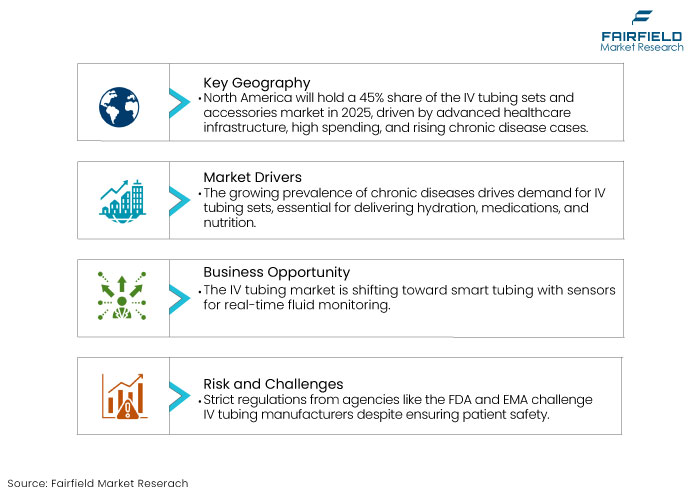
The global rise in chronic diseases is a key driver for the IV tubing sets and accessories market. Conditions such as diabetes, cancer, cardiovascular diseases, and renal disorders often require ongoing intravenous (IV) therapy to administer essential treatments like hydration, medications, or nutritional support.
Increasing incidence of these diseases is closely linked to aging populations and lifestyle factors, such as poor diet, lack of exercise, and increased stress levels. According to the World Health Organization (WHO), chronic diseases are responsible for over 70% of global deaths annually, with cardiovascular diseases alone accounting for 17.9 million deaths per year. Such alarming statistics highlight the critical need for innovative healthcare solutions to manage these conditions effectively.
- Surging Preference for Home Healthcare Owing to High Affordability
Growing preference for home healthcare due to cost efficiency and convenience is a key driver for the IV tubing sets and accessories market. As more patients opt for at-home intravenous therapies, such as hydration, antibiotic administration, or chemotherapy, demand for portable and user-friendly IV tubing systems has surged.
Technological developments that make IV therapy safe and easy to manage outside hospital settings further support this trend. The rise in outpatient care facilities and supportive insurance policies has encouraged the shift toward home-based care.
Key Growth Barriers
- Stringent Regulatory Requirements for IV Tubing Sets
One of the primary restraints for the IV tubing sets and accessories market is the stringent regulatory landscape. Medical devices, including tubing sets, are subject to rigorous standards and approvals from agencies such as the FDA in the U.S. and the EMA in Europe. These regulations are implemented to ensure patient safety. However, these can pose significant challenges for manufacturers.
The lengthy approval processes, coupled with the need for extensive clinical testing, can delay the introduction of new products to the market. The high costs associated with compliance can be a barrier, especially for small-scale companies. These regulatory hurdles may limit innovation and slow market growth as manufacturers must navigate complex requirements before bringing their products to market.
IV Tubing Sets and Accessories Market Trends and Opportunities
- Emergence of Smart Tubing Systems to Obtain Real-time Information
A significant trend in the IV tubing sets and accessories market is the rising adoption of smart tubing systems. Such innovative systems integrate sensors and monitoring technologies into traditional tubing sets, providing real-time data on fluid flow, pressure, and other critical parameters.
The innovation is driven by rising demand for enhanced patient safety and treatment efficacy. Smart tubing systems offer several benefits, including early detection of issues such as blockages or leaks as well as the ability to monitor patient responses accurately. This real-time data enables healthcare providers to make more informed decisions and adjust treatments promptly, improving patient outcomes.
- Launch of Antimicrobial-coated Tubing to Reduce Risks of HAIs
The healthcare industry’s emphasis on reducing Hospital-Acquired Infections (HAIs) and improving patient safety is a transformative opportunity for the IV tubing sets and accessories market. Innovations such as antimicrobial-coated tubing, closed system connectors, and air-eliminating filters address critical infection risks associated with IV therapy. Unique safety features are significant in high-risk environments like Intensive Care Units (ICUs) and oncology wards.
Regulatory mandates and guidelines promoting infection-prevention technologies further drive the adoption of novel IV tubing sets. By prioritizing safety, manufacturers can differentiate their products and cater to the increasing demand for infection-resistant solutions in hospital and homecare settings.
Segments Covered in the Report
- Primary IV Tubing Sets to Lead Amid Enhancements in Product Design
The dominance of primary IV tubing sets is mainly attributed to their key role in several medical operations, constant improvements in product design and materials, and their cost-effectiveness. This segment is estimated to account for 32% of market share in 2025.
The importance of primary IV tubing sets in acute and chronic care settings highlights their importance. In emergency care, these help facilitate the prompt delivery of significant drugs and fluids. In the field of chronic care, these enable the administration of long-term treatments for illnesses such as cancer, in which patients necessitate frequent infusions of chemotherapy medications.
Primary Intravenous (IV) tubing sets are comparatively cost-effective in comparison to specialist IV accessories and complex medical devices. Their cost-effectiveness is a vital consideration, particularly in hospital settings with limited resources.
Hospitals and clinics can get these vital supplies in bulk without incurring substantial financial burden, guaranteeing their availability for a range of medical treatments. Their cost and crucial patient care function are key factors contributing to their significant market share.
- Peripheral Intravenous Catheter Insertion Application to Dominate the Market
The peripheral intravenous catheter insertion segment dominates the market, which is primarily attributed to its extensive utilization across different medical settings, changing catheter design, and growing acceptance of minimally invasive procedures. Progress in technology has resulted in the development of peripheral IV catheters that have been enhanced in terms of their designs and materials, thereby improving patient safety and comfort. Modern catheters are made using biocompatible materials, which effectively decrease the likelihood of phlebitis and other associated issues.
New developments, such as closed-system intravenous catheters equipped with integrated safety characteristics like needleless connectors and anti-reflux valves effectively reduce the likelihood of infections and needle-stick accidents. Becton Dickinson (BD) and Smiths Medical have created innovative peripheral IV catheters with integrated safety features, resulting in improved clinical outcomes and stimulating market growth.
Regional Analysis
- North America Remains Lucrative with Increasing Investments in Healthcare Infrastructure
North America dominates the IV tubing sets and accessories market and is set to hold a 45% share in 2025, driven by its novel healthcare infrastructure and high healthcare expenditure. The region’s significant burden of chronic diseases, including diabetes, cancer, and cardiovascular conditions, has created a rising demand for intravenous therapies.
The aging population, which constitutes a considerable portion of healthcare consumers, further boosts the need for IV tubing systems to administer medications, hydration, and nutritional support. Increasing trend of outpatient care and home-based therapies has also amplified the demand for portable and user-friendly IV tubing solutions.
The region’s stringent regulatory standards prioritize patient safety, augmenting the adoption of high-quality and infection-resistant products. North America remains a lucrative market, with continuous investments in healthcare infrastructure ensuring sustained growth. The U.S. leads the region, followed by Canada, where healthcare accessibility and spending further support market growth.
- Europe Sees Steady Growth with Launch of Closed System Connectors
Europe accounts for a substantial share of the IV tubing sets and accessories market, driven by the region's strong focus on patient safety. Increasing prevalence of chronic diseases, particularly among the aging population, has significantly contributed to the demand for IV therapies.
Europe's stringent regulatory frameworks and healthcare policies emphasize infection prevention and high-quality standards, encouraging the widespread adoption of innovative IV tubing systems with features like antimicrobial coatings and closed system connectors.
The regional market further benefits from extensive healthcare investments and research initiatives across leading countries such as Germany, France, and the U.K. Expansion of home healthcare services and outpatient care facilities has increased the demand for portable and user-friendly IV tubing accessories. These solutions align with Europe's rising focus on cost-efficient and patient-centric care models.
Fairfield’s Competitive Landscape Analysis
The presence of several key players, including global medical device manufacturers and specialized suppliers, characterizes the competitive landscape of the IV tubing sets and accessories market. Leading companies like Medtronic, Baxter International, and B. Braun dominate the market with a broad portfolio of products and extensive distribution networks.
Key players invest heavily in research and development to innovate and enhance product performance, such as developing smart tubing systems and using novel materials. A few other companies are increasingly engaging in strategic partnerships, mergers, and acquisitions to broaden their market presence and leverage complementary strengths, thereby intensifying the competitive dynamics in the industry.
Key Market Companies
- Baxter International Inc.
- Hospira Inc. (Pfizer Inc.)
- Becton, Dickinson Company (CareFusion)
- B. Braun Melsungen AG
- Fresenius Kabi AG
- Smiths Medical
- C.R. Bard, Inc.
- ICU Medical Inc.
- Zyno Medical
- Nipro Corporation
- Poly Medicure Ltd.
- Vygon U.S.A
- Health Line International Corporation
- Perfect Medical Ind. Co., Ltd
- Dynarex Corporation
Global IV Tubing Sets and Accessories Market is Segmented as-
By Product
- Primary IV Tubing Sets
- Secondary IV Tubing Sets
- Extension IV Tubing Sets
By Application
- Peripheral Intravenous Catheter Insertion
- Central Venous Catheter Placement
- PICC Line Insertion
By End Use
- Hospitals
- Clinics
- Ambulatory Surgery Centers
By Region
- North America
- Europe
- Asia Pacific
- Latin America
- The Middle East & Africa
- Executive Summary
- Global IV Tubing Sets and Accessories Market Snapshot
- Future Projections
- Key Market Trends
- Regional Snapshot, by Value, 2026
- Analyst Recommendations
- Market Overview
- Market Definitions and Segmentations
- Market Dynamics
- Drivers
- Restraints
- Market Opportunities
- Value Chain Analysis
- COVID-19 Impact Analysis
- Porter's Five Forces Analysis
- Impact of Russia-Ukraine Conflict
- PESTLE Analysis
- Regulatory Analysis
- Price Trend Analysis
- Current Prices and Future Projections, 2025-2033
- Price Impact Factors
- Global IV Tubing Sets and Accessories Market Outlook, 2020 - 2033
- Global IV Tubing Sets and Accessories Market Outlook, by Product Type, Value (US$ Bn), 2020-2033
- Primary IV Tubing Sets
- Secondary IV Tubing Sets
- Extension IV Tubing Sets
- Global IV Tubing Sets and Accessories Market Outlook, by Application, Value (US$ Bn), 2020-2033
- Peripheral Intravenous Catheter Insertion
- Central Venous Catheter Placement
- PICC Line Insertion
- Global IV Tubing Sets and Accessories Market Outlook, by End Use, Value (US$ Bn), 2020-2033
- Hospitals
- Clinics
- Ambulatory Surgery Centers
- Global IV Tubing Sets and Accessories Market Outlook, by Region, Value (US$ Bn), 2020-2033
- North America
- Europe
- Asia Pacific
- Latin America
- Middle East & Africa
- Global IV Tubing Sets and Accessories Market Outlook, by Product Type, Value (US$ Bn), 2020-2033
- North America IV Tubing Sets and Accessories Market Outlook, 2020 - 2033
- North America IV Tubing Sets and Accessories Market Outlook, by Product Type, Value (US$ Bn), 2020-2033
- Primary IV Tubing Sets
- Secondary IV Tubing Sets
- Extension IV Tubing Sets
- North America IV Tubing Sets and Accessories Market Outlook, by Application, Value (US$ Bn), 2020-2033
- Peripheral Intravenous Catheter Insertion
- Central Venous Catheter Placement
- PICC Line Insertion
- North America IV Tubing Sets and Accessories Market Outlook, by End Use, Value (US$ Bn), 2020-2033
- Hospitals
- Clinics
- Ambulatory Surgery Centers
- North America IV Tubing Sets and Accessories Market Outlook, by Country, Value (US$ Bn), 2020-2033
- U.S. IV Tubing Sets and Accessories Market Outlook, by Product Type, 2020-2033
- U.S. IV Tubing Sets and Accessories Market Outlook, by Application, 2020-2033
- U.S. IV Tubing Sets and Accessories Market Outlook, by End Use, 2020-2033
- Canada IV Tubing Sets and Accessories Market Outlook, by Product Type, 2020-2033
- Canada IV Tubing Sets and Accessories Market Outlook, by Application, 2020-2033
- Canada IV Tubing Sets and Accessories Market Outlook, by End Use, 2020-2033
- BPS Analysis/Market Attractiveness Analysis
- North America IV Tubing Sets and Accessories Market Outlook, by Product Type, Value (US$ Bn), 2020-2033
- Europe IV Tubing Sets and Accessories Market Outlook, 2020 - 2033
- Europe IV Tubing Sets and Accessories Market Outlook, by Product Type, Value (US$ Bn), 2020-2033
- Primary IV Tubing Sets
- Secondary IV Tubing Sets
- Extension IV Tubing Sets
- Europe IV Tubing Sets and Accessories Market Outlook, by Application, Value (US$ Bn), 2020-2033
- Peripheral Intravenous Catheter Insertion
- Central Venous Catheter Placement
- PICC Line Insertion
- Europe IV Tubing Sets and Accessories Market Outlook, by End Use, Value (US$ Bn), 2020-2033
- Hospitals
- Clinics
- Ambulatory Surgery Centers
- Europe IV Tubing Sets and Accessories Market Outlook, by Country, Value (US$ Bn), 2020-2033
- Germany IV Tubing Sets and Accessories Market Outlook, by Product Type, 2020-2033
- Germany IV Tubing Sets and Accessories Market Outlook, by Application, 2020-2033
- Germany IV Tubing Sets and Accessories Market Outlook, by End Use, 2020-2033
- Italy IV Tubing Sets and Accessories Market Outlook, by Product Type, 2020-2033
- Italy IV Tubing Sets and Accessories Market Outlook, by Application, 2020-2033
- Italy IV Tubing Sets and Accessories Market Outlook, by End Use, 2020-2033
- France IV Tubing Sets and Accessories Market Outlook, by Product Type, 2020-2033
- France IV Tubing Sets and Accessories Market Outlook, by Application, 2020-2033
- France IV Tubing Sets and Accessories Market Outlook, by End Use, 2020-2033
- U.K. IV Tubing Sets and Accessories Market Outlook, by Product Type, 2020-2033
- U.K. IV Tubing Sets and Accessories Market Outlook, by Application, 2020-2033
- U.K. IV Tubing Sets and Accessories Market Outlook, by End Use, 2020-2033
- Spain IV Tubing Sets and Accessories Market Outlook, by Product Type, 2020-2033
- Spain IV Tubing Sets and Accessories Market Outlook, by Application, 2020-2033
- Spain IV Tubing Sets and Accessories Market Outlook, by End Use, 2020-2033
- Russia IV Tubing Sets and Accessories Market Outlook, by Product Type, 2020-2033
- Russia IV Tubing Sets and Accessories Market Outlook, by Application, 2020-2033
- Russia IV Tubing Sets and Accessories Market Outlook, by End Use, 2020-2033
- Rest of Europe IV Tubing Sets and Accessories Market Outlook, by Product Type, 2020-2033
- Rest of Europe IV Tubing Sets and Accessories Market Outlook, by Application, 2020-2033
- Rest of Europe IV Tubing Sets and Accessories Market Outlook, by End Use, 2020-2033
- BPS Analysis/Market Attractiveness Analysis
- Europe IV Tubing Sets and Accessories Market Outlook, by Product Type, Value (US$ Bn), 2020-2033
- Asia Pacific IV Tubing Sets and Accessories Market Outlook, 2020 - 2033
- Asia Pacific IV Tubing Sets and Accessories Market Outlook, by Product Type, Value (US$ Bn), 2020-2033
- Primary IV Tubing Sets
- Secondary IV Tubing Sets
- Extension IV Tubing Sets
- Asia Pacific IV Tubing Sets and Accessories Market Outlook, by Application, Value (US$ Bn), 2020-2033
- Peripheral Intravenous Catheter Insertion
- Central Venous Catheter Placement
- PICC Line Insertion
- Asia Pacific IV Tubing Sets and Accessories Market Outlook, by End Use, Value (US$ Bn), 2020-2033
- Hospitals
- Clinics
- Ambulatory Surgery Centers
- Asia Pacific IV Tubing Sets and Accessories Market Outlook, by Country, Value (US$ Bn), 2020-2033
- China IV Tubing Sets and Accessories Market Outlook, by Product Type, 2020-2033
- China IV Tubing Sets and Accessories Market Outlook, by Application, 2020-2033
- China IV Tubing Sets and Accessories Market Outlook, by End Use, 2020-2033
- Japan IV Tubing Sets and Accessories Market Outlook, by Product Type, 2020-2033
- Japan IV Tubing Sets and Accessories Market Outlook, by Application, 2020-2033
- Japan IV Tubing Sets and Accessories Market Outlook, by End Use, 2020-2033
- South Korea IV Tubing Sets and Accessories Market Outlook, by Product Type, 2020-2033
- South Korea IV Tubing Sets and Accessories Market Outlook, by Application, 2020-2033
- South Korea IV Tubing Sets and Accessories Market Outlook, by End Use, 2020-2033
- India IV Tubing Sets and Accessories Market Outlook, by Product Type, 2020-2033
- India IV Tubing Sets and Accessories Market Outlook, by Application, 2020-2033
- India IV Tubing Sets and Accessories Market Outlook, by End Use, 2020-2033
- Southeast Asia IV Tubing Sets and Accessories Market Outlook, by Product Type, 2020-2033
- Southeast Asia IV Tubing Sets and Accessories Market Outlook, by Application, 2020-2033
- Southeast Asia IV Tubing Sets and Accessories Market Outlook, by End Use, 2020-2033
- Rest of SAO IV Tubing Sets and Accessories Market Outlook, by Product Type, 2020-2033
- Rest of SAO IV Tubing Sets and Accessories Market Outlook, by Application, 2020-2033
- Rest of SAO IV Tubing Sets and Accessories Market Outlook, by End Use, 2020-2033
- BPS Analysis/Market Attractiveness Analysis
- Asia Pacific IV Tubing Sets and Accessories Market Outlook, by Product Type, Value (US$ Bn), 2020-2033
- Latin America IV Tubing Sets and Accessories Market Outlook, 2020 - 2033
- Latin America IV Tubing Sets and Accessories Market Outlook, by Product Type, Value (US$ Bn), 2020-2033
- Primary IV Tubing Sets
- Secondary IV Tubing Sets
- Extension IV Tubing Sets
- Latin America IV Tubing Sets and Accessories Market Outlook, by Application, Value (US$ Bn), 2020-2033
- Peripheral Intravenous Catheter Insertion
- Central Venous Catheter Placement
- PICC Line Insertion
- Latin America IV Tubing Sets and Accessories Market Outlook, by End Use, Value (US$ Bn), 2020-2033
- Hospitals
- Clinics
- Ambulatory Surgery Centers
- Latin America IV Tubing Sets and Accessories Market Outlook, by Country, Value (US$ Bn), 2020-2033
- Brazil IV Tubing Sets and Accessories Market Outlook, by Product Type, 2020-2033
- Brazil IV Tubing Sets and Accessories Market Outlook, by Application, 2020-2033
- Brazil IV Tubing Sets and Accessories Market Outlook, by End Use, 2020-2033
- Mexico IV Tubing Sets and Accessories Market Outlook, by Product Type, 2020-2033
- Mexico IV Tubing Sets and Accessories Market Outlook, by Application, 2020-2033
- Mexico IV Tubing Sets and Accessories Market Outlook, by End Use, 2020-2033
- Argentina IV Tubing Sets and Accessories Market Outlook, by Product Type, 2020-2033
- Argentina IV Tubing Sets and Accessories Market Outlook, by Application, 2020-2033
- Argentina IV Tubing Sets and Accessories Market Outlook, by End Use, 2020-2033
- Rest of LATAM IV Tubing Sets and Accessories Market Outlook, by Product Type, 2020-2033
- Rest of LATAM IV Tubing Sets and Accessories Market Outlook, by Application, 2020-2033
- Rest of LATAM IV Tubing Sets and Accessories Market Outlook, by End Use, 2020-2033
- BPS Analysis/Market Attractiveness Analysis
- Latin America IV Tubing Sets and Accessories Market Outlook, by Product Type, Value (US$ Bn), 2020-2033
- Middle East & Africa IV Tubing Sets and Accessories Market Outlook, 2020 - 2033
- Middle East & Africa IV Tubing Sets and Accessories Market Outlook, by Product Type, Value (US$ Bn), 2020-2033
- Primary IV Tubing Sets
- Secondary IV Tubing Sets
- Extension IV Tubing Sets
- Middle East & Africa IV Tubing Sets and Accessories Market Outlook, by Application, Value (US$ Bn), 2020-2033
- Peripheral Intravenous Catheter Insertion
- Central Venous Catheter Placement
- PICC Line Insertion
- Middle East & Africa IV Tubing Sets and Accessories Market Outlook, by End Use, Value (US$ Bn), 2020-2033
- Hospitals
- Clinics
- Ambulatory Surgery Centers
- Middle East & Africa IV Tubing Sets and Accessories Market Outlook, by Country, Value (US$ Bn), 2020-2033
- GCC IV Tubing Sets and Accessories Market Outlook, by Product Type, 2020-2033
- GCC IV Tubing Sets and Accessories Market Outlook, by Application, 2020-2033
- GCC IV Tubing Sets and Accessories Market Outlook, by End Use, 2020-2033
- South Africa IV Tubing Sets and Accessories Market Outlook, by Product Type, 2020-2033
- South Africa IV Tubing Sets and Accessories Market Outlook, by Application, 2020-2033
- South Africa IV Tubing Sets and Accessories Market Outlook, by End Use, 2020-2033
- Egypt IV Tubing Sets and Accessories Market Outlook, by Product Type, 2020-2033
- Egypt IV Tubing Sets and Accessories Market Outlook, by Application, 2020-2033
- Egypt IV Tubing Sets and Accessories Market Outlook, by End Use, 2020-2033
- Nigeria IV Tubing Sets and Accessories Market Outlook, by Product Type, 2020-2033
- Nigeria IV Tubing Sets and Accessories Market Outlook, by Application, 2020-2033
- Nigeria IV Tubing Sets and Accessories Market Outlook, by End Use, 2020-2033
- Rest of Middle East IV Tubing Sets and Accessories Market Outlook, by Product Type, 2020-2033
- Rest of Middle East IV Tubing Sets and Accessories Market Outlook, by Application, 2020-2033
- Rest of Middle East IV Tubing Sets and Accessories Market Outlook, by End Use, 2020-2033
- BPS Analysis/Market Attractiveness Analysis
- Middle East & Africa IV Tubing Sets and Accessories Market Outlook, by Product Type, Value (US$ Bn), 2020-2033
- Competitive Landscape
- Company Vs Segment Heatmap
- Company Market Share Analysis, 2025
- Competitive Dashboard
- Company Profiles
- Baxter International Inc.
- Company Overview
- Product Portfolio
- Financial Overview
- Business Strategies and Developments
- Hospira Inc. (Pfizer Inc.)
- Becton, Dickinson Company (CareFusion)
- Braun Melsungen AG
- Fresenius Kabi AG
- Smiths Medical
- R. Bard, Inc.
- ICU Medical Inc.
- Zyno Medical
- Nipro Corporation
- Baxter International Inc.
- Appendix
- Research Methodology
- Report Assumptions
- Acronyms and Abbreviations
|
BASE YEAR |
HISTORICAL DATA |
FORECAST PERIOD |
UNITS |
|||
 |
2025 |
 |
2020 - 2025 |
 |
2026 - 2033 |
Value: US$ Billion |
|
REPORT FEATURES |
DETAILS |
|
Product Coverage |
|
|
Application Coverage |
|
|
End Use Coverage |
|
|
Geographical Coverage |
|
|
Leading Companies |
|
|
Report Highlights |
Key Market Indicators, Macro-micro economic impact analysis, Technological Roadmap, Key Trends, Driver, Restraints, and Future Opportunities & Revenue Pockets, Porter’s 5 Forces Analysis, Historical Trend (2019-2024), Market Estimates and Forecast, Market Dynamics, Industry Trends, Competition Landscape, Category, Region, Country-wise Trends & Analysis, COVID-19 Impact Analysis (Demand and Supply Chain) |
Our Research Methodology
Considering the volatility of business today, traditional approaches to strategizing a game plan can be unfruitful if not detrimental. True ambiguity is no way to determine a forecast. A myriad of predetermined factors must be accounted for such as the degree of risk involved, the magnitude of circumstances, as well as conditions or consequences that are not known or unpredictable. To circumvent binary views that cast uncertainty, the application of market research intelligence to strategically posture, move, and enable actionable outcomes is necessary.
View Methodology
Quality Assured
Rigorous Validation Process

Confidentiality Assured
End-to-end Data Security

Custom Research Services
Tailored To Your Objectives
FAQs
The industry is set to witness a CAGR of 5% from 2026 to 2036.
North America IV tubing sets and accessories market is set to hold a 45% share in 2025.
Baxter International Inc., Hospira Inc. (Pfizer Inc.), and Becton, Dickinson Company (CareFusion) are a few pivotal contributors.
The market is set to create opportunities due to rising prevalence of cancer and diabetes.
The industry will likely reach a value of USS 1.9 Bn by 2033.
Related Reports
Foot And Ankle Devices Market Insights, Competitive Landscape, and Market Forecast 2033
The foot and ankle devices market will grow from USD 6.40 Bn in 2026 to USD 10.14 Bn by 2033 at a CAGR of 6.8%, driven by rising trauma & sports injuries.
Digital Therapeutics Delivery Devices Market Insights, Competitive Landscape, and Market Forecast 2033
The digital therapeutics delivery devices market will expand at a 15.5% CAGR from USD 2.10 Bn in 2026 to USD 5.76 Bn by 2033, led by wearable devices.
Global Infant Incubator Insights, Competitive Landscape, and Market Forecast 2033
Infant Incubator Market to reach US$1,306.72 Mn by 2033, growing at 5.3% CAGR, driven by preterm births, NICU expansion and transport incubators care.
Pulse Electromagnetic Field Therapy Devices Market Insights, Competitive Landscape, and Market Forecast 2026–2033
Pulse Electromagnetic Field Therapy Devices Market to reach US$930.86 Mn by 2033, driven by pain management and wearable devices.
Vaginal Rejuvenation Market Insights, Competitive Landscape, and Market Forecast 2026–2033
Vaginal Rejuvenation Market to Reach US$26.75 Billion by 2033, Driven by Rising Demand for Minimally Invasive Women's Health Solutions.
Red Light Therapy Market Insights, Competitive Landscape, and Market Forecast 2033
The red light therapy market will grow from US$587.50 Mn in 2026 to US$1,130.38 Mn by 2033 at a 9.8% CAGR, driven by clinical adoption & FDA clearances.