



Ankle Splints Market
Ankle Splints Market Size, Share, Insights, Competitive Landscape, and Forecast 2026 to 2033
Report Overview
Ankle Splints Market Size and Trend Analysis
How Fast Is the Ankle Splints Market Growing?
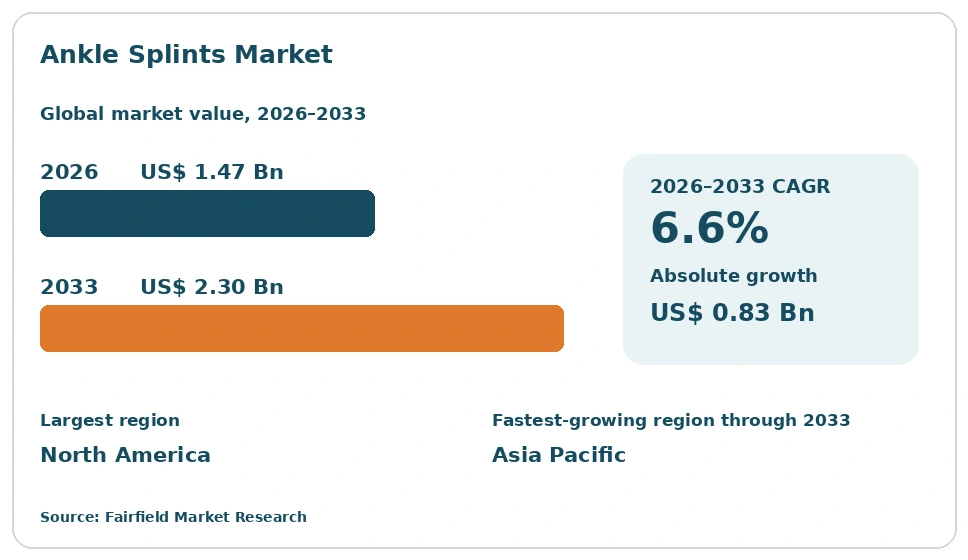
The global ankle splints market size is expected to be valued at US$ 1.47 billion in 2026 and projected to reach US$ 2.30 billion by 2033, growing at a CAGR of 6.6% between 2026 and 2033.
Between 2020 and 2025, the market grew at a CAGR of about 5.7%, rising from roughly US$ 1.05 billion to about US$ 1.39 billion, as sports and fitness activity returned after pandemic lockdowns, orthopedic surgery volumes recovered, and more patients bought supports online and in pharmacies. The ankle splints market covers devices that immobilize, stabilize, or support the ankle after sprains, fractures, ligament tears, tendon injuries, and surgery. Main products include walking boots, also called CAM walkers, lace-up braces, stirrup and pneumatic splints, rigid immobilizers, and night splints. Ankle sprains are among the most common musculoskeletal injuries, and many patients use splints for weeks during recovery. Devices are sold through hospitals, orthopedic clinics, physical therapists, pharmacies, sporting goods stores, and online channels. In July 2025, Össur parent Embla Medical agreed to take a majority stake in Streifeneder, widening its orthotics range.
Key Report Takeaways
- By Product Type: Walking Boots held about 36% share in 2025, while Pneumatic Splints are projected to expand at a 7.2% CAGR through 2033, driven by better swelling control, adjustable air cells, faster recovery, and wider use after sprains and fractures.
- By Application: Ligament Injuries held about 52% share in 2025, while Post-operative Rehabilitation is projected to expand at a 7.3% CAGR through 2033, driven by rising foot and ankle surgery volumes, outpatient procedures, and protocols that use early protected movement.
- By Distribution Channel: Hospitals and Clinics held about 48% share in 2025, while Online Retail is projected to expand at a 9.0% CAGR through 2033, driven by convenient home delivery, lower prices, wide product choice, and growing consumer comfort with buying medical supports online.
- By Region: North America held about 45% share in 2025, while Asia Pacific is projected to expand at a 9.1% CAGR through 2033, driven by rising sports participation, aging populations, expanding orthopedic care, and growing online sales in China and India.
Global Ankle Splints Market Trends and Insights
Drivers Impact Analysis
Two drivers carry the strongest influence on ankle splints market demand during the forecast period.
| Driver | Impact on CAGR Forecast | Geographic Relevance | Impact Timeline |
| High rates of sports and everyday ankle injuries | High | Global | Long term (≥4 years) |
| Aging populations and rising orthopedic surgery volumes | Medium | North America, Europe, Asia Pacific | Medium term (2-4 years) |
Ankle Injuries Are Driving the Ankle Splints Market
High rates of sports and everyday ankle injuries are the strongest driver of the ankle splints market. Ankle sprains happen to millions of people every year.
The mechanism is that ankle sprains are one of the most common injuries treated in emergency rooms, urgent care centers, and sports medicine clinics, and many patients need a brace or boot during healing. Basketball, soccer, volleyball, running, tennis, and other sports involve jumping, cutting, and quick turns that put stress on ankle ligaments. Participation in fitness, recreational sports, and youth leagues keeps growing, and many people who have one sprain go on to have repeat sprains or chronic instability, which leads to long-term brace use. Falls on stairs, uneven ground, and ice also cause many injuries in everyday life. Military training adds demand. These trends create steady, recurring demand for ankle splints worldwide.
Aging and Surgery Volumes Are Expanding the Ankle Splints Market
Aging populations and rising orthopedic surgery volumes are expanding the ankle splints market. Older adults face more fractures and joint problems.
The cause is that the number of people over 65 is rising quickly in North America, Europe, Japan, and China, and older adults have higher rates of falls, ankle fractures, arthritis, and diabetes-related foot problems. Many of these patients need walking boots or splints after injury or surgery. Foot and ankle surgery, including fracture fixation, ligament repair, Achilles tendon repair, ankle fusion, and total ankle replacement, is growing, and more procedures now take place in outpatient surgery centers. After surgery, patients usually wear walking boots or rigid splints for several weeks. Obesity, which increases stress on ankle joints, adds to injury risk. These trends support higher demand for post-operative devices.
Restraints Impact Analysis
Two restraints limit how quickly the ankle splints market grows.
| Restraint | Impact on CAGR Forecast | Geographic Relevance | Impact Timeline |
| Limited reimbursement and pricing pressure | High | North America, Europe | Medium term (2-4 years) |
| Low-cost competition and product quality concerns | Medium | Global | Long term (≥4 years) |
Reimbursement Limits Slow the Ankle Splints Market
Limited reimbursement and pricing pressure slow the ankle splints market. Payers keep a close eye on brace costs.
The problem is that insurers and government programs have tightened payment rules for orthotic devices. In the United States, Medicare and private payers require detailed documentation, and some off-the-shelf braces face competitive bidding or lower payment rates. Many patients face high deductibles and must pay a large part of the cost themselves. Hospitals and clinics negotiate hard with suppliers through group purchasing organizations, which pushes down prices. In Europe, public health systems use tenders that favor low-cost products, and some countries cover only basic devices. Fraud concerns around brace billing have also led to tighter audits. These pressures limit revenue growth for premium devices and slow the adoption of newer designs.
Low-Cost Competition Restricts the Ankle Splints Market
Low-cost competition and product quality concerns restrict the ankle splints market. Many cheap products now compete for buyers.
The constraint is that simple ankle braces, sleeves, and walking boots are easy to copy, and many low-cost manufacturers in China and other countries sell directly through online marketplaces at very low prices. Consumers often choose these products based on price and reviews without professional fitting, which can lead to poor support, discomfort, or delayed healing. This competition pushes established brands to cut prices or invest heavily in marketing and online channels. Trade tariffs and changing supply chains have also raised costs for some companies that use imported materials. Clinicians sometimes worry about patients using the wrong product. These factors squeeze margins and slow growth for premium suppliers in many countries.
Market Opportunities
Smart and Comfortable Designs Open a Fast-Growth Revenue Pool
Smart and comfortable designs open a fast-growth revenue pool. Patients want splints they are willing to wear.
The opportunity comes from strong demand for lighter, breathable, and easier-to-fit splints that improve patient compliance. New walking boots offer adjustable air cells, rocker soles for natural walking, ventilated liners, and quick-fit straps, while new braces use low-profile materials that fit inside shoes. 3D scanning and printing allow custom splints matched to each patient’s ankle, and some companies are exploring sensors that track wear time, load, and range of motion for remote monitoring by physical therapists. Companies such as Enovis are launching new walker boot families for post-operative and post-trauma care. Suppliers that combine comfort, clinical evidence, and digital features can win premium pricing and loyal clinician customers.
Asia Pacific and Online Channels Create a Growth Revenue Pool
Asia Pacific and online channels create a growth revenue pool. More consumers are buying supports directly.
The opportunity reflects rapid growth in sports participation, fitness clubs, and organized youth sports in China, India, Japan, South Korea, and Australia, along with rising healthcare spending and more orthopedic specialists. Aging populations in Japan and China add demand for fracture care. At the same time, e-commerce platforms let patients and athletes buy braces and boots quickly at competitive prices, and companies can sell directly to consumers with fitting guides and virtual support. Pharmacies and sporting goods chains are also expanding their brace sections. Companies that offer affordable product lines, local manufacturing, strong online stores, and partnerships with sports teams can capture strong growth across the region’s large and diverse markets.
Segment Analysis
By Product Type: Walking Boots Lead While Pneumatic Splints Grow Fastest
Walking Boots held about 36% share in 2025. These boots, also called CAM walkers, immobilize the ankle and foot after fractures, severe sprains, Achilles tendon injuries, and surgery while allowing patients to walk. They are widely used in hospitals, emergency rooms, and orthopedic clinics, and their higher prices add to their revenue share.
Pneumatic Splints are the fastest-growing product type, expanding at a 7.2% CAGR through 2033. These splints use air cells that can be inflated to provide adjustable compression, control swelling, and improve comfort, and they are popular for acute sprains. Lace-Up Braces, Rigid Immobilizers, and Other Products, including night splints and sleeves, form further segments. For the market, pneumatic growth supports higher-value product sales.
By Application: Ligament Injuries Lead While Post-operative Rehabilitation Grows Fastest
Ligament Injuries held about 52% share in 2025. Ankle sprains, which stretch or tear ligaments, are the most common reason for using an ankle splint, from mild sprains treated with lace-up braces to severe sprains that need walking boots. Athletes also use braces to prevent repeat injuries, and many sports teams, schools, and military units require ankle bracing during training and competition.
Post-operative Rehabilitation is the fastest-growing application, expanding at a 7.3% CAGR through 2033. Patients recovering from fracture repair, ligament reconstruction, Achilles tendon repair, and ankle replacement wear boots and splints for weeks, and more procedures now take place in outpatient centers that dispense devices directly. Chronic Ankle Instability and Fractures form further segments. For the market, surgical growth adds steady demand.
By Distribution Channel: Hospitals and Clinics Lead While Online Retail Grows Fastest
Hospitals and Clinics held about 48% share in 2025. Emergency rooms, orthopedic clinics, sports medicine centers, and outpatient surgery centers fit and dispense most walking boots and rigid splints, often billing insurers directly. Clinicians strongly influence which brands patients use, and many practices keep stock on hand so patients can leave with a fitted device on the same day. Group purchasing contracts also shape which suppliers hospitals choose.
Online Retail is the fastest-growing channel, expanding at a 9.0% CAGR through 2033. Consumers buy braces, sleeves, and boots through online marketplaces and brand websites for convenience and lower prices. Retail Pharmacies and Sporting Goods Stores form further channels. For the market, online growth widens access but increases price competition, pushing established brands to build their own online stores, offer fitting videos, and work with large marketplaces to protect their share.
Geography Analysis
Which Region Is Leading the Ankle Splints Market?
North America is leading the ankle splints market with about 45% share in 2025. The United States has very high sports participation, large numbers of emergency visits for ankle sprains, a big network of orthopedic and sports medicine clinics, and growing foot and ankle surgery volumes in outpatient centers. Enovis, Breg, Aspen Medical Products, and Mueller Sports Medicine are based in the region. Canada adds demand through public health coverage and active populations. Key barriers include tighter reimbursement and price pressure. One change shaping the region is consolidation among bracing suppliers, as larger companies buy smaller brands to widen their product ranges.
Europe Shapes the Ankle Splints Market Through Strong Orthopedic Care
Europe is a major ankle splints market, holding about 27% share in 2025. Germany, France, the United Kingdom, Italy, and Spain have large orthopedic care sectors and strong sports cultures, especially soccer. Companies such as Bauerfeind, Ottobock, medi, and Thuasne are based in the region, and Össur is expanding in Germany. Public health systems cover many devices, and aging populations add fracture care demand. Key barriers include tender-based price pressure. One opportunity is premium braces sold through pharmacies and medical supply stores, supported by doctor recommendations and strong brand recognition.
Which Region Is Growing Fastest in the Ankle Splints Market?
Asia Pacific is the fastest-growing ankle splints market, expanding at a 9.1% CAGR through 2033. China and India have large populations, rising sports participation, and expanding orthopedic hospitals, while Japan has one of the oldest populations in the world. South Korea and Australia have strong sports medicine sectors. Zamst, a Japan-based brand, is popular with athletes in the region. E-commerce platforms are driving fast growth in consumer braces. Key barriers include low-cost competition and limited reimbursement. One change shaping the region is fast online sales growth, with large marketplaces in China and India reaching smaller cities.
Latin America Grows the Ankle Splints Market Through Sports and Trauma Care
Latin America is a growing ankle splints market. Brazil and Mexico lead demand, supported by popular sports such as soccer, large urban populations, and expanding private hospitals and orthopedic clinics. Argentina, Colombia, and Chile add demand as healthcare access improves and more patients receive fracture and sprain care. Breg has manufacturing operations in Mexico. Key barriers include out-of-pocket costs, currency swings, and limited insurance coverage. One opportunity is affordable splints sold through pharmacy chains and online platforms, supported by local distributors and training for clinicians. Growing fitness club membership adds demand for sports braces across the region.
Middle East & Africa Builds the Ankle Splints Market Through Hospital Investment
Middle East & Africa is an emerging ankle splints market. Saudi Arabia, the United Arab Emirates, and Qatar are investing in new hospitals, sports medicine centers, and major sports events, which raises demand for orthopedic devices. Israel has an advanced orthopedic care sector. South Africa, Egypt, and Nigeria show rising demand as urban populations grow and road traffic injuries remain common. Key barriers include limited reimbursement and reliance on imports. One opportunity is partnerships with private hospital groups and sports clubs, supported by government investment in healthcare and growing sports participation among young people across the region.
Competitive Landscape
The ankle splints market is moderately consolidated. Enovis, Össur, Bauerfeind, Ottobock, and Breg are leading players, while Thuasne, medi, DeRoyal Industries, Aspen Medical Products, Mueller Sports Medicine, Zamst, and Essity compete strongly. Large orthopedic companies offer full ranges of walking boots, braces, and splints alongside knee, spine, and upper limb supports, while sports brands focus on athletic braces sold through retail and online channels. Many low-cost suppliers sell simple braces and boots through online marketplaces.
Companies compete on clinical performance, comfort, ease of fitting, durability, product range, price, reimbursement codes, and relationships with orthopedic surgeons, emergency departments, physical therapists, and athletic trainers. Large suppliers win contracts with hospital systems and group purchasing organizations, and many run in-office dispensing programs for orthopedic practices. Brand strength and sports team partnerships matter in consumer channels.
Strategic moves show how competition is changing. In January 2025, Aspen Medical Products acquired Advanced Orthopaedics, and Mueller Sports Medicine acquired Pro Orthopedic Devices, adding bracing products. In July 2025, Embla Medical, parent of Össur, agreed to take a majority stake in Streifeneder ortho.production in Germany. Enovis has also launched new walker boot families for foot and ankle recovery.
Three themes shape vendor strategy. First, companies are consolidating to build broader bracing portfolios and reach. Second, they are developing lighter, more comfortable, and custom-fit designs that improve compliance. Third, they are expanding online sales and growing in Asia Pacific, Latin America, and Middle East & Africa.
Ankle Splints Market Industry Leaders
- Enovis
- Össur
- Bauerfeind
- Ottobock
- Breg
Recent Industry Developments
- July 2025: Embla Medical, parent of Össur, agreed to take a majority stake in Streifeneder ortho.production, a German orthopedic mobility supplier - broadens its orthotics range and strengthens its position in Germany.
- January 2025: Aspen Medical Products acquired Advanced Orthopaedics, a supplier of bracing solutions and orthopedic soft goods - expands its reach in the bracing and supports segment of the ankle splints market.
- January 2025: Mueller Sports Medicine acquired Pro Orthopedic Devices, a maker of orthopedic supports and braces - adds to its sports bracing portfolio in North America.
Companies Covered in the Report
- Enovis
- Össur
- Bauerfeind
- Ottobock
- Breg
- Thuasne
- medi
- DeRoyal Industries
- Aspen Medical Products
- Mueller Sports Medicine
- Zamst
- Essity
Ankle Splints Market Report Scope
This report covers the ankle splints market, including walking boots, pneumatic splints, lace-up braces, rigid immobilizers, and other products, used for ligament injuries, post-operative rehabilitation, chronic ankle instability, and fractures, sold through hospitals and clinics, online retail, retail pharmacies, and sporting goods stores. The base year is 2025, and the forecast period runs from 2026 to 2033. All values are expressed in US$ Billion.
| Product Type | Walking Boots, Pneumatic Splints, Lace-Up Braces, Rigid Immobilizers, Other Products |
| Application | Ligament Injuries, Post-operative Rehabilitation, Chronic Ankle Instability, Fractures |
| Distribution Channel | Hospitals and Clinics, Online Retail, Retail Pharmacies, Sporting Goods Stores |
| Regions | North America, Europe, Asia Pacific, Latin America, Middle East & Africa |
1. Executive Summary
1.1 Ankle Splints Market Snapshot
1.2 Future Projections
1.3 Key Market Trends
1.4 Regional Snapshot
2. Market Overview
2.1 Market Definition and Report Scope
2.2 Historical Market Trends
2.3 Market Dynamics
2.3.1 Drivers
2.3.1.1 Ankle Injuries Are Driving the Ankle Splints Market
2.3.1.2 Aging and Surgery Volumes Are Expanding the Ankle Splints Market
2.3.2 Restraints
2.3.2.1 Reimbursement Limits Slow the Ankle Splints Market
2.3.2.2 Low-Cost Competition Restricts the Ankle Splints Market
2.3.3 Market Opportunities
2.3.3.1 Smart and Comfortable Designs Open a Fast-Growth Revenue Pool
2.3.3.2 Asia Pacific and Online Channels Create a Growth Revenue Pool
3. Global Ankle Splints Market Outlook, 2020–2033
3.1 Global Ankle Splints Market Outlook, by Product Type, Value (US$ Billion), 2020–2033
3.1.1 Walking Boots
3.1.2 Pneumatic Splints
3.1.3 Lace-Up Braces
3.1.4 Rigid Immobilizers
3.1.5 Other Products
3.2 Global Ankle Splints Market Outlook, by Application, Value (US$ Billion), 2020–2033
3.2.1 Ligament Injuries
3.2.2 Post-operative Rehabilitation
3.2.3 Chronic Ankle Instability
3.2.4 Fractures
3.3 Global Ankle Splints Market Outlook, by Distribution Channel, Value (US$ Billion), 2020–2033
3.3.1 Hospitals and Clinics
3.3.2 Online Retail
3.3.3 Retail Pharmacies
3.3.4 Sporting Goods Stores
3.4 Global Ankle Splints Market Outlook, by Region, Value (US$ Billion), 2020–2033
3.4.1 North America
3.4.2 Europe
3.4.3 Asia Pacific
3.4.4 Latin America
3.4.5 Middle East & Africa
4. North America Ankle Splints Market Outlook, 2020–2033
4.1 North America Ankle Splints Market Outlook, by Product Type, Value (US$ Billion), 2020–2033
4.1.1 Walking Boots
4.1.2 Pneumatic Splints
4.1.3 Lace-Up Braces
4.1.4 Rigid Immobilizers
4.1.5 Other Products
4.2 North America Ankle Splints Market Outlook, by Application, Value (US$ Billion), 2020–2033
4.2.1 Ligament Injuries
4.2.2 Post-operative Rehabilitation
4.2.3 Chronic Ankle Instability
4.2.4 Fractures
4.3 North America Ankle Splints Market Outlook, by Distribution Channel, Value (US$ Billion), 2020–2033
4.3.1 Hospitals and Clinics
4.3.2 Online Retail
4.3.3 Retail Pharmacies
4.3.4 Sporting Goods Stores
4.4 North America Ankle Splints Market Outlook, by Country, Value (US$ Billion), 2020–2033
4.4.1 United States Ankle Splints Market Outlook, by Product Type, 2020–2033
4.4.2 United States Ankle Splints Market Outlook, by Application, 2020–2033
4.4.3 United States Ankle Splints Market Outlook, by Distribution Channel, 2020–2033
4.4.4 Canada Ankle Splints Market Outlook, by Product Type, 2020–2033
4.4.5 Canada Ankle Splints Market Outlook, by Application, 2020–2033
4.4.6 Canada Ankle Splints Market Outlook, by Distribution Channel, 2020–2033
5. Europe Ankle Splints Market Outlook, 2020–2033
5.1 Europe Ankle Splints Market Outlook, by Product Type, Value (US$ Billion), 2020–2033
5.1.1 Walking Boots
5.1.2 Pneumatic Splints
5.1.3 Lace-Up Braces
5.1.4 Rigid Immobilizers
5.1.5 Other Products
5.2 Europe Ankle Splints Market Outlook, by Application, Value (US$ Billion), 2020–2033
5.2.1 Ligament Injuries
5.2.2 Post-operative Rehabilitation
5.2.3 Chronic Ankle Instability
5.2.4 Fractures
5.3 Europe Ankle Splints Market Outlook, by Distribution Channel, Value (US$ Billion), 2020–2033
5.3.1 Hospitals and Clinics
5.3.2 Online Retail
5.3.3 Retail Pharmacies
5.3.4 Sporting Goods Stores
5.4 Europe Ankle Splints Market Outlook, by Country, Value (US$ Billion), 2020–2033
5.4.1 Germany Ankle Splints Market Outlook, by Product Type, 2020–2033
5.4.2 Germany Ankle Splints Market Outlook, by Application, 2020–2033
5.4.3 Germany Ankle Splints Market Outlook, by Distribution Channel, 2020–2033
5.4.4 France Ankle Splints Market Outlook, by Product Type, 2020–2033
5.4.5 France Ankle Splints Market Outlook, by Application, 2020–2033
5.4.6 France Ankle Splints Market Outlook, by Distribution Channel, 2020–2033
5.4.7 United Kingdom Ankle Splints Market Outlook, by Product Type, 2020–2033
5.4.8 United Kingdom Ankle Splints Market Outlook, by Application, 2020–2033
5.4.9 United Kingdom Ankle Splints Market Outlook, by Distribution Channel, 2020–2033
5.4.10 Italy Ankle Splints Market Outlook, by Product Type, 2020–2033
5.4.11 Italy Ankle Splints Market Outlook, by Application, 2020–2033
5.4.12 Italy Ankle Splints Market Outlook, by Distribution Channel, 2020–2033
5.4.13 Spain Ankle Splints Market Outlook, by Product Type, 2020–2033
5.4.14 Spain Ankle Splints Market Outlook, by Application, 2020–2033
5.4.15 Spain Ankle Splints Market Outlook, by Distribution Channel, 2020–2033
6. Asia Pacific Ankle Splints Market Outlook, 2020–2033
6.1 Asia Pacific Ankle Splints Market Outlook, by Product Type, Value (US$ Billion), 2020–2033
6.1.1 Walking Boots
6.1.2 Pneumatic Splints
6.1.3 Lace-Up Braces
6.1.4 Rigid Immobilizers
6.1.5 Other Products
6.2 Asia Pacific Ankle Splints Market Outlook, by Application, Value (US$ Billion), 2020–2033
6.2.1 Ligament Injuries
6.2.2 Post-operative Rehabilitation
6.2.3 Chronic Ankle Instability
6.2.4 Fractures
6.3 Asia Pacific Ankle Splints Market Outlook, by Distribution Channel, Value (US$ Billion), 2020–2033
6.3.1 Hospitals and Clinics
6.3.2 Online Retail
6.3.3 Retail Pharmacies
6.3.4 Sporting Goods Stores
6.4 Asia Pacific Ankle Splints Market Outlook, by Country, Value (US$ Billion), 2020–2033
6.4.1 China Ankle Splints Market Outlook, by Product Type, 2020–2033
6.4.2 China Ankle Splints Market Outlook, by Application, 2020–2033
6.4.3 China Ankle Splints Market Outlook, by Distribution Channel, 2020–2033
6.4.4 India Ankle Splints Market Outlook, by Product Type, 2020–2033
6.4.5 India Ankle Splints Market Outlook, by Application, 2020–2033
6.4.6 India Ankle Splints Market Outlook, by Distribution Channel, 2020–2033
6.4.7 Japan Ankle Splints Market Outlook, by Product Type, 2020–2033
6.4.8 Japan Ankle Splints Market Outlook, by Application, 2020–2033
6.4.9 Japan Ankle Splints Market Outlook, by Distribution Channel, 2020–2033
6.4.10 South Korea Ankle Splints Market Outlook, by Product Type, 2020–2033
6.4.11 South Korea Ankle Splints Market Outlook, by Application, 2020–2033
6.4.12 South Korea Ankle Splints Market Outlook, by Distribution Channel, 2020–2033
6.4.13 Australia Ankle Splints Market Outlook, by Product Type, 2020–2033
6.4.14 Australia Ankle Splints Market Outlook, by Application, 2020–2033
6.4.15 Australia Ankle Splints Market Outlook, by Distribution Channel, 2020–2033
7. Latin America Ankle Splints Market Outlook, 2020–2033
7.1 Latin America Ankle Splints Market Outlook, by Product Type, Value (US$ Billion), 2020–2033
7.1.1 Walking Boots
7.1.2 Pneumatic Splints
7.1.3 Lace-Up Braces
7.1.4 Rigid Immobilizers
7.1.5 Other Products
7.2 Latin America Ankle Splints Market Outlook, by Application, Value (US$ Billion), 2020–2033
7.2.1 Ligament Injuries
7.2.2 Post-operative Rehabilitation
7.2.3 Chronic Ankle Instability
7.2.4 Fractures
7.3 Latin America Ankle Splints Market Outlook, by Distribution Channel, Value (US$ Billion), 2020–2033
7.3.1 Hospitals and Clinics
7.3.2 Online Retail
7.3.3 Retail Pharmacies
7.3.4 Sporting Goods Stores
7.4 Latin America Ankle Splints Market Outlook, by Country, Value (US$ Billion), 2020–2033
7.4.1 Brazil Ankle Splints Market Outlook, by Product Type, 2020–2033
7.4.2 Brazil Ankle Splints Market Outlook, by Application, 2020–2033
7.4.3 Brazil Ankle Splints Market Outlook, by Distribution Channel, 2020–2033
7.4.4 Mexico Ankle Splints Market Outlook, by Product Type, 2020–2033
7.4.5 Mexico Ankle Splints Market Outlook, by Application, 2020–2033
7.4.6 Mexico Ankle Splints Market Outlook, by Distribution Channel, 2020–2033
7.4.7 Argentina Ankle Splints Market Outlook, by Product Type, 2020–2033
7.4.8 Argentina Ankle Splints Market Outlook, by Application, 2020–2033
7.4.9 Argentina Ankle Splints Market Outlook, by Distribution Channel, 2020–2033
7.4.10 Colombia Ankle Splints Market Outlook, by Product Type, 2020–2033
7.4.11 Colombia Ankle Splints Market Outlook, by Application, 2020–2033
7.4.12 Colombia Ankle Splints Market Outlook, by Distribution Channel, 2020–2033
7.4.13 Chile Ankle Splints Market Outlook, by Product Type, 2020–2033
7.4.14 Chile Ankle Splints Market Outlook, by Application, 2020–2033
7.4.15 Chile Ankle Splints Market Outlook, by Distribution Channel, 2020–2033
8. Middle East & Africa Ankle Splints Market Outlook, 2020–2033
8.1 Middle East & Africa Ankle Splints Market Outlook, by Product Type, Value (US$ Billion), 2020–2033
8.1.1 Walking Boots
8.1.2 Pneumatic Splints
8.1.3 Lace-Up Braces
8.1.4 Rigid Immobilizers
8.1.5 Other Products
8.2 Middle East & Africa Ankle Splints Market Outlook, by Application, Value (US$ Billion), 2020–2033
8.2.1 Ligament Injuries
8.2.2 Post-operative Rehabilitation
8.2.3 Chronic Ankle Instability
8.2.4 Fractures
8.3 Middle East & Africa Ankle Splints Market Outlook, by Distribution Channel, Value (US$ Billion), 2020–2033
8.3.1 Hospitals and Clinics
8.3.2 Online Retail
8.3.3 Retail Pharmacies
8.3.4 Sporting Goods Stores
8.4 Middle East & Africa Ankle Splints Market Outlook, by Country, Value (US$ Billion), 2020–2033
8.4.1 Saudi Arabia Ankle Splints Market Outlook, by Product Type, 2020–2033
8.4.2 Saudi Arabia Ankle Splints Market Outlook, by Application, 2020–2033
8.4.3 Saudi Arabia Ankle Splints Market Outlook, by Distribution Channel, 2020–2033
8.4.4 United Arab Emirates Ankle Splints Market Outlook, by Product Type, 2020–2033
8.4.5 United Arab Emirates Ankle Splints Market Outlook, by Application, 2020–2033
8.4.6 United Arab Emirates Ankle Splints Market Outlook, by Distribution Channel, 2020–2033
8.4.7 Qatar Ankle Splints Market Outlook, by Product Type, 2020–2033
8.4.8 Qatar Ankle Splints Market Outlook, by Application, 2020–2033
8.4.9 Qatar Ankle Splints Market Outlook, by Distribution Channel, 2020–2033
8.4.10 Israel Ankle Splints Market Outlook, by Product Type, 2020–2033
8.4.11 Israel Ankle Splints Market Outlook, by Application, 2020–2033
8.4.12 Israel Ankle Splints Market Outlook, by Distribution Channel, 2020–2033
8.4.13 South Africa Ankle Splints Market Outlook, by Product Type, 2020–2033
8.4.14 South Africa Ankle Splints Market Outlook, by Application, 2020–2033
8.4.15 South Africa Ankle Splints Market Outlook, by Distribution Channel, 2020–2033
8.4.16 Egypt Ankle Splints Market Outlook, by Product Type, 2020–2033
8.4.17 Egypt Ankle Splints Market Outlook, by Application, 2020–2033
8.4.18 Egypt Ankle Splints Market Outlook, by Distribution Channel, 2020–2033
8.4.19 Nigeria Ankle Splints Market Outlook, by Product Type, 2020–2033
8.4.20 Nigeria Ankle Splints Market Outlook, by Application, 2020–2033
8.4.21 Nigeria Ankle Splints Market Outlook, by Distribution Channel, 2020–2033
9. Competitive Landscape
9.1 Ankle Splints Market Industry Leaders
9.2 Recent Industry Developments
9.3 Company Profiles
9.3.1 Enovis
9.3.2 Össur
9.3.3 Bauerfeind
9.3.4 Ottobock
9.3.5 Breg
9.3.6 Thuasne
9.3.7 medi
9.3.8 DeRoyal Industries
9.3.9 Aspen Medical Products
9.3.10 Mueller Sports Medicine
9.3.11 Zamst
9.3.12 Essity
10. Appendix
10.1 Research Methodology
10.2 Report Assumptions
10.3 Acronyms and Abbreviations
| Product Type | Walking Boots, Pneumatic Splints, Lace-Up Braces, Rigid Immobilizers, Other Products |
| Application | Ligament Injuries, Post-operative Rehabilitation, Chronic Ankle Instability, Fractures |
| Distribution Channel | Hospitals and Clinics, Online Retail, Retail Pharmacies, Sporting Goods Stores |
| Regions | North America, Europe, Asia Pacific, Latin America, Middle East & Africa |
Our Research Methodology
Considering the volatility of business today, traditional approaches to strategizing a game plan can be unfruitful if not detrimental. True ambiguity is no way to determine a forecast. A myriad of predetermined factors must be accounted for such as the degree of risk involved, the magnitude of circumstances, as well as conditions or consequences that are not known or unpredictable. To circumvent binary views that cast uncertainty, the application of market research intelligence to strategically posture, move, and enable actionable outcomes is necessary.
View Methodology
Quality Assured
Rigorous Validation Process

Confidentiality Assured
End-to-end Data Security

Custom Research Services
Tailored To Your Objectives
FAQs
The market is valued at US$ 1.47 billion in 2026, led by walking boots, ligament injury treatment, and North America.
The market is projected to reach US$ 2.30 billion by 2033, growing at a 6.6% CAGR and adding US$ 0.83 billion.
Online Retail is growing fastest at a 9.0% CAGR through 2033, driven by convenience, lower prices, and wide product choice.
Asia Pacific is growing fastest at a 9.1% CAGR through 2033, driven by rising sports participation and expanding orthopedic care.
North America holds the largest share at about 45% in 2025, supported by high sports participation and strong orthopedic care.
Related Reports
ACL Reconstruction Market Size, Share, Insights, Competitive Landscape, and Forecast 2026 to 2033
Explore the ACL reconstruction market, forecast to reach US$14.04 billion by 2033 at 6.9% CAGR, with insights on grafts, fixation, end users, and regions.
Stroke Diagnostics and Therapeutics Market Size, Share, Insights, Competitive Landscape, and Forecast 2026 to 2033
Explore the stroke diagnostics and therapeutics market, forecast to reach US$81.70 billion by 2033 at 7.9% CAGR, with insights on types and regions.
IoT Medical Devices Market Size, Share, Insights, Competitive Landscape, and Forecast 2026 to 2033
Explore the IoT medical devices market, forecast to reach US$259.93 billion by 2033 at 18.9% CAGR, with insights on products, connectivity, and regions.
Prostate Specific Antigen Testing Market Size, Share, Insights, Competitive Landscape, and Forecast 2026 to 2033
Explore the prostate specific antigen testing market outlook for 2026–2033, covering test types, applications, end users, regions, and key companies.
Cryopreservation Bags and Freezing Bags Market Size, Share, Insights, Competitive Landscape, and Forecast 2026 to 2033
The global cryopreservation bags and freezing bags market is valued at US$292 million in 2026, reaching US$599 million by 2033, growing at a 10.8% CAGR
Orthopedic Oncology Market Size, Share, Insights, Competitive Landscape, and Forecast 2026 to 2033
Explore the orthopedic oncology market outlook for 2026–2033, including reconstruction devices, surgical trends, regions, and competitive insights.