



IoT Medical Devices Market
IoT Medical Devices Market Size, Share, Insights, Competitive Landscape, and Forecast 2026 to 2033
Report Overview
IoT Medical Devices Market Size and Trend Analysis
How Fast Is the IoT Medical Devices Market Growing?
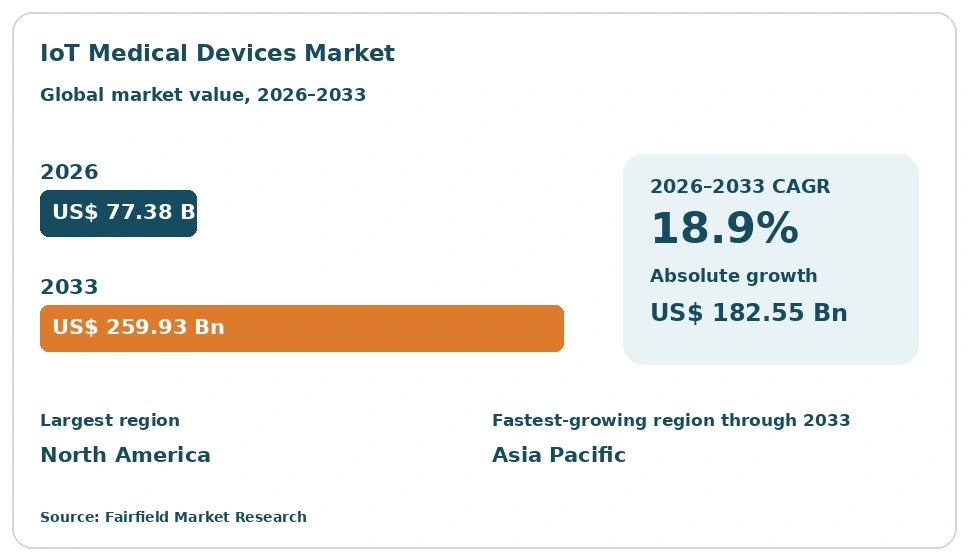
The global IoT medical devices market size is expected to be valued at US$ 77.38 billion in 2026 and projected to reach US$ 259.93 billion by 2033, growing at a CAGR of 18.9% between 2026 and 2033.
Between 2020 and 2025, the market grew at a CAGR of about 19.2%, rising from roughly US$ 27 billion to US$ 65.08 billion, as the pandemic pushed hospitals and patients toward remote monitoring, governments expanded payment for virtual care, and wearable sensors, smartphones, and cloud platforms became cheaper and more reliable. The IoT medical devices market covers connected medical devices that collect and share health data over networks such as Bluetooth, Wi-Fi, and cellular, including continuous glucose monitors, wearable heart and blood pressure monitors, connected inhalers, smart infusion pumps, implantable cardiac devices with remote monitoring, connected imaging systems, and hospital patient monitors. Data flows to clinicians, apps, and health records, allowing earlier action and fewer hospital visits. Artificial intelligence turns this data into alerts and insights. In September 2026, Biolinq received FDA clearance for over-the-counter sale of its needle-free glucose monitor.
Key Report Takeaways
- By Product: Wearable External Medical Devices held about 40% share in 2025, while Implantable Medical Devices are projected to expand at a 20.8% CAGR through 2033, driven by remotely monitored pacemakers, defibrillators, neurostimulators, and implantable cardiac monitors that send data automatically to care teams.
- By Connectivity: Bluetooth held about 36% share in 2025, while Cellular is projected to expand at a 22.0% CAGR through 2033, driven by 5G networks and devices that send data directly to the cloud without needing a smartphone.
- By End User: Hospitals and Clinics held about 48% share in 2025, while Home Care Settings are projected to expand at a 22.4% CAGR through 2033, driven by remote patient monitoring programs, aging populations, and hospital-at-home models.
- By Region: North America held about 41% share in 2025, while Asia Pacific is projected to expand at a 21.5% CAGR through 2033, driven by digital health programs, large chronic disease populations, and fast smartphone adoption in China, India, and Japan.
Global IoT Medical Devices Market Trends and Insights
Drivers Impact Analysis
Two drivers carry the strongest influence on IoT medical devices market demand during the forecast period.
| Driver | Impact on CAGR Forecast | Geographic Relevance | Impact Timeline |
| Chronic disease and remote patient monitoring | High | Global | Long term (≥4 years) |
| Wearable sensors, 5G, and artificial intelligence | High | North America, Asia Pacific, Europe | Medium term (2-4 years) |
Remote Monitoring Is Driving the IoT Medical Devices Market
Chronic disease and remote patient monitoring are the strongest driver of the IoT medical devices market. Health systems want to manage patients at home.
The mechanism is the large and growing number of people with diabetes, heart failure, high blood pressure, lung disease, and other long-term conditions. These patients need regular checks, and connected devices let doctors and nurses track glucose, heart rhythm, blood pressure, oxygen levels, and weight without frequent clinic visits. Payers in the United States reimburse remote patient monitoring and chronic care management, and many countries in Europe and Asia Pacific are funding virtual care. Hospital-at-home programs use connected monitors to treat patients outside hospitals, freeing beds and reducing costs. Aging populations add more patients each year. These trends support strong long-term demand for connected devices and data services.
Wearables and 5G Are Expanding the IoT Medical Devices Market
Wearable sensors, 5G networks, and artificial intelligence are expanding the IoT medical devices market. Technology is making connected care easier and cheaper.
The cause is fast improvement in sensors, batteries, wireless chips, and software. Small wearable patches can track heart rhythm, temperature, and movement for days, while continuous glucose monitors such as Dexcom’s Stelo and Abbott’s Lingo are now sold over the counter. Biolinq won clearance for a needle-free monitor in 2026. 5G and low-power cellular networks let devices send data directly to the cloud from almost anywhere. Artificial intelligence analyzes large data streams to spot problems early, such as heart rhythm changes or lung disease flare-ups. Smartphones and smartwatches act as hubs for many devices. These advances lower costs, improve accuracy, and widen the number of patients and consumers using connected devices.
Restraints Impact Analysis
Two restraints limit how quickly the IoT medical devices market grows.
| Restraint | Impact on CAGR Forecast | Geographic Relevance | Impact Timeline |
| Cybersecurity and data privacy risks | High | Global | Long term (≥4 years) |
| Interoperability and reimbursement gaps | Medium | Europe, Asia Pacific, Latin America | Medium term (2-4 years) |
Cybersecurity Risks Slow the IoT Medical Devices Market
Cybersecurity and data privacy risks slow the IoT medical devices market. Connected devices can be targets for hackers.
The problem is that every connected device creates a possible entry point into hospital networks or patient data. Ransomware attacks on hospitals have disrupted care in many countries, and security researchers have found weaknesses in insulin pumps, pacemakers, and infusion pumps. Regulators now require stronger protection, with the FDA demanding cybersecurity plans, software bills of materials, and update processes for new devices, and the European Union adding cybersecurity rules. Privacy laws such as HIPAA and GDPR limit how health data can be shared and stored. Meeting these rules adds cost and slows product launches, while hospitals may hesitate to connect older devices. Insurance costs for cyber risks are also rising for hospitals. These concerns limit adoption speed.
Interoperability Gaps Restrict the IoT Medical Devices Market
Interoperability and reimbursement gaps restrict the IoT medical devices market. Many devices do not work well together.
The constraint is that devices from different makers often use different data formats and platforms, so hospitals struggle to bring all data into one health record or dashboard. Clinicians can face too many alerts and too much data without clear workflows to act on it. Integrating devices with hospital systems takes time and money. In many countries outside North America, there is no clear payment for remote monitoring, so hospitals must fund programs themselves. Patients may also struggle with technology, especially older adults, and some areas lack reliable internet. Device batteries, connectivity problems, and patient drop-out reduce data quality. Small clinics often lack staff to review incoming data. These issues slow large-scale rollout.
Market Opportunities
Hospital-at-Home and Chronic Care Platforms Open a Fast-Growth Revenue Pool
Hospital-at-home and chronic care platforms open a fast-growth revenue pool. Health systems want to treat more patients outside hospitals.
The opportunity comes from programs that use connected monitors, tablets, and nurse teams to care for patients with heart failure, lung disease, infections, and post-surgery recovery at home. These programs can cut costs and readmissions while improving patient satisfaction. Companies are combining devices with software and clinical services, as shown by Withings buying respiratory monitoring firm Biosency and ChartSpan buying data platform Validic in 2026. Subscription and per-patient pricing create recurring revenue. Remote monitoring nurses and call centers are often part of these programs. Companies that offer complete solutions including devices, data platforms, artificial intelligence alerts, and care team support can win long-term contracts with hospitals, insurers, and governments.
Consumer Health and Emerging Markets Create a Growth Revenue Pool
Consumer health devices and emerging markets create a growth revenue pool. Many people want to track their own health.
The opportunity reflects strong demand for over-the-counter glucose monitors, smart blood pressure cuffs, smart rings, ECG-enabled watches, and connected scales among people without serious illness who want to prevent disease. At the same time, China, India, Indonesia, Brazil, and Saudi Arabia are building national digital health systems and expanding telemedicine to reach rural patients. Low-cost connected devices linked to smartphones can extend care where doctors are scarce. Employers and insurers also offer devices to members to prevent costly disease. Companies that offer affordable, easy-to-use devices with local language apps and partnerships with insurers and telecom operators can capture large new user groups.
Segment Analysis
By Product: Wearable External Medical Devices Lead While Implantable Medical Devices Grow Fastest
Wearable External Medical Devices held about 40% share in 2025. They include continuous glucose monitors, heart rhythm patches, blood pressure monitors, pulse oximeters, smart inhalers, and fitness and health trackers with medical features. Ease of use, falling prices, and over-the-counter availability make wearables the largest product group.
Implantable Medical Devices are the fastest-growing product, expanding at a 20.8% CAGR through 2033. Pacemakers, defibrillators, neurostimulators, insulin pumps, and implantable heart monitors now send data automatically to clinicians, allowing early detection of problems. Stationary Medical Devices, such as connected imaging systems, patient monitors, and smart infusion pumps, form another large segment. Remote follow-up reduces the number of clinic visits these patients need. For the market, implantable growth adds high-value remote monitoring.
By Connectivity: Bluetooth Leads While Cellular Grows Fastest
Bluetooth held about 36% share in 2025. Most wearables and home devices connect to smartphones or hubs using low-energy Bluetooth, which saves battery power and keeps costs low. It is widely supported by phones and tablets.
Cellular is the fastest-growing connectivity type, expanding at a 22.0% CAGR through 2033. Devices with built-in cellular chips send data directly to the cloud, which helps older patients who do not use smartphones and supports reliable remote monitoring. 5G and low-power networks improve coverage. Wi-Fi, Zigbee, and Other Technologies form other segments. Device makers often pay for data plans as part of service fees. For the market, cellular growth improves data reliability and supports home programs.
By End User: Hospitals and Clinics Lead While Home Care Settings Grow Fastest
Hospitals and Clinics held about 48% share in 2025. They use connected patient monitors, smart infusion pumps, imaging systems, asset tracking, and wearable sensors to improve safety, efficiency, and staff workflows. Large hospital networks are major buyers and often run central monitoring rooms that watch many patients at once.
Home Care Settings are the fastest-growing end user, expanding at a 22.4% CAGR through 2033. Patients with chronic diseases, older adults, and people recovering from surgery use connected devices at home, supported by remote monitoring programs. Nursing Homes and Long-Term Care Facilities form another segment. Payers support this shift because home care costs less than hospital stays. Family caregivers can also see data through apps. For the market, home care growth shifts care outside hospitals.
Geography Analysis
Which Region Is Leading the IoT Medical Devices Market?
North America is leading the IoT medical devices market with about 41% share in 2025. The United States has high healthcare spending, wide adoption of electronic health records, reimbursement for remote patient monitoring, and many leading device and technology companies, including Medtronic, Abbott, Dexcom, GE HealthCare, and Boston Scientific. Over-the-counter glucose monitors and smartwatches with health features are popular. Canada is expanding virtual care. Key barriers include cybersecurity risks and data overload for clinicians. Employers also offer connected devices in wellness programs. One change shaping the region is fast growth of hospital-at-home programs.
Europe Shapes the IoT Medical Devices Market Through Digital Health Policies
Europe is a major IoT medical devices market. Germany, France, the United Kingdom, the Netherlands, and Denmark support digital health with national programs, and Germany pays for approved digital health apps. Companies such as Philips, Siemens Healthineers, and Withings are based in the region. The European Health Data Space and medical device rules are shaping data sharing and safety. Key barriers include strict privacy rules and uneven reimbursement. Many hospitals are running pilot programs for heart failure and lung disease. France has created payment rules for some remote monitoring. One opportunity is remote monitoring for aging populations.
Which Region Is Growing Fastest in the IoT Medical Devices Market?
Asia Pacific is the fastest-growing IoT medical devices market, expanding at a 21.5% CAGR through 2033. China has large technology companies, fast 5G rollout, and government support for smart hospitals and internet healthcare. India is building digital health infrastructure and expanding telemedicine to reach rural patients. Japan and South Korea use connected devices to care for aging populations, while Australia has strong national digital health programs. Key barriers include strict data rules and uneven internet access in rural areas. Local device makers offer lower-cost products. One change shaping the region is fast growth of consumer health wearables.
Latin America Grows the IoT Medical Devices Market Through Telemedicine
Latin America is a growing IoT medical devices market. Brazil and Mexico lead, with private hospitals, insurers, and health technology startups using connected devices for chronic disease management and telemedicine. Colombia, Chile, and Argentina are expanding digital health programs and remote monitoring. High rates of diabetes and heart disease support demand. Key barriers include limited reimbursement, budget constraints, and uneven connectivity outside large cities. Mobile phone use is very high across the region. Telecom operators are partnering with health companies to offer connected care services. Public health systems are testing remote monitoring for diabetes patients. One opportunity is affordable remote monitoring for chronic disease programs.
Middle East & Africa Builds the IoT Medical Devices Market Through Smart Hospitals
Middle East & Africa is an emerging IoT medical devices market. Saudi Arabia and the United Arab Emirates are investing in smart hospitals, virtual hospitals, and national digital health platforms, supported by strong mobile networks. Israel has many health technology startups. South Africa, Kenya, Nigeria, and Egypt use mobile health tools to reach remote areas. Key barriers include limited infrastructure and funding in many countries. High rates of diabetes in Saudi Arabia and the United Arab Emirates support glucose monitoring. Governments are also building national health records. Telecom operators are investing in 5G networks across major cities. One opportunity is mobile-linked monitoring devices.
Competitive Landscape
The IoT medical devices market is moderately fragmented. Medtronic, Abbott, Philips, GE HealthCare, and Dexcom are leading players, while Siemens Healthineers, Boston Scientific, BD, Masimo, Omron Healthcare, Baxter, and Withings compete strongly. Large medical device companies lead in implantable devices, glucose monitors, patient monitors, and infusion pumps, while consumer technology companies, telecom operators, and software firms compete in wearables, connectivity, and data platforms. Hundreds of startups offer specialized sensors and remote monitoring services.
Companies compete on clinical accuracy, regulatory clearances, battery life, ease of use, cybersecurity, interoperability with health records, and the strength of their data and analytics platforms. Partnerships between device makers, cloud providers, and health systems are common, because no single company controls the full chain from sensor to clinical action. Reimbursement support and proof of reduced hospital visits help win contracts.
Strategic moves show how competition is changing. In June 2026, Dexcom won clearance for Stelo for children, Withings acquired Biosency, and ChartSpan acquired Validic. In September 2026, Biolinq won FDA clearance for over-the-counter sale of its needle-free monitor. These moves show competition moving toward consumer access, broader disease coverage, and integrated data platforms.
Three themes shape vendor strategy. First, companies are launching over-the-counter and consumer-friendly connected devices. Second, they are acquiring software and services firms to offer complete remote monitoring programs. Third, they are expanding in Asia Pacific, Latin America, and Middle East & Africa through partnerships with governments, insurers, and telecom operators.
IoT Medical Devices Market Industry Leaders
- Medtronic
- Abbott
- Philips
- GE HealthCare
- Dexcom
Recent Industry Developments
- September 2026: Biolinq received FDA 510(k) clearance for over-the-counter sale of Biolinq Shine, a needle-free continuous glucose monitor that also tracks activity and sleep - widens consumer access in the IoT medical devices market.
- June 2026: Withings acquired Biosency, a French developer of remote monitoring tools for chronic respiratory disease - marks its entry into respiratory remote monitoring.
- June 2026: ChartSpan acquired Validic, a health data platform that connects personal health devices to care teams - strengthens remote patient monitoring data integration.
- June 2026: Dexcom received FDA clearance for Stelo as the first over-the-counter continuous glucose monitor for children - expands connected glucose monitoring to younger users.
Companies Covered in the Report
- Medtronic
- Abbott
- Philips
- GE HealthCare
- Dexcom
- Siemens Healthineers
- Boston Scientific
- BD
- Masimo
- Omron Healthcare
- Baxter
- Withings
IoT Medical Devices Market Report Scope
This report covers the IoT medical devices market, including wearable external, implantable, and stationary medical devices connected through Bluetooth, Wi-Fi, cellular, Zigbee, and other technologies, used in hospitals and clinics, home care settings, and nursing homes and long-term care facilities. The base year is 2025, and the forecast period runs from 2026 to 2033. All values are expressed in US$ Billion.
| Product | Wearable External Medical Devices, Implantable Medical Devices, Stationary Medical Devices |
| Connectivity | Bluetooth, Wi-Fi, Cellular, Zigbee, Others |
| End User | Hospitals and Clinics, Home Care Settings, Nursing Homes and Long-Term Care Facilities |
| Regions | North America, Europe, Asia Pacific, Latin America, Middle East & Africa |
1. Executive Summary
1.1 IoT Medical Devices Market Snapshot
1.2 Future Projections
1.3 Key Market Trends
1.4 Regional Snapshot
2. Market Overview
2.1 Market Definition and Report Scope
2.2 Historical Market Trends
2.3 Market Dynamics
2.3.1 Drivers
2.3.1.1 Remote Monitoring Is Driving the IoT Medical Devices Market
2.3.1.2 Wearables and 5G Are Expanding the IoT Medical Devices Market
2.3.2 Restraints
2.3.2.1 Cybersecurity Risks Slow the IoT Medical Devices Market
2.3.2.2 Interoperability Gaps Restrict the IoT Medical Devices Market
2.3.3 Market Opportunities
2.3.3.1 Hospital-at-Home and Chronic Care Platforms Open a Fast-Growth Revenue Pool
2.3.3.2 Consumer Health and Emerging Markets Create a Growth Revenue Pool
3. Global IoT Medical Devices Market Outlook, 2020–2033
3.1 Global IoT Medical Devices Market Outlook, by Product, Value (US$ Billion), 2020–2033
3.1.1 Wearable External Medical Devices
3.1.2 Implantable Medical Devices
3.1.3 Stationary Medical Devices
3.2 Global IoT Medical Devices Market Outlook, by Connectivity, Value (US$ Billion), 2020–2033
3.2.1 Bluetooth
3.2.2 Wi-Fi
3.2.3 Cellular
3.2.4 Zigbee
3.2.5 Others
3.3 Global IoT Medical Devices Market Outlook, by End User, Value (US$ Billion), 2020–2033
3.3.1 Hospitals and Clinics
3.3.2 Home Care Settings
3.3.3 Nursing Homes and Long-Term Care Facilities
3.4 Global IoT Medical Devices Market Outlook, by Region, Value (US$ Billion), 2020–2033
3.4.1 North America
3.4.2 Europe
3.4.3 Asia Pacific
3.4.4 Latin America
3.4.5 Middle East & Africa
4. North America IoT Medical Devices Market Outlook, 2020–2033
4.1 North America IoT Medical Devices Market Outlook, by Product, Value (US$ Billion), 2020–2033
4.1.1 Wearable External Medical Devices
4.1.2 Implantable Medical Devices
4.1.3 Stationary Medical Devices
4.2 North America IoT Medical Devices Market Outlook, by Connectivity, Value (US$ Billion), 2020–2033
4.2.1 Bluetooth
4.2.2 Wi-Fi
4.2.3 Cellular
4.2.4 Zigbee
4.2.5 Others
4.3 North America IoT Medical Devices Market Outlook, by End User, Value (US$ Billion), 2020–2033
4.3.1 Hospitals and Clinics
4.3.2 Home Care Settings
4.3.3 Nursing Homes and Long-Term Care Facilities
4.4 North America IoT Medical Devices Market Outlook, by Country, Value (US$ Billion), 2020–2033
4.4.1 United States IoT Medical Devices Market Outlook, by Product, 2020–2033
4.4.2 United States IoT Medical Devices Market Outlook, by Connectivity, 2020–2033
4.4.3 United States IoT Medical Devices Market Outlook, by End User, 2020–2033
4.4.4 Canada IoT Medical Devices Market Outlook, by Product, 2020–2033
4.4.5 Canada IoT Medical Devices Market Outlook, by Connectivity, 2020–2033
4.4.6 Canada IoT Medical Devices Market Outlook, by End User, 2020–2033
5. Europe IoT Medical Devices Market Outlook, 2020–2033
5.1 Europe IoT Medical Devices Market Outlook, by Product, Value (US$ Billion), 2020–2033
5.1.1 Wearable External Medical Devices
5.1.2 Implantable Medical Devices
5.1.3 Stationary Medical Devices
5.2 Europe IoT Medical Devices Market Outlook, by Connectivity, Value (US$ Billion), 2020–2033
5.2.1 Bluetooth
5.2.2 Wi-Fi
5.2.3 Cellular
5.2.4 Zigbee
5.2.5 Others
5.3 Europe IoT Medical Devices Market Outlook, by End User, Value (US$ Billion), 2020–2033
5.3.1 Hospitals and Clinics
5.3.2 Home Care Settings
5.3.3 Nursing Homes and Long-Term Care Facilities
5.4 Europe IoT Medical Devices Market Outlook, by Country, Value (US$ Billion), 2020–2033
5.4.1 Germany IoT Medical Devices Market Outlook, by Product, 2020–2033
5.4.2 Germany IoT Medical Devices Market Outlook, by Connectivity, 2020–2033
5.4.3 Germany IoT Medical Devices Market Outlook, by End User, 2020–2033
5.4.4 France IoT Medical Devices Market Outlook, by Product, 2020–2033
5.4.5 France IoT Medical Devices Market Outlook, by Connectivity, 2020–2033
5.4.6 France IoT Medical Devices Market Outlook, by End User, 2020–2033
5.4.7 United Kingdom IoT Medical Devices Market Outlook, by Product, 2020–2033
5.4.8 United Kingdom IoT Medical Devices Market Outlook, by Connectivity, 2020–2033
5.4.9 United Kingdom IoT Medical Devices Market Outlook, by End User, 2020–2033
5.4.10 Netherlands IoT Medical Devices Market Outlook, by Product, 2020–2033
5.4.11 Netherlands IoT Medical Devices Market Outlook, by Connectivity, 2020–2033
5.4.12 Netherlands IoT Medical Devices Market Outlook, by End User, 2020–2033
5.4.13 Denmark IoT Medical Devices Market Outlook, by Product, 2020–2033
5.4.14 Denmark IoT Medical Devices Market Outlook, by Connectivity, 2020–2033
5.4.15 Denmark IoT Medical Devices Market Outlook, by End User, 2020–2033
6. Asia Pacific IoT Medical Devices Market Outlook, 2020–2033
6.1 Asia Pacific IoT Medical Devices Market Outlook, by Product, Value (US$ Billion), 2020–2033
6.1.1 Wearable External Medical Devices
6.1.2 Implantable Medical Devices
6.1.3 Stationary Medical Devices
6.2 Asia Pacific IoT Medical Devices Market Outlook, by Connectivity, Value (US$ Billion), 2020–2033
6.2.1 Bluetooth
6.2.2 Wi-Fi
6.2.3 Cellular
6.2.4 Zigbee
6.2.5 Others
6.3 Asia Pacific IoT Medical Devices Market Outlook, by End User, Value (US$ Billion), 2020–2033
6.3.1 Hospitals and Clinics
6.3.2 Home Care Settings
6.3.3 Nursing Homes and Long-Term Care Facilities
6.4 Asia Pacific IoT Medical Devices Market Outlook, by Country, Value (US$ Billion), 2020–2033
6.4.1 China IoT Medical Devices Market Outlook, by Product, 2020–2033
6.4.2 China IoT Medical Devices Market Outlook, by Connectivity, 2020–2033
6.4.3 China IoT Medical Devices Market Outlook, by End User, 2020–2033
6.4.4 India IoT Medical Devices Market Outlook, by Product, 2020–2033
6.4.5 India IoT Medical Devices Market Outlook, by Connectivity, 2020–2033
6.4.6 India IoT Medical Devices Market Outlook, by End User, 2020–2033
6.4.7 Japan IoT Medical Devices Market Outlook, by Product, 2020–2033
6.4.8 Japan IoT Medical Devices Market Outlook, by Connectivity, 2020–2033
6.4.9 Japan IoT Medical Devices Market Outlook, by End User, 2020–2033
6.4.10 South Korea IoT Medical Devices Market Outlook, by Product, 2020–2033
6.4.11 South Korea IoT Medical Devices Market Outlook, by Connectivity, 2020–2033
6.4.12 South Korea IoT Medical Devices Market Outlook, by End User, 2020–2033
6.4.13 Australia IoT Medical Devices Market Outlook, by Product, 2020–2033
6.4.14 Australia IoT Medical Devices Market Outlook, by Connectivity, 2020–2033
6.4.15 Australia IoT Medical Devices Market Outlook, by End User, 2020–2033
7. Latin America IoT Medical Devices Market Outlook, 2020–2033
7.1 Latin America IoT Medical Devices Market Outlook, by Product, Value (US$ Billion), 2020–2033
7.1.1 Wearable External Medical Devices
7.1.2 Implantable Medical Devices
7.1.3 Stationary Medical Devices
7.2 Latin America IoT Medical Devices Market Outlook, by Connectivity, Value (US$ Billion), 2020–2033
7.2.1 Bluetooth
7.2.2 Wi-Fi
7.2.3 Cellular
7.2.4 Zigbee
7.2.5 Others
7.3 Latin America IoT Medical Devices Market Outlook, by End User, Value (US$ Billion), 2020–2033
7.3.1 Hospitals and Clinics
7.3.2 Home Care Settings
7.3.3 Nursing Homes and Long-Term Care Facilities
7.4 Latin America IoT Medical Devices Market Outlook, by Country, Value (US$ Billion), 2020–2033
7.4.1 Brazil IoT Medical Devices Market Outlook, by Product, 2020–2033
7.4.2 Brazil IoT Medical Devices Market Outlook, by Connectivity, 2020–2033
7.4.3 Brazil IoT Medical Devices Market Outlook, by End User, 2020–2033
7.4.4 Mexico IoT Medical Devices Market Outlook, by Product, 2020–2033
7.4.5 Mexico IoT Medical Devices Market Outlook, by Connectivity, 2020–2033
7.4.6 Mexico IoT Medical Devices Market Outlook, by End User, 2020–2033
7.4.7 Colombia IoT Medical Devices Market Outlook, by Product, 2020–2033
7.4.8 Colombia IoT Medical Devices Market Outlook, by Connectivity, 2020–2033
7.4.9 Colombia IoT Medical Devices Market Outlook, by End User, 2020–2033
7.4.10 Chile IoT Medical Devices Market Outlook, by Product, 2020–2033
7.4.11 Chile IoT Medical Devices Market Outlook, by Connectivity, 2020–2033
7.4.12 Chile IoT Medical Devices Market Outlook, by End User, 2020–2033
7.4.13 Argentina IoT Medical Devices Market Outlook, by Product, 2020–2033
7.4.14 Argentina IoT Medical Devices Market Outlook, by Connectivity, 2020–2033
7.4.15 Argentina IoT Medical Devices Market Outlook, by End User, 2020–2033
8. Middle East & Africa IoT Medical Devices Market Outlook, 2020–2033
8.1 Middle East & Africa IoT Medical Devices Market Outlook, by Product, Value (US$ Billion), 2020–2033
8.1.1 Wearable External Medical Devices
8.1.2 Implantable Medical Devices
8.1.3 Stationary Medical Devices
8.2 Middle East & Africa IoT Medical Devices Market Outlook, by Connectivity, Value (US$ Billion), 2020–2033
8.2.1 Bluetooth
8.2.2 Wi-Fi
8.2.3 Cellular
8.2.4 Zigbee
8.2.5 Others
8.3 Middle East & Africa IoT Medical Devices Market Outlook, by End User, Value (US$ Billion), 2020–2033
8.3.1 Hospitals and Clinics
8.3.2 Home Care Settings
8.3.3 Nursing Homes and Long-Term Care Facilities
8.4 Middle East & Africa IoT Medical Devices Market Outlook, by Country, Value (US$ Billion), 2020–2033
8.4.1 Saudi Arabia IoT Medical Devices Market Outlook, by Product, 2020–2033
8.4.2 Saudi Arabia IoT Medical Devices Market Outlook, by Connectivity, 2020–2033
8.4.3 Saudi Arabia IoT Medical Devices Market Outlook, by End User, 2020–2033
8.4.4 United Arab Emirates IoT Medical Devices Market Outlook, by Product, 2020–2033
8.4.5 United Arab Emirates IoT Medical Devices Market Outlook, by Connectivity, 2020–2033
8.4.6 United Arab Emirates IoT Medical Devices Market Outlook, by End User, 2020–2033
8.4.7 Israel IoT Medical Devices Market Outlook, by Product, 2020–2033
8.4.8 Israel IoT Medical Devices Market Outlook, by Connectivity, 2020–2033
8.4.9 Israel IoT Medical Devices Market Outlook, by End User, 2020–2033
8.4.10 South Africa IoT Medical Devices Market Outlook, by Product, 2020–2033
8.4.11 South Africa IoT Medical Devices Market Outlook, by Connectivity, 2020–2033
8.4.12 South Africa IoT Medical Devices Market Outlook, by End User, 2020–2033
8.4.13 Kenya IoT Medical Devices Market Outlook, by Product, 2020–2033
8.4.14 Kenya IoT Medical Devices Market Outlook, by Connectivity, 2020–2033
8.4.15 Kenya IoT Medical Devices Market Outlook, by End User, 2020–2033
8.4.16 Nigeria IoT Medical Devices Market Outlook, by Product, 2020–2033
8.4.17 Nigeria IoT Medical Devices Market Outlook, by Connectivity, 2020–2033
8.4.18 Nigeria IoT Medical Devices Market Outlook, by End User, 2020–2033
8.4.19 Egypt IoT Medical Devices Market Outlook, by Product, 2020–2033
8.4.20 Egypt IoT Medical Devices Market Outlook, by Connectivity, 2020–2033
8.4.21 Egypt IoT Medical Devices Market Outlook, by End User, 2020–2033
9. Competitive Landscape
9.1 IoT Medical Devices Market Industry Leaders
9.2 Recent Industry Developments
9.3 Company Profiles
9.3.1 Medtronic
9.3.2 Abbott
9.3.3 Philips
9.3.4 GE HealthCare
9.3.5 Dexcom
9.3.6 Siemens Healthineers
9.3.7 Boston Scientific
9.3.8 BD
9.3.9 Masimo
9.3.10 Omron Healthcare
9.3.11 Baxter
9.3.12 Withings
10. Appendix
10.1 Research Methodology
10.2 Report Assumptions
10.3 Acronyms and Abbreviations
| Product | Wearable External Medical Devices, Implantable Medical Devices, Stationary Medical Devices |
| Connectivity | Bluetooth, Wi-Fi, Cellular, Zigbee, Others |
| End User | Hospitals and Clinics, Home Care Settings, Nursing Homes and Long-Term Care Facilities |
| Regions | North America, Europe, Asia Pacific, Latin America, Middle East & Africa |
Our Research Methodology
Considering the volatility of business today, traditional approaches to strategizing a game plan can be unfruitful if not detrimental. True ambiguity is no way to determine a forecast. A myriad of predetermined factors must be accounted for such as the degree of risk involved, the magnitude of circumstances, as well as conditions or consequences that are not known or unpredictable. To circumvent binary views that cast uncertainty, the application of market research intelligence to strategically posture, move, and enable actionable outcomes is necessary.
View Methodology
Quality Assured
Rigorous Validation Process

Confidentiality Assured
End-to-end Data Security

Custom Research Services
Tailored To Your Objectives
FAQs
The IoT medical devices market is valued at US$ 77.38 billion in 2026, led by wearables, hospitals, and North America.
The market is projected to reach US$ 259.93 billion by 2033, growing at an 18.9% CAGR and adding US$ 182.55 billion.
Home care settings are growing fastest at a 22.4% CAGR through 2033, driven by remote monitoring and hospital-at-home programs.
Asia Pacific is growing fastest at a 21.5% CAGR through 2033, driven by digital health programs and fast smartphone adoption.
North America holds the largest share at about 41% in 2025, supported by high spending and remote monitoring reimbursement.
Related Reports
Prostate Specific Antigen Testing Market Size, Share, Insights, Competitive Landscape, and Forecast 2026 to 2033
Explore the prostate specific antigen testing market outlook for 2026–2033, covering test types, applications, end users, regions, and key companies.
Cryopreservation Bags and Freezing Bags Market Size, Share, Insights, Competitive Landscape, and Forecast 2026 to 2033
The global cryopreservation bags and freezing bags market is valued at US$292 million in 2026, reaching US$599 million by 2033, growing at a 10.8% CAGR
Orthopedic Oncology Market Size, Share, Insights, Competitive Landscape, and Forecast 2026 to 2033
Explore the orthopedic oncology market outlook for 2026–2033, including reconstruction devices, surgical trends, regions, and competitive insights.
Latin America In Vitro Diagnostics (IVD) Market Size, Share, Insights, Competitive Landscape, and Forecast 2026 to 2033
Explore the Latin America in vitro diagnostics market outlook for 2026–2033, including testing techniques, applications, country trends, and competition.
Absorbable Tissue Spacer Market Size, Share, Insights, Competitive Landscape, and Forecast 2026 to 2033
Explore the absorbable tissue spacer market outlook for 2026–2033, with product trends, regional insights, growth drivers, and competitive analysis.
Glucose Tolerance Test Market Size, Share, Insights, Competitive Landscape, and Forecast 2026 to 2033
The global glucose tolerance test market is valued at US$1.97 billion in 2026, reaching US$2.98 billion by 2033, growing at a 6.1% CAGR