



Orthopedic Oncology Market
Orthopedic Oncology Market Size, Share, Insights, Competitive Landscape, and Forecast 2026 to 2033
Report Overview
Orthopedic Oncology Market Size and Trend Analysis
How Fast Will the Orthopedic Oncology Market Grow Through 2033?
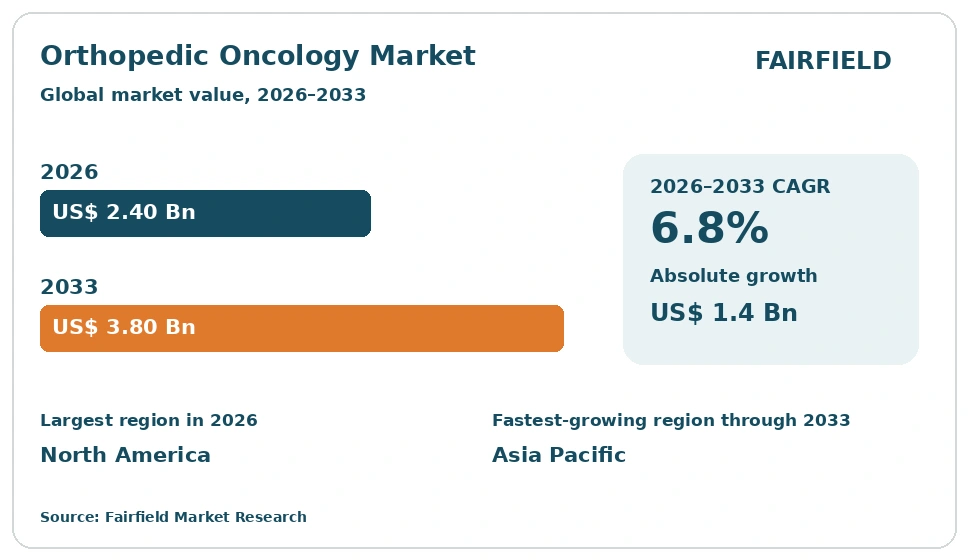
The global Orthopedic Oncology market size is expected to be valued at US$ 2.4 billion in 2026 and projected to reach US$ 3.8 billion by 2033, growing at a CAGR of 6.8% between 2026 and 2033. Growth rests on wider access to limb-salvage reconstruction, steady adoption of modular tumour endoprostheses, and routine three-dimensional planning inside sarcoma units. Rising detection of metastatic bone disease in ageing populations expands the pool of reconstructive procedures performed each year. Between 2020 and 2025 the market advanced at a historical CAGR of 5.6%, and the absolute dollar opportunity across the forecast period stands at US$ 1.4 billion.
Key Report Takeaways
- By Product Type: Tumour endoprostheses and limb-salvage implants led with 41.5% share in 2026, while surgical navigation and patient-specific instrumentation is projected to expand at a 9.4% CAGR through 2033, driven by wider use of additive manufacturing in resection planning.
- By Tumour Type: Metastatic bone disease held 38.0% share in 2026, while soft-tissue sarcoma procedures are set to grow at a 7.9% CAGR through 2033, driven by referral of complex cases into multidisciplinary sarcoma networks.
- By Surgery Type: Limb-salvage reconstruction accounted for 44.0% share in 2026, while minimally invasive and ablative procedures should rise at an 8.6% CAGR through 2033, driven by growing image-guided ablation capacity in interventional suites.
- By End User: Specialist cancer centres and sarcoma units captured 46.0% share in 2026, while ambulatory surgical centres are forecast to advance at an 8.8% CAGR through 2033, driven by payer pressure to move lower-acuity procedures outpatient.
- By Region: North America led with 38.5% share in 2026, while Asia Pacific is projected to expand at an 8.9% CAGR through 2033, driven by new tertiary oncology hospitals across China and India.
Market Trends and Insights
Market Growth Drivers
Wider Use of Limb-Salvage Reconstruction in Musculoskeletal Tumour Care
Limb-salvage reconstruction has become the usual surgical pathway in musculoskeletal tumour care, and that shift lifts device demand directly. Each salvage case consumes a modular endoprosthesis, cutting guides, fixation hardware and a void filler, so revenue per procedure sits far above amputation pathways. Hospitals that build sarcoma capability also commit to inventory, instrument sets and loaner kits, creating recurring purchasing relationships with implant suppliers.
The trend behind this is the maturing of multidisciplinary sarcoma units that combine surgical oncology, radiology and pathology in one referral pathway. Cross-sectional imaging and neoadjuvant protocols let surgeons plan resection margins in advance, which makes modular and custom reconstruction practical. Suppliers have answered with coated surfaces, growing prostheses for paediatric cases and expandable stems. National cancer plans in several countries designate sarcoma referral centres, concentrating volume where these systems are stocked.
Growing Burden of Metastatic Bone Disease in Ageing Populations
Metastatic bone disease now supplies the largest share of orthopedic oncology procedure volume, and that base keeps widening as populations age. Longer survival in breast, prostate, lung, renal and thyroid cancer means more patients reach the point where skeletal lesions need stabilisation or reconstruction. Demand concentrates in intramedullary fixation, cemented augmentation, acetabular reconstruction and proximal femoral replacement, which gives suppliers a steadier, higher-frequency revenue line than primary sarcoma work.
Underpinning this is the spread of routine skeletal surveillance in oncology follow-up, with imaging picking up lesions earlier in the disease course. Orthopedic departments inside general hospitals handle much of this caseload, so demand reaches a broader customer base than sarcoma centres alone. Device makers package oncology-specific stems, cement restrictors and fixation constructs for these cases, and several firms now sell dedicated metastatic disease configurations rather than adapting trauma hardware.
Restraints Impact Analysis of Market
Procedure Volume Concentrated in a Small Number of Specialist Centres
Orthopedic oncology is a low-volume, high-complexity field, and the concentration of cases in a handful of specialist centres caps the addressable customer base. A country may run only a few sarcoma units with the surgical, pathology and imaging depth required, so suppliers sell into dozens rather than thousands of accounts. That structure lengthens sales cycles, raises the cost of field support per case, and leaves revenue exposed to procurement decisions at a small number of institutions.
The same concentration creates real access problems for patients living far from a referral centre. Travel distance, time away from work and the need for repeated follow-up visits shape whether complex reconstruction is practical at all. Health systems in large or sparsely populated countries have begun funding networked care models and regional outreach clinics, yet the underlying distribution of expertise changes slowly and limits procedure growth.
High Implant Cost and Uneven Reimbursement for Custom Devices
Custom and modular tumour implants carry costs well above standard arthroplasty components, and uneven reimbursement for them restrains market expansion. Patient-specific devices involve imaging, engineering design, additive manufacturing and single-use tooling, with no volume effect to spread that work across. Where tariff systems pay a fixed amount per episode, hospitals absorb the difference, and procurement committees push surgeons toward off-the-shelf modular systems rather than bespoke reconstruction.
Coding and funding pathways for custom devices remain inconsistent between health systems, and some require case-by-case approval before surgery. That adds administrative delay in a setting where scheduling is driven by oncology treatment timing. Suppliers have responded by broadening modular ranges that cover most anatomy without bespoke manufacture, and by offering managed-inventory arrangements. Budget pressure in public hospitals keeps this a live constraint on adoption.
Market Opportunities
Patient-Specific Implants and Additive Manufacturing Pull-Through
Patient-specific implants built through additive manufacturing open the fastest new revenue line in this market, because they address anatomy that modular systems handle poorly. Pelvic, sacral, scapular and periacetabular resections vary widely between patients, and printed titanium constructs with porous interfaces let suppliers serve cases that previously had limited reconstructive options. Each case also pulls through planning software, printed cutting guides and engineering services, which lifts contract value beyond the implant itself.
Supporting this are maturing design workflows, wider hospital access to segmentation software, and clearer regulatory routes for custom-made devices in major markets. Several device makers and service bureaus now run dedicated engineering teams that work from a surgeon’s imaging data. Growing use of printed porous structures in standard orthopedics has normalised the technology in procurement. Digital files also create long-term service relationships around revision planning.
Expansion of Sarcoma Surgical Capacity Across Emerging Markets
Building sarcoma surgical capacity across emerging markets represents the largest untapped volume opportunity, since much of the world’s cancer burden sits where reconstructive capability is thin. New tertiary oncology hospitals in Asia Pacific, Latin America and the Middle East are adding musculoskeletal tumour units, imaging suites and pathology services. Each new unit creates first-time demand for endoprosthesis sets, navigation hardware and consignment inventory, often on long procurement cycles with public funding behind them.
Driving this are national cancer control plans, public investment in tertiary infrastructure and growing insurance coverage for oncology surgery. Surgeon training partnerships and fellowship programmes are spreading reconstruction technique into centres that previously defaulted to amputation. Suppliers that localise manufacturing, register products early and support training stand to establish positions before competition intensifies. Tiered product ranges priced for these budgets are becoming a standard market entry approach.
Category-wise Insights
Which Product Type Holds the Largest Revenue Share?
Tumour endoprostheses and limb-salvage implants hold the largest revenue share at 41.5% in 2026, because every salvage reconstruction consumes a high-value segmental implant system. Modular proximal femoral, distal femoral, proximal tibial and total femoral constructs carry prices far above standard joint replacement components, so a modest procedure count still produces substantial revenue. Bone graft and void-filling materials follow at 23.0%, supported by curettage cases and cavity reconstruction.
Surgical navigation and patient-specific instrumentation is the fastest-growing product type at a 9.4% CAGR between 2026 and 2033. Printed cutting guides, intraoperative navigation and planning software are moving from pelvic and sacral work into routine extremity resections. The practical effect is a shift in supplier economics: revenue increasingly attaches to software, engineering services and single-use guides rather than metal alone, which rewards firms able to combine implant manufacture with digital planning capability.
Metastatic Bone Disease Anchors Volume While Soft-Tissue Sarcoma Accelerates
Metastatic bone disease anchors procedure volume with 38.0% share in 2026, because skeletal metastases are far more common than primary bone tumours. Stabilisation and reconstruction of the femur, humerus, spine and pelvis generate steady caseloads across general orthopedic departments as well as cancer centres. Primary bone tumours account for 29.5%, a smaller but higher-value pool concentrated in sarcoma units treating osteosarcoma, Ewing sarcoma and chondrosarcoma.
Soft-tissue sarcoma is the fastest-growing tumour type at a 7.9% CAGR between 2026 and 2033. Wider referral into multidisciplinary networks, better cross-sectional imaging and growing use of complex reconstruction after wide excision are lifting the associated device and service content. For the broader market the signal is clear: growth is coming from case types that demand planning, soft-tissue management and reconstructive judgement rather than from a simple rise in implant unit counts.
Limb-Salvage Reconstruction Dominates as Ablative Procedures Gain Ground
Limb-salvage reconstruction dominates by surgery type with 44.0% share in 2026, reflecting its position as the default approach where margins and function allow. These cases carry the heaviest device content, combining a segmental implant, fixation hardware, graft material and often custom instrumentation. Resection and curettage with void filling holds 22.5%, driven by benign and locally aggressive lesions treated with cavity reconstruction rather than full replacement.
Minimally invasive and ablative procedures grow fastest at an 8.6% CAGR between 2026 and 2033, as hospitals add image-guided ablation and cementoplasty capacity in interventional suites. This expands the market beyond the operating theatre and brings interventional radiology into the purchasing conversation. For suppliers the implication is a widening set of buying centres, with consumables, cement delivery systems and imaging-compatible instruments becoming a separate growth channel alongside traditional implant sales.
Specialist Sarcoma Units Concentrate Spending as Ambulatory Settings Expand
Specialist cancer centres and sarcoma units concentrate the largest share of spending at 46.0% in 2026, because complex resection and reconstruction require surgical, pathology and imaging depth that few sites maintain. These accounts carry full consignment inventory, custom implant relationships and engineering support. Hospitals with general or academic orthopedic departments take 36.5%, handling much of the metastatic disease caseload that does not require a dedicated sarcoma team.
Ambulatory surgical centres are the fastest-growing end user at an 8.8% CAGR between 2026 and 2033, as payers push lower-acuity biopsy, benign lesion and soft-tissue excision work into outpatient settings. The shift matters commercially because ambulatory buyers purchase differently, favouring compact instrument sets, predictable pricing and lower inventory commitments. Suppliers now need two distinct commercial models: deep clinical partnership at referral centres, and efficient, price-transparent supply to outpatient operators.
Geography Analysis
Which Region Is Leading the Orthopedic Oncology Market?
North America leads the market with 38.5% share in 2026, built on a dense network of designated cancer centres and consistent reimbursement for complex reconstruction. The United States supplies most of this, with Canada contributing through provincial sarcoma programmes. High per-procedure device spending reflects early adoption of modular endoprostheses, navigation systems and printed patient-specific instrumentation. The U.S. Food and Drug Administration maintains a defined pathway for custom-made devices, which gives manufacturers a predictable route for bespoke reconstruction. Academic medical centres also run fellowship training that spreads technique across the region. Concentration remains a live issue: patients outside major metropolitan areas often travel long distances to reach a sarcoma unit, and regional outreach models are being funded to narrow that gap.
Europe Combines Dense Sarcoma Networks With Cost-Controlled Procurement
Europe holds 28.0% share in 2026, supported by formally designated reference networks that channel rare tumour cases into accredited centres. Germany, the United Kingdom, France, Italy and the Netherlands account for most regional activity, with Germany notable for domestic tumour endoprosthesis manufacturing. Conformity assessment under the region’s medical device regulation sets a demanding clinical evidence and documentation standard, raising compliance cost and favouring established suppliers. Public procurement and tariff-based hospital payment keep pricing tight, so vendors compete on modular range breadth and inventory service rather than premium positioning. Cross-border referral arrangements give smaller member states access to specialist surgery without building full units, which sustains volume in a limited set of high-capability hospitals.
Which Region Is Growing Fastest in the Orthopedic Oncology Market?
Asia Pacific is growing fastest at an 8.9% CAGR between 2026 and 2033, as new tertiary oncology infrastructure converts previously untreated demand into surgical volume. China, India, Japan, South Korea and Australia lead this expansion. Chinese provincial cancer hospitals and Indian tertiary institutions are adding musculoskeletal tumour units, imaging suites and pathology capability, each creating first-time demand for endoprosthesis inventory. Public insurance expansion and national cancer control programmes are improving affordability for reconstruction that patients previously could not fund. Local manufacturing in China and India is lowering entry prices and widening access, while surgeon training partnerships spread limb-salvage technique beyond flagship centres. Rapid urbanisation and ageing populations in Japan and South Korea add steady metastatic disease caseloads.
Latin America Builds Capacity Around a Few National Referral Hospitals
Latin America accounts for 6.0% share in 2026, with activity concentrated in a small number of national referral hospitals. Brazil and Mexico supply most regional demand, followed by Argentina, Colombia and Chile. Public cancer institutes handle the bulk of sarcoma surgery, and their procurement runs on tender cycles that favour suppliers with registered, competitively priced modular systems. Import duties, currency movement and registration timelines slow product availability, so distributor relationships carry real commercial weight. Access remains uneven, with patients from interior regions travelling to capital-city centres for both surgery and follow-up. Growing private hospital investment in Brazil and Mexico is adding a second channel that adopts navigation and planning tools earlier than public institutions.
Middle East & Africa Growth Tracks New Tertiary Oncology Infrastructure
Middle East & Africa holds 5.0% share in 2026, the smallest regional position, with demand tied closely to new tertiary oncology construction. Saudi Arabia, the United Arab Emirates, Israel, Turkey and South Africa form the core markets. Gulf health transformation programmes are funding specialist cancer hospitals with musculoskeletal tumour capability, and these projects buy full implant and navigation inventory at commissioning. Turkey supports a domestic orthopedic manufacturing base that serves regional demand. Across much of sub-Saharan Africa, sarcoma surgical capacity remains thin, and referral abroad is still common for complex reconstruction. Training partnerships, government investment in tertiary infrastructure and growing insurance coverage are the practical conditions on which future regional growth depends.
Competitive Landscape
The orthopedic oncology market is moderately concentrated, with a small group of global orthopedic manufacturers and a set of focused specialists holding most supply. Large diversified firms bring scale, regulatory infrastructure and global distribution, while dedicated tumour implant makers in Germany and the United States compete on depth of range and surgeon relationships. The low case volume per centre favours suppliers able to fund consignment inventory and on-site technical support. Smaller firms focused wholly on musculoskeletal oncology have retained strong positions because specialisation matters more here than breadth, and this balance has held rather than consolidating toward a single tier of vendor.
Competition runs on modular system breadth, materials and surface technology, custom manufacturing capability and digital planning. Vendors differentiate through coated and porous surfaces, growing and expandable constructs for paediatric anatomy, and the speed with which they can deliver a patient-specific implant from imaging data. Additive manufacturing has lowered the barrier for engineering-led entrants and service bureaus, which now compete for the pelvic and sacral reconstruction work that modular ranges cover least well. Regulatory documentation depth has become a competitive asset in its own right.
Strategic activity centres on extending modular ranges into harder anatomy, building in-house printing and design capability, and acquiring or partnering with navigation and planning software providers. Capacity investment aims at shortening custom device lead times, which directly affects whether a centre can schedule surgery around oncology treatment timing. Training and fellowship support functions as market development in regions adding sarcoma capacity.
Vendor strategy is moving toward integrated offerings that bundle implant, instrumentation, planning software and engineering service into one commercial relationship, alongside tiered product ranges built for emerging market budgets.
Industry Leaders
- Stryker Corporation
- Zimmer Biomet Holdings, Inc.
- Johnson & Johnson MedTech (DePuy Synthes)
- Smith & Nephew plc
- Waldemar Link GmbH & Co. KG
- implantcast GmbH
- Onkos Surgical, Inc.
- B. Braun SE (Aesculap AG)
Companies Covered in the Report
- Stryker Corporation
- Zimmer Biomet Holdings, Inc.
- Johnson & Johnson MedTech (DePuy Synthes)
- Smith & Nephew plc
- B. Braun SE (Aesculap AG)
- Waldemar Link GmbH & Co. KG
- implantcast GmbH
- Onkos Surgical, Inc.
- Exactech, Inc.
- Medacta International SA
- Globus Medical, Inc.
- Brainlab AG
- Materialise NV
- Orthofix Medical Inc.
- Bioventus Inc.
Orthopedic Oncology Market Report Scope
Fairfield Market Research segments the Orthopedic Oncology market by product type, tumour type, surgery type, end user and region.
| By Product Type | Tumour Endoprostheses and Limb-Salvage Implants, Bone Graft and Void-Filling Materials, Surgical Navigation and Patient-Specific Instrumentation, Fixation and Reconstruction Hardware, Other Devices and Services |
| By Tumour Type | Metastatic Bone Disease, Primary Bone Tumours, Soft-Tissue Sarcomas, Benign and Locally Aggressive Lesions |
| By Surgery Type | Limb-Salvage Reconstruction, Resection and Curettage with Void Filling, Revision Surgery, Minimally Invasive and Ablative Procedures, Amputation and Rotationplasty |
| By End User | Specialist Cancer Centres and Sarcoma Units, Hospitals, Ambulatory Surgical Centres, Research and Academic Institutes |
| By Region | North America, Europe, Asia Pacific, Latin America, Middle East & Africa |
1. Executive Summary
1.1 Orthopedic Oncology Market Snapshot
1.2 Future Projections
1.3 Key Industry Highlights
1.4 Geographical Snapshot
2. Market Overview
2.1 Market Definition and Segmentation
2.2 Historical Market Trends
2.3 Market Dynamics
2.3.1 Drivers
2.3.1.1 Wider Use of Limb-Salvage Reconstruction in Musculoskeletal Tumour Care
2.3.1.2 Growing Burden of Metastatic Bone Disease in Ageing Populations
2.3.2 Restraints
2.3.2.1 Procedure Volume Concentrated in a Small Number of Specialist Centres
2.3.2.2 High Implant Cost and Uneven Reimbursement for Custom Devices
2.3.3 Market Opportunities
2.3.3.1 Patient-Specific Implants and Additive Manufacturing Pull-Through
2.3.3.2 Expansion of Sarcoma Surgical Capacity Across Emerging Markets
3. Global Orthopedic Oncology Market Outlook, 2026–2033
3.1 Global Orthopedic Oncology Market Outlook, by Product Type, Value (US$ Billion), 2026–2033
3.1.1 Tumour Endoprostheses and Limb-Salvage Implants
3.1.2 Bone Graft and Void-Filling Materials
3.1.3 Surgical Navigation and Patient-Specific Instrumentation
3.1.4 Fixation and Reconstruction Hardware
3.1.5 Other Devices and Services
3.2 Global Orthopedic Oncology Market Outlook, by Tumour Type, Value (US$ Billion), 2026–2033
3.2.1 Metastatic Bone Disease
3.2.2 Primary Bone Tumours
3.2.3 Soft-Tissue Sarcomas
3.2.4 Benign and Locally Aggressive Lesions
3.3 Global Orthopedic Oncology Market Outlook, by Surgery Type, Value (US$ Billion), 2026–2033
3.3.1 Limb-Salvage Reconstruction
3.3.2 Resection and Curettage with Void Filling
3.3.3 Revision Surgery
3.3.4 Minimally Invasive and Ablative Procedures
3.3.5 Amputation and Rotationplasty
3.4 Global Orthopedic Oncology Market Outlook, by End User, Value (US$ Billion), 2026–2033
3.4.1 Specialist Cancer Centres and Sarcoma Units
3.4.2 Hospitals
3.4.3 Ambulatory Surgical Centres
3.4.4 Research and Academic Institutes
3.5 Global Orthopedic Oncology Market Outlook, by Region, Value (US$ Billion), 2026–2033
3.5.1 North America
3.5.2 Europe
3.5.3 Asia Pacific
3.5.4 Latin America
3.5.5 Middle East & Africa
4. North America Orthopedic Oncology Market Outlook, 2026–2033
4.1 North America Orthopedic Oncology Market Outlook, by Product Type, Value (US$ Billion), 2026–2033
4.1.1 Tumour Endoprostheses and Limb-Salvage Implants
4.1.2 Bone Graft and Void-Filling Materials
4.1.3 Surgical Navigation and Patient-Specific Instrumentation
4.1.4 Fixation and Reconstruction Hardware
4.1.5 Other Devices and Services
4.2 North America Orthopedic Oncology Market Outlook, by Tumour Type, Value (US$ Billion), 2026–2033
4.2.1 Metastatic Bone Disease
4.2.2 Primary Bone Tumours
4.2.3 Soft-Tissue Sarcomas
4.2.4 Benign and Locally Aggressive Lesions
4.3 North America Orthopedic Oncology Market Outlook, by Surgery Type, Value (US$ Billion), 2026–2033
4.3.1 Limb-Salvage Reconstruction
4.3.2 Resection and Curettage with Void Filling
4.3.3 Revision Surgery
4.3.4 Minimally Invasive and Ablative Procedures
4.3.5 Amputation and Rotationplasty
4.4 North America Orthopedic Oncology Market Outlook, by End User, Value (US$ Billion), 2026–2033
4.4.1 Specialist Cancer Centres and Sarcoma Units
4.4.2 Hospitals
4.4.3 Ambulatory Surgical Centres
4.4.4 Research and Academic Institutes
4.5 North America Orthopedic Oncology Market Outlook, by Country, Value (US$ Billion), 2026–2033
4.5.1 United States Orthopedic Oncology Market Outlook, by Product Type, 2026–2033
4.5.2 United States Orthopedic Oncology Market Outlook, by Tumour Type, 2026–2033
4.5.3 United States Orthopedic Oncology Market Outlook, by Surgery Type, 2026–2033
4.5.4 United States Orthopedic Oncology Market Outlook, by End User, 2026–2033
4.5.5 Canada Orthopedic Oncology Market Outlook, by Product Type, 2026–2033
4.5.6 Canada Orthopedic Oncology Market Outlook, by Tumour Type, 2026–2033
4.5.7 Canada Orthopedic Oncology Market Outlook, by Surgery Type, 2026–2033
4.5.8 Canada Orthopedic Oncology Market Outlook, by End User, 2026–2033
5. Europe Orthopedic Oncology Market Outlook, 2026–2033
5.1 Europe Orthopedic Oncology Market Outlook, by Product Type, Value (US$ Billion), 2026–2033
5.1.1 Tumour Endoprostheses and Limb-Salvage Implants
5.1.2 Bone Graft and Void-Filling Materials
5.1.3 Surgical Navigation and Patient-Specific Instrumentation
5.1.4 Fixation and Reconstruction Hardware
5.1.5 Other Devices and Services
5.2 Europe Orthopedic Oncology Market Outlook, by Tumour Type, Value (US$ Billion), 2026–2033
5.2.1 Metastatic Bone Disease
5.2.2 Primary Bone Tumours
5.2.3 Soft-Tissue Sarcomas
5.2.4 Benign and Locally Aggressive Lesions
5.3 Europe Orthopedic Oncology Market Outlook, by Surgery Type, Value (US$ Billion), 2026–2033
5.3.1 Limb-Salvage Reconstruction
5.3.2 Resection and Curettage with Void Filling
5.3.3 Revision Surgery
5.3.4 Minimally Invasive and Ablative Procedures
5.3.5 Amputation and Rotationplasty
5.4 Europe Orthopedic Oncology Market Outlook, by End User, Value (US$ Billion), 2026–2033
5.4.1 Specialist Cancer Centres and Sarcoma Units
5.4.2 Hospitals
5.4.3 Ambulatory Surgical Centres
5.4.4 Research and Academic Institutes
5.5 Europe Orthopedic Oncology Market Outlook, by Country, Value (US$ Billion), 2026–2033
5.5.1 Germany Orthopedic Oncology Market Outlook, by Product Type, 2026–2033
5.5.2 Germany Orthopedic Oncology Market Outlook, by Tumour Type, 2026–2033
5.5.3 Germany Orthopedic Oncology Market Outlook, by Surgery Type, 2026–2033
5.5.4 Germany Orthopedic Oncology Market Outlook, by End User, 2026–2033
5.5.5 United Kingdom Orthopedic Oncology Market Outlook, by Product Type, 2026–2033
5.5.6 United Kingdom Orthopedic Oncology Market Outlook, by Tumour Type, 2026–2033
5.5.7 United Kingdom Orthopedic Oncology Market Outlook, by Surgery Type, 2026–2033
5.5.8 United Kingdom Orthopedic Oncology Market Outlook, by End User, 2026–2033
5.5.9 France Orthopedic Oncology Market Outlook, by Product Type, 2026–2033
5.5.10 France Orthopedic Oncology Market Outlook, by Tumour Type, 2026–2033
5.5.11 France Orthopedic Oncology Market Outlook, by Surgery Type, 2026–2033
5.5.12 France Orthopedic Oncology Market Outlook, by End User, 2026–2033
5.5.13 Italy Orthopedic Oncology Market Outlook, by Product Type, 2026–2033
5.5.14 Italy Orthopedic Oncology Market Outlook, by Tumour Type, 2026–2033
5.5.15 Italy Orthopedic Oncology Market Outlook, by Surgery Type, 2026–2033
5.5.16 Italy Orthopedic Oncology Market Outlook, by End User, 2026–2033
5.5.17 Netherlands Orthopedic Oncology Market Outlook, by Product Type, 2026–2033
5.5.18 Netherlands Orthopedic Oncology Market Outlook, by Tumour Type, 2026–2033
5.5.19 Netherlands Orthopedic Oncology Market Outlook, by Surgery Type, 2026–2033
5.5.20 Netherlands Orthopedic Oncology Market Outlook, by End User, 2026–2033
6. Asia Pacific Orthopedic Oncology Market Outlook, 2026–2033
6.1 Asia Pacific Orthopedic Oncology Market Outlook, by Product Type, Value (US$ Billion), 2026–2033
6.1.1 Tumour Endoprostheses and Limb-Salvage Implants
6.1.2 Bone Graft and Void-Filling Materials
6.1.3 Surgical Navigation and Patient-Specific Instrumentation
6.1.4 Fixation and Reconstruction Hardware
6.1.5 Other Devices and Services
6.2 Asia Pacific Orthopedic Oncology Market Outlook, by Tumour Type, Value (US$ Billion), 2026–2033
6.2.1 Metastatic Bone Disease
6.2.2 Primary Bone Tumours
6.2.3 Soft-Tissue Sarcomas
6.2.4 Benign and Locally Aggressive Lesions
6.3 Asia Pacific Orthopedic Oncology Market Outlook, by Surgery Type, Value (US$ Billion), 2026–2033
6.3.1 Limb-Salvage Reconstruction
6.3.2 Resection and Curettage with Void Filling
6.3.3 Revision Surgery
6.3.4 Minimally Invasive and Ablative Procedures
6.3.5 Amputation and Rotationplasty
6.4 Asia Pacific Orthopedic Oncology Market Outlook, by End User, Value (US$ Billion), 2026–2033
6.4.1 Specialist Cancer Centres and Sarcoma Units
6.4.2 Hospitals
6.4.3 Ambulatory Surgical Centres
6.4.4 Research and Academic Institutes
6.5 Asia Pacific Orthopedic Oncology Market Outlook, by Country, Value (US$ Billion), 2026–2033
6.5.1 China Orthopedic Oncology Market Outlook, by Product Type, 2026–2033
6.5.2 China Orthopedic Oncology Market Outlook, by Tumour Type, 2026–2033
6.5.3 China Orthopedic Oncology Market Outlook, by Surgery Type, 2026–2033
6.5.4 China Orthopedic Oncology Market Outlook, by End User, 2026–2033
6.5.5 India Orthopedic Oncology Market Outlook, by Product Type, 2026–2033
6.5.6 India Orthopedic Oncology Market Outlook, by Tumour Type, 2026–2033
6.5.7 India Orthopedic Oncology Market Outlook, by Surgery Type, 2026–2033
6.5.8 India Orthopedic Oncology Market Outlook, by End User, 2026–2033
6.5.9 Japan Orthopedic Oncology Market Outlook, by Product Type, 2026–2033
6.5.10 Japan Orthopedic Oncology Market Outlook, by Tumour Type, 2026–2033
6.5.11 Japan Orthopedic Oncology Market Outlook, by Surgery Type, 2026–2033
6.5.12 Japan Orthopedic Oncology Market Outlook, by End User, 2026–2033
6.5.13 South Korea Orthopedic Oncology Market Outlook, by Product Type, 2026–2033
6.5.14 South Korea Orthopedic Oncology Market Outlook, by Tumour Type, 2026–2033
6.5.15 South Korea Orthopedic Oncology Market Outlook, by Surgery Type, 2026–2033
6.5.16 South Korea Orthopedic Oncology Market Outlook, by End User, 2026–2033
6.5.17 Australia Orthopedic Oncology Market Outlook, by Product Type, 2026–2033
6.5.18 Australia Orthopedic Oncology Market Outlook, by Tumour Type, 2026–2033
6.5.19 Australia Orthopedic Oncology Market Outlook, by Surgery Type, 2026–2033
6.5.20 Australia Orthopedic Oncology Market Outlook, by End User, 2026–2033
7. Latin America Orthopedic Oncology Market Outlook, 2026–2033
7.1 Latin America Orthopedic Oncology Market Outlook, by Product Type, Value (US$ Billion), 2026–2033
7.1.1 Tumour Endoprostheses and Limb-Salvage Implants
7.1.2 Bone Graft and Void-Filling Materials
7.1.3 Surgical Navigation and Patient-Specific Instrumentation
7.1.4 Fixation and Reconstruction Hardware
7.1.5 Other Devices and Services
7.2 Latin America Orthopedic Oncology Market Outlook, by Tumour Type, Value (US$ Billion), 2026–2033
7.2.1 Metastatic Bone Disease
7.2.2 Primary Bone Tumours
7.2.3 Soft-Tissue Sarcomas
7.2.4 Benign and Locally Aggressive Lesions
7.3 Latin America Orthopedic Oncology Market Outlook, by Surgery Type, Value (US$ Billion), 2026–2033
7.3.1 Limb-Salvage Reconstruction
7.3.2 Resection and Curettage with Void Filling
7.3.3 Revision Surgery
7.3.4 Minimally Invasive and Ablative Procedures
7.3.5 Amputation and Rotationplasty
7.4 Latin America Orthopedic Oncology Market Outlook, by End User, Value (US$ Billion), 2026–2033
7.4.1 Specialist Cancer Centres and Sarcoma Units
7.4.2 Hospitals
7.4.3 Ambulatory Surgical Centres
7.4.4 Research and Academic Institutes
7.5 Latin America Orthopedic Oncology Market Outlook, by Country, Value (US$ Billion), 2026–2033
7.5.1 Brazil Orthopedic Oncology Market Outlook, by Product Type, 2026–2033
7.5.2 Brazil Orthopedic Oncology Market Outlook, by Tumour Type, 2026–2033
7.5.3 Brazil Orthopedic Oncology Market Outlook, by Surgery Type, 2026–2033
7.5.4 Brazil Orthopedic Oncology Market Outlook, by End User, 2026–2033
7.5.5 Mexico Orthopedic Oncology Market Outlook, by Product Type, 2026–2033
7.5.6 Mexico Orthopedic Oncology Market Outlook, by Tumour Type, 2026–2033
7.5.7 Mexico Orthopedic Oncology Market Outlook, by Surgery Type, 2026–2033
7.5.8 Mexico Orthopedic Oncology Market Outlook, by End User, 2026–2033
7.5.9 Argentina Orthopedic Oncology Market Outlook, by Product Type, 2026–2033
7.5.10 Argentina Orthopedic Oncology Market Outlook, by Tumour Type, 2026–2033
7.5.11 Argentina Orthopedic Oncology Market Outlook, by Surgery Type, 2026–2033
7.5.12 Argentina Orthopedic Oncology Market Outlook, by End User, 2026–2033
7.5.13 Colombia Orthopedic Oncology Market Outlook, by Product Type, 2026–2033
7.5.14 Colombia Orthopedic Oncology Market Outlook, by Tumour Type, 2026–2033
7.5.15 Colombia Orthopedic Oncology Market Outlook, by Surgery Type, 2026–2033
7.5.16 Colombia Orthopedic Oncology Market Outlook, by End User, 2026–2033
7.5.17 Chile Orthopedic Oncology Market Outlook, by Product Type, 2026–2033
7.5.18 Chile Orthopedic Oncology Market Outlook, by Tumour Type, 2026–2033
7.5.19 Chile Orthopedic Oncology Market Outlook, by Surgery Type, 2026–2033
7.5.20 Chile Orthopedic Oncology Market Outlook, by End User, 2026–2033
8. Middle East & Africa Orthopedic Oncology Market Outlook, 2026–2033
8.1 Middle East & Africa Orthopedic Oncology Market Outlook, by Product Type, Value (US$ Billion), 2026–2033
8.1.1 Tumour Endoprostheses and Limb-Salvage Implants
8.1.2 Bone Graft and Void-Filling Materials
8.1.3 Surgical Navigation and Patient-Specific Instrumentation
8.1.4 Fixation and Reconstruction Hardware
8.1.5 Other Devices and Services
8.2 Middle East & Africa Orthopedic Oncology Market Outlook, by Tumour Type, Value (US$ Billion), 2026–2033
8.2.1 Metastatic Bone Disease
8.2.2 Primary Bone Tumours
8.2.3 Soft-Tissue Sarcomas
8.2.4 Benign and Locally Aggressive Lesions
8.3 Middle East & Africa Orthopedic Oncology Market Outlook, by Surgery Type, Value (US$ Billion), 2026–2033
8.3.1 Limb-Salvage Reconstruction
8.3.2 Resection and Curettage with Void Filling
8.3.3 Revision Surgery
8.3.4 Minimally Invasive and Ablative Procedures
8.3.5 Amputation and Rotationplasty
8.4 Middle East & Africa Orthopedic Oncology Market Outlook, by End User, Value (US$ Billion), 2026–2033
8.4.1 Specialist Cancer Centres and Sarcoma Units
8.4.2 Hospitals
8.4.3 Ambulatory Surgical Centres
8.4.4 Research and Academic Institutes
8.5 Middle East & Africa Orthopedic Oncology Market Outlook, by Country, Value (US$ Billion), 2026–2033
8.5.1 Saudi Arabia Orthopedic Oncology Market Outlook, by Product Type, 2026–2033
8.5.2 Saudi Arabia Orthopedic Oncology Market Outlook, by Tumour Type, 2026–2033
8.5.3 Saudi Arabia Orthopedic Oncology Market Outlook, by Surgery Type, 2026–2033
8.5.4 Saudi Arabia Orthopedic Oncology Market Outlook, by End User, 2026–2033
8.5.5 United Arab Emirates Orthopedic Oncology Market Outlook, by Product Type, 2026–2033
8.5.6 United Arab Emirates Orthopedic Oncology Market Outlook, by Tumour Type, 2026–2033
8.5.7 United Arab Emirates Orthopedic Oncology Market Outlook, by Surgery Type, 2026–2033
8.5.8 United Arab Emirates Orthopedic Oncology Market Outlook, by End User, 2026–2033
8.5.9 Israel Orthopedic Oncology Market Outlook, by Product Type, 2026–2033
8.5.10 Israel Orthopedic Oncology Market Outlook, by Tumour Type, 2026–2033
8.5.11 Israel Orthopedic Oncology Market Outlook, by Surgery Type, 2026–2033
8.5.12 Israel Orthopedic Oncology Market Outlook, by End User, 2026–2033
8.5.13 Turkey Orthopedic Oncology Market Outlook, by Product Type, 2026–2033
8.5.14 Turkey Orthopedic Oncology Market Outlook, by Tumour Type, 2026–2033
8.5.15 Turkey Orthopedic Oncology Market Outlook, by Surgery Type, 2026–2033
8.5.16 Turkey Orthopedic Oncology Market Outlook, by End User, 2026–2033
8.5.17 South Africa Orthopedic Oncology Market Outlook, by Product Type, 2026–2033
8.5.18 South Africa Orthopedic Oncology Market Outlook, by Tumour Type, 2026–2033
8.5.19 South Africa Orthopedic Oncology Market Outlook, by Surgery Type, 2026–2033
8.5.20 South Africa Orthopedic Oncology Market Outlook, by End User, 2026–2033
9. Competitive Landscape
9.1 Industry Leaders
9.2 Company Profiles
9.2.1 Stryker Corporation
9.2.2 Zimmer Biomet Holdings, Inc.
9.2.3 Johnson & Johnson MedTech (DePuy Synthes)
9.2.4 Smith & Nephew plc
9.2.5 B. Braun SE (Aesculap AG)
9.2.6 Waldemar Link GmbH & Co. KG
9.2.7 implantcast GmbH
9.2.8 Onkos Surgical, Inc.
9.2.9 Exactech, Inc.
9.2.10 Medacta International SA
9.2.11 Globus Medical, Inc.
9.2.12 Brainlab AG
9.2.13 Materialise NV
9.2.14 Orthofix Medical Inc.
9.2.15 Bioventus Inc.
10. Appendix
10.1 Research Methodology
10.2 Report Assumptions
10.3 Acronyms and Abbreviations
| By Product Type | Tumour Endoprostheses and Limb-Salvage Implants, Bone Graft and Void-Filling Materials, Surgical Navigation and Patient-Specific Instrumentation, Fixation and Reconstruction Hardware, Other Devices and Services |
| By Tumour Type | Metastatic Bone Disease, Primary Bone Tumours, Soft-Tissue Sarcomas, Benign and Locally Aggressive Lesions |
| By Surgery Type | Limb-Salvage Reconstruction, Resection and Curettage with Void Filling, Revision Surgery, Minimally Invasive and Ablative Procedures, Amputation and Rotationplasty |
| By End User | Specialist Cancer Centres and Sarcoma Units, Hospitals, Ambulatory Surgical Centres, Research and Academic Institutes |
| By Region | North America, Europe, Asia Pacific, Latin America, Middle East & Africa |
Our Research Methodology
Considering the volatility of business today, traditional approaches to strategizing a game plan can be unfruitful if not detrimental. True ambiguity is no way to determine a forecast. A myriad of predetermined factors must be accounted for such as the degree of risk involved, the magnitude of circumstances, as well as conditions or consequences that are not known or unpredictable. To circumvent binary views that cast uncertainty, the application of market research intelligence to strategically posture, move, and enable actionable outcomes is necessary.
View Methodology
Quality Assured
Rigorous Validation Process

Confidentiality Assured
End-to-end Data Security

Custom Research Services
Tailored To Your Objectives
FAQs
The global Orthopedic Oncology market is valued at US$ 2.4 billion in 2026, supported by limb-salvage reconstruction volumes and steady bone graft consumption.
The market is projected to grow at a 6.8% CAGR between 2026 and 2033, reaching US$ 3.8 billion and adding US$ 1.4 billion.
Tumour endoprostheses and limb-salvage implants lead with 41.5% share in 2026, because each reconstruction case needs a modular, often custom, segmental implant system.
North America leads with 38.5% share in 2026, helped by dense sarcoma referral centres, broad reimbursement coverage and early adoption of navigation systems.
Stryker, Zimmer Biomet, Johnson & Johnson MedTech, Waldemar Link, implantcast and Onkos Surgical are among the principal suppliers serving sarcoma reconstruction worldwide.
Related Reports
Latin America In Vitro Diagnostics (IVD) Market Size, Share, Insights, Competitive Landscape, and Forecast 2026 to 2033
Explore the Latin America in vitro diagnostics market outlook for 2026–2033, including testing techniques, applications, country trends, and competition.
Absorbable Tissue Spacer Market Size, Share, Insights, Competitive Landscape, and Forecast 2026 to 2033
Explore the absorbable tissue spacer market outlook for 2026–2033, with product trends, regional insights, growth drivers, and competitive analysis.
Glucose Tolerance Test Market Size, Share, Insights, Competitive Landscape, and Forecast 2026 to 2033
The global glucose tolerance test market is valued at US$1.97 billion in 2026, reaching US$2.98 billion by 2033, growing at a 6.1% CAGR
Medical Fiber Optics Market Size, Share, Insights, Competitive Landscape, and Forecast 2026 to 2033
The medical fiber optics market is projected to grow from US$1.4 billion in 2026 to US$1.9 billion by 2033 at a 4.5% CAGR.
Laser Hair Removal Market Size, Share, Insights, Competitive Landscape, and Forecast 2026 to 2033
The laser hair removal market is projected to reach US$4.5 billion by 2033. Explore diode and multi-wavelength devices, clinic demand, and regional growth.
Joint Reconstruction Devices Market Size, Share, Insights, Competitive Landscape, and Forecast 2026 to 2033
The joint reconstruction devices market is projected to reach US$35.2 billion by 2033. Explore knee and hip implants, revision procedures, and surgical robotics.