



Absorbable Tissue Spacer Market
Absorbable Tissue Spacer Market Size, Share, Insights, Competitive Landscape, and Forecast 2026 to 2033
Report Overview
Absorbable Tissue Spacer Market Size and Trend Analysis
What Is Driving Absorbable Tissue Spacer Market Growth?
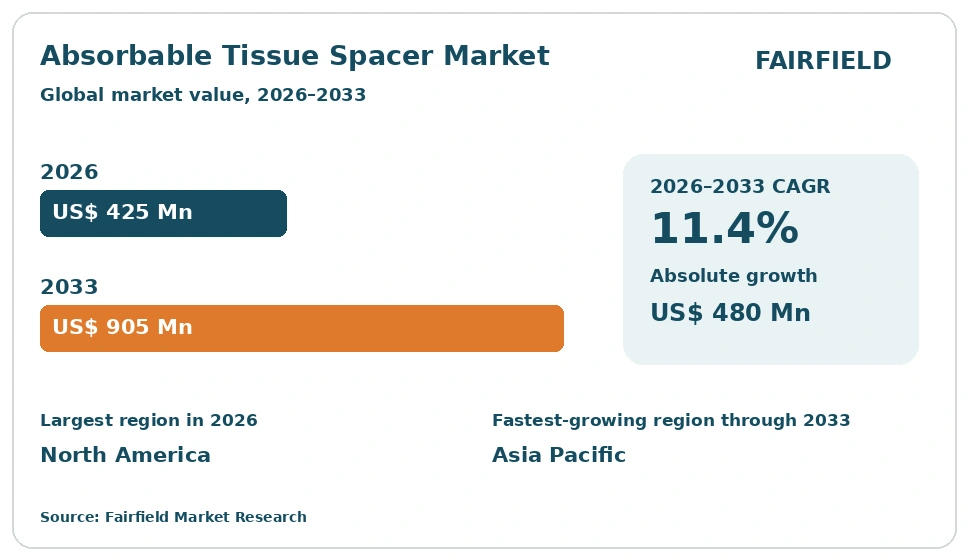
The global Absorbable Tissue Spacer market size is expected to be valued at US$ 425 Mn in 2026 and projected to reach US$ 905 Mn by 2033, growing at a CAGR of 11.4% between 2026 and 2033. Growth tracks rising radiotherapy procedure volumes, wider installed bases of image-guided treatment systems, and steady adoption of resorbable polymer implants in oncology surgery. Between 2020 and 2025 the market grew at a CAGR of 9.6%, and the pace quickens as spacer placement moves from academic centres into community practice. The absolute dollar opportunity over the forecast period reaches US$ 480 Mn. Procedure-linked consumable demand now sets market direction.
Key Report Takeaways
- By Product Type: Hydrogel spacers led with 58.6% share in 2026, while biopolymer and collagen spacers are projected to expand at a 13.2% CAGR through 2033, supported by established surgeon familiarity with resorbable collagen implants in general surgical suites.
- By Material: Polyethylene glycol held 54.3% share in 2026, while hyaluronic acid formulations are set to grow at a 13.6% CAGR through 2033, helped by existing hospital supply contracts for hyaluronic acid injectables.
- By Application: Prostate cancer radiotherapy accounted for 62.4% share in 2026, while cervical and gynecologic oncology is forecast to advance at a 14.1% CAGR through 2033, as brachytherapy suites expand image-guided procedure capacity.
- By End User: Hospitals commanded 48.2% share in 2026, while ambulatory surgical centres are projected to rise at a 13.9% CAGR through 2033, reflecting payer pressure to move short placement procedures out of inpatient settings.
- By Geography: North America led with 46.8% share in 2026, while Asia Pacific is expected to post a 14.8% CAGR through 2033, driven by national radiotherapy buildout programmes across China, India, Japan and South Korea.
Market Trends and Insights
Market Growth Drivers
Expanding Radiotherapy Capacity Lifts Procedure-Linked Spacer Demand
Growing radiotherapy volumes are lifting demand for absorbable tissue spacers across oncology programmes. Treatment centres keep adding linear accelerators and brachytherapy suites, and every added treatment slot widens the pool of candidates for spacer placement. Manufacturers position these devices as procedure-linked consumables, so revenue scales with case counts rather than capital replacement cycles. Hospitals buying radiotherapy equipment now budget for soft-tissue separation products in the same procurement round.
Behind this sits a steady rise in cancer case volumes among ageing populations in North America, Europe and Asia Pacific. Screening programmes detect localised disease earlier, raising the share of patients managed with definitive radiotherapy. Urology and radiation oncology groups have built structured placement workflows under ultrasound or CT guidance, standardising technique. Contract manufacturers have widened capacity for absorbable polymer implants, supporting supply as order volumes climb.
Precision Radiotherapy Workflows Favour Engineered Tissue Separation
The shift toward precision radiotherapy is pulling spacer products deeper into standard treatment planning. Hypofractionated schedules concentrate dose into fewer sessions, and planners value predictable, reproducible anatomy between target and adjacent structures. Absorbable spacers create that physical separation mechanically, so they fit into planning software, contouring steps and quality-assurance checks. Vendors sell into this workflow by matching product handling characteristics to existing image guidance hardware.
Supporting this is the broad installed base of stereotactic and image-guided platforms now running in mid-sized hospitals rather than only academic centres. Treatment planning vendors have improved soft-tissue contouring tools, making separation distance easier to document. Professional societies in radiation oncology and urology publish procedural and credentialing guidance that formalises placement technique. That formalisation lowers perceived novelty and widens the base of trained operators across community hospital practice.
Restraints Impact Analysis of Market
Reimbursement Variability Slows Adoption in Cost-Sensitive Systems
Uneven reimbursement remains the largest brake on absorbable tissue spacer adoption. Coverage for the placement procedure and for the implant differs sharply between public payers, private insurers and single-payer health systems. Where the device sits outside a bundled payment, the hospital absorbs the cost, and value-analysis committees resist any addition to the per-case bill. That dynamic delays formulary approval even in centres with the technical capability to place spacers.
Health technology assessment bodies in Europe and Asia apply formal cost-effectiveness thresholds before granting routine funding. Each national submission takes time, requires locally relevant economic modelling, and may end in restricted-use coverage. Manufacturers run parallel market-access programmes country by country rather than relying on one approval. Hospital procurement groups increasingly demand budget-impact evidence before stocking the product, which lengthens sales cycles and limits volume commitments.
Training Burden and Added Case Cost Constrain Community Uptake
Procedural training requirements limit how quickly spacer placement spreads beyond specialist centres. Placement is an added interventional step needing image guidance, sterile setup, and an operator comfortable with the relevant anatomy. Smaller radiotherapy units often lack staffing to add a procedure room session before treatment planning begins. The result is usage concentrated in larger hospitals, with slower penetration across community oncology networks.
Cost structure compounds the constraint. The implant, the guidance equipment time and the proceduralist’s time land on one case, in settings already managing tight oncology service margins. Vendors respond with proctoring programmes, simulation training and simplified delivery systems that shorten the learning curve. Supply chains for absorbable polymers also carry shelf-life handling requirements that add inventory cost. Together these factors keep the trained operator base narrower than the eligible patient base.
Market Opportunities
Widening Clinical Applications Beyond Prostate Radiotherapy
Expansion into anatomies beyond the prostate represents the clearest new revenue pool. Gynecologic brachytherapy, head and neck treatment, and abdominal or pelvic surgical separation share the same core requirement for a temporary, resorbable barrier between adjacent tissues. Each indication adds a distinct delivery system, a different volume profile and a separate call point inside the hospital. Vendors with modular platform technology can address several at once.
Development activity reflects that logic. Companies engineer viscosity, resorption window and radiopacity options so one material platform serves multiple procedure types. Regulatory bodies including the FDA and the EMA maintain established pathways for absorbable implantable devices, giving manufacturers a predictable route for indication expansion. Surgical adhesion barriers and resorbable marker implants already sit in the same hospital catalogues, letting established surgical suppliers enter through existing distribution.
Emerging Market Radiotherapy Buildout Opens New Demand Centres
National radiotherapy expansion programmes in emerging economies create a long-run demand base that barely exists today. Governments across Asia Pacific, Latin America and the Middle East are financing new cancer centres to close documented gaps in treatment machine availability per million population. Each new centre becomes a potential account, and early-entering vendors shape purchasing standards before incumbents arrive. The commercial prize is standard-setting access rather than immediate volume.
Execution depends on local infrastructure and pricing. Manufacturers are building distributor networks, regional training centres and tiered product configurations priced for public tender processes. Local manufacturing partnerships help meet domestic content rules several governments apply to device procurement. Ambulatory surgical facilities in these markets are also growing quickly, giving vendors a second channel alongside public hospitals. Over the forecast period these programmes convert treatment access gaps into addressable demand.
Category-wise Insights
Why Do Hydrogel Spacers Hold the Largest Product Share?
Hydrogel spacers lead with 58.6% share in 2026, while biopolymer and collagen spacers grow fastest at a 13.2% CAGR through 2033. Hydrogel dominance rests on the longest commercial track record in radiotherapy spacing, the widest body of procedural training material, and delivery systems designed around existing transperineal ultrasound workflows.
Biopolymer and collagen products grow faster from a smaller base. Surgical departments already stock resorbable collagen implants, so the supply relationship exists before the oncology application arrives. These materials also suit procedures preferring a shorter resorption window. For the broader market, the pattern signals a shift from a single-material category toward a portfolio category, where vendors compete on handling characteristics and procedure fit. Balloon spacers at 16.4% share retain a niche in centres favouring a removable, mechanically fixed option.
Polyethylene Glycol Anchors Material Demand While Hyaluronic Acid Accelerates
Polyethylene glycol holds 54.3% of material demand in 2026, while hyaluronic acid grows fastest at a 13.6% CAGR through 2033. PEG leads because its crosslinking chemistry allows controlled gelation at the point of placement and a predictable resorption profile, both of which simplify procedure planning. The polymer is also well characterised in regulatory submissions for absorbable implants.
Hyaluronic acid gains ground for commercial as much as technical reasons. Hospitals already purchase hyaluronic acid products for orthopaedic and ophthalmic use, so contracting, storage and handling are familiar. Suppliers with fermentation-derived capacity can scale output without new plant investment. Collagen at 17.1% share serves procedures needing a firmer implant structure. Material mix matters strategically because raw material sourcing increasingly determines gross margin and supply resilience.
Which Application Segment Leads the Absorbable Tissue Spacer Market?
Prostate cancer radiotherapy leads applications with 62.4% share in 2026, while cervical and gynecologic oncology expands fastest at a 14.1% CAGR through 2033. Prostate treatment leads because it combines high global case volumes, a well-defined placement anatomy, and the most mature pool of trained operators. Departments in developed markets have run these workflows long enough for them to sit in standard budgets.
Gynecologic oncology grows faster as brachytherapy capacity expands and applicator and imaging technology improve. The procedure base is large in Asia Pacific and Latin America. Head and neck and other oncology applications hold 12.3% share and depend on more specialised delivery tools. Application diversification reduces dependence on a single tumour type and spreads commercial risk across hospital departments with separate purchasing cycles.
Hospitals Lead End Users While Ambulatory Facilities Grow Quickest
Hospitals hold 48.2% of end-user demand in 2026, while ambulatory surgical centres grow fastest at a 13.9% CAGR through 2033. Hospitals lead because they house the combination of imaging suites, radiation oncology departments and interventional staff that placement requires. They also carry the administrative capacity to run value-analysis reviews and negotiate volume contracts directly.
Ambulatory surgical centres grow quickest as payers push short, scheduled procedures into lower-cost sites of care. Placement fits that profile, and portable ultrasound makes the required guidance affordable outside hospital walls. Dedicated cancer and radiation oncology centres hold 29.6% share and often adopt new product formats early. The end-user shift matters commercially because it changes the sales model, moving vendors toward distributor-led coverage of many small accounts rather than direct selling into a few large ones.
Geography Analysis
Which Region Is Leading the Absorbable Tissue Spacer Market?
North America leads the absorbable tissue spacer market with 46.8% share in 2026 and a forecast CAGR of 10.2% through 2033. The United States supplies most of that revenue, with Canada contributing a smaller volume. Leadership rests on a dense installed base of image-guided radiotherapy systems, a large pool of credentialed urologists and radiation oncologists, and established coding pathways that make placement administratively routine. Integrated delivery networks run centralised value-analysis processes, so once a product clears review it spreads quickly across member hospitals. Physician-owned ambulatory facilities add a second purchasing channel outside the academic system. Mature distribution and strong field-support coverage keep training capacity close to the point of care.
Europe Builds Volume Through Structured Health Technology Assessment
Europe holds 26.3% share in 2026 and is projected to expand at an 11.1% CAGR through 2033. Germany, France, the United Kingdom, Italy and Spain account for most regional demand. National health technology assessment processes govern uptake, so adoption follows a slower but more durable pattern once funding is granted. Regional radiotherapy networks concentrate treatment in designated centres, creating fewer but larger accounts. The EU Medical Device Regulation raises documentation requirements for absorbable implants, favouring manufacturers with mature quality systems. Public tenders reward suppliers able to commit multi-year pricing. Cross-border clinical collaboration among European radiation oncology groups spreads standardised placement technique between member states.
Which Region Is Growing Fastest in the Absorbable Tissue Spacer Market?
Asia Pacific is growing fastest, at a 14.8% CAGR through 2033, from an 18.4% share in 2026. China, India, Japan, South Korea and Australia drive that expansion. China and India are financing large increases in radiotherapy machine installations to close shortfalls in treatment capacity per million population, and each new centre adds addressable procedure volume. Japan and South Korea contribute through high per-capita oncology spending and early adoption of precision treatment platforms. Rising private hospital investment creates demand for differentiated procedure offerings. Regional regulators have streamlined review pathways for implantable devices already cleared in major markets. Domestic polymer manufacturing capacity is also maturing, supporting local supply and competitive public procurement pricing.
Latin America Expands as Public Cancer Networks Modernise
Latin America accounts for 5.2% share in 2026 with a forecast CAGR of 11.9% through 2033. Brazil and Mexico lead, followed by Argentina, Chile and Colombia. Growth comes from public investment in regional cancer centres and from private hospital groups competing on treatment technology. Brazil’s public health network purchases through centralised tenders, rewarding suppliers that meet local registration and pricing requirements. High cervical cancer incidence supports gynecologic brachytherapy demand. Currency volatility and import duties remain practical constraints, and distributor partnerships are the standard route to market. Manufacturers investing early in proctor training build durable positions with a limited number of high-volume treatment centres.
Middle East & Africa Advances From a Narrow Installed Base
Middle East & Africa represents 3.3% share in 2026 and a projected 10.7% CAGR through 2033. Saudi Arabia, the United Arab Emirates, Israel, Turkey and South Africa account for most activity. Gulf states are building tertiary oncology capacity under national development plans, and these projects specify current-generation radiotherapy technology from the outset. Israel contributes an active medical device development base alongside strong domestic clinical demand. Adoption across Sub-Saharan Africa stays limited by machine availability and constrained public budgets. Regulatory harmonisation across Gulf states simplifies multi-country registration. Medical tourism into regional centres of excellence adds incremental procedure volume at a small number of large facilities.
Competitive Landscape
The absorbable tissue spacer market is moderately concentrated. A small group of device makers holds most radiotherapy spacer revenue, supported by first-mover training networks and established hospital contracts. Around them sits a wider set of surgical and wound-care suppliers whose absorbable barrier and resorbable implant portfolios overlap with the category. Consolidation has pulled specialist spacer developers into larger diversified device groups, giving those products access to global sales infrastructure. The pattern signals a market moving from clinician-led early adoption toward structured enterprise procurement.
Competition centres on material science and procedure fit rather than headline device features. Vendors differentiate through resorption profile control, deployment handling, imaging visibility, shelf-life and delivery system ergonomics. Manufacturing capability matters as much as design, since absorbable polymer production demands tight process control and validated sterilisation. Newer entrants arrive from two directions: biomaterials specialists with hydrogel or hyaluronic acid platforms, and regional manufacturers in Asia pursuing domestic procurement programmes.
Strategic activity concentrates on indication expansion, geographic registration and training capacity. Portfolio companies extend a single material platform across several anatomies to spread development cost over more revenue. Partnerships with imaging and treatment planning vendors embed the product inside the workflow a department already uses, which raises switching cost. Investment in proctoring and simulation functions as a competitive asset, since the trained operator base defines the near-term addressable market.
The direction of travel favours breadth. Vendors combining validated absorbable materials, multi-indication delivery systems, market-access capability across several reimbursement regimes and distributed clinical training will shape how the category develops through 2033.
Industry Leaders
- Boston Scientific Corporation
- Teleflex Incorporated
- Palette Life Sciences
- BioProtect Ltd.
- Integra LifeSciences Holdings Corporation
- Baxter International Inc.
Companies Covered in the Report
- Boston Scientific Corporation
- Teleflex Incorporated
- Palette Life Sciences
- BioProtect Ltd.
- Integra LifeSciences Holdings Corporation
- Baxter International Inc.
- Johnson & Johnson MedTech
- Medtronic plc
- B. Braun Melsungen AG
- Becton, Dickinson and Company
- Anika Therapeutics, Inc.
- Advanced Medical Solutions Group plc
- FzioMed, Inc.
- Hologic, Inc.
Absorbable Tissue Spacer Market Report Scope
Fairfield Market Research segments the absorbable tissue spacer market by product type, material, application, end user and region.
| By Product Type | Hydrogel Spacers, Balloon Spacers, Biopolymer and Collagen Spacers, Hyaluronic Acid Spacers |
| By Material | Polyethylene Glycol, Collagen, Hyaluronic Acid, Other Synthetic Absorbable Polymers |
| By Application | Prostate Cancer Radiotherapy, Cervical and Gynecologic Oncology, Head and Neck and Other Oncology, Surgical Tissue Separation |
| By End User | Hospitals, Cancer and Radiation Oncology Centres, Ambulatory Surgical Centres, Specialty Clinics |
| By Region | North America, Europe, Asia Pacific, Latin America, Middle East & Africa |
1. Executive Summary
1.1 Absorbable Tissue Spacer Market Snapshot
1.2 Future Projections
1.3 Key Industry Highlights
1.4 Geographical Snapshot
2. Market Overview
2.1 Market Definition and Segmentation
2.2 Historical Market Trends
2.3 Market Dynamics
2.3.1 Drivers
2.3.2 Restraints
2.3.3 Market Opportunities
3. Global Absorbable Tissue Spacer Market Outlook, 2026–2033
3.1 Global Absorbable Tissue Spacer Market Outlook, by Product Type, Value (US$ Mn), 2026–2033
3.1.1 Hydrogel Spacers
3.1.2 Balloon Spacers
3.1.3 Biopolymer and Collagen Spacers
3.1.4 Hyaluronic Acid Spacers
3.2 Global Absorbable Tissue Spacer Market Outlook, by Material, Value (US$ Mn), 2026–2033
3.2.1 Polyethylene Glycol
3.2.2 Collagen
3.2.3 Hyaluronic Acid
3.2.4 Other Synthetic Absorbable Polymers
3.3 Global Absorbable Tissue Spacer Market Outlook, by Application, Value (US$ Mn), 2026–2033
3.3.1 Prostate Cancer Radiotherapy
3.3.2 Cervical and Gynecologic Oncology
3.3.3 Head and Neck and Other Oncology
3.3.4 Surgical Tissue Separation
3.4 Global Absorbable Tissue Spacer Market Outlook, by End User, Value (US$ Mn), 2026–2033
3.4.1 Hospitals
3.4.2 Cancer and Radiation Oncology Centres
3.4.3 Ambulatory Surgical Centres
3.4.4 Specialty Clinics
3.5 Global Absorbable Tissue Spacer Market Outlook, by Region, Value (US$ Mn), 2026–2033
3.5.1 North America
3.5.2 Europe
3.5.3 Asia Pacific
3.5.4 Latin America
3.5.5 Middle East & Africa
4. North America Absorbable Tissue Spacer Market Outlook, 2026–2033
4.1 North America Absorbable Tissue Spacer Market Outlook, by Product Type, Value (US$ Mn), 2026–2033
4.1.1 Hydrogel Spacers
4.1.2 Balloon Spacers
4.1.3 Biopolymer and Collagen Spacers
4.1.4 Hyaluronic Acid Spacers
4.2 North America Absorbable Tissue Spacer Market Outlook, by Material, Value (US$ Mn), 2026–2033
4.2.1 Polyethylene Glycol
4.2.2 Collagen
4.2.3 Hyaluronic Acid
4.2.4 Other Synthetic Absorbable Polymers
4.3 North America Absorbable Tissue Spacer Market Outlook, by Application, Value (US$ Mn), 2026–2033
4.3.1 Prostate Cancer Radiotherapy
4.3.2 Cervical and Gynecologic Oncology
4.3.3 Head and Neck and Other Oncology
4.3.4 Surgical Tissue Separation
4.4 North America Absorbable Tissue Spacer Market Outlook, by End User, Value (US$ Mn), 2026–2033
4.4.1 Hospitals
4.4.2 Cancer and Radiation Oncology Centres
4.4.3 Ambulatory Surgical Centres
4.4.4 Specialty Clinics
4.5 North America Absorbable Tissue Spacer Market Outlook, by Country, Value (US$ Mn), 2026–2033
4.5.1 United States Absorbable Tissue Spacer Market Outlook, by Product Type, 2026–2033
4.5.2 United States Absorbable Tissue Spacer Market Outlook, by Material, 2026–2033
4.5.3 United States Absorbable Tissue Spacer Market Outlook, by Application, 2026–2033
4.5.4 United States Absorbable Tissue Spacer Market Outlook, by End User, 2026–2033
4.5.5 Canada Absorbable Tissue Spacer Market Outlook, by Product Type, 2026–2033
4.5.6 Canada Absorbable Tissue Spacer Market Outlook, by Material, 2026–2033
4.5.7 Canada Absorbable Tissue Spacer Market Outlook, by Application, 2026–2033
4.5.8 Canada Absorbable Tissue Spacer Market Outlook, by End User, 2026–2033
5. Europe Absorbable Tissue Spacer Market Outlook, 2026–2033
5.1 Europe Absorbable Tissue Spacer Market Outlook, by Product Type, Value (US$ Mn), 2026–2033
5.1.1 Hydrogel Spacers
5.1.2 Balloon Spacers
5.1.3 Biopolymer and Collagen Spacers
5.1.4 Hyaluronic Acid Spacers
5.2 Europe Absorbable Tissue Spacer Market Outlook, by Material, Value (US$ Mn), 2026–2033
5.2.1 Polyethylene Glycol
5.2.2 Collagen
5.2.3 Hyaluronic Acid
5.2.4 Other Synthetic Absorbable Polymers
5.3 Europe Absorbable Tissue Spacer Market Outlook, by Application, Value (US$ Mn), 2026–2033
5.3.1 Prostate Cancer Radiotherapy
5.3.2 Cervical and Gynecologic Oncology
5.3.3 Head and Neck and Other Oncology
5.3.4 Surgical Tissue Separation
5.4 Europe Absorbable Tissue Spacer Market Outlook, by End User, Value (US$ Mn), 2026–2033
5.4.1 Hospitals
5.4.2 Cancer and Radiation Oncology Centres
5.4.3 Ambulatory Surgical Centres
5.4.4 Specialty Clinics
5.5 Europe Absorbable Tissue Spacer Market Outlook, by Country, Value (US$ Mn), 2026–2033
5.5.1 Germany Absorbable Tissue Spacer Market Outlook, by Product Type, 2026–2033
5.5.2 Germany Absorbable Tissue Spacer Market Outlook, by Material, 2026–2033
5.5.3 Germany Absorbable Tissue Spacer Market Outlook, by Application, 2026–2033
5.5.4 Germany Absorbable Tissue Spacer Market Outlook, by End User, 2026–2033
5.5.5 France Absorbable Tissue Spacer Market Outlook, by Product Type, 2026–2033
5.5.6 France Absorbable Tissue Spacer Market Outlook, by Material, 2026–2033
5.5.7 France Absorbable Tissue Spacer Market Outlook, by Application, 2026–2033
5.5.8 France Absorbable Tissue Spacer Market Outlook, by End User, 2026–2033
5.5.9 United Kingdom Absorbable Tissue Spacer Market Outlook, by Product Type, 2026–2033
5.5.10 United Kingdom Absorbable Tissue Spacer Market Outlook, by Material, 2026–2033
5.5.11 United Kingdom Absorbable Tissue Spacer Market Outlook, by Application, 2026–2033
5.5.12 United Kingdom Absorbable Tissue Spacer Market Outlook, by End User, 2026–2033
5.5.13 Italy Absorbable Tissue Spacer Market Outlook, by Product Type, 2026–2033
5.5.14 Italy Absorbable Tissue Spacer Market Outlook, by Material, 2026–2033
5.5.15 Italy Absorbable Tissue Spacer Market Outlook, by Application, 2026–2033
5.5.16 Italy Absorbable Tissue Spacer Market Outlook, by End User, 2026–2033
5.5.17 Spain Absorbable Tissue Spacer Market Outlook, by Product Type, 2026–2033
5.5.18 Spain Absorbable Tissue Spacer Market Outlook, by Material, 2026–2033
5.5.19 Spain Absorbable Tissue Spacer Market Outlook, by Application, 2026–2033
5.5.20 Spain Absorbable Tissue Spacer Market Outlook, by End User, 2026–2033
6. Asia Pacific Absorbable Tissue Spacer Market Outlook, 2026–2033
6.1 Asia Pacific Absorbable Tissue Spacer Market Outlook, by Product Type, Value (US$ Mn), 2026–2033
6.1.1 Hydrogel Spacers
6.1.2 Balloon Spacers
6.1.3 Biopolymer and Collagen Spacers
6.1.4 Hyaluronic Acid Spacers
6.2 Asia Pacific Absorbable Tissue Spacer Market Outlook, by Material, Value (US$ Mn), 2026–2033
6.2.1 Polyethylene Glycol
6.2.2 Collagen
6.2.3 Hyaluronic Acid
6.2.4 Other Synthetic Absorbable Polymers
6.3 Asia Pacific Absorbable Tissue Spacer Market Outlook, by Application, Value (US$ Mn), 2026–2033
6.3.1 Prostate Cancer Radiotherapy
6.3.2 Cervical and Gynecologic Oncology
6.3.3 Head and Neck and Other Oncology
6.3.4 Surgical Tissue Separation
6.4 Asia Pacific Absorbable Tissue Spacer Market Outlook, by End User, Value (US$ Mn), 2026–2033
6.4.1 Hospitals
6.4.2 Cancer and Radiation Oncology Centres
6.4.3 Ambulatory Surgical Centres
6.4.4 Specialty Clinics
6.5 Asia Pacific Absorbable Tissue Spacer Market Outlook, by Country, Value (US$ Mn), 2026–2033
6.5.1 China Absorbable Tissue Spacer Market Outlook, by Product Type, 2026–2033
6.5.2 China Absorbable Tissue Spacer Market Outlook, by Material, 2026–2033
6.5.3 China Absorbable Tissue Spacer Market Outlook, by Application, 2026–2033
6.5.4 China Absorbable Tissue Spacer Market Outlook, by End User, 2026–2033
6.5.5 India Absorbable Tissue Spacer Market Outlook, by Product Type, 2026–2033
6.5.6 India Absorbable Tissue Spacer Market Outlook, by Material, 2026–2033
6.5.7 India Absorbable Tissue Spacer Market Outlook, by Application, 2026–2033
6.5.8 India Absorbable Tissue Spacer Market Outlook, by End User, 2026–2033
6.5.9 Japan Absorbable Tissue Spacer Market Outlook, by Product Type, 2026–2033
6.5.10 Japan Absorbable Tissue Spacer Market Outlook, by Material, 2026–2033
6.5.11 Japan Absorbable Tissue Spacer Market Outlook, by Application, 2026–2033
6.5.12 Japan Absorbable Tissue Spacer Market Outlook, by End User, 2026–2033
6.5.13 South Korea Absorbable Tissue Spacer Market Outlook, by Product Type, 2026–2033
6.5.14 South Korea Absorbable Tissue Spacer Market Outlook, by Material, 2026–2033
6.5.15 South Korea Absorbable Tissue Spacer Market Outlook, by Application, 2026–2033
6.5.16 South Korea Absorbable Tissue Spacer Market Outlook, by End User, 2026–2033
6.5.17 Australia Absorbable Tissue Spacer Market Outlook, by Product Type, 2026–2033
6.5.18 Australia Absorbable Tissue Spacer Market Outlook, by Material, 2026–2033
6.5.19 Australia Absorbable Tissue Spacer Market Outlook, by Application, 2026–2033
6.5.20 Australia Absorbable Tissue Spacer Market Outlook, by End User, 2026–2033
7. Latin America Absorbable Tissue Spacer Market Outlook, 2026–2033
7.1 Latin America Absorbable Tissue Spacer Market Outlook, by Product Type, Value (US$ Mn), 2026–2033
7.1.1 Hydrogel Spacers
7.1.2 Balloon Spacers
7.1.3 Biopolymer and Collagen Spacers
7.1.4 Hyaluronic Acid Spacers
7.2 Latin America Absorbable Tissue Spacer Market Outlook, by Material, Value (US$ Mn), 2026–2033
7.2.1 Polyethylene Glycol
7.2.2 Collagen
7.2.3 Hyaluronic Acid
7.2.4 Other Synthetic Absorbable Polymers
7.3 Latin America Absorbable Tissue Spacer Market Outlook, by Application, Value (US$ Mn), 2026–2033
7.3.1 Prostate Cancer Radiotherapy
7.3.2 Cervical and Gynecologic Oncology
7.3.3 Head and Neck and Other Oncology
7.3.4 Surgical Tissue Separation
7.4 Latin America Absorbable Tissue Spacer Market Outlook, by End User, Value (US$ Mn), 2026–2033
7.4.1 Hospitals
7.4.2 Cancer and Radiation Oncology Centres
7.4.3 Ambulatory Surgical Centres
7.4.4 Specialty Clinics
7.5 Latin America Absorbable Tissue Spacer Market Outlook, by Country, Value (US$ Mn), 2026–2033
7.5.1 Brazil Absorbable Tissue Spacer Market Outlook, by Product Type, 2026–2033
7.5.2 Brazil Absorbable Tissue Spacer Market Outlook, by Material, 2026–2033
7.5.3 Brazil Absorbable Tissue Spacer Market Outlook, by Application, 2026–2033
7.5.4 Brazil Absorbable Tissue Spacer Market Outlook, by End User, 2026–2033
7.5.5 Mexico Absorbable Tissue Spacer Market Outlook, by Product Type, 2026–2033
7.5.6 Mexico Absorbable Tissue Spacer Market Outlook, by Material, 2026–2033
7.5.7 Mexico Absorbable Tissue Spacer Market Outlook, by Application, 2026–2033
7.5.8 Mexico Absorbable Tissue Spacer Market Outlook, by End User, 2026–2033
7.5.9 Argentina Absorbable Tissue Spacer Market Outlook, by Product Type, 2026–2033
7.5.10 Argentina Absorbable Tissue Spacer Market Outlook, by Material, 2026–2033
7.5.11 Argentina Absorbable Tissue Spacer Market Outlook, by Application, 2026–2033
7.5.12 Argentina Absorbable Tissue Spacer Market Outlook, by End User, 2026–2033
7.5.13 Chile Absorbable Tissue Spacer Market Outlook, by Product Type, 2026–2033
7.5.14 Chile Absorbable Tissue Spacer Market Outlook, by Material, 2026–2033
7.5.15 Chile Absorbable Tissue Spacer Market Outlook, by Application, 2026–2033
7.5.16 Chile Absorbable Tissue Spacer Market Outlook, by End User, 2026–2033
7.5.17 Colombia Absorbable Tissue Spacer Market Outlook, by Product Type, 2026–2033
7.5.18 Colombia Absorbable Tissue Spacer Market Outlook, by Material, 2026–2033
7.5.19 Colombia Absorbable Tissue Spacer Market Outlook, by Application, 2026–2033
7.5.20 Colombia Absorbable Tissue Spacer Market Outlook, by End User, 2026–2033
8. Middle East & Africa Absorbable Tissue Spacer Market Outlook, 2026–2033
8.1 Middle East & Africa Absorbable Tissue Spacer Market Outlook, by Product Type, Value (US$ Mn), 2026–2033
8.1.1 Hydrogel Spacers
8.1.2 Balloon Spacers
8.1.3 Biopolymer and Collagen Spacers
8.1.4 Hyaluronic Acid Spacers
8.2 Middle East & Africa Absorbable Tissue Spacer Market Outlook, by Material, Value (US$ Mn), 2026–2033
8.2.1 Polyethylene Glycol
8.2.2 Collagen
8.2.3 Hyaluronic Acid
8.2.4 Other Synthetic Absorbable Polymers
8.3 Middle East & Africa Absorbable Tissue Spacer Market Outlook, by Application, Value (US$ Mn), 2026–2033
8.3.1 Prostate Cancer Radiotherapy
8.3.2 Cervical and Gynecologic Oncology
8.3.3 Head and Neck and Other Oncology
8.3.4 Surgical Tissue Separation
8.4 Middle East & Africa Absorbable Tissue Spacer Market Outlook, by End User, Value (US$ Mn), 2026–2033
8.4.1 Hospitals
8.4.2 Cancer and Radiation Oncology Centres
8.4.3 Ambulatory Surgical Centres
8.4.4 Specialty Clinics
8.5 Middle East & Africa Absorbable Tissue Spacer Market Outlook, by Country and Subregion, Value (US$ Mn), 2026–2033
8.5.1 Saudi Arabia Absorbable Tissue Spacer Market Outlook, by Product Type, 2026–2033
8.5.2 Saudi Arabia Absorbable Tissue Spacer Market Outlook, by Material, 2026–2033
8.5.3 Saudi Arabia Absorbable Tissue Spacer Market Outlook, by Application, 2026–2033
8.5.4 Saudi Arabia Absorbable Tissue Spacer Market Outlook, by End User, 2026–2033
8.5.5 United Arab Emirates Absorbable Tissue Spacer Market Outlook, by Product Type, 2026–2033
8.5.6 United Arab Emirates Absorbable Tissue Spacer Market Outlook, by Material, 2026–2033
8.5.7 United Arab Emirates Absorbable Tissue Spacer Market Outlook, by Application, 2026–2033
8.5.8 United Arab Emirates Absorbable Tissue Spacer Market Outlook, by End User, 2026–2033
8.5.9 Israel Absorbable Tissue Spacer Market Outlook, by Product Type, 2026–2033
8.5.10 Israel Absorbable Tissue Spacer Market Outlook, by Material, 2026–2033
8.5.11 Israel Absorbable Tissue Spacer Market Outlook, by Application, 2026–2033
8.5.12 Israel Absorbable Tissue Spacer Market Outlook, by End User, 2026–2033
8.5.13 Turkey Absorbable Tissue Spacer Market Outlook, by Product Type, 2026–2033
8.5.14 Turkey Absorbable Tissue Spacer Market Outlook, by Material, 2026–2033
8.5.15 Turkey Absorbable Tissue Spacer Market Outlook, by Application, 2026–2033
8.5.16 Turkey Absorbable Tissue Spacer Market Outlook, by End User, 2026–2033
8.5.17 South Africa Absorbable Tissue Spacer Market Outlook, by Product Type, 2026–2033
8.5.18 South Africa Absorbable Tissue Spacer Market Outlook, by Material, 2026–2033
8.5.19 South Africa Absorbable Tissue Spacer Market Outlook, by Application, 2026–2033
8.5.20 South Africa Absorbable Tissue Spacer Market Outlook, by End User, 2026–2033
8.5.21 Gulf states Absorbable Tissue Spacer Market Outlook, by Product Type, 2026–2033
8.5.22 Gulf states Absorbable Tissue Spacer Market Outlook, by Material, 2026–2033
8.5.23 Gulf states Absorbable Tissue Spacer Market Outlook, by Application, 2026–2033
8.5.24 Gulf states Absorbable Tissue Spacer Market Outlook, by End User, 2026–2033
9. Competitive Landscape
9.1 Industry Leaders
9.2 Company Profiles
9.2.1 Boston Scientific Corporation
9.2.2 Teleflex Incorporated
9.2.3 Palette Life Sciences
9.2.4 BioProtect Ltd.
9.2.5 Integra LifeSciences Holdings Corporation
9.2.6 Baxter International Inc.
9.2.7 Johnson & Johnson MedTech
9.2.8 Medtronic plc
9.2.9 B. Braun Melsungen AG
9.2.10 Becton, Dickinson and Company
9.2.11 Anika Therapeutics, Inc.
9.2.12 Advanced Medical Solutions Group plc
9.2.13 FzioMed, Inc.
9.2.14 Hologic, Inc.
10. Appendix
10.1 Research Methodology
10.2 Report Assumptions
10.3 Acronyms and Abbreviations
| By Product Type | Hydrogel Spacers, Balloon Spacers, Biopolymer and Collagen Spacers, Hyaluronic Acid Spacers |
| By Material | Polyethylene Glycol, Collagen, Hyaluronic Acid, Other Synthetic Absorbable Polymers |
| By Application | Prostate Cancer Radiotherapy, Cervical and Gynecologic Oncology, Head and Neck and Other Oncology, Surgical Tissue Separation |
| By End User | Hospitals, Cancer and Radiation Oncology Centres, Ambulatory Surgical Centres, Specialty Clinics |
| By Region | North America, Europe, Asia Pacific, Latin America, Middle East & Africa |
Our Research Methodology
Considering the volatility of business today, traditional approaches to strategizing a game plan can be unfruitful if not detrimental. True ambiguity is no way to determine a forecast. A myriad of predetermined factors must be accounted for such as the degree of risk involved, the magnitude of circumstances, as well as conditions or consequences that are not known or unpredictable. To circumvent binary views that cast uncertainty, the application of market research intelligence to strategically posture, move, and enable actionable outcomes is necessary.
View Methodology
Quality Assured
Rigorous Validation Process

Confidentiality Assured
End-to-end Data Security

Custom Research Services
Tailored To Your Objectives
FAQs
The market is valued at US$ 425 Mn in 2026 and is projected to reach US$ 905 Mn by 2033.
The market is forecast to grow at a CAGR of 11.4% between 2026 and 2033, supported by rising radiotherapy procedure volumes across hospitals worldwide.
Hydrogel spacers led with 58.6% share in 2026, helped by the longest commercial track record and delivery systems built around ultrasound-guided placement workflows.
North America held 46.8% share in 2026, supported by its dense installed base of image-guided radiotherapy systems and established procedural coding pathways.
Asia Pacific is growing fastest at a 14.8% CAGR through 2033, driven by national radiotherapy capacity expansion across China, India, Japan and South Korea.
Related Reports
Glucose Tolerance Test Market Size, Share, Insights, Competitive Landscape, and Forecast 2026 to 2033
The global glucose tolerance test market is valued at US$1.97 billion in 2026, reaching US$2.98 billion by 2033, growing at a 6.1% CAGR
Medical Fiber Optics Market Size, Share, Insights, Competitive Landscape, and Forecast 2026 to 2033
The medical fiber optics market is projected to grow from US$1.4 billion in 2026 to US$1.9 billion by 2033 at a 4.5% CAGR.
Laser Hair Removal Market Size, Share, Insights, Competitive Landscape, and Forecast 2026 to 2033
The laser hair removal market is projected to reach US$4.5 billion by 2033. Explore diode and multi-wavelength devices, clinic demand, and regional growth.
Joint Reconstruction Devices Market Size, Share, Insights, Competitive Landscape, and Forecast 2026 to 2033
The joint reconstruction devices market is projected to reach US$35.2 billion by 2033. Explore knee and hip implants, revision procedures, and surgical robotics.
Interventional Cardiology Devices Market Size, Share, Insights, Competitive Landscape, and Forecast 2026 to 2033
The global interventional cardiology devices market is valued at US$18.0 billion in 2026, reaching US$26.4 billion by 2033, growing at a 5.62% CAGR
Infusion Catheter Market Size, Share, Insights, Competitive Landscape, and Forecast 2026 to 2033
The infusion catheter market is projected to reach US$4.97 billion by 2033 at a 10.1% CAGR, driven by growth in outpatient and home infusion care.