



Infusion Catheter Market
Infusion Catheter Market Size, Share, Insights, Competitive Landscape, and Forecast 2026 to 2033
Infusion Catheter Market Snapshot
How Fast Is the Infusion Catheter Market Growing?
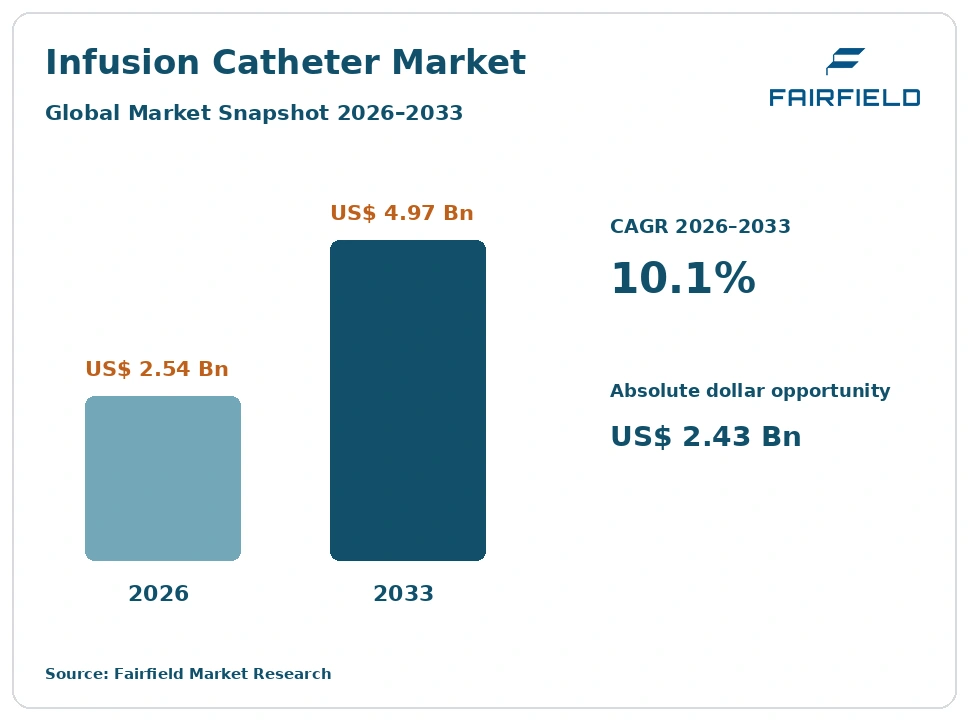
The global infusion catheter market size is expected to be valued at US$ 2.54 billion in 2026 and projected to reach US$ 4.97 billion by 2033, growing at a CAGR of 10.1% between 2026 and 2033.
Between 2020 and 2025, the market grew at a CAGR of about 8.6%, as COVID-19 sharply increased hospital use of central lines and infusions in 2020 and 2021, then elective procedures, cancer treatment, and outpatient infusion recovered strongly. The infusion catheter market covers catheters used to deliver fluids, drugs, nutrition, blood products, and contrast media into veins, arteries, or other spaces, including peripheral IV catheters, midline catheters, central venous catheters, peripherally inserted central catheters, implanted ports, thermodilution catheters, anesthesia and epidural catheters, and infusion catheters used in vascular procedures. These vascular access devices are made from polyurethane, silicone, and other materials. They are used in hospitals, clinics, ambulatory surgery centers, and home care. Growth comes from chronic disease, cancer therapy, an aging population, and home infusion. In June 2026, BD announced the Japan launch of its PowerGlide Pro midline catheter.
Key Report Takeaways
- By Product Type: Thermodilution Catheters held about 31% share in 2025, while Anesthesia Catheters is projected to expand at an 11.4% CAGR through 2033, driven by growing surgical volumes, regional anesthesia, and continuous nerve block use for pain control after operations.
- By Material: Polyurethane held about 46% share in 2025, while Silicone is projected to expand at an 11.2% CAGR through 2033, driven by long-term ports, tunneled catheters, and home infusion needing soft, durable, biocompatible materials.
- By End User: Hospitals held about 48% share in 2025, while Clinics is projected to expand at an 11.0% CAGR through 2033, driven by the shift of chemotherapy, biologic infusions, and minor procedures to outpatient and specialty settings.
- By Region: North America held about 36% share in 2025, while Asia Pacific is projected to expand at an 11.8% CAGR through 2033, driven by hospital expansion, rising surgery and cancer treatment volumes, and growing medical device production in China and India.
Global Infusion Catheter Market Trends and Insights
Drivers Impact Analysis
Two drivers carry the strongest influence on infusion catheter market demand during the forecast period.
| Driver | Impact on CAGR Forecast | Geographic Relevance | Impact Timeline |
| Rising chronic disease, cancer, and surgical volumes | High | Global | Long term (≥4 years) |
| Growth of outpatient and home infusion | Medium | North America, Europe, Asia Pacific | Medium term (2-4 years) |
Disease Burden Is Driving the Infusion Catheter Market
Rising chronic disease, cancer, and surgical volumes are the strongest driver of the infusion catheter market. More patients need infusions.
The mechanism is the central role of catheters in modern care. Most hospital patients receive at least one IV catheter, and many need fluids, antibiotics, pain medicines, or nutrition through a vein. Cancer patients often need long-term access for chemotherapy and biologic drugs, using ports and peripherally inserted central catheters. Diabetes, kidney disease, heart disease, and infections add to demand. Surgery volumes are rising with aging populations, and regional anesthesia catheters are used more for pain control after joint replacements and other operations. Critical care patients need central lines and thermodilution catheters to monitor heart function. Populations over 65 are growing quickly in Japan, Europe, China, and North America, increasing hospital stays and treatments. These trends support steady, long-term demand.
Outpatient and Home Infusion Is Expanding the Infusion Catheter Market
The growth of outpatient and home infusion is expanding the infusion catheter market. Care is moving out of hospitals.
The cause is cost pressure and patient preference. Health systems and insurers want to reduce expensive hospital stays, so more antibiotics, chemotherapy, biologics, and nutrition are given in infusion centers, clinics, and patients’ homes. These settings need catheters that can stay in place safely for days or weeks, such as midlines, peripherally inserted central catheters, and ports. Specialty drugs for autoimmune diseases, cancer, and rare conditions are often infused regularly. Home infusion companies are growing in the United States and Europe, and patients prefer receiving treatment at home when it is safe. Remote monitoring and nurse visits support home therapy. These trends expand sales of long-dwell and safety catheters.
Restraints Impact Analysis
Two restraints limit how quickly the infusion catheter market grows.
| Restraint | Impact on CAGR Forecast | Geographic Relevance | Impact Timeline |
| Catheter-related infections and complications | High | Global | Long term (≥4 years) |
| Pricing pressure and strict regulation | Medium | North America, Europe | Medium term (2-4 years) |
Infection Risks Slow the Infusion Catheter Market
Catheter-related infections and complications slow the infusion catheter market. Every catheter carries some risk.
The specific causes are the invasive nature of vascular access. Catheters can introduce bacteria into the bloodstream, causing central line-associated bloodstream infections that are serious, costly, and sometimes fatal. Other complications include blood clots, vein irritation, blockages, and catheters slipping out. Hospitals face penalties and public reporting for infection rates in some countries, such as the United States, which pushes them to limit unnecessary catheter use and remove lines quickly. Programs to reduce central line use in favor of peripheral catheters can lower demand for higher-value products. Training and care bundles add costs. These factors slow growth in some segments, though they also boost demand for safer, coated, and needle-free designs.
Pricing Pressure Restricts the Infusion Catheter Market
Pricing pressure and strict regulation restrict the infusion catheter market. Buyers push for lower prices.
The underlying causes are hospital purchasing power and device rules. Group purchasing organizations in the United States and tenders in Europe and China drive down prices for standard catheters. China’s volume-based procurement has cut prices for many devices, and India caps prices on some medical products. Medical device rules in Europe add certification costs and delays for new products. Supply chain disruptions and raw material costs squeeze margins, and sterilization limits on ethylene oxide in the United States add pressure on producers. Recalls of faulty catheters can damage reputations and lead to costly fixes. Smaller suppliers struggle to meet the clinical evidence demanded by hospitals. Reimbursement for some procedures does not cover premium devices. These factors restrict growth.
Market Opportunities
Long-Dwell and Difficult Access Catheters Open a Fast-Growth Revenue Pool
Long-dwell and difficult access catheters open a fast-growth revenue pool in the infusion catheter market. Many patients have hard-to-find veins.
Producers can capture this opportunity. A large share of hospital patients have difficult intravenous access because of age, obesity, chronic illness, or repeated treatments, leading to multiple needlesticks, delays, and escalation to central lines. Longer peripheral catheters, midlines, and ultrasound-guided placement can reach deeper veins and stay in longer, reducing restarts and patient discomfort. In May 2026, B. Braun received FDA clearance for its Introcan Safety Deep Access XL catheter, and in June 2026, BD announced the Japan launch of its PowerGlide Pro midline catheter. Companies offering long-dwell, safety, and ultrasound-friendly designs, along with training, can win share and premium prices.
Emerging Market Hospital Expansion Creates a Growth Revenue Pool
Emerging market hospital expansion creates a growth revenue pool in the infusion catheter market. New hospitals need large catheter volumes.
Suppliers can capture this opportunity as demand rises. Rising incomes and aging populations add patients. Governments in China, India, Indonesia, Saudi Arabia, and Brazil are building hospitals, cancer centers, and intensive care units, and health insurance programs are bringing millions more patients into hospital care each year. Safety catheters that protect workers from needlestick injuries are being adopted as rules tighten in many countries. Local manufacturing reduces costs, shortens delivery times, and supports government programs that favor domestic products. Training nurses and doctors in modern vascular access practices also builds demand for better devices and lowers infection rates. Companies with affordable portfolios, local production, and training programs can grow quickly.
Segment Analysis
By Product Type: Thermodilution Catheters Lead While Anesthesia Catheters Grow Fastest
Thermodilution Catheters held about 31% share in 2025. These catheters are placed in the heart and lungs to measure blood flow and pressure and to deliver fluids and drugs in critically ill patients, especially during heart surgery and intensive care. Their higher price supports a large value share, and use is steady in cardiac and critical care units.
Anesthesia Catheters is the fastest-growing product type, expanding at an 11.4% CAGR through 2033. Epidural and peripheral nerve block catheters deliver local anesthetics continuously after surgery, reducing the need for opioid painkillers and helping patients recover faster. Surgery volumes and enhanced recovery programs are driving use. Peripheral IV catheters, midlines, central venous catheters, peripherally inserted central catheters, ports, and other infusion catheters form further segments, with peripheral IV catheters used in most hospital patients. For the market, anesthesia growth adds value.
By Material: Polyurethane Leads While Silicone Grows Fastest
Polyurethane held about 46% share in 2025. Polyurethane catheters are strong, kink-resistant, and soften at body temperature, making them the standard for peripheral IV catheters, midlines, and many central lines. They allow thin walls with large inner channels, supporting high flow rates and power injection of contrast media.
Silicone is the fastest-growing material, expanding at an 11.2% CAGR through 2033. Silicone is soft, flexible, resistant to many drugs, and highly biocompatible, making it suitable for long-term tunneled catheters, implanted ports, and catheters used in home infusion and cancer care. Other materials, including polyvinyl chloride and coated or antimicrobial catheters, form further segments. Antimicrobial and anti-clotting coatings are gaining use to reduce infections and blockages. For the market, silicone growth follows long-term therapy.
By End User: Hospitals Lead While Clinics Grow Fastest
Hospitals held about 48% share in 2025. Emergency departments, operating rooms, intensive care units, and general wards use large numbers of peripheral and central catheters, and hospitals are the main buyers of thermodilution and anesthesia catheters. Hospital purchasing groups negotiate large contracts with major suppliers, and vascular access teams influence which products are chosen.
Clinics is the fastest-growing end user, expanding at an 11.0% CAGR through 2033. Oncology clinics, infusion centers, dialysis centers, and specialty clinics are taking on more infusion therapy, supported by insurers seeking lower costs. Ambulatory surgery centers and home care settings form other end users, with home care using ports, midlines, and peripherally inserted central catheters. For the market, clinic growth supports outpatient care.
Geography Analysis
Which Region Is Leading the Infusion Catheter Market?
North America is leading the infusion catheter market with about 36% share in 2025. The United States market was valued at about US$ 580 million in 2025, supported by high healthcare spending, large surgical and cancer treatment volumes, widespread use of safety and long-dwell catheters, and a strong home infusion industry. Becton, Dickinson and Company, Teleflex, ICU Medical, AngioDynamics, and Merit Medical are based in the region, and the FDA regularly clears new vascular access devices. Canada adds hospital demand. Key barriers include pricing pressure from purchasing groups and infection penalties. One change shaping the region is the shift of infusion to clinics and homes.
Europe Shapes the Infusion Catheter Market Through Safety Standards
Europe is a major infusion catheter market. Germany, France, the United Kingdom, Italy, and Spain have large hospital systems and aging populations. B. Braun, Vygon, and Fresenius Kabi are based in the region. European rules on needlestick safety have driven adoption of safety catheters across hospitals, and nurse-led vascular access teams are growing. Home infusion services are expanding in several countries, supporting demand for ports and midlines. Key barriers include tender-based pricing, staff shortages, and the cost of meeting new medical device rules. One opportunity is long-dwell and ultrasound-guided access programs.
Which Region Is Growing Fastest in the Infusion Catheter Market?
Asia Pacific is growing fastest in the infusion catheter market, expanding at an 11.8% CAGR through 2033. China and India are building hospitals and cancer centers and expanding insurance coverage, while Japan has one of the world’s oldest populations and high hospital use. Terumo and Nipro in Japan are major producers, and Chinese makers are growing fast. South Korea, Australia, Indonesia, and Vietnam add demand. In 2025, Japan added midline catheters to its national infusion catheter guidelines. Key barriers include price cuts from bulk buying in China. One change shaping the region is local manufacturing growth.
Latin America Grows the Infusion Catheter Market Through Hospital Investment
Latin America is a growing infusion catheter market. Brazil and Mexico have large public and private hospital systems, rising cancer treatment volumes, and growing surgical activity. Argentina, Colombia, Peru, and Chile add demand as private hospitals expand and adopt modern vascular access practices. Global companies supply most advanced products through local distributors, while basic catheters are often bought through public tenders. Cancer centers in São Paulo and Mexico City are major users of ports. Key barriers include limited public budgets, currency swings, slow device approvals, and price-based buying. One opportunity is safety catheters and training programs in private hospitals.
Middle East & Africa Builds the Infusion Catheter Market Through Healthcare Expansion
Middle East & Africa is an emerging infusion catheter market. Saudi Arabia, the United Arab Emirates, and Qatar are building new hospitals, cancer centers, and specialty clinics under national health plans, and they adopt advanced catheters quickly. South Africa, Egypt, Nigeria, and Kenya are expanding hospital capacity. Key barriers include uneven access, limited budgets in many countries, and reliance on imports. One opportunity is supplying new hospitals with safety and long-dwell catheters along with nurse training.
Competitive Landscape
The infusion catheter market is moderately consolidated. Becton, Dickinson and Company, B. Braun, Teleflex, Medtronic, and Terumo are leading players, while ICU Medical, Nipro, AngioDynamics, Cook Medical, Vygon, Fresenius Kabi, and Merit Medical Systems compete strongly. The largest companies offer complete vascular access portfolios, from peripheral IV catheters to central lines, ports, and accessories, while regional makers in China, India, and other countries compete on price in standard products.
Companies compete on safety features, infection prevention, ease of insertion, dwell time, clinical evidence, training, and price. Hospitals prefer suppliers that can provide full product lines, staff education, and data showing fewer complications. Group purchasing contracts and tenders make price important for standard catheters, while advanced long-dwell and difficult access products earn premium prices.
Strategic moves show how competition is changing. In December 2025, Teleflex agreed to sell its OEM, acute care, and urology businesses for about US$ 2.03 billion, keeping vascular access as a core business. In May 2026, B. Braun received FDA clearance for a longer safety IV catheter for deeper veins. In June 2026, BD announced the Japan launch of its PowerGlide Pro midline catheter. These moves show competition focused on difficult access and portfolio focus.
Three themes shape vendor strategy. First, companies are developing longer, safer catheters for difficult venous access. Second, they are adding infection prevention and needle-free features. Third, they are expanding in Asia Pacific and outpatient and home infusion settings.
Infusion Catheter Market Industry Leaders
- Becton, Dickinson and Company
- B. Braun
- Teleflex
- Medtronic
- Terumo
Recent Industry Developments
- June 2026: BD announced the Japan launch of its PowerGlide Pro midline catheter for patients with difficult venous access, with sales starting in July 2026 - expands long-dwell vascular access devices in the infusion catheter market.
- May 2026: B. Braun received FDA clearance for its Introcan Safety Deep Access XL catheter, a longer passive-safety IV catheter for deeper veins - strengthens its peripheral IV catheters for difficult access patients.
- December 2025: Teleflex agreed to sell its OEM, acute care, and interventional urology businesses for about US$ 2.03 billion, keeping its vascular access business - sharpens its focus on hospital vascular access.
Companies Covered in the Report
- Becton, Dickinson and Company
- B. Braun
- Teleflex
- Medtronic
- Terumo
- ICU Medical
- Nipro
- AngioDynamics
- Cook Medical
- Vygon
- Fresenius Kabi
- Merit Medical Systems
Infusion Catheter Market Scope
This report covers the infusion catheter market, including thermodilution, anesthesia, peripheral IV, midline, central venous, peripherally inserted central, and other infusion catheters and ports, made from polyurethane, silicone, and other materials, used in hospitals, clinics, ambulatory surgery centers, and home care settings. The base year is 2025, and the forecast period runs from 2026 to 2033. All values are expressed in US$ Billion.
| Metric | Value |
| Study Period | 2020-2033 |
| Market Size 2026 | US$ 2.54 Billion |
| Market Size 2033 | US$ 4.97 Billion |
| CAGR 2026-2033 | 10.1% |
| Absolute Dollar Opportunity | US$ 2.43 Billion |
| Largest Market | North America |
| Fastest-Growing Market | Asia Pacific |
| Market Concentration | Moderately Consolidated |
| Major Players | Becton, Dickinson and Company, B. Braun, Teleflex, Medtronic, Terumo |
Product Type
- Thermodilution Catheters
- Anesthesia Catheters
- Peripheral IV and Midline Catheters
- Central Venous Catheters
- Others
Material
- Polyurethane
- Silicone
- Others
End User
- Hospitals
- Clinics
- Ambulatory Surgery Centers
- Home Care Settings
Regions
- North America
- Europe
- Asia Pacific
- Latin America
- Middle East & Africa
1. Executive Summary
1.1 Global Infusion Catheter Market Snapshot
1.2 Future Projections, 2026-2033
1.3 Key Market Trends
1.4 Regional Snapshot
2. Market Overview
2.1 Market Definition and Report Scope
2.2 Historical Market Trends
2.3 Market Dynamics
2.3.1 Drivers Impact Analysis
2.3.1.1 Disease Burden Is Driving the Infusion Catheter Market
2.3.1.2 Outpatient and Home Infusion Is Expanding the Infusion Catheter Market
2.3.2 Restraints Impact Analysis
2.3.2.1 Infection Risks Slow the Infusion Catheter Market
2.3.2.2 Pricing Pressure Restricts the Infusion Catheter Market
2.3.3 Market Opportunities
2.3.3.1 Long-Dwell and Difficult Access Catheters Open a Fast-Growth Revenue Pool
2.3.3.2 Emerging Market Hospital Expansion Creates a Growth Revenue Pool
3. Global Infusion Catheter Market Outlook, 2020-2033
3.1 Global Infusion Catheter Market Outlook, by Product Type, Value (US$ Billion), 2020-2033
3.1.1 Thermodilution Catheters
3.1.2 Anesthesia Catheters
3.1.3 Peripheral IV and Midline Catheters
3.1.4 Central Venous Catheters
3.1.5 Others
3.2 Global Infusion Catheter Market Outlook, by Material, Value (US$ Billion), 2020-2033
3.2.1 Polyurethane
3.2.2 Silicone
3.2.3 Others
3.3 Global Infusion Catheter Market Outlook, by End User, Value (US$ Billion), 2020-2033
3.3.1 Hospitals
3.3.2 Clinics
3.3.3 Ambulatory Surgery Centers
3.3.4 Home Care Settings
3.4 Global Infusion Catheter Market Outlook, by Region, Value (US$ Billion), 2020-2033
3.4.1 North America
3.4.2 Europe
3.4.3 Asia Pacific
3.4.4 Latin America
3.4.5 Middle East & Africa
4. North America Infusion Catheter Market Outlook, 2020-2033
4.1 North America Infusion Catheter Market Outlook, by Product Type, Value (US$ Billion), 2020-2033
4.1.1 Thermodilution Catheters
4.1.2 Anesthesia Catheters
4.1.3 Peripheral IV and Midline Catheters
4.1.4 Central Venous Catheters
4.1.5 Others
4.2 North America Infusion Catheter Market Outlook, by Material, Value (US$ Billion), 2020-2033
4.2.1 Polyurethane
4.2.2 Silicone
4.2.3 Others
4.3 North America Infusion Catheter Market Outlook, by End User, Value (US$ Billion), 2020-2033
4.3.1 Hospitals
4.3.2 Clinics
4.3.3 Ambulatory Surgery Centers
4.3.4 Home Care Settings
4.4 North America Infusion Catheter Market Outlook, by Country, Value (US$ Billion), 2020-2033
4.4.1 United States Infusion Catheter Market Outlook, by Product Type, 2020-2033
4.4.2 United States Infusion Catheter Market Outlook, by Material, 2020-2033
4.4.3 United States Infusion Catheter Market Outlook, by End User, 2020-2033
4.4.4 Canada Infusion Catheter Market Outlook, by Product Type, 2020-2033
4.4.5 Canada Infusion Catheter Market Outlook, by Material, 2020-2033
4.4.6 Canada Infusion Catheter Market Outlook, by End User, 2020-2033
5. Europe Infusion Catheter Market Outlook, 2020-2033
5.1 Europe Infusion Catheter Market Outlook, by Product Type, Value (US$ Billion), 2020-2033
5.1.1 Thermodilution Catheters
5.1.2 Anesthesia Catheters
5.1.3 Peripheral IV and Midline Catheters
5.1.4 Central Venous Catheters
5.1.5 Others
5.2 Europe Infusion Catheter Market Outlook, by Material, Value (US$ Billion), 2020-2033
5.2.1 Polyurethane
5.2.2 Silicone
5.2.3 Others
5.3 Europe Infusion Catheter Market Outlook, by End User, Value (US$ Billion), 2020-2033
5.3.1 Hospitals
5.3.2 Clinics
5.3.3 Ambulatory Surgery Centers
5.3.4 Home Care Settings
5.4 Europe Infusion Catheter Market Outlook, by Country, Value (US$ Billion), 2020-2033
5.4.1 Germany Infusion Catheter Market Outlook, by Product Type, 2020-2033
5.4.2 Germany Infusion Catheter Market Outlook, by Material, 2020-2033
5.4.3 Germany Infusion Catheter Market Outlook, by End User, 2020-2033
5.4.4 France Infusion Catheter Market Outlook, by Product Type, 2020-2033
5.4.5 France Infusion Catheter Market Outlook, by Material, 2020-2033
5.4.6 France Infusion Catheter Market Outlook, by End User, 2020-2033
5.4.7 United Kingdom Infusion Catheter Market Outlook, by Product Type, 2020-2033
5.4.8 United Kingdom Infusion Catheter Market Outlook, by Material, 2020-2033
5.4.9 United Kingdom Infusion Catheter Market Outlook, by End User, 2020-2033
5.4.10 Italy Infusion Catheter Market Outlook, by Product Type, 2020-2033
5.4.11 Italy Infusion Catheter Market Outlook, by Material, 2020-2033
5.4.12 Italy Infusion Catheter Market Outlook, by End User, 2020-2033
5.4.13 Spain Infusion Catheter Market Outlook, by Product Type, 2020-2033
5.4.14 Spain Infusion Catheter Market Outlook, by Material, 2020-2033
5.4.15 Spain Infusion Catheter Market Outlook, by End User, 2020-2033
6. Asia Pacific Infusion Catheter Market Outlook, 2020-2033
6.1 Asia Pacific Infusion Catheter Market Outlook, by Product Type, Value (US$ Billion), 2020-2033
6.1.1 Thermodilution Catheters
6.1.2 Anesthesia Catheters
6.1.3 Peripheral IV and Midline Catheters
6.1.4 Central Venous Catheters
6.1.5 Others
6.2 Asia Pacific Infusion Catheter Market Outlook, by Material, Value (US$ Billion), 2020-2033
6.2.1 Polyurethane
6.2.2 Silicone
6.2.3 Others
6.3 Asia Pacific Infusion Catheter Market Outlook, by End User, Value (US$ Billion), 2020-2033
6.3.1 Hospitals
6.3.2 Clinics
6.3.3 Ambulatory Surgery Centers
6.3.4 Home Care Settings
6.4 Asia Pacific Infusion Catheter Market Outlook, by Country, Value (US$ Billion), 2020-2033
6.4.1 China Infusion Catheter Market Outlook, by Product Type, 2020-2033
6.4.2 China Infusion Catheter Market Outlook, by Material, 2020-2033
6.4.3 China Infusion Catheter Market Outlook, by End User, 2020-2033
6.4.4 India Infusion Catheter Market Outlook, by Product Type, 2020-2033
6.4.5 India Infusion Catheter Market Outlook, by Material, 2020-2033
6.4.6 India Infusion Catheter Market Outlook, by End User, 2020-2033
6.4.7 Japan Infusion Catheter Market Outlook, by Product Type, 2020-2033
6.4.8 Japan Infusion Catheter Market Outlook, by Material, 2020-2033
6.4.9 Japan Infusion Catheter Market Outlook, by End User, 2020-2033
6.4.10 South Korea Infusion Catheter Market Outlook, by Product Type, 2020-2033
6.4.11 South Korea Infusion Catheter Market Outlook, by Material, 2020-2033
6.4.12 South Korea Infusion Catheter Market Outlook, by End User, 2020-2033
6.4.13 Australia Infusion Catheter Market Outlook, by Product Type, 2020-2033
6.4.14 Australia Infusion Catheter Market Outlook, by Material, 2020-2033
6.4.15 Australia Infusion Catheter Market Outlook, by End User, 2020-2033
6.4.16 Indonesia Infusion Catheter Market Outlook, by Product Type, 2020-2033
6.4.17 Indonesia Infusion Catheter Market Outlook, by Material, 2020-2033
6.4.18 Indonesia Infusion Catheter Market Outlook, by End User, 2020-2033
6.4.19 Vietnam Infusion Catheter Market Outlook, by Product Type, 2020-2033
6.4.20 Vietnam Infusion Catheter Market Outlook, by Material, 2020-2033
6.4.21 Vietnam Infusion Catheter Market Outlook, by End User, 2020-2033
7. Latin America Infusion Catheter Market Outlook, 2020-2033
7.1 Latin America Infusion Catheter Market Outlook, by Product Type, Value (US$ Billion), 2020-2033
7.1.1 Thermodilution Catheters
7.1.2 Anesthesia Catheters
7.1.3 Peripheral IV and Midline Catheters
7.1.4 Central Venous Catheters
7.1.5 Others
7.2 Latin America Infusion Catheter Market Outlook, by Material, Value (US$ Billion), 2020-2033
7.2.1 Polyurethane
7.2.2 Silicone
7.2.3 Others
7.3 Latin America Infusion Catheter Market Outlook, by End User, Value (US$ Billion), 2020-2033
7.3.1 Hospitals
7.3.2 Clinics
7.3.3 Ambulatory Surgery Centers
7.3.4 Home Care Settings
7.4 Latin America Infusion Catheter Market Outlook, by Country, Value (US$ Billion), 2020-2033
7.4.1 Brazil Infusion Catheter Market Outlook, by Product Type, 2020-2033
7.4.2 Brazil Infusion Catheter Market Outlook, by Material, 2020-2033
7.4.3 Brazil Infusion Catheter Market Outlook, by End User, 2020-2033
7.4.4 Mexico Infusion Catheter Market Outlook, by Product Type, 2020-2033
7.4.5 Mexico Infusion Catheter Market Outlook, by Material, 2020-2033
7.4.6 Mexico Infusion Catheter Market Outlook, by End User, 2020-2033
7.4.7 Argentina Infusion Catheter Market Outlook, by Product Type, 2020-2033
7.4.8 Argentina Infusion Catheter Market Outlook, by Material, 2020-2033
7.4.9 Argentina Infusion Catheter Market Outlook, by End User, 2020-2033
7.4.10 Colombia Infusion Catheter Market Outlook, by Product Type, 2020-2033
7.4.11 Colombia Infusion Catheter Market Outlook, by Material, 2020-2033
7.4.12 Colombia Infusion Catheter Market Outlook, by End User, 2020-2033
7.4.13 Peru Infusion Catheter Market Outlook, by Product Type, 2020-2033
7.4.14 Peru Infusion Catheter Market Outlook, by Material, 2020-2033
7.4.15 Peru Infusion Catheter Market Outlook, by End User, 2020-2033
7.4.16 Chile Infusion Catheter Market Outlook, by Product Type, 2020-2033
7.4.17 Chile Infusion Catheter Market Outlook, by Material, 2020-2033
7.4.18 Chile Infusion Catheter Market Outlook, by End User, 2020-2033
8. Middle East & Africa Infusion Catheter Market Outlook, 2020-2033
8.1 Middle East & Africa Infusion Catheter Market Outlook, by Product Type, Value (US$ Billion), 2020-2033
8.1.1 Thermodilution Catheters
8.1.2 Anesthesia Catheters
8.1.3 Peripheral IV and Midline Catheters
8.1.4 Central Venous Catheters
8.1.5 Others
8.2 Middle East & Africa Infusion Catheter Market Outlook, by Material, Value (US$ Billion), 2020-2033
8.2.1 Polyurethane
8.2.2 Silicone
8.2.3 Others
8.3 Middle East & Africa Infusion Catheter Market Outlook, by End User, Value (US$ Billion), 2020-2033
8.3.1 Hospitals
8.3.2 Clinics
8.3.3 Ambulatory Surgery Centers
8.3.4 Home Care Settings
8.4 Middle East & Africa Infusion Catheter Market Outlook, by Country, Value (US$ Billion), 2020-2033
8.4.1 Saudi Arabia Infusion Catheter Market Outlook, by Product Type, 2020-2033
8.4.2 Saudi Arabia Infusion Catheter Market Outlook, by Material, 2020-2033
8.4.3 Saudi Arabia Infusion Catheter Market Outlook, by End User, 2020-2033
8.4.4 United Arab Emirates Infusion Catheter Market Outlook, by Product Type, 2020-2033
8.4.5 United Arab Emirates Infusion Catheter Market Outlook, by Material, 2020-2033
8.4.6 United Arab Emirates Infusion Catheter Market Outlook, by End User, 2020-2033
8.4.7 Qatar Infusion Catheter Market Outlook, by Product Type, 2020-2033
8.4.8 Qatar Infusion Catheter Market Outlook, by Material, 2020-2033
8.4.9 Qatar Infusion Catheter Market Outlook, by End User, 2020-2033
8.4.10 South Africa Infusion Catheter Market Outlook, by Product Type, 2020-2033
8.4.11 South Africa Infusion Catheter Market Outlook, by Material, 2020-2033
8.4.12 South Africa Infusion Catheter Market Outlook, by End User, 2020-2033
8.4.13 Egypt Infusion Catheter Market Outlook, by Product Type, 2020-2033
8.4.14 Egypt Infusion Catheter Market Outlook, by Material, 2020-2033
8.4.15 Egypt Infusion Catheter Market Outlook, by End User, 2020-2033
8.4.16 Nigeria Infusion Catheter Market Outlook, by Product Type, 2020-2033
8.4.17 Nigeria Infusion Catheter Market Outlook, by Material, 2020-2033
8.4.18 Nigeria Infusion Catheter Market Outlook, by End User, 2020-2033
8.4.19 Kenya Infusion Catheter Market Outlook, by Product Type, 2020-2033
8.4.20 Kenya Infusion Catheter Market Outlook, by Material, 2020-2033
8.4.21 Kenya Infusion Catheter Market Outlook, by End User, 2020-2033
9. Competitive Landscape
9.1 Industry Leaders
9.2 Recent Industry Developments
9.3 Company Profiles
9.3.1 Becton, Dickinson and Company
9.3.2 B. Braun
9.3.3 Teleflex
9.3.4 Medtronic
9.3.5 Terumo
9.3.6 ICU Medical
9.3.7 Nipro
9.3.8 AngioDynamics
9.3.9 Cook Medical
9.3.10 Vygon
9.3.11 Fresenius Kabi
9.3.12 Merit Medical Systems
10. Appendix
10.1 Research Methodology
10.2 Report Assumptions
10.3 Acronyms and Abbreviations
| Segment | Categories |
|---|---|
| Product Type | Thermodilution Catheters, Anesthesia Catheters, Peripheral IV and Midline Catheters, Central Venous Catheters, Others |
| Material | Polyurethane, Silicone, Others |
| End User | Hospitals, Clinics, Ambulatory Surgery Centers, Home Care Settings |
| Regions | North America, Europe, Asia Pacific, Latin America, Middle East & Africa |
Our Research Methodology
Considering the volatility of business today, traditional approaches to strategizing a game plan can be unfruitful if not detrimental. True ambiguity is no way to determine a forecast. A myriad of predetermined factors must be accounted for such as the degree of risk involved, the magnitude of circumstances, as well as conditions or consequences that are not known or unpredictable. To circumvent binary views that cast uncertainty, the application of market research intelligence to strategically posture, move, and enable actionable outcomes is necessary.
View Methodology
Quality Assured
Rigorous Validation Process

Confidentiality Assured
End-to-end Data Security

Custom Research Services
Tailored To Your Objectives
FAQs
The infusion catheter market is valued at US$ 2.54 billion in 2026, led by thermodilution catheters, hospitals, and North America.
The market is projected to reach US$ 4.97 billion by 2033, growing at a 10.1% CAGR and adding US$ 2.43 billion.
Anesthesia catheters are growing fastest at an 11.4% CAGR through 2033, driven by surgical volumes and continuous nerve block use.
Asia Pacific is growing fastest at an 11.8% CAGR through 2033, driven by hospital expansion and growing device production in China and India.
North America holds the largest share at about 36% in 2025, supported by high spending, large treatment volumes, and home infusion.
Related Reports
Medical Fiber Optics Market Size, Share, Insights, Competitive Landscape, and Forecast 2026 to 2033
The medical fiber optics market is projected to grow from US$1.4 billion in 2026 to US$1.9 billion by 2033 at a 4.5% CAGR.
Laser Hair Removal Market Size, Share, Insights, Competitive Landscape, and Forecast 2026 to 2033
The laser hair removal market is projected to reach US$4.5 billion by 2033. Explore diode and multi-wavelength devices, clinic demand, and regional growth.
Joint Reconstruction Devices Market Size, Share, Insights, Competitive Landscape, and Forecast 2026 to 2033
The joint reconstruction devices market is projected to reach US$35.2 billion by 2033. Explore knee and hip implants, revision procedures, and surgical robotics.
Interventional Cardiology Devices Market Size, Share, Insights, Competitive Landscape, and Forecast 2026 to 2033
The global interventional cardiology devices market is valued at US$18.0 billion in 2026, reaching US$26.4 billion by 2033, growing at a 5.62% CAGR
Influenza Diagnostic Market Size, Share, Insights, Competitive Landscape, and Forecast 2026 to 2033
The influenza diagnostic market is projected to reach US$3.56 billion by 2033 at a 7.8% CAGR, driven by rapid molecular tests and wider home testing.
Implantable Insulin Pumps Market Size, Share, Insights, Competitive Landscape, and Forecast 2026 to 2033
The global implantable insulin pumps market is valued at US$3.80 billion in 2026, reaching US$6.90 billion by 2033, growing at an 8.9% CAGR