



Interventional Cardiology Devices Market
Interventional Cardiology Devices Market Size, Share, Insights, Competitive Landscape, and Forecast 2026 to 2033
Interventional Cardiology Devices Market Size and Trend Analysis
What Is the Outlook for Catheter-Based Cardiac Devices to 2033?
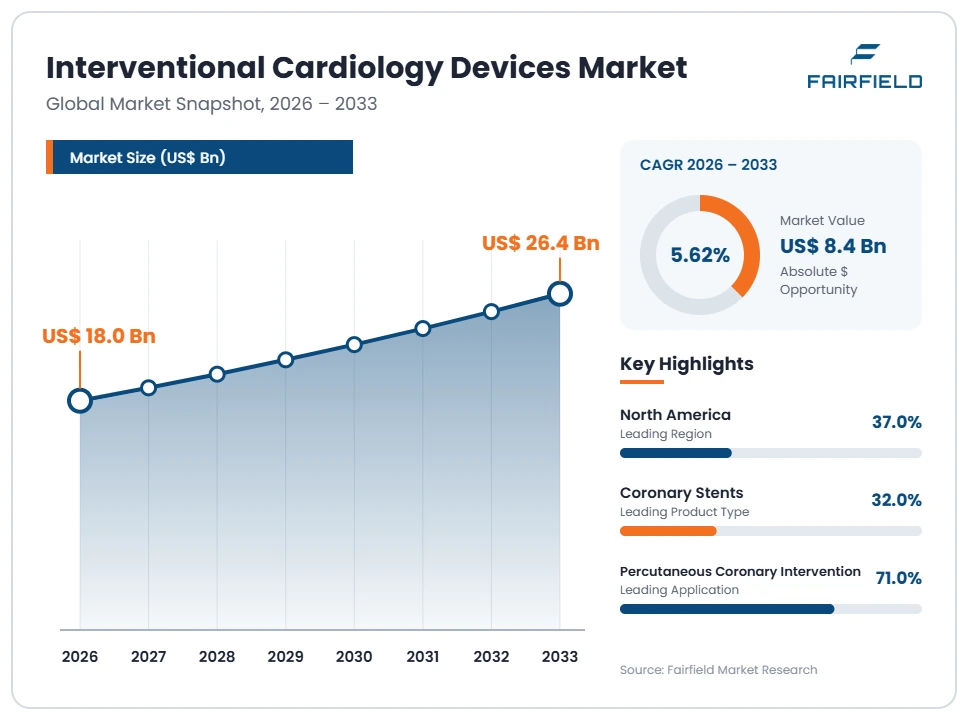
The global Interventional Cardiology Devices market size is expected to be valued at US$ 18.0 billion in 2026 and projected to reach US$ 26.4 billion by 2033, growing at a CAGR of 5.62% between 2026 and 2033.
Between 2020 and 2025 the catheterization laboratory device market grew at an estimated 4.7% CAGR, held back by stent price controls and by deferred elective procedures in 2020. The forecast rests on a mix shift rather than on procedure growth. Coronary intervention volumes in developed systems rise only with demographics, and stent prices have been cut hard by tendering and national price-control programmes. Value therefore migrates to what is used alongside the stent: intravascular imaging and physiology, calcium-modification tools, and access and closure products. Procedure growth in markets with low intervention rates supplies the remaining expansion. The direction is modest unit growth with rising spend per procedure.
Key Report Takeaways
- By Product Type: Coronary Stents held 32.0% share in 2026, while Intravascular Imaging and Physiology Systems are projected to expand at a 9.4% CAGR through 2033, as guideline-referenced procedural guidance moves into routine catheterization laboratory practice.
- By Application: Percutaneous Coronary Intervention held 71.0% share in 2026, while Peripheral Vascular Intervention is projected to expand at a 7.2% CAGR through 2033, as the same laboratories and operators take on below-the-knee and iliac caseloads.
- By Access Route: Femoral Access held 51.0% share in 2026, while Radial Access is projected to expand at a 7.8% CAGR through 2033, supported by same-day discharge pathways and dedicated wrist access product lines.
- By End User: Hospitals and Cardiac Catheterization Laboratories held 84.0% share in 2026, while Ambulatory Surgical Centers and Office-Based Laboratories are projected to expand at a 9.1% CAGR through 2033, following payment policy changes for selected catheter procedures.
- By Region: North America held 37.0% share in 2026, while Asia Pacific is projected to expand at a 7.6% CAGR through 2033, driven by catheterization laboratory build-out in China, India and Indonesia.
Global Interventional Cardiology Devices Market Trends and Insights
Drivers Impact Analysis
Two forces account for most of the forecast expansion in catheter-based cardiac device spending.
| Driver | Impact on CAGR Forecast | Geographic Relevance | Impact Timeline |
| Adoption of intravascular imaging and physiology as routine procedural adjuncts | High | North America, Europe, Asia Pacific | Medium term (2–4 years) |
| Uptake of calcium-modification tools in complex and calcified lesion caseloads | Medium | North America, Europe, Asia Pacific | Long term (≥4 years) |
Imaging and Physiology Adjuncts Raise Device Spend Per Coronary Intervention
Adjunctive technology, not stent volume, carries value growth. Intravascular ultrasound, optical coherence tomography and fractional flow reserve measurement add disposable catheters, wires and software licences to a procedure whose stent component is price-controlled in several large markets. Where adoption rises from a minority of cases toward routine use, average device revenue per intervention increases materially without any change in the number of procedures performed.
The mechanism is professional practice converging with payment. European and American cardiology societies now reference intravascular imaging and physiological assessment in their revascularisation documents, national audits record their use, and several payment systems recognise the associated consumables separately from the stent. Capital placement of imaging consoles, often bundled with multi-year consumable commitments, accelerates the shift. Device interfaces are governed by ISO 10555 for intravascular catheters and by general electrical safety and software standards.
Calcium-Modification Platforms Extend Treatable Lesion Complexity in the Catheterization Laboratory
Lesion preparation has become a distinct device category. Rotational, orbital and laser atherectomy systems and intravascular lithotripsy catheters are used before stent placement in heavily calcified vessels. They add a high-value single-use component and, in the case of atherectomy, a capital console. As operators take on older patients, longer lesions and previously deferred anatomy, the proportion of cases requiring preparation rises, lifting consumable spend per case.
The underlying change is caseload composition. Populations treated today include more patients with diabetes, chronic kidney disease and advanced age, in whom vessel calcification is more frequently documented in registries. Operators also increasingly image calcium directly rather than estimating it from angiography, which makes preparation decisions explicit and auditable. Regulatory routes differ by modality, with US Food and Drug Administration premarket pathways and EU Medical Device Regulation conformity assessment both applying according to device class.
Restraints Impact Analysis
Two structural constraints hold back value growth in catheter-based cardiac devices.
| Restraint | Impact on CAGR Forecast | Geographic Relevance | Impact Timeline |
| Price capping and volume-based procurement for coronary stents | High | Asia Pacific, Europe, Latin America | Long term (≥4 years) |
| Catheterization laboratory capacity and trained operator availability | Medium | Global | Medium term (2–4 years) |
Price Caps and Volume-Based Procurement Permanently Reset Coronary Stent Economics
Direct price intervention has reshaped the largest product category. Several major markets have imposed ceiling prices or centralised volume-based procurement on coronary stents, cutting unit prices by very large margins in a single tender round and locking the reduction in for subsequent cycles. Because stents still account for the biggest single share of catheterization laboratory device spend, those decisions cap the value of the market even where procedure counts keep rising.
The cost pressure is procurement policy rather than manufacturing economics. National pricing authorities and centralised purchasing bodies tender for guaranteed volumes at fixed prices, with award terms that favour scale suppliers and domestic manufacturers. Suppliers respond by shifting commercial focus to categories outside the capped list, by localising production, and by bundling imaging, physiology and accessory products into the same supply agreement. Margin recovery depends on that mix, not on stent pricing.
Laboratory Capacity and Operator Availability Limit Interventional Procedure Throughput
Physical and human capacity sets a ceiling on procedure numbers. A catheterization laboratory is a capital asset requiring imaging equipment, shielding, recovery space and a trained team, and hospital capital budgets release only a limited number of new rooms each year. Where rooms exist, they are frequently shared between cardiac, peripheral and electrophysiology work, so device demand grows more slowly than the referred population.
The binding constraint in most systems is trained staff rather than equipment. Interventional cardiology requires a fellowship pathway measured in years, supported by catheterization laboratory nurses, radiographers and technologists who are also in short supply. Several national health services report fixed activity caps, waiting lists and session limits for coronary intervention. Reimbursement structures based on diagnosis-related group payment give hospitals little incentive to add capacity where the marginal case is loss-making.
Market Opportunities
Radial Access and Same-Day Discharge Pathways Open an Access and Closure Product Pool
Access-site management has become a revenue pool in its own right. Wrist access requires dedicated sheaths, hydrophilic wires, compression bands and spasm-management kits, while femoral work sustains a separate vascular closure device category. As health systems adopt day-case coronary intervention to free inpatient beds, the products that make early discharge administratively defensible are bought in volume, and they sit outside the categories subject to stent price capping.
Hospitals under bed-occupancy pressure and ambulatory providers are the buyers, and national cardiology societies and payment reform programmes create the demand. Supporting developments include diagnosis-related group and ambulatory payment structures that recognise same-day coronary intervention, published national audit data on access route, and distal radial techniques that have broadened the consumable range. Suppliers with complete access-to-closure portfolios capture a disproportionate share of these bundled tenders.
Low Intervention Rates in Under-Served Markets Create Durable Procedure Volume Headroom
Procedure headroom, not technology, is the clearest long-run opportunity. Coronary intervention rates per million population in much of Asia Pacific, Latin America and Middle East & Africa remain a fraction of those in North America and Europe, while the underlying cardiovascular disease burden is documented as high and rising. Each new catheterization laboratory commissioned creates a recurring consumable contract for stents, balloons, wires and closure products.
Health ministries, insurance schemes and private hospital groups determine the pace of conversion. National cardiovascular programmes, expanding public insurance coverage and tiered-city hospital investment in China and India are the practical mechanisms, alongside donor-funded capacity projects. Supporting developments include domestic manufacturing that lowers delivered device cost, simplified registration routes for established device types, and structured training programmes that address the operator shortage now limiting throughput in newly built laboratories.
Segment Analysis
- By Product Type: Coronary Stents Lead While Imaging and Physiology Scale Fastest
Coronary Stents held 32.0% of 2026 revenue, the largest single category despite deep price cuts. Drug-eluting platforms account for the great majority of stent value, with bare metal and bioresorbable scaffolds forming small remainders. The category leads on sheer unit volume, since almost every intervention places at least one device.
Intravascular Imaging and Physiology Systems are the fastest-growing product type at a 9.4% CAGR to 2033. Intravascular ultrasound, optical coherence tomography and fractional flow reserve consumables are referenced in revascularisation documents and are increasingly recorded in national audits.
Balloon Catheters, Guidewires, Guide Catheters and Microcatheters, Atherectomy and Intravascular Lithotripsy Systems, Vascular Closure and Radial Access Products, and Embolic Protection and Thrombectomy Devices make up the balance. The implication is that portfolio breadth beyond the stent now determines account economics.
- By Application: Coronary Work Dominates While Peripheral Cases Expand Quicker
Percutaneous Coronary Intervention represented 71.0% of 2026 device revenue. It leads because coronary disease generates the highest procedure counts, because the device set per case is the most extensive, and because payment pathways for coronary intervention are established in every developed health system.
Peripheral Vascular Intervention is the fastest-growing application at a 7.2% CAGR. The same laboratories, imaging equipment and operators absorb iliac, femoropopliteal and below-the-knee caseloads, and device portfolios overlap substantially with coronary lines.
Diagnostic Catheterization accounts for the remainder and is growing slowly, as physiological and non-invasive assessment reduce purely diagnostic studies. The business implication is that suppliers increasingly sell one catalogue into a shared laboratory rather than separate coronary and peripheral franchises, which changes contract structure and field coverage.
- By Access Route: Femoral Entry Retains Value Share While Wrist Access Grows Faster
Femoral Access held 51.0% of 2026 device revenue. Large-bore procedures, complex coronary work, peripheral intervention and most mechanical support cases still use the groin, and each femoral case consumes a vascular closure device, which raises recorded value per procedure.
Radial Access is the fastest-growing route at a 7.8% CAGR to 2033. Adoption is highest in Europe and Asia Pacific, and growth is driven by same-day discharge pathways and by dedicated sheath, wire, catheter and compression product lines.
Other Access Sites, including brachial and pedal entry, remain a small residual used mainly where the usual routes are unavailable. For manufacturers, the implication is that the access decision determines a whole accessory basket, from sheath and wire through to closure or compression, so winning the access-site standard inside a hospital influences far more than one line item in the contract.
- By End User: Hospital Laboratories Hold Volume While Ambulatory Sites Grow Fastest
Hospitals and Cardiac Catheterization Laboratories accounted for 84.0% of 2026 revenue. Acute inpatient settings hold this position because emergency coronary intervention, on-site surgical backup, intensive care access and capital-intensive imaging suites sit inside hospitals rather than in standalone facilities.
Ambulatory Surgical Centers and Office-Based Laboratories are the fastest-growing end user at a 9.1% CAGR. Payment policy in the United States has extended coverage to selected catheter-based procedures outside the hospital, and peripheral work in particular has migrated to these settings.
Specialty Cardiac Centers complete the mix, concentrating elective and referral caseloads in dedicated facilities. The commercial implication is that suppliers now face two very different buyers: hospital value-analysis committees negotiating system-wide contracts across many departments, and smaller ambulatory operators buying on delivered cost per case with very limited inventory capacity.
Geography Analysis
- Which Region Is Leading the Interventional Cardiology Devices Market?
North America leads with 37.0% share of the catheterization laboratory device market in 2026 and grows at a 4.6% CAGR. The United States supplies most of it, through a dense network of percutaneous coronary intervention centres, high adoption of adjunctive imaging and physiology, and diagnosis-related group payment that funds the full device basket per admission. Canada contributes a smaller, budget-constrained volume.
Regulation and payment explain the value concentration. Coronary stents are regulated through the US Food and Drug Administration premarket approval pathway, which sets a high evidence bar and limits the number of competing platforms. Payment policy has extended selected catheter procedures to ambulatory settings, creating a second purchasing channel. The main change ahead is wider routine use of intravascular imaging and physiology, which raises revenue per procedure in a market where case growth is demographic.
- Europe Combines Mature Procedure Volumes With a Heavy Evidence Burden
Europe holds 26.0% of the 2026 market and grows at a 4.8% CAGR. Germany performs the highest national coronary intervention volumes, followed by France, Italy, the United Kingdom, Spain and Poland, supported by well-established radial access practice and national registries that publish procedural data.
Regulatory cost is the defining feature. The EU Medical Device Regulation (EU) 2017/745 reclassified and raised the clinical evidence burden for implantable cardiovascular devices, and notified body capacity is the practical constraint on how quickly products can be certified or recertified. Unique device identification and EUDAMED registration obligations add continuing administrative cost. Hospital tendering and reference pricing keep stent prices low, so suppliers compete on bundled contracts spanning imaging, physiology and accessory lines rather than on implant price.
- Which Region Is Growing Fastest in the Interventional Cardiology Devices Market?
Asia Pacific is the fastest-growing geography at a 7.6% CAGR between 2026 and 2033, from 29.0% share in 2026. China accounts for the largest share of regional volume, with Japan, India, South Korea, Australia and Indonesia adding substantial caseloads as catheterization laboratories are commissioned in secondary cities.
Procurement policy is the defining variable. Centralised volume-based procurement for coronary stents has reduced unit prices dramatically in the region’s largest market, which lowers value per case while accelerating access. Domestic manufacturers hold strong positions in stents, balloons and guidewires, and are extending into imaging and lithotripsy. Intervention rates per million population remain far below developed-market levels, so unit growth is structural. Operator training capacity, not equipment supply, is the main limit on throughput.
- Latin America Demand Follows Public Tenders and Private Hospital Investment
Latin America represents 4.5% of the 2026 market and grows at a 6.0% CAGR. Brazil, Mexico, Argentina, Colombia and Chile account for most procedures, split between private hospital networks in large cities and public systems that purchase through consolidated tenders with long award cycles.
Barriers are economic and logistical. Devices are largely imported and exposed to currency movements and import duties, public procurement is periodically disrupted by budget cycles, and catheterization laboratories are concentrated in a small number of metropolitan areas. Several countries apply price references that compress stent margins further. The most meaningful change is private hospital group investment in new laboratories and the gradual spread of radial access and day-case pathways, which reduce the bed capacity needed per intervention.
- Middle East & Africa Capacity Concentrates in Gulf Cardiac Centres
Middle East & Africa accounts for 3.5% of 2026 revenue and grows at a 6.2% CAGR, the smallest regional base. Saudi Arabia, the United Arab Emirates, Qatar, Kuwait, Israel and Turkey generate most activity, supported by national health investment in tertiary cardiac hospitals with modern catheterization suites and ministry tenders covering full device baskets.
Constraints are severe elsewhere. Much of sub-Saharan Africa has very few catheterization laboratories, limited interventional training capacity and no reliable emergency coronary intervention pathway, while Egypt, Nigeria, Kenya and South Africa account for most remaining volume. Device registration and tender cycles are long and prices are exposed to import costs. The main opportunity is continued cardiac service build-out under Gulf Cooperation Council health strategies, which fund laboratory capacity and consumable contracts together.
Competitive Landscape
The interventional cardiology devices market is highly concentrated at the top. A small group of global manufacturers accounts for most coronary stent, balloon, imaging and physiology revenue, reflecting the cost of premarket approval programmes, the breadth of catalogue a hospital contract requires, and the field support that catheterization laboratories expect. Below that tier the market is more fragmented, with specialists in guidewires, microcatheters, closure devices, atherectomy and thrombectomy holding defensible niches. Domestic manufacturers in China and India have built substantial home-market positions, helped by centralised procurement rules that favour local supply and scale.
Competition has moved away from the implant. Vendors now compete on catalogue completeness, delivered cost per procedure, imaging console placement terms, software and physiology integration, guidewire and catheter performance characteristics, inventory consignment terms and training support. New approaches have come from intravascular lithotripsy, from imaging companies entering through console and software platforms rather than disposables, and from specialists offering single-category depth to hospitals that unbundle their tenders. Price-controlled stent lines are increasingly treated as access products that secure the wider basket.
Strategic activity concentrates on portfolio assembly and localisation. Large suppliers have broadened from implants into imaging, physiology and lesion preparation, placed capital consoles against multi-year consumable commitments, and regionalised manufacturing to qualify for volume-based procurement. Investment in notified body documentation and clinical evidence programmes has become a recurring cost line under the EU Medical Device Regulation, alongside conformity testing against the ISO 25539 series for cardiovascular implants and endovascular devices.
Strategic direction converges on three themes: defending revenue per procedure as stent prices stay capped, owning the data and software layer inside the catheterization laboratory, and building cost structures that work in volume-based procurement markets.
Interventional Cardiology Devices Industry Leaders
Abbott Laboratories
Boston Scientific Corporation
Medtronic plc
Terumo Corporation
Koninklijke Philips N.V.
Recent Industry Developments
- February 2017: The National Pharmaceutical Pricing Authority in India imposed ceiling prices on coronary stents – it cut device prices sharply and became the template for later price intervention in other categories.
- November 2020: China ran its first national centralised volume-based procurement round for coronary stents – awarded prices fell by a very large margin and permanently reset the economics of the region’s biggest stent market.
- May 2021: The EU Medical Device Regulation (EU) 2017/745 became applicable across the European Union – it raised the clinical evidence and post-market surveillance burden for implantable cardiovascular devices and made notified body capacity a practical constraint.
- May 2021: Unique device identification assignment obligations took effect for implantable and class III devices under the EU Medical Device Regulation, alongside phased EUDAMED registration – it added traceability and database reporting cost to every cardiovascular implant placed in Europe.
Companies Covered in the Report
Abbott Laboratories
Boston Scientific Corporation
Medtronic plc
Terumo Corporation
Koninklijke Philips N.V.
Teleflex Incorporated
Cordis Corporation
B. Braun Melsungen AG
MicroPort Scientific Corporation
Biotronik SE & Co. KG
Nipro Corporation
Asahi Intecc Co., Ltd.
Merit Medical Systems, Inc.
Lepu Medical Technology (Beijing) Co., Ltd.
Interventional Cardiology Devices Market Report Scope
| Metric | Value |
| Study Period | 2020–2033 |
| Market Size 2026 | US$ 18.0 Billion |
| Market Size 2033 | US$ 26.4 Billion |
| CAGR 2026–2033 | 5.62% |
| Absolute Dollar Opportunity | US$ 8.4 Billion |
| Largest Market | North America (37.0% share in 2026) |
| Fastest-Growing Market | Asia Pacific (7.6% CAGR 2026–2033) |
| Market Concentration | High |
| Major Players | Abbott Laboratories, Boston Scientific Corporation, Medtronic plc, Terumo Corporation, Koninklijke Philips N.V. |
Interventional Cardiology Devices Market Segmentation
- Executive Summary
- Global Interventional Cardiology Devices Market Snapshot
- Future Projections, 2026-2033
- Key Market Trends
- Regional Snapshot
- Market Overview
- Market Definition and Report Scope
- Historical Market Trends
- Market Dynamics
- Drivers Impact Analysis
- Imaging and Physiology Adjuncts Raise Device Spend Per Coronary Intervention
- Calcium-Modification Platforms Extend Treatable Lesion Complexity in the Catheterization Laboratory
- Restraints Impact Analysis
- Price Caps and Volume-Based Procurement Permanently Reset Coronary Stent Economics
- Laboratory Capacity and Operator Availability Limit Interventional Procedure Throughput
- Market Opportunities
- Radial Access and Same-Day Discharge Pathways Open an Access and Closure Product Pool
- Low Intervention Rates in Under-Served Markets Create Durable Procedure Volume Headroom
- Drivers Impact Analysis
- Global Interventional Cardiology Devices Market Outlook, 2020-2033
- Global Interventional Cardiology Devices Market Outlook, by Product Type, Value (US$ Billion), 2020-2033
- Coronary Stents
- Balloon Catheters
- Guidewires, Guide Catheters and Microcatheters
- Atherectomy and Intravascular Lithotripsy Systems
- Intravascular Imaging and Physiology Systems
- Vascular Closure and Radial Access Products
- Embolic Protection and Thrombectomy Devices
- Global Interventional Cardiology Devices Market Outlook, by Application, Value (US$ Billion), 2020-2033
- Percutaneous Coronary Intervention
- Peripheral Vascular Intervention
- Diagnostic Catheterization
- Global Interventional Cardiology Devices Market Outlook, by Access Route, Value (US$ Billion), 2020-2033
- Femoral Access
- Radial Access
- Other Access Sites
- Global Interventional Cardiology Devices Market Outlook, by End User, Value (US$ Billion), 2020-2033
- Hospitals and Cardiac Catheterization Laboratories
- Ambulatory Surgical Centers and Office-Based Laboratories
- Specialty Cardiac Centers
- Global Interventional Cardiology Devices Market Outlook, by Region, Value (US$ Billion), 2020-2033
- North America
- Europe
- Asia Pacific
- Latin America
- Middle East & Africa
- Global Interventional Cardiology Devices Market Outlook, by Product Type, Value (US$ Billion), 2020-2033
- North America Interventional Cardiology Devices Market Outlook, 2020-2033
- North America Interventional Cardiology Devices Market Outlook, by Product Type, Value (US$ Billion), 2020-2033
- Coronary Stents
- Balloon Catheters
- Guidewires, Guide Catheters and Microcatheters
- Atherectomy and Intravascular Lithotripsy Systems
- Intravascular Imaging and Physiology Systems
- Vascular Closure and Radial Access Products
- Embolic Protection and Thrombectomy Devices
- North America Interventional Cardiology Devices Market Outlook, by Application, Value (US$ Billion), 2020-2033
- Percutaneous Coronary Intervention
- Peripheral Vascular Intervention
- Diagnostic Catheterization
- North America Interventional Cardiology Devices Market Outlook, by Access Route, Value (US$ Billion), 2020-2033
- Femoral Access
- Radial Access
- Other Access Sites
- North America Interventional Cardiology Devices Market Outlook, by End User, Value (US$ Billion), 2020-2033
- Hospitals and Cardiac Catheterization Laboratories
- Ambulatory Surgical Centers and Office-Based Laboratories
- Specialty Cardiac Centers
- North America Interventional Cardiology Devices Market Outlook, by Country, Value (US$ Billion), 2020-2033
- United States Interventional Cardiology Devices Market Outlook, by Product Type, 2020-2033
- United States Interventional Cardiology Devices Market Outlook, by Application, 2020-2033
- United States Interventional Cardiology Devices Market Outlook, by Access Route, 2020-2033
- United States Interventional Cardiology Devices Market Outlook, by End User, 2020-2033
- Canada Interventional Cardiology Devices Market Outlook, by Product Type, 2020-2033
- Canada Interventional Cardiology Devices Market Outlook, by Application, 2020-2033
- Canada Interventional Cardiology Devices Market Outlook, by Access Route, 2020-2033
- Canada Interventional Cardiology Devices Market Outlook, by End User, 2020-2033
- North America Interventional Cardiology Devices Market Outlook, by Product Type, Value (US$ Billion), 2020-2033
- Europe Interventional Cardiology Devices Market Outlook, 2020-2033
- Europe Interventional Cardiology Devices Market Outlook, by Product Type, Value (US$ Billion), 2020-2033
- Coronary Stents
- Balloon Catheters
- Guidewires, Guide Catheters and Microcatheters
- Atherectomy and Intravascular Lithotripsy Systems
- Intravascular Imaging and Physiology Systems
- Vascular Closure and Radial Access Products
- Embolic Protection and Thrombectomy Devices
- Europe Interventional Cardiology Devices Market Outlook, by Application, Value (US$ Billion), 2020-2033
- Percutaneous Coronary Intervention
- Peripheral Vascular Intervention
- Diagnostic Catheterization
- Europe Interventional Cardiology Devices Market Outlook, by Access Route, Value (US$ Billion), 2020-2033
- Femoral Access
- Radial Access
- Other Access Sites
- Europe Interventional Cardiology Devices Market Outlook, by End User, Value (US$ Billion), 2020-2033
- Hospitals and Cardiac Catheterization Laboratories
- Ambulatory Surgical Centers and Office-Based Laboratories
- Specialty Cardiac Centers
- Europe Interventional Cardiology Devices Market Outlook, by Country, Value (US$ Billion), 2020-2033
- Germany Interventional Cardiology Devices Market Outlook, by Product Type, 2020-2033
- Germany Interventional Cardiology Devices Market Outlook, by Application, 2020-2033
- Germany Interventional Cardiology Devices Market Outlook, by Access Route, 2020-2033
- Germany Interventional Cardiology Devices Market Outlook, by End User, 2020-2033
- France Interventional Cardiology Devices Market Outlook, by Product Type, 2020-2033
- France Interventional Cardiology Devices Market Outlook, by Application, 2020-2033
- France Interventional Cardiology Devices Market Outlook, by Access Route, 2020-2033
- France Interventional Cardiology Devices Market Outlook, by End User, 2020-2033
- Italy Interventional Cardiology Devices Market Outlook, by Product Type, 2020-2033
- Italy Interventional Cardiology Devices Market Outlook, by Application, 2020-2033
- Italy Interventional Cardiology Devices Market Outlook, by Access Route, 2020-2033
- Italy Interventional Cardiology Devices Market Outlook, by End User, 2020-2033
- United Kingdom Interventional Cardiology Devices Market Outlook, by Product Type, 2020-2033
- United Kingdom Interventional Cardiology Devices Market Outlook, by Application, 2020-2033
- United Kingdom Interventional Cardiology Devices Market Outlook, by Access Route, 2020-2033
- United Kingdom Interventional Cardiology Devices Market Outlook, by End User, 2020-2033
- Spain Interventional Cardiology Devices Market Outlook, by Product Type, 2020-2033
- Spain Interventional Cardiology Devices Market Outlook, by Application, 2020-2033
- Spain Interventional Cardiology Devices Market Outlook, by Access Route, 2020-2033
- Spain Interventional Cardiology Devices Market Outlook, by End User, 2020-2033
- Poland Interventional Cardiology Devices Market Outlook, by Product Type, 2020-2033
- Poland Interventional Cardiology Devices Market Outlook, by Application, 2020-2033
- Poland Interventional Cardiology Devices Market Outlook, by Access Route, 2020-2033
- Poland Interventional Cardiology Devices Market Outlook, by End User, 2020-2033
- Europe Interventional Cardiology Devices Market Outlook, by Product Type, Value (US$ Billion), 2020-2033
- Asia Pacific Interventional Cardiology Devices Market Outlook, 2020-2033
- Asia Pacific Interventional Cardiology Devices Market Outlook, by Product Type, Value (US$ Billion), 2020-2033
- Coronary Stents
- Balloon Catheters
- Guidewires, Guide Catheters and Microcatheters
- Atherectomy and Intravascular Lithotripsy Systems
- Intravascular Imaging and Physiology Systems
- Vascular Closure and Radial Access Products
- Embolic Protection and Thrombectomy Devices
- Asia Pacific Interventional Cardiology Devices Market Outlook, by Application, Value (US$ Billion), 2020-2033
- Percutaneous Coronary Intervention
- Peripheral Vascular Intervention
- Diagnostic Catheterization
- Asia Pacific Interventional Cardiology Devices Market Outlook, by Access Route, Value (US$ Billion), 2020-2033
- Femoral Access
- Radial Access
- Other Access Sites
- Asia Pacific Interventional Cardiology Devices Market Outlook, by End User, Value (US$ Billion), 2020-2033
- Hospitals and Cardiac Catheterization Laboratories
- Ambulatory Surgical Centers and Office-Based Laboratories
- Specialty Cardiac Centers
- Asia Pacific Interventional Cardiology Devices Market Outlook, by Country, Value (US$ Billion), 2020-2033
- China Interventional Cardiology Devices Market Outlook, by Product Type, 2020-2033
- China Interventional Cardiology Devices Market Outlook, by Application, 2020-2033
- China Interventional Cardiology Devices Market Outlook, by Access Route, 2020-2033
- China Interventional Cardiology Devices Market Outlook, by End User, 2020-2033
- Japan Interventional Cardiology Devices Market Outlook, by Product Type, 2020-2033
- Japan Interventional Cardiology Devices Market Outlook, by Application, 2020-2033
- Japan Interventional Cardiology Devices Market Outlook, by Access Route, 2020-2033
- Japan Interventional Cardiology Devices Market Outlook, by End User, 2020-2033
- India Interventional Cardiology Devices Market Outlook, by Product Type, 2020-2033
- India Interventional Cardiology Devices Market Outlook, by Application, 2020-2033
- India Interventional Cardiology Devices Market Outlook, by Access Route, 2020-2033
- India Interventional Cardiology Devices Market Outlook, by End User, 2020-2033
- South Korea Interventional Cardiology Devices Market Outlook, by Product Type, 2020-2033
- South Korea Interventional Cardiology Devices Market Outlook, by Application, 2020-2033
- South Korea Interventional Cardiology Devices Market Outlook, by Access Route, 2020-2033
- South Korea Interventional Cardiology Devices Market Outlook, by End User, 2020-2033
- Australia Interventional Cardiology Devices Market Outlook, by Product Type, 2020-2033
- Australia Interventional Cardiology Devices Market Outlook, by Application, 2020-2033
- Australia Interventional Cardiology Devices Market Outlook, by Access Route, 2020-2033
- Australia Interventional Cardiology Devices Market Outlook, by End User, 2020-2033
- Indonesia Interventional Cardiology Devices Market Outlook, by Product Type, 2020-2033
- Indonesia Interventional Cardiology Devices Market Outlook, by Application, 2020-2033
- Indonesia Interventional Cardiology Devices Market Outlook, by Access Route, 2020-2033
- Indonesia Interventional Cardiology Devices Market Outlook, by End User, 2020-2033
- Asia Pacific Interventional Cardiology Devices Market Outlook, by Product Type, Value (US$ Billion), 2020-2033
- Latin America Interventional Cardiology Devices Market Outlook, 2020-2033
- Latin America Interventional Cardiology Devices Market Outlook, by Product Type, Value (US$ Billion), 2020-2033
- Coronary Stents
- Balloon Catheters
- Guidewires, Guide Catheters and Microcatheters
- Atherectomy and Intravascular Lithotripsy Systems
- Intravascular Imaging and Physiology Systems
- Vascular Closure and Radial Access Products
- Embolic Protection and Thrombectomy Devices
- Latin America Interventional Cardiology Devices Market Outlook, by Application, Value (US$ Billion), 2020-2033
- Percutaneous Coronary Intervention
- Peripheral Vascular Intervention
- Diagnostic Catheterization
- Latin America Interventional Cardiology Devices Market Outlook, by Access Route, Value (US$ Billion), 2020-2033
- Femoral Access
- Radial Access
- Other Access Sites
- Latin America Interventional Cardiology Devices Market Outlook, by End User, Value (US$ Billion), 2020-2033
- Hospitals and Cardiac Catheterization Laboratories
- Ambulatory Surgical Centers and Office-Based Laboratories
- Specialty Cardiac Centers
- Latin America Interventional Cardiology Devices Market Outlook, by Country, Value (US$ Billion), 2020-2033
- Brazil Interventional Cardiology Devices Market Outlook, by Product Type, 2020-2033
- Brazil Interventional Cardiology Devices Market Outlook, by Application, 2020-2033
- Brazil Interventional Cardiology Devices Market Outlook, by Access Route, 2020-2033
- Brazil Interventional Cardiology Devices Market Outlook, by End User, 2020-2033
- Mexico Interventional Cardiology Devices Market Outlook, by Product Type, 2020-2033
- Mexico Interventional Cardiology Devices Market Outlook, by Application, 2020-2033
- Mexico Interventional Cardiology Devices Market Outlook, by Access Route, 2020-2033
- Mexico Interventional Cardiology Devices Market Outlook, by End User, 2020-2033
- Argentina Interventional Cardiology Devices Market Outlook, by Product Type, 2020-2033
- Argentina Interventional Cardiology Devices Market Outlook, by Application, 2020-2033
- Argentina Interventional Cardiology Devices Market Outlook, by Access Route, 2020-2033
- Argentina Interventional Cardiology Devices Market Outlook, by End User, 2020-2033
- Colombia Interventional Cardiology Devices Market Outlook, by Product Type, 2020-2033
- Colombia Interventional Cardiology Devices Market Outlook, by Application, 2020-2033
- Colombia Interventional Cardiology Devices Market Outlook, by Access Route, 2020-2033
- Colombia Interventional Cardiology Devices Market Outlook, by End User, 2020-2033
- Chile Interventional Cardiology Devices Market Outlook, by Product Type, 2020-2033
- Chile Interventional Cardiology Devices Market Outlook, by Application, 2020-2033
- Chile Interventional Cardiology Devices Market Outlook, by Access Route, 2020-2033
- Chile Interventional Cardiology Devices Market Outlook, by End User, 2020-2033
- Latin America Interventional Cardiology Devices Market Outlook, by Product Type, Value (US$ Billion), 2020-2033
- Middle East & Africa Interventional Cardiology Devices Market Outlook, 2020-2033
- Middle East & Africa Interventional Cardiology Devices Market Outlook, by Product Type, Value (US$ Billion), 2020-2033
- Coronary Stents
- Balloon Catheters
- Guidewires, Guide Catheters and Microcatheters
- Atherectomy and Intravascular Lithotripsy Systems
- Intravascular Imaging and Physiology Systems
- Vascular Closure and Radial Access Products
- Embolic Protection and Thrombectomy Devices
- Middle East & Africa Interventional Cardiology Devices Market Outlook, by Application, Value (US$ Billion), 2020-2033
- Percutaneous Coronary Intervention
- Peripheral Vascular Intervention
- Diagnostic Catheterization
- Middle East & Africa Interventional Cardiology Devices Market Outlook, by Access Route, Value (US$ Billion), 2020-2033
- Femoral Access
- Radial Access
- Other Access Sites
- Middle East & Africa Interventional Cardiology Devices Market Outlook, by End User, Value (US$ Billion), 2020-2033
- Hospitals and Cardiac Catheterization Laboratories
- Ambulatory Surgical Centers and Office-Based Laboratories
- Specialty Cardiac Centers
- Middle East & Africa Interventional Cardiology Devices Market Outlook, by Country and Subregion, Value (US$ Billion), 2020-2033
- Saudi Arabia Interventional Cardiology Devices Market Outlook, by Product Type, 2020-2033
- Saudi Arabia Interventional Cardiology Devices Market Outlook, by Application, 2020-2033
- Saudi Arabia Interventional Cardiology Devices Market Outlook, by Access Route, 2020-2033
- Saudi Arabia Interventional Cardiology Devices Market Outlook, by End User, 2020-2033
- United Arab Emirates Interventional Cardiology Devices Market Outlook, by Product Type, 2020-2033
- United Arab Emirates Interventional Cardiology Devices Market Outlook, by Application, 2020-2033
- United Arab Emirates Interventional Cardiology Devices Market Outlook, by Access Route, 2020-2033
- United Arab Emirates Interventional Cardiology Devices Market Outlook, by End User, 2020-2033
- Qatar Interventional Cardiology Devices Market Outlook, by Product Type, 2020-2033
- Qatar Interventional Cardiology Devices Market Outlook, by Application, 2020-2033
- Qatar Interventional Cardiology Devices Market Outlook, by Access Route, 2020-2033
- Qatar Interventional Cardiology Devices Market Outlook, by End User, 2020-2033
- Kuwait Interventional Cardiology Devices Market Outlook, by Product Type, 2020-2033
- Kuwait Interventional Cardiology Devices Market Outlook, by Application, 2020-2033
- Kuwait Interventional Cardiology Devices Market Outlook, by Access Route, 2020-2033
- Kuwait Interventional Cardiology Devices Market Outlook, by End User, 2020-2033
- Israel Interventional Cardiology Devices Market Outlook, by Product Type, 2020-2033
- Israel Interventional Cardiology Devices Market Outlook, by Application, 2020-2033
- Israel Interventional Cardiology Devices Market Outlook, by Access Route, 2020-2033
- Israel Interventional Cardiology Devices Market Outlook, by End User, 2020-2033
- Turkey Interventional Cardiology Devices Market Outlook, by Product Type, 2020-2033
- Turkey Interventional Cardiology Devices Market Outlook, by Application, 2020-2033
- Turkey Interventional Cardiology Devices Market Outlook, by Access Route, 2020-2033
- Turkey Interventional Cardiology Devices Market Outlook, by End User, 2020-2033
- Egypt Interventional Cardiology Devices Market Outlook, by Product Type, 2020-2033
- Egypt Interventional Cardiology Devices Market Outlook, by Application, 2020-2033
- Egypt Interventional Cardiology Devices Market Outlook, by Access Route, 2020-2033
- Egypt Interventional Cardiology Devices Market Outlook, by End User, 2020-2033
- Nigeria Interventional Cardiology Devices Market Outlook, by Product Type, 2020-2033
- Nigeria Interventional Cardiology Devices Market Outlook, by Application, 2020-2033
- Nigeria Interventional Cardiology Devices Market Outlook, by Access Route, 2020-2033
- Nigeria Interventional Cardiology Devices Market Outlook, by End User, 2020-2033
- Kenya Interventional Cardiology Devices Market Outlook, by Product Type, 2020-2033
- Kenya Interventional Cardiology Devices Market Outlook, by Application, 2020-2033
- Kenya Interventional Cardiology Devices Market Outlook, by Access Route, 2020-2033
- Kenya Interventional Cardiology Devices Market Outlook, by End User, 2020-2033
- South Africa Interventional Cardiology Devices Market Outlook, by Product Type, 2020-2033
- South Africa Interventional Cardiology Devices Market Outlook, by Application, 2020-2033
- South Africa Interventional Cardiology Devices Market Outlook, by Access Route, 2020-2033
- South Africa Interventional Cardiology Devices Market Outlook, by End User, 2020-2033
- Gulf Cooperation Council Interventional Cardiology Devices Market Outlook, by Product Type, 2020-2033
- Gulf Cooperation Council Interventional Cardiology Devices Market Outlook, by Application, 2020-2033
- Gulf Cooperation Council Interventional Cardiology Devices Market Outlook, by Access Route, 2020-2033
- Gulf Cooperation Council Interventional Cardiology Devices Market Outlook, by End User, 2020-2033
- Middle East & Africa Interventional Cardiology Devices Market Outlook, by Product Type, Value (US$ Billion), 2020-2033
- Competitive Landscape
- Industry Leaders
- Recent Industry Developments
- Company Profiles
- Abbott Laboratories
- Boston Scientific Corporation
- Medtronic plc
- Terumo Corporation
- Koninklijke Philips N.V.
- Teleflex Incorporated
- Cordis Corporation
- B. Braun Melsungen AG
- MicroPort Scientific Corporation
- Biotronik SE & Co. KG
- Nipro Corporation
- Asahi Intecc Co., Ltd.
- Merit Medical Systems, Inc.
- Lepu Medical Technology (Beijing) Co., Ltd.
- Appendix
- Research Methodology
- Report Assumptions
- Acronyms and Abbreviations
Product Type
- Coronary Stents
- Balloon Catheters
- Guidewires, Guide Catheters and Microcatheters
- Atherectomy and Intravascular Lithotripsy Systems
- Intravascular Imaging and Physiology Systems
- Vascular Closure and Radial Access Products
- Embolic Protection and Thrombectomy Devices
Application
- Percutaneous Coronary Intervention
- Peripheral Vascular Intervention
- Diagnostic Catheterization
Access Route
- Femoral Access
- Radial Access
- Other Access Sites
End User
- Hospitals and Cardiac Catheterization Laboratories
- Ambulatory Surgical Centers and Office-Based Laboratories
- Specialty Cardiac Centers
Regions
- North America
- Europe
- Asia Pacific
- Latin America
- Middle East & Africa
Our Research Methodology
Considering the volatility of business today, traditional approaches to strategizing a game plan can be unfruitful if not detrimental. True ambiguity is no way to determine a forecast. A myriad of predetermined factors must be accounted for such as the degree of risk involved, the magnitude of circumstances, as well as conditions or consequences that are not known or unpredictable. To circumvent binary views that cast uncertainty, the application of market research intelligence to strategically posture, move, and enable actionable outcomes is necessary.
View Methodology
Quality Assured
Rigorous Validation Process

Confidentiality Assured
End-to-end Data Security

Custom Research Services
Tailored To Your Objectives
FAQs
The market is valued at US$ 18.0 billion in 2026, covering catheter-based coronary and peripheral devices used in the cardiac catheterization laboratory.
Revenue is projected to reach US$ 26.4 billion by 2033 at a 5.62% CAGR, an absolute dollar opportunity of US$ 8.4 billion.
Coronary Stents lead with 32.0% share in 2026, retaining the largest category despite ceiling prices and volume-based procurement in several markets.
Intravascular Imaging and Physiology Systems grow fastest at a 9.4% CAGR through 2033, as procedural guidance moves from selective use toward routine practice.
North America leads with 37.0% share in 2026, and concentration is high, with a small group of global suppliers holding most catalogue revenue.
Related Reports
Medical Fiber Optics Market Size, Share, Insights, Competitive Landscape, and Forecast 2026 to 2033
The medical fiber optics market is projected to grow from US$1.4 billion in 2026 to US$1.9 billion by 2033 at a 4.5% CAGR.
Laser Hair Removal Market Size, Share, Insights, Competitive Landscape, and Forecast 2026 to 2033
The laser hair removal market is projected to reach US$4.5 billion by 2033. Explore diode and multi-wavelength devices, clinic demand, and regional growth.
Joint Reconstruction Devices Market Size, Share, Insights, Competitive Landscape, and Forecast 2026 to 2033
The joint reconstruction devices market is projected to reach US$35.2 billion by 2033. Explore knee and hip implants, revision procedures, and surgical robotics.
Infusion Catheter Market Size, Share, Insights, Competitive Landscape, and Forecast 2026 to 2033
The infusion catheter market is projected to reach US$4.97 billion by 2033 at a 10.1% CAGR, driven by growth in outpatient and home infusion care.
Influenza Diagnostic Market Size, Share, Insights, Competitive Landscape, and Forecast 2026 to 2033
The influenza diagnostic market is projected to reach US$3.56 billion by 2033 at a 7.8% CAGR, driven by rapid molecular tests and wider home testing.
Implantable Insulin Pumps Market Size, Share, Insights, Competitive Landscape, and Forecast 2026 to 2033
The global implantable insulin pumps market is valued at US$3.80 billion in 2026, reaching US$6.90 billion by 2033, growing at an 8.9% CAGR