



Medical Fiber Optics Market
Medical Fiber Optics Market Size, Share, Insights, Competitive Landscape, and Forecast 2026 to 2033
Report Overview
Medical Fiber Optics Market Size and Trend Analysis
What Is the Outlook for Medical Fiber Optics to 2033?
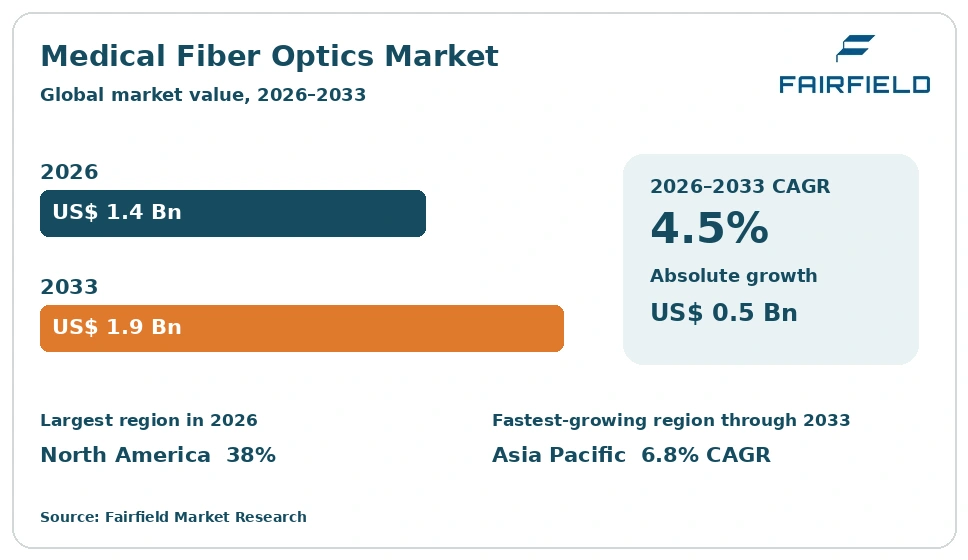
The global medical fiber optics market size is expected to be valued at US$ 1.4 billion in 2026 and projected to reach US$ 1.9 billion by 2033, growing at a CAGR of 4.5% between 2026 and 2033.
The market expanded at an estimated 3.5% CAGR between 2020 and 2025, ending that period near US$ 1.3 billion. The headline rate hides three very different trajectories. Fibre carries light, energy and measurement down a two-millimetre channel, and one of those three jobs is disappearing. Coherent imaging bundles, which made flexible endoscopy possible, have largely been displaced by miniature image sensors placed at the distal tip. Laser energy delivery continues to grow, because no non-optical method carries high-power laser light into the body. Optical sensing grows fastest of all. Telecom and datacom fibre, complete endoscopes and laser consoles are not counted here.
Key Report Takeaways
- By Product Type: Laser delivery fibres held 34% share in 2026, while optical sensing fibres are projected to expand at a 9.6% CAGR through 2033, driven by shape, pressure and temperature sensing built into catheters and surgical instruments.
- By Application: Endoscopy and minimally invasive surgery held 29% share in 2026, while cardiology and vascular is projected to expand at a 7.8% CAGR through 2033, driven by fibre-based navigation and intravascular probe assemblies.
- By Usage Model: Reusable assemblies held 56% share in 2026, while single-use assemblies are projected to expand at an 8.4% CAGR through 2033, driven by device manufacturers designing disposable fibre sets into their platforms.
- By End User: Medical device manufacturers held 62% share in 2026, while hospitals and ambulatory surgical centres are projected to expand at a 6.4% CAGR through 2033, driven by direct purchasing of disposable laser fibre stock.
- By Geography: North America held 38% share in 2026, while Asia Pacific is projected to expand at a 6.8% CAGR through 2033, driven by device manufacturing capacity in China, Japan and South Korea.
Global Medical Fiber Optics Market Trends and Insights
Drivers Impact Analysis
Two applications are expanding fast enough to offset the structural decline elsewhere in the product mix.
| Driver | Impact on CAGR Forecast | Geographic Relevance | Impact Timeline |
| Laser energy delivery with no practical non-optical alternative at catheter scale | High | North America, Europe, Asia Pacific | Long term ≥4 years |
| Fibre optic shape, pressure and temperature sensing inside instruments and catheters | Medium | North America, Europe | Medium term 2–4 years |
Laser Energy Delivery Keeps Fibre Essential Inside Narrow Working Channels
Laser delivery is the largest and most durable source of fibre demand, because nothing else carries high-power light through a flexible path a few hundred microns across. Surgical and therapeutic laser platforms in urology, vascular work, dentistry, ophthalmology and aesthetics all terminate in a fibre, and the console is useless without one. Each console sold therefore creates a continuing fibre requirement for as long as it operates.
The mechanism is geometric and physical rather than commercial. A working channel in a flexible endoscope or catheter is typically one to three millimetres, and the energy must arrive at a controlled spot with a defined emission pattern. Bare, ball-tip, side-firing and radial emitting geometries exist precisely to shape that delivery. Laser equipment requirements under IEC 60601-2-22 and classification under IEC 60825 govern how the assembly is specified, labelled and supplied.
Fibre Optic Sensing Adds Measurement Where No Electrical Equivalent Fits the Device
Sensing is the fastest-expanding reason to put fibre into a medical device. Fibre Bragg grating shape sensing, together with fibre pressure, temperature and oxygen sensing, provides measurement inside instruments that are too small and too electrically sensitive for conventional transducers. A single fibre can carry many sensing points along its length, which no wired alternative achieves at that diameter.
The mechanism is immunity and scale. Optical sensing carries no current into the body, is unaffected by electromagnetic interference from nearby equipment, and survives bending radii that electrical sensor assemblies do not. Catheter navigation systems, robotic surgical instruments and ablation devices use these properties to know where an instrument is and what conditions it is experiencing. Because the sensing fibre is specified into the device design, the supplier position is durable once a platform reaches production.
Restraints Impact Analysis
Two forces hold the aggregate growth rate well below the rate of the expanding applications.
| Restraint | Impact on CAGR Forecast | Geographic Relevance | Impact Timeline |
| Displacement of coherent imaging bundles by distal image sensors | High | Global | Long term ≥4 years |
| Single-use cost targets, tip damage limits and qualification documentation | Medium | Global | Medium term 2–4 years |
Chip-on-Tip Image Sensors Have Removed Imaging Bundles From the Endoscope Light Path
One of the three historic fibre applications is in structural decline. Coherent imaging bundles, made of tens of thousands of individually drawn and aligned fibres, were once the only way to return an image from inside the body. Complementary metal-oxide-semiconductor sensors mounted at the distal tip now do that job, and the fibre bundle has simply left the imaging path in most new designs. Suppliers of imaging bundles have lost volume that will not return.
The cause is cost and manufacturing yield. A coherent bundle is slow to make, expensive per unit and fragile, since broken fibres appear permanently in the image. A distal sensor is a semiconductor part whose price falls with volume. Illumination fibre has partly survived the same transition, although distal light-emitting diodes are displacing light guides in some disposable scope designs as well.
Single-Use Cost Targets, Tip Damage and Qualification Files Compress Fibre Supplier Margins
Margin pressure is the practical constraint on the growing half of this market. Disposable fibre assemblies are bought against a unit cost target set inside a device manufacturer’s bill of materials, not against the value the hospital sees, so suppliers compete on automated assembly and scale rather than on optical specification. Small specialist fibre shops find that difficult, and several applications have consolidated toward larger assemblers.
Two technical and regulatory costs sit on top. Burn-back and tip damage during high-power laser delivery limit usable fibre life and force conservative design margins, additional tip processing and tighter incoming inspection. Anything entering the body also needs biological evaluation documentation under the ISO 10993 series and a design history that supports the device manufacturer’s submission, which lengthens qualification and raises the cost of changing a supplier or a process.
Market Opportunities
Two revenue pools are opening as fibre moves from imaging into energy and measurement.
Single-Use Laser Fibres in Urology and Vascular Work Open a High-Volume Consumable Pool
Disposable laser delivery fibres are the largest volume opportunity in this market. Where a device manufacturer designs a procedure around a sterile, pre-packaged fibre supplied with the kit, the fibre becomes a per-procedure consumable rather than a durable accessory. Urology and lithotripsy, vascular and ablation procedures generate the highest volumes, and the annual quantity scales with procedure counts rather than with console installations.
Capturing this pool favours suppliers with automated termination, polishing and packaging lines and with the quality system to support high-volume lot release. The customer is the device manufacturer or kit assembler, not the hospital, which changes the commercial relationship entirely: contracts are multi-year, specifications are fixed in a design file, and pricing is negotiated per thousand units. Single-use labelling and reprocessing prohibition rules keep the consumption pattern stable once a platform is launched.
Shape Sensing and Optical Coherence Tomography Probes Create a Measurement Revenue Pool
Sensing and probe assemblies form a smaller but far higher-value pool than bulk fibre supply. Fibre Bragg grating shape sensing in catheter navigation, optical coherence tomography probes, and pressure, temperature and oxygen sensing fibres all sell at prices per assembly that bulk illumination fibre never reaches, because the value lies in the grating writing, the distal optics and the calibration rather than in the fibre itself.
Specialty fibre drawers, grating writers and precision micro-optic assemblers are positioned to capture it, usually as a designed-in component supplier rather than through a catalogue. Demand comes from cardiology and vascular device programmes, robotic surgical platforms and interventional navigation systems, where instrument position and local conditions must be known at a scale where electrical sensing does not fit. Spectroscopy probes for diagnostics and monitoring extend the same component set into laboratory and bedside equipment.
Segment Analysis
By Product Type: Laser Delivery Fibres Lead While Optical Sensing Fibres Expand Fastest
Laser delivery fibres held 34% of market value in 2026, the largest product category. Bare, ball-tip, side-firing and radial emitting designs serve surgical and therapeutic laser platforms across urology, vascular, dental, ophthalmic and aesthetic equipment, and each console in service consumes fibre continuously. Illumination bundles and light guides take the next largest share, while connectors, couplers and assemblies form a steady supporting category.
Optical sensing fibres are the fastest-growing product type at a 9.6% CAGR through 2033, from a small base. Shape, pressure, temperature and oxygen sensing fibres sell at high value per assembly because the content lies in grating writing and distal optics. Imaging fibre bundles move in the opposite direction, losing volume to distal image sensors in new scope designs. The implication is that a supplier’s product mix, more than its total volume, now determines whether it grows.
By Application: Endoscopy Holds the Largest Share as Cardiology and Vascular Grows Quickest
Endoscopy and minimally invasive surgery accounted for 29% of fibre demand in 2026, the leading application, although its composition has changed. Illumination and laser delivery now make up most of that demand, while the imaging bundles that once defined the category have receded. Urology and lithotripsy form the next largest block, consuming disposable laser fibres in high volumes, followed by dentistry, ophthalmology and aesthetic and dermatology equipment.
Cardiology and vascular is expanding fastest at a 7.8% CAGR through 2033. Catheter-based procedures use fibre for shape sensing, pressure measurement, optical coherence tomography probes and laser energy delivery, often within the same device family. Diagnostics and monitoring applications add spectroscopy and oximetry probes. For suppliers, the practical consequence is that the growth applications demand sensing and probe engineering rather than the bundle drawing skills the industry was originally built on.
By Usage Model: Reusable Assemblies Still Lead While Single-Use Assemblies Grow Faster
Reusable fibre assemblies represented 56% of market value in 2026, still the larger usage model. Durable light guides, reusable laser fibres and fixed instrument fibre remain standard in dentistry, ophthalmology, aesthetic equipment and much hospital-owned endoscopy, where assemblies are cleaned and reused across many procedures and the hospital is the purchaser.
Single-use assemblies are growing faster at an 8.4% CAGR through 2033, and their rise has changed who the fibre supplier sells to. When a scope or delivery fibre is disposable, the buyer stops being a hospital purchasing durable equipment and becomes a device manufacturer purchasing high volumes against a unit cost target. That rewards automated termination and packaging, scale and quality system depth, and it squeezes small specialist workshops. The business implication is a shift in the industry’s cost structure and customer base, not simply a change in product life.
By End User: Device Manufacturers Buy Most Fibre While Hospitals Increase Direct Purchasing
Medical device manufacturers purchased 62% of medical fibre output in 2026, by far the largest end user group. They specify fibre into design files, hold the regulatory submissions and buy against multi-year agreements, so they anchor supplier relationships and set prices. Dental and specialty clinics, and research and diagnostic laboratories, account for smaller volumes bought largely through catalogue and distribution channels.
Hospitals and ambulatory surgical centres are the fastest-growing group at a 6.4% CAGR through 2033. As disposable laser fibre volumes rise, more hospitals buy fibre stock directly against procedure schedules rather than receiving it inside a capital equipment contract. That brings tender pricing, stock management and shelf-life considerations into a market that was previously business to business throughout. Suppliers consequently need both design-in capability for manufacturers and distribution reach for clinical buyers.
Geography Analysis
Which Region Is Leading the Medical Fiber Optics Market?
North America leads the medical fiber optics market with a 38% share in 2026, because the region hosts the largest concentration of medical device manufacturers that design fibre into their products. The United States accounts for almost all regional value, with device clusters in Massachusetts, Minnesota, California and Colorado buying laser delivery, sensing and illumination assemblies in volume. Canada contributes specialist photonics capacity.
Three causes underpin the position. Device manufacturers headquartered in the region set the specifications that fibre suppliers build to, so design-in decisions made here propagate globally. Clearance through FDA 510(k) gives fibre-based accessories a predictable route to market. Laser product requirements administered under federal performance standards shape how assemblies are classified and labelled. The change to watch is continued migration of disposable fibre assembly to contract manufacturers, which concentrates purchasing into fewer, larger accounts.
Europe Supplies Specialty Fibre and Absorbs the Full Weight of Device Regulation
Europe accounted for 28% of medical fibre revenue in 2026, anchored by Germany, Switzerland, France, Italy and the United Kingdom. The region holds unusual strength in specialty glass drawing, light guide manufacture and precision micro-optics, and it exports fibre and assemblies well beyond its own device industry.
Regulation is the dominant commercial variable. Conformity assessment under the Medical Device Regulation applies to fibre-based accessories as well as to complete devices, and notified body capacity has lengthened timelines for even modest design changes. Laser equipment requirements under IEC 60601-2-22 and the IEC 60825 classification series govern product documentation, while ISO 8600 defines the endoscope and endotherapy device family these components serve. Common specifications now cover certain laser and light-based equipment without an intended medical purpose, which has brought part of the aesthetics supply chain into formal scope.
Which Region Is Growing Fastest in the Medical Fiber Optics Market?
Asia Pacific is growing fastest in the medical fiber optics market at a 6.8% CAGR between 2026 and 2033, from a 24% base share in 2026. China, Japan, South Korea and India drive the expansion, with Japan contributing high-specification fibre and endoscope component manufacturing and China contributing volume.
The cause is manufacturing location rather than procedure growth alone. Disposable scope and laser fibre assembly has moved toward the region because labour-intensive termination and packaging benefit from local cost structures, and domestic device manufacturers in China now design fibre into their own platforms rather than importing finished assemblies. Specialty fibre drawing capacity in Japan supports both. The opportunity lies in sensing fibre, where regional device makers are beginning to specify shape and pressure sensing that was previously imported as a complete subsystem.
Latin America Buys Imported Fibre Assemblies Through Price-Sensitive Tender Channels
Latin America represented 5% of the market in 2026, with Brazil and Mexico accounting for most activity and Argentina, Chile and Colombia adding modest volumes. Mexico matters more as a manufacturing location than as a consuming market, because its northern border device clusters assemble catheters, probes and disposables for export.
Barriers are significant. Almost all specialty fibre is imported, so currency movements and customs clearance affect both cost and lead time, and small order sizes make direct supply agreements uneconomic for specialist producers. Registration with national health authorities adds time for each assembly variant. Price-driven tendering in public hospitals pushes buyers toward reusable assemblies that spread cost across procedures. The change worth watching is the maturing contract manufacturing base in Mexico, which aggregates demand into volumes that fibre suppliers can serve directly.
Middle East & Africa Grows From a Small Base as Procedure Capacity and Assembly Arrive
Middle East & Africa accounted for 5% of global demand in 2026, the smallest regional share. Saudi Arabia, the United Arab Emirates, Israel, Turkey and South Africa account for most of it, with Israel contributing disproportionately through its medical device development sector rather than through consumption.
Constraints are structural. There is almost no local specialty fibre or assembly capacity, so fibre arrives embedded in imported devices and kits, which makes the regional figure partly invisible in trade data. Fragmented regulatory frameworks across African markets raise the cost of registering each assembly variant, and service and stock-holding networks are thin. The shaping change is healthcare localisation policy in the Gulf Cooperation Council states, where investment in surgical capacity and in domestic device assembly is beginning to create direct demand for fibre components.
Competitive Landscape
The medical fiber optics market is fragmented, with low concentration and no supplier holding a commanding share across all product types. The field divides into three loosely connected groups. Large glass and fibre producers such as SCHOTT AG, Corning Incorporated, Fujikura Ltd. and Sumitomo Electric Industries, Ltd. draw specialty fibre and supply light guides. Photonics and component companies including Coherent Corp., IPG Photonics Corporation and Thorlabs, Inc. supply laser delivery fibre, optics and sub-assemblies. Interconnect and assembly specialists such as Molex, LLC and smaller workshops including art photonics GmbH and biolitec AG build finished medical assemblies. Consolidation has been slow and selective, usually involving an assembler acquiring termination or micro-optics capability rather than a large structural combination.
Competition rests on design-in position and manufacturing cost rather than on catalogue optical performance. Once a fibre assembly is written into a device manufacturer’s design history file, changing supplier requires requalification, so incumbency is strong and the contest happens at the platform development stage. Suppliers compete on the ability to meet a unit cost target at volume, on automated termination and polishing, on documentation that supports the customer’s submission, and on tip geometries that resist burn-back. New entrants appear mainly in sensing, where grating writing and interrogation expertise matter more than fibre drawing scale, and in low-cost disposable assembly.
Strategic activity concentrates on automation and vertical integration. Assemblers are adding automated termination, polishing and inspection lines to meet disposable cost targets, while fibre producers move downstream into finished assemblies to capture more of the value.
Strategic direction across the field converges on three themes: shifting product mix away from imaging bundles toward energy delivery and sensing, building quality systems deep enough to serve high-volume single-use programmes, and securing designed-in positions early in a device manufacturer’s development cycle.
Medical Fiber Optics Industry Leaders
- SCHOTT AG
- Coherent Corp.
- Molex, LLC
- Fujikura Ltd.
- Sumitomo Electric Industries, Ltd.
Recent Industry Developments
- 2014: The third edition of IEC 60825-1 on safety of laser products was published, consolidating laser classification and labelling requirements – fibre delivery assemblies are specified and documented against this classification by every laser equipment manufacturer.
- May 2021: The European Union Medical Device Regulation became fully applicable, covering accessories such as fibre delivery and sensing assemblies alongside complete devices – suppliers with full technical documentation gained an access advantage over catalogue-only competitors.
- March 2023: The European Union adopted an amending regulation extending the transitional periods of the Medical Device Regulation – the extension relieved certificate expiry pressure on legacy fibre-based accessories without changing the underlying requirements.
- June 2023: Common specifications for products without an intended medical purpose began to apply in the European Union, covering certain laser and light-based equipment used for aesthetic purposes – this brought part of the aesthetic device supply chain, and the fibre assemblies within it, into formal regulatory scope.
Companies Covered in the Report
- SCHOTT AG
- Coherent Corp.
- Molex, LLC
- Fujikura Ltd.
- Sumitomo Electric Industries, Ltd.
- Corning Incorporated
- OFS Fitel, LLC
- art photonics GmbH
- biolitec AG
- IPG Photonics Corporation
- Thorlabs, Inc.
- Toray Industries, Inc.
- Mitsubishi Chemical Group Corporation
Medical Fiber Optics Market Report Scope
This report sizes optical fibre and fibre-based components used inside medical devices and procedures, covering illumination bundles and light guides, imaging bundles, laser delivery fibres, optical sensing fibres, probe fibre for tomography and spectroscopy, and connectors, couplers and sterile single-use assemblies. Telecommunications and datacentre fibre are excluded, as are complete endoscopes and laser consoles. The base year is 2025, the forecast period runs from 2026 to 2033, and values are reported in US$ Billion.
| Product Type | Illumination Fibre Bundles and Light Guides, Imaging Fibre Bundles, Laser Delivery Fibres, Optical Sensing Fibres, Connectors, Couplers and Assemblies |
| Application | Endoscopy and Minimally Invasive Surgery, Urology and Lithotripsy, Cardiology and Vascular, Dentistry, Ophthalmology, Aesthetic and Dermatology, Diagnostics and Monitoring |
| Usage Model | Reusable Assemblies, Single-Use Assemblies |
| End User | Medical Device Manufacturers, Hospitals and Ambulatory Surgical Centres, Dental and Specialty Clinics, Research and Diagnostic Laboratories |
| Regions | North America, Europe, Asia Pacific, Latin America, Middle East & Africa |
1. Executive Summary
1.1 Global Medical Fiber Optics Market Snapshot
1.2 Future Projections, 2026-2033
1.3 Key Market Trends
1.4 Regional Snapshot
2. Market Overview
2.1 Market Definition and Report Scope
2.2 Historical Market Trends
2.3 Market Dynamics
2.3.1 Drivers Impact Analysis
2.3.1.1 Laser Energy Delivery Keeps Fibre Essential Inside Narrow Working Channels
2.3.1.2 Fibre Optic Sensing Adds Measurement Where No Electrical Equivalent Fits the Device
2.3.2 Restraints Impact Analysis
2.3.2.1 Chip-on-Tip Image Sensors Have Removed Imaging Bundles From the Endoscope Light Path
2.3.2.2 Single-Use Cost Targets, Tip Damage and Qualification Files Compress Fibre Supplier Margins
2.3.3 Market Opportunities
2.3.3.1 Single-Use Laser Fibres in Urology and Vascular Work Open a High-Volume Consumable Pool
2.3.3.2 Shape Sensing and Optical Coherence Tomography Probes Create a Measurement Revenue Pool
3. Global Medical Fiber Optics Market Outlook, 2020-2033
3.1 Global Medical Fiber Optics Market Outlook, by Product Type, Value (US$ Billion), 2020-2033
3.1.1 Illumination Fibre Bundles and Light Guides
3.1.2 Imaging Fibre Bundles
3.1.3 Laser Delivery Fibres
3.1.4 Optical Sensing Fibres
3.1.5 Connectors, Couplers and Assemblies
3.2 Global Medical Fiber Optics Market Outlook, by Application, Value (US$ Billion), 2020-2033
3.2.1 Endoscopy and Minimally Invasive Surgery
3.2.2 Urology and Lithotripsy
3.2.3 Cardiology and Vascular
3.2.4 Dentistry
3.2.5 Ophthalmology
3.2.6 Aesthetic and Dermatology
3.2.7 Diagnostics and Monitoring
3.3 Global Medical Fiber Optics Market Outlook, by Usage Model, Value (US$ Billion), 2020-2033
3.3.1 Reusable Assemblies
3.3.2 Single-Use Assemblies
3.4 Global Medical Fiber Optics Market Outlook, by End User, Value (US$ Billion), 2020-2033
3.4.1 Medical Device Manufacturers
3.4.2 Hospitals and Ambulatory Surgical Centres
3.4.3 Dental and Specialty Clinics
3.4.4 Research and Diagnostic Laboratories
3.5 Global Medical Fiber Optics Market Outlook, by Region, Value (US$ Billion), 2020-2033
3.5.1 North America
3.5.2 Europe
3.5.3 Asia Pacific
3.5.4 Latin America
3.5.5 Middle East & Africa
4. North America Medical Fiber Optics Market Outlook, 2020-2033
4.1 North America Medical Fiber Optics Market Outlook, by Product Type, Value (US$ Billion), 2020-2033
4.1.1 Illumination Fibre Bundles and Light Guides
4.1.2 Imaging Fibre Bundles
4.1.3 Laser Delivery Fibres
4.1.4 Optical Sensing Fibres
4.1.5 Connectors, Couplers and Assemblies
4.2 North America Medical Fiber Optics Market Outlook, by Application, Value (US$ Billion), 2020-2033
4.2.1 Endoscopy and Minimally Invasive Surgery
4.2.2 Urology and Lithotripsy
4.2.3 Cardiology and Vascular
4.2.4 Dentistry
4.2.5 Ophthalmology
4.2.6 Aesthetic and Dermatology
4.2.7 Diagnostics and Monitoring
4.3 North America Medical Fiber Optics Market Outlook, by Usage Model, Value (US$ Billion), 2020-2033
4.3.1 Reusable Assemblies
4.3.2 Single-Use Assemblies
4.4 North America Medical Fiber Optics Market Outlook, by End User, Value (US$ Billion), 2020-2033
4.4.1 Medical Device Manufacturers
4.4.2 Hospitals and Ambulatory Surgical Centres
4.4.3 Dental and Specialty Clinics
4.4.4 Research and Diagnostic Laboratories
4.5 North America Medical Fiber Optics Market Outlook, by Country, Value (US$ Billion), 2020-2033
4.5.1 United States Medical Fiber Optics Market Outlook, by Product Type, 2020-2033
4.5.2 United States Medical Fiber Optics Market Outlook, by Application, 2020-2033
4.5.3 United States Medical Fiber Optics Market Outlook, by Usage Model, 2020-2033
4.5.4 United States Medical Fiber Optics Market Outlook, by End User, 2020-2033
4.5.5 Canada Medical Fiber Optics Market Outlook, by Product Type, 2020-2033
4.5.6 Canada Medical Fiber Optics Market Outlook, by Application, 2020-2033
4.5.7 Canada Medical Fiber Optics Market Outlook, by Usage Model, 2020-2033
4.5.8 Canada Medical Fiber Optics Market Outlook, by End User, 2020-2033
5. Europe Medical Fiber Optics Market Outlook, 2020-2033
5.1 Europe Medical Fiber Optics Market Outlook, by Product Type, Value (US$ Billion), 2020-2033
5.1.1 Illumination Fibre Bundles and Light Guides
5.1.2 Imaging Fibre Bundles
5.1.3 Laser Delivery Fibres
5.1.4 Optical Sensing Fibres
5.1.5 Connectors, Couplers and Assemblies
5.2 Europe Medical Fiber Optics Market Outlook, by Application, Value (US$ Billion), 2020-2033
5.2.1 Endoscopy and Minimally Invasive Surgery
5.2.2 Urology and Lithotripsy
5.2.3 Cardiology and Vascular
5.2.4 Dentistry
5.2.5 Ophthalmology
5.2.6 Aesthetic and Dermatology
5.2.7 Diagnostics and Monitoring
5.3 Europe Medical Fiber Optics Market Outlook, by Usage Model, Value (US$ Billion), 2020-2033
5.3.1 Reusable Assemblies
5.3.2 Single-Use Assemblies
5.4 Europe Medical Fiber Optics Market Outlook, by End User, Value (US$ Billion), 2020-2033
5.4.1 Medical Device Manufacturers
5.4.2 Hospitals and Ambulatory Surgical Centres
5.4.3 Dental and Specialty Clinics
5.4.4 Research and Diagnostic Laboratories
5.5 Europe Medical Fiber Optics Market Outlook, by Country, Value (US$ Billion), 2020-2033
5.5.1 Germany Medical Fiber Optics Market Outlook, by Product Type, 2020-2033
5.5.2 Germany Medical Fiber Optics Market Outlook, by Application, 2020-2033
5.5.3 Germany Medical Fiber Optics Market Outlook, by Usage Model, 2020-2033
5.5.4 Germany Medical Fiber Optics Market Outlook, by End User, 2020-2033
5.5.5 Switzerland Medical Fiber Optics Market Outlook, by Product Type, 2020-2033
5.5.6 Switzerland Medical Fiber Optics Market Outlook, by Application, 2020-2033
5.5.7 Switzerland Medical Fiber Optics Market Outlook, by Usage Model, 2020-2033
5.5.8 Switzerland Medical Fiber Optics Market Outlook, by End User, 2020-2033
5.5.9 France Medical Fiber Optics Market Outlook, by Product Type, 2020-2033
5.5.10 France Medical Fiber Optics Market Outlook, by Application, 2020-2033
5.5.11 France Medical Fiber Optics Market Outlook, by Usage Model, 2020-2033
5.5.12 France Medical Fiber Optics Market Outlook, by End User, 2020-2033
5.5.13 Italy Medical Fiber Optics Market Outlook, by Product Type, 2020-2033
5.5.14 Italy Medical Fiber Optics Market Outlook, by Application, 2020-2033
5.5.15 Italy Medical Fiber Optics Market Outlook, by Usage Model, 2020-2033
5.5.16 Italy Medical Fiber Optics Market Outlook, by End User, 2020-2033
5.5.17 United Kingdom Medical Fiber Optics Market Outlook, by Product Type, 2020-2033
5.5.18 United Kingdom Medical Fiber Optics Market Outlook, by Application, 2020-2033
5.5.19 United Kingdom Medical Fiber Optics Market Outlook, by Usage Model, 2020-2033
5.5.20 United Kingdom Medical Fiber Optics Market Outlook, by End User, 2020-2033
6. Asia Pacific Medical Fiber Optics Market Outlook, 2020-2033
6.1 Asia Pacific Medical Fiber Optics Market Outlook, by Product Type, Value (US$ Billion), 2020-2033
6.1.1 Illumination Fibre Bundles and Light Guides
6.1.2 Imaging Fibre Bundles
6.1.3 Laser Delivery Fibres
6.1.4 Optical Sensing Fibres
6.1.5 Connectors, Couplers and Assemblies
6.2 Asia Pacific Medical Fiber Optics Market Outlook, by Application, Value (US$ Billion), 2020-2033
6.2.1 Endoscopy and Minimally Invasive Surgery
6.2.2 Urology and Lithotripsy
6.2.3 Cardiology and Vascular
6.2.4 Dentistry
6.2.5 Ophthalmology
6.2.6 Aesthetic and Dermatology
6.2.7 Diagnostics and Monitoring
6.3 Asia Pacific Medical Fiber Optics Market Outlook, by Usage Model, Value (US$ Billion), 2020-2033
6.3.1 Reusable Assemblies
6.3.2 Single-Use Assemblies
6.4 Asia Pacific Medical Fiber Optics Market Outlook, by End User, Value (US$ Billion), 2020-2033
6.4.1 Medical Device Manufacturers
6.4.2 Hospitals and Ambulatory Surgical Centres
6.4.3 Dental and Specialty Clinics
6.4.4 Research and Diagnostic Laboratories
6.5 Asia Pacific Medical Fiber Optics Market Outlook, by Country, Value (US$ Billion), 2020-2033
6.5.1 China Medical Fiber Optics Market Outlook, by Product Type, 2020-2033
6.5.2 China Medical Fiber Optics Market Outlook, by Application, 2020-2033
6.5.3 China Medical Fiber Optics Market Outlook, by Usage Model, 2020-2033
6.5.4 China Medical Fiber Optics Market Outlook, by End User, 2020-2033
6.5.5 Japan Medical Fiber Optics Market Outlook, by Product Type, 2020-2033
6.5.6 Japan Medical Fiber Optics Market Outlook, by Application, 2020-2033
6.5.7 Japan Medical Fiber Optics Market Outlook, by Usage Model, 2020-2033
6.5.8 Japan Medical Fiber Optics Market Outlook, by End User, 2020-2033
6.5.9 South Korea Medical Fiber Optics Market Outlook, by Product Type, 2020-2033
6.5.10 South Korea Medical Fiber Optics Market Outlook, by Application, 2020-2033
6.5.11 South Korea Medical Fiber Optics Market Outlook, by Usage Model, 2020-2033
6.5.12 South Korea Medical Fiber Optics Market Outlook, by End User, 2020-2033
6.5.13 India Medical Fiber Optics Market Outlook, by Product Type, 2020-2033
6.5.14 India Medical Fiber Optics Market Outlook, by Application, 2020-2033
6.5.15 India Medical Fiber Optics Market Outlook, by Usage Model, 2020-2033
6.5.16 India Medical Fiber Optics Market Outlook, by End User, 2020-2033
7. Latin America Medical Fiber Optics Market Outlook, 2020-2033
7.1 Latin America Medical Fiber Optics Market Outlook, by Product Type, Value (US$ Billion), 2020-2033
7.1.1 Illumination Fibre Bundles and Light Guides
7.1.2 Imaging Fibre Bundles
7.1.3 Laser Delivery Fibres
7.1.4 Optical Sensing Fibres
7.1.5 Connectors, Couplers and Assemblies
7.2 Latin America Medical Fiber Optics Market Outlook, by Application, Value (US$ Billion), 2020-2033
7.2.1 Endoscopy and Minimally Invasive Surgery
7.2.2 Urology and Lithotripsy
7.2.3 Cardiology and Vascular
7.2.4 Dentistry
7.2.5 Ophthalmology
7.2.6 Aesthetic and Dermatology
7.2.7 Diagnostics and Monitoring
7.3 Latin America Medical Fiber Optics Market Outlook, by Usage Model, Value (US$ Billion), 2020-2033
7.3.1 Reusable Assemblies
7.3.2 Single-Use Assemblies
7.4 Latin America Medical Fiber Optics Market Outlook, by End User, Value (US$ Billion), 2020-2033
7.4.1 Medical Device Manufacturers
7.4.2 Hospitals and Ambulatory Surgical Centres
7.4.3 Dental and Specialty Clinics
7.4.4 Research and Diagnostic Laboratories
7.5 Latin America Medical Fiber Optics Market Outlook, by Country, Value (US$ Billion), 2020-2033
7.5.1 Brazil Medical Fiber Optics Market Outlook, by Product Type, 2020-2033
7.5.2 Brazil Medical Fiber Optics Market Outlook, by Application, 2020-2033
7.5.3 Brazil Medical Fiber Optics Market Outlook, by Usage Model, 2020-2033
7.5.4 Brazil Medical Fiber Optics Market Outlook, by End User, 2020-2033
7.5.5 Mexico Medical Fiber Optics Market Outlook, by Product Type, 2020-2033
7.5.6 Mexico Medical Fiber Optics Market Outlook, by Application, 2020-2033
7.5.7 Mexico Medical Fiber Optics Market Outlook, by Usage Model, 2020-2033
7.5.8 Mexico Medical Fiber Optics Market Outlook, by End User, 2020-2033
7.5.9 Argentina Medical Fiber Optics Market Outlook, by Product Type, 2020-2033
7.5.10 Argentina Medical Fiber Optics Market Outlook, by Application, 2020-2033
7.5.11 Argentina Medical Fiber Optics Market Outlook, by Usage Model, 2020-2033
7.5.12 Argentina Medical Fiber Optics Market Outlook, by End User, 2020-2033
7.5.13 Chile Medical Fiber Optics Market Outlook, by Product Type, 2020-2033
7.5.14 Chile Medical Fiber Optics Market Outlook, by Application, 2020-2033
7.5.15 Chile Medical Fiber Optics Market Outlook, by Usage Model, 2020-2033
7.5.16 Chile Medical Fiber Optics Market Outlook, by End User, 2020-2033
7.5.17 Colombia Medical Fiber Optics Market Outlook, by Product Type, 2020-2033
7.5.18 Colombia Medical Fiber Optics Market Outlook, by Application, 2020-2033
7.5.19 Colombia Medical Fiber Optics Market Outlook, by Usage Model, 2020-2033
7.5.20 Colombia Medical Fiber Optics Market Outlook, by End User, 2020-2033
8. Middle East & Africa Medical Fiber Optics Market Outlook, 2020-2033
8.1 Middle East & Africa Medical Fiber Optics Market Outlook, by Product Type, Value (US$ Billion), 2020-2033
8.1.1 Illumination Fibre Bundles and Light Guides
8.1.2 Imaging Fibre Bundles
8.1.3 Laser Delivery Fibres
8.1.4 Optical Sensing Fibres
8.1.5 Connectors, Couplers and Assemblies
8.2 Middle East & Africa Medical Fiber Optics Market Outlook, by Application, Value (US$ Billion), 2020-2033
8.2.1 Endoscopy and Minimally Invasive Surgery
8.2.2 Urology and Lithotripsy
8.2.3 Cardiology and Vascular
8.2.4 Dentistry
8.2.5 Ophthalmology
8.2.6 Aesthetic and Dermatology
8.2.7 Diagnostics and Monitoring
8.3 Middle East & Africa Medical Fiber Optics Market Outlook, by Usage Model, Value (US$ Billion), 2020-2033
8.3.1 Reusable Assemblies
8.3.2 Single-Use Assemblies
8.4 Middle East & Africa Medical Fiber Optics Market Outlook, by End User, Value (US$ Billion), 2020-2033
8.4.1 Medical Device Manufacturers
8.4.2 Hospitals and Ambulatory Surgical Centres
8.4.3 Dental and Specialty Clinics
8.4.4 Research and Diagnostic Laboratories
8.5 Middle East & Africa Medical Fiber Optics Market Outlook, by Country and Subregion, Value (US$ Billion), 2020-2033
8.5.1 Saudi Arabia Medical Fiber Optics Market Outlook, by Product Type, 2020-2033
8.5.2 Saudi Arabia Medical Fiber Optics Market Outlook, by Application, 2020-2033
8.5.3 Saudi Arabia Medical Fiber Optics Market Outlook, by Usage Model, 2020-2033
8.5.4 Saudi Arabia Medical Fiber Optics Market Outlook, by End User, 2020-2033
8.5.5 United Arab Emirates Medical Fiber Optics Market Outlook, by Product Type, 2020-2033
8.5.6 United Arab Emirates Medical Fiber Optics Market Outlook, by Application, 2020-2033
8.5.7 United Arab Emirates Medical Fiber Optics Market Outlook, by Usage Model, 2020-2033
8.5.8 United Arab Emirates Medical Fiber Optics Market Outlook, by End User, 2020-2033
8.5.9 Israel Medical Fiber Optics Market Outlook, by Product Type, 2020-2033
8.5.10 Israel Medical Fiber Optics Market Outlook, by Application, 2020-2033
8.5.11 Israel Medical Fiber Optics Market Outlook, by Usage Model, 2020-2033
8.5.12 Israel Medical Fiber Optics Market Outlook, by End User, 2020-2033
8.5.13 Turkey Medical Fiber Optics Market Outlook, by Product Type, 2020-2033
8.5.14 Turkey Medical Fiber Optics Market Outlook, by Application, 2020-2033
8.5.15 Turkey Medical Fiber Optics Market Outlook, by Usage Model, 2020-2033
8.5.16 Turkey Medical Fiber Optics Market Outlook, by End User, 2020-2033
8.5.17 South Africa Medical Fiber Optics Market Outlook, by Product Type, 2020-2033
8.5.18 South Africa Medical Fiber Optics Market Outlook, by Application, 2020-2033
8.5.19 South Africa Medical Fiber Optics Market Outlook, by Usage Model, 2020-2033
8.5.20 South Africa Medical Fiber Optics Market Outlook, by End User, 2020-2033
8.5.21 Gulf Cooperation Council Medical Fiber Optics Market Outlook, by Product Type, 2020-2033
8.5.22 Gulf Cooperation Council Medical Fiber Optics Market Outlook, by Application, 2020-2033
8.5.23 Gulf Cooperation Council Medical Fiber Optics Market Outlook, by Usage Model, 2020-2033
8.5.24 Gulf Cooperation Council Medical Fiber Optics Market Outlook, by End User, 2020-2033
9. Competitive Landscape
9.1 Industry Leaders
9.2 Recent Industry Developments
9.3 Company Profiles
9.3.1 SCHOTT AG
9.3.2 Coherent Corp.
9.3.3 Molex, LLC
9.3.4 Fujikura Ltd.
9.3.5 Sumitomo Electric Industries, Ltd.
9.3.6 Corning Incorporated
9.3.7 OFS Fitel, LLC
9.3.8 art photonics GmbH
9.3.9 biolitec AG
9.3.10 IPG Photonics Corporation
9.3.11 Thorlabs, Inc.
9.3.12 Toray Industries, Inc.
9.3.13 Mitsubishi Chemical Group Corporation
10. Appendix
10.1 Research Methodology
10.2 Report Assumptions
10.3 Acronyms and Abbreviations
| Product Type | Illumination Fibre Bundles and Light Guides, Imaging Fibre Bundles, Laser Delivery Fibres, Optical Sensing Fibres, Connectors, Couplers and Assemblies |
| Application | Endoscopy and Minimally Invasive Surgery, Urology and Lithotripsy, Cardiology and Vascular, Dentistry, Ophthalmology, Aesthetic and Dermatology, Diagnostics and Monitoring |
| Usage Model | Reusable Assemblies, Single-Use Assemblies |
| End User | Medical Device Manufacturers, Hospitals and Ambulatory Surgical Centres, Dental and Specialty Clinics, Research and Diagnostic Laboratories |
| Regions | North America, Europe, Asia Pacific, Latin America, Middle East & Africa |
Our Research Methodology
Considering the volatility of business today, traditional approaches to strategizing a game plan can be unfruitful if not detrimental. True ambiguity is no way to determine a forecast. A myriad of predetermined factors must be accounted for such as the degree of risk involved, the magnitude of circumstances, as well as conditions or consequences that are not known or unpredictable. To circumvent binary views that cast uncertainty, the application of market research intelligence to strategically posture, move, and enable actionable outcomes is necessary.
View Methodology
Quality Assured
Rigorous Validation Process

Confidentiality Assured
End-to-end Data Security

Custom Research Services
Tailored To Your Objectives
FAQs
The market is valued at US$ 1.4 billion in 2026, covering fibre and fibre assemblies supplied into medical devices rather than finished instruments.
The market is projected to reach US$ 1.9 billion by 2033, growing at a 4.5% CAGR and adding US$ 0.5 billion over the forecast period.
Laser delivery fibres lead with 34% share in 2026, because every surgical and therapeutic laser console requires fibre to carry its output.
Optical sensing fibres grow fastest at a 9.6% CAGR, ahead of single-use assemblies at 8.4% and cardiology and vascular applications at 7.8%.
North America holds 38% share in 2026, while Asia Pacific grows fastest at a 6.8% CAGR on device assembly capacity in China and Japan.
Related Reports
Laser Hair Removal Market Size, Share, Insights, Competitive Landscape, and Forecast 2026 to 2033
The laser hair removal market is projected to reach US$4.5 billion by 2033. Explore diode and multi-wavelength devices, clinic demand, and regional growth.
Joint Reconstruction Devices Market Size, Share, Insights, Competitive Landscape, and Forecast 2026 to 2033
The joint reconstruction devices market is projected to reach US$35.2 billion by 2033. Explore knee and hip implants, revision procedures, and surgical robotics.
Interventional Cardiology Devices Market Size, Share, Insights, Competitive Landscape, and Forecast 2026 to 2033
The global interventional cardiology devices market is valued at US$18.0 billion in 2026, reaching US$26.4 billion by 2033, growing at a 5.62% CAGR
Infusion Catheter Market Size, Share, Insights, Competitive Landscape, and Forecast 2026 to 2033
The infusion catheter market is projected to reach US$4.97 billion by 2033 at a 10.1% CAGR, driven by growth in outpatient and home infusion care.
Influenza Diagnostic Market Size, Share, Insights, Competitive Landscape, and Forecast 2026 to 2033
The influenza diagnostic market is projected to reach US$3.56 billion by 2033 at a 7.8% CAGR, driven by rapid molecular tests and wider home testing.
Implantable Insulin Pumps Market Size, Share, Insights, Competitive Landscape, and Forecast 2026 to 2033
The global implantable insulin pumps market is valued at US$3.80 billion in 2026, reaching US$6.90 billion by 2033, growing at an 8.9% CAGR