



Influenza Diagnostic Market
Influenza Diagnostic Market Size, Share, Insights, Competitive Landscape, and Forecast 2026 to 2033
Influenza Diagnostic Market Snapshot
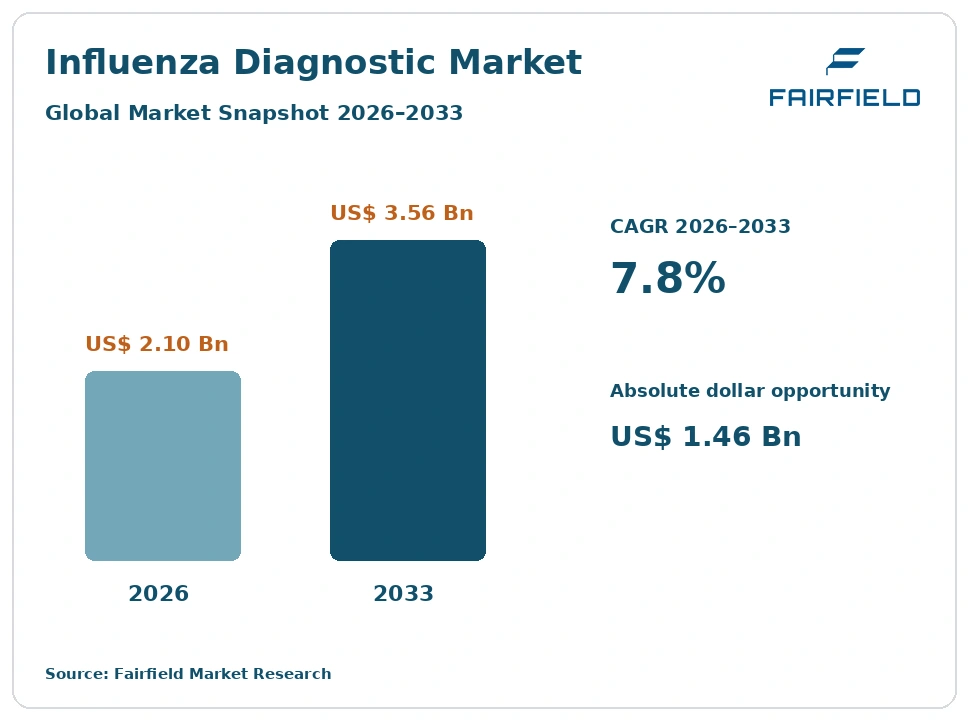
The global influenza diagnostic market size is expected to be valued at US$ 2.10 billion in 2026 and projected to reach US$ 3.56 billion by 2033, growing at a CAGR of 7.8% between 2026 and 2033.
Between 2020 and 2025, the market moved unevenly, as flu cases nearly vanished in 2020 and 2021 during pandemic restrictions, then returned strongly with severe seasons from 2022 onward while combined COVID-19 and flu tests became standard. The influenza diagnostic market covers tests that detect influenza A and B viruses, including rapid influenza diagnostic tests based on antigen detection, rapid molecular assays, laboratory RT-PCR panels, viral culture, immunofluorescence, and serological tests, along with instruments, reagents, and home test kits. Molecular flu testing offers higher accuracy and is moving from central labs to clinics, pharmacies, and homes. Tests guide antiviral treatment, infection control, and public health surveillance. Growth comes from severe flu seasons, avian flu concerns, multiplex respiratory testing, and point-of-care adoption. In July 2026, Visby Medical received FDA clearance for an at-home flu and COVID-19 PCR test.
Key Report Takeaways
- By Test Type: Rapid Influenza Diagnostic Tests held about 41% share in 2025, while Rapid Molecular Assays is projected to expand at a 10.2% CAGR through 2033, driven by higher accuracy, CLIA-waived platforms, and multiplex testing for flu, COVID-19, and RSV.
- By Testing Setting: Laboratory Testing held about 58% share in 2025, while Home Testing is projected to expand at a 12.6% CAGR through 2033, driven by over-the-counter combination tests, telehealth links to antiviral prescriptions, and pharmacy availability.
- By End User: Hospitals held about 44% share in 2025, while Clinics and Urgent Care Centers is projected to expand at an 8.9% CAGR through 2033, driven by fast point-of-care decisions on antivirals and growing walk-in care networks.
- By Region: North America held about 42% share in 2025, while Asia Pacific is projected to expand at a 9.3% CAGR through 2033, driven by large populations, rising testing access, surveillance programs, and expanding diagnostic laboratories in China, Japan, and India.
Global Influenza Diagnostic Market Trends and Insights
Drivers Impact Analysis
Two drivers carry the strongest influence on influenza diagnostic market demand during the forecast period.
| Driver | Impact on CAGR Forecast | Geographic Relevance | Impact Timeline |
| Severe flu seasons and pandemic preparedness | High | Global | Long term (≥4 years) |
| Shift to multiplex and point-of-care molecular testing | Medium | North America, Europe, Asia Pacific | Medium term (2-4 years) |
Flu Burden and Preparedness Are Driving the Influenza Diagnostic Market
Severe flu seasons and pandemic preparedness are the strongest driver of the influenza diagnostic market. Flu remains a major health threat.
The mechanism is the high and unpredictable burden of influenza. Seasonal flu causes millions of severe cases and hundreds of thousands of deaths worldwide each year, and recent seasons in the United States, Japan, and Europe have filled hospitals and clinics. Accurate testing helps doctors decide quickly whether to prescribe antivirals, which work best when started early, and helps hospitals isolate patients to prevent spread. Avian influenza outbreaks in birds and dairy cattle, with occasional human cases, have raised concern about a new pandemic and led governments to strengthen surveillance and stockpile tests. The World Health Organization global surveillance network relies on laboratory testing to choose vaccine strains. These factors keep testing a priority, supporting steady, long-term demand.
Multiplex and Point-of-Care Testing Is Expanding the Influenza Diagnostic Market
The shift to multiplex and point-of-care molecular testing is expanding the influenza diagnostic market. Doctors want fast, accurate answers.
The cause is the overlap of respiratory viruses and new technology. Flu, COVID-19, and RSV cause similar symptoms and often circulate at the same time, so combination tests that detect several viruses from one swab are now preferred. Rapid molecular platforms deliver lab-quality results in about 15 to 30 minutes, and CLIA waivers allow their use in clinics, pharmacies, and urgent care centers. The pandemic built a large base of installed instruments and familiarity with home testing. Telehealth services can now link a positive home test to an antiviral prescription. Pharmacies in some countries can test and treat flu in one visit, and new antivirals that work with a single dose make quick testing more valuable. These trends expand sales across major markets.
Restraints Impact Analysis
Two restraints limit how quickly the influenza diagnostic market grows.
| Restraint | Impact on CAGR Forecast | Geographic Relevance | Impact Timeline |
| Seasonal and unpredictable demand | High | Global | Medium term (2-4 years) |
| Accuracy limits of rapid antigen tests and cost of molecular tests | Medium | Asia Pacific, Latin America, Middle East & Africa | Medium term (2-4 years) |
Seasonal Demand Slows the Influenza Diagnostic Market
Seasonal and unpredictable demand slows the influenza diagnostic market. Testing volumes swing with each flu season.
The specific causes are the nature of influenza outbreaks. Most flu cases occur in a few winter months in the northern and southern hemispheres, so test makers must build inventory in advance without knowing how severe the season will be. Mild seasons leave distributors and clinics with excess stock, while severe seasons can cause shortages and rationing. The near disappearance of flu in 2020 and 2021 showed how quickly demand can collapse. Manufacturers must also manage short shelf lives for reagents and kits, and unsold product may expire. Revenues can vary sharply from year to year, making planning and investment harder. These factors slow steady growth and create volatility for test makers and distributors.
Test Limitations Restrict the Influenza Diagnostic Market
Accuracy limits of rapid antigen tests and the cost of molecular tests restrict the influenza diagnostic market. Each method has trade-offs.
The underlying causes are performance and price gaps. Rapid antigen tests are cheap and fast but can miss many true flu cases, so negative results may need confirmation. Molecular tests are more accurate but cost more and need instruments, which raises upfront costs for clinics. In India, Indonesia, Brazil, and Nigeria, many doctors diagnose flu by symptoms alone. Reimbursement for flu testing is limited in many countries, and some health systems question the cost of testing every patient during busy seasons. Molecular instruments need trained staff and maintenance, which small clinics may lack. False negatives from rapid tests can reduce trust among doctors. These factors restrict growth.
Market Opportunities
Home and Over-the-Counter Testing Opens a Fast-Growth Revenue Pool
Home and over-the-counter testing opens a fast-growth revenue pool in the influenza diagnostic market. Patients want to test without a visit.
Producers can capture this opportunity. The pandemic made home testing normal, and regulators in the United States have cleared several home tests that detect flu and COVID-19, and now RSV, from one swab. In January 2026, ACON Laboratories received FDA clearance for a home test that detects RSV, flu A, flu B, and COVID-19, including for children as young as six months. In July 2026, Visby Medical received clearance for an at-home PCR test for flu and COVID-19. Linking results to telehealth and pharmacy antiviral prescriptions adds value. Companies with accurate, easy-to-use home tests and strong retail distribution can grow quickly.
Surveillance and Pandemic Preparedness Create a Growth Revenue Pool
Surveillance and pandemic preparedness create a growth revenue pool in the influenza diagnostic market. Governments are investing in early warning.
Suppliers can capture this opportunity through public contracts. Avian influenza outbreaks have led health agencies to expand testing in people, animals, and wastewater, and to build stockpiles of tests that can detect new subtypes. Public health laboratories in North America, Europe, and Asia Pacific are upgrading sequencing and high-throughput molecular platforms. International funding supports surveillance and laboratory training in lower-income countries. Testing of farm workers and animals exposed to infected flocks and herds is expanding in the United States and Europe. Pandemic preparedness plans call for manufacturers who can raise output quickly. Companies offering subtyping assays, sequencing, and rapid scale-up capacity can win government contracts.
Segment Analysis
By Test Type: Rapid Influenza Diagnostic Tests Lead While Rapid Molecular Assays Grow Fastest
Rapid Influenza Diagnostic Tests held about 41% share in 2025. These antigen tests give results in about 15 minutes at low cost, making them widely used in doctors’ offices, clinics, and homes. Combination antigen tests for flu and COVID-19 are now common, and digital readers improve accuracy and record keeping.
Rapid Molecular Assays is the fastest-growing test type, expanding at a 10.2% CAGR through 2033. These tests use nucleic acid amplification to give highly accurate results in 15 to 30 minutes, and many are CLIA-waived for use in clinics, pharmacies, and urgent care centers. In June 2026, Baebies received FDA clearance and a CLIA waiver for a rapid PCR test for flu and COVID-19. Laboratory RT-PCR panels, viral culture, immunofluorescence, and serological tests form other segments, with RT-PCR used widely in hospitals and public health labs. For the market, rapid molecular growth adds value.
By Testing Setting: Laboratory Testing Leads While Home Testing Grows Fastest
Laboratory Testing held about 58% share in 2025. Hospital and commercial laboratories run high-volume molecular panels that detect flu along with many other respiratory pathogens, supporting diagnosis of seriously ill patients. Public health labs perform subtyping and surveillance, and large commercial laboratories in the United States process high volumes during peak season. Laboratory panels also detect bacteria and other viruses, helping doctors avoid unnecessary antibiotics.
Home Testing is the fastest-growing setting, expanding at a 12.6% CAGR through 2033. Over-the-counter combination tests for flu, COVID-19, and RSV are sold in pharmacies and online, and at-home molecular tests are now available. Point-of-care testing in clinics and pharmacies forms another fast-growing setting. For the market, home testing growth widens access.
By End User: Hospitals Lead While Clinics and Urgent Care Centers Grow Fastest
Hospitals held about 44% share in 2025. Emergency departments and inpatient units test patients with severe respiratory symptoms, and hospital laboratories run rapid and high-throughput molecular tests to guide treatment and isolation, and test results help manage beds during busy flu seasons.
Clinics and Urgent Care Centers is the fastest-growing end user, expanding at an 8.9% CAGR through 2033. Walk-in clinics, urgent care centers, and retail health clinics use rapid antigen and molecular tests to decide on antivirals during a single visit. Diagnostic laboratories, home care, and research institutes form other end users. Retail pharmacies in the United States are adding test-and-treat services. For the market, clinic growth supports point-of-care adoption.
Geography Analysis
Which Region Is Leading the Influenza Diagnostic Market?
North America is leading the influenza diagnostic market with about 42% share in 2025. The United States has high testing rates, broad insurance coverage, widespread use of rapid molecular tests in clinics and urgent care, and a large over-the-counter home test market. Companies such as Abbott, QuidelOrtho, Becton, Dickinson and Company, Cepheid, Hologic, ACON Laboratories, and Visby Medical are active in the region, and the FDA has cleared several new combination and home tests. Avian influenza in dairy cattle has raised surveillance activity. Canada adds public health testing. Key barriers include seasonal swings and pricing pressure. One change shaping the region is the rise of home molecular testing.
Europe Shapes the Influenza Diagnostic Market Through Laboratory Networks
Europe is a major influenza diagnostic market. Germany, the United Kingdom, France, Italy, and Spain have strong hospital and laboratory networks that run molecular respiratory panels. Roche, Siemens Healthineers, bioMérieux, and DiaSorin are based in the region. National surveillance networks report data to European health agencies. Rapid tests are used in general practice, but reimbursement varies by country. Pharmacies in the United Kingdom and other countries are expanding respiratory testing services. Key barriers include budget limits and slower adoption of home testing. One opportunity is point-of-care molecular testing in primary care.
Which Region Is Growing Fastest in the Influenza Diagnostic Market?
Asia Pacific is growing fastest in the influenza diagnostic market, expanding at a 9.3% CAGR through 2033. Japan is one of the world’s largest users of rapid flu tests, with testing common in clinics and quick use of antivirals. China has large populations, frequent flu outbreaks, and growing hospital laboratories and local test makers. India, South Korea, Australia, Indonesia, and Vietnam are expanding diagnostic access and surveillance. Avian influenza in poultry adds pressure for testing. Key barriers include cost and limited reimbursement in some countries. One change shaping the region is growing local manufacturing of rapid and molecular tests.
Latin America Grows the Influenza Diagnostic Market Through Surveillance Programs
Latin America is a growing influenza diagnostic market. Brazil, Mexico, Argentina, Chile, and Colombia run national flu surveillance programs and have growing private hospital and laboratory networks. Rapid tests and molecular panels expanded during the pandemic, leaving installed instruments and trained staff in many hospitals and private labs. Flu seasons vary across the region’s climates, creating demand at different times of the year. Public health agencies work with international networks to track new strains. Key barriers include limited public budgets, currency swings, and reliance on imported tests. One opportunity is combination respiratory testing in private clinics and hospitals.
Middle East & Africa Builds the Influenza Diagnostic Market Through Health Investment
Middle East & Africa is an emerging influenza diagnostic market. Saudi Arabia, the United Arab Emirates, and Qatar are investing in hospitals and laboratories, and mass gatherings such as the Hajj require respiratory disease surveillance. South Africa has strong surveillance and research programs, while Egypt, Nigeria, and Kenya are building laboratory capacity with international support. Key barriers include limited funding and access in many countries. One opportunity is surveillance programs supported by global health agencies.
Competitive Landscape
The influenza diagnostic market is moderately consolidated. Abbott, Roche, QuidelOrtho, Becton, Dickinson and Company, and Cepheid are leading players, while Hologic, Thermo Fisher Scientific, bioMérieux, DiaSorin, Siemens Healthineers, Sekisui Diagnostics, and ACON Laboratories compete strongly. Large diagnostics companies lead in laboratory and point-of-care molecular platforms with large installed bases, while many smaller firms and new entrants compete in rapid antigen and home tests.
Companies compete on accuracy, speed, ease of use, multiplex capability, CLIA-waived status, installed instruments, test cost, and supply reliability during peak season. Instrument-based platforms create recurring revenue from test cartridges, so building an installed base in clinics and hospitals is key. Retail distribution and brand awareness matter most for home tests sold in pharmacies.
Strategic moves show how competition is changing. In January 2026, ACON Laboratories received FDA clearance for a four-in-one home test for RSV, flu, and COVID-19. In June 2026, Baebies won FDA clearance and a CLIA waiver for a 15-minute PCR test. In July 2026, Visby Medical received clearance for an at-home PCR test for flu and COVID-19. These moves show competition shifting toward multiplex, molecular, and home testing.
Three themes shape vendor strategy. First, companies are building combination tests for several respiratory viruses. Second, they are moving molecular accuracy to point-of-care and home settings. Third, they are expanding in Asia Pacific and strengthening surveillance offerings for pandemic preparedness.
Influenza Diagnostic Market Industry Leaders
- Abbott
- Roche
- QuidelOrtho
- Becton, Dickinson and Company
- Cepheid
Recent Industry Developments
- July 2026: Visby Medical received FDA clearance for an at-home PCR test that detects influenza A and B and COVID-19 in about 30 minutes - advances molecular flu testing at home in the influenza diagnostic market.
- June 2026: Baebies received FDA clearance and a CLIA waiver for its Finder rapid PCR test for flu A, flu B, and COVID-19, giving results in about 15 minutes - expands point-of-care molecular testing in clinics and pharmacies.
- January 2026: ACON Laboratories received FDA clearance for its Flowflex Plus home test that detects RSV, flu A, flu B, and COVID-19 from one swab - widens home use of rapid influenza diagnostic tests.
Companies Covered in the Report
- Abbott
- Roche
- QuidelOrtho
- Becton, Dickinson and Company
- Cepheid
- Hologic
- Thermo Fisher Scientific
- bioMérieux
- DiaSorin
- Siemens Healthineers
- Sekisui Diagnostics
- ACON Laboratories
Influenza Diagnostic Market Scope
This report covers the influenza diagnostic market, including rapid influenza diagnostic tests, rapid molecular assays, RT-PCR, viral culture, immunofluorescence, and serological tests, used in laboratory, point-of-care, and home settings, across hospitals, clinics and urgent care centers, diagnostic laboratories, home care, and research institutes. The base year is 2025, and the forecast period runs from 2026 to 2033. All values are expressed in US$ Billion.
| Metric | Value |
| Study Period | 2020-2033 |
| Market Size 2026 | US$ 2.10 Billion |
| Market Size 2033 | US$ 3.56 Billion |
| CAGR 2026-2033 | 7.8% |
| Absolute Dollar Opportunity | US$ 1.46 Billion |
| Largest Market | North America |
| Fastest-Growing Market | Asia Pacific |
| Market Concentration | Moderately Consolidated |
| Major Players | Abbott, Roche, QuidelOrtho, Becton, Dickinson and Company, Cepheid |
Test Type
- Rapid Influenza Diagnostic Tests
- Rapid Molecular Assays
- RT-PCR
- Viral Culture
- Immunofluorescence and Serological Tests
Testing Setting
- Laboratory Testing
- Point-of-Care Testing
- Home Testing
End User
- Hospitals
- Clinics and Urgent Care Centers
- Diagnostic Laboratories
- Home Care
- Research Institutes
Regions
- North America
- Europe
- Asia Pacific
- Latin America
- Middle East & Africa
1. Executive Summary
1.1 Global Influenza Diagnostic Market Snapshot
1.2 Future Projections, 2026-2033
1.3 Key Market Trends
1.4 Regional Snapshot
2. Market Overview
2.1 Market Definition and Report Scope
2.2 Historical Market Trends
2.3 Market Dynamics
2.3.1 Drivers Impact Analysis
2.3.1.1 Flu Burden and Preparedness Are Driving the Influenza Diagnostic Market
2.3.1.2 Multiplex and Point-of-Care Testing Is Expanding the Influenza Diagnostic Market
2.3.2 Restraints Impact Analysis
2.3.2.1 Seasonal Demand Slows the Influenza Diagnostic Market
2.3.2.2 Test Limitations Restrict the Influenza Diagnostic Market
2.3.3 Market Opportunities
2.3.3.1 Home and Over-the-Counter Testing Opens a Fast-Growth Revenue Pool
2.3.3.2 Surveillance and Pandemic Preparedness Create a Growth Revenue Pool
3. Global Influenza Diagnostic Market Outlook, 2020-2033
3.1 Global Influenza Diagnostic Market Outlook, by Test Type, Value (US$ Billion), 2020-2033
3.1.1 Rapid Influenza Diagnostic Tests
3.1.2 Rapid Molecular Assays
3.1.3 RT-PCR
3.1.4 Viral Culture
3.1.5 Immunofluorescence and Serological Tests
3.2 Global Influenza Diagnostic Market Outlook, by Testing Setting, Value (US$ Billion), 2020-2033
3.2.1 Laboratory Testing
3.2.2 Point-of-Care Testing
3.2.3 Home Testing
3.3 Global Influenza Diagnostic Market Outlook, by End User, Value (US$ Billion), 2020-2033
3.3.1 Hospitals
3.3.2 Clinics and Urgent Care Centers
3.3.3 Diagnostic Laboratories
3.3.4 Home Care
3.3.5 Research Institutes
3.4 Global Influenza Diagnostic Market Outlook, by Region, Value (US$ Billion), 2020-2033
3.4.1 North America
3.4.2 Europe
3.4.3 Asia Pacific
3.4.4 Latin America
3.4.5 Middle East & Africa
4. North America Influenza Diagnostic Market Outlook, 2020-2033
4.1 North America Influenza Diagnostic Market Outlook, by Test Type, Value (US$ Billion), 2020-2033
4.1.1 Rapid Influenza Diagnostic Tests
4.1.2 Rapid Molecular Assays
4.1.3 RT-PCR
4.1.4 Viral Culture
4.1.5 Immunofluorescence and Serological Tests
4.2 North America Influenza Diagnostic Market Outlook, by Testing Setting, Value (US$ Billion), 2020-2033
4.2.1 Laboratory Testing
4.2.2 Point-of-Care Testing
4.2.3 Home Testing
4.3 North America Influenza Diagnostic Market Outlook, by End User, Value (US$ Billion), 2020-2033
4.3.1 Hospitals
4.3.2 Clinics and Urgent Care Centers
4.3.3 Diagnostic Laboratories
4.3.4 Home Care
4.3.5 Research Institutes
4.4 North America Influenza Diagnostic Market Outlook, by Country, Value (US$ Billion), 2020-2033
4.4.1 United States Influenza Diagnostic Market Outlook, by Test Type, 2020-2033
4.4.2 United States Influenza Diagnostic Market Outlook, by Testing Setting, 2020-2033
4.4.3 United States Influenza Diagnostic Market Outlook, by End User, 2020-2033
4.4.4 Canada Influenza Diagnostic Market Outlook, by Test Type, 2020-2033
4.4.5 Canada Influenza Diagnostic Market Outlook, by Testing Setting, 2020-2033
4.4.6 Canada Influenza Diagnostic Market Outlook, by End User, 2020-2033
5. Europe Influenza Diagnostic Market Outlook, 2020-2033
5.1 Europe Influenza Diagnostic Market Outlook, by Test Type, Value (US$ Billion), 2020-2033
5.1.1 Rapid Influenza Diagnostic Tests
5.1.2 Rapid Molecular Assays
5.1.3 RT-PCR
5.1.4 Viral Culture
5.1.5 Immunofluorescence and Serological Tests
5.2 Europe Influenza Diagnostic Market Outlook, by Testing Setting, Value (US$ Billion), 2020-2033
5.2.1 Laboratory Testing
5.2.2 Point-of-Care Testing
5.2.3 Home Testing
5.3 Europe Influenza Diagnostic Market Outlook, by End User, Value (US$ Billion), 2020-2033
5.3.1 Hospitals
5.3.2 Clinics and Urgent Care Centers
5.3.3 Diagnostic Laboratories
5.3.4 Home Care
5.3.5 Research Institutes
5.4 Europe Influenza Diagnostic Market Outlook, by Country, Value (US$ Billion), 2020-2033
5.4.1 Germany Influenza Diagnostic Market Outlook, by Test Type, 2020-2033
5.4.2 Germany Influenza Diagnostic Market Outlook, by Testing Setting, 2020-2033
5.4.3 Germany Influenza Diagnostic Market Outlook, by End User, 2020-2033
5.4.4 United Kingdom Influenza Diagnostic Market Outlook, by Test Type, 2020-2033
5.4.5 United Kingdom Influenza Diagnostic Market Outlook, by Testing Setting, 2020-2033
5.4.6 United Kingdom Influenza Diagnostic Market Outlook, by End User, 2020-2033
5.4.7 France Influenza Diagnostic Market Outlook, by Test Type, 2020-2033
5.4.8 France Influenza Diagnostic Market Outlook, by Testing Setting, 2020-2033
5.4.9 France Influenza Diagnostic Market Outlook, by End User, 2020-2033
5.4.10 Italy Influenza Diagnostic Market Outlook, by Test Type, 2020-2033
5.4.11 Italy Influenza Diagnostic Market Outlook, by Testing Setting, 2020-2033
5.4.12 Italy Influenza Diagnostic Market Outlook, by End User, 2020-2033
5.4.13 Spain Influenza Diagnostic Market Outlook, by Test Type, 2020-2033
5.4.14 Spain Influenza Diagnostic Market Outlook, by Testing Setting, 2020-2033
5.4.15 Spain Influenza Diagnostic Market Outlook, by End User, 2020-2033
6. Asia Pacific Influenza Diagnostic Market Outlook, 2020-2033
6.1 Asia Pacific Influenza Diagnostic Market Outlook, by Test Type, Value (US$ Billion), 2020-2033
6.1.1 Rapid Influenza Diagnostic Tests
6.1.2 Rapid Molecular Assays
6.1.3 RT-PCR
6.1.4 Viral Culture
6.1.5 Immunofluorescence and Serological Tests
6.2 Asia Pacific Influenza Diagnostic Market Outlook, by Testing Setting, Value (US$ Billion), 2020-2033
6.2.1 Laboratory Testing
6.2.2 Point-of-Care Testing
6.2.3 Home Testing
6.3 Asia Pacific Influenza Diagnostic Market Outlook, by End User, Value (US$ Billion), 2020-2033
6.3.1 Hospitals
6.3.2 Clinics and Urgent Care Centers
6.3.3 Diagnostic Laboratories
6.3.4 Home Care
6.3.5 Research Institutes
6.4 Asia Pacific Influenza Diagnostic Market Outlook, by Country, Value (US$ Billion), 2020-2033
6.4.1 Japan Influenza Diagnostic Market Outlook, by Test Type, 2020-2033
6.4.2 Japan Influenza Diagnostic Market Outlook, by Testing Setting, 2020-2033
6.4.3 Japan Influenza Diagnostic Market Outlook, by End User, 2020-2033
6.4.4 China Influenza Diagnostic Market Outlook, by Test Type, 2020-2033
6.4.5 China Influenza Diagnostic Market Outlook, by Testing Setting, 2020-2033
6.4.6 China Influenza Diagnostic Market Outlook, by End User, 2020-2033
6.4.7 India Influenza Diagnostic Market Outlook, by Test Type, 2020-2033
6.4.8 India Influenza Diagnostic Market Outlook, by Testing Setting, 2020-2033
6.4.9 India Influenza Diagnostic Market Outlook, by End User, 2020-2033
6.4.10 South Korea Influenza Diagnostic Market Outlook, by Test Type, 2020-2033
6.4.11 South Korea Influenza Diagnostic Market Outlook, by Testing Setting, 2020-2033
6.4.12 South Korea Influenza Diagnostic Market Outlook, by End User, 2020-2033
6.4.13 Australia Influenza Diagnostic Market Outlook, by Test Type, 2020-2033
6.4.14 Australia Influenza Diagnostic Market Outlook, by Testing Setting, 2020-2033
6.4.15 Australia Influenza Diagnostic Market Outlook, by End User, 2020-2033
6.4.16 Indonesia Influenza Diagnostic Market Outlook, by Test Type, 2020-2033
6.4.17 Indonesia Influenza Diagnostic Market Outlook, by Testing Setting, 2020-2033
6.4.18 Indonesia Influenza Diagnostic Market Outlook, by End User, 2020-2033
6.4.19 Vietnam Influenza Diagnostic Market Outlook, by Test Type, 2020-2033
6.4.20 Vietnam Influenza Diagnostic Market Outlook, by Testing Setting, 2020-2033
6.4.21 Vietnam Influenza Diagnostic Market Outlook, by End User, 2020-2033
7. Latin America Influenza Diagnostic Market Outlook, 2020-2033
7.1 Latin America Influenza Diagnostic Market Outlook, by Test Type, Value (US$ Billion), 2020-2033
7.1.1 Rapid Influenza Diagnostic Tests
7.1.2 Rapid Molecular Assays
7.1.3 RT-PCR
7.1.4 Viral Culture
7.1.5 Immunofluorescence and Serological Tests
7.2 Latin America Influenza Diagnostic Market Outlook, by Testing Setting, Value (US$ Billion), 2020-2033
7.2.1 Laboratory Testing
7.2.2 Point-of-Care Testing
7.2.3 Home Testing
7.3 Latin America Influenza Diagnostic Market Outlook, by End User, Value (US$ Billion), 2020-2033
7.3.1 Hospitals
7.3.2 Clinics and Urgent Care Centers
7.3.3 Diagnostic Laboratories
7.3.4 Home Care
7.3.5 Research Institutes
7.4 Latin America Influenza Diagnostic Market Outlook, by Country, Value (US$ Billion), 2020-2033
7.4.1 Brazil Influenza Diagnostic Market Outlook, by Test Type, 2020-2033
7.4.2 Brazil Influenza Diagnostic Market Outlook, by Testing Setting, 2020-2033
7.4.3 Brazil Influenza Diagnostic Market Outlook, by End User, 2020-2033
7.4.4 Mexico Influenza Diagnostic Market Outlook, by Test Type, 2020-2033
7.4.5 Mexico Influenza Diagnostic Market Outlook, by Testing Setting, 2020-2033
7.4.6 Mexico Influenza Diagnostic Market Outlook, by End User, 2020-2033
7.4.7 Argentina Influenza Diagnostic Market Outlook, by Test Type, 2020-2033
7.4.8 Argentina Influenza Diagnostic Market Outlook, by Testing Setting, 2020-2033
7.4.9 Argentina Influenza Diagnostic Market Outlook, by End User, 2020-2033
7.4.10 Chile Influenza Diagnostic Market Outlook, by Test Type, 2020-2033
7.4.11 Chile Influenza Diagnostic Market Outlook, by Testing Setting, 2020-2033
7.4.12 Chile Influenza Diagnostic Market Outlook, by End User, 2020-2033
7.4.13 Colombia Influenza Diagnostic Market Outlook, by Test Type, 2020-2033
7.4.14 Colombia Influenza Diagnostic Market Outlook, by Testing Setting, 2020-2033
7.4.15 Colombia Influenza Diagnostic Market Outlook, by End User, 2020-2033
8. Middle East & Africa Influenza Diagnostic Market Outlook, 2020-2033
8.1 Middle East & Africa Influenza Diagnostic Market Outlook, by Test Type, Value (US$ Billion), 2020-2033
8.1.1 Rapid Influenza Diagnostic Tests
8.1.2 Rapid Molecular Assays
8.1.3 RT-PCR
8.1.4 Viral Culture
8.1.5 Immunofluorescence and Serological Tests
8.2 Middle East & Africa Influenza Diagnostic Market Outlook, by Testing Setting, Value (US$ Billion), 2020-2033
8.2.1 Laboratory Testing
8.2.2 Point-of-Care Testing
8.2.3 Home Testing
8.3 Middle East & Africa Influenza Diagnostic Market Outlook, by End User, Value (US$ Billion), 2020-2033
8.3.1 Hospitals
8.3.2 Clinics and Urgent Care Centers
8.3.3 Diagnostic Laboratories
8.3.4 Home Care
8.3.5 Research Institutes
8.4 Middle East & Africa Influenza Diagnostic Market Outlook, by Country, Value (US$ Billion), 2020-2033
8.4.1 Saudi Arabia Influenza Diagnostic Market Outlook, by Test Type, 2020-2033
8.4.2 Saudi Arabia Influenza Diagnostic Market Outlook, by Testing Setting, 2020-2033
8.4.3 Saudi Arabia Influenza Diagnostic Market Outlook, by End User, 2020-2033
8.4.4 United Arab Emirates Influenza Diagnostic Market Outlook, by Test Type, 2020-2033
8.4.5 United Arab Emirates Influenza Diagnostic Market Outlook, by Testing Setting, 2020-2033
8.4.6 United Arab Emirates Influenza Diagnostic Market Outlook, by End User, 2020-2033
8.4.7 Qatar Influenza Diagnostic Market Outlook, by Test Type, 2020-2033
8.4.8 Qatar Influenza Diagnostic Market Outlook, by Testing Setting, 2020-2033
8.4.9 Qatar Influenza Diagnostic Market Outlook, by End User, 2020-2033
8.4.10 South Africa Influenza Diagnostic Market Outlook, by Test Type, 2020-2033
8.4.11 South Africa Influenza Diagnostic Market Outlook, by Testing Setting, 2020-2033
8.4.12 South Africa Influenza Diagnostic Market Outlook, by End User, 2020-2033
8.4.13 Egypt Influenza Diagnostic Market Outlook, by Test Type, 2020-2033
8.4.14 Egypt Influenza Diagnostic Market Outlook, by Testing Setting, 2020-2033
8.4.15 Egypt Influenza Diagnostic Market Outlook, by End User, 2020-2033
8.4.16 Nigeria Influenza Diagnostic Market Outlook, by Test Type, 2020-2033
8.4.17 Nigeria Influenza Diagnostic Market Outlook, by Testing Setting, 2020-2033
8.4.18 Nigeria Influenza Diagnostic Market Outlook, by End User, 2020-2033
8.4.19 Kenya Influenza Diagnostic Market Outlook, by Test Type, 2020-2033
8.4.20 Kenya Influenza Diagnostic Market Outlook, by Testing Setting, 2020-2033
8.4.21 Kenya Influenza Diagnostic Market Outlook, by End User, 2020-2033
9. Competitive Landscape
9.1 Industry Leaders
9.2 Recent Industry Developments
9.3 Company Profiles
9.3.1 Abbott
9.3.2 Roche
9.3.3 QuidelOrtho
9.3.4 Becton, Dickinson and Company
9.3.5 Cepheid
9.3.6 Hologic
9.3.7 Thermo Fisher Scientific
9.3.8 bioMérieux
9.3.9 DiaSorin
9.3.10 Siemens Healthineers
9.3.11 Sekisui Diagnostics
9.3.12 ACON Laboratories
10. Appendix
10.1 Research Methodology
10.2 Report Assumptions
10.3 Acronyms and Abbreviations
| Segment | Categories |
|---|---|
| Test Type | Rapid Influenza Diagnostic Tests, Rapid Molecular Assays, RT-PCR, Viral Culture, Immunofluorescence and Serological Tests |
| Testing Setting | Laboratory Testing, Point-of-Care Testing, Home Testing |
| End User | Hospitals, Clinics and Urgent Care Centers, Diagnostic Laboratories, Home Care, Research Institutes |
| Regions | North America, Europe, Asia Pacific, Latin America, Middle East & Africa |
Our Research Methodology
Considering the volatility of business today, traditional approaches to strategizing a game plan can be unfruitful if not detrimental. True ambiguity is no way to determine a forecast. A myriad of predetermined factors must be accounted for such as the degree of risk involved, the magnitude of circumstances, as well as conditions or consequences that are not known or unpredictable. To circumvent binary views that cast uncertainty, the application of market research intelligence to strategically posture, move, and enable actionable outcomes is necessary.
View Methodology
Quality Assured
Rigorous Validation Process

Confidentiality Assured
End-to-end Data Security

Custom Research Services
Tailored To Your Objectives
FAQs
The influenza diagnostic market is valued at US$ 2.10 billion in 2026, led by rapid antigen tests, laboratory testing, and North America.
The market is projected to reach US$ 3.56 billion by 2033, growing at a 7.8% CAGR and adding US$ 1.46 billion.
Rapid molecular assays are growing fastest at a 10.2% CAGR through 2033, driven by higher accuracy and CLIA-waived point-of-care platforms.
Asia Pacific is growing fastest at a 9.3% CAGR through 2033, driven by large populations, rapid test use in Japan, and expanding labs.
North America holds the largest share at about 42% in 2025, supported by high testing rates, broad coverage, and home test adoption.
Related Reports
Medical Fiber Optics Market Size, Share, Insights, Competitive Landscape, and Forecast 2026 to 2033
The medical fiber optics market is projected to grow from US$1.4 billion in 2026 to US$1.9 billion by 2033 at a 4.5% CAGR.
Laser Hair Removal Market Size, Share, Insights, Competitive Landscape, and Forecast 2026 to 2033
The laser hair removal market is projected to reach US$4.5 billion by 2033. Explore diode and multi-wavelength devices, clinic demand, and regional growth.
Joint Reconstruction Devices Market Size, Share, Insights, Competitive Landscape, and Forecast 2026 to 2033
The joint reconstruction devices market is projected to reach US$35.2 billion by 2033. Explore knee and hip implants, revision procedures, and surgical robotics.
Interventional Cardiology Devices Market Size, Share, Insights, Competitive Landscape, and Forecast 2026 to 2033
The global interventional cardiology devices market is valued at US$18.0 billion in 2026, reaching US$26.4 billion by 2033, growing at a 5.62% CAGR
Infusion Catheter Market Size, Share, Insights, Competitive Landscape, and Forecast 2026 to 2033
The infusion catheter market is projected to reach US$4.97 billion by 2033 at a 10.1% CAGR, driven by growth in outpatient and home infusion care.
Implantable Insulin Pumps Market Size, Share, Insights, Competitive Landscape, and Forecast 2026 to 2033
The global implantable insulin pumps market is valued at US$3.80 billion in 2026, reaching US$6.90 billion by 2033, growing at an 8.9% CAGR