



Laser Hair Removal Market
Laser Hair Removal Market Size, Share, Insights, Competitive Landscape, and Forecast 2026 to 2033
Report Overview
Laser Hair Removal Market Size and Trend Analysis
What Is the Growth Outlook for Laser Hair Removal Devices?
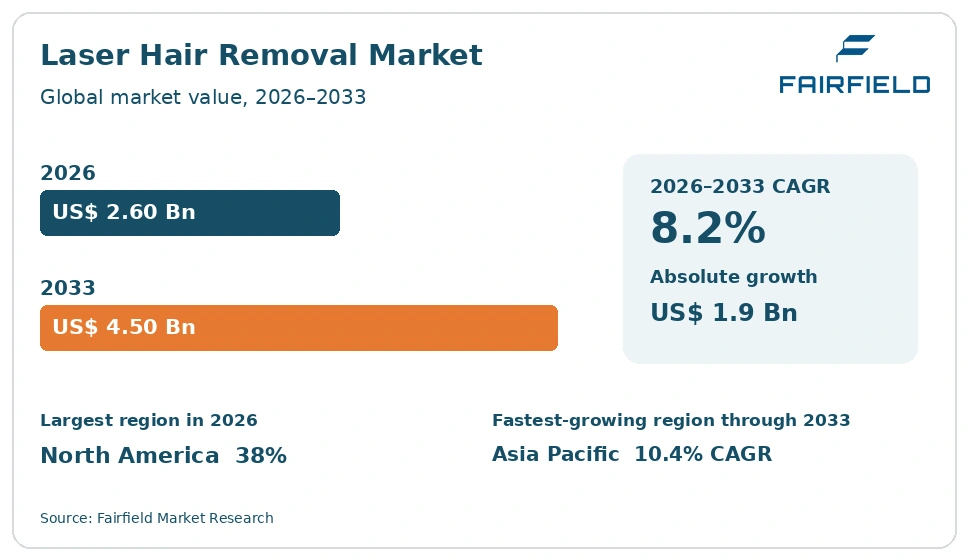
The global Laser Hair Removal market size is expected to be valued at US$ 2.6 billion in 2026 and projected to reach US$ 4.5 billion by 2033, growing at a CAGR of 8.2% between 2026 and 2033.
Device revenue expanded at a 7.1% CAGR between 2020 and 2025, closing that period near US$ 2.4 billion. These figures count device sales only: professional laser platforms, intense pulsed light systems, home-use units, and the consumables, handpieces, cooling systems and service contracts attached to them. Revenue earned by clinics and medical spas from delivering procedures is several times larger and is excluded throughout. Three factors carry the forecast: a rising count of aesthetic outlets in emerging economies, the shift toward multi-wavelength platforms that spread fixed capital across more cleared indications, and finance structures that let undercapitalised operators acquire equipment. Regulatory classification and operator licensing decisions remain the main variable in either direction.
Key Report Takeaways
- By Product Type: Diode laser platforms held 31% share in 2026, while multi-wavelength laser platforms are projected to expand at a 10.9% CAGR through 2033, because one chassis covering several cleared indications improves the utilisation arithmetic clinics use when buying.
- By End User: Dermatology and aesthetic clinics accounted for 42% share in 2026, while medical spas are projected to grow at a 9.9% CAGR through 2033, as non-hospital outlets multiply in jurisdictions that permit trained non-medical operators under supervision.
- By Revenue Stream: Capital equipment held 68% share in 2026, while service contracts and maintenance are projected to advance at a 10.3% CAGR through 2033, driven by ageing installed bases and manufacturer programmes attached to financed platforms.
- By Distribution Channel: Direct sales held 54% share in 2026, while online and direct-to-consumer retail is projected to rise at a 10.8% CAGR through 2033, reflecting home-use device volumes sold at a fraction of professional platform prices.
- By Geography: North America led with 38% share in 2026, while Asia Pacific is projected to grow at a 10.4% CAGR through 2033, as clinic counts rise across China, India, Korea and Japan.
Global Laser Hair Removal Market Trends and Insights
Drivers Impact Analysis
Two commercial forces account for most of the incremental device revenue expected between 2026 and 2033.
| Driver | Impact on CAGR Forecast | Geographic Relevance | Impact Timeline |
| Utilisation arithmetic favouring platforms cleared for several indications over single-purpose systems | High | Global, led by North America and Europe | Short term ≤2 years |
| Leasing, rental and vendor finance lowering the capital barrier for new aesthetic outlets | Medium | Asia Pacific, Latin America and Middle East & Africa | Medium term 2–4 years |
Utilisation Economics Push Clinics Toward Platforms Cleared for Several Indications
The buyer in this market is a small business running a utilisation calculation. A professional platform costs a substantial capital sum, and the owner must fill appointment slots to service that outlay. Throughput per hour therefore matters as much as the purchase price, and so does the number of cleared indications a chassis can be used for, because idle capacity has no revenue. Platforms that sit unused on a single application are difficult to justify at any price.
The mechanism is straightforward payback modelling. Larger spot sizes and higher repetition rates shorten the time a slot occupies the room, while a multi-wavelength or modular chassis lets the same capital earn across additional cleared uses. Manufacturers have responded by selling configurable platforms with upgradeable handpieces rather than fixed single-application systems. That is why the professional end of the installed base is consolidating around fewer, more capable units per site.
Leasing and Vendor Finance Lower the Capital Barrier for New Aesthetic Outlets
Finance structures determine how many outlets can buy equipment at all. The customer base is fragmented and undercapitalised, and a large share of it cannot fund a professional platform from cash flow. Operating leases, hire purchase, rental agreements and pay-per-use arrangements convert that capital sum into a monthly figure that can be matched against appointment revenue. Where such terms are available, outlet formation accelerates and unit shipments follow.
The underlying change is the entry of specialist equipment lessors and manufacturer captive finance arms into aesthetics. Lenders have built underwriting models for a sector they previously avoided, using remote usage telemetry and consumable reordering data to monitor utilisation. Vendors now bundle finance with installation, training and a service contract, which stabilises their own revenue and lowers the deposit a new clinic must find. Emerging markets with rapid clinic formation benefit most.
Restraints Impact Analysis
The binding constraints are the capital intensity of a fragile customer base and the rules governing who may operate the equipment.
| Restraint | Impact on CAGR Forecast | Geographic Relevance | Impact Timeline |
| Capital cost, clinic closure rates and a secondary market in used and unauthorised systems | High | Global, acute in Latin America and Middle East & Africa | Long term ≥4 years |
| Operator licensing and medical supervision requirements limiting the number of outlets | High | Europe and North America above all | Short term ≤2 years |
Capital Cost and Clinic Closure Rates Interrupt Platform Replacement Cycles
Capital intensity in a fragile customer base limits new orders more than demand does. A professional platform represents a large share of a single-site clinic’s total assets, and the sector has a high rate of business closure within the first few years of trading. Each closure removes a future replacement order and releases a working system into circulation. Replacement cycles therefore stretch well beyond the technical life manufacturers design for.
The specific cost sources are the chassis itself, the laser source and its scheduled refurbishment, cooling hardware, calibration and the annual service contract. Together these make total cost of ownership far higher than the headline price. Released equipment also feeds a documented secondary and grey market, where used, re-badged and unauthorised systems are resold across borders without manufacturer support or verified conformity. That channel depresses new-unit pricing and complicates post-market surveillance at industry level.
Operator Licensing and Supervision Rules Cap the Number of Outlets That Buy Devices
Who may lawfully operate a light-based device is the single most important market-access variable. Some jurisdictions restrict operation to registered medical practitioners, some permit delegation to trained staff under documented supervision, and others allow licensed non-medical operators to work independently. Each position produces a different maximum number of outlets, and the number of outlets sets the number of devices sold. Several jurisdictions have tightened their requirements, which slows outlet formation directly.
The cause is regulatory rather than technical. Rules on premises registration, operator qualification, supervision ratios and mandatory incident reporting are set nationally, and in federal systems they vary by state or province. Compliance adds registration fees, documented training records and inspection exposure to the cost of opening a site. Advertising standards for aesthetic procedures impose a further constraint on how outlets may promote capacity, which affects the appointment volume used to justify equipment purchases.
Market Opportunities
Multi-Application Platforms Expand Revenue per Installed System Across More Cleared Uses
Multi-application platforms are the clearest incremental revenue pool for manufacturers. Selling one configurable chassis with several wavelengths and upgradeable handpieces raises the average order value above a single-purpose system, and it creates a later upgrade sale into the same installed base. For the clinic, one capitalised asset serving several cleared indications improves utilisation, which makes the purchase financeable. Both sides of the transaction improve at once.
Established platform manufacturers with regulatory portfolios spanning multiple indications are best placed to capture this, since each additional use requires its own conformity assessment or clearance rather than a marketing decision. Demand comes from multi-site clinic groups and medical spa chains standardising their equipment fleets to simplify training, servicing and procurement. The conformity assessment regimes now applied to aesthetic light-based equipment reinforce the trend, because the documentation burden favours vendors able to amortise it across a broad platform.
Service Contracts, Consumables and Certified Training Build Recurring Revenue Streams
Recurring revenue attached to the installed base is the second pool, and it carries better margin and far lower volatility than capital sales. Annual service and maintenance agreements, calibration visits, handpiece and crystal replacement, cooling system parts, extended warranties and software entitlements all bill against machines already in the field. As the installed base ages, this pool grows independently of new-unit shipments.
Manufacturers with direct field service networks can capture most of it, and authorised distributors can capture the rest in territories where direct coverage is uneconomic. Demand comes from clinic owners who cannot absorb unplanned downtime on a financed asset, and from insurers and lenders who require documented maintenance. Certified operator training is a related and underdeveloped line, because jurisdictions that require documented operator qualification create a continuing, chargeable obligation that vendors are well positioned to supply.
Segment Analysis
By Product Type: Diode Platforms Lead While Multi-Wavelength Systems Gain Share Fastest
Diode laser platforms held 31% share in 2026, the largest single product type, because their wavelength range and cooling designs suit a wide span of skin phototypes and because high-throughput configurations shorten room time. Alexandrite platforms hold a substantial installed base, neodymium-doped yttrium aluminium garnet systems serve clinics whose patient mix includes darker phototypes, and intense pulsed light systems occupy the lower capital tier. Home-use devices sell in far higher unit numbers at a small fraction of professional prices. Multi-wavelength laser platforms are the fastest-growing product type at a 10.9% CAGR to 2033, because combining sources in one chassis lets a clinic serve a wider patient mix and more cleared indications from a single capitalised asset. The commercial implication is that wavelength coverage has become a procurement specification rather than a clinical preference, and vendors now compete on configurability.
By End User: Dermatology Clinics Hold the Installed Base as Medical Spas Expand Quickest
Dermatology and aesthetic clinics accounted for 42% share in 2026, because physician-led practices can purchase the highest-capital platforms, satisfy supervision requirements in restrictive jurisdictions, and spread the asset across several cleared indications. Hospitals and specialty centres take a smaller share, usually within dermatology departments. Home users represent a large unit count but a modest revenue share. Medical spas are the fastest-growing end user at a 9.9% CAGR to 2033, concentrated in jurisdictions that permit trained non-medical operators working under defined supervision arrangements. Chain-format medical spas also buy fleets rather than single units, which changes the negotiation entirely. The business implication is that the shape of demand follows national operator rules more closely than it follows consumer spending, so manufacturers model territory potential from licensing frameworks and registered premises counts before they model population or income.
By Revenue Stream: Capital Equipment Dominates While Service Contracts Compound Faster
Capital equipment held 68% share in 2026, since a professional platform carries a price far above anything else in the transaction and most sites still buy or finance outright. Consumables and handpieces, covering replacement optics, crystals, cooling components and disposable tips, form the second stream. Service contracts and maintenance are the fastest-growing stream at a 10.3% CAGR to 2033. Growth comes from an ageing installed base, from lenders and lessors requiring documented maintenance on financed assets, and from manufacturers bundling multi-year coverage at the point of sale to protect aftermarket access. The strategic implication is a shift in how vendors are valued: recurring revenue attached to machines in the field is less cyclical than capital orders, and it is also the main defence against the grey market, because unsupported systems cannot access authorised service.
By Distribution Channel: Direct Sales Lead Professional Supply While Online Retail Grows Fastest
Direct sales held 54% share in 2026, because professional platforms require technical demonstration, finance structuring, installation, operator training and a service commitment that distributors cannot always provide. Distributors and dealers carry the remainder of professional supply, particularly across fragmented territories where direct field coverage is uneconomic. Online and direct-to-consumer retail is the fastest-growing channel at a 10.8% CAGR to 2033, almost entirely on home-use device volumes sold through marketplaces and brand sites. Unit growth there is far steeper than revenue growth, because device prices sit orders of magnitude below professional systems. The implication for manufacturers is channel separation: professional platforms are sold on utilisation economics and after-sales support, while consumer devices compete on price and retail placement, and the two require different regulatory classifications and distinct commercial organisations.
Geography Analysis
Which Region Is Leading the Laser Hair Removal Market?
North America leads the laser hair removal market with 38% share in 2026, growing at a 6.9% CAGR to 2033. The United States holds the largest installed base of professional platforms, supported by a dense population of dermatology practices, medical spas and franchised clinic chains, and by mature equipment finance. Device classification runs through US Food and Drug Administration premarket notification, commonly known as 510(k) clearance, with a separate route and labelling regime for over-the-counter home-use products. Operator rules are set state by state, so supervision requirements and permitted delegation differ sharply within one national market, which makes territory planning unusually granular. Canada adds a smaller but comparable base. The change now shaping the region is fleet standardisation by multi-site chains, which concentrates purchasing power and lengthens negotiation cycles for vendors.
Conformity Assessment Under the Medical Device Regulation Redefines Europe’s Equipment Supply
Europe accounted for 27% share in 2026 and is expected to grow at a 7.4% CAGR to 2033. Germany, the United Kingdom, France, Italy and Spain hold most of the installed base, with a dense population of independent clinics alongside emerging chains. The defining change is regulatory. The European Union Medical Device Regulation brought certain products without an intended medical purpose, listed in its Annex XVI, into the device conformity regime, and the accompanying common specifications set requirements for high-intensity light-emitting equipment used for hair removal. Manufacturers that previously placed such equipment on the market under general product safety rules now require notified body involvement. Member states also set their own operator and premises rules. The practical effect is consolidation of supply toward vendors able to fund and maintain conformity documentation.
Which Region Is Growing Fastest in the Laser Hair Removal Market?
Asia Pacific is the fastest-growing region in the laser hair removal market, advancing at a 10.4% CAGR to 2033 from 24% share in 2026. Growth is driven by outlet formation rather than by price. China and India are adding aesthetic clinics at pace in tier-one and tier-two cities, Korea has an unusually high clinic density and a strong domestic manufacturing base, and Japan, Australia and Taiwan support established installed bases. Patient mix across the region includes a wide span of skin phototypes, which shifts procurement toward longer-wavelength and multi-wavelength platforms rather than the configurations common elsewhere. Regulatory approval pathways differ considerably by country, and several national authorities have tightened premises registration and operator qualification rules. Domestic manufacturers competing on price are the clearest structural change under way.
Clinic Formation and Import Dependence Define Latin America’s Aesthetic Device Trade
Latin America represented 7% share in 2026 and is projected to grow at an 8.6% CAGR to 2033. Brazil and Mexico account for most installed capacity, followed by Colombia, Argentina and Chile, and clinic formation in large urban centres is the main source of new demand. Almost all professional platforms are imported, which exposes buyers to currency movements, customs duties and registration timelines with national health authorities. Two barriers dominate. Finance for small clinics is expensive, which pushes buyers toward used and refurbished equipment, and the regional secondary market includes systems resold without manufacturer support or verified conformity. Service coverage is thin outside major cities. The opportunity lies in local distributor service networks and in rental models that convert an unaffordable capital outlay into an operating cost.
Clinic Investment and Regulatory Build-Out Shape Middle East & Africa Device Demand
Middle East & Africa represented 4% share in 2026 and is forecast to expand at an 8.9% CAGR to 2033, from the smallest base of the five regions. The Gulf states, led by the United Arab Emirates and Saudi Arabia, account for a disproportionate share, with well-funded private clinics, medical tourism positioning and health authorities that operate formal device registration and facility licensing. South Africa, Egypt, Türkiye and Israel add further capacity. Barriers are substantial: import dependence on professional platforms, limited authorised service coverage across most African markets, foreign exchange constraints, and uneven enforcement of operator qualification rules that allows unauthorised equipment to circulate. The opportunity sits in regional service hubs and certified training programmes, which address the support gap that currently deters manufacturers from committing direct resources.
Competitive Landscape
The laser hair removal device market is fragmented. Several dozen manufacturers sell professional platforms worldwide, and no single vendor approaches a dominant global position. The leading group of specialist aesthetic equipment companies holds a meaningful share of installed professional capacity in developed markets, but regional manufacturers in Korea, China, Italy and Israel supply large volumes at lower price points, and consumer electronics companies dominate the home-use tier entirely. Ownership has shifted repeatedly through private equity transactions and combinations among mid-sized aesthetic device firms, which has consolidated brands without meaningfully concentrating the market. Distribution remains the main structural barrier to entry, because service coverage is harder to replicate than hardware.
Competition rests on the economics the buyer is modelling. Vendors compete on throughput per hour, the breadth of cleared or certified indications a single chassis covers, upgrade paths that protect the buyer’s capital, finance and leasing terms offered at the point of sale, service response times, consumable cost per procedure, and the training and documentation a clinic needs to satisfy its regulator. Price matters, but monthly cost against appointment revenue matters more. New entrants arrive from two directions: regional manufacturers moving upmarket with multi-wavelength systems, and consumer device brands scaling home-use volumes through online retail.
A market-integrity problem shapes competition across the industry. Used, re-badged and unauthorised systems circulate through brokers and online marketplaces, sold without manufacturer support, current conformity documentation or verified calibration. This depresses new-unit pricing, undermines post-market surveillance and gives authorised vendors a commercial reason to tie service entitlements to verified ownership.
Vendor strategy is converging on platform configurability, recurring aftermarket revenue and the regulatory documentation needed to keep selling in markets that have reclassified aesthetic light-based equipment.
Laser Hair Removal Industry Leaders
Candela Corporation
Lumenis Be Ltd.
Cutera, Inc.
Alma Lasers Ltd.
Cynosure Lutronic
Recent Industry Developments
- 2014: The third edition of IEC 60825-1, the international standard for the safety classification and labelling of laser products, was published – it remains the reference used by manufacturers and regulators to classify laser emission from aesthetic platforms.
- 2012: An amendment was issued to IEC 60601-2-22, the particular requirements standard for the basic safety and essential performance of surgical, cosmetic, therapeutic and diagnostic laser equipment – it tightened the design and labelling requirements applied during conformity assessment.
- May 2021: The European Union Medical Device Regulation became applicable, replacing the earlier medical devices directive – it introduced Annex XVI, which brings specified products without an intended medical purpose, including certain high-intensity light-emitting equipment, into the device regime.
- June 2023: The common specifications for Annex XVI products under the European Union Medical Device Regulation became applicable – they set risk management, labelling and clinical evaluation requirements that manufacturers of light-based hair removal equipment must now satisfy through notified body assessment.
Companies Covered in the Report
- Candela Corporation
- Lumenis Be Ltd.
- Cutera, Inc.
- Cynosure Lutronic
- Alma Lasers Ltd.
- Sciton, Inc.
- Fotona d.o.o.
- Venus Concept Inc.
- InMode Ltd.
- SharpLight Technologies Inc.
- Quanta System S.p.A.
- DEKA M.E.L.A. S.r.l.
- Asclepion Laser Technologies GmbH
- Koninklijke Philips N.V.
Laser Hair Removal Market Report Scope
This report covers devices used for light-based hair reduction and the items attached to them: alexandrite, diode, neodymium-doped yttrium aluminium garnet and multi-wavelength laser platforms, intense pulsed light systems, home-use units, handpieces, cooling systems and service contracts. Revenue earned by clinics and medical spas from delivering procedures is not counted. Coverage spans direct sales, distributor channels and consumer retail. The base year is 2025, and the forecast period runs from 2026 to 2033, valued in US$ Billion.
| Product Type | Alexandrite laser platforms, Diode laser platforms, Neodymium-doped yttrium aluminium garnet laser platforms, Multi-wavelength laser platforms, Intense pulsed light systems, Home-use devices |
| End User | Dermatology and aesthetic clinics, Medical spas, Hospitals and specialty centres, Home users |
| Revenue Stream | Capital equipment, Consumables and handpieces, Service contracts and maintenance |
| Distribution Channel | Direct sales, Distributors and dealers, Online and direct-to-consumer retail |
| Regions | North America, Europe, Asia Pacific, Latin America, Middle East & Africa |
1. Executive Summary
1.1 Global Laser Hair Removal Market Snapshot
1.2 Future Projections, 2026-2033
1.3 Key Market Trends
1.4 Regional Snapshot
2. Market Overview
2.1 Market Definition and Report Scope
2.2 Historical Market Trends
2.3 Market Dynamics
2.3.1 Drivers Impact Analysis
2.3.1.1 Utilisation Economics Push Clinics Toward Platforms Cleared for Several Indications
2.3.1.2 Leasing and Vendor Finance Lower the Capital Barrier for New Aesthetic Outlets
2.3.2 Restraints Impact Analysis
2.3.2.1 Capital Cost and Clinic Closure Rates Interrupt Platform Replacement Cycles
2.3.2.2 Operator Licensing and Supervision Rules Cap the Number of Outlets That Buy Devices
2.3.3 Market Opportunities
2.3.3.1 Multi-Application Platforms Expand Revenue per Installed System Across More Cleared Uses
2.3.3.2 Service Contracts, Consumables and Certified Training Build Recurring Revenue Streams
3. Global Laser Hair Removal Market Outlook, 2020-2033
3.1 Global Laser Hair Removal Market Outlook, by Product Type, Value (US$ Billion), 2020-2033
3.1.1 Alexandrite laser platforms
3.1.2 Diode laser platforms
3.1.3 Neodymium-doped yttrium aluminium garnet laser platforms
3.1.4 Multi-wavelength laser platforms
3.1.5 Intense pulsed light systems
3.1.6 Home-use devices
3.2 Global Laser Hair Removal Market Outlook, by End User, Value (US$ Billion), 2020-2033
3.2.1 Dermatology and aesthetic clinics
3.2.2 Medical spas
3.2.3 Hospitals and specialty centres
3.2.4 Home users
3.3 Global Laser Hair Removal Market Outlook, by Revenue Stream, Value (US$ Billion), 2020-2033
3.3.1 Capital equipment
3.3.2 Consumables and handpieces
3.3.3 Service contracts and maintenance
3.4 Global Laser Hair Removal Market Outlook, by Distribution Channel, Value (US$ Billion), 2020-2033
3.4.1 Direct sales
3.4.2 Distributors and dealers
3.4.3 Online and direct-to-consumer retail
3.5 Global Laser Hair Removal Market Outlook, by Region, Value (US$ Billion), 2020-2033
3.5.1 North America
3.5.2 Europe
3.5.3 Asia Pacific
3.5.4 Latin America
3.5.5 Middle East & Africa
4. North America Laser Hair Removal Market Outlook, 2020-2033
4.1 North America Laser Hair Removal Market Outlook, by Product Type, Value (US$ Billion), 2020-2033
4.1.1 Alexandrite laser platforms
4.1.2 Diode laser platforms
4.1.3 Neodymium-doped yttrium aluminium garnet laser platforms
4.1.4 Multi-wavelength laser platforms
4.1.5 Intense pulsed light systems
4.1.6 Home-use devices
4.2 North America Laser Hair Removal Market Outlook, by End User, Value (US$ Billion), 2020-2033
4.2.1 Dermatology and aesthetic clinics
4.2.2 Medical spas
4.2.3 Hospitals and specialty centres
4.2.4 Home users
4.3 North America Laser Hair Removal Market Outlook, by Revenue Stream, Value (US$ Billion), 2020-2033
4.3.1 Capital equipment
4.3.2 Consumables and handpieces
4.3.3 Service contracts and maintenance
4.4 North America Laser Hair Removal Market Outlook, by Distribution Channel, Value (US$ Billion), 2020-2033
4.4.1 Direct sales
4.4.2 Distributors and dealers
4.4.3 Online and direct-to-consumer retail
4.5 North America Laser Hair Removal Market Outlook, by Country, Value (US$ Billion), 2020-2033
4.5.1 United States Laser Hair Removal Market Outlook, by Product Type, 2020-2033
4.5.2 United States Laser Hair Removal Market Outlook, by End User, 2020-2033
4.5.3 United States Laser Hair Removal Market Outlook, by Revenue Stream, 2020-2033
4.5.4 United States Laser Hair Removal Market Outlook, by Distribution Channel, 2020-2033
4.5.5 Canada Laser Hair Removal Market Outlook, by Product Type, 2020-2033
4.5.6 Canada Laser Hair Removal Market Outlook, by End User, 2020-2033
4.5.7 Canada Laser Hair Removal Market Outlook, by Revenue Stream, 2020-2033
4.5.8 Canada Laser Hair Removal Market Outlook, by Distribution Channel, 2020-2033
5. Europe Laser Hair Removal Market Outlook, 2020-2033
5.1 Europe Laser Hair Removal Market Outlook, by Product Type, Value (US$ Billion), 2020-2033
5.1.1 Alexandrite laser platforms
5.1.2 Diode laser platforms
5.1.3 Neodymium-doped yttrium aluminium garnet laser platforms
5.1.4 Multi-wavelength laser platforms
5.1.5 Intense pulsed light systems
5.1.6 Home-use devices
5.2 Europe Laser Hair Removal Market Outlook, by End User, Value (US$ Billion), 2020-2033
5.2.1 Dermatology and aesthetic clinics
5.2.2 Medical spas
5.2.3 Hospitals and specialty centres
5.2.4 Home users
5.3 Europe Laser Hair Removal Market Outlook, by Revenue Stream, Value (US$ Billion), 2020-2033
5.3.1 Capital equipment
5.3.2 Consumables and handpieces
5.3.3 Service contracts and maintenance
5.4 Europe Laser Hair Removal Market Outlook, by Distribution Channel, Value (US$ Billion), 2020-2033
5.4.1 Direct sales
5.4.2 Distributors and dealers
5.4.3 Online and direct-to-consumer retail
5.5 Europe Laser Hair Removal Market Outlook, by Country, Value (US$ Billion), 2020-2033
5.5.1 Germany Laser Hair Removal Market Outlook, by Product Type, 2020-2033
5.5.2 Germany Laser Hair Removal Market Outlook, by End User, 2020-2033
5.5.3 Germany Laser Hair Removal Market Outlook, by Revenue Stream, 2020-2033
5.5.4 Germany Laser Hair Removal Market Outlook, by Distribution Channel, 2020-2033
5.5.5 United Kingdom Laser Hair Removal Market Outlook, by Product Type, 2020-2033
5.5.6 United Kingdom Laser Hair Removal Market Outlook, by End User, 2020-2033
5.5.7 United Kingdom Laser Hair Removal Market Outlook, by Revenue Stream, 2020-2033
5.5.8 United Kingdom Laser Hair Removal Market Outlook, by Distribution Channel, 2020-2033
5.5.9 France Laser Hair Removal Market Outlook, by Product Type, 2020-2033
5.5.10 France Laser Hair Removal Market Outlook, by End User, 2020-2033
5.5.11 France Laser Hair Removal Market Outlook, by Revenue Stream, 2020-2033
5.5.12 France Laser Hair Removal Market Outlook, by Distribution Channel, 2020-2033
5.5.13 Italy Laser Hair Removal Market Outlook, by Product Type, 2020-2033
5.5.14 Italy Laser Hair Removal Market Outlook, by End User, 2020-2033
5.5.15 Italy Laser Hair Removal Market Outlook, by Revenue Stream, 2020-2033
5.5.16 Italy Laser Hair Removal Market Outlook, by Distribution Channel, 2020-2033
5.5.17 Spain Laser Hair Removal Market Outlook, by Product Type, 2020-2033
5.5.18 Spain Laser Hair Removal Market Outlook, by End User, 2020-2033
5.5.19 Spain Laser Hair Removal Market Outlook, by Revenue Stream, 2020-2033
5.5.20 Spain Laser Hair Removal Market Outlook, by Distribution Channel, 2020-2033
6. Asia Pacific Laser Hair Removal Market Outlook, 2020-2033
6.1 Asia Pacific Laser Hair Removal Market Outlook, by Product Type, Value (US$ Billion), 2020-2033
6.1.1 Alexandrite laser platforms
6.1.2 Diode laser platforms
6.1.3 Neodymium-doped yttrium aluminium garnet laser platforms
6.1.4 Multi-wavelength laser platforms
6.1.5 Intense pulsed light systems
6.1.6 Home-use devices
6.2 Asia Pacific Laser Hair Removal Market Outlook, by End User, Value (US$ Billion), 2020-2033
6.2.1 Dermatology and aesthetic clinics
6.2.2 Medical spas
6.2.3 Hospitals and specialty centres
6.2.4 Home users
6.3 Asia Pacific Laser Hair Removal Market Outlook, by Revenue Stream, Value (US$ Billion), 2020-2033
6.3.1 Capital equipment
6.3.2 Consumables and handpieces
6.3.3 Service contracts and maintenance
6.4 Asia Pacific Laser Hair Removal Market Outlook, by Distribution Channel, Value (US$ Billion), 2020-2033
6.4.1 Direct sales
6.4.2 Distributors and dealers
6.4.3 Online and direct-to-consumer retail
6.5 Asia Pacific Laser Hair Removal Market Outlook, by Country, Value (US$ Billion), 2020-2033
6.5.1 China Laser Hair Removal Market Outlook, by Product Type, 2020-2033
6.5.2 China Laser Hair Removal Market Outlook, by End User, 2020-2033
6.5.3 China Laser Hair Removal Market Outlook, by Revenue Stream, 2020-2033
6.5.4 China Laser Hair Removal Market Outlook, by Distribution Channel, 2020-2033
6.5.5 India Laser Hair Removal Market Outlook, by Product Type, 2020-2033
6.5.6 India Laser Hair Removal Market Outlook, by End User, 2020-2033
6.5.7 India Laser Hair Removal Market Outlook, by Revenue Stream, 2020-2033
6.5.8 India Laser Hair Removal Market Outlook, by Distribution Channel, 2020-2033
6.5.9 Korea Laser Hair Removal Market Outlook, by Product Type, 2020-2033
6.5.10 Korea Laser Hair Removal Market Outlook, by End User, 2020-2033
6.5.11 Korea Laser Hair Removal Market Outlook, by Revenue Stream, 2020-2033
6.5.12 Korea Laser Hair Removal Market Outlook, by Distribution Channel, 2020-2033
6.5.13 Japan Laser Hair Removal Market Outlook, by Product Type, 2020-2033
6.5.14 Japan Laser Hair Removal Market Outlook, by End User, 2020-2033
6.5.15 Japan Laser Hair Removal Market Outlook, by Revenue Stream, 2020-2033
6.5.16 Japan Laser Hair Removal Market Outlook, by Distribution Channel, 2020-2033
6.5.17 Australia Laser Hair Removal Market Outlook, by Product Type, 2020-2033
6.5.18 Australia Laser Hair Removal Market Outlook, by End User, 2020-2033
6.5.19 Australia Laser Hair Removal Market Outlook, by Revenue Stream, 2020-2033
6.5.20 Australia Laser Hair Removal Market Outlook, by Distribution Channel, 2020-2033
6.5.21 Taiwan Laser Hair Removal Market Outlook, by Product Type, 2020-2033
6.5.22 Taiwan Laser Hair Removal Market Outlook, by End User, 2020-2033
6.5.23 Taiwan Laser Hair Removal Market Outlook, by Revenue Stream, 2020-2033
6.5.24 Taiwan Laser Hair Removal Market Outlook, by Distribution Channel, 2020-2033
7. Latin America Laser Hair Removal Market Outlook, 2020-2033
7.1 Latin America Laser Hair Removal Market Outlook, by Product Type, Value (US$ Billion), 2020-2033
7.1.1 Alexandrite laser platforms
7.1.2 Diode laser platforms
7.1.3 Neodymium-doped yttrium aluminium garnet laser platforms
7.1.4 Multi-wavelength laser platforms
7.1.5 Intense pulsed light systems
7.1.6 Home-use devices
7.2 Latin America Laser Hair Removal Market Outlook, by End User, Value (US$ Billion), 2020-2033
7.2.1 Dermatology and aesthetic clinics
7.2.2 Medical spas
7.2.3 Hospitals and specialty centres
7.2.4 Home users
7.3 Latin America Laser Hair Removal Market Outlook, by Revenue Stream, Value (US$ Billion), 2020-2033
7.3.1 Capital equipment
7.3.2 Consumables and handpieces
7.3.3 Service contracts and maintenance
7.4 Latin America Laser Hair Removal Market Outlook, by Distribution Channel, Value (US$ Billion), 2020-2033
7.4.1 Direct sales
7.4.2 Distributors and dealers
7.4.3 Online and direct-to-consumer retail
7.5 Latin America Laser Hair Removal Market Outlook, by Country, Value (US$ Billion), 2020-2033
7.5.1 Brazil Laser Hair Removal Market Outlook, by Product Type, 2020-2033
7.5.2 Brazil Laser Hair Removal Market Outlook, by End User, 2020-2033
7.5.3 Brazil Laser Hair Removal Market Outlook, by Revenue Stream, 2020-2033
7.5.4 Brazil Laser Hair Removal Market Outlook, by Distribution Channel, 2020-2033
7.5.5 Mexico Laser Hair Removal Market Outlook, by Product Type, 2020-2033
7.5.6 Mexico Laser Hair Removal Market Outlook, by End User, 2020-2033
7.5.7 Mexico Laser Hair Removal Market Outlook, by Revenue Stream, 2020-2033
7.5.8 Mexico Laser Hair Removal Market Outlook, by Distribution Channel, 2020-2033
7.5.9 Colombia Laser Hair Removal Market Outlook, by Product Type, 2020-2033
7.5.10 Colombia Laser Hair Removal Market Outlook, by End User, 2020-2033
7.5.11 Colombia Laser Hair Removal Market Outlook, by Revenue Stream, 2020-2033
7.5.12 Colombia Laser Hair Removal Market Outlook, by Distribution Channel, 2020-2033
7.5.13 Argentina Laser Hair Removal Market Outlook, by Product Type, 2020-2033
7.5.14 Argentina Laser Hair Removal Market Outlook, by End User, 2020-2033
7.5.15 Argentina Laser Hair Removal Market Outlook, by Revenue Stream, 2020-2033
7.5.16 Argentina Laser Hair Removal Market Outlook, by Distribution Channel, 2020-2033
7.5.17 Chile Laser Hair Removal Market Outlook, by Product Type, 2020-2033
7.5.18 Chile Laser Hair Removal Market Outlook, by End User, 2020-2033
7.5.19 Chile Laser Hair Removal Market Outlook, by Revenue Stream, 2020-2033
7.5.20 Chile Laser Hair Removal Market Outlook, by Distribution Channel, 2020-2033
8. Middle East & Africa Laser Hair Removal Market Outlook, 2020-2033
8.1 Middle East & Africa Laser Hair Removal Market Outlook, by Product Type, Value (US$ Billion), 2020-2033
8.1.1 Alexandrite laser platforms
8.1.2 Diode laser platforms
8.1.3 Neodymium-doped yttrium aluminium garnet laser platforms
8.1.4 Multi-wavelength laser platforms
8.1.5 Intense pulsed light systems
8.1.6 Home-use devices
8.2 Middle East & Africa Laser Hair Removal Market Outlook, by End User, Value (US$ Billion), 2020-2033
8.2.1 Dermatology and aesthetic clinics
8.2.2 Medical spas
8.2.3 Hospitals and specialty centres
8.2.4 Home users
8.3 Middle East & Africa Laser Hair Removal Market Outlook, by Revenue Stream, Value (US$ Billion), 2020-2033
8.3.1 Capital equipment
8.3.2 Consumables and handpieces
8.3.3 Service contracts and maintenance
8.4 Middle East & Africa Laser Hair Removal Market Outlook, by Distribution Channel, Value (US$ Billion), 2020-2033
8.4.1 Direct sales
8.4.2 Distributors and dealers
8.4.3 Online and direct-to-consumer retail
8.5 Middle East & Africa Laser Hair Removal Market Outlook, by Country and Subregion, Value (US$ Billion), 2020-2033
8.5.1 Gulf states Laser Hair Removal Market Outlook, by Product Type, 2020-2033
8.5.2 Gulf states Laser Hair Removal Market Outlook, by End User, 2020-2033
8.5.3 Gulf states Laser Hair Removal Market Outlook, by Revenue Stream, 2020-2033
8.5.4 Gulf states Laser Hair Removal Market Outlook, by Distribution Channel, 2020-2033
8.5.5 United Arab Emirates Laser Hair Removal Market Outlook, by Product Type, 2020-2033
8.5.6 United Arab Emirates Laser Hair Removal Market Outlook, by End User, 2020-2033
8.5.7 United Arab Emirates Laser Hair Removal Market Outlook, by Revenue Stream, 2020-2033
8.5.8 United Arab Emirates Laser Hair Removal Market Outlook, by Distribution Channel, 2020-2033
8.5.9 Saudi Arabia Laser Hair Removal Market Outlook, by Product Type, 2020-2033
8.5.10 Saudi Arabia Laser Hair Removal Market Outlook, by End User, 2020-2033
8.5.11 Saudi Arabia Laser Hair Removal Market Outlook, by Revenue Stream, 2020-2033
8.5.12 Saudi Arabia Laser Hair Removal Market Outlook, by Distribution Channel, 2020-2033
8.5.13 South Africa Laser Hair Removal Market Outlook, by Product Type, 2020-2033
8.5.14 South Africa Laser Hair Removal Market Outlook, by End User, 2020-2033
8.5.15 South Africa Laser Hair Removal Market Outlook, by Revenue Stream, 2020-2033
8.5.16 South Africa Laser Hair Removal Market Outlook, by Distribution Channel, 2020-2033
8.5.17 Egypt Laser Hair Removal Market Outlook, by Product Type, 2020-2033
8.5.18 Egypt Laser Hair Removal Market Outlook, by End User, 2020-2033
8.5.19 Egypt Laser Hair Removal Market Outlook, by Revenue Stream, 2020-2033
8.5.20 Egypt Laser Hair Removal Market Outlook, by Distribution Channel, 2020-2033
8.5.21 Türkiye Laser Hair Removal Market Outlook, by Product Type, 2020-2033
8.5.22 Türkiye Laser Hair Removal Market Outlook, by End User, 2020-2033
8.5.23 Türkiye Laser Hair Removal Market Outlook, by Revenue Stream, 2020-2033
8.5.24 Türkiye Laser Hair Removal Market Outlook, by Distribution Channel, 2020-2033
8.5.25 Israel Laser Hair Removal Market Outlook, by Product Type, 2020-2033
8.5.26 Israel Laser Hair Removal Market Outlook, by End User, 2020-2033
8.5.27 Israel Laser Hair Removal Market Outlook, by Revenue Stream, 2020-2033
8.5.28 Israel Laser Hair Removal Market Outlook, by Distribution Channel, 2020-2033
9. Competitive Landscape
9.1 Industry Leaders
9.2 Recent Industry Developments
9.3 Company Profiles
9.3.1 Candela Corporation
9.3.2 Lumenis Be Ltd.
9.3.3 Cutera, Inc.
9.3.4 Cynosure Lutronic
9.3.5 Alma Lasers Ltd.
9.3.6 Sciton, Inc.
9.3.7 Fotona d.o.o.
9.3.8 Venus Concept Inc.
9.3.9 InMode Ltd.
9.3.10 SharpLight Technologies Inc.
9.3.11 Quanta System S.p.A.
9.3.12 DEKA M.E.L.A. S.r.l.
9.3.13 Asclepion Laser Technologies GmbH
9.3.14 Koninklijke Philips N.V.
10. Appendix
10.1 Research Methodology
10.2 Report Assumptions
10.3 Acronyms and Abbreviations
| Product Type | Alexandrite laser platforms, Diode laser platforms, Neodymium-doped yttrium aluminium garnet laser platforms, Multi-wavelength laser platforms, Intense pulsed light systems, Home-use devices |
| End User | Dermatology and aesthetic clinics, Medical spas, Hospitals and specialty centres, Home users |
| Revenue Stream | Capital equipment, Consumables and handpieces, Service contracts and maintenance |
| Distribution Channel | Direct sales, Distributors and dealers, Online and direct-to-consumer retail |
| Regions | North America, Europe, Asia Pacific, Latin America, Middle East & Africa |
Our Research Methodology
Considering the volatility of business today, traditional approaches to strategizing a game plan can be unfruitful if not detrimental. True ambiguity is no way to determine a forecast. A myriad of predetermined factors must be accounted for such as the degree of risk involved, the magnitude of circumstances, as well as conditions or consequences that are not known or unpredictable. To circumvent binary views that cast uncertainty, the application of market research intelligence to strategically posture, move, and enable actionable outcomes is necessary.
View Methodology
Quality Assured
Rigorous Validation Process

Confidentiality Assured
End-to-end Data Security

Custom Research Services
Tailored To Your Objectives
FAQs
Device revenue is valued at US$ 2.6 billion in 2026, covering professional platforms, intense pulsed light systems, home-use units, consumables and service contracts.
The market is projected to reach US$ 4.5 billion by 2033, expanding at an 8.2% CAGR and adding US$ 1.9 billion in absolute value.
Diode laser platforms lead with 31% share in 2026, supported by wavelength coverage and high-throughput configurations that shorten room time per appointment.
Multi-wavelength laser platforms grow fastest among products at a 10.9% CAGR, while Asia Pacific leads regional growth at a 10.4% CAGR.
North America holds 38% share in 2026, reflecting the largest installed base of professional platforms and mature equipment finance and service networks.
Related Reports
Medical Fiber Optics Market Size, Share, Insights, Competitive Landscape, and Forecast 2026 to 2033
The medical fiber optics market is projected to grow from US$1.4 billion in 2026 to US$1.9 billion by 2033 at a 4.5% CAGR.
Joint Reconstruction Devices Market Size, Share, Insights, Competitive Landscape, and Forecast 2026 to 2033
The joint reconstruction devices market is projected to reach US$35.2 billion by 2033. Explore knee and hip implants, revision procedures, and surgical robotics.
Interventional Cardiology Devices Market Size, Share, Insights, Competitive Landscape, and Forecast 2026 to 2033
The global interventional cardiology devices market is valued at US$18.0 billion in 2026, reaching US$26.4 billion by 2033, growing at a 5.62% CAGR
Infusion Catheter Market Size, Share, Insights, Competitive Landscape, and Forecast 2026 to 2033
The infusion catheter market is projected to reach US$4.97 billion by 2033 at a 10.1% CAGR, driven by growth in outpatient and home infusion care.
Influenza Diagnostic Market Size, Share, Insights, Competitive Landscape, and Forecast 2026 to 2033
The influenza diagnostic market is projected to reach US$3.56 billion by 2033 at a 7.8% CAGR, driven by rapid molecular tests and wider home testing.
Implantable Insulin Pumps Market Size, Share, Insights, Competitive Landscape, and Forecast 2026 to 2033
The global implantable insulin pumps market is valued at US$3.80 billion in 2026, reaching US$6.90 billion by 2033, growing at an 8.9% CAGR