



Glucose Tolerance Test Market
Glucose Tolerance Test Market Size, Share, Insights, Competitive Landscape, and Forecast 2026 to 2033
Glucose Tolerance Test Market Size and Trend Analysis
How Fast Is the Glucose Tolerance Test Market Growing?
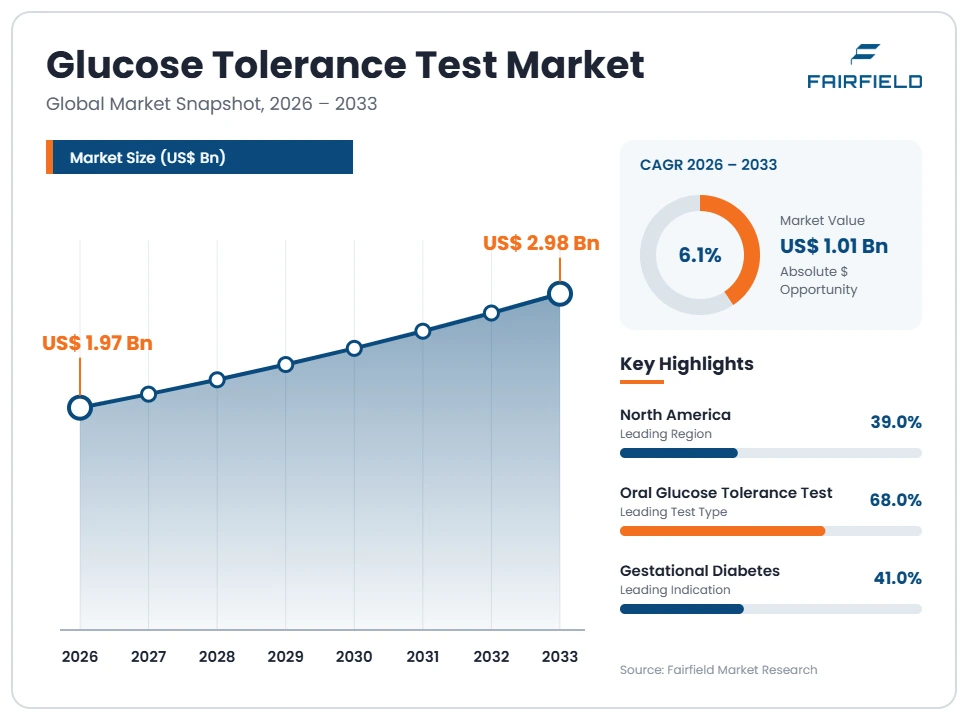
The global glucose tolerance test market size is expected to be valued at US$ 1.97 billion in 2026 and projected to reach US$ 2.98 billion by 2033, growing at a CAGR of 6.1% between 2026 and 2033.
Between 2020 and 2025, the market grew at a CAGR of about 5.4%, as routine and prenatal testing fell during lockdowns in 2020, then recovered strongly with catch-up screening, rising diabetes rates, and wider gestational diabetes screening programs. The glucose tolerance test market covers tests that measure how well the body handles sugar. The most common is the oral glucose tolerance test, in which a patient drinks a measured glucose solution, usually 75 g, and blood glucose is checked before and after one or two hours. The market includes glucose challenge tests, intravenous glucose tolerance tests, glucose drinks and kits, laboratory analyzers and reagents, point-of-care meters, and testing services. These tests diagnose type 2 diabetes, prediabetes, insulin resistance, gestational diabetes, and reactive hypoglycemia. Growth comes from rising diabetes and obesity, prenatal care, and home testing. In June 2025, Australia’s diabetes in pregnancy society raised its diagnostic thresholds for gestational diabetes.
Key Report Takeaways
- By Test Type: Oral Glucose Tolerance Test held about 68% share in 2025, while Glucose Challenge Test is projected to expand at a 6.9% CAGR through 2033, driven by two-step prenatal screening, no fasting requirement, and wider use in busy clinics.
- By Indication: Gestational Diabetes held about 41% share in 2025, while Prediabetes and Insulin Resistance is projected to expand at a 7.3% CAGR through 2033, driven by obesity, earlier screening, and interest in the one-hour test for risk prediction.
- By End User: Hospitals held about 45% share in 2025, while Home and Point-of-Care Settings is projected to expand at an 8.2% CAGR through 2033, driven by at-home test kits, capillary sampling, and remote prenatal care models.
- By Region: North America held about 39% share in 2025, while Asia Pacific is projected to expand at a 7.6% CAGR through 2033, driven by very large diabetes populations, high gestational diabetes rates, and expanding prenatal programs in India and China.
Global Glucose Tolerance Test Market Trends and Insights
Drivers Impact Analysis
Two drivers carry the strongest influence on glucose tolerance test market demand during the forecast period.
| Driver | Impact on CAGR Forecast | Geographic Relevance | Impact Timeline |
| Rising diabetes, prediabetes, and obesity | High | Global | Long term (≥4 years) |
| Universal prenatal screening for gestational diabetes | Medium | Asia Pacific, North America, Europe | Medium term (2-4 years) |
Rising Diabetes Is Driving the Glucose Tolerance Test Market
Rising diabetes, prediabetes, and obesity are the strongest driver of the glucose tolerance test market. More people need accurate testing.
The mechanism is the large and growing number of people with abnormal blood sugar. Hundreds of millions of adults live with diabetes worldwide, and many more have prediabetes, much of it undiagnosed. Obesity, inactive lifestyles, and aging populations are increasing these numbers in every region, especially in India, China, Middle East & Africa, and Latin America. The glucose tolerance test can find abnormal glucose handling that fasting tests and HbA1c sometimes miss, particularly in people of Asian descent and in early disease. Doctors use it to confirm diagnoses, assess people with borderline results, and study insulin resistance in conditions such as polycystic ovary syndrome. National diabetes prevention programs and workplace health checks are increasing screening. These trends support steady, long-term demand.
Prenatal Screening Is Expanding the Glucose Tolerance Test Market
Universal prenatal screening for gestational diabetes is expanding the glucose tolerance test market. Most pregnant women are tested.
The cause is the high and rising rate of diabetes during pregnancy. Gestational diabetes affects a large share of pregnancies worldwide, with especially high rates among women of Asian descent, in Middle East & Africa, and among women with obesity, and it raises risks for both mother and baby. Guidelines in many countries recommend screening all pregnant women between 24 and 28 weeks using a one-step 75 g test or a two-step approach starting with a 50 g glucose challenge. Women diagnosed with gestational diabetes also need follow-up testing after birth, since they face a much higher risk of type 2 diabetes later. National programs in India and China are expanding prenatal care. These trends expand sales.
Restraints Impact Analysis
Two restraints limit how quickly the glucose tolerance test market grows.
| Restraint | Impact on CAGR Forecast | Geographic Relevance | Impact Timeline |
| Inconvenience, time, and patient discomfort | High | Global | Long term (≥4 years) |
| Competition from HbA1c and continuous glucose monitoring | Medium | North America, Europe | Medium term (2-4 years) |
Inconvenience Slows the Glucose Tolerance Test Market
Inconvenience, time, and patient discomfort slow the glucose tolerance test market. The test is hard for many patients.
The specific causes are the test’s demands on patients. The standard two-hour test requires an overnight fast, a sweet drink that causes nausea or vomiting in some people, sitting in a clinic for two hours or more, and several blood draws. Pregnant women with morning sickness find it especially difficult, and many skip or delay testing. Only about half of women with gestational diabetes receive recommended testing after birth. Results can vary with diet, illness, and how samples are handled, and changing diagnostic thresholds in different countries cause confusion. Clinics need staff and space to supervise patients during the test. These factors slow growth and push doctors toward simpler options when they are acceptable.
Competing Tests Restrict the Glucose Tolerance Test Market
Competition from HbA1c and continuous glucose monitoring restricts the glucose tolerance test market. Simpler tests are often preferred.
The underlying causes are convenience and new technology. HbA1c requires a single blood draw with no fasting and is widely used to diagnose diabetes outside pregnancy in most countries. Continuous glucose monitors from Abbott and Dexcom track glucose all day and are being studied as alternatives for diagnosis and pregnancy screening, and some doctors already use them to monitor women with gestational diabetes. Fasting glucose and HbA1c together can identify many cases without a full tolerance test, and some guidelines accept them for early pregnancy screening in high-risk women. Low prices for basic glucose tests also limit revenue per test, and reimbursement for supervised testing time is often low. These factors restrict growth.
Market Opportunities
Home and Point-of-Care Testing Opens a Fast-Growth Revenue Pool
Home and point-of-care testing opens a fast-growth revenue pool in the glucose tolerance test market. Patients want to avoid long clinic waits.
Developers can capture this opportunity. At-home oral glucose tolerance test kits let patients drink the glucose solution and collect capillary blood samples at home, either measured on a device or sent to a laboratory. A study published in February 2026 in JMIR Diabetes found that the GTT@home kit agreed with laboratory results in about 88.5% of high-risk pregnant women. Home tests could raise testing rates, especially after birth and in rural areas, and fit with remote prenatal care. Point-of-care analyzers in clinics also shorten waiting times and give faster results. Companies offering validated, easy-to-use home kits and partnerships with prenatal care providers can grow quickly.
One-Hour Testing and Early Detection Create a Growth Revenue Pool
One-hour testing and early detection create a growth revenue pool in the glucose tolerance test market. Shorter tests may predict risk better.
Providers can capture this opportunity. Research shows that the one-hour glucose level during a glucose tolerance test can predict future diabetes better than the two-hour level. In March 2025, a study in Diabetes Care found the one-hour test identified more women at risk after gestational diabetes. The International Diabetes Federation has also recognized the one-hour test as a practical option. Shorter tests are more convenient, save clinic time, and could be used in large screening programs for people at high risk. Laboratories and clinics that adopt one-hour protocols can serve more patients each day, and testing after gestational diabetes may rise if it becomes easier. Companies offering one-hour testing services and supporting software can benefit.
Segment Analysis
- By Test Type: Oral Glucose Tolerance Test Leads While Glucose Challenge Test Grows Fastest
Oral Glucose Tolerance Test held about 68% share in 2025. The oral glucose tolerance test is the standard diagnostic test for gestational diabetes in most countries and is also used to diagnose diabetes, prediabetes, and insulin resistance. It uses a 75 g glucose drink, with blood drawn while fasting and at one and two hours, and is performed in hospitals, clinics, and laboratories. The 100 g three-hour version is used in the second step of two-step testing in the United States.
Glucose Challenge Test is the fastest-growing test type, expanding at a 6.9% CAGR through 2033. The 50 g one-hour challenge test needs no fasting and is used as the first step of two-step screening, sending only women with high results to a full test. Intravenous glucose tolerance tests form another segment, used mainly in research. For the market, challenge test growth supports wider screening.
- By Indication: Gestational Diabetes Leads While Prediabetes and Insulin Resistance Grow Fastest
Gestational Diabetes held about 41% share in 2025. Nearly all pregnant women in many countries are screened, and rising maternal age and obesity are increasing diagnosis rates. Follow-up testing after birth adds further demand, and doctors are being encouraged to improve low postnatal testing rates. Guidelines continue to change, with Australia raising thresholds in 2025, which may lower diagnosis rates there.
Prediabetes and Insulin Resistance is the fastest-growing indication, expanding at a 7.3% CAGR through 2033. Doctors use glucose tolerance tests to identify people at high risk of type 2 diabetes, including those with obesity, polycystic ovary syndrome, and a family history. Type 2 diabetes diagnosis and reactive hypoglycemia form other indications, with the tolerance test used when other results are unclear. For the market, prediabetes growth widens use.
- By End User: Hospitals Lead While Home and Point-of-Care Settings Grow Fastest
Hospitals held about 45% share in 2025. Hospitals perform many prenatal and diagnostic glucose tolerance tests in outpatient departments and maternity units, using laboratory analyzers and supervised testing rooms. Hospital laboratories also run tests for referred patients, and maternity units handle high volumes of prenatal screening.
Home and Point-of-Care Settings is the fastest-growing end user, expanding at an 8.2% CAGR through 2033. At-home kits, capillary sampling, and point-of-care analyzers allow testing outside hospitals, improving convenience and access for pregnant women and people in remote areas. Diagnostic laboratories and clinics form other end users, with large laboratory chains such as Quest Diagnostics and Labcorp performing many tests in North America. For the market, home testing growth improves access.
Geography Analysis
- Which Region Is Leading the Glucose Tolerance Test Market?
North America is leading the glucose tolerance test market with about 39% share in 2025. The United States has high rates of diabetes and obesity, routine prenatal screening using both one-step and two-step methods, and large laboratory networks run by Quest Diagnostics and Labcorp. Diagnostic companies such as Abbott, Roche Diagnostics, and Siemens Healthineers supply analyzers and reagents, and insurance generally covers prenatal and diagnostic testing. Research on one-hour testing and home kits is active in the United States and Canada. Key barriers include patient inconvenience and competition from HbA1c. One change shaping the region is remote prenatal care.
- Europe Shapes the Glucose Tolerance Test Market Through Prenatal Guidelines
Europe is a major glucose tolerance test market. Germany, the United Kingdom, France, Italy, and Spain perform large numbers of prenatal and diagnostic tests through public health systems, though screening approaches vary by country, with some testing all pregnant women and others testing only those at risk. Rising obesity and maternal age are increasing gestational diabetes rates across the region. Roche and Siemens Healthineers are major suppliers of analyzers and reagents to hospital laboratories. Key barriers include budget limits, differing national guidelines, and low postnatal testing rates. One opportunity is home testing for postnatal follow-up.
- Which Region Is Growing Fastest in the Glucose Tolerance Test Market?
Asia Pacific is growing fastest in the glucose tolerance test market, expanding at a 7.6% CAGR through 2033. India and China have the world’s largest numbers of people with diabetes and very high rates of gestational diabetes, and national programs are expanding prenatal screening. India uses a single-step non-fasting test in many public clinics. Japan, South Korea, Indonesia, and Australia add demand, and Australia updated its gestational diabetes guidelines in 2025. Key barriers include limited laboratory access in rural areas, cost, and missed follow-up after birth. One change shaping the region is wider prenatal care.
- Latin America Grows the Glucose Tolerance Test Market Through Rising Diabetes
Latin America is a growing glucose tolerance test market. Brazil, Mexico, Argentina, Colombia, and Chile have high and rising rates of obesity and diabetes, and public health systems include glucose testing in prenatal care. Mexico has one of the highest diabetes rates in the world, and screening programs target adults at risk. Private laboratory chains are expanding in major cities, and home sample collection services are growing in Brazil and Mexico. Key barriers include limited budgets, uneven rural access, economic swings, and staff shortages in public clinics. One opportunity is point-of-care testing in primary care clinics.
- Middle East & Africa Builds the Glucose Tolerance Test Market Through High Diabetes Rates
Middle East & Africa is a growing glucose tolerance test market. Saudi Arabia, the United Arab Emirates, Kuwait, Qatar, and Egypt have some of the world’s highest diabetes and gestational diabetes rates, and governments are investing in national screening programs, prenatal care, and laboratory upgrades. South Africa, Nigeria, and Kenya are expanding prenatal care, and international health programs support gestational diabetes screening in some countries. Private laboratories are growing in major cities. Key barriers include limited laboratory capacity, cost, and access in rural areas. One opportunity is national diabetes screening programs for adults and pregnant women.
Competitive Landscape
The glucose tolerance test market is moderately fragmented. Roche Diagnostics, Abbott, Siemens Healthineers, Quest Diagnostics, and Labcorp are leading players, while Thermo Fisher Scientific, Beckman Coulter, Ascensia Diabetes Care, ARKRAY, Trividia Health, LifeScan, and NIPRO compete strongly. Large diagnostics companies supply laboratory analyzers and reagents, large laboratory chains perform millions of tests, and many smaller firms make glucose drinks, kits, and point-of-care meters.
Companies compete on accuracy, test convenience, turnaround time, cost per test, laboratory network reach, and relationships with hospitals, prenatal clinics, and insurers. Glucose drink makers compete on taste and tolerability, since nausea causes some patients to fail the test. Laboratory chains win business through convenient collection sites, contracts with health plans, and fast reporting to doctors.
Strategic moves show how competition is changing. In March 2025, a study in Diabetes Care showed the one-hour glucose result predicts future diabetes better than the two-hour result, supporting shorter tests. In June 2025, Australia raised its diagnostic thresholds for gestational diabetes. In February 2026, a study found the GTT@home kit agreed closely with laboratory results. These moves show the field shifting toward shorter, more convenient, and home-based testing.
Three themes shape vendor strategy. First, companies are developing at-home and point-of-care testing options. Second, they are improving the patient experience with better-tolerated glucose drinks and shorter tests. Third, they are expanding in Asia Pacific and Middle East & Africa, where diabetes and gestational diabetes rates are highest.
Glucose Tolerance Test Market Industry Leaders
Roche Diagnostics Abbott Siemens Healthineers Quest Diagnostics Labcorp
Recent Industry Developments
- February 2026: A study in JMIR Diabetes found the GTT@home at-home oral glucose tolerance test kit matched laboratory classifications in about 88.5% of high-risk pregnant women - supports home testing in the glucose tolerance test market.
- June 2025: The Australasian Diabetes in Pregnancy Society raised diagnostic thresholds for gestational diabetes using the 75 g two-hour test - reshapes gestational diabetes screening in Australia.
- March 2025: A study in Diabetes Care led by University of Toronto researchers found the one-hour glucose result predicted future diabetes better than the two-hour result after gestational diabetes - supports shorter testing.
Companies Covered in the Report
- Roche Diagnostics
- Abbott
- Siemens Healthineers
- Quest Diagnostics
- Labcorp
- Thermo Fisher Scientific
- Beckman Coulter
- Ascensia Diabetes Care
- ARKRAY
- Trividia Health
- LifeScan
- NIPRO
Glucose Tolerance Test Market Report Scope
| Metric | Value |
| Study Period | 2020-2033 |
| Market Size 2026 | US$ 1.97 Billion |
| Market Size 2033 | US$ 2.98 Billion |
| CAGR 2026-2033 | 6.1% |
| Absolute Dollar Opportunity | US$ 1.01 Billion |
| Largest Market | North America |
| Fastest-Growing Market | Asia Pacific |
| Market Concentration | Moderately Fragmented |
| Major Players | Roche Diagnostics, Abbott, Siemens Healthineers, Quest Diagnostics, Labcorp |
Glucose Tolerance Test Market Segmentation
- Executive Summary
- Global Glucose Tolerance Test Market Snapshot
- Future Projections, 2026–2033
- Key Industry Highlights
- Regional Snapshot
- Market Overview
- Market Definition and Report Scope
- Historical Market Trends
- Market Dynamics
- Drivers
- Rising Diabetes Is Driving the Glucose Tolerance Test Market
- Prenatal Screening Is Expanding the Glucose Tolerance Test Market
- Restraints
- Inconvenience Slows the Glucose Tolerance Test Market
- Competing Tests Restrict the Glucose Tolerance Test Market
- Market Opportunities
- Home and Point-of-Care Testing Opens a Fast-Growth Revenue Pool
- One-Hour Testing and Early Detection Create a Growth Revenue Pool
- Drivers
- Global Glucose Tolerance Test Market Outlook, 2020–2033
- Global Glucose Tolerance Test Market Outlook, by Test Type, Value (US$ Billion), 2020–2033
- Oral Glucose Tolerance Test
- Glucose Challenge Test
- Intravenous Glucose Tolerance Test
- Global Glucose Tolerance Test Market Outlook, by Indication, Value (US$ Billion), 2020–2033
- Gestational Diabetes
- Type 2 Diabetes
- Prediabetes and Insulin Resistance
- Others
- Global Glucose Tolerance Test Market Outlook, by End User, Value (US$ Billion), 2020–2033
- Hospitals
- Diagnostic Laboratories
- Clinics
- Home and Point-of-Care Settings
- Global Glucose Tolerance Test Market Outlook, by Region, Value (US$ Billion), 2020–2033
- North America
- Europe
- Asia Pacific
- Latin America
- Middle East & Africa
- Global Glucose Tolerance Test Market Outlook, by Test Type, Value (US$ Billion), 2020–2033
- North America Glucose Tolerance Test Market Outlook, 2020–2033
- North America Glucose Tolerance Test Market Outlook, by Test Type, Value (US$ Billion), 2020–2033
- Oral Glucose Tolerance Test
- Glucose Challenge Test
- Intravenous Glucose Tolerance Test
- North America Glucose Tolerance Test Market Outlook, by Indication, Value (US$ Billion), 2020–2033
- Gestational Diabetes
- Type 2 Diabetes
- Prediabetes and Insulin Resistance
- Others
- North America Glucose Tolerance Test Market Outlook, by End User, Value (US$ Billion), 2020–2033
- Hospitals
- Diagnostic Laboratories
- Clinics
- Home and Point-of-Care Settings
- North America Glucose Tolerance Test Market Outlook, by Country, Value (US$ Billion), 2020–2033
- United States Glucose Tolerance Test Market Outlook, by Test Type, 2020–2033
- United States Glucose Tolerance Test Market Outlook, by Indication, 2020–2033
- United States Glucose Tolerance Test Market Outlook, by End User, 2020–2033
- Canada Glucose Tolerance Test Market Outlook, by Test Type, 2020–2033
- Canada Glucose Tolerance Test Market Outlook, by Indication, 2020–2033
- Canada Glucose Tolerance Test Market Outlook, by End User, 2020–2033
- North America Glucose Tolerance Test Market Outlook, by Test Type, Value (US$ Billion), 2020–2033
- Europe Glucose Tolerance Test Market Outlook, 2020–2033
- Europe Glucose Tolerance Test Market Outlook, by Test Type, Value (US$ Billion), 2020–2033
- Oral Glucose Tolerance Test
- Glucose Challenge Test
- Intravenous Glucose Tolerance Test
- Europe Glucose Tolerance Test Market Outlook, by Indication, Value (US$ Billion), 2020–2033
- Gestational Diabetes
- Type 2 Diabetes
- Prediabetes and Insulin Resistance
- Others
- Europe Glucose Tolerance Test Market Outlook, by End User, Value (US$ Billion), 2020–2033
- Hospitals
- Diagnostic Laboratories
- Clinics
- Home and Point-of-Care Settings
- Europe Glucose Tolerance Test Market Outlook, by Country, Value (US$ Billion), 2020–2033
- Germany Glucose Tolerance Test Market Outlook, by Test Type, 2020–2033
- Germany Glucose Tolerance Test Market Outlook, by Indication, 2020–2033
- Germany Glucose Tolerance Test Market Outlook, by End User, 2020–2033
- United Kingdom Glucose Tolerance Test Market Outlook, by Test Type, 2020–2033
- United Kingdom Glucose Tolerance Test Market Outlook, by Indication, 2020–2033
- United Kingdom Glucose Tolerance Test Market Outlook, by End User, 2020–2033
- France Glucose Tolerance Test Market Outlook, by Test Type, 2020–2033
- France Glucose Tolerance Test Market Outlook, by Indication, 2020–2033
- France Glucose Tolerance Test Market Outlook, by End User, 2020–2033
- Italy Glucose Tolerance Test Market Outlook, by Test Type, 2020–2033
- Italy Glucose Tolerance Test Market Outlook, by Indication, 2020–2033
- Italy Glucose Tolerance Test Market Outlook, by End User, 2020–2033
- Spain Glucose Tolerance Test Market Outlook, by Test Type, 2020–2033
- Spain Glucose Tolerance Test Market Outlook, by Indication, 2020–2033
- Spain Glucose Tolerance Test Market Outlook, by End User, 2020–2033
- Europe Glucose Tolerance Test Market Outlook, by Test Type, Value (US$ Billion), 2020–2033
- Asia Pacific Glucose Tolerance Test Market Outlook, 2020–2033
- Asia Pacific Glucose Tolerance Test Market Outlook, by Test Type, Value (US$ Billion), 2020–2033
- Oral Glucose Tolerance Test
- Glucose Challenge Test
- Intravenous Glucose Tolerance Test
- Asia Pacific Glucose Tolerance Test Market Outlook, by Indication, Value (US$ Billion), 2020–2033
- Gestational Diabetes
- Type 2 Diabetes
- Prediabetes and Insulin Resistance
- Others
- Asia Pacific Glucose Tolerance Test Market Outlook, by End User, Value (US$ Billion), 2020–2033
- Hospitals
- Diagnostic Laboratories
- Clinics
- Home and Point-of-Care Settings
- Asia Pacific Glucose Tolerance Test Market Outlook, by Country, Value (US$ Billion), 2020–2033
- India Glucose Tolerance Test Market Outlook, by Test Type, 2020–2033
- India Glucose Tolerance Test Market Outlook, by Indication, 2020–2033
- India Glucose Tolerance Test Market Outlook, by End User, 2020–2033
- China Glucose Tolerance Test Market Outlook, by Test Type, 2020–2033
- China Glucose Tolerance Test Market Outlook, by Indication, 2020–2033
- China Glucose Tolerance Test Market Outlook, by End User, 2020–2033
- Japan Glucose Tolerance Test Market Outlook, by Test Type, 2020–2033
- Japan Glucose Tolerance Test Market Outlook, by Indication, 2020–2033
- Japan Glucose Tolerance Test Market Outlook, by End User, 2020–2033
- South Korea Glucose Tolerance Test Market Outlook, by Test Type, 2020–2033
- South Korea Glucose Tolerance Test Market Outlook, by Indication, 2020–2033
- South Korea Glucose Tolerance Test Market Outlook, by End User, 2020–2033
- Indonesia Glucose Tolerance Test Market Outlook, by Test Type, 2020–2033
- Indonesia Glucose Tolerance Test Market Outlook, by Indication, 2020–2033
- Indonesia Glucose Tolerance Test Market Outlook, by End User, 2020–2033
- Australia Glucose Tolerance Test Market Outlook, by Test Type, 2020–2033
- Australia Glucose Tolerance Test Market Outlook, by Indication, 2020–2033
- Australia Glucose Tolerance Test Market Outlook, by End User, 2020–2033
- Asia Pacific Glucose Tolerance Test Market Outlook, by Test Type, Value (US$ Billion), 2020–2033
- Latin America Glucose Tolerance Test Market Outlook, 2020–2033
- Latin America Glucose Tolerance Test Market Outlook, by Test Type, Value (US$ Billion), 2020–2033
- Oral Glucose Tolerance Test
- Glucose Challenge Test
- Intravenous Glucose Tolerance Test
- Latin America Glucose Tolerance Test Market Outlook, by Indication, Value (US$ Billion), 2020–2033
- Gestational Diabetes
- Type 2 Diabetes
- Prediabetes and Insulin Resistance
- Others
- Latin America Glucose Tolerance Test Market Outlook, by End User, Value (US$ Billion), 2020–2033
- Hospitals
- Diagnostic Laboratories
- Clinics
- Home and Point-of-Care Settings
- Latin America Glucose Tolerance Test Market Outlook, by Country, Value (US$ Billion), 2020–2033
- Brazil Glucose Tolerance Test Market Outlook, by Test Type, 2020–2033
- Brazil Glucose Tolerance Test Market Outlook, by Indication, 2020–2033
- Brazil Glucose Tolerance Test Market Outlook, by End User, 2020–2033
- Mexico Glucose Tolerance Test Market Outlook, by Test Type, 2020–2033
- Mexico Glucose Tolerance Test Market Outlook, by Indication, 2020–2033
- Mexico Glucose Tolerance Test Market Outlook, by End User, 2020–2033
- Argentina Glucose Tolerance Test Market Outlook, by Test Type, 2020–2033
- Argentina Glucose Tolerance Test Market Outlook, by Indication, 2020–2033
- Argentina Glucose Tolerance Test Market Outlook, by End User, 2020–2033
- Colombia Glucose Tolerance Test Market Outlook, by Test Type, 2020–2033
- Colombia Glucose Tolerance Test Market Outlook, by Indication, 2020–2033
- Colombia Glucose Tolerance Test Market Outlook, by End User, 2020–2033
- Chile Glucose Tolerance Test Market Outlook, by Test Type, 2020–2033
- Chile Glucose Tolerance Test Market Outlook, by Indication, 2020–2033
- Chile Glucose Tolerance Test Market Outlook, by End User, 2020–2033
- Latin America Glucose Tolerance Test Market Outlook, by Test Type, Value (US$ Billion), 2020–2033
- Middle East & Africa Glucose Tolerance Test Market Outlook, 2020–2033
- Middle East & Africa Glucose Tolerance Test Market Outlook, by Test Type, Value (US$ Billion), 2020–2033
- Oral Glucose Tolerance Test
- Glucose Challenge Test
- Intravenous Glucose Tolerance Test
- Middle East & Africa Glucose Tolerance Test Market Outlook, by Indication, Value (US$ Billion), 2020–2033
- Gestational Diabetes
- Type 2 Diabetes
- Prediabetes and Insulin Resistance
- Others
- Middle East & Africa Glucose Tolerance Test Market Outlook, by End User, Value (US$ Billion), 2020–2033
- Hospitals
- Diagnostic Laboratories
- Clinics
- Home and Point-of-Care Settings
- Middle East & Africa Glucose Tolerance Test Market Outlook, by Country, Value (US$ Billion), 2020–2033
- Saudi Arabia Glucose Tolerance Test Market Outlook, by Test Type, 2020–2033
- Saudi Arabia Glucose Tolerance Test Market Outlook, by Indication, 2020–2033
- Saudi Arabia Glucose Tolerance Test Market Outlook, by End User, 2020–2033
- United Arab Emirates Glucose Tolerance Test Market Outlook, by Test Type, 2020–2033
- United Arab Emirates Glucose Tolerance Test Market Outlook, by Indication, 2020–2033
- United Arab Emirates Glucose Tolerance Test Market Outlook, by End User, 2020–2033
- Kuwait Glucose Tolerance Test Market Outlook, by Test Type, 2020–2033
- Kuwait Glucose Tolerance Test Market Outlook, by Indication, 2020–2033
- Kuwait Glucose Tolerance Test Market Outlook, by End User, 2020–2033
- Qatar Glucose Tolerance Test Market Outlook, by Test Type, 2020–2033
- Qatar Glucose Tolerance Test Market Outlook, by Indication, 2020–2033
- Qatar Glucose Tolerance Test Market Outlook, by End User, 2020–2033
- Egypt Glucose Tolerance Test Market Outlook, by Test Type, 2020–2033
- Egypt Glucose Tolerance Test Market Outlook, by Indication, 2020–2033
- Egypt Glucose Tolerance Test Market Outlook, by End User, 2020–2033
- South Africa Glucose Tolerance Test Market Outlook, by Test Type, 2020–2033
- South Africa Glucose Tolerance Test Market Outlook, by Indication, 2020–2033
- South Africa Glucose Tolerance Test Market Outlook, by End User, 2020–2033
- Nigeria Glucose Tolerance Test Market Outlook, by Test Type, 2020–2033
- Nigeria Glucose Tolerance Test Market Outlook, by Indication, 2020–2033
- Nigeria Glucose Tolerance Test Market Outlook, by End User, 2020–2033
- Kenya Glucose Tolerance Test Market Outlook, by Test Type, 2020–2033
- Kenya Glucose Tolerance Test Market Outlook, by Indication, 2020–2033
- Kenya Glucose Tolerance Test Market Outlook, by End User, 2020–2033
- Middle East & Africa Glucose Tolerance Test Market Outlook, by Test Type, Value (US$ Billion), 2020–2033
- Competitive Landscape
- Industry Leaders
- Recent Industry Developments
- Company Profiles
- Roche Diagnostics
- Abbott
- Siemens Healthineers
- Quest Diagnostics
- Labcorp
- Thermo Fisher Scientific
- Beckman Coulter
- Ascensia Diabetes Care
- ARKRAY
- Trividia Health
- LifeScan
- NIPRO
- Appendix
- Research Methodology
- Report Assumptions
- Acronyms and Abbreviations
Test Type
- Oral Glucose Tolerance Test
- Glucose Challenge Test
- Intravenous Glucose Tolerance Test
Indication
- Gestational Diabetes
- Type 2 Diabetes
- Prediabetes and Insulin Resistance
- Others
End User
- Hospitals
- Diagnostic Laboratories
- Clinics
- Home and Point-of-Care Settings
Regions
- North America
- Europe
- Asia Pacific
- Latin America
- Middle East & Africa
Our Research Methodology
Considering the volatility of business today, traditional approaches to strategizing a game plan can be unfruitful if not detrimental. True ambiguity is no way to determine a forecast. A myriad of predetermined factors must be accounted for such as the degree of risk involved, the magnitude of circumstances, as well as conditions or consequences that are not known or unpredictable. To circumvent binary views that cast uncertainty, the application of market research intelligence to strategically posture, move, and enable actionable outcomes is necessary.
View Methodology
Quality Assured
Rigorous Validation Process

Confidentiality Assured
End-to-end Data Security

Custom Research Services
Tailored To Your Objectives
FAQs
The glucose tolerance test market is valued at US$ 1.97 billion in 2026, led by oral tests, gestational diabetes, and North America.
The market is projected to reach US$ 2.98 billion by 2033, growing at a 6.1% CAGR and adding US$ 1.01 billion.
Home and point-of-care settings are growing fastest at an 8.2% CAGR through 2033, driven by at-home kits and remote prenatal care.
Asia Pacific is growing fastest at a 7.6% CAGR through 2033, driven by large diabetes populations and prenatal programs in India and China.
North America holds the largest share at about 39% in 2025, supported by high diabetes rates, prenatal screening, and large laboratory networks.
Related Reports
Medical Fiber Optics Market Size, Share, Insights, Competitive Landscape, and Forecast 2026 to 2033
The medical fiber optics market is projected to grow from US$1.4 billion in 2026 to US$1.9 billion by 2033 at a 4.5% CAGR.
Laser Hair Removal Market Size, Share, Insights, Competitive Landscape, and Forecast 2026 to 2033
The laser hair removal market is projected to reach US$4.5 billion by 2033. Explore diode and multi-wavelength devices, clinic demand, and regional growth.
Joint Reconstruction Devices Market Size, Share, Insights, Competitive Landscape, and Forecast 2026 to 2033
The joint reconstruction devices market is projected to reach US$35.2 billion by 2033. Explore knee and hip implants, revision procedures, and surgical robotics.
Interventional Cardiology Devices Market Size, Share, Insights, Competitive Landscape, and Forecast 2026 to 2033
The global interventional cardiology devices market is valued at US$18.0 billion in 2026, reaching US$26.4 billion by 2033, growing at a 5.62% CAGR
Infusion Catheter Market Size, Share, Insights, Competitive Landscape, and Forecast 2026 to 2033
The infusion catheter market is projected to reach US$4.97 billion by 2033 at a 10.1% CAGR, driven by growth in outpatient and home infusion care.
Influenza Diagnostic Market Size, Share, Insights, Competitive Landscape, and Forecast 2026 to 2033
The influenza diagnostic market is projected to reach US$3.56 billion by 2033 at a 7.8% CAGR, driven by rapid molecular tests and wider home testing.