



Latin America In Vitro Diagnostics (IVD) Market
Latin America In Vitro Diagnostics (IVD) Market Size, Share, Insights, Competitive Landscape, and Forecast 2026 to 2033
Report Overview
Latin America In Vitro Diagnostics (IVD) Market Size and Trend Analysis
How Fast Will Latin America IVD Demand Grow?
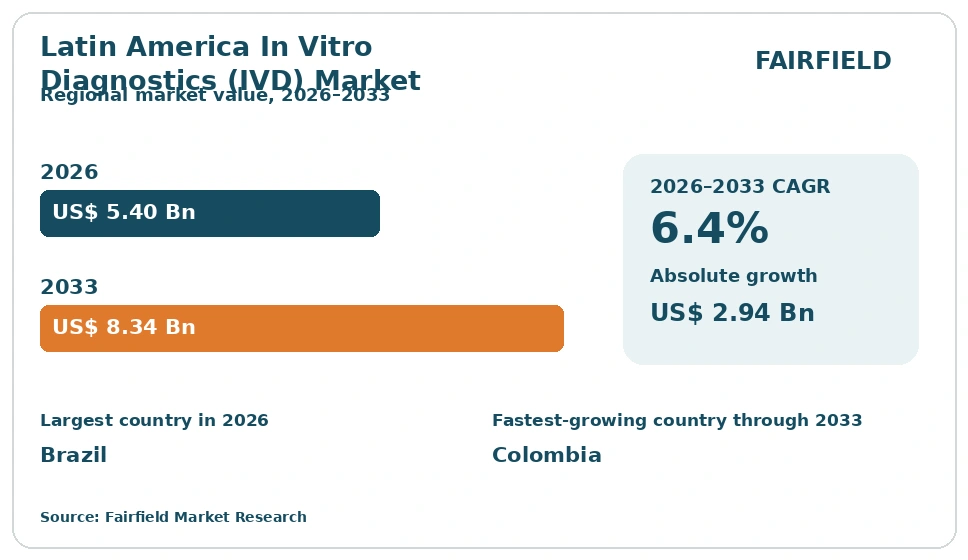
The Latin America In Vitro Diagnostics (IVD) market size is expected to be valued at US$ 5.4 billion in 2026 and projected to reach US$ 8.34 billion by 2033, growing at a CAGR of 6.4% between 2026 and 2033. That path creates an absolute dollar opportunity of US$ 2.94 billion, against a slower historical CAGR of 5.1% between 2020 and 2025. Growth now rests on steady test volumes rather than pandemic surges. Ageing populations, rising cardiometabolic disease and wider private laboratory networks lift routine testing. Automation in high-throughput laboratories and gradual molecular adoption raise revenue per sample. Public procurement, however, remains price-sensitive, so volume growth outpaces value growth across much of the region.
Key Report Takeaways
- By Product: Reagents and kits led with 68.4% share in 2026, while software and services is projected to expand at a 8.9% CAGR through 2033, driven by laboratory information system upgrades and remote instrument monitoring contracts across consolidating private laboratory chains.
- By Technique: Clinical chemistry led with 28.6% share in 2026, while molecular diagnostics is projected to expand at a 9.2% CAGR through 2033, driven by sequencing and PCR capacity retained after regional respiratory testing programmes and widening oncology panel use.
- By Application: Infectious diseases led with 32.5% share in 2026, while oncology is projected to expand at a 8.6% CAGR through 2033, driven by earlier screening in private health plans and growing tissue and liquid biopsy workflows.
- By End User: Hospitals led with 41.2% share in 2026, while point-of-care settings is projected to expand at a 8.4% CAGR through 2033, driven by primary care decentralisation and testing placed in pharmacies, clinics and remote municipal health posts.
- By Country: Brazil led with 42.8% share in 2026, while Colombia is projected to expand at a 7.9% CAGR through 2033, driven by insurance coverage expansion and new laboratory capacity outside Bogotá in secondary regional cities.
Market Trends and Insights
Market Growth Drivers
Rising Chronic and Infectious Disease Burden Lifts Routine Test Volumes
Latin America is running more diagnostic tests per person each year, and that volume is the main engine of market value. Populations are ageing quickly in Brazil, Chile and Argentina, while obesity and metabolic disease spread across urban centres. Diabetes, renal and cardiovascular monitoring generate repeat testing rather than one-off orders. At the same time, dengue, tuberculosis and other endemic infections keep microbiology and serology workloads high. The result is a broad, recurring reagent base that is far less cyclical than instrument sales.
This demand reaches laboratories through both public and private channels. Public systems such as SUS in Brazil fund large panels of basic chemistry and haematology tests at high volume. Private health plans add preventive check-up packages that bundle lipid, thyroid and glucose panels. Laboratory chains respond by standardising menus and raising analyser utilisation, which steadily pulls reagent consumption upward.
Laboratory Consolidation and Automation Raise Revenue Per Sample
Consolidation among private laboratory networks is shifting the market from scattered manual testing toward centralised, automated production. Larger groups buy track systems, high-throughput immunoassay platforms and middleware, then route samples from collection points into a few core facilities. Each consolidated site processes more tests with fewer staff, which improves turnaround and lowers unit cost. For suppliers, this changes the commercial model: contracts become multi-year reagent rental agreements tied to placed instruments rather than one-time equipment sales.
The trend also lifts the technical mix. Centralised laboratories can justify broader menus, including specialty immunoassays and molecular panels that smaller sites cannot support. Suppliers that offer connectivity, service coverage and consumable breadth win placements. Consequently, average revenue per sample rises even where list prices face pressure, and installed-base loyalty becomes a durable competitive asset across Brazil and Mexico.
Restraints Impact Analysis of Market
Unequal Healthcare Access and Public Reimbursement Constraints
Access to diagnostic testing varies sharply within Latin American countries, and this genuinely limits addressable volume. Urban residents with private coverage reach well-equipped laboratories, while rural and low-income populations often depend on underfunded public facilities with narrow test menus. Many people therefore remain undiagnosed or are tested late, which suppresses demand for confirmatory and specialty assays. The gap is structural rather than temporary, reflecting differences in infrastructure, staffing and transport in each country.
Public reimbursement adds a second constraint. State purchasers buy through competitive tenders where price weighs heavily, so newer or higher-cost assays enter slowly even when they are clinically established elsewhere. Budget cycles can delay payment and procurement, which discourages suppliers from placing advanced instruments in public networks. The outcome is a two-speed market: a modern, well-served private segment alongside a much larger population with limited routine access.
Import Dependence, Currency Volatility and Regulatory Complexity
Almost all analysers and most reagents sold in the region are imported, which exposes the market to exchange rate swings. When local currencies weaken, landed costs rise immediately while tender prices stay fixed, compressing distributor margins and delaying instrument purchases. Buyers respond by extending the service life of ageing platforms and deferring menu expansion. This import dependence makes regional revenue less predictable than unit volumes alone would suggest.
Regulatory and logistical complexity compounds the problem. Each country maintains its own registration pathway, with ANVISA in Brazil and COFEPRIS in Mexico operating separate dossier and labelling requirements. Manufacturers must prepare country-specific submissions, local representation and translated documentation before launch. Cold-chain distribution across long distances and customs clearance add further cost and delay, so product rollouts across the region are staggered rather than simultaneous.
Market Opportunities
Decentralised and Point-of-Care Testing Beyond Major Cities
Point-of-care testing offers the clearest route to reaching populations that central laboratories cannot serve economically. Compact immunoassay readers, handheld chemistry devices and cartridge-based molecular systems can operate in primary care clinics, pharmacies and remote municipal posts. Because results are produced during the visit, patients who would otherwise be lost between appointments are managed in one encounter. For suppliers, every placed device creates a recurring cartridge stream in territories that previously generated almost no diagnostic revenue.
Several conditions now favour this shift. Mobile connectivity has improved across secondary cities, which allows device data to flow into central systems for quality oversight and record-keeping. Governments and private insurers alike are interested in moving routine care out of crowded hospitals. Distributors with field service reach can bundle devices, training and consumables, turning dispersed demand into a manageable commercial channel.
Molecular and Digital Capability Built on Existing Laboratory Infrastructure
Significant molecular capacity was installed across the region during recent respiratory testing programmes, and much of it remains underused. Repurposing those extraction systems, thermal cyclers and sequencers toward oncology, transplant, hereditary and antimicrobial resistance testing converts stranded assets into new revenue. The incremental investment is modest because the instruments, biosafety space and trained technologists already exist. This makes molecular menu expansion one of the most capital-efficient growth paths open to regional laboratories.
Digital infrastructure extends the same logic. Laboratory information systems, middleware and image management tools let a few specialist sites support many collection points through centralised reporting and remote review. Reference laboratories in São Paulo, Mexico City and Bogotá can therefore serve national referral volumes. Suppliers that pair assays with software, connectivity and interpretation support will capture a growing share of this value.
Category-wise Insights
Which Product Segment Anchors Latin America IVD Revenue?
Reagents and kits anchor the market with 68.4% share in 2026, because consumables are consumed with every test while instruments are bought once. The region’s large installed base of chemistry, immunoassay and haematology analysers converts steady sample volumes into predictable reagent demand. Instruments hold 24.1% share, with purchases concentrated among private laboratory groups and larger public hospitals. Software and services accounts for 7.5% but grows fastest at a 8.9% CAGR through 2033.
That software growth reflects consolidation. As laboratory networks centralise, they need middleware, quality management tools and remote instrument monitoring to run dispersed collection points from a few production sites. Service contracts also lengthen as reagent rental replaces outright purchase. For suppliers, the implication is clear: competitive position increasingly depends on connectivity and support capability, not only on assay menu breadth or analyser throughput.
Clinical Chemistry Holds Volume While Molecular Diagnostics Sets the Growth Pace
Clinical chemistry leads by technique with 28.6% share in 2026, supported by high-volume metabolic, lipid, liver and renal panels ordered across both public and private systems. Immunoassay follows at 26.3%, driven by hormone, cardiac and infectious disease markers. Molecular diagnostics holds 18.4% share yet expands fastest at a 9.2% CAGR through 2033. Haematology contributes 12.1%, microbiology 9.4%, and other techniques 5.2%.
Molecular momentum comes from infrastructure that already exists. Extraction platforms and thermal cyclers installed for respiratory testing are being redirected toward oncology panels, transplant monitoring and antimicrobial resistance work. Reference laboratories in Brazil and Mexico are adding sequencing capacity to serve national referrals. The broader effect is a gradual rebalancing of laboratory economics toward fewer, higher-value tests alongside the stable chemistry base.
Infectious Disease Testing Dominates While Oncology Accelerates
Infectious diseases lead applications with 32.5% share in 2026, reflecting endemic dengue, tuberculosis, hepatitis and respiratory testing alongside routine screening programmes. Oncology holds 14.8% share and grows fastest at a 8.6% CAGR through 2033. Diabetes contributes 13.6%, cardiology 11.2%, autoimmune diseases 7.4%, nephrology 6.3%, and other applications 14.2%.
Oncology acceleration follows demographic and coverage change. Ageing urban populations raise cancer incidence, while private health plans increasingly include screening in preventive packages. Tissue-based molecular profiling and circulating tumour DNA workflows are being established in reference centres, supported by pathology networks in São Paulo, Mexico City and Buenos Aires. For strategy teams, this signals a shift in where margin sits: high-volume infectious disease work sustains scale, while oncology drives mix enrichment and specialist laboratory investment.
Hospitals Lead Testing Demand as Point-of-Care Settings Expand Quickest
Hospitals lead end users with 41.2% share in 2026, because inpatient care, emergency departments and surgical services generate continuous stat and routine testing. Independent laboratories hold 33.7%, a notably high figure reflecting strong private laboratory chains across Brazil, Mexico and Colombia. Point-of-care settings account for 16.5% and grow fastest at a 8.4% CAGR through 2033, while academic and research institutes hold 8.6%.
Point-of-care expansion is driven by geography and system design. Long travel distances and overloaded hospitals push testing toward clinics, pharmacies and municipal health posts, where same-visit results reduce patient loss to follow-up. Compact analysers and cartridge systems make this practical outside major cities. The consequence for suppliers is a widening channel that rewards field service coverage, training capability and distributor depth rather than central laboratory relationships alone.
Geography Analysis
Which Country Is Leading the Latin America In Vitro Diagnostics Market?
Brazil leads the market with 42.8% share in 2026, reflecting its population scale, dense private laboratory sector and large public health system. SUS funds very high volumes of routine chemistry, haematology and infectious disease testing through nationwide facilities, while private laboratory chains operate automated core laboratories in São Paulo, Rio de Janeiro and Belo Horizonte. ANVISA registration is a prerequisite for market entry, so most international suppliers maintain local subsidiaries or long-standing distributor relationships. Domestic reagent manufacturers supply parts of the public tender market, which keeps pricing competitive in basic chemistry. Investment is concentrated in automation, laboratory information systems and molecular capacity at reference sites. Access gaps between the industrialised south-east and the north remain wide, limiting how quickly advanced testing spreads nationally.
Mexico Builds Scale Through Private Chains and Cross-Border Manufacturing
Mexico holds 24.6% share in 2026, supported by a large population and rapidly expanding private laboratory and pharmacy-clinic networks. Public institutions provide substantial routine testing volume, while private chains compete on turnaround, price and retail convenience in Mexico City, Monterrey and Guadalajara. COFEPRIS governs device registration, and manufacturers manage separate dossiers from those used elsewhere in the region. Proximity to the United States gives the country a distinct advantage: medical device manufacturing clusters in northern states support regional assembly and distribution, shortening supply lines. Diabetes and cardiometabolic disease prevalence drives heavy demand for chemistry and point-of-care glucose testing. Growth is tempered by uneven public funding and by coverage gaps in southern and rural states, where laboratory infrastructure remains comparatively thin.
Argentina Sustains a Strong Laboratory Base Amid Economic Pressure
Argentina accounts for 9.7% share in 2026, underpinned by a well-established laboratory profession, strong academic medicine and a domestic diagnostics manufacturing tradition. Buenos Aires hosts reference laboratories and university hospitals with broad test menus, including specialty immunoassay and molecular work. Local reagent producers supply a meaningful portion of routine demand, which partly insulates the market from import costs. Persistent currency volatility and inflation nonetheless constrain capital equipment purchases, pushing laboratories to extend analyser service life and negotiate reagent rental terms. Social security and union-based health coverage shape procurement patterns, creating fragmented purchasing across many separate payers. Demand remains resilient for routine chemistry and haematology, while advanced molecular adoption advances more slowly than population health needs would otherwise support.
Which Country Is Growing Fastest in the Latin America In Vitro Diagnostics Market?
Colombia grows fastest at a 7.9% CAGR through 2033, from 7.4% share in 2026. Growth is driven by broad health insurance coverage, which channels a large share of the population into funded diagnostic pathways, and by laboratory capacity being added outside Bogotá. Secondary cities such as Medellín, Cali and Barranquilla are gaining automated core laboratories and specialist referral services that previously existed only in the capital. Private laboratory groups are consolidating collection points into centralised production sites, improving utilisation and widening menus. Oncology and molecular testing are expanding from a small base as pathology networks mature. Reimbursement timing and administrative complexity still slow procurement, but the combination of coverage breadth and infrastructure investment supports growth above the regional average.
Rest of Latin America Advances Unevenly Across Smaller National Markets
Rest of Latin America represents 15.5% share in 2026, covering Chile, Peru, Ecuador, Central America and the Caribbean. Chile is the most developed of these, with high laboratory standards, strong private providers and comparatively advanced molecular adoption. Peru and Ecuador are expanding public laboratory networks and building regional capacity beyond capital cities. Central American and Caribbean markets are small individually, so suppliers typically serve them through regional distributors rather than local subsidiaries. Testing menus in these territories concentrate on infectious disease, maternal health and basic chemistry, with specialist work referred abroad or to larger regional hubs. Import dependence, limited technologist numbers and fragmented procurement keep advanced adoption slow, though point-of-care platforms are making testing viable in dispersed, lower-volume locations.
Competitive Landscape
The Latin America IVD market is moderately concentrated. A small group of global diagnostics manufacturers supplies most automated chemistry, immunoassay, haematology and molecular platforms, while regional and domestic producers compete in routine reagents, rapid tests and tender-driven public supply. Because almost all advanced instruments are imported, distributor relationships carry unusual weight. Suppliers that hold strong local service networks, registered portfolios and credit capacity often outperform competitors with broader global menus. Consolidation among private laboratory customers is reshaping this structure, as larger buyers negotiate multi-year, multi-site agreements that favour vendors able to support an entire network.
Competition centres on installed base rather than individual product sales. Vendors place analysers under reagent rental or placement agreements, then compete on menu breadth, throughput, uptime and connectivity across the contract life. Service response time matters greatly given long distances and customs complexity, so field engineering coverage is a genuine differentiator. Middleware, laboratory information system integration and remote monitoring have become standard expectations rather than premium features. New entrants, particularly manufacturers offering cost-competitive haematology and chemistry systems, are gaining share in price-sensitive public tenders and in mid-sized private laboratories.
Strategic activity concentrates on building regional depth. Suppliers invest in local registration capability, regional warehousing and cold-chain logistics to shorten lead times and reduce currency exposure. Partnerships with distributors and laboratory chains extend reach into secondary cities where direct presence is uneconomic. Training programmes and application support help customers expand into molecular and specialty testing, which in turn increases consumable pull-through.
The overall direction favours integrated offerings. Vendors are moving from selling instruments toward supplying capability, combining platforms, assays, software and service under managed agreements aligned with how consolidated laboratory networks now operate.
Industry Leaders
- Roche Diagnostics
- Abbott Laboratories
- Siemens Healthineers
- Danaher Corporation (Beckman Coulter Diagnostics)
- bioMérieux
- Becton, Dickinson and Company
- Thermo Fisher Scientific
- Sysmex Corporation
Companies Covered in the Report
- Roche Diagnostics
- Abbott Laboratories
- Siemens Healthineers
- Danaher Corporation (Beckman Coulter Diagnostics)
- bioMérieux
- Becton, Dickinson and Company
- Thermo Fisher Scientific
- Sysmex Corporation
- QuidelOrtho Corporation
- Bio-Rad Laboratories
- Werfen
- DiaSorin
- Hologic
- QIAGEN
- Shenzhen Mindray Bio-Medical Electronics
- Labtest Diagnóstica
- Wiener Laboratorios
Latin America In Vitro Diagnostics (IVD) Market Report Scope
The Latin America In Vitro Diagnostics (IVD) market is segmented by product, technique, application, end user and country.
| By Product | Reagents and Kits, Instruments, Software and Services |
| By Technique | Clinical Chemistry, Immunoassay, Molecular Diagnostics, Haematology, Microbiology, Other Techniques |
| By Application | Infectious Diseases, Oncology, Diabetes, Cardiology, Autoimmune Diseases, Nephrology, Other Applications |
| By End User | Hospitals, Independent Laboratories, Point-of-Care Settings, Academic and Research Institutes |
| By Country | Brazil, Mexico, Argentina, Colombia, Rest of Latin America |
1. Executive Summary
1.1 Latin America In Vitro Diagnostics (IVD) Market Snapshot
1.2 Future Projections
1.3 Key Industry Highlights
1.4 Geographical Snapshot
2. Market Overview
2.1 Market Definition and Segmentation
2.2 Historical Market Trends
2.3 Market Dynamics
2.3.1 Drivers
2.3.1.1 Rising Chronic and Infectious Disease Burden Lifts Routine Test Volumes
2.3.1.2 Laboratory Consolidation and Automation Raise Revenue Per Sample
2.3.2 Restraints
2.3.2.1 Unequal Healthcare Access and Public Reimbursement Constraints
2.3.2.2 Import Dependence, Currency Volatility and Regulatory Complexity
2.3.3 Market Opportunities
2.3.3.1 Decentralised and Point-of-Care Testing Beyond Major Cities
2.3.3.2 Molecular and Digital Capability Built on Existing Laboratory Infrastructure
3. Latin America In Vitro Diagnostics (IVD) Market Outlook, 2026–2033
3.1 Latin America In Vitro Diagnostics (IVD) Market Outlook, by Product, Value (US$ Billion), 2026–2033
3.1.1 Reagents and Kits
3.1.2 Instruments
3.1.3 Software and Services
3.2 Latin America In Vitro Diagnostics (IVD) Market Outlook, by Technique, Value (US$ Billion), 2026–2033
3.2.1 Clinical Chemistry
3.2.2 Immunoassay
3.2.3 Molecular Diagnostics
3.2.4 Haematology
3.2.5 Microbiology
3.2.6 Other Techniques
3.3 Latin America In Vitro Diagnostics (IVD) Market Outlook, by Application, Value (US$ Billion), 2026–2033
3.3.1 Infectious Diseases
3.3.2 Oncology
3.3.3 Diabetes
3.3.4 Cardiology
3.3.5 Autoimmune Diseases
3.3.6 Nephrology
3.3.7 Other Applications
3.4 Latin America In Vitro Diagnostics (IVD) Market Outlook, by End User, Value (US$ Billion), 2026–2033
3.4.1 Hospitals
3.4.2 Independent Laboratories
3.4.3 Point-of-Care Settings
3.4.4 Academic and Research Institutes
3.5 Latin America In Vitro Diagnostics (IVD) Market Outlook, by Country, Value (US$ Billion), 2026–2033
3.5.1 Brazil
3.5.2 Mexico
3.5.3 Argentina
3.5.4 Colombia
3.5.5 Rest of Latin America
4. Brazil In Vitro Diagnostics (IVD) Market Outlook, 2026–2033
4.1 Brazil In Vitro Diagnostics (IVD) Market Outlook, by Product, Value (US$ Billion), 2026–2033
4.1.1 Reagents and Kits
4.1.2 Instruments
4.1.3 Software and Services
4.2 Brazil In Vitro Diagnostics (IVD) Market Outlook, by Technique, Value (US$ Billion), 2026–2033
4.2.1 Clinical Chemistry
4.2.2 Immunoassay
4.2.3 Molecular Diagnostics
4.2.4 Haematology
4.2.5 Microbiology
4.2.6 Other Techniques
4.3 Brazil In Vitro Diagnostics (IVD) Market Outlook, by Application, Value (US$ Billion), 2026–2033
4.3.1 Infectious Diseases
4.3.2 Oncology
4.3.3 Diabetes
4.3.4 Cardiology
4.3.5 Autoimmune Diseases
4.3.6 Nephrology
4.3.7 Other Applications
4.4 Brazil In Vitro Diagnostics (IVD) Market Outlook, by End User, Value (US$ Billion), 2026–2033
4.4.1 Hospitals
4.4.2 Independent Laboratories
4.4.3 Point-of-Care Settings
4.4.4 Academic and Research Institutes
5. Mexico In Vitro Diagnostics (IVD) Market Outlook, 2026–2033
5.1 Mexico In Vitro Diagnostics (IVD) Market Outlook, by Product, Value (US$ Billion), 2026–2033
5.1.1 Reagents and Kits
5.1.2 Instruments
5.1.3 Software and Services
5.2 Mexico In Vitro Diagnostics (IVD) Market Outlook, by Technique, Value (US$ Billion), 2026–2033
5.2.1 Clinical Chemistry
5.2.2 Immunoassay
5.2.3 Molecular Diagnostics
5.2.4 Haematology
5.2.5 Microbiology
5.2.6 Other Techniques
5.3 Mexico In Vitro Diagnostics (IVD) Market Outlook, by Application, Value (US$ Billion), 2026–2033
5.3.1 Infectious Diseases
5.3.2 Oncology
5.3.3 Diabetes
5.3.4 Cardiology
5.3.5 Autoimmune Diseases
5.3.6 Nephrology
5.3.7 Other Applications
5.4 Mexico In Vitro Diagnostics (IVD) Market Outlook, by End User, Value (US$ Billion), 2026–2033
5.4.1 Hospitals
5.4.2 Independent Laboratories
5.4.3 Point-of-Care Settings
5.4.4 Academic and Research Institutes
6. Argentina In Vitro Diagnostics (IVD) Market Outlook, 2026–2033
6.1 Argentina In Vitro Diagnostics (IVD) Market Outlook, by Product, Value (US$ Billion), 2026–2033
6.1.1 Reagents and Kits
6.1.2 Instruments
6.1.3 Software and Services
6.2 Argentina In Vitro Diagnostics (IVD) Market Outlook, by Technique, Value (US$ Billion), 2026–2033
6.2.1 Clinical Chemistry
6.2.2 Immunoassay
6.2.3 Molecular Diagnostics
6.2.4 Haematology
6.2.5 Microbiology
6.2.6 Other Techniques
6.3 Argentina In Vitro Diagnostics (IVD) Market Outlook, by Application, Value (US$ Billion), 2026–2033
6.3.1 Infectious Diseases
6.3.2 Oncology
6.3.3 Diabetes
6.3.4 Cardiology
6.3.5 Autoimmune Diseases
6.3.6 Nephrology
6.3.7 Other Applications
6.4 Argentina In Vitro Diagnostics (IVD) Market Outlook, by End User, Value (US$ Billion), 2026–2033
6.4.1 Hospitals
6.4.2 Independent Laboratories
6.4.3 Point-of-Care Settings
6.4.4 Academic and Research Institutes
7. Colombia In Vitro Diagnostics (IVD) Market Outlook, 2026–2033
7.1 Colombia In Vitro Diagnostics (IVD) Market Outlook, by Product, Value (US$ Billion), 2026–2033
7.1.1 Reagents and Kits
7.1.2 Instruments
7.1.3 Software and Services
7.2 Colombia In Vitro Diagnostics (IVD) Market Outlook, by Technique, Value (US$ Billion), 2026–2033
7.2.1 Clinical Chemistry
7.2.2 Immunoassay
7.2.3 Molecular Diagnostics
7.2.4 Haematology
7.2.5 Microbiology
7.2.6 Other Techniques
7.3 Colombia In Vitro Diagnostics (IVD) Market Outlook, by Application, Value (US$ Billion), 2026–2033
7.3.1 Infectious Diseases
7.3.2 Oncology
7.3.3 Diabetes
7.3.4 Cardiology
7.3.5 Autoimmune Diseases
7.3.6 Nephrology
7.3.7 Other Applications
7.4 Colombia In Vitro Diagnostics (IVD) Market Outlook, by End User, Value (US$ Billion), 2026–2033
7.4.1 Hospitals
7.4.2 Independent Laboratories
7.4.3 Point-of-Care Settings
7.4.4 Academic and Research Institutes
8. Rest of Latin America In Vitro Diagnostics (IVD) Market Outlook, 2026–2033
8.1 Rest of Latin America In Vitro Diagnostics (IVD) Market Outlook, by Product, Value (US$ Billion), 2026–2033
8.1.1 Reagents and Kits
8.1.2 Instruments
8.1.3 Software and Services
8.2 Rest of Latin America In Vitro Diagnostics (IVD) Market Outlook, by Technique, Value (US$ Billion), 2026–2033
8.2.1 Clinical Chemistry
8.2.2 Immunoassay
8.2.3 Molecular Diagnostics
8.2.4 Haematology
8.2.5 Microbiology
8.2.6 Other Techniques
8.3 Rest of Latin America In Vitro Diagnostics (IVD) Market Outlook, by Application, Value (US$ Billion), 2026–2033
8.3.1 Infectious Diseases
8.3.2 Oncology
8.3.3 Diabetes
8.3.4 Cardiology
8.3.5 Autoimmune Diseases
8.3.6 Nephrology
8.3.7 Other Applications
8.4 Rest of Latin America In Vitro Diagnostics (IVD) Market Outlook, by End User, Value (US$ Billion), 2026–2033
8.4.1 Hospitals
8.4.2 Independent Laboratories
8.4.3 Point-of-Care Settings
8.4.4 Academic and Research Institutes
9. Competitive Landscape
9.1 Industry Leaders
9.2 Company Profiles
9.2.1 Roche Diagnostics
9.2.2 Abbott Laboratories
9.2.3 Siemens Healthineers
9.2.4 Danaher Corporation (Beckman Coulter Diagnostics)
9.2.5 bioMérieux
9.2.6 Becton, Dickinson and Company
9.2.7 Thermo Fisher Scientific
9.2.8 Sysmex Corporation
9.2.9 QuidelOrtho Corporation
9.2.10 Bio-Rad Laboratories
9.2.11 Werfen
9.2.12 DiaSorin
9.2.13 Hologic
9.2.14 QIAGEN
9.2.15 Shenzhen Mindray Bio-Medical Electronics
9.2.16 Labtest Diagnóstica
9.2.17 Wiener Laboratorios
10. Appendix
10.1 Research Methodology
10.2 Report Assumptions
10.3 Acronyms and Abbreviations
| By Product | Reagents and Kits, Instruments, Software and Services |
| By Technique | Clinical Chemistry, Immunoassay, Molecular Diagnostics, Haematology, Microbiology, Other Techniques |
| By Application | Infectious Diseases, Oncology, Diabetes, Cardiology, Autoimmune Diseases, Nephrology, Other Applications |
| By End User | Hospitals, Independent Laboratories, Point-of-Care Settings, Academic and Research Institutes |
| By Country | Brazil, Mexico, Argentina, Colombia, Rest of Latin America |
Our Research Methodology
Considering the volatility of business today, traditional approaches to strategizing a game plan can be unfruitful if not detrimental. True ambiguity is no way to determine a forecast. A myriad of predetermined factors must be accounted for such as the degree of risk involved, the magnitude of circumstances, as well as conditions or consequences that are not known or unpredictable. To circumvent binary views that cast uncertainty, the application of market research intelligence to strategically posture, move, and enable actionable outcomes is necessary.
View Methodology
Quality Assured
Rigorous Validation Process

Confidentiality Assured
End-to-end Data Security

Custom Research Services
Tailored To Your Objectives
FAQs
The market is valued at US$ 5.4 billion in 2026, supported by steady routine testing volumes across public health systems and private laboratory networks.
The market is projected to grow at a 6.4% CAGR between 2026 and 2033, reaching US$ 8.34 billion and creating US$ 2.94 billion in opportunity.
Reagents and kits lead with 68.4% share in 2026, because consumables are used with every test while instruments are purchased only once.
Brazil holds 42.8% share in 2026, reflecting its population scale, extensive public health system and highly developed private laboratory sector.
The market is moderately concentrated, with global platform suppliers competing alongside regional reagent producers on service coverage, menu breadth, connectivity and tender pricing.
Related Reports
Cryopreservation Bags and Freezing Bags Market Size, Share, Insights, Competitive Landscape, and Forecast 2026 to 2033
The global cryopreservation bags and freezing bags market is valued at US$292 million in 2026, reaching US$599 million by 2033, growing at a 10.8% CAGR
Orthopedic Oncology Market Size, Share, Insights, Competitive Landscape, and Forecast 2026 to 2033
Explore the orthopedic oncology market outlook for 2026–2033, including reconstruction devices, surgical trends, regions, and competitive insights.
Absorbable Tissue Spacer Market Size, Share, Insights, Competitive Landscape, and Forecast 2026 to 2033
Explore the absorbable tissue spacer market outlook for 2026–2033, with product trends, regional insights, growth drivers, and competitive analysis.
Glucose Tolerance Test Market Size, Share, Insights, Competitive Landscape, and Forecast 2026 to 2033
The global glucose tolerance test market is valued at US$1.97 billion in 2026, reaching US$2.98 billion by 2033, growing at a 6.1% CAGR
Medical Fiber Optics Market Size, Share, Insights, Competitive Landscape, and Forecast 2026 to 2033
The medical fiber optics market is projected to grow from US$1.4 billion in 2026 to US$1.9 billion by 2033 at a 4.5% CAGR.
Laser Hair Removal Market Size, Share, Insights, Competitive Landscape, and Forecast 2026 to 2033
The laser hair removal market is projected to reach US$4.5 billion by 2033. Explore diode and multi-wavelength devices, clinic demand, and regional growth.