



Prostate Specific Antigen Testing Market
Prostate Specific Antigen Testing Market Size, Share, Insights, Competitive Landscape, and Forecast 2026 to 2033
Report Overview
Prostate Specific Antigen Testing Market Size and Trend Analysis
How Fast Is the Prostate Specific Antigen Testing Market Growing?
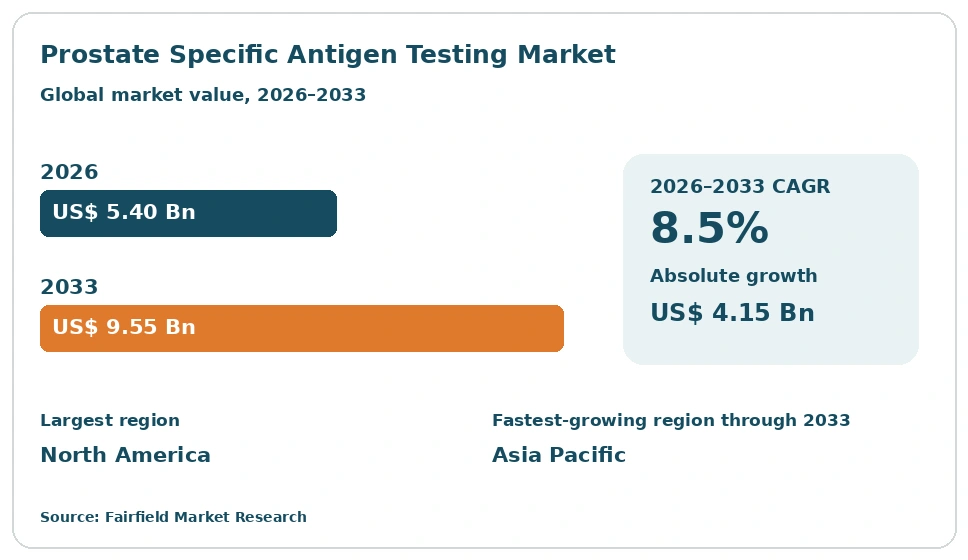
The global prostate specific antigen testing market size is expected to be valued at US$ 5.40 billion in 2026 and projected to reach US$ 9.55 billion by 2033, growing at a CAGR of 8.5% between 2026 and 2033.
Between 2020 and 2025, the market grew at a CAGR of about 7.4%, as routine screening dropped sharply during pandemic lockdowns in 2020, then recovered strongly with catch-up testing, rising awareness campaigns, and wider use of PSA in monitoring men after treatment. The prostate specific antigen testing market covers blood tests that measure PSA, a protein made by the prostate gland, to screen for, diagnose, and monitor prostate cancer. It includes total PSA, free PSA, complexed PSA, and newer blood tests that combine PSA with other markers, such as the Prostate Health Index, 4Kscore, IsoPSA, and Stockholm3, along with analyzers, reagents, and laboratory services. PSA screening helps find cancer early, and prostate cancer diagnostics increasingly combine PSA with MRI before biopsy. Growth comes from aging men, rising cancer cases, and better risk tests. In May 2026, the UK National Screening Committee recommended targeted screening for men with a BRCA2 gene change.
Key Report Takeaways
- By Test Type: Preliminary Tests held about 69% share in 2025, while Confirmatory and Reflex Tests is projected to expand at a 9.2% CAGR through 2033, driven by blood-based risk tests that reduce unnecessary biopsies and MRI-first diagnostic pathways.
- By Application: Screening held about 54.3% share in 2025, while Monitoring is projected to expand at an 8.8% CAGR through 2033, driven by more men living after prostate cancer treatment and active surveillance of low-risk disease.
- By End Use: Hospitals held about 38% share in 2025, while Diagnostic Laboratories is projected to expand at a 9.4% CAGR through 2033, driven by high-volume automated testing, reference lab networks, and specialized reflex test menus.
- By Region: North America held about 38% share in 2025, while Asia Pacific is projected to expand at a 10.1% CAGR through 2033, driven by aging populations, rising prostate cancer rates, and expanding laboratory networks in China, Japan, and India.
Global Prostate Specific Antigen Testing Market Trends and Insights
Drivers Impact Analysis
Two drivers carry the strongest influence on prostate specific antigen testing market demand during the forecast period.
| Driver | Impact on CAGR Forecast | Geographic Relevance | Impact Timeline |
| Aging men and rising prostate cancer cases | High | Global | Long term (≥4 years) |
| Targeted screening programs and awareness campaigns | Medium | Europe, North America, Asia Pacific | Medium term (2-4 years) |
Aging Populations Are Driving the Prostate Specific Antigen Testing Market
Aging men and rising prostate cancer cases are the strongest driver of the prostate specific antigen testing market. Prostate cancer is very common.
The mechanism is the strong link between age and prostate cancer. Prostate cancer is one of the most frequently diagnosed cancers in men worldwide, with well over a million new cases each year, and the risk rises sharply after age 50. Populations of older men are growing quickly in North America, Europe, Japan, and China, increasing the number of men eligible for testing. PSA tests are cheap, widely available, and easy to repeat, so doctors use them for screening, diagnosis, and monitoring after surgery or radiation. Men treated for prostate cancer often have PSA checked for years, creating steady repeat testing. Black men and men with family histories face higher risks and are encouraged to test earlier. These trends support long-term demand.
Targeted Screening Is Expanding the Prostate Specific Antigen Testing Market
Targeted screening programs and awareness campaigns are expanding the prostate specific antigen testing market. Health systems are rethinking how to screen.
The cause is new evidence and public pressure. The European Union recommended in 2022 that member states assess organized prostate cancer screening using PSA with MRI follow-up, and pilot programs are running in Sweden, Germany, and other countries. In May 2026, the UK National Screening Committee recommended screening for men with a BRCA2 gene change and family history of cancer. Awareness campaigns such as Movember, high-profile diagnoses of public figures, and charity events drive more men to ask for tests. Primary care doctors increasingly use risk calculators that combine PSA with age, family history, and ethnicity. Some insurers and employers offer health check-ups that include PSA for older men. These trends expand sales.
Restraints Impact Analysis
Two restraints limit how quickly the prostate specific antigen testing market grows.
| Restraint | Impact on CAGR Forecast | Geographic Relevance | Impact Timeline |
| Overdiagnosis concerns and limited test specificity | High | North America, Europe | Long term (≥4 years) |
| Mixed screening guidelines and reimbursement limits | Medium | Global | Medium term (2-4 years) |
Overdiagnosis Concerns Slow the Prostate Specific Antigen Testing Market
Overdiagnosis concerns and limited test specificity slow the prostate specific antigen testing market. PSA is not specific to cancer.
The specific causes are false positives and overtreatment. PSA levels can rise because of an enlarged prostate, infection, recent exercise, or other harmless causes, so many men with high PSA do not have cancer, while some men with aggressive cancer have normal PSA. High results often lead to anxiety, MRI scans, and biopsies, which carry risks of infection and bleeding. Population screening also finds many slow-growing cancers that would never cause harm, leading to unnecessary surgery or radiation with side effects such as incontinence and erectile problems. These concerns led several health bodies to recommend against routine screening for all men. These factors slow growth and push the field toward more accurate tests.
Mixed Guidelines Restrict the Prostate Specific Antigen Testing Market
Mixed screening guidelines and reimbursement limits restrict the prostate specific antigen testing market. Recommendations differ widely.
The underlying causes are differing views on benefits and harms. Some guidelines advise shared decision-making for men aged 55 to 69, while others recommend no routine screening. In November 2025, the UK National Screening Committee advised against screening all men. Professional bodies in the United States and Europe give different age ranges and testing intervals, which confuses doctors and patients and leads to uneven testing rates. Newer reflex tests are often not covered by insurers, so patients may pay out of pocket or skip them. In many lower-income countries, PSA testing is not part of public health programs, and laboratory access is limited. Price pressure on standard PSA tests reduces revenue per test. These factors restrict growth.
Market Opportunities
Next-Generation Blood Tests Open a Fast-Growth Revenue Pool
Next-generation blood tests open a fast-growth revenue pool in the prostate specific antigen testing market. Better tests reduce unnecessary biopsies.
Developers can capture this opportunity. New blood tests combine PSA forms with other proteins, genetic markers, and clinical data to identify men most likely to have aggressive cancer. In December 2025, the FDA approved Cleveland Diagnostics’ IsoPSA test as an aid in diagnosing high-grade prostate cancer. Tests such as Stockholm3, the Prostate Health Index, and 4Kscore are gaining use in Europe and North America, and studies show they can cut unnecessary biopsies while finding more serious cancers. Health systems that adopt MRI-first pathways also use these tests to decide who needs scanning. Companies with validated, reimbursed reflex tests can earn higher prices than standard PSA and build strong positions.
Point-of-Care and Home Testing Create a Growth Revenue Pool
Point-of-care and home testing create a growth revenue pool in the prostate specific antigen testing market. Easier testing can reach more men.
Developers can capture this opportunity. Rapid PSA tests that use a finger-prick blood sample can be performed in clinics, pharmacies, and at home, giving results in minutes. These tests help reach men who avoid doctor visits, live in rural areas, or lack access to laboratories, especially in Asia Pacific and Middle East & Africa. Pharmacies in some countries already offer PSA checks as part of men’s health services, and mobile health vans run screening events in rural areas. Digital apps can help men understand results and book follow-up care. Rapid tests must prove accuracy close to laboratory tests to win approval and doctor trust. Companies offering accurate, low-cost rapid tests with clear follow-up pathways can grow.
Segment Analysis
By Test Type: Preliminary Tests Lead While Confirmatory and Reflex Tests Grow Fastest
Preliminary Tests held about 69% share in 2025. Total, free, and complexed PSA tests are the first step in screening and monitoring, and they run on high-volume automated immunoassay analyzers from Roche, Abbott, Siemens Healthineers, and Beckman Coulter. These tests are low in cost, widely reimbursed, and ordered millions of times each year by primary care doctors and urologists.
Confirmatory and Reflex Tests is the fastest-growing test type, expanding at a 9.2% CAGR through 2033. Blood tests such as IsoPSA, Stockholm3, and the Prostate Health Index, along with urine tests such as PCA3, help decide whether men with raised PSA need MRI or biopsy. Guidelines increasingly recommend these tools to avoid overdiagnosis. For the market, reflex test growth raises value per patient.
By Application: Screening Leads While Monitoring Grows Fastest
Screening held about 54.3% share in 2025. PSA screening of men without symptoms remains the main use, especially in North America, where many men discuss testing with their doctors from age 50, or earlier for high-risk groups. Organized and targeted programs in Europe add structured screening for high-risk men.
Monitoring is the fastest-growing application, expanding at an 8.8% CAGR through 2033. Men who have had surgery, radiation, or hormone therapy have PSA checked regularly to detect recurrence, and men on active surveillance for low-risk cancer are tested every few months. Diagnosis of men with urinary symptoms forms another use, often alongside physical exams. For the market, monitoring growth adds repeat tests, since each man under surveillance may be tested several times a year for many years.
By End Use: Hospitals Lead While Diagnostic Laboratories Grow Fastest
Hospitals held about 38% share in 2025. Hospital laboratories run PSA tests for outpatients, urology clinics, and cancer centers, and they use PSA alongside MRI and biopsy to diagnose and stage cancer. Large hospital systems buy analyzers and reagents through long-term contracts.
Diagnostic Laboratories is the fastest-growing end use, expanding at a 9.4% CAGR through 2033. Reference laboratories such as Labcorp and Quest Diagnostics process large volumes of PSA tests from primary care and offer specialized reflex tests. Specialty clinics and other settings form further end uses, with urology clinics ordering many reflex tests. Point-of-care testing in pharmacies and community programs is a small but growing setting. For the market, laboratory growth supports efficient, lower-cost testing.
Geography Analysis
Which Region Is Leading the Prostate Specific Antigen Testing Market?
North America is leading the prostate specific antigen testing market with about 38% share in 2025. The United States has high PSA testing rates, broad insurance coverage for screening and monitoring, large laboratory networks such as Labcorp and Quest Diagnostics, and leading diagnostics companies including Abbott and Beckman Coulter. The FDA approved Cleveland Diagnostics’ IsoPSA test in December 2025, and new reflex tests are gaining use. Black men face higher risk and are a focus of awareness programs. Canada adds demand. Key barriers include overdiagnosis concerns and coverage limits for newer tests. One change shaping the region is MRI-first diagnosis.
Europe Shapes the Prostate Specific Antigen Testing Market Through Screening Pilots
Europe is a major prostate specific antigen testing market. Germany, the United Kingdom, France, Sweden, and Italy have large numbers of older men and active debate about screening. The European Union recommended assessing organized PSA screening with MRI in 2022, and pilot programs are testing new approaches. Sweden developed the Stockholm3 test. Roche and Siemens Healthineers are based in the region. Some countries, such as Lithuania, have run national PSA programs. Key barriers include mixed guidelines and budget limits. One opportunity is targeted screening of high-risk men, including those with BRCA2 gene changes and family histories.
Which Region Is Growing Fastest in the Prostate Specific Antigen Testing Market?
Asia Pacific is growing fastest in the prostate specific antigen testing market, expanding at a 10.1% CAGR through 2033. Japan has a large aging male population and community PSA screening in many cities. China is seeing rising prostate cancer rates and expanding hospital and laboratory capacity, while India, South Korea, and Australia are increasing awareness and testing. Diagnostics companies are expanding sales and local production, and private health check-up chains include PSA in packages for older men. Key barriers include low awareness in rural areas and limited reimbursement. One change shaping the region is rising health check-ups for older men.
Latin America Grows the Prostate Specific Antigen Testing Market Through Awareness
Latin America is a growing prostate specific antigen testing market. Brazil, Mexico, Argentina, Colombia, and Chile have rising prostate cancer rates and campaigns such as Blue November in Brazil that encourage men to get tested each year. Private laboratory chains are expanding testing in major cities, and public health systems offer free PSA tests in some programs. Key barriers include limited public budgets, cultural reluctance among men to seek care, long waits, and uneven rural access. One opportunity is laboratory and point-of-care testing in primary care clinics, supported by awareness campaigns and health insurers.
Middle East & Africa Builds the Prostate Specific Antigen Testing Market Through Health Investment
Middle East & Africa is an emerging prostate specific antigen testing market. South Africa and Nigeria have high prostate cancer death rates, and awareness campaigns are encouraging testing. Saudi Arabia, the United Arab Emirates, and Egypt are expanding hospital laboratories and health check-up programs, and national cancer plans are adding men’s health services. Men of African descent face higher prostate cancer risk, which raises the importance of early testing in the region. Key barriers include limited laboratory access, cost, and late diagnosis when disease has already spread. One opportunity is affordable rapid tests for community screening and outreach programs in cities.
Competitive Landscape
The prostate specific antigen testing market is moderately consolidated. Roche Diagnostics, Abbott, Siemens Healthineers, Beckman Coulter, and Labcorp are leading players, while Quest Diagnostics, Bio-Rad Laboratories, Cleveland Diagnostics, OPKO Health, MDxHealth, A3P Biomedical, and Fujirebio compete strongly. Large diagnostics companies supply automated analyzers and PSA reagents to hospitals and laboratories, while specialist firms develop next-generation risk tests, and reference laboratories perform most testing in some countries.
Companies compete on test accuracy, analyzer installed base, throughput, menu breadth, price per test, clinical evidence, and reimbursement. Standard PSA tests are low in price and compete on volume and analyzer contracts, while reflex and risk tests compete on clinical studies showing fewer unnecessary biopsies. Guideline inclusion and insurance coverage strongly influence adoption of newer tests.
Strategic moves show how competition is changing. In November 2025, the UK National Screening Committee advised against screening all men. In December 2025, the FDA approved Cleveland Diagnostics’ IsoPSA test for high-grade cancer. In May 2026, the UK National Screening Committee recommended targeted screening for men with a BRCA2 gene change. These moves show competition shifting toward targeted screening and more accurate risk tests.
Three themes shape vendor strategy. First, companies are developing blood tests that combine PSA with other markers to improve accuracy. Second, they are linking tests to MRI-first diagnostic pathways. Third, they are expanding in Asia Pacific, where aging populations and testing access are growing fastest.
Prostate Specific Antigen Testing Market Industry Leaders
- Roche Diagnostics
- Abbott
- Siemens Healthineers
- Beckman Coulter
- Labcorp
Recent Industry Developments
- May 2026: The UK National Screening Committee recommended prostate cancer screening for men with a BRCA2 gene change and family history of cancer - creates a targeted PSA screening program in the prostate specific antigen testing market.
- December 2025: The FDA approved Cleveland Diagnostics’ IsoPSA blood test as an aid in diagnosing high-grade prostate cancer in men with raised PSA - advances prostate cancer diagnostics beyond standard PSA.
- November 2025: The UK National Screening Committee advised against population-wide prostate cancer screening in its draft recommendation - shows ongoing debate over routine screening.
Companies Covered in the Report
- Roche Diagnostics
- Abbott
- Siemens Healthineers
- Beckman Coulter
- Labcorp
- Quest Diagnostics
- Bio-Rad Laboratories
- Cleveland Diagnostics
- OPKO Health
- MDxHealth
- A3P Biomedical
- Fujirebio
Prostate Specific Antigen Testing Market Report Scope
This report covers the prostate specific antigen testing market, including preliminary total, free, and complexed PSA tests and confirmatory and reflex tests, used for screening, monitoring, and diagnosis, across hospitals, diagnostic laboratories, specialty clinics, and other settings. The base year is 2025, and the forecast period runs from 2026 to 2033. All values are expressed in US$ Billion.
| Test Type | Preliminary Tests, Confirmatory and Reflex Tests |
| Application | Screening, Monitoring, Diagnosis |
| End Use | Hospitals, Diagnostic Laboratories, Specialty Clinics, Others |
| Regions | North America, Europe, Asia Pacific, Latin America, Middle East & Africa |
1. Executive Summary
1.1 Prostate Specific Antigen Testing Market Snapshot
1.2 Future Projections
1.3 Key Market Trends
1.4 Regional Snapshot
2. Market Overview
2.1 Market Definition and Report Scope
2.2 Historical Market Trends
2.3 Market Dynamics
2.3.1 Drivers
2.3.1.1 Aging Populations Are Driving the Prostate Specific Antigen Testing Market
2.3.1.2 Targeted Screening Is Expanding the Prostate Specific Antigen Testing Market
2.3.2 Restraints
2.3.2.1 Overdiagnosis Concerns Slow the Prostate Specific Antigen Testing Market
2.3.2.2 Mixed Guidelines Restrict the Prostate Specific Antigen Testing Market
2.3.3 Market Opportunities
2.3.3.1 Next-Generation Blood Tests Open a Fast-Growth Revenue Pool
2.3.3.2 Point-of-Care and Home Testing Create a Growth Revenue Pool
3. Global Prostate Specific Antigen Testing Market Outlook, 2020–2033
3.1 Global Prostate Specific Antigen Testing Market Outlook, by Test Type, Value (US$ Billion), 2020–2033
3.1.1 Preliminary Tests
3.1.2 Confirmatory and Reflex Tests
3.2 Global Prostate Specific Antigen Testing Market Outlook, by Application, Value (US$ Billion), 2020–2033
3.2.1 Screening
3.2.2 Monitoring
3.2.3 Diagnosis
3.3 Global Prostate Specific Antigen Testing Market Outlook, by End Use, Value (US$ Billion), 2020–2033
3.3.1 Hospitals
3.3.2 Diagnostic Laboratories
3.3.3 Specialty Clinics
3.3.4 Others
3.4 Global Prostate Specific Antigen Testing Market Outlook, by Region, Value (US$ Billion), 2020–2033
3.4.1 North America
3.4.2 Europe
3.4.3 Asia Pacific
3.4.4 Latin America
3.4.5 Middle East & Africa
4. North America Prostate Specific Antigen Testing Market Outlook, 2020–2033
4.1 North America Prostate Specific Antigen Testing Market Outlook, by Test Type, Value (US$ Billion), 2020–2033
4.1.1 Preliminary Tests
4.1.2 Confirmatory and Reflex Tests
4.2 North America Prostate Specific Antigen Testing Market Outlook, by Application, Value (US$ Billion), 2020–2033
4.2.1 Screening
4.2.2 Monitoring
4.2.3 Diagnosis
4.3 North America Prostate Specific Antigen Testing Market Outlook, by End Use, Value (US$ Billion), 2020–2033
4.3.1 Hospitals
4.3.2 Diagnostic Laboratories
4.3.3 Specialty Clinics
4.3.4 Others
4.4 North America Prostate Specific Antigen Testing Market Outlook, by Country, Value (US$ Billion), 2020–2033
4.4.1 United States Prostate Specific Antigen Testing Market Outlook, by Test Type, 2020–2033
4.4.2 United States Prostate Specific Antigen Testing Market Outlook, by Application, 2020–2033
4.4.3 United States Prostate Specific Antigen Testing Market Outlook, by End Use, 2020–2033
4.4.4 Canada Prostate Specific Antigen Testing Market Outlook, by Test Type, 2020–2033
4.4.5 Canada Prostate Specific Antigen Testing Market Outlook, by Application, 2020–2033
4.4.6 Canada Prostate Specific Antigen Testing Market Outlook, by End Use, 2020–2033
5. Europe Prostate Specific Antigen Testing Market Outlook, 2020–2033
5.1 Europe Prostate Specific Antigen Testing Market Outlook, by Test Type, Value (US$ Billion), 2020–2033
5.1.1 Preliminary Tests
5.1.2 Confirmatory and Reflex Tests
5.2 Europe Prostate Specific Antigen Testing Market Outlook, by Application, Value (US$ Billion), 2020–2033
5.2.1 Screening
5.2.2 Monitoring
5.2.3 Diagnosis
5.3 Europe Prostate Specific Antigen Testing Market Outlook, by End Use, Value (US$ Billion), 2020–2033
5.3.1 Hospitals
5.3.2 Diagnostic Laboratories
5.3.3 Specialty Clinics
5.3.4 Others
5.4 Europe Prostate Specific Antigen Testing Market Outlook, by Country, Value (US$ Billion), 2020–2033
5.4.1 Germany Prostate Specific Antigen Testing Market Outlook, by Test Type, 2020–2033
5.4.2 Germany Prostate Specific Antigen Testing Market Outlook, by Application, 2020–2033
5.4.3 Germany Prostate Specific Antigen Testing Market Outlook, by End Use, 2020–2033
5.4.4 United Kingdom Prostate Specific Antigen Testing Market Outlook, by Test Type, 2020–2033
5.4.5 United Kingdom Prostate Specific Antigen Testing Market Outlook, by Application, 2020–2033
5.4.6 United Kingdom Prostate Specific Antigen Testing Market Outlook, by End Use, 2020–2033
5.4.7 France Prostate Specific Antigen Testing Market Outlook, by Test Type, 2020–2033
5.4.8 France Prostate Specific Antigen Testing Market Outlook, by Application, 2020–2033
5.4.9 France Prostate Specific Antigen Testing Market Outlook, by End Use, 2020–2033
5.4.10 Sweden Prostate Specific Antigen Testing Market Outlook, by Test Type, 2020–2033
5.4.11 Sweden Prostate Specific Antigen Testing Market Outlook, by Application, 2020–2033
5.4.12 Sweden Prostate Specific Antigen Testing Market Outlook, by End Use, 2020–2033
5.4.13 Italy Prostate Specific Antigen Testing Market Outlook, by Test Type, 2020–2033
5.4.14 Italy Prostate Specific Antigen Testing Market Outlook, by Application, 2020–2033
5.4.15 Italy Prostate Specific Antigen Testing Market Outlook, by End Use, 2020–2033
6. Asia Pacific Prostate Specific Antigen Testing Market Outlook, 2020–2033
6.1 Asia Pacific Prostate Specific Antigen Testing Market Outlook, by Test Type, Value (US$ Billion), 2020–2033
6.1.1 Preliminary Tests
6.1.2 Confirmatory and Reflex Tests
6.2 Asia Pacific Prostate Specific Antigen Testing Market Outlook, by Application, Value (US$ Billion), 2020–2033
6.2.1 Screening
6.2.2 Monitoring
6.2.3 Diagnosis
6.3 Asia Pacific Prostate Specific Antigen Testing Market Outlook, by End Use, Value (US$ Billion), 2020–2033
6.3.1 Hospitals
6.3.2 Diagnostic Laboratories
6.3.3 Specialty Clinics
6.3.4 Others
6.4 Asia Pacific Prostate Specific Antigen Testing Market Outlook, by Country, Value (US$ Billion), 2020–2033
6.4.1 Japan Prostate Specific Antigen Testing Market Outlook, by Test Type, 2020–2033
6.4.2 Japan Prostate Specific Antigen Testing Market Outlook, by Application, 2020–2033
6.4.3 Japan Prostate Specific Antigen Testing Market Outlook, by End Use, 2020–2033
6.4.4 China Prostate Specific Antigen Testing Market Outlook, by Test Type, 2020–2033
6.4.5 China Prostate Specific Antigen Testing Market Outlook, by Application, 2020–2033
6.4.6 China Prostate Specific Antigen Testing Market Outlook, by End Use, 2020–2033
6.4.7 India Prostate Specific Antigen Testing Market Outlook, by Test Type, 2020–2033
6.4.8 India Prostate Specific Antigen Testing Market Outlook, by Application, 2020–2033
6.4.9 India Prostate Specific Antigen Testing Market Outlook, by End Use, 2020–2033
6.4.10 South Korea Prostate Specific Antigen Testing Market Outlook, by Test Type, 2020–2033
6.4.11 South Korea Prostate Specific Antigen Testing Market Outlook, by Application, 2020–2033
6.4.12 South Korea Prostate Specific Antigen Testing Market Outlook, by End Use, 2020–2033
6.4.13 Australia Prostate Specific Antigen Testing Market Outlook, by Test Type, 2020–2033
6.4.14 Australia Prostate Specific Antigen Testing Market Outlook, by Application, 2020–2033
6.4.15 Australia Prostate Specific Antigen Testing Market Outlook, by End Use, 2020–2033
7. Latin America Prostate Specific Antigen Testing Market Outlook, 2020–2033
7.1 Latin America Prostate Specific Antigen Testing Market Outlook, by Test Type, Value (US$ Billion), 2020–2033
7.1.1 Preliminary Tests
7.1.2 Confirmatory and Reflex Tests
7.2 Latin America Prostate Specific Antigen Testing Market Outlook, by Application, Value (US$ Billion), 2020–2033
7.2.1 Screening
7.2.2 Monitoring
7.2.3 Diagnosis
7.3 Latin America Prostate Specific Antigen Testing Market Outlook, by End Use, Value (US$ Billion), 2020–2033
7.3.1 Hospitals
7.3.2 Diagnostic Laboratories
7.3.3 Specialty Clinics
7.3.4 Others
7.4 Latin America Prostate Specific Antigen Testing Market Outlook, by Country, Value (US$ Billion), 2020–2033
7.4.1 Brazil Prostate Specific Antigen Testing Market Outlook, by Test Type, 2020–2033
7.4.2 Brazil Prostate Specific Antigen Testing Market Outlook, by Application, 2020–2033
7.4.3 Brazil Prostate Specific Antigen Testing Market Outlook, by End Use, 2020–2033
7.4.4 Mexico Prostate Specific Antigen Testing Market Outlook, by Test Type, 2020–2033
7.4.5 Mexico Prostate Specific Antigen Testing Market Outlook, by Application, 2020–2033
7.4.6 Mexico Prostate Specific Antigen Testing Market Outlook, by End Use, 2020–2033
7.4.7 Argentina Prostate Specific Antigen Testing Market Outlook, by Test Type, 2020–2033
7.4.8 Argentina Prostate Specific Antigen Testing Market Outlook, by Application, 2020–2033
7.4.9 Argentina Prostate Specific Antigen Testing Market Outlook, by End Use, 2020–2033
7.4.10 Colombia Prostate Specific Antigen Testing Market Outlook, by Test Type, 2020–2033
7.4.11 Colombia Prostate Specific Antigen Testing Market Outlook, by Application, 2020–2033
7.4.12 Colombia Prostate Specific Antigen Testing Market Outlook, by End Use, 2020–2033
7.4.13 Chile Prostate Specific Antigen Testing Market Outlook, by Test Type, 2020–2033
7.4.14 Chile Prostate Specific Antigen Testing Market Outlook, by Application, 2020–2033
7.4.15 Chile Prostate Specific Antigen Testing Market Outlook, by End Use, 2020–2033
8. Middle East & Africa Prostate Specific Antigen Testing Market Outlook, 2020–2033
8.1 Middle East & Africa Prostate Specific Antigen Testing Market Outlook, by Test Type, Value (US$ Billion), 2020–2033
8.1.1 Preliminary Tests
8.1.2 Confirmatory and Reflex Tests
8.2 Middle East & Africa Prostate Specific Antigen Testing Market Outlook, by Application, Value (US$ Billion), 2020–2033
8.2.1 Screening
8.2.2 Monitoring
8.2.3 Diagnosis
8.3 Middle East & Africa Prostate Specific Antigen Testing Market Outlook, by End Use, Value (US$ Billion), 2020–2033
8.3.1 Hospitals
8.3.2 Diagnostic Laboratories
8.3.3 Specialty Clinics
8.3.4 Others
8.4 Middle East & Africa Prostate Specific Antigen Testing Market Outlook, by Country, Value (US$ Billion), 2020–2033
8.4.1 South Africa Prostate Specific Antigen Testing Market Outlook, by Test Type, 2020–2033
8.4.2 South Africa Prostate Specific Antigen Testing Market Outlook, by Application, 2020–2033
8.4.3 South Africa Prostate Specific Antigen Testing Market Outlook, by End Use, 2020–2033
8.4.4 Nigeria Prostate Specific Antigen Testing Market Outlook, by Test Type, 2020–2033
8.4.5 Nigeria Prostate Specific Antigen Testing Market Outlook, by Application, 2020–2033
8.4.6 Nigeria Prostate Specific Antigen Testing Market Outlook, by End Use, 2020–2033
8.4.7 Saudi Arabia Prostate Specific Antigen Testing Market Outlook, by Test Type, 2020–2033
8.4.8 Saudi Arabia Prostate Specific Antigen Testing Market Outlook, by Application, 2020–2033
8.4.9 Saudi Arabia Prostate Specific Antigen Testing Market Outlook, by End Use, 2020–2033
8.4.10 United Arab Emirates Prostate Specific Antigen Testing Market Outlook, by Test Type, 2020–2033
8.4.11 United Arab Emirates Prostate Specific Antigen Testing Market Outlook, by Application, 2020–2033
8.4.12 United Arab Emirates Prostate Specific Antigen Testing Market Outlook, by End Use, 2020–2033
8.4.13 Egypt Prostate Specific Antigen Testing Market Outlook, by Test Type, 2020–2033
8.4.14 Egypt Prostate Specific Antigen Testing Market Outlook, by Application, 2020–2033
8.4.15 Egypt Prostate Specific Antigen Testing Market Outlook, by End Use, 2020–2033
9. Competitive Landscape
9.1 Prostate Specific Antigen Testing Market Industry Leaders
9.2 Recent Industry Developments
9.3 Company Profiles
9.3.1 Roche Diagnostics
9.3.2 Abbott
9.3.3 Siemens Healthineers
9.3.4 Beckman Coulter
9.3.5 Labcorp
9.3.6 Quest Diagnostics
9.3.7 Bio-Rad Laboratories
9.3.8 Cleveland Diagnostics
9.3.9 OPKO Health
9.3.10 MDxHealth
9.3.11 A3P Biomedical
9.3.12 Fujirebio
10. Appendix
10.1 Research Methodology
10.2 Report Assumptions
10.3 Acronyms and Abbreviations
| Test Type | Preliminary Tests, Confirmatory and Reflex Tests |
| Application | Screening, Monitoring, Diagnosis |
| End Use | Hospitals, Diagnostic Laboratories, Specialty Clinics, Others |
| Regions | North America, Europe, Asia Pacific, Latin America, Middle East & Africa |
Our Research Methodology
Considering the volatility of business today, traditional approaches to strategizing a game plan can be unfruitful if not detrimental. True ambiguity is no way to determine a forecast. A myriad of predetermined factors must be accounted for such as the degree of risk involved, the magnitude of circumstances, as well as conditions or consequences that are not known or unpredictable. To circumvent binary views that cast uncertainty, the application of market research intelligence to strategically posture, move, and enable actionable outcomes is necessary.
View Methodology
Quality Assured
Rigorous Validation Process

Confidentiality Assured
End-to-end Data Security

Custom Research Services
Tailored To Your Objectives
FAQs
The prostate specific antigen testing market is valued at US$ 5.40 billion in 2026, led by preliminary tests and North America.
The market is projected to reach US$ 9.55 billion by 2033, growing at an 8.5% CAGR and adding US$ 4.15 billion.
Confirmatory and reflex tests are growing fastest at a 9.2% CAGR through 2033, driven by blood tests that reduce unnecessary biopsies.
Asia Pacific is growing fastest at a 10.1% CAGR through 2033, driven by aging men and expanding laboratories in China and Japan.
North America holds the largest share at about 38% in 2025, supported by high testing rates, broad coverage, and large laboratory networks.
Related Reports
Cryopreservation Bags and Freezing Bags Market Size, Share, Insights, Competitive Landscape, and Forecast 2026 to 2033
The global cryopreservation bags and freezing bags market is valued at US$292 million in 2026, reaching US$599 million by 2033, growing at a 10.8% CAGR
Orthopedic Oncology Market Size, Share, Insights, Competitive Landscape, and Forecast 2026 to 2033
Explore the orthopedic oncology market outlook for 2026–2033, including reconstruction devices, surgical trends, regions, and competitive insights.
Latin America In Vitro Diagnostics (IVD) Market Size, Share, Insights, Competitive Landscape, and Forecast 2026 to 2033
Explore the Latin America in vitro diagnostics market outlook for 2026–2033, including testing techniques, applications, country trends, and competition.
Absorbable Tissue Spacer Market Size, Share, Insights, Competitive Landscape, and Forecast 2026 to 2033
Explore the absorbable tissue spacer market outlook for 2026–2033, with product trends, regional insights, growth drivers, and competitive analysis.
Glucose Tolerance Test Market Size, Share, Insights, Competitive Landscape, and Forecast 2026 to 2033
The global glucose tolerance test market is valued at US$1.97 billion in 2026, reaching US$2.98 billion by 2033, growing at a 6.1% CAGR
Medical Fiber Optics Market Size, Share, Insights, Competitive Landscape, and Forecast 2026 to 2033
The medical fiber optics market is projected to grow from US$1.4 billion in 2026 to US$1.9 billion by 2033 at a 4.5% CAGR.