



ACL Reconstruction Market
ACL Reconstruction Market Size, Share, Insights, Competitive Landscape, and Forecast 2026 to 2033
Report Overview
ACL Reconstruction Market Size and Trend Analysis
How Fast Is the ACL Reconstruction Market Growing?
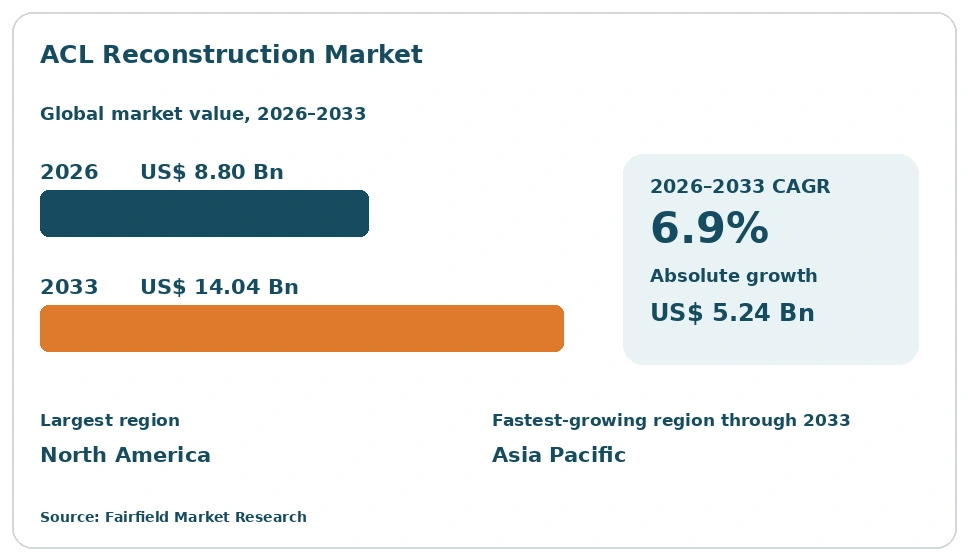
The global ACL reconstruction market size is expected to be valued at US$ 8.80 billion in 2026 and projected to reach US$ 14.04 billion by 2033, growing at a CAGR of 6.9% between 2026 and 2033.
Between 2020 and 2025, the market grew at a CAGR of about 6.7%, rising from roughly US$ 6.0 billion to about US$ 8.3 billion, as elective sports surgeries postponed during the pandemic returned, youth and adult sports participation recovered, and more procedures moved to outpatient surgery centers. The ACL reconstruction market covers surgery that replaces a torn anterior cruciate ligament in the knee with a tendon graft, along with the grafts, fixation devices, instruments, and services used in these procedures. Surgeons use autografts taken from the patient’s own patellar, hamstring, or quadriceps tendon, allografts from donors, or synthetic grafts, and secure them with interference screws, suspensory cortical buttons, and other fixation devices. ACL tears are among the most common serious knee injuries in sports. In July 2026, Smith+Nephew received FDA De Novo classification for its TESSA augmented reality navigation system for ACL reconstruction.
Key Report Takeaways
- By Graft Type: Autografts held about 55% share in 2025, while Synthetic Grafts are projected to expand at an 8.4% CAGR through 2033, driven by no donor-site pain, faster return to activity in selected patients, and steady improvements in graft materials and design.
- By Fixation Type: Interference Screws held about 45% share in 2025, while Suspensory Fixation is projected to expand at an 8.2% CAGR through 2033, driven by strong fixation strength, all-inside techniques, adjustable loop buttons, and growing surgeon preference for quadriceps tendon grafts.
- By End User: Hospitals held about 58% share in 2025, while Ambulatory Surgical Centers are projected to expand at an 8.6% CAGR through 2033, driven by lower costs, same-day discharge, payer support, and fast-growing outpatient sports medicine programs in many countries.
- By Region: North America held about 40% share in 2025, while Asia Pacific is projected to expand at a 9.0% CAGR through 2033, driven by rising sports participation, growing numbers of sports medicine surgeons, and expanding hospitals in China and India.
Global ACL Reconstruction Market Trends and Insights
Drivers Impact Analysis
Two drivers carry the strongest influence on ACL reconstruction market demand during the forecast period.
| Driver | Impact on CAGR Forecast | Geographic Relevance | Impact Timeline |
| High rates of sports-related ACL injuries | High | Global | Long term (≥4 years) |
| Advances in grafts, fixation, and surgical navigation | Medium | North America, Europe, Asia Pacific | Medium term (2-4 years) |
Sports Injuries Are Driving the ACL Reconstruction Market
High rates of sports-related ACL injuries are the strongest driver of the ACL reconstruction market. Millions of people play sports that put the knee at risk.
The mechanism is that ACL tears often happen during sudden stops, pivots, cutting movements, and awkward landings in soccer, basketball, American football, rugby, skiing, netball, and volleyball. Youth sports participation and year-round training have increased injury rates in teenagers, and female athletes face a higher risk of ACL tears than male athletes in many sports. Adults stay active longer in recreational sports, adding older patients to the treatment pool. For active patients, ACL reconstruction is usually the standard treatment to restore knee stability and allow return to sport. Many patients also have repeat or revision surgeries. These trends create steady, recurring demand for ACL procedures worldwide.
Technology Advances Are Expanding the ACL Reconstruction Market
Advances in grafts, fixation, and surgical navigation are expanding the ACL reconstruction market. Surgeons want better and more reliable results.
The cause is that ACL graft failure and revision surgery remain a major concern, and poor tunnel placement is a leading cause of failure. New tools are helping surgeons improve accuracy, such as Smith+Nephew’s TESSA system, which overlays a patient-specific 3D bone model on live arthroscopic video to guide femoral tunnel placement. Suspensory fixation buttons, all-inside techniques, and quadriceps tendon harvesting systems are making surgery less invasive. Lateral extra-articular tenodesis is being added in high-risk patients to lower re-tear rates. Allograft processing and synthetic graft materials continue to improve. Companies such as Arthrex, Stryker, and CONMED invest heavily in surgeon training. These trends support adoption of premium devices.
Restraints Impact Analysis
Two restraints limit how quickly the ACL reconstruction market grows.
| Restraint | Impact on CAGR Forecast | Geographic Relevance | Impact Timeline |
| High procedure costs and reimbursement pressure | High | North America, Europe | Medium term (2-4 years) |
| Long recovery times and alternative treatments | Medium | Global | Long term (≥4 years) |
High Costs Slow the ACL Reconstruction Market
High procedure costs and reimbursement pressure slow the ACL reconstruction market. ACL surgery is expensive for patients and health systems.
The problem is that ACL reconstruction involves surgeon fees, anesthesia, facility costs, implants, grafts, imaging, bracing, and months of physical therapy, which can add up to a large bill. In the United States, many patients have high-deductible insurance plans and delay or avoid surgery. Payers push procedures to lower-cost outpatient settings and negotiate lower implant prices. In Europe, public health systems use waiting lists and tenders that limit spending on premium devices. In many Asia Pacific, Latin America, and Middle East & Africa countries, patients pay out of pocket, and access to trained sports surgeons is limited outside large cities. These cost pressures slow adoption of advanced technologies and limit procedure growth.
Long Recovery and Alternatives Restrict the ACL Reconstruction Market
Long recovery times and alternative treatments restrict the ACL reconstruction market. Not every patient chooses surgery.
The constraint is that recovery after ACL reconstruction often takes nine months to a year before patients can safely return to sport, and some never return to their previous level. Graft re-tears, stiffness, and pain at the graft harvest site are known risks, and many patients develop knee arthritis years later. Some less active patients choose rehabilitation and bracing instead of surgery, and studies show this can work well for selected people. New repair approaches such as Miach Orthopaedics’ BEAR Implant, which helps the torn ligament heal instead of replacing it, offer an alternative for some patients. In January 2026, the implant gained a label claim for lower arthritis risk compared with hamstring reconstruction. These options may limit reconstruction growth.
Market Opportunities
Digital Navigation and Robotics Open a Fast-Growth Revenue Pool
Digital navigation and robotics open a fast-growth revenue pool. Technology is making ACL surgery more precise.
The opportunity comes from augmented reality, AI-based planning, and navigation systems that help surgeons place bone tunnels in the best position for each patient. Smith+Nephew plans to introduce its TESSA system commercially in the second half of 2026, with wider rollout in 2027. These systems use preoperative MRI or CT scans to build patient-specific 3D models and track instruments during surgery, which may reduce graft failure and revision rates. They also create data that can improve training and outcomes research. Companies that combine navigation systems with implants, instruments, and capital equipment such as arthroscopy towers can build strong, long-term relationships with hospitals and surgery centers and earn recurring revenue.
Outpatient Growth and Emerging Markets Create a Growth Revenue Pool
Outpatient growth and emerging markets create a growth revenue pool. Surgery is moving to new settings and new countries.
The opportunity reflects the rapid shift of ACL reconstruction to ambulatory surgical centers in the United States and other countries, where same-day discharge lowers costs and improves patient satisfaction. These centers buy efficient instrument sets, single-use kits, and implant bundles. At the same time, China, India, Brazil, Saudi Arabia, and other countries are building sports medicine departments, training more arthroscopic surgeons, and seeing more patients with sports injuries as participation grows. Professional and amateur sports leagues are expanding. Companies that offer cost-effective implants, surgeon education programs, local distribution, and support for new outpatient centers can capture strong growth across these large and fast-developing markets.
Segment Analysis
By Graft Type: Autografts Lead While Synthetic Grafts Grow Fastest
Autografts held about 55% share in 2025. Surgeons commonly use tendon taken from the patient’s own hamstring, patellar, or quadriceps tendon, which heals well and has low re-tear rates in young athletes. Quadriceps tendon autografts are gaining popularity because of lower harvest-site pain and strong graft size.
Synthetic Grafts are the fastest-growing graft type, expanding at an 8.4% CAGR through 2033. Artificial ligaments avoid donor-site pain and allow faster early recovery, and newer materials are improving durability, especially in Europe and Asia Pacific. Allografts from tissue banks form another segment and are often used in older patients, revision surgery, and multi-ligament injuries. For the market, synthetic growth adds new product options for surgeons and patients.
By Fixation Type: Interference Screws Lead While Suspensory Fixation Grows Fastest
Interference Screws held about 45% share in 2025. These metal, bioabsorbable, or composite screws hold the graft tightly inside the bone tunnel and are widely used with patellar tendon and hamstring grafts. They are familiar to most surgeons and widely available, and many hospitals keep large stocks of different sizes and materials for routine cases.
Suspensory Fixation is the fastest-growing fixation type, expanding at an 8.2% CAGR through 2033. Cortical buttons with fixed or adjustable loops sit on the outside of the bone and hold the graft in place, and they suit all-inside techniques and quadriceps tendon grafts. Cross-Pins and Other Fixation Devices form further segments. For the market, suspensory growth supports higher-value implant sales and encourages companies to develop new button and loop designs.
By End User: Hospitals Lead While Ambulatory Surgical Centers Grow Fastest
Hospitals held about 58% share in 2025. Hospitals perform many ACL reconstructions, especially complex, revision, and multi-ligament cases, and they treat many trauma and insured patients. Large hospital systems buy implants and instruments through group contracts, and teaching hospitals train new surgeons in the latest techniques. Hospitals also treat most patients in countries where outpatient centers are less common.
Ambulatory Surgical Centers are the fastest-growing end user, expanding at an 8.6% CAGR through 2033. Most primary ACL reconstructions in the United States can be performed as same-day surgery, and payers support outpatient care because of lower costs. Specialty Orthopedic Clinics form another segment. For the market, outpatient growth increases demand for efficient procedure kits, reusable instrument sets, and implant bundles priced for lower-cost settings.
Geography Analysis
Which Region Is Leading the ACL Reconstruction Market?
North America is leading the ACL reconstruction market with about 40% share in 2025. The United States performs a very large number of ACL reconstructions each year, supported by high participation in school and college sports, a large network of sports medicine surgeons, and widespread use of outpatient surgery centers. Arthrex, Stryker, CONMED, and Zimmer Biomet are based in the region. Canada adds demand through public health coverage. Key barriers include high costs and payer pressure. One change shaping the region is early use of AR navigation, which may improve tunnel placement and lower revision rates.
Europe Shapes the ACL Reconstruction Market Through Advanced Sports Medicine
Europe is a major ACL reconstruction market. Germany, France, the United Kingdom, Italy, and Spain have strong soccer and skiing cultures and large sports medicine sectors. Smith+Nephew is based in the United Kingdom, and many European surgeons are early adopters of quadriceps tendon grafts, lateral tenodesis, and synthetic ligaments. Public health systems cover most procedures. Key barriers include waiting lists and price pressure. One opportunity is advanced fixation and navigation for high-volume sports centers, supported by strong surgeon networks, clinical research, and professional sports clubs that demand the best possible care for their players.
Which Region Is Growing Fastest in the ACL Reconstruction Market?
Asia Pacific is the fastest-growing ACL reconstruction market, expanding at a 9.0% CAGR through 2033. China and India have rising sports participation, growing numbers of trained arthroscopic surgeons, and expanding private hospitals. Japan, South Korea, and Australia have advanced sports medicine sectors, and Australia has some of the highest ACL injury rates in the world because of popular contact sports. Local companies in China are producing lower-cost implants. Key barriers include price controls and limited access in rural areas. One change shaping the region is fast sports medicine growth in large private hospital chains and university hospitals.
Latin America Grows the ACL Reconstruction Market Through Sports Medicine Investment
Latin America is a growing ACL reconstruction market. Brazil and Mexico lead demand, supported by the huge popularity of soccer, growing private hospitals, and expanding sports medicine programs. Argentina, Colombia, and Chile add demand as more patients gain access to arthroscopic surgery. Professional soccer clubs invest heavily in player care. Key barriers include out-of-pocket costs, currency swings, and limited insurance coverage. One opportunity is cost-effective implant systems and surgeon training programs, supported by local distributors and partnerships with leading sports clinics. Growing private health insurance in Brazil and Mexico also supports demand for surgery each year.
Middle East & Africa Builds the ACL Reconstruction Market Through Hospital Expansion
Middle East & Africa is an emerging ACL reconstruction market. Saudi Arabia, the United Arab Emirates, and Qatar are investing in sports medicine hospitals, professional sports leagues, and major international sporting events, which raises demand for ACL surgery. Israel has advanced orthopedic care. South Africa, Egypt, and Nigeria show rising demand in private hospitals. Key barriers include limited specialists and reliance on imports. One opportunity is partnerships with new sports medicine centers, supported by government health investment, medical tourism, and growing youth sports programs across the region. International implant makers are also expanding training and distribution in the region.
Competitive Landscape
The ACL reconstruction market is moderately consolidated. Arthrex, Smith+Nephew, Stryker, CONMED, and Zimmer Biomet are leading players, while Johnson & Johnson MedTech, Miach Orthopaedics, Enovis, LifeNet Health, MTF Biologics, Corin Group, and Karl Storz compete strongly. Arthrex is widely seen as the leader in ACL and sports medicine implants. Large companies sell complete ACL systems, including grafts, fixation devices, harvesting tools, drills, guides, arthroscopy towers, and fluid management systems. Tissue banks supply allografts, and regional companies in China and India offer lower-cost implants.
Companies compete on clinical outcomes, fixation strength, ease of use, procedure time, instrument design, graft options, surgeon training, and price. Relationships with sports medicine surgeons, team physicians, and residency programs strongly influence product choice. Bundling implants with capital equipment and single-use kits helps large suppliers win contracts with hospitals and outpatient surgery centers. Clinical evidence and surgeon education are major investments.
Strategic moves show how competition is changing. In March 2025, Miach Orthopaedics expanded the BEAR Implant label to children and partial tears, and in January 2026, it added a claim for lower arthritis risk. In July 2026, Smith+Nephew received FDA De Novo classification for its TESSA navigation system for ACL reconstruction, opening a new digital category.
Three themes shape vendor strategy. First, companies are adding digital planning, navigation, and data tools to improve tunnel placement and outcomes. Second, they are developing less invasive techniques, new fixation systems, and better grafts. Third, they are targeting outpatient surgery centers and fast-growing sports medicine programs in Asia Pacific, Latin America, and Middle East & Africa.
ACL Reconstruction Market Industry Leaders
- Arthrex
- Smith+Nephew
- Stryker
- CONMED
- Zimmer Biomet
Recent Industry Developments
- July 2026: Smith+Nephew received FDA De Novo classification for its TESSA Spatial Surgery System, an augmented reality navigation platform for femoral tunnel placement in ACL reconstruction - creates a new category of digital navigation in the ACL reconstruction market.
- January 2026: Miach Orthopaedics received FDA 510(k) clearance to update the BEAR Implant label with a reduced risk of post-traumatic osteoarthritis compared with hamstring autograft reconstruction - strengthens a repair-based alternative to reconstruction.
- March 2025: Miach Orthopaedics received FDA clearance to expand BEAR Implant use to children and adolescents of any age and to partial ACL tears - widens the patient pool for ACL-preserving surgery.
Companies Covered in the Report
- Arthrex
- Smith+Nephew
- Stryker
- CONMED
- Zimmer Biomet
- Johnson & Johnson MedTech
- Miach Orthopaedics
- Enovis
- LifeNet Health
- MTF Biologics
- Corin Group
- Karl Storz
ACL Reconstruction Market Report Scope
This report covers the ACL reconstruction market, including autografts, allografts, and synthetic grafts, secured with interference screws, suspensory fixation, cross-pins, and other fixation devices, used in hospitals, ambulatory surgical centers, and specialty orthopedic clinics. The base year is 2025, and the forecast period runs from 2026 to 2033. All values are expressed in US$ Billion, and estimates include devices and procedure value.
| Graft Type | Autografts, Allografts, Synthetic Grafts |
| Fixation Type | Interference Screws, Suspensory Fixation, Cross-Pins, Other Fixation Devices |
| End User | Hospitals, Ambulatory Surgical Centers, Specialty Orthopedic Clinics |
| Regions | North America, Europe, Asia Pacific, Latin America, Middle East & Africa |
1. Executive Summary
1.1 ACL Reconstruction Market Snapshot
1.2 Future Projections
1.3 Key Market Trends
1.4 Regional Snapshot
2. Market Overview
2.1 Market Definition and Report Scope
2.2 Historical Market Trends
2.3 Market Dynamics
2.3.1 Drivers
2.3.1.1 Sports Injuries Are Driving the ACL Reconstruction Market
2.3.1.2 Technology Advances Are Expanding the ACL Reconstruction Market
2.3.2 Restraints
2.3.2.1 High Costs Slow the ACL Reconstruction Market
2.3.2.2 Long Recovery and Alternatives Restrict the ACL Reconstruction Market
2.3.3 Market Opportunities
2.3.3.1 Digital Navigation and Robotics Open a Fast-Growth Revenue Pool
2.3.3.2 Outpatient Growth and Emerging Markets Create a Growth Revenue Pool
3. Global ACL Reconstruction Market Outlook, 2020–2033
3.1 Global ACL Reconstruction Market Outlook, by Graft Type, Value (US$ Billion), 2020–2033
3.1.1 Autografts
3.1.2 Allografts
3.1.3 Synthetic Grafts
3.2 Global ACL Reconstruction Market Outlook, by Fixation Type, Value (US$ Billion), 2020–2033
3.2.1 Interference Screws
3.2.2 Suspensory Fixation
3.2.3 Cross-Pins
3.2.4 Other Fixation Devices
3.3 Global ACL Reconstruction Market Outlook, by End User, Value (US$ Billion), 2020–2033
3.3.1 Hospitals
3.3.2 Ambulatory Surgical Centers
3.3.3 Specialty Orthopedic Clinics
3.4 Global ACL Reconstruction Market Outlook, by Region, Value (US$ Billion), 2020–2033
3.4.1 North America
3.4.2 Europe
3.4.3 Asia Pacific
3.4.4 Latin America
3.4.5 Middle East & Africa
4. North America ACL Reconstruction Market Outlook, 2020–2033
4.1 North America ACL Reconstruction Market Outlook, by Graft Type, Value (US$ Billion), 2020–2033
4.1.1 Autografts
4.1.2 Allografts
4.1.3 Synthetic Grafts
4.2 North America ACL Reconstruction Market Outlook, by Fixation Type, Value (US$ Billion), 2020–2033
4.2.1 Interference Screws
4.2.2 Suspensory Fixation
4.2.3 Cross-Pins
4.2.4 Other Fixation Devices
4.3 North America ACL Reconstruction Market Outlook, by End User, Value (US$ Billion), 2020–2033
4.3.1 Hospitals
4.3.2 Ambulatory Surgical Centers
4.3.3 Specialty Orthopedic Clinics
4.4 North America ACL Reconstruction Market Outlook, by Country, Value (US$ Billion), 2020–2033
4.4.1 United States ACL Reconstruction Market Outlook, by Graft Type, 2020–2033
4.4.2 United States ACL Reconstruction Market Outlook, by Fixation Type, 2020–2033
4.4.3 United States ACL Reconstruction Market Outlook, by End User, 2020–2033
4.4.4 Canada ACL Reconstruction Market Outlook, by Graft Type, 2020–2033
4.4.5 Canada ACL Reconstruction Market Outlook, by Fixation Type, 2020–2033
4.4.6 Canada ACL Reconstruction Market Outlook, by End User, 2020–2033
5. Europe ACL Reconstruction Market Outlook, 2020–2033
5.1 Europe ACL Reconstruction Market Outlook, by Graft Type, Value (US$ Billion), 2020–2033
5.1.1 Autografts
5.1.2 Allografts
5.1.3 Synthetic Grafts
5.2 Europe ACL Reconstruction Market Outlook, by Fixation Type, Value (US$ Billion), 2020–2033
5.2.1 Interference Screws
5.2.2 Suspensory Fixation
5.2.3 Cross-Pins
5.2.4 Other Fixation Devices
5.3 Europe ACL Reconstruction Market Outlook, by End User, Value (US$ Billion), 2020–2033
5.3.1 Hospitals
5.3.2 Ambulatory Surgical Centers
5.3.3 Specialty Orthopedic Clinics
5.4 Europe ACL Reconstruction Market Outlook, by Country, Value (US$ Billion), 2020–2033
5.4.1 Germany ACL Reconstruction Market Outlook, by Graft Type, 2020–2033
5.4.2 Germany ACL Reconstruction Market Outlook, by Fixation Type, 2020–2033
5.4.3 Germany ACL Reconstruction Market Outlook, by End User, 2020–2033
5.4.4 France ACL Reconstruction Market Outlook, by Graft Type, 2020–2033
5.4.5 France ACL Reconstruction Market Outlook, by Fixation Type, 2020–2033
5.4.6 France ACL Reconstruction Market Outlook, by End User, 2020–2033
5.4.7 United Kingdom ACL Reconstruction Market Outlook, by Graft Type, 2020–2033
5.4.8 United Kingdom ACL Reconstruction Market Outlook, by Fixation Type, 2020–2033
5.4.9 United Kingdom ACL Reconstruction Market Outlook, by End User, 2020–2033
5.4.10 Italy ACL Reconstruction Market Outlook, by Graft Type, 2020–2033
5.4.11 Italy ACL Reconstruction Market Outlook, by Fixation Type, 2020–2033
5.4.12 Italy ACL Reconstruction Market Outlook, by End User, 2020–2033
5.4.13 Spain ACL Reconstruction Market Outlook, by Graft Type, 2020–2033
5.4.14 Spain ACL Reconstruction Market Outlook, by Fixation Type, 2020–2033
5.4.15 Spain ACL Reconstruction Market Outlook, by End User, 2020–2033
6. Asia Pacific ACL Reconstruction Market Outlook, 2020–2033
6.1 Asia Pacific ACL Reconstruction Market Outlook, by Graft Type, Value (US$ Billion), 2020–2033
6.1.1 Autografts
6.1.2 Allografts
6.1.3 Synthetic Grafts
6.2 Asia Pacific ACL Reconstruction Market Outlook, by Fixation Type, Value (US$ Billion), 2020–2033
6.2.1 Interference Screws
6.2.2 Suspensory Fixation
6.2.3 Cross-Pins
6.2.4 Other Fixation Devices
6.3 Asia Pacific ACL Reconstruction Market Outlook, by End User, Value (US$ Billion), 2020–2033
6.3.1 Hospitals
6.3.2 Ambulatory Surgical Centers
6.3.3 Specialty Orthopedic Clinics
6.4 Asia Pacific ACL Reconstruction Market Outlook, by Country, Value (US$ Billion), 2020–2033
6.4.1 China ACL Reconstruction Market Outlook, by Graft Type, 2020–2033
6.4.2 China ACL Reconstruction Market Outlook, by Fixation Type, 2020–2033
6.4.3 China ACL Reconstruction Market Outlook, by End User, 2020–2033
6.4.4 India ACL Reconstruction Market Outlook, by Graft Type, 2020–2033
6.4.5 India ACL Reconstruction Market Outlook, by Fixation Type, 2020–2033
6.4.6 India ACL Reconstruction Market Outlook, by End User, 2020–2033
6.4.7 Japan ACL Reconstruction Market Outlook, by Graft Type, 2020–2033
6.4.8 Japan ACL Reconstruction Market Outlook, by Fixation Type, 2020–2033
6.4.9 Japan ACL Reconstruction Market Outlook, by End User, 2020–2033
6.4.10 South Korea ACL Reconstruction Market Outlook, by Graft Type, 2020–2033
6.4.11 South Korea ACL Reconstruction Market Outlook, by Fixation Type, 2020–2033
6.4.12 South Korea ACL Reconstruction Market Outlook, by End User, 2020–2033
6.4.13 Australia ACL Reconstruction Market Outlook, by Graft Type, 2020–2033
6.4.14 Australia ACL Reconstruction Market Outlook, by Fixation Type, 2020–2033
6.4.15 Australia ACL Reconstruction Market Outlook, by End User, 2020–2033
7. Latin America ACL Reconstruction Market Outlook, 2020–2033
7.1 Latin America ACL Reconstruction Market Outlook, by Graft Type, Value (US$ Billion), 2020–2033
7.1.1 Autografts
7.1.2 Allografts
7.1.3 Synthetic Grafts
7.2 Latin America ACL Reconstruction Market Outlook, by Fixation Type, Value (US$ Billion), 2020–2033
7.2.1 Interference Screws
7.2.2 Suspensory Fixation
7.2.3 Cross-Pins
7.2.4 Other Fixation Devices
7.3 Latin America ACL Reconstruction Market Outlook, by End User, Value (US$ Billion), 2020–2033
7.3.1 Hospitals
7.3.2 Ambulatory Surgical Centers
7.3.3 Specialty Orthopedic Clinics
7.4 Latin America ACL Reconstruction Market Outlook, by Country, Value (US$ Billion), 2020–2033
7.4.1 Brazil ACL Reconstruction Market Outlook, by Graft Type, 2020–2033
7.4.2 Brazil ACL Reconstruction Market Outlook, by Fixation Type, 2020–2033
7.4.3 Brazil ACL Reconstruction Market Outlook, by End User, 2020–2033
7.4.4 Mexico ACL Reconstruction Market Outlook, by Graft Type, 2020–2033
7.4.5 Mexico ACL Reconstruction Market Outlook, by Fixation Type, 2020–2033
7.4.6 Mexico ACL Reconstruction Market Outlook, by End User, 2020–2033
7.4.7 Argentina ACL Reconstruction Market Outlook, by Graft Type, 2020–2033
7.4.8 Argentina ACL Reconstruction Market Outlook, by Fixation Type, 2020–2033
7.4.9 Argentina ACL Reconstruction Market Outlook, by End User, 2020–2033
7.4.10 Colombia ACL Reconstruction Market Outlook, by Graft Type, 2020–2033
7.4.11 Colombia ACL Reconstruction Market Outlook, by Fixation Type, 2020–2033
7.4.12 Colombia ACL Reconstruction Market Outlook, by End User, 2020–2033
7.4.13 Chile ACL Reconstruction Market Outlook, by Graft Type, 2020–2033
7.4.14 Chile ACL Reconstruction Market Outlook, by Fixation Type, 2020–2033
7.4.15 Chile ACL Reconstruction Market Outlook, by End User, 2020–2033
8. Middle East & Africa ACL Reconstruction Market Outlook, 2020–2033
8.1 Middle East & Africa ACL Reconstruction Market Outlook, by Graft Type, Value (US$ Billion), 2020–2033
8.1.1 Autografts
8.1.2 Allografts
8.1.3 Synthetic Grafts
8.2 Middle East & Africa ACL Reconstruction Market Outlook, by Fixation Type, Value (US$ Billion), 2020–2033
8.2.1 Interference Screws
8.2.2 Suspensory Fixation
8.2.3 Cross-Pins
8.2.4 Other Fixation Devices
8.3 Middle East & Africa ACL Reconstruction Market Outlook, by End User, Value (US$ Billion), 2020–2033
8.3.1 Hospitals
8.3.2 Ambulatory Surgical Centers
8.3.3 Specialty Orthopedic Clinics
8.4 Middle East & Africa ACL Reconstruction Market Outlook, by Country, Value (US$ Billion), 2020–2033
8.4.1 Saudi Arabia ACL Reconstruction Market Outlook, by Graft Type, 2020–2033
8.4.2 Saudi Arabia ACL Reconstruction Market Outlook, by Fixation Type, 2020–2033
8.4.3 Saudi Arabia ACL Reconstruction Market Outlook, by End User, 2020–2033
8.4.4 United Arab Emirates ACL Reconstruction Market Outlook, by Graft Type, 2020–2033
8.4.5 United Arab Emirates ACL Reconstruction Market Outlook, by Fixation Type, 2020–2033
8.4.6 United Arab Emirates ACL Reconstruction Market Outlook, by End User, 2020–2033
8.4.7 Qatar ACL Reconstruction Market Outlook, by Graft Type, 2020–2033
8.4.8 Qatar ACL Reconstruction Market Outlook, by Fixation Type, 2020–2033
8.4.9 Qatar ACL Reconstruction Market Outlook, by End User, 2020–2033
8.4.10 Israel ACL Reconstruction Market Outlook, by Graft Type, 2020–2033
8.4.11 Israel ACL Reconstruction Market Outlook, by Fixation Type, 2020–2033
8.4.12 Israel ACL Reconstruction Market Outlook, by End User, 2020–2033
8.4.13 South Africa ACL Reconstruction Market Outlook, by Graft Type, 2020–2033
8.4.14 South Africa ACL Reconstruction Market Outlook, by Fixation Type, 2020–2033
8.4.15 South Africa ACL Reconstruction Market Outlook, by End User, 2020–2033
8.4.16 Egypt ACL Reconstruction Market Outlook, by Graft Type, 2020–2033
8.4.17 Egypt ACL Reconstruction Market Outlook, by Fixation Type, 2020–2033
8.4.18 Egypt ACL Reconstruction Market Outlook, by End User, 2020–2033
8.4.19 Nigeria ACL Reconstruction Market Outlook, by Graft Type, 2020–2033
8.4.20 Nigeria ACL Reconstruction Market Outlook, by Fixation Type, 2020–2033
8.4.21 Nigeria ACL Reconstruction Market Outlook, by End User, 2020–2033
9. Competitive Landscape
9.1 ACL Reconstruction Market Industry Leaders
9.2 Recent Industry Developments
9.3 Company Profiles
9.3.1 Arthrex
9.3.2 Smith+Nephew
9.3.3 Stryker
9.3.4 CONMED
9.3.5 Zimmer Biomet
9.3.6 Johnson & Johnson MedTech
9.3.7 Miach Orthopaedics
9.3.8 Enovis
9.3.9 LifeNet Health
9.3.10 MTF Biologics
9.3.11 Corin Group
9.3.12 Karl Storz
10. Appendix
10.1 Research Methodology
10.2 Report Assumptions
10.3 Acronyms and Abbreviations
| Graft Type | Autografts, Allografts, Synthetic Grafts |
| Fixation Type | Interference Screws, Suspensory Fixation, Cross-Pins, Other Fixation Devices |
| End User | Hospitals, Ambulatory Surgical Centers, Specialty Orthopedic Clinics |
| Regions | North America, Europe, Asia Pacific, Latin America, Middle East & Africa |
Our Research Methodology
Considering the volatility of business today, traditional approaches to strategizing a game plan can be unfruitful if not detrimental. True ambiguity is no way to determine a forecast. A myriad of predetermined factors must be accounted for such as the degree of risk involved, the magnitude of circumstances, as well as conditions or consequences that are not known or unpredictable. To circumvent binary views that cast uncertainty, the application of market research intelligence to strategically posture, move, and enable actionable outcomes is necessary.
View Methodology
Quality Assured
Rigorous Validation Process

Confidentiality Assured
End-to-end Data Security

Custom Research Services
Tailored To Your Objectives
FAQs
The market is valued at US$ 8.80 billion in 2026, led by autografts, interference screw fixation, hospitals, and North America.
The market is projected to reach US$ 14.04 billion by 2033, growing at a 6.9% CAGR and adding US$ 5.24 billion.
Ambulatory Surgical Centers are growing fastest at an 8.6% CAGR through 2033, driven by lower costs and same-day discharge.
Asia Pacific is growing fastest at a 9.0% CAGR through 2033, driven by rising sports participation and more trained surgeons.
North America holds the largest share at about 40% in 2025, supported by high sports participation and many outpatient centers.
Related Reports
Ankle Splints Market Size, Share, Insights, Competitive Landscape, and Forecast 2026 to 2033
Explore the ankle splints market, forecast to reach US$2.30 billion by 2033 at 6.6% CAGR, with insights on products, applications, channels, and regions.
Stroke Diagnostics and Therapeutics Market Size, Share, Insights, Competitive Landscape, and Forecast 2026 to 2033
Explore the stroke diagnostics and therapeutics market, forecast to reach US$81.70 billion by 2033 at 7.9% CAGR, with insights on types and regions.
IoT Medical Devices Market Size, Share, Insights, Competitive Landscape, and Forecast 2026 to 2033
Explore the IoT medical devices market, forecast to reach US$259.93 billion by 2033 at 18.9% CAGR, with insights on products, connectivity, and regions.
Prostate Specific Antigen Testing Market Size, Share, Insights, Competitive Landscape, and Forecast 2026 to 2033
Explore the prostate specific antigen testing market outlook for 2026–2033, covering test types, applications, end users, regions, and key companies.
Cryopreservation Bags and Freezing Bags Market Size, Share, Insights, Competitive Landscape, and Forecast 2026 to 2033
The global cryopreservation bags and freezing bags market is valued at US$292 million in 2026, reaching US$599 million by 2033, growing at a 10.8% CAGR
Orthopedic Oncology Market Size, Share, Insights, Competitive Landscape, and Forecast 2026 to 2033
Explore the orthopedic oncology market outlook for 2026–2033, including reconstruction devices, surgical trends, regions, and competitive insights.