



Stroke Diagnostics and Therapeutics Market
Stroke Diagnostics and Therapeutics Market Size, Share, Insights, Competitive Landscape, and Forecast 2026 to 2033
Report Overview
Stroke Diagnostics and Therapeutics Market Size and Trend Analysis
How Fast Is the Stroke Diagnostics and Therapeutics Market Growing?
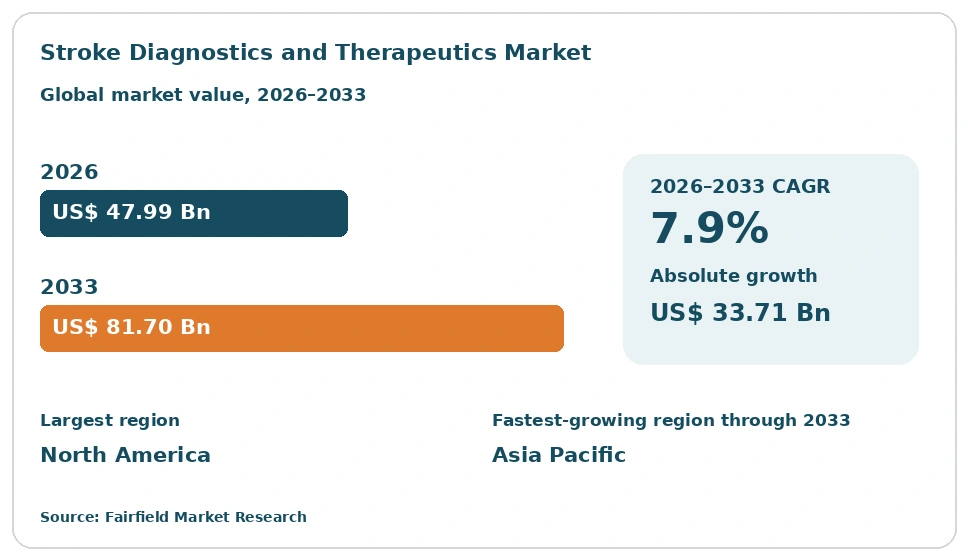
The global stroke diagnostics and therapeutics market size is expected to be valued at US$ 47.99 billion in 2026 and projected to reach US$ 81.70 billion by 2033, growing at a CAGR of 7.9% between 2026 and 2033.
Between 2020 and 2025, the market grew at a CAGR of about 7.1%, rising from roughly US$ 31.5 billion to about US$ 44.5 billion, as stroke centers expanded, mechanical thrombectomy became standard care for large clots, artificial intelligence tools began reading brain scans in minutes, and hospitals recovered from pandemic disruptions that had delayed stroke care. The stroke diagnostics and therapeutics market covers tools and treatments used to detect, treat, and prevent stroke, including CT and MRI imaging, CT angiography, perfusion imaging, carotid ultrasound, blood tests, and AI triage software, as well as clot-busting drugs such as alteplase and tenecteplase, antiplatelet and anticoagulant drugs, thrombectomy devices, aneurysm coils, flow diverters, and carotid stents. Stroke is a leading cause of death and disability worldwide. In July 2026, Penumbra received FDA clearance for its Thunderbolt computer-assisted thrombectomy device.
Key Report Takeaways
- By Type: Therapeutics held about 57.3% share in 2025, while Diagnostics are projected to expand at an 8.6% CAGR through 2033, driven by AI-powered imaging software, portable CT and MRI scanners, mobile stroke units, and blood tests that help identify stroke type within minutes.
- By Stroke Type: Ischemic Stroke held about 76.4% share in 2025, while Hemorrhagic Stroke is projected to expand at an 8.7% CAGR through 2033, driven by new aneurysm treatment devices, flow diverters, embolization products, and better reversal drugs for bleeding.
- By End User: Hospitals held about 62% share in 2025, while Diagnostic and Imaging Centers are projected to expand at an 8.9% CAGR through 2033, driven by outpatient vascular imaging, stroke risk screening, and follow-up scans.
- By Region: North America held about 38.6% share in 2025, while Asia Pacific is projected to expand at a 9.4% CAGR through 2033, driven by a very high stroke burden, new stroke centers, and expanding thrombectomy access in China and India.
Global Stroke Diagnostics and Therapeutics Market Trends and Insights
Drivers Impact Analysis
Two drivers carry the strongest influence on stroke diagnostics and therapeutics market demand during the forecast period.
| Driver | Impact on CAGR Forecast | Geographic Relevance | Impact Timeline |
| Rising stroke burden and aging populations | High | Global | Long term (≥4 years) |
| Expansion of thrombectomy and stroke systems of care | High | North America, Europe, Asia Pacific | Medium term (2-4 years) |
Rising Stroke Burden Is Driving the Stroke Diagnostics and Therapeutics Market
The rising stroke burden and aging populations are the strongest driver of the stroke diagnostics and therapeutics market. Stroke cases keep increasing worldwide.
The mechanism is that stroke risk rises sharply with age, high blood pressure, diabetes, obesity, smoking, atrial fibrillation, and high cholesterol, all of which are becoming more common. Millions of people have a stroke each year, and the number is growing fastest in Asia Pacific, Latin America, and Middle East & Africa. Every stroke patient needs urgent brain imaging, and many receive clot-busting drugs, thrombectomy, or surgery, followed by long-term medicines to prevent another stroke. Aging populations in North America, Europe, Japan, and China add more patients each year. Awareness campaigns teach people to recognize symptoms and call for help quickly. These trends support steady long-term demand for diagnostics, drugs, and devices.
Thrombectomy Growth Is Expanding the Stroke Diagnostics and Therapeutics Market
Expansion of thrombectomy and stroke systems of care is expanding the stroke diagnostics and therapeutics market. More patients can now receive advanced treatment.
The cause is strong clinical evidence that removing large clots with catheters greatly improves recovery. Trials have extended the treatment window to 24 hours for selected patients and shown benefit for patients with large strokes and smaller distal clots. Hospitals are opening more certified thrombectomy-capable and comprehensive stroke centers, and regions are building networks that route patients quickly to these centers. New devices such as Penumbra’s Thunderbolt and Rapid Medical’s Tigertriever 25 improve clot removal. Genentech’s TNKase gained FDA approval for stroke in 2025, offering a faster single-injection clot-busting drug. AI software from companies such as Viz.ai alerts specialists within minutes. These advances raise treatment rates and spending.
Restraints Impact Analysis
Two restraints limit how quickly the stroke diagnostics and therapeutics market grows.
| Restraint | Impact on CAGR Forecast | Geographic Relevance | Impact Timeline |
| Limited access to stroke centers and specialists | High | Asia Pacific, Latin America, Middle East & Africa | Long term (≥4 years) |
| High costs and narrow treatment windows | Medium | Global | Medium term (2-4 years) |
Limited Access Slows the Stroke Diagnostics and Therapeutics Market
Limited access to stroke centers and specialists slows the stroke diagnostics and therapeutics market. Many patients cannot reach advanced care in time.
The problem is that thrombectomy requires specialized hospitals, neurointerventional doctors, catheter labs, and 24-hour teams, which are concentrated in large cities. In many parts of Asia Pacific, Latin America, and Middle East & Africa, there are very few such centers, and even in rural parts of North America and Europe, patients may live hours away. Many hospitals lack CT scanners available around the clock or radiologists to read scans quickly. Ambulance systems may not route patients to the right hospital. Low awareness of stroke symptoms also delays arrival. As a result, only a small share of eligible patients receive thrombectomy in many countries. These gaps limit market growth where stroke burden is highest.
High Costs Restrict the Stroke Diagnostics and Therapeutics Market
High costs and narrow treatment windows restrict the stroke diagnostics and therapeutics market. Stroke treatment must happen fast and is expensive.
The constraint is that clot-busting drugs work best within 4.5 hours of symptom onset, and thrombectomy is most effective when done quickly, so patients who arrive late often cannot receive these treatments. Advanced imaging systems, thrombectomy catheters, stent retrievers, and aneurysm devices are costly, and some health systems limit their use. Building and staffing stroke centers needs large investment. Reimbursement for AI software and new devices varies between countries. Bleeding risks with clot-busting and blood-thinning drugs also limit their use in some patients. Generic versions of older drugs lower prices. Hospitals must also pay for staff on call day and night. These factors limit revenue growth even as stroke cases rise.
Market Opportunities
AI and Mobile Stroke Diagnostics Open a Fast-Growth Revenue Pool
AI and mobile stroke diagnostics open a fast-growth revenue pool. Faster diagnosis means better outcomes.
The opportunity comes from artificial intelligence software that detects large vessel blockages, bleeding, and brain tissue damage on CT and MRI scans within minutes and alerts stroke teams by smartphone. Mobile stroke units, which are ambulances with built-in CT scanners, allow diagnosis and clot-busting treatment before patients reach the hospital. Portable low-field MRI, point-of-care blood tests for brain injury markers, and wearable devices that detect stroke signs are also emerging. Companies such as Siemens Healthineers, GE HealthCare, Philips, and AI specialists are investing in these tools. Hospitals and stroke networks value faster treatment decisions. Companies that offer accurate, connected, and fast diagnostic solutions can win long-term contracts and recurring software revenue.
New Devices and Neuroprotective Drugs Create a Growth Revenue Pool
New devices and neuroprotective drugs create a growth revenue pool. Treatment options are expanding beyond large clots.
The opportunity reflects growing evidence for treating medium and distal vessel blockages, intracranial atherosclerosis, and patients with large strokes, which requires new smaller catheters, stent retrievers, and aspiration systems. Computer-assisted thrombectomy, robotic systems, and better imaging guidance can improve first-pass success. Flow diverters and intrasaccular devices are improving aneurysm treatment. Researchers are also testing neuroprotective drugs that protect brain cells during and after stroke, and China has approved new agents such as edaravone dexborneol. Rehabilitation technologies, including robotics and brain stimulation, support recovery. Stroke prevention devices that close a heart opening called the left atrial appendage also reduce stroke risk. Companies that bring innovative devices and drugs with strong clinical data can capture premium pricing and new patient groups.
Segment Analysis
By Type: Therapeutics Lead While Diagnostics Grow Fastest
Therapeutics held about 57.3% share in 2025. This segment includes clot-busting drugs, antiplatelet and anticoagulant medicines for stroke prevention, blood pressure and cholesterol drugs, thrombectomy devices, aneurysm coils, flow diverters, and carotid stents. High device prices and long-term prevention medicines make therapeutics the largest segment across all regions. Long-term prevention drugs are taken for years after a first stroke.
Diagnostics are the fastest-growing type, expanding at an 8.6% CAGR through 2033. CT, CT angiography, perfusion imaging, MRI, carotid ultrasound, and AI software are essential for deciding treatment within minutes. Mobile stroke units, portable scanners, and blood biomarker tests widen access. For the market, diagnostics growth supports faster and more accurate treatment, which in turn increases the number of patients who receive therapy.
By Stroke Type: Ischemic Stroke Leads While Hemorrhagic Stroke Grows Fastest
Ischemic Stroke held about 76.4% share in 2025. Caused by blood clots blocking brain arteries, it accounts for most strokes worldwide and is treated with clot-busting drugs, thrombectomy, and long-term prevention medicines. Growing thrombectomy use makes this the largest and most valuable segment.
Prevention of second strokes is also a large spending area. Hemorrhagic Stroke is the fastest-growing stroke type, expanding at an 8.7% CAGR through 2033. It is caused by bleeding in or around the brain and is treated with surgery, aneurysm coils, flow diverters, embolization, and blood pressure and reversal drugs. New minimally invasive surgery and device options support growth. Transient Ischemic Attack forms another segment. For the market, hemorrhagic growth adds high-value device sales.
By End User: Hospitals Lead While Diagnostic and Imaging Centers Grow Fastest
Hospitals held about 62% share in 2025. Emergency departments, stroke units, catheter labs, and intensive care units in hospitals diagnose and treat almost all acute stroke patients. Comprehensive stroke centers perform thrombectomy and aneurysm procedures, while smaller hospitals use telestroke links to consult experts and transfer patients who need advanced care. Hospital stroke units also start rehabilitation early.
Diagnostic and Imaging Centers are the fastest-growing end user, expanding at an 8.9% CAGR through 2033. Outpatient centers perform carotid ultrasound, MRI, and CT angiography for stroke risk screening and follow-up, at lower cost than hospitals. Specialty Clinics, Rehabilitation Centers, and Ambulatory Surgical Centers form other segments. Primary care doctors increasingly refer high-risk patients for screening. For the market, outpatient growth supports prevention and early detection of narrowed arteries.
Geography Analysis
Which Region Is Leading the Stroke Diagnostics and Therapeutics Market?
North America is leading the stroke diagnostics and therapeutics market with about 38.6% share in 2025. The United States has hundreds of certified stroke centers, advanced imaging in most hospitals, wide use of thrombectomy, and early access to new devices and drugs such as TNKase, Thunderbolt, and Tigertriever 25. Leading companies including Medtronic, Stryker, Penumbra, GE HealthCare, and Genentech are active in the region. AI stroke software is widely used. Canada has strong stroke systems. Key barriers include rural access gaps. One change shaping the region is the shift to tenecteplase across many hospitals.
Europe Shapes the Stroke Diagnostics and Therapeutics Market Through Stroke Networks
Europe is a major stroke diagnostics and therapeutics market. Germany, France, the United Kingdom, Spain, and Italy have organized stroke networks, mobile stroke units in some cities, and strong research that shaped global treatment guidelines. Siemens Healthineers and Philips are both based in the region. The European Stroke Organisation action plan aims to improve access to thrombectomy and rehabilitation. Key barriers include uneven access between countries and regions, budget limits, and staff shortages. Mobile stroke units operate in cities such as Berlin and Oslo. One opportunity is expanding thrombectomy access in central and eastern countries.
Which Region Is Growing Fastest in the Stroke Diagnostics and Therapeutics Market?
Asia Pacific is the fastest-growing stroke diagnostics and therapeutics market, expanding at a 9.4% CAGR through 2033. China has the world’s largest number of stroke patients and is building many stroke centers, while local companies are approving new drugs and devices. India has a fast-growing stroke burden and is expanding stroke-ready hospitals and telestroke networks. Japan and South Korea have aging populations and advanced stroke care, and Australia has strong stroke systems. Key barriers include access gaps and costs. Telestroke networks help rural hospitals in India and China reach specialists. One change shaping the region is rapid thrombectomy growth.
Latin America Grows the Stroke Diagnostics and Therapeutics Market Through Stroke Programs
Latin America is a growing stroke diagnostics and therapeutics market. Brazil and Mexico have high stroke rates and are building stroke units and thrombectomy programs, supported by initiatives such as Mission Thrombectomy. Argentina, Colombia, and Chile are improving stroke care networks and telemedicine. Clot-busting drug use is rising. Key barriers include limited thrombectomy centers, costs, and uneven access outside major cities. Public health systems are adding clot-busting drugs to hospital formularies. Awareness campaigns teach people stroke warning signs. Private hospitals in large cities are opening comprehensive stroke centers. One opportunity is telestroke networks and training for neurointerventional teams.
Middle East & Africa Builds the Stroke Diagnostics and Therapeutics Market Through Hospital Investment
Middle East & Africa is an emerging stroke diagnostics and therapeutics market. Saudi Arabia and the United Arab Emirates have high rates of diabetes and high blood pressure and are building modern stroke centers with thrombectomy capability. Egypt has expanded national stroke programs, while South Africa, Nigeria, and Kenya face major access gaps. Key barriers include few specialists, limited imaging, and funding constraints. National health plans in Saudi Arabia prioritize stroke and heart care. Medical tourism brings some patients to hospitals in the United Arab Emirates. Awareness of stroke warning signs is still low in many countries. One opportunity is telestroke and training programs.
Competitive Landscape
The stroke diagnostics and therapeutics market is moderately fragmented. Medtronic, Siemens Healthineers, GE HealthCare, Stryker, and Genentech are leading players, while Penumbra, Philips, Johnson & Johnson MedTech, Boehringer Ingelheim, Bayer, Rapid Medical, and Viz.ai compete strongly. The market spans three groups: imaging companies that sell CT, MRI, and angiography systems; neurovascular device makers that sell thrombectomy and aneurysm devices; and drug makers that sell clot-busting and stroke prevention medicines. AI software companies form a fast-growing fourth group.
Companies compete on clinical evidence, speed and ease of use, first-pass clot removal rates, image quality, software integration, price, and training support for stroke teams. Neurovascular device makers invest heavily in physician education and clinical trials to expand treatment indications. Imaging and AI companies compete to cut the time from hospital arrival to treatment, which strongly affects patient outcomes.
Strategic moves show how competition is changing. In March 2025, Genentech won FDA approval for TNKase in stroke. In April 2026, Rapid Medical won clearance for Tigertriever 25, and in July 2026, Penumbra won FDA clearance and a CE Mark for Thunderbolt. These moves show competition focused on faster clot-busting drugs and smarter thrombectomy devices that improve first-pass success.
Three themes shape vendor strategy. First, device makers are developing computer-assisted and smaller thrombectomy tools for more types of clots. Second, imaging and AI companies are building faster, connected diagnosis tools. Third, companies are expanding in Asia Pacific, Latin America, and Middle East & Africa through training and stroke network partnerships.
Stroke Diagnostics and Therapeutics Market Industry Leaders
- Medtronic
- Siemens Healthineers
- GE HealthCare
- Stryker
- Genentech
Recent Industry Developments
- July 2026: Penumbra received FDA clearance and a CE Mark for Thunderbolt, the first computer-assisted vacuum thrombectomy device with modulated aspiration for large vessel occlusions - advances clot removal in the stroke diagnostics and therapeutics market.
- April 2026: Rapid Medical received FDA clearance for Tigertriever 25, a thrombectomy device with real-time force control for large clots - adds options for large vessel occlusion stroke.
- March 2025: Genentech received FDA approval for TNKase (tenecteplase) for acute ischemic stroke in adults - offers a faster single-injection clot-busting treatment.
Companies Covered in the Report
- Medtronic
- Siemens Healthineers
- GE HealthCare
- Stryker
- Genentech
- Penumbra
- Philips
- Johnson & Johnson MedTech
- Boehringer Ingelheim
- Bayer
- Rapid Medical
- Viz.ai
Stroke Diagnostics and Therapeutics Market Report Scope
This report covers the stroke diagnostics and therapeutics market, including diagnostic imaging, AI software, and tests, and therapeutic drugs and devices, for ischemic stroke, hemorrhagic stroke, and transient ischemic attack, used in hospitals, diagnostic and imaging centers, specialty clinics, rehabilitation centers, and ambulatory surgical centers. The base year is 2025, and the forecast period runs from 2026 to 2033. All values are expressed in US$ Billion.
| Type | Diagnostics, Therapeutics |
| Stroke Type | Ischemic Stroke, Hemorrhagic Stroke, Transient Ischemic Attack |
| End User | Hospitals, Diagnostic and Imaging Centers, Specialty Clinics, Rehabilitation Centers, Ambulatory Surgical Centers |
| Regions | North America, Europe, Asia Pacific, Latin America, Middle East & Africa |
1. Executive Summary
1.1 Stroke Diagnostics and Therapeutics Market Snapshot
1.2 Future Projections
1.3 Key Market Trends
1.4 Regional Snapshot
2. Market Overview
2.1 Market Definition and Report Scope
2.2 Historical Market Trends
2.3 Market Dynamics
2.3.1 Drivers
2.3.1.1 Rising Stroke Burden Is Driving the Stroke Diagnostics and Therapeutics Market
2.3.1.2 Thrombectomy Growth Is Expanding the Stroke Diagnostics and Therapeutics Market
2.3.2 Restraints
2.3.2.1 Limited Access Slows the Stroke Diagnostics and Therapeutics Market
2.3.2.2 High Costs Restrict the Stroke Diagnostics and Therapeutics Market
2.3.3 Market Opportunities
2.3.3.1 AI and Mobile Stroke Diagnostics Open a Fast-Growth Revenue Pool
2.3.3.2 New Devices and Neuroprotective Drugs Create a Growth Revenue Pool
3. Global Stroke Diagnostics and Therapeutics Market Outlook, 2020–2033
3.1 Global Stroke Diagnostics and Therapeutics Market Outlook, by Type, Value (US$ Billion), 2020–2033
3.1.1 Diagnostics
3.1.2 Therapeutics
3.2 Global Stroke Diagnostics and Therapeutics Market Outlook, by Stroke Type, Value (US$ Billion), 2020–2033
3.2.1 Ischemic Stroke
3.2.2 Hemorrhagic Stroke
3.2.3 Transient Ischemic Attack
3.3 Global Stroke Diagnostics and Therapeutics Market Outlook, by End User, Value (US$ Billion), 2020–2033
3.3.1 Hospitals
3.3.2 Diagnostic and Imaging Centers
3.3.3 Specialty Clinics
3.3.4 Rehabilitation Centers
3.3.5 Ambulatory Surgical Centers
3.4 Global Stroke Diagnostics and Therapeutics Market Outlook, by Region, Value (US$ Billion), 2020–2033
3.4.1 North America
3.4.2 Europe
3.4.3 Asia Pacific
3.4.4 Latin America
3.4.5 Middle East & Africa
4. North America Stroke Diagnostics and Therapeutics Market Outlook, 2020–2033
4.1 North America Stroke Diagnostics and Therapeutics Market Outlook, by Type, Value (US$ Billion), 2020–2033
4.1.1 Diagnostics
4.1.2 Therapeutics
4.2 North America Stroke Diagnostics and Therapeutics Market Outlook, by Stroke Type, Value (US$ Billion), 2020–2033
4.2.1 Ischemic Stroke
4.2.2 Hemorrhagic Stroke
4.2.3 Transient Ischemic Attack
4.3 North America Stroke Diagnostics and Therapeutics Market Outlook, by End User, Value (US$ Billion), 2020–2033
4.3.1 Hospitals
4.3.2 Diagnostic and Imaging Centers
4.3.3 Specialty Clinics
4.3.4 Rehabilitation Centers
4.3.5 Ambulatory Surgical Centers
4.4 North America Stroke Diagnostics and Therapeutics Market Outlook, by Country, Value (US$ Billion), 2020–2033
4.4.1 United States Stroke Diagnostics and Therapeutics Market Outlook, by Type, 2020–2033
4.4.2 United States Stroke Diagnostics and Therapeutics Market Outlook, by Stroke Type, 2020–2033
4.4.3 United States Stroke Diagnostics and Therapeutics Market Outlook, by End User, 2020–2033
4.4.4 Canada Stroke Diagnostics and Therapeutics Market Outlook, by Type, 2020–2033
4.4.5 Canada Stroke Diagnostics and Therapeutics Market Outlook, by Stroke Type, 2020–2033
4.4.6 Canada Stroke Diagnostics and Therapeutics Market Outlook, by End User, 2020–2033
5. Europe Stroke Diagnostics and Therapeutics Market Outlook, 2020–2033
5.1 Europe Stroke Diagnostics and Therapeutics Market Outlook, by Type, Value (US$ Billion), 2020–2033
5.1.1 Diagnostics
5.1.2 Therapeutics
5.2 Europe Stroke Diagnostics and Therapeutics Market Outlook, by Stroke Type, Value (US$ Billion), 2020–2033
5.2.1 Ischemic Stroke
5.2.2 Hemorrhagic Stroke
5.2.3 Transient Ischemic Attack
5.3 Europe Stroke Diagnostics and Therapeutics Market Outlook, by End User, Value (US$ Billion), 2020–2033
5.3.1 Hospitals
5.3.2 Diagnostic and Imaging Centers
5.3.3 Specialty Clinics
5.3.4 Rehabilitation Centers
5.3.5 Ambulatory Surgical Centers
5.4 Europe Stroke Diagnostics and Therapeutics Market Outlook, by Country, Value (US$ Billion), 2020–2033
5.4.1 Germany Stroke Diagnostics and Therapeutics Market Outlook, by Type, 2020–2033
5.4.2 Germany Stroke Diagnostics and Therapeutics Market Outlook, by Stroke Type, 2020–2033
5.4.3 Germany Stroke Diagnostics and Therapeutics Market Outlook, by End User, 2020–2033
5.4.4 France Stroke Diagnostics and Therapeutics Market Outlook, by Type, 2020–2033
5.4.5 France Stroke Diagnostics and Therapeutics Market Outlook, by Stroke Type, 2020–2033
5.4.6 France Stroke Diagnostics and Therapeutics Market Outlook, by End User, 2020–2033
5.4.7 United Kingdom Stroke Diagnostics and Therapeutics Market Outlook, by Type, 2020–2033
5.4.8 United Kingdom Stroke Diagnostics and Therapeutics Market Outlook, by Stroke Type, 2020–2033
5.4.9 United Kingdom Stroke Diagnostics and Therapeutics Market Outlook, by End User, 2020–2033
5.4.10 Spain Stroke Diagnostics and Therapeutics Market Outlook, by Type, 2020–2033
5.4.11 Spain Stroke Diagnostics and Therapeutics Market Outlook, by Stroke Type, 2020–2033
5.4.12 Spain Stroke Diagnostics and Therapeutics Market Outlook, by End User, 2020–2033
5.4.13 Italy Stroke Diagnostics and Therapeutics Market Outlook, by Type, 2020–2033
5.4.14 Italy Stroke Diagnostics and Therapeutics Market Outlook, by Stroke Type, 2020–2033
5.4.15 Italy Stroke Diagnostics and Therapeutics Market Outlook, by End User, 2020–2033
6. Asia Pacific Stroke Diagnostics and Therapeutics Market Outlook, 2020–2033
6.1 Asia Pacific Stroke Diagnostics and Therapeutics Market Outlook, by Type, Value (US$ Billion), 2020–2033
6.1.1 Diagnostics
6.1.2 Therapeutics
6.2 Asia Pacific Stroke Diagnostics and Therapeutics Market Outlook, by Stroke Type, Value (US$ Billion), 2020–2033
6.2.1 Ischemic Stroke
6.2.2 Hemorrhagic Stroke
6.2.3 Transient Ischemic Attack
6.3 Asia Pacific Stroke Diagnostics and Therapeutics Market Outlook, by End User, Value (US$ Billion), 2020–2033
6.3.1 Hospitals
6.3.2 Diagnostic and Imaging Centers
6.3.3 Specialty Clinics
6.3.4 Rehabilitation Centers
6.3.5 Ambulatory Surgical Centers
6.4 Asia Pacific Stroke Diagnostics and Therapeutics Market Outlook, by Country, Value (US$ Billion), 2020–2033
6.4.1 China Stroke Diagnostics and Therapeutics Market Outlook, by Type, 2020–2033
6.4.2 China Stroke Diagnostics and Therapeutics Market Outlook, by Stroke Type, 2020–2033
6.4.3 China Stroke Diagnostics and Therapeutics Market Outlook, by End User, 2020–2033
6.4.4 India Stroke Diagnostics and Therapeutics Market Outlook, by Type, 2020–2033
6.4.5 India Stroke Diagnostics and Therapeutics Market Outlook, by Stroke Type, 2020–2033
6.4.6 India Stroke Diagnostics and Therapeutics Market Outlook, by End User, 2020–2033
6.4.7 Japan Stroke Diagnostics and Therapeutics Market Outlook, by Type, 2020–2033
6.4.8 Japan Stroke Diagnostics and Therapeutics Market Outlook, by Stroke Type, 2020–2033
6.4.9 Japan Stroke Diagnostics and Therapeutics Market Outlook, by End User, 2020–2033
6.4.10 South Korea Stroke Diagnostics and Therapeutics Market Outlook, by Type, 2020–2033
6.4.11 South Korea Stroke Diagnostics and Therapeutics Market Outlook, by Stroke Type, 2020–2033
6.4.12 South Korea Stroke Diagnostics and Therapeutics Market Outlook, by End User, 2020–2033
6.4.13 Australia Stroke Diagnostics and Therapeutics Market Outlook, by Type, 2020–2033
6.4.14 Australia Stroke Diagnostics and Therapeutics Market Outlook, by Stroke Type, 2020–2033
6.4.15 Australia Stroke Diagnostics and Therapeutics Market Outlook, by End User, 2020–2033
7. Latin America Stroke Diagnostics and Therapeutics Market Outlook, 2020–2033
7.1 Latin America Stroke Diagnostics and Therapeutics Market Outlook, by Type, Value (US$ Billion), 2020–2033
7.1.1 Diagnostics
7.1.2 Therapeutics
7.2 Latin America Stroke Diagnostics and Therapeutics Market Outlook, by Stroke Type, Value (US$ Billion), 2020–2033
7.2.1 Ischemic Stroke
7.2.2 Hemorrhagic Stroke
7.2.3 Transient Ischemic Attack
7.3 Latin America Stroke Diagnostics and Therapeutics Market Outlook, by End User, Value (US$ Billion), 2020–2033
7.3.1 Hospitals
7.3.2 Diagnostic and Imaging Centers
7.3.3 Specialty Clinics
7.3.4 Rehabilitation Centers
7.3.5 Ambulatory Surgical Centers
7.4 Latin America Stroke Diagnostics and Therapeutics Market Outlook, by Country, Value (US$ Billion), 2020–2033
7.4.1 Brazil Stroke Diagnostics and Therapeutics Market Outlook, by Type, 2020–2033
7.4.2 Brazil Stroke Diagnostics and Therapeutics Market Outlook, by Stroke Type, 2020–2033
7.4.3 Brazil Stroke Diagnostics and Therapeutics Market Outlook, by End User, 2020–2033
7.4.4 Mexico Stroke Diagnostics and Therapeutics Market Outlook, by Type, 2020–2033
7.4.5 Mexico Stroke Diagnostics and Therapeutics Market Outlook, by Stroke Type, 2020–2033
7.4.6 Mexico Stroke Diagnostics and Therapeutics Market Outlook, by End User, 2020–2033
7.4.7 Argentina Stroke Diagnostics and Therapeutics Market Outlook, by Type, 2020–2033
7.4.8 Argentina Stroke Diagnostics and Therapeutics Market Outlook, by Stroke Type, 2020–2033
7.4.9 Argentina Stroke Diagnostics and Therapeutics Market Outlook, by End User, 2020–2033
7.4.10 Colombia Stroke Diagnostics and Therapeutics Market Outlook, by Type, 2020–2033
7.4.11 Colombia Stroke Diagnostics and Therapeutics Market Outlook, by Stroke Type, 2020–2033
7.4.12 Colombia Stroke Diagnostics and Therapeutics Market Outlook, by End User, 2020–2033
7.4.13 Chile Stroke Diagnostics and Therapeutics Market Outlook, by Type, 2020–2033
7.4.14 Chile Stroke Diagnostics and Therapeutics Market Outlook, by Stroke Type, 2020–2033
7.4.15 Chile Stroke Diagnostics and Therapeutics Market Outlook, by End User, 2020–2033
8. Middle East & Africa Stroke Diagnostics and Therapeutics Market Outlook, 2020–2033
8.1 Middle East & Africa Stroke Diagnostics and Therapeutics Market Outlook, by Type, Value (US$ Billion), 2020–2033
8.1.1 Diagnostics
8.1.2 Therapeutics
8.2 Middle East & Africa Stroke Diagnostics and Therapeutics Market Outlook, by Stroke Type, Value (US$ Billion), 2020–2033
8.2.1 Ischemic Stroke
8.2.2 Hemorrhagic Stroke
8.2.3 Transient Ischemic Attack
8.3 Middle East & Africa Stroke Diagnostics and Therapeutics Market Outlook, by End User, Value (US$ Billion), 2020–2033
8.3.1 Hospitals
8.3.2 Diagnostic and Imaging Centers
8.3.3 Specialty Clinics
8.3.4 Rehabilitation Centers
8.3.5 Ambulatory Surgical Centers
8.4 Middle East & Africa Stroke Diagnostics and Therapeutics Market Outlook, by Country, Value (US$ Billion), 2020–2033
8.4.1 Saudi Arabia Stroke Diagnostics and Therapeutics Market Outlook, by Type, 2020–2033
8.4.2 Saudi Arabia Stroke Diagnostics and Therapeutics Market Outlook, by Stroke Type, 2020–2033
8.4.3 Saudi Arabia Stroke Diagnostics and Therapeutics Market Outlook, by End User, 2020–2033
8.4.4 United Arab Emirates Stroke Diagnostics and Therapeutics Market Outlook, by Type, 2020–2033
8.4.5 United Arab Emirates Stroke Diagnostics and Therapeutics Market Outlook, by Stroke Type, 2020–2033
8.4.6 United Arab Emirates Stroke Diagnostics and Therapeutics Market Outlook, by End User, 2020–2033
8.4.7 Egypt Stroke Diagnostics and Therapeutics Market Outlook, by Type, 2020–2033
8.4.8 Egypt Stroke Diagnostics and Therapeutics Market Outlook, by Stroke Type, 2020–2033
8.4.9 Egypt Stroke Diagnostics and Therapeutics Market Outlook, by End User, 2020–2033
8.4.10 South Africa Stroke Diagnostics and Therapeutics Market Outlook, by Type, 2020–2033
8.4.11 South Africa Stroke Diagnostics and Therapeutics Market Outlook, by Stroke Type, 2020–2033
8.4.12 South Africa Stroke Diagnostics and Therapeutics Market Outlook, by End User, 2020–2033
8.4.13 Nigeria Stroke Diagnostics and Therapeutics Market Outlook, by Type, 2020–2033
8.4.14 Nigeria Stroke Diagnostics and Therapeutics Market Outlook, by Stroke Type, 2020–2033
8.4.15 Nigeria Stroke Diagnostics and Therapeutics Market Outlook, by End User, 2020–2033
8.4.16 Kenya Stroke Diagnostics and Therapeutics Market Outlook, by Type, 2020–2033
8.4.17 Kenya Stroke Diagnostics and Therapeutics Market Outlook, by Stroke Type, 2020–2033
8.4.18 Kenya Stroke Diagnostics and Therapeutics Market Outlook, by End User, 2020–2033
9. Competitive Landscape
9.1 Stroke Diagnostics and Therapeutics Market Industry Leaders
9.2 Recent Industry Developments
9.3 Company Profiles
9.3.1 Medtronic
9.3.2 Siemens Healthineers
9.3.3 GE HealthCare
9.3.4 Stryker
9.3.5 Genentech
9.3.6 Penumbra
9.3.7 Philips
9.3.8 Johnson & Johnson MedTech
9.3.9 Boehringer Ingelheim
9.3.10 Bayer
9.3.11 Rapid Medical
9.3.12 Viz.ai
10. Appendix
10.1 Research Methodology
10.2 Report Assumptions
10.3 Acronyms and Abbreviations
| Type | Diagnostics, Therapeutics |
| Stroke Type | Ischemic Stroke, Hemorrhagic Stroke, Transient Ischemic Attack |
| End User | Hospitals, Diagnostic and Imaging Centers, Specialty Clinics, Rehabilitation Centers, Ambulatory Surgical Centers |
| Regions | North America, Europe, Asia Pacific, Latin America, Middle East & Africa |
Our Research Methodology
Considering the volatility of business today, traditional approaches to strategizing a game plan can be unfruitful if not detrimental. True ambiguity is no way to determine a forecast. A myriad of predetermined factors must be accounted for such as the degree of risk involved, the magnitude of circumstances, as well as conditions or consequences that are not known or unpredictable. To circumvent binary views that cast uncertainty, the application of market research intelligence to strategically posture, move, and enable actionable outcomes is necessary.
View Methodology
Quality Assured
Rigorous Validation Process

Confidentiality Assured
End-to-end Data Security

Custom Research Services
Tailored To Your Objectives
FAQs
The stroke diagnostics and therapeutics market is valued at US$ 47.99 billion in 2026, led by therapeutics and North America.
The market is projected to reach US$ 81.70 billion by 2033, growing at a 7.9% CAGR and adding US$ 33.71 billion.
Hemorrhagic stroke is growing fastest at an 8.7% CAGR through 2033, driven by new aneurysm devices and better reversal drugs.
Asia Pacific is growing fastest at a 9.4% CAGR through 2033, driven by high stroke burden and new stroke centers in China.
North America holds the largest share at about 38.6% in 2025, supported by stroke centers, thrombectomy use, and new devices.
Related Reports
IoT Medical Devices Market Size, Share, Insights, Competitive Landscape, and Forecast 2026 to 2033
Explore the IoT medical devices market, forecast to reach US$259.93 billion by 2033 at 18.9% CAGR, with insights on products, connectivity, and regions.
Prostate Specific Antigen Testing Market Size, Share, Insights, Competitive Landscape, and Forecast 2026 to 2033
Explore the prostate specific antigen testing market outlook for 2026–2033, covering test types, applications, end users, regions, and key companies.
Cryopreservation Bags and Freezing Bags Market Size, Share, Insights, Competitive Landscape, and Forecast 2026 to 2033
The global cryopreservation bags and freezing bags market is valued at US$292 million in 2026, reaching US$599 million by 2033, growing at a 10.8% CAGR
Orthopedic Oncology Market Size, Share, Insights, Competitive Landscape, and Forecast 2026 to 2033
Explore the orthopedic oncology market outlook for 2026–2033, including reconstruction devices, surgical trends, regions, and competitive insights.
Latin America In Vitro Diagnostics (IVD) Market Size, Share, Insights, Competitive Landscape, and Forecast 2026 to 2033
Explore the Latin America in vitro diagnostics market outlook for 2026–2033, including testing techniques, applications, country trends, and competition.
Absorbable Tissue Spacer Market Size, Share, Insights, Competitive Landscape, and Forecast 2026 to 2033
Explore the absorbable tissue spacer market outlook for 2026–2033, with product trends, regional insights, growth drivers, and competitive analysis.