



Endodontic Instruments Market
Endodontic Instruments Market Size, Share, Insights, Competitive Landscape, and Forecast 2026 to 2033
Report Overview
Endodontic Instruments Market Size and Trend Analysis
How Fast Will the Endodontic Instruments Market Grow?
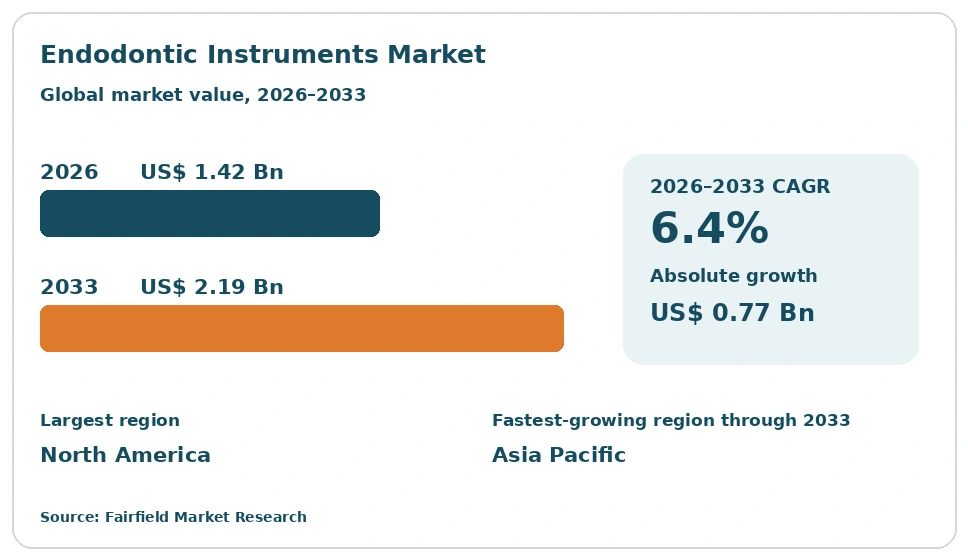
The global endodontic instruments market size is expected to be valued at US$ 1.42 billion in 2026 and projected to reach US$ 2.19 billion by 2033, growing at a CAGR of 6.4% between 2026 and 2033. Growth tracks rising root canal caseloads, wider adoption of nickel-titanium rotary systems, and steady replacement cycles in private dental practice. Demand also reflects the shift from manual filing toward motor-driven, length-controlled workflows across modern operatories. Historical expansion averaged a CAGR of 5.6% between 2020 and 2025, and the forecast window adds an absolute dollar opportunity of US$ 770 million. Spending is broadening beyond mature markets as organized dental chains scale across Asia Pacific.
Key Report Takeaways
- By Product Type: Endodontic files led with 38.6% share in 2026, while endodontic motors and handpieces are projected to expand at a 7.9% CAGR through 2033, driven by practice-level automation of canal shaping and torque control.
- By Application: Primary root canal therapy held 57.3% share in 2026, while endodontic retreatment is set to grow at a 7.6% CAGR through 2033, driven by an ageing base of previously treated teeth.
- By End User: Dental clinics accounted for 61.8% of revenue in 2026, while dental academic and research institutes are forecast to advance at a 7.4% CAGR through 2033, driven by curriculum investment in simulation and preclinical training labs.
- By Sales Channel: Direct sales contributed 44.2% of revenue in 2026, while e-commerce and online retail should rise at an 8.6% CAGR through 2033, driven by subscription-style consumable replenishment among small independent practices.
- By Region: North America held 36.4% share in 2026, followed by Europe at 28.2% and Asia Pacific at 24.1%, while Latin America and Middle East & Africa together held 11.3%; Asia Pacific grows fastest at 8.5% CAGR.
Market Trends and Insights
Market Growth Drivers
Rising Burden of Advanced Caries Sustains Procedure Volumes
Endodontic instrument demand rises in step with the number of teeth clinicians choose to save rather than extract. Tooth-retention preferences, wider dental insurance coverage, and growing out-of-pocket spending in middle-income economies all push more pulpal cases toward root canal therapy. Each case consumes shaping files, irrigation tips and obturation materials, so volume growth converts directly into recurring instrument purchases rather than one-time capital spending. That consumable intensity gives manufacturers a predictable revenue base across economic cycles.
Behind this sits a broader shift in how dentistry is organized. Group practices and corporate dental networks standardize instrument kits across sites, which concentrates purchasing and favours suppliers able to serve multi-location accounts. Dental schools continue to expand enrolment in several markets, seeding familiarity with specific file systems early. Public oral-health programmes in Asia and Latin America also widen access to restorative care, lifting baseline procedure counts.
Shift from Hand Filing to Motor-Driven and Digitally Guided Workflows
Automation is changing what a practice buys, not just how it works. Clinics replacing manual hand filing with torque-controlled motors, integrated apex location and reciprocating systems move from low-cost steel instruments to higher-value device platforms. That raises the average selling price per operatory and creates an installed base that pulls through proprietary file sequences. Vendors therefore compete for the motor placement first, then monetize the consumable stream that follows it over several years.
The enabling trend is wider digital integration across the operatory. Cone-beam imaging, intraoral scanning and practice-management software increasingly share data with chairside devices, encouraging purchases that fit a connected workflow. Nickel-titanium metallurgy and heat-treatment processes have matured enough for manufacturers to differentiate file families by flexibility and fatigue behaviour. Training programmes, hands-on courses and continuing-education credits reinforce adoption by building clinician confidence with newer systems.
Restraints Impact Analysis of Market
Specialist Shortages and Referral Bottlenecks Cap Procedure Throughput
The market is limited less by willingness to buy than by available clinical capacity. Endodontics remains a referral-heavy discipline in many countries, and the number of trained specialists grows slowly relative to population need. Rural and secondary-city catchments often lack any specialist practice at all, so complex cases are extracted rather than treated. Where throughput is constrained, instrument consumption plateaus regardless of how advanced the available systems become.
Workforce economics reinforce the ceiling. Postgraduate endodontic training is long and costly, and graduates concentrate in metropolitan markets where fee levels support the investment. General dentists can absorb some caseload, but many limit themselves to straightforward anterior cases and refer curved or calcified canals onward. Chair-time pressure in high-volume clinics further discourages multi-visit treatment. Reimbursement structures that pay modestly for root canal therapy relative to implants compound the imbalance.
Price Pressure from Generic Instruments and Procurement Consolidation
Margin compression is the most immediate constraint on branded instrument suppliers. Large volumes of unbranded and regionally manufactured files, broaches and accessories now circulate through distributors and online channels at a fraction of premium pricing. Cost-focused clinics in price-sensitive markets switch readily, especially for commodity consumables where perceived differences are small. That pulls down blended average selling prices and forces established vendors to defend value through systems rather than individual items.
Procurement behaviour amplifies the effect. Dental service organizations and hospital groups buy centrally, run competitive tenders and negotiate on landed cost per procedure. Public health systems in Europe and Asia apply similar tendering discipline. At the same time, regulatory expectations under medical-device frameworks raise documentation, traceability and quality-system costs, which fall hardest on mid-sized manufacturers. The result is a widening gap between scale players and smaller specialist brands.
Market Opportunities
Retreatment and Single-Use Instrumentation Open New Revenue Pools
Retreatment is becoming a distinct commercial category rather than an edge case. Decades of root canal therapy have produced a large installed base of previously treated teeth, and a share of those cases eventually return for revision. Revision work uses dedicated removal instruments, ultrasonic tips and retreatment file sequences that sit outside standard shaping kits. Suppliers able to package these as a defined system capture incremental revenue per case without needing new clinical users.
Single-use instrumentation reinforces the same economics. Infection-control expectations and the cost of reprocessing have pushed many practices toward sterile, pre-packaged file sets intended for one patient. That converts a durable good into a consumable and raises units sold per operatory each year. Manufacturers are responding with packaging formats, kitting and replenishment programmes designed around predictable reordering, while distributors build subscription models on top of them.
Emerging-Market Clinic Expansion and Digital Distribution
The clearest volume opportunity lies in fast-urbanizing markets building private dental capacity. Organized clinic chains across Asia Pacific, the Gulf and Latin America are opening operatories at pace, each requiring motors, apex locators and starter instrument inventories. These buyers are value-conscious but brand-aware, which favours tiered portfolios rather than a single premium line. Winning early placements here shapes consumable purchasing for years, giving suppliers a long tail of recurring demand.
Digital distribution lowers the cost of reaching these accounts. Online dental marketplaces and manufacturer web stores now serve independent practices that traditional field sales cannot cover economically. Virtual training, recorded technique libraries and remote product support substitute for in-person demonstration. Local assembly and regional warehousing shorten lead times and reduce import friction. Together these levers make smaller, dispersed accounts commercially viable for the first time.
Category-wise Insights
Which Product Type Leads Endodontic Instrument Demand?
Endodontic files lead the market with a 38.6% share in 2026, reflecting their consumable role in every shaping procedure. Hand and rotary files are purchased repeatedly, so the category tracks procedure volume more closely than any other. Obturation systems follow at 19.4%, supported by steady demand for carrier-based and thermoplastic filling. Endodontic motors and handpieces hold 16.2% but grow fastest at a 7.9% CAGR through 2033, as clinics move to torque-controlled, programmable shaping. Apex locators at 13.5% and irrigation devices and accessories at 12.3% complete the mix. Growth in motors matters strategically because the device placement anchors the file sequence a practice subsequently buys. For suppliers, that makes capital-light instruments the volume base and motorized platforms the lever for share gain.
Primary Treatment Anchors Volume While Retreatment Sets the Growth Pace
Primary root canal therapy accounts for 57.3% of application revenue in 2026, since first-time pulpal treatment remains the dominant case type across general and specialist practice. Endodontic retreatment holds 21.6% but expands fastest at a 7.6% CAGR through 2033, reflecting a maturing population of previously treated teeth. Pulpotomy and vital pulp procedures contribute 12.4%, supported by paediatric caseloads and more conservative management of deep caries. Surgical endodontics represents 8.7%, a smaller but technically demanding niche. The commercial implication is that instrument portfolios built only for initial shaping address a shrinking share of incremental growth. Retreatment and vital pulp work use different tip geometries, ultrasonic accessories and irrigation formats, so suppliers broadening beyond the core file sequence capture more revenue per installed operatory.
Clinic Purchasing Dominates as Teaching Institutions Scale Fastest
Dental clinics generate 61.8% of end-user revenue in 2026, because the majority of root canal treatment is delivered in private and group outpatient settings. Purchasing there is frequent, low-value and strongly influenced by individual clinician preference. Hospitals hold 23.4%, concentrated in markets where public systems or academic medical centres deliver complex and medically compromised cases. Dental academic and research institutes account for 14.8% and grow fastest at a 7.4% CAGR through 2033, as schools expand simulation laboratories and preclinical training capacity. That growth carries influence beyond its size: students trained on a particular motor and file system often reproduce that choice in practice. Suppliers therefore treat institutional placements as long-horizon investments in future clinic demand rather than straightforward volume sales across their core markets.
Direct Accounts Hold Value While Online Ordering Gains Share
Direct sales channels captured 44.2% of revenue in 2026, reflecting the importance of field support, demonstration and training when placing motors and apex locators. Distributors and dental dealers follow at 39.1%, remaining essential for consumable breadth and local credit terms. E-commerce and online retail hold 16.7% but expand fastest at an 8.6% CAGR through 2033, driven by repeat ordering of files and accessories where product choice is already settled. The split is becoming functional rather than competitive: complex equipment moves through direct and dealer relationships, while routine replenishment migrates online. For manufacturers, the practical task is managing price consistency across channels, since visible online pricing constrains what distributors can sustain and reshapes negotiation with larger clinic groups, particularly dental service organizations.
Geography Analysis
Which Region Is Leading the Endodontic Instruments Market?
North America leads with 36.4% share in 2026, supported by high treatment rates, broad dental insurance coverage and strong specialist density. The United States contributes most of the regional total, with Canada adding a smaller but stable base. Consolidation into dental service organizations has standardized equipment purchasing across large clinic networks, accelerating replacement of hand instrumentation with motorized systems. Reimbursement for root canal therapy through employer dental plans keeps procedure volumes resilient, while patient preference for tooth retention supports case acceptance. Device oversight by the U.S. Food and Drug Administration sets clear market-entry expectations that favour established manufacturers with mature quality systems. A dense base of dental schools and continuing-education providers also sustains adoption of newer file and irrigation formats across general practice.
Europe Combines Mature Demand with Strict Device Oversight
Europe holds 28.2% share in 2026, anchored by Germany, France, Italy, the United Kingdom and Spain. Public and statutory health systems fund a substantial part of restorative dentistry, which stabilizes procedure volumes even when private spending softens. The region hosts several long-established instrument manufacturers, so domestic supply and clinician familiarity with European file systems remain strong. Compliance obligations under the European Union Medical Device Regulation have raised documentation and conformity-assessment requirements, lengthening launch timelines and increasing fixed costs for smaller suppliers. Centralized tendering by hospital groups and regional purchasing bodies places continuous pressure on pricing. Growth is therefore driven less by new patient volume than by upgrade cycles, with clinics replacing older motors and adopting single-use file formats to meet infection-control expectations.
Which Region Is Growing Fastest in the Endodontic Instruments Market?
Asia Pacific is growing fastest at an 8.5% CAGR between 2026 and 2033, from a 24.1% share in 2026. China, India, Japan, South Korea and Australia drive most of the expansion. Rising disposable income, rapid growth in organized private clinic chains and expanding dental school capacity together lift both procedure volumes and equipment purchasing. Domestic manufacturing in China and India has widened access to affordable files and motors, pulling first-time buyers into motorized workflows. Urbanization and greater awareness of tooth retention shift demand away from extraction toward restorative treatment. Regulatory systems are also maturing, with clearer device registration pathways improving import predictability. Medical tourism in Thailand, Malaysia and India adds a further layer of demand for well-equipped operatories.
Private Clinic Networks Drive Latin American Uptake
Latin America accounts for 6.8% share in 2026, with Brazil and Mexico supplying most regional revenue, followed by Argentina, Colombia and Chile. Brazil combines a large dental workforce, an established domestic manufacturing base and high per-capita dentist density, which supports broad instrument consumption. Private clinic networks and franchised dental chains have expanded access to affordable root canal treatment among middle-income patients. Cross-border dental tourism into Mexico sustains demand for modern equipment in border cities. Currency volatility and import duties remain practical constraints, pushing purchasing toward locally produced consumables and value-tier motors. Public oral-health programmes provide a slow but steady floor for procedure volumes, while financing schemes offered at the clinic level help patients spread treatment costs.
Gulf Investment and Urban Clinic Growth Shape Middle East & Africa
Middle East & Africa holds 4.5% share in 2026, the smallest regional position but one with visible upgrade activity. Saudi Arabia, the United Arab Emirates, Qatar, South Africa and Egypt account for most spending. Gulf states continue to fund hospital and specialty clinic construction under national health-transformation agendas, creating demand for fully equipped endodontic operatories. Private providers competing for insured and expatriate patients invest in motorized systems to differentiate their service offering. Across much of sub-Saharan Africa, limited specialist availability and constrained public budgets keep treatment rates low, so extraction remains common. Import dependence, distribution gaps and foreign-exchange constraints further restrict uptake. Growth is therefore concentrated in a handful of urban markets rather than spread evenly across the region.
Competitive Landscape
The endodontic instruments market is moderately concentrated. A small group of global dental device manufacturers holds the majority of branded revenue, while a long tail of regional specialists and private-label producers competes on price in consumables. Positioning divides broadly between full-line dental companies that bundle endodontics into wider portfolios and focused endodontic specialists that build depth in file metallurgy and motor design. Consolidation has been steady rather than dramatic, usually taking the form of larger groups absorbing niche instrument brands.
Competition centres on the instrument system rather than the individual item. Vendors differentiate through file design philosophy, heat-treatment and alloy processing, motor control electronics, integrated apex location and the breadth of matching obturation and irrigation accessories. Sterile, single-use packaging has become a competitive requirement in several markets. Newer entrants from Asia compete mainly on cost and distribution reach, which pressures mid-tier pricing and pushes established brands toward system selling, clinician education and workflow integration.
Strategic activity concentrates on portfolio breadth, channel control and manufacturing capability. Companies invest in precision machining and surface-treatment capacity because process control underpins file consistency at scale. Education programmes, hands-on training centres and digital technique libraries function as commercial infrastructure, building preference before a purchase decision. Regional manufacturing and distribution agreements reduce lead times and tariff exposure in growth markets.
Competitive direction is shifting from instrument sales toward operatory relationships. Suppliers that connect motors, imaging data and replenishment into a coherent workflow gain recurring revenue and switching resistance. Regulatory burden continues to favour organizations with established quality systems, while channel economics increasingly reward those able to serve both large clinic groups and dispersed independent practices.
Industry Leaders
- Dentsply Sirona Inc.
- Coltene Holding AG
- Kerr Corporation
- Mani, Inc.
- FKG Dentaire SA
- Micro-Mega SAS
- J. Morita Corporation
- Ultradent Products, Inc.
Companies Covered in the Report
- Dentsply Sirona Inc.
- Coltene Holding AG
- Kerr Corporation
- Mani, Inc.
- FKG Dentaire SA
- Micro-Mega SAS
- J. Morita Corporation
- Ultradent Products, Inc.
- VDW GmbH
- Brasseler USA
- Ivoclar Vivadent AG
- NSK Nakanishi Inc.
- Septodont Holding
- DiaDent Group International
- Prevest DenPro Limited
- Shofu Inc.
- W&H Dentalwerk Bürmoos GmbH
Endodontic Instruments Market Report Scope
The market is segmented by product type, application, end user, sales channel and region.
| By Product Type | Endodontic files (hand and rotary), Obturation systems, Endodontic motors and handpieces, Apex locators, Irrigation devices and accessories |
| By Application | Primary root canal therapy, Endodontic retreatment, Pulpotomy and vital pulp procedures, Surgical endodontics |
| By End User | Dental clinics, Hospitals, Dental academic and research institutes |
| By Sales Channel | Direct sales, Distributors and dental dealers, E-commerce and online retail |
| By Region | North America, Europe, Asia Pacific, Latin America, Middle East & Africa |
1. Executive Summary
1.1 Endodontic Instruments Market Snapshot
1.2 Future Projections
1.3 Key Market Trends
1.4 Regional Snapshot
2. Market Overview
2.1 Market Definition and Report Scope
2.2 Historical Market Trends
2.3 Market Dynamics
2.3.1 Drivers
2.3.1.1 Rising Burden of Advanced Caries Sustains Procedure Volumes
2.3.1.2 Shift from Hand Filing to Motor-Driven and Digitally Guided Workflows
2.3.2 Restraints
2.3.2.1 Specialist Shortages and Referral Bottlenecks Cap Procedure Throughput
2.3.2.2 Price Pressure from Generic Instruments and Procurement Consolidation
2.3.3 Market Opportunities
2.3.3.1 Retreatment and Single-Use Instrumentation Open New Revenue Pools
2.3.3.2 Emerging-Market Clinic Expansion and Digital Distribution
3. Global Endodontic Instruments Market Outlook, 2026–2033
3.1 Global Endodontic Instruments Market Outlook, by Product Type, Value (US$ Billion), 2026–2033
3.1.1 Endodontic files (hand and rotary)
3.1.2 Obturation systems
3.1.3 Endodontic motors and handpieces
3.1.4 Apex locators
3.1.5 Irrigation devices and accessories
3.2 Global Endodontic Instruments Market Outlook, by Application, Value (US$ Billion), 2026–2033
3.2.1 Primary root canal therapy
3.2.2 Endodontic retreatment
3.2.3 Pulpotomy and vital pulp procedures
3.2.4 Surgical endodontics
3.3 Global Endodontic Instruments Market Outlook, by End User, Value (US$ Billion), 2026–2033
3.3.1 Dental clinics
3.3.2 Hospitals
3.3.3 Dental academic and research institutes
3.4 Global Endodontic Instruments Market Outlook, by Sales Channel, Value (US$ Billion), 2026–2033
3.4.1 Direct sales
3.4.2 Distributors and dental dealers
3.4.3 E-commerce and online retail
3.5 Global Endodontic Instruments Market Outlook, by Region, Value (US$ Billion), 2026–2033
3.5.1 North America
3.5.2 Europe
3.5.3 Asia Pacific
3.5.4 Latin America
3.5.5 Middle East & Africa
4. North America Endodontic Instruments Market Outlook, 2026–2033
4.1 North America Endodontic Instruments Market Outlook, by Product Type, Value (US$ Billion), 2026–2033
4.1.1 Endodontic files (hand and rotary)
4.1.2 Obturation systems
4.1.3 Endodontic motors and handpieces
4.1.4 Apex locators
4.1.5 Irrigation devices and accessories
4.2 North America Endodontic Instruments Market Outlook, by Application, Value (US$ Billion), 2026–2033
4.2.1 Primary root canal therapy
4.2.2 Endodontic retreatment
4.2.3 Pulpotomy and vital pulp procedures
4.2.4 Surgical endodontics
4.3 North America Endodontic Instruments Market Outlook, by End User, Value (US$ Billion), 2026–2033
4.3.1 Dental clinics
4.3.2 Hospitals
4.3.3 Dental academic and research institutes
4.4 North America Endodontic Instruments Market Outlook, by Sales Channel, Value (US$ Billion), 2026–2033
4.4.1 Direct sales
4.4.2 Distributors and dental dealers
4.4.3 E-commerce and online retail
4.5 North America Endodontic Instruments Market Outlook, by Country, Value (US$ Billion), 2026–2033
4.5.1 United States Endodontic Instruments Market Outlook, by Product Type, 2026–2033
4.5.2 United States Endodontic Instruments Market Outlook, by Application, 2026–2033
4.5.3 United States Endodontic Instruments Market Outlook, by End User, 2026–2033
4.5.4 United States Endodontic Instruments Market Outlook, by Sales Channel, 2026–2033
4.5.5 Canada Endodontic Instruments Market Outlook, by Product Type, 2026–2033
4.5.6 Canada Endodontic Instruments Market Outlook, by Application, 2026–2033
4.5.7 Canada Endodontic Instruments Market Outlook, by End User, 2026–2033
4.5.8 Canada Endodontic Instruments Market Outlook, by Sales Channel, 2026–2033
5. Europe Endodontic Instruments Market Outlook, 2026–2033
5.1 Europe Endodontic Instruments Market Outlook, by Product Type, Value (US$ Billion), 2026–2033
5.1.1 Endodontic files (hand and rotary)
5.1.2 Obturation systems
5.1.3 Endodontic motors and handpieces
5.1.4 Apex locators
5.1.5 Irrigation devices and accessories
5.2 Europe Endodontic Instruments Market Outlook, by Application, Value (US$ Billion), 2026–2033
5.2.1 Primary root canal therapy
5.2.2 Endodontic retreatment
5.2.3 Pulpotomy and vital pulp procedures
5.2.4 Surgical endodontics
5.3 Europe Endodontic Instruments Market Outlook, by End User, Value (US$ Billion), 2026–2033
5.3.1 Dental clinics
5.3.2 Hospitals
5.3.3 Dental academic and research institutes
5.4 Europe Endodontic Instruments Market Outlook, by Sales Channel, Value (US$ Billion), 2026–2033
5.4.1 Direct sales
5.4.2 Distributors and dental dealers
5.4.3 E-commerce and online retail
5.5 Europe Endodontic Instruments Market Outlook, by Country, Value (US$ Billion), 2026–2033
5.5.1 Germany Endodontic Instruments Market Outlook, by Product Type, 2026–2033
5.5.2 Germany Endodontic Instruments Market Outlook, by Application, 2026–2033
5.5.3 Germany Endodontic Instruments Market Outlook, by End User, 2026–2033
5.5.4 Germany Endodontic Instruments Market Outlook, by Sales Channel, 2026–2033
5.5.5 France Endodontic Instruments Market Outlook, by Product Type, 2026–2033
5.5.6 France Endodontic Instruments Market Outlook, by Application, 2026–2033
5.5.7 France Endodontic Instruments Market Outlook, by End User, 2026–2033
5.5.8 France Endodontic Instruments Market Outlook, by Sales Channel, 2026–2033
5.5.9 Italy Endodontic Instruments Market Outlook, by Product Type, 2026–2033
5.5.10 Italy Endodontic Instruments Market Outlook, by Application, 2026–2033
5.5.11 Italy Endodontic Instruments Market Outlook, by End User, 2026–2033
5.5.12 Italy Endodontic Instruments Market Outlook, by Sales Channel, 2026–2033
5.5.13 United Kingdom Endodontic Instruments Market Outlook, by Product Type, 2026–2033
5.5.14 United Kingdom Endodontic Instruments Market Outlook, by Application, 2026–2033
5.5.15 United Kingdom Endodontic Instruments Market Outlook, by End User, 2026–2033
5.5.16 United Kingdom Endodontic Instruments Market Outlook, by Sales Channel, 2026–2033
5.5.17 Spain Endodontic Instruments Market Outlook, by Product Type, 2026–2033
5.5.18 Spain Endodontic Instruments Market Outlook, by Application, 2026–2033
5.5.19 Spain Endodontic Instruments Market Outlook, by End User, 2026–2033
5.5.20 Spain Endodontic Instruments Market Outlook, by Sales Channel, 2026–2033
6. Asia Pacific Endodontic Instruments Market Outlook, 2026–2033
6.1 Asia Pacific Endodontic Instruments Market Outlook, by Product Type, Value (US$ Billion), 2026–2033
6.1.1 Endodontic files (hand and rotary)
6.1.2 Obturation systems
6.1.3 Endodontic motors and handpieces
6.1.4 Apex locators
6.1.5 Irrigation devices and accessories
6.2 Asia Pacific Endodontic Instruments Market Outlook, by Application, Value (US$ Billion), 2026–2033
6.2.1 Primary root canal therapy
6.2.2 Endodontic retreatment
6.2.3 Pulpotomy and vital pulp procedures
6.2.4 Surgical endodontics
6.3 Asia Pacific Endodontic Instruments Market Outlook, by End User, Value (US$ Billion), 2026–2033
6.3.1 Dental clinics
6.3.2 Hospitals
6.3.3 Dental academic and research institutes
6.4 Asia Pacific Endodontic Instruments Market Outlook, by Sales Channel, Value (US$ Billion), 2026–2033
6.4.1 Direct sales
6.4.2 Distributors and dental dealers
6.4.3 E-commerce and online retail
6.5 Asia Pacific Endodontic Instruments Market Outlook, by Country, Value (US$ Billion), 2026–2033
6.5.1 China Endodontic Instruments Market Outlook, by Product Type, 2026–2033
6.5.2 China Endodontic Instruments Market Outlook, by Application, 2026–2033
6.5.3 China Endodontic Instruments Market Outlook, by End User, 2026–2033
6.5.4 China Endodontic Instruments Market Outlook, by Sales Channel, 2026–2033
6.5.5 India Endodontic Instruments Market Outlook, by Product Type, 2026–2033
6.5.6 India Endodontic Instruments Market Outlook, by Application, 2026–2033
6.5.7 India Endodontic Instruments Market Outlook, by End User, 2026–2033
6.5.8 India Endodontic Instruments Market Outlook, by Sales Channel, 2026–2033
6.5.9 Japan Endodontic Instruments Market Outlook, by Product Type, 2026–2033
6.5.10 Japan Endodontic Instruments Market Outlook, by Application, 2026–2033
6.5.11 Japan Endodontic Instruments Market Outlook, by End User, 2026–2033
6.5.12 Japan Endodontic Instruments Market Outlook, by Sales Channel, 2026–2033
6.5.13 South Korea Endodontic Instruments Market Outlook, by Product Type, 2026–2033
6.5.14 South Korea Endodontic Instruments Market Outlook, by Application, 2026–2033
6.5.15 South Korea Endodontic Instruments Market Outlook, by End User, 2026–2033
6.5.16 South Korea Endodontic Instruments Market Outlook, by Sales Channel, 2026–2033
6.5.17 Australia Endodontic Instruments Market Outlook, by Product Type, 2026–2033
6.5.18 Australia Endodontic Instruments Market Outlook, by Application, 2026–2033
6.5.19 Australia Endodontic Instruments Market Outlook, by End User, 2026–2033
6.5.20 Australia Endodontic Instruments Market Outlook, by Sales Channel, 2026–2033
6.5.21 Thailand Endodontic Instruments Market Outlook, by Product Type, 2026–2033
6.5.22 Thailand Endodontic Instruments Market Outlook, by Application, 2026–2033
6.5.23 Thailand Endodontic Instruments Market Outlook, by End User, 2026–2033
6.5.24 Thailand Endodontic Instruments Market Outlook, by Sales Channel, 2026–2033
6.5.25 Malaysia Endodontic Instruments Market Outlook, by Product Type, 2026–2033
6.5.26 Malaysia Endodontic Instruments Market Outlook, by Application, 2026–2033
6.5.27 Malaysia Endodontic Instruments Market Outlook, by End User, 2026–2033
6.5.28 Malaysia Endodontic Instruments Market Outlook, by Sales Channel, 2026–2033
7. Latin America Endodontic Instruments Market Outlook, 2026–2033
7.1 Latin America Endodontic Instruments Market Outlook, by Product Type, Value (US$ Billion), 2026–2033
7.1.1 Endodontic files (hand and rotary)
7.1.2 Obturation systems
7.1.3 Endodontic motors and handpieces
7.1.4 Apex locators
7.1.5 Irrigation devices and accessories
7.2 Latin America Endodontic Instruments Market Outlook, by Application, Value (US$ Billion), 2026–2033
7.2.1 Primary root canal therapy
7.2.2 Endodontic retreatment
7.2.3 Pulpotomy and vital pulp procedures
7.2.4 Surgical endodontics
7.3 Latin America Endodontic Instruments Market Outlook, by End User, Value (US$ Billion), 2026–2033
7.3.1 Dental clinics
7.3.2 Hospitals
7.3.3 Dental academic and research institutes
7.4 Latin America Endodontic Instruments Market Outlook, by Sales Channel, Value (US$ Billion), 2026–2033
7.4.1 Direct sales
7.4.2 Distributors and dental dealers
7.4.3 E-commerce and online retail
7.5 Latin America Endodontic Instruments Market Outlook, by Country, Value (US$ Billion), 2026–2033
7.5.1 Brazil Endodontic Instruments Market Outlook, by Product Type, 2026–2033
7.5.2 Brazil Endodontic Instruments Market Outlook, by Application, 2026–2033
7.5.3 Brazil Endodontic Instruments Market Outlook, by End User, 2026–2033
7.5.4 Brazil Endodontic Instruments Market Outlook, by Sales Channel, 2026–2033
7.5.5 Mexico Endodontic Instruments Market Outlook, by Product Type, 2026–2033
7.5.6 Mexico Endodontic Instruments Market Outlook, by Application, 2026–2033
7.5.7 Mexico Endodontic Instruments Market Outlook, by End User, 2026–2033
7.5.8 Mexico Endodontic Instruments Market Outlook, by Sales Channel, 2026–2033
7.5.9 Argentina Endodontic Instruments Market Outlook, by Product Type, 2026–2033
7.5.10 Argentina Endodontic Instruments Market Outlook, by Application, 2026–2033
7.5.11 Argentina Endodontic Instruments Market Outlook, by End User, 2026–2033
7.5.12 Argentina Endodontic Instruments Market Outlook, by Sales Channel, 2026–2033
7.5.13 Colombia Endodontic Instruments Market Outlook, by Product Type, 2026–2033
7.5.14 Colombia Endodontic Instruments Market Outlook, by Application, 2026–2033
7.5.15 Colombia Endodontic Instruments Market Outlook, by End User, 2026–2033
7.5.16 Colombia Endodontic Instruments Market Outlook, by Sales Channel, 2026–2033
7.5.17 Chile Endodontic Instruments Market Outlook, by Product Type, 2026–2033
7.5.18 Chile Endodontic Instruments Market Outlook, by Application, 2026–2033
7.5.19 Chile Endodontic Instruments Market Outlook, by End User, 2026–2033
7.5.20 Chile Endodontic Instruments Market Outlook, by Sales Channel, 2026–2033
8. Middle East & Africa Endodontic Instruments Market Outlook, 2026–2033
8.1 Middle East & Africa Endodontic Instruments Market Outlook, by Product Type, Value (US$ Billion), 2026–2033
8.1.1 Endodontic files (hand and rotary)
8.1.2 Obturation systems
8.1.3 Endodontic motors and handpieces
8.1.4 Apex locators
8.1.5 Irrigation devices and accessories
8.2 Middle East & Africa Endodontic Instruments Market Outlook, by Application, Value (US$ Billion), 2026–2033
8.2.1 Primary root canal therapy
8.2.2 Endodontic retreatment
8.2.3 Pulpotomy and vital pulp procedures
8.2.4 Surgical endodontics
8.3 Middle East & Africa Endodontic Instruments Market Outlook, by End User, Value (US$ Billion), 2026–2033
8.3.1 Dental clinics
8.3.2 Hospitals
8.3.3 Dental academic and research institutes
8.4 Middle East & Africa Endodontic Instruments Market Outlook, by Sales Channel, Value (US$ Billion), 2026–2033
8.4.1 Direct sales
8.4.2 Distributors and dental dealers
8.4.3 E-commerce and online retail
8.5 Middle East & Africa Endodontic Instruments Market Outlook, by Country and Subregion, Value (US$ Billion), 2026–2033
8.5.1 Saudi Arabia Endodontic Instruments Market Outlook, by Product Type, 2026–2033
8.5.2 Saudi Arabia Endodontic Instruments Market Outlook, by Application, 2026–2033
8.5.3 Saudi Arabia Endodontic Instruments Market Outlook, by End User, 2026–2033
8.5.4 Saudi Arabia Endodontic Instruments Market Outlook, by Sales Channel, 2026–2033
8.5.5 United Arab Emirates Endodontic Instruments Market Outlook, by Product Type, 2026–2033
8.5.6 United Arab Emirates Endodontic Instruments Market Outlook, by Application, 2026–2033
8.5.7 United Arab Emirates Endodontic Instruments Market Outlook, by End User, 2026–2033
8.5.8 United Arab Emirates Endodontic Instruments Market Outlook, by Sales Channel, 2026–2033
8.5.9 Qatar Endodontic Instruments Market Outlook, by Product Type, 2026–2033
8.5.10 Qatar Endodontic Instruments Market Outlook, by Application, 2026–2033
8.5.11 Qatar Endodontic Instruments Market Outlook, by End User, 2026–2033
8.5.12 Qatar Endodontic Instruments Market Outlook, by Sales Channel, 2026–2033
8.5.13 South Africa Endodontic Instruments Market Outlook, by Product Type, 2026–2033
8.5.14 South Africa Endodontic Instruments Market Outlook, by Application, 2026–2033
8.5.15 South Africa Endodontic Instruments Market Outlook, by End User, 2026–2033
8.5.16 South Africa Endodontic Instruments Market Outlook, by Sales Channel, 2026–2033
8.5.17 Egypt Endodontic Instruments Market Outlook, by Product Type, 2026–2033
8.5.18 Egypt Endodontic Instruments Market Outlook, by Application, 2026–2033
8.5.19 Egypt Endodontic Instruments Market Outlook, by End User, 2026–2033
8.5.20 Egypt Endodontic Instruments Market Outlook, by Sales Channel, 2026–2033
8.5.21 Gulf states Endodontic Instruments Market Outlook, by Product Type, 2026–2033
8.5.22 Gulf states Endodontic Instruments Market Outlook, by Application, 2026–2033
8.5.23 Gulf states Endodontic Instruments Market Outlook, by End User, 2026–2033
8.5.24 Gulf states Endodontic Instruments Market Outlook, by Sales Channel, 2026–2033
9. Competitive Landscape
9.1 Industry Leaders
9.2 Company Profiles
9.2.1 Dentsply Sirona Inc.
9.2.2 Coltene Holding AG
9.2.3 Kerr Corporation
9.2.4 Mani, Inc.
9.2.5 FKG Dentaire SA
9.2.6 Micro-Mega SAS
9.2.7 J. Morita Corporation
9.2.8 Ultradent Products, Inc.
9.2.9 VDW GmbH
9.2.10 Brasseler USA
9.2.11 Ivoclar Vivadent AG
9.2.12 NSK Nakanishi Inc.
9.2.13 Septodont Holding
9.2.14 DiaDent Group International
9.2.15 Prevest DenPro Limited
9.2.16 Shofu Inc.
9.2.17 W&H Dentalwerk Bürmoos GmbH
10. Appendix
10.1 Research Methodology
10.2 Report Assumptions
10.3 Acronyms and Abbreviations
| By Product Type | Endodontic files (hand and rotary), Obturation systems, Endodontic motors and handpieces, Apex locators, Irrigation devices and accessories |
| By Application | Primary root canal therapy, Endodontic retreatment, Pulpotomy and vital pulp procedures, Surgical endodontics |
| By End User | Dental clinics, Hospitals, Dental academic and research institutes |
| By Sales Channel | Direct sales, Distributors and dental dealers, E-commerce and online retail |
| By Region | North America, Europe, Asia Pacific, Latin America, Middle East & Africa |
Our Research Methodology
Considering the volatility of business today, traditional approaches to strategizing a game plan can be unfruitful if not detrimental. True ambiguity is no way to determine a forecast. A myriad of predetermined factors must be accounted for such as the degree of risk involved, the magnitude of circumstances, as well as conditions or consequences that are not known or unpredictable. To circumvent binary views that cast uncertainty, the application of market research intelligence to strategically posture, move, and enable actionable outcomes is necessary.
View Methodology
Quality Assured
Rigorous Validation Process

Confidentiality Assured
End-to-end Data Security

Custom Research Services
Tailored To Your Objectives
FAQs
The global endodontic instruments market is valued at US$ 1.42 billion in 2026, supported by steady root canal procedure volumes across clinics worldwide.
The market is projected to grow at a 6.4% CAGR between 2026 and 2033, reaching US$ 2.19 billion and adding US$ 770 million.
Endodontic files hold the largest share at 38.6% in 2026, while endodontic motors and handpieces grow fastest at a 7.9% CAGR.
North America leads with 36.4% share in 2026, while Asia Pacific grows fastest at an 8.5% CAGR between 2026 and 2033.
Leading suppliers include Dentsply Sirona, Coltene Holding AG, Kerr Corporation, Mani, Inc., FKG Dentaire SA and Micro-Mega SAS, alongside regional instrument manufacturers.
Related Reports
Smart Fertility Trackers Market Size, Share, Insights, Competitive Landscape, and Forecast 2026 to 2033
Explore the smart fertility trackers market, forecast to reach US$3.10 billion by 2033 at 11.8% CAGR, with product, technology, channel, and regional insights.
Blood Transfusion Diagnostics Market Size, Share, Insights, Competitive Landscape, and Forecast 2026 to 2033
Explore the blood transfusion diagnostics market, forecast to reach US$7.4 billion by 2033 at 6.4% CAGR, with insights on products, tests, and regions.
Ankle Splints Market Size, Share, Insights, Competitive Landscape, and Forecast 2026 to 2033
Explore the ankle splints market, forecast to reach US$2.30 billion by 2033 at 6.6% CAGR, with insights on products, applications, channels, and regions.
ACL Reconstruction Market Size, Share, Insights, Competitive Landscape, and Forecast 2026 to 2033
Explore the ACL reconstruction market, forecast to reach US$14.04 billion by 2033 at 6.9% CAGR, with insights on grafts, fixation, end users, and regions.
Stroke Diagnostics and Therapeutics Market Size, Share, Insights, Competitive Landscape, and Forecast 2026 to 2033
Explore the stroke diagnostics and therapeutics market, forecast to reach US$81.70 billion by 2033 at 7.9% CAGR, with insights on types and regions.
IoT Medical Devices Market Size, Share, Insights, Competitive Landscape, and Forecast 2026 to 2033
Explore the IoT medical devices market, forecast to reach US$259.93 billion by 2033 at 18.9% CAGR, with insights on products, connectivity, and regions.