



Micro-LED Displays Market
Micro-LED Displays Market Insights, Competitive Landscape, and Market Forecast - 2033
Global Micro-LED Displays Market Forecast
The Micro-LED Displays Market is expected to grow from USD 3.8 Billion in 2026 to USD 44.5 Billion by 2033, reflecting strong industry expansion and registering a CAGR of 42.1% during the forecast period from 2026 to 2033.
Micro-LED Displays Market Summary: Key Insights & Trends
- Large-scale displays dominate the Micro-LED Displays Market with over half of total share due to wide use in commercial and public installations.
- Micro displays are expanding fastest, supported by AR/VR and smartwatch integration across wearable and automotive applications.
- AR/VR and other specialized applications lead with about 35% share, fueled by immersive content demand and low-latency visuals.
- Smartphones and tablets continue gaining share as high-brightness and foldable micro-LED screens enter premium device portfolios.
- Consumer electronics hold roughly 70% share, driven by strong adoption in TVs, laptops, and smart home devices.
- Automotive displays are rapidly increasing their share through heads-up, dashboard, and in-vehicle infotainment integrations.
- Asia Pacific accounts for about 42% of global share, anchored by China, Japan, and South Korea’s large-scale production capacity.
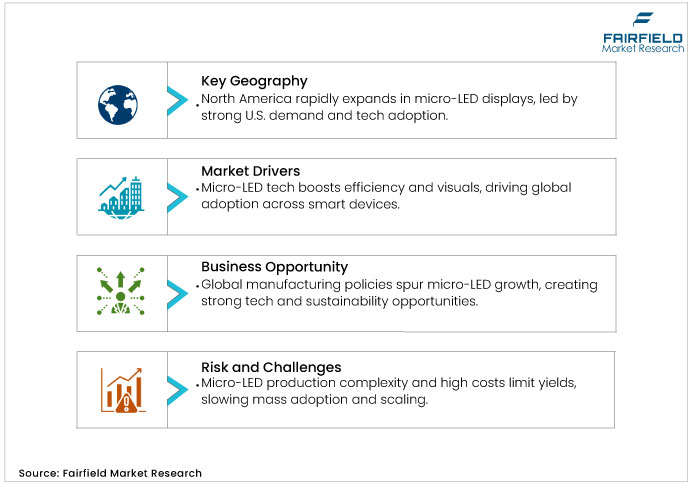
- North America strengthens its position with rising smart-device and home-automation demand, led by U.S. consumer adoption.
Key Growth Drivers
- Cutting-Edge Micro-LED Innovations Redefine Display Efficiency and Visual Performance Globally
Micro-LED technology revolutionizes visual experiences by delivering superior brightness, contrast ratios, and energy efficiency compared to traditional LCD and OLED displays. This innovation stems from self-emissive pixels that eliminate backlighting needs, enabling wider viewing angles and faster response times ideal for dynamic content. Governments worldwide support such progress through policies promoting electronic manufacturing, such as India's National Electronics Policy aiming for substantial domestic output. As consumer demand rises for immersive viewing in smart devices, manufacturers invest in R&D to miniaturize components and improve yield rates, fostering broader adoption across sectors. These advancements not only reduce power consumption but also extend device lifespans, aligning with sustainability goals and driving the Micro-LED Displays Market forward through enhanced user satisfaction and operational efficiencies.
- Growing Consumer Electronics Demand Accelerates Global Adoption of Micro-LED Displays
The surge in discretionary incomes and urban lifestyles propels as consumers seek high-end gadgets with vivid, burn-in-resistant screens. Integration with 5G, IoT, and AI amplifies this trend, enabling seamless connectivity in smart homes and wearables. Industry associations report increased adoption in premium smartphones and TVs, where micro-LED's color gamut outperforms competitors, supported by company filings showing expanded production capacities. This demand encourages alliances for technology sharing, reducing barriers to entry and accelerating market penetration. Ultimately, the focus on eco-friendly, durable displays positions micro-LED as a preferred choice, boosting revenue streams and encouraging innovation in application-specific designs.
Key Restraints
- Complex Production Processes and High Costs Challenge Micro-LED Display Scalability
The intricate manufacturing process of micro-LED displays, involving ultra-precise LED epitaxy, mass transfer, and defect repair, significantly elevates production costs and limits yield efficiency. These technical challenges make large-scale manufacturing difficult, particularly for high-resolution displays. Moreover, fluctuations in semiconductor industry cycles further aggravate the issue by creating supply bottlenecks and inventory imbalances. The lack of established, cost-effective supply chains and automation technologies exposes vendors to operational and financial risks, ultimately hindering the commercialization and mass adoption of micro-LED technology.
- Patent Gaps and Supply Chain Weaknesses Restrict Micro-LED Market Expansion
Incomplete patent landscapes and fragmented intellectual property ownership restrict collaboration and innovation within the micro-LED ecosystem. At the same time, weak integration across supply chain stages—such as wafer fabrication, chip transfer, and panel assembly—creates significant bottlenecks for mass production. Compared to mature LCD or OLED technologies, micro-LED manufacturing demands higher precision and specialized equipment, which amplifies production risks and costs. These inefficiencies not only delay time-to-market but also discourage investment, limiting the pace of market expansion and technology standardization.
Micro-LED Displays Market Trends and Opportunities
- Government Policies and Incentives Accelerate Global Micro-LED Display Development
Opportunities abound in the sector through global policies aimed at revitalizing manufacturing sectors. For instance, national electronics policies target ambitious turnover goals, integrating AI, IoT, and 5G to amplify demand for advanced displays. Justifications include subsidies that lower barriers for R&D, enabling faster prototyping and commercialization. This fosters alliances between governments and industry, creating ecosystems where micro-LEDs enhance smart infrastructure. Emerging trends in sustainable tech further justify expansions, as energy-efficient displays align with green agendas, opening doors to public-private partnerships for widespread deployment.
- Sustainable Innovations Drive New Micro-LED Opportunities Across Emerging Applications
The Micro-LED Displays Market capitalizes on rising preferences for sustainable tech, with low-power designs ideal for eco-conscious consumers in automotive and retail sectors. Opportunities arise from AR/VR expansions, where micro-LEDs' efficiency supports prolonged usage without environmental strain. Justifications encompass trade alliances forming flexible lighting solutions, broadening applications in smart homes and defense. Technological roadmaps predict integrations into VLC for niche areas such as marine exploration, justifying investments in durability enhancements that promise long-term returns.
Segment-wise Trends & Analysis
- Large-Scale Displays Lead Micro-LED Market as Micro Displays Gain Momentum
Large scale displays command over 50% market share in the Micro-LED Displays Market for 2025, reflecting their dominance in commercial installations. These segments lead due to scalability for public venues and advertising, where high brightness ensures visibility in ambient light. Competitors position large scale variants as premium solutions, leveraging modular assembly for custom sizes. Growth trajectory hinges on declining production costs, projected to accelerate adoption in retail and transportation hubs.
Emerging micro displays gain traction in the market as fast-growing segments, driven by AR/VR demands. Their compact size supports portable applications, with underlying drivers including miniaturization advancements. Competitive positioning favors innovators focusing on integration with optics, differentiating through energy efficiency and resolution. This segment's expansion underscores strategic shifts toward wearable tech.
- AR/VR and Smart Devices Drive Rapid Growth in Micro-LED Applications
Other applications hold approximately 35% market share in 2025, encompassing AR/VR and specialized uses. This leading segment thrives on immersive technology needs, where Micro-LEDs provide low latency and high fidelity. Players position these applications as innovative frontiers, capitalizing on consumer trends toward interactive content.
Smartphone and tablet segments emerge rapidly, fueled by demand for high-end devices. Growth drivers include rising disposable incomes and 5G integration, enabling superior visuals. Competitive analysis reveals tech giants leading through R&D, securing advantages in battery life and screen durability.
- Consumer Electronics Dominate While Automotive Emerges as Fast-Growing Micro-LED Vertical
Consumer electronics secured around 70% market share in 2025, dominating due to widespread adoption in home devices. This leading vertical benefits from preferences for energy-efficient screens, with TVs and laptops driving volume. Positioning emphasizes user experience enhancements, such as burn-in resistance.
Automotive emerges as a fast-growing vertical, propelled by electric vehicle trends. Drivers include safety regulations requiring clear interfaces, with competitors integrating displays for heads-up systems. This positions the segment for strategic gains in connected mobility.
Regional Trends & Analysis
North America Emerges as Fast-Growing Hub for Smart Micro-LED Adoption
North America positions itself as a fast-growing/emerging region in the Micro-LED Displays Market, driven by smartphone penetration and smart home ecosystems. Major corporations invest in alliances for automotive integrations, enhancing product features. Rising demand for new electronics fuels this expansion, with the United States accounting for the bulk of consumption.
U.S. Micro-LED Displays Market – 2025 Snapshot & Outlook
Trends in the U.S. market emphasize energy-efficient screens for consumer applications. Drivers include the rapid adoption of smart appliances, supported by government energy standards from the Department of Energy. Margin advantages arise from tax incentives for R&D, positively impacting costs by up to 20%. A consumer survey by Consumer Reports indicates 65% prefer high-brightness displays for TVs. Retail shifts toward online platforms amplify demand.
Policies such as supportive tax credits bolster the U.S. industry, encouraging local manufacturing. Trends show integration in XR devices, with shipments rising 6% in 2025. Government initiatives promote innovation, yielding margin gains through efficiency.
Asia Pacific Dominates Global Micro-LED Market with Strong Manufacturing Base
Asia Pacific holds approximately 42% share in the Micro-LED Displays Market for 2025, leading through technical advancements and investments. Japan, South Korea, and China drive trends with production expansions in smartphones and TVs. Government subsidies in China, such as the Hubei project, enhance capacity. South Korea leaps in IT convergence, while India targets electronics growth via policies.
Japan Micro-LED Displays Market – 2025 Snapshot & Outlook
Japan's market trends toward automotive and consumer integrations, driven by precision engineering. Government investments in next-generation displays provide margin advantages through subsidies, impacting R&D costs favorably. Consumer trends lean toward high-resolution screens, with industry data showing 70% preference for energy-efficient tech. Retail shifts to e-commerce boost accessibility.
Policies in Japan support Micro-LED Displays industry via funding for OLED alternatives, yielding positive tax effects. Trends include transparent displays for AR, enhancing demand. Regulator surveys indicate 60% consumer adoption in wearables. This framework drives sustainable growth.
India Micro-LED Displays Market – 2025 Snapshot & Outlook
India's market trends focus on e-commerce and consumer electronics boom. Drivers encompass national policies targeting US$400 Bn electronics turnover by 2025, offering tax incentives that reduce costs by 15%. Consumer surveys from IBEF reveal 50% favoring premium displays. Retail transitions to digital platforms accelerate adoption.
Government initiatives propel India's industry, with supportive policies enhancing margins. Trends show AV integration in events. Regulator data highlights a sustainable CAGR in e-commerce, driving display needs.
Europe Advances Micro-LED Displays Through Sustainability and Automotive Innovation
Europe advances the Micro-LED Displays Market through emphasis on eco-friendly technologies and automotive applications. Germany leads in precision manufacturing, while the U.K. excels in photonics. Trends include regulatory pushes for energy efficiency, with France contributing via innovation hubs.
Germany Micro-LED Displays Market – 2025 Snapshot & Outlook
Germany's market trends toward automotive displays, driven by EU sustainability mandates. Government policies offer tax rebates, improving margins by 10%. Consumer trends favor efficient lighting, with association data showing 80% preference for LED tech. Retail shifts to integrated systems enhance demand.
Supportive frameworks in Germany boost via R&D grants. Trends include photonics resurgence. Regulator surveys indicate 70% adoption in vehicles.
U.K. Micro-LED Displays Market – 2025 Snapshot & Outlook
U.K. trends in market highlight photonics growth, driven by £18.5 Bn industry contribution. Policies provide tax incentives, aiding margins. Consumer preferences shift to high-productivity tech, with 101,000 GBP per employee. Government support accelerates the U.K. market, with trends in AR displays. Association data shows resurgence in markets.
Prominent Players in Global Micro-LED Displays Market
• Samsung Electronics
• LG Display
• Sony Corporation
• BOE Technology Group
• TCL
• Sharp Corporation
• Apple, Inc.
• Innolux
• AUO Corporation
• PlayNitride
The Global Micro Led Displays Market is Segmented as Below
By Technology
• Active Matrix Micro LED
• Passive Matrix Micro LED
• Reflective Micro LED
• Transparent Micro LED
By Application
• Micro LED TVs
• Wearable Displays
• Smartphone & Tablet Displays
• Automotive Displays
By End User
• Residential
• Commercial
• Healthcare
• Industrial
By Region
• North America
• Europe
• Asia Pacific
• Latin America
• Middle East & Africa
- Executive Summary
- Global Micro-LED Displays Market Snapshot
- Future Projections
- Key Market Trends
- Regional Snapshot, by Value, 2026
- Analyst Recommendations
- Market Overview
- Market Definitions and Segmentations
- Market Dynamics
- Drivers
- Restraints
- Market Opportunities
- Value Chain Analysis
- COVID-19 Impact Analysis
- Porter's Five Forces Analysis
- Impact of Russia-Ukraine Conflict
- PESTLE Analysis
- Regulatory Analysis
- Price Trend Analysis
- Current Prices and Future Projections, 2025-2033
- Price Impact Factors
- Global Micro-LED Displays Market Outlook, 2020 - 2033
- Global Micro-LED Displays Market Outlook, By Technology, Value (US$ Bn), 2020-2033
- Active Matrix Micro LED
- Passive Matrix Micro LED
- Reflective Micro LED
- Transparent Micro LED
- Global Micro-LED Displays Market Outlook, By Application, Value (US$ Bn), 2020-2033
- Micro LED TVs
- Wearable Displays
- Smartphone & Tablet Displays
- Automotive Displays
- Global Micro-LED Displays Market Outlook, by Automotive Displays, Value (US$ Bn), 2020-2033
- Residential
- Commercial
- Healthcare
- Industrial
- Global Micro-LED Displays Market Outlook, by Region, Value (US$ Bn), 2020-2033
- North America
- Europe
- Asia Pacific
- Latin America
- Middle East & Africa
- Global Micro-LED Displays Market Outlook, By Technology, Value (US$ Bn), 2020-2033
- North America Micro-LED Displays Market Outlook, 2020 - 2033
- North America Micro-LED Displays Market Outlook, By Technology, Value (US$ Bn), 2020-2033
- Active Matrix Micro LED
- Passive Matrix Micro LED
- Reflective Micro LED
- Transparent Micro LED
- North America Micro-LED Displays Market Outlook, By Application, Value (US$ Bn), 2020-2033
- Micro LED TVs
- Wearable Displays
- Smartphone & Tablet Displays
- Automotive Displays
- North America Micro-LED Displays Market Outlook, by Automotive Displays, Value (US$ Bn), 2020-2033
- Residential
- Commercial
- Healthcare
- Industrial
- North America Micro-LED Displays Market Outlook, by Country, Value (US$ Bn), 2020-2033
- U.S. Micro-LED Displays Market Outlook, By Technology, 2020-2033
- U.S. Micro-LED Displays Market Outlook, By Application, 2020-2033
- U.S. Micro-LED Displays Market Outlook, by Automotive Displays, 2020-2033
- Canada Micro-LED Displays Market Outlook, By Technology, 2020-2033
- Canada Micro-LED Displays Market Outlook, By Application, 2020-2033
- Canada Micro-LED Displays Market Outlook, by Automotive Displays, 2020-2033
- BPS Analysis/Market Attractiveness Analysis
- North America Micro-LED Displays Market Outlook, By Technology, Value (US$ Bn), 2020-2033
- Europe Micro-LED Displays Market Outlook, 2020 - 2033
- Europe Micro-LED Displays Market Outlook, By Technology, Value (US$ Bn), 2020-2033
- Active Matrix Micro LED
- Passive Matrix Micro LED
- Reflective Micro LED
- Transparent Micro LED
- Europe Micro-LED Displays Market Outlook, By Application, Value (US$ Bn), 2020-2033
- Micro LED TVs
- Wearable Displays
- Smartphone & Tablet Displays
- Automotive Displays
- Europe Micro-LED Displays Market Outlook, by Automotive Displays, Value (US$ Bn), 2020-2033
- Residential
- Commercial
- Healthcare
- Industrial
- Europe Micro-LED Displays Market Outlook, by Country, Value (US$ Bn), 2020-2033
- Germany Micro-LED Displays Market Outlook, By Technology, 2020-2033
- Germany Micro-LED Displays Market Outlook, By Application, 2020-2033
- Germany Micro-LED Displays Market Outlook, by Automotive Displays, 2020-2033
- Italy Micro-LED Displays Market Outlook, By Technology, 2020-2033
- Italy Micro-LED Displays Market Outlook, By Application, 2020-2033
- Italy Micro-LED Displays Market Outlook, by Automotive Displays, 2020-2033
- France Micro-LED Displays Market Outlook, By Technology, 2020-2033
- France Micro-LED Displays Market Outlook, By Application, 2020-2033
- France Micro-LED Displays Market Outlook, by Automotive Displays, 2020-2033
- U.K. Micro-LED Displays Market Outlook, By Technology, 2020-2033
- U.K. Micro-LED Displays Market Outlook, By Application, 2020-2033
- U.K. Micro-LED Displays Market Outlook, by Automotive Displays, 2020-2033
- Spain Micro-LED Displays Market Outlook, By Technology, 2020-2033
- Spain Micro-LED Displays Market Outlook, By Application, 2020-2033
- Spain Micro-LED Displays Market Outlook, by Automotive Displays, 2020-2033
- Russia Micro-LED Displays Market Outlook, By Technology, 2020-2033
- Russia Micro-LED Displays Market Outlook, By Application, 2020-2033
- Russia Micro-LED Displays Market Outlook, by Automotive Displays, 2020-2033
- Rest of Europe Micro-LED Displays Market Outlook, By Technology, 2020-2033
- Rest of Europe Micro-LED Displays Market Outlook, By Application, 2020-2033
- Rest of Europe Micro-LED Displays Market Outlook, by Automotive Displays, 2020-2033
- BPS Analysis/Market Attractiveness Analysis
- Europe Micro-LED Displays Market Outlook, By Technology, Value (US$ Bn), 2020-2033
- Asia Pacific Micro-LED Displays Market Outlook, 2020 - 2033
- Asia Pacific Micro-LED Displays Market Outlook, By Technology, Value (US$ Bn), 2020-2033
- Active Matrix Micro LED
- Passive Matrix Micro LED
- Reflective Micro LED
- Transparent Micro LED
- Asia Pacific Micro-LED Displays Market Outlook, By Application, Value (US$ Bn), 2020-2033
- Micro LED TVs
- Wearable Displays
- Smartphone & Tablet Displays
- Automotive Displays
- Asia Pacific Micro-LED Displays Market Outlook, by Automotive Displays, Value (US$ Bn), 2020-2033
- Residential
- Commercial
- Healthcare
- Industrial
- Asia Pacific Micro-LED Displays Market Outlook, by Country, Value (US$ Bn), 2020-2033
- China Micro-LED Displays Market Outlook, By Technology, 2020-2033
- China Micro-LED Displays Market Outlook, By Application, 2020-2033
- China Micro-LED Displays Market Outlook, by Automotive Displays, 2020-2033
- Japan Micro-LED Displays Market Outlook, By Technology, 2020-2033
- Japan Micro-LED Displays Market Outlook, By Application, 2020-2033
- Japan Micro-LED Displays Market Outlook, by Automotive Displays, 2020-2033
- South Korea Micro-LED Displays Market Outlook, By Technology, 2020-2033
- South Korea Micro-LED Displays Market Outlook, By Application, 2020-2033
- South Korea Micro-LED Displays Market Outlook, by Automotive Displays, 2020-2033
- India Micro-LED Displays Market Outlook, By Technology, 2020-2033
- India Micro-LED Displays Market Outlook, By Application, 2020-2033
- India Micro-LED Displays Market Outlook, by Automotive Displays, 2020-2033
- Southeast Asia Micro-LED Displays Market Outlook, By Technology, 2020-2033
- Southeast Asia Micro-LED Displays Market Outlook, By Application, 2020-2033
- Southeast Asia Micro-LED Displays Market Outlook, by Automotive Displays, 2020-2033
- Rest of SAO Micro-LED Displays Market Outlook, By Technology, 2020-2033
- Rest of SAO Micro-LED Displays Market Outlook, By Application, 2020-2033
- Rest of SAO Micro-LED Displays Market Outlook, by Automotive Displays, 2020-2033
- BPS Analysis/Market Attractiveness Analysis
- Asia Pacific Micro-LED Displays Market Outlook, By Technology, Value (US$ Bn), 2020-2033
- Latin America Micro-LED Displays Market Outlook, 2020 - 2033
- Latin America Micro-LED Displays Market Outlook, By Technology, Value (US$ Bn), 2020-2033
- Active Matrix Micro LED
- Passive Matrix Micro LED
- Reflective Micro LED
- Transparent Micro LED
- Latin America Micro-LED Displays Market Outlook, By Application, Value (US$ Bn), 2020-2033
- Micro LED TVs
- Wearable Displays
- Smartphone & Tablet Displays
- Automotive Displays
- Latin America Micro-LED Displays Market Outlook, by Automotive Displays, Value (US$ Bn), 2020-2033
- Residential
- Commercial
- Healthcare
- Industrial
- Latin America Micro-LED Displays Market Outlook, by Country, Value (US$ Bn), 2020-2033
- Brazil Micro-LED Displays Market Outlook, By Technology, 2020-2033
- Brazil Micro-LED Displays Market Outlook, By Application, 2020-2033
- Brazil Micro-LED Displays Market Outlook, by Automotive Displays, 2020-2033
- Mexico Micro-LED Displays Market Outlook, By Technology, 2020-2033
- Mexico Micro-LED Displays Market Outlook, By Application, 2020-2033
- Mexico Micro-LED Displays Market Outlook, by Automotive Displays, 2020-2033
- Argentina Micro-LED Displays Market Outlook, By Technology, 2020-2033
- Argentina Micro-LED Displays Market Outlook, By Application, 2020-2033
- Argentina Micro-LED Displays Market Outlook, by Automotive Displays, 2020-2033
- Rest of LATAM Micro-LED Displays Market Outlook, By Technology, 2020-2033
- Rest of LATAM Micro-LED Displays Market Outlook, By Application, 2020-2033
- Rest of LATAM Micro-LED Displays Market Outlook, by Automotive Displays, 2020-2033
- BPS Analysis/Market Attractiveness Analysis
- Latin America Micro-LED Displays Market Outlook, By Technology, Value (US$ Bn), 2020-2033
- Middle East & Africa Micro-LED Displays Market Outlook, 2020 - 2033
- Middle East & Africa Micro-LED Displays Market Outlook, By Technology, Value (US$ Bn), 2020-2033
- Active Matrix Micro LED
- Passive Matrix Micro LED
- Reflective Micro LED
- Transparent Micro LED
- Middle East & Africa Micro-LED Displays Market Outlook, By Application, Value (US$ Bn), 2020-2033
- Micro LED TVs
- Wearable Displays
- Smartphone & Tablet Displays
- Automotive Displays
- Middle East & Africa Micro-LED Displays Market Outlook, by Automotive Displays, Value (US$ Bn), 2020-2033
- Residential
- Commercial
- Healthcare
- Industrial
- Middle East & Africa Micro-LED Displays Market Outlook, by Country, Value (US$ Bn), 2020-2033
- GCC Micro-LED Displays Market Outlook, By Technology, 2020-2033
- GCC Micro-LED Displays Market Outlook, By Application, 2020-2033
- GCC Micro-LED Displays Market Outlook, by Automotive Displays, 2020-2033
- South Africa Micro-LED Displays Market Outlook, By Technology, 2020-2033
- South Africa Micro-LED Displays Market Outlook, By Application, 2020-2033
- South Africa Micro-LED Displays Market Outlook, by Automotive Displays, 2020-2033
- Egypt Micro-LED Displays Market Outlook, By Technology, 2020-2033
- Egypt Micro-LED Displays Market Outlook, By Application, 2020-2033
- Egypt Micro-LED Displays Market Outlook, by Automotive Displays, 2020-2033
- Nigeria Micro-LED Displays Market Outlook, By Technology, 2020-2033
- Nigeria Micro-LED Displays Market Outlook, By Application, 2020-2033
- Nigeria Micro-LED Displays Market Outlook, by Automotive Displays, 2020-2033
- Rest of Middle East Micro-LED Displays Market Outlook, By Technology, 2020-2033
- Rest of Middle East Micro-LED Displays Market Outlook, By Application, 2020-2033
- Rest of Middle East Micro-LED Displays Market Outlook, by Automotive Displays, 2020-2033
- BPS Analysis/Market Attractiveness Analysis
- Middle East & Africa Micro-LED Displays Market Outlook, By Technology, Value (US$ Bn), 2020-2033
- Competitive Landscape
- Company Vs Segment Heatmap
- Company Market Share Analysis, 2025
- Competitive Dashboard
- Company Profiles
- Samsung Electronics
- Company Overview
- Product Portfolio
- Financial Overview
- Business Strategies and Developments
- LG Display
- Sony Corporation
- BOE Technology Group
- TCL
- Sharp Corporation
- Apple, Inc.
- Innolux
- AUO Corporation
- PlayNitride
- Samsung Electronics
- Appendix
- Research Methodology
- Report Assumptions
- Acronyms and Abbreviations
|
BASE YEAR |
HISTORICAL DATA |
FORECAST PERIOD |
UNITS |
|||
 |
2025 |
 |
2020 - 2025 |
 |
2026 - 2033 |
Value: US$ Billion Volume: Tons |
|
REPORT FEATURES |
DETAILS |
|
Product Coverage |
|
|
Application Coverage |
|
|
Industry Vertical Coverage |
|
|
Geographical Coverage |
|
|
Leading Companies |
|
|
Report Highlights |
Key Market Indicators, Macro-micro economic impact analysis, Technological Roadmap, Key Trends, Driver, Restraints, and Future Opportunities & Revenue Pockets, Porter’s 5 Forces Analysis, Historical Trend (2019-2021), Price Trend Analysis, Market Estimates and Forecast, Market Dynamics, Industry Trends, Competition Landscape, Category, Region, Country-wise Trends & Analysis, COVID-19 Impact Analysis (Demand and Supply Chain) |
Our Research Methodology
Considering the volatility of business today, traditional approaches to strategizing a game plan can be unfruitful if not detrimental. True ambiguity is no way to determine a forecast. A myriad of predetermined factors must be accounted for such as the degree of risk involved, the magnitude of circumstances, as well as conditions or consequences that are not known or unpredictable. To circumvent binary views that cast uncertainty, the application of market research intelligence to strategically posture, move, and enable actionable outcomes is necessary.
View Methodology
Quality Assured
Rigorous Validation Process

Confidentiality Assured
End-to-end Data Security

Custom Research Services
Tailored To Your Objectives
FAQs
The Micro-LED Displays market size is USD 3.8 billion in 2026.
The Micro-LED Displays market is projected to grow at a 42.1% CAGR by 2033.
The Micro-LED Displays market growth drivers include superior brightness and energy efficiency, rising demand for premium consumer electronics, and expanding AR/VR and automotive display adoption.
Asia Pacific is a dominant region for the Micro-LED Displays market.
Samsung Electronics, LG Display, Sony Corporation, BOE Technology Group, and Apple Inc. are some leading industry players in the Micro LED Displays market.
Related Reports
Smart Water Management Market Size, Share, Insights, Competitive Landscape, and Forecast 2026 to 2033
Explore the smart water management market, reaching US$ 45.2 billion by 2033 at 11.0% CAGR, with solution, regional and competitive insights.
Infusion Pump Software Market Size, Share, Insights, Competitive Landscape, and Forecast 2026 to 2033
Explore the infusion pump software market, reaching US$ 2.4 billion by 2033 at 10.4% CAGR, with software, regional and competitive insights.
Database Security Market Size, Share, Insights, Competitive Landscape, and Forecast 2026 to 2033
Explore the database security market, reaching US$ 28.5 billion by 2033 at 14.3% CAGR, with offering, regional and competitive insights.
Smart Home Appliances Market Size, Share, Insights, Competitive Landscape, and Forecast 2026 to 2033
Explore the smart home appliances market, reaching US$ 113.0 billion by 2033 at 13.0% CAGR, with product, regional and competitive insights.
Smart Cities Market Size, Share, Insights, Competitive Landscape, and Forecast 2026 to 2033
Explore the smart cities market, reaching US$ 420.0 billion by 2033 at 12.7% CAGR, with solution, regional and competitive insights.
Industrial Robotics Market Size, Share, Insights, Competitive Landscape, and Forecast 2026 to 2033
Explore the industrial robotics market, reaching US$ 95.0 billion by 2033 at 8.4% CAGR, with robot types, regional and competitive insights.