



Mobile Wallet Market
Mobile Wallet Market Size, Share, Insights, Competitive Landscape, and Forecast 2026 to 2033
Mobile Wallet Market Size and Trend Analysis
How Fast Is the Mobile Wallet Market Growing?
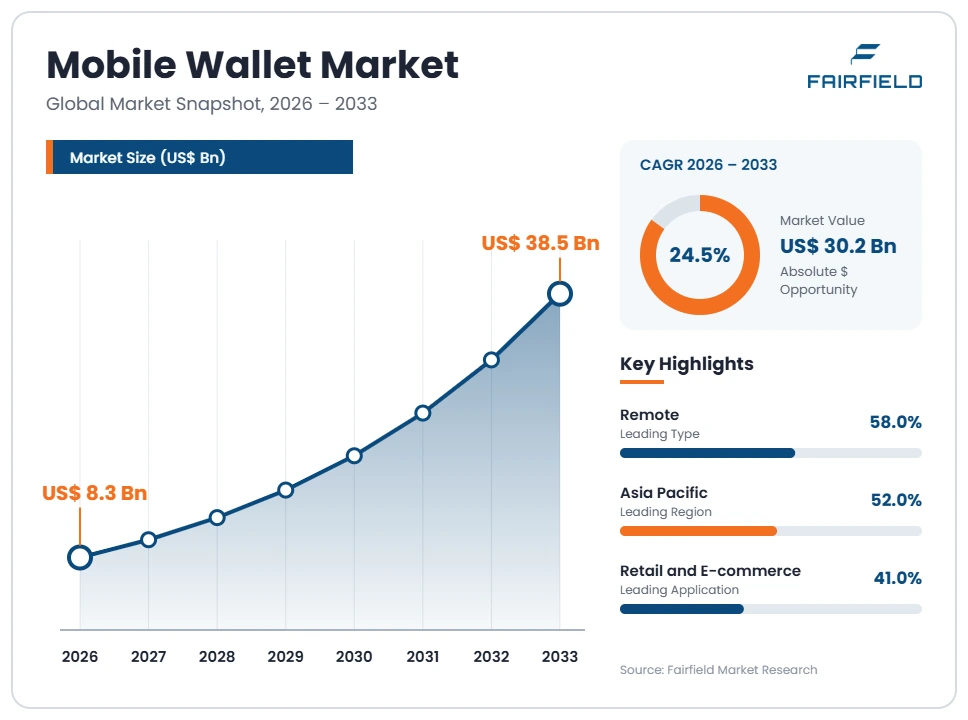
The global mobile wallet market size is expected to be valued at US$ 8.30 billion in 2026 and projected to reach US$ 38.50 billion by 2033, growing at a CAGR of 24.5% between 2026 and 2033.
Between 2020 and 2025, the market grew at a CAGR of about 22.8%, as the pandemic pushed consumers and merchants toward contactless payments in 2020, then smartphone adoption, real-time payment systems, and QR codes made mobile wallets an everyday habit in many countries. The mobile wallet market covers apps and services on smartphones and wearables that store payment cards, bank accounts, and balances, letting users pay in stores, online, and to other people. It includes proximity wallets that use NFC or QR codes at checkout, and remote wallets used for e-commerce, bills, transfers, and app purchases. Leading digital wallets include Apple Pay, Google Pay, Samsung Wallet, PayPal, Alipay, WeChat Pay, Paytm, PhonePe, Cash App, and Amazon Pay. Growth comes from smartphones, instant payment rails, and financial inclusion. In September 2026, Apple Pay launched in India with Axis Bank.
Key Report Takeaways
- By Type: Remote held about 58% share in 2025, while Proximity is projected to expand at a 26.1% CAGR through 2033, driven by NFC and QR code payments at stores, transit gates, and restaurants as merchants upgrade checkout terminals.
- By Technology: Mobile Apps held about 40% share in 2025, while QR Code is projected to expand at a 27.3% CAGR through 2033, driven by low-cost merchant acceptance, real-time payment systems, and small business adoption in Asia Pacific and Latin America.
- By Application: Retail and E-commerce held about 41% share in 2025, while Hospitality and Transportation is projected to expand at a 26.9% CAGR through 2033, driven by tap-to-ride transit, ride-hailing, travel bookings, and in-app food ordering.
- By Region: Asia Pacific held about 52% share in 2025, while India is projected to expand at a 27.8% CAGR through 2033, driven by the UPI payment system, cheap smartphones and data, and government digital payment programs.
Global Mobile Wallet Market Trends and Insights
Drivers Impact Analysis
Two drivers carry the strongest influence on mobile wallet market demand during the forecast period.
| Driver | Impact on CAGR Forecast | Geographic Relevance | Impact Timeline |
| Smartphone adoption and real-time payment systems | High | Asia Pacific, Latin America, Middle East & Africa | Long term (≥4 years) |
| Shift to contactless and e-commerce payments | Medium | North America, Europe | Medium term (2-4 years) |
Smartphones and Instant Payments Are Driving the Mobile Wallet Market
Smartphone adoption and real-time payment systems are the strongest driver of the mobile wallet market. Phones are becoming the main way to pay.
The mechanism is the spread of low-cost smartphones and government-backed instant payment rails. Global smartphone subscriptions have passed six billion, and cheap mobile data has brought hundreds of millions of new users online in India, Indonesia, Nigeria, and Brazil. Real-time payment systems such as India’s UPI, Brazil’s Pix, and similar systems in Thailand, Indonesia, and Mexico let people send money instantly at almost no cost, and mobile wallets are the main way users access them. Many people without credit cards go straight to mobile payments. Governments promote digital payments to reduce cash use and costs, and merchants can accept payments with a printed QR code. These trends support strong long-term demand.
Contactless and E-commerce Are Expanding the Mobile Wallet Market
The shift to contactless and e-commerce payments is expanding the mobile wallet market. Consumers want fast and secure checkout.
The cause is changing shopping habits. The pandemic made contactless payments normal in stores, and many consumers in North America and Europe now tap their phones or watches instead of cards. Online shopping, food delivery, ride-hailing, and subscriptions use stored wallet credentials for one-click checkout. Tokenization and biometric authentication with face or fingerprint make wallets safer than cards. Transit systems in London, New York, and Singapore accept phone payments. Loyalty cards, tickets, digital IDs, and car keys are being added to wallets, making them more useful each day. Smartwatches and other wearables add new ways to pay without taking out a phone. These trends expand sales.
Restraints Impact Analysis
Two restraints limit how quickly the mobile wallet market grows.
| Restraint | Impact on CAGR Forecast | Geographic Relevance | Impact Timeline |
| Security, fraud, and privacy concerns | High | Global | Long term (≥4 years) |
| Regulatory pressure and low transaction fees | Medium | Asia Pacific, Europe, North America | Medium term (2-4 years) |
Security Concerns Slow the Mobile Wallet Market
Security, fraud, and privacy concerns slow the mobile wallet market. Users worry about losing money.
The specific causes are scams, account takeovers, and data risks. Instant payment systems make it easy to send money but hard to reverse mistakes, and fraudsters use fake QR codes, phishing messages, and social engineering to trick users into sending funds. Lost or stolen phones can expose accounts if security is weak. Older users and people new to digital payments are especially vulnerable. Wallets collect data on spending habits, raising privacy concerns. High-profile fraud cases and outages reduce trust, and some consumers return to cash or cards after a bad experience. Regulators are requiring stronger authentication and refund rules, which add costs. Wallet providers must invest heavily in fraud detection and customer support. These factors slow adoption among cautious users.
Regulation and Low Fees Restrict the Mobile Wallet Market
Regulatory pressure and low transaction fees restrict the mobile wallet market. Earning profit from payments is hard.
The underlying causes are policy limits and competition. In India, UPI payments are free for users and merchants, so wallets struggle to earn revenue from transactions. Regulators cap market shares, require licenses, and investigate big technology companies, such as the European Union’s actions to open iPhone NFC access to rival wallets. In India, proposed market share caps for UPI apps could limit the largest players, and data localization rules in several countries require local storage. Competition from bank apps and card networks keeps pricing tight, and heavy cashback and rewards spending has hurt profits at many wallet companies. Some wallets have been forced to shut down or merge after failing to reach profitability. These factors restrict growth.
Market Opportunities
Cross-Border and Interoperable Wallets Open a Fast-Growth Revenue Pool
Cross-border and interoperable wallets open a fast-growth revenue pool in the mobile wallet market. Travelers and migrants need easy payments abroad.
Providers can capture this opportunity. Millions of tourists, students, and migrant workers send and spend money across borders, often paying high fees. Linking national wallets and instant payment systems lets users pay abroad with their home app. In July 2025, PayPal announced PayPal World, a platform connecting PayPal, Venmo, India’s UPI, China’s Tenpay Global, and Mercado Pago. Regional links between payment systems in Asia Pacific are also growing. Remittances to India, Mexico, the Philippines, and Nigeria are a large market for low-cost wallet transfers. Companies building interoperable networks can earn fees on cross-border flows and win users.
Super Apps and Financial Services Create a Growth Revenue Pool
Super apps and financial services create a growth revenue pool in the mobile wallet market. Wallets are becoming financial hubs.
Providers can capture this opportunity by widening services. Mobile wallets with large user bases can offer credit, buy-now-pay-later, insurance, savings, investments, and bill payments, earning more than from payments alone. Alipay, Paytm, PhonePe, and Mercado Pago are expanding into lending, insurance, and wealth products for millions of users. Data from payment history helps assess credit for people without formal records or credit scores. Merchant services such as small business loans, advertising, and sales analytics add further revenue streams. Partnerships with banks help wallets offer regulated products without holding full banking licenses. Companies offering broad financial services can raise revenue per user and keep customers loyal.
Segment Analysis
- By Type: Remote Leads While Proximity Grows Fastest
Remote held about 58% share in 2025. Remote wallets are used for online shopping, app purchases, bill payments, subscriptions, and person-to-person transfers, and they include PayPal, Cash App, Venmo, Paytm, and many bank apps. Growth in e-commerce, food delivery, and digital services supports this segment, as stored credentials allow fast checkout across many websites and apps.
Proximity is the fastest-growing type, expanding at a 26.1% CAGR through 2033. NFC wallets such as Apple Pay, Google Pay, and Samsung Wallet are used at store terminals, transit gates, and vending machines, while QR code wallets dominate in-store payments in China and India. Merchant terminal upgrades and wearable devices support growth. For the market, proximity growth increases daily use.
- By Technology: Mobile Apps Lead While QR Code Grows Fastest
Mobile Apps held about 40% share in 2025. Wallet apps manage cards, balances, transfers, and other services, and they are the main interface for remote payments and peer-to-peer transfers. Banks, fintech firms, and technology companies all compete to be the main payment app on users’ phones, often using cashback and rewards to win users.
QR Code is the fastest-growing technology, expanding at a 27.3% CAGR through 2033. QR codes are cheap for merchants because they need no special terminal, which makes them ideal for small shops and street vendors. Instant payment systems in India, Brazil, Thailand, and Indonesia use standard QR codes. NFC and other technologies form further segments. For the market, QR growth widens merchant acceptance.
- By Application: Retail and E-commerce Lead While Hospitality and Transportation Grow Fastest
Retail and E-commerce held about 41% share in 2025. Supermarkets, convenience stores, online marketplaces, and fashion retailers accept mobile wallets, and many offer discounts or rewards to encourage their use. Large platforms such as Amazon, Alibaba, and Flipkart run their own wallets.
Hospitality and Transportation is the fastest-growing application, expanding at a 26.9% CAGR through 2033. Transit systems, ride-hailing apps, airlines, hotels, and restaurants are adopting phone payments for tickets, fares, and bills. Banking, telecommunication, and healthcare form other applications, including bill payments, mobile top-ups, and payments for clinic visits and pharmacy purchases. Government services such as tax and utility payments are also moving to wallets. For the market, travel growth adds frequent transactions.
Geography Analysis
- Why Is North America Important to the Mobile Wallet Market?
North America is important to the mobile wallet market because it is home to the companies that lead global wallet technology and has high spending per user. Apple, Google, PayPal, Block’s Cash App, and Amazon are based in the United States, where Apple Pay is widely used in stores and online and Venmo and Cash App dominate peer-to-peer transfers. Contactless terminals are now standard at major retailers, and transit systems in New York and other cities accept phone payments. Canada has high contactless use. Key barriers include fraud concerns and strong habits of using credit cards for rewards. One change shaping the region is digital IDs and passes in wallets.
- Europe Shapes the Mobile Wallet Market Through Contactless Adoption
Europe is the second-largest mobile wallet market. The United Kingdom, Germany, France, the Netherlands, and Norway have high contactless use, and Apple Pay and Google Pay are widely accepted. Local wallets such as Vipps MobilePay in Norway and Denmark and Bizum in Spain are popular, and European banks are building a shared payment wallet through the European Payments Initiative’s Wero. Strong customer authentication rules improve security, and transit systems in many cities accept phone payments. Key barriers include fragmented national systems, strict data rules, and strong cash use in Germany. One opportunity is pan-European instant payments.
- Which Region Is Leading the Mobile Wallet Market?
Asia Pacific is leading the mobile wallet market with about 52% share in 2025, and India is the fastest-growing country, expanding at a 27.8% CAGR through 2033. China has the world’s largest mobile payment market, dominated by Alipay and WeChat Pay, with mobile payment users above 850 million. India’s UPI processes billions of transactions each month through PhonePe, Google Pay, and Paytm. Indonesia, Thailand, Vietnam, and the Philippines have fast-growing QR wallets, while Japan, South Korea, and Australia use NFC wallets widely. Key barriers include low fees and regulation. One change shaping the region is cross-border QR links.
- Latin America Grows the Mobile Wallet Market Through Instant Payments
Latin America is a fast-growing mobile wallet market. Brazil’s Pix instant payment system has been adopted by most adults, and Mercado Pago, Nubank, and PicPay offer wallets and financial services to tens of millions of users. Mexico, Argentina, Colombia, Peru, and Chile are seeing strong growth in wallets as many people who lack bank cards gain access to digital payments. Ride-hailing and food delivery apps drive frequent wallet use in large cities. Key barriers include fraud, informal economies, and economic swings. One opportunity is wallet-based credit, savings, and insurance for underbanked users.
- Middle East & Africa Builds the Mobile Wallet Market Through Financial Inclusion
Middle East & Africa is a growing mobile wallet market. Kenya’s M-Pesa and other mobile money services serve hundreds of millions of users across many countries, including Tanzania and Ghana, and Nigeria and Egypt are growing fast. Saudi Arabia and the United Arab Emirates are promoting cashless payments, with Apple Pay and local wallets such as STC Pay widely used. Mobile money operators are adding savings, loans, and insurance for users without bank accounts. Key barriers include limited smartphone access in rural areas and fraud. One opportunity is linking mobile money with merchant payments and cross-border remittances.
Competitive Landscape
The mobile wallet market is moderately consolidated. Apple, Google, Alipay (Ant Group), PayPal, and Samsung are leading players, while Tencent (WeChat Pay), PhonePe, Paytm, Amazon, Block (Cash App), Mercado Pago, and Safaricom (M-Pesa) compete strongly. A few large platforms dominate each country, such as Alipay and WeChat Pay in China, PhonePe and Google Pay in India, and Apple Pay in many developed markets, while banks and local fintech companies compete with their own wallets.
Companies compete on user base, merchant acceptance, ease of use, security, rewards, and the range of services offered. Control of the phone operating system gives Apple and Google a strong position for NFC payments, while QR wallets win where instant payment systems are free and widely accepted. Wallets increasingly earn money from lending, insurance, and merchant services rather than from payment fees alone.
Strategic moves show how competition is changing. In July 2025, PayPal announced PayPal World to connect major wallets and payment systems across borders. In January 2026, PhonePe won regulatory approval for its initial public offering in India. In September 2026, Apple Pay launched in India with Axis Bank. These moves show competition shifting toward cross-border reach and growth in India.
Three themes shape vendor strategy. First, companies are linking wallets across borders and payment systems. Second, they are adding credit, savings, and other financial services. Third, they are expanding in India, Latin America, and Middle East & Africa, where digital payments are growing fastest.
Mobile Wallet Market Industry Leaders
Apple Google Alipay (Ant Group) PayPal Samsung
Recent Industry Developments
- September 2026: Apple Pay launched in India with Axis Bank as its first issuing partner, supporting contactless card payments with Face ID and Touch ID - brings a global wallet into the fastest-growing country in the mobile wallet market.
- January 2026: PhonePe received approval from India’s securities regulator for its initial public offering - highlights the scale of digital wallets built on UPI.
- July 2025: PayPal announced PayPal World, a platform linking PayPal, Venmo, UPI, Tenpay Global, and Mercado Pago so users can pay abroad with their home wallets - expands cross-border contactless payments and transfers.
Companies Covered in the Report
- Apple
- Alipay (Ant Group)
- PayPal
- Samsung
- Tencent (WeChat Pay)
- PhonePe
- Paytm
- Amazon
- Block (Cash App)
- Mercado Pago
- Safaricom (M-Pesa)
Mobile Wallet Market Report Scope
| Metric | Value |
| Study Period | 2020-2033 |
| Market Size 2026 | US$ 8.30 Billion |
| Market Size 2033 | US$ 38.50 Billion |
| CAGR 2026-2033 | 24.5% |
| Absolute Dollar Opportunity | US$ 30.20 Billion |
| Largest Market | Asia Pacific |
| Fastest-Growing Market | India |
| Market Concentration | Moderately Consolidated |
| Major Players | Apple, Google, Alipay (Ant Group), PayPal, Samsung |
Mobile Wallet Market Segmentation
Type
- Remote
- Proximity
Technology
- Mobile Apps
- QR Code
- NFC
- Others
Application
- Retail and E-commerce
- Banking
- Hospitality and Transportation
- Telecommunication
- Healthcare
- Others
Regions
- North America
- Europe
- Asia Pacific
- Latin America
- Middle East & Africa
- Executive Summary
- Global Mobile Wallet Market Snapshot
- Future Projections, 2026–2033
- Key Industry Highlights
- Regional Snapshot
- Market Overview
- Market Definition and Report Scope
- Historical Market Trends
- Market Dynamics
- Drivers
- Smartphones and Instant Payments Are Driving the Mobile Wallet Market
- Contactless and E-commerce Are Expanding the Mobile Wallet Market
- Restraints
- Security Concerns Slow the Mobile Wallet Market
- Regulation and Low Fees Restrict the Mobile Wallet Market
- Market Opportunities
- Cross-Border and Interoperable Wallets Open a Fast-Growth Revenue Pool
- Super Apps and Financial Services Create a Growth Revenue Pool
- Drivers
- Global Mobile Wallet Market Outlook, 2020–2033
- Global Mobile Wallet Market Outlook, by Type, Value (US$ Billion), 2020–2033
- Remote
- Proximity
- Global Mobile Wallet Market Outlook, by Technology, Value (US$ Billion), 2020–2033
- Mobile Apps
- QR Code
- NFC
- Others
- Global Mobile Wallet Market Outlook, by Application, Value (US$ Billion), 2020–2033
- Retail and E-commerce
- Banking
- Hospitality and Transportation
- Telecommunication
- Healthcare
- Others
- Global Mobile Wallet Market Outlook, by Region, Value (US$ Billion), 2020–2033
- North America
- Europe
- Asia Pacific
- Latin America
- Middle East & Africa
- Global Mobile Wallet Market Outlook, by Type, Value (US$ Billion), 2020–2033
- North America Mobile Wallet Market Outlook, 2020–2033
- North America Mobile Wallet Market Outlook, by Type, Value (US$ Billion), 2020–2033
- Remote
- Proximity
- North America Mobile Wallet Market Outlook, by Technology, Value (US$ Billion), 2020–2033
- Mobile Apps
- QR Code
- NFC
- Others
- North America Mobile Wallet Market Outlook, by Application, Value (US$ Billion), 2020–2033
- Retail and E-commerce
- Banking
- Hospitality and Transportation
- Telecommunication
- Healthcare
- Others
- North America Mobile Wallet Market Outlook, by Country, Value (US$ Billion), 2020–2033
- United States Mobile Wallet Market Outlook, by Type, 2020–2033
- United States Mobile Wallet Market Outlook, by Technology, 2020–2033
- United States Mobile Wallet Market Outlook, by Application, 2020–2033
- Canada Mobile Wallet Market Outlook, by Type, 2020–2033
- Canada Mobile Wallet Market Outlook, by Technology, 2020–2033
- Canada Mobile Wallet Market Outlook, by Application, 2020–2033
- North America Mobile Wallet Market Outlook, by Type, Value (US$ Billion), 2020–2033
- Europe Mobile Wallet Market Outlook, 2020–2033
- Europe Mobile Wallet Market Outlook, by Type, Value (US$ Billion), 2020–2033
- Remote
- Proximity
- Europe Mobile Wallet Market Outlook, by Technology, Value (US$ Billion), 2020–2033
- Mobile Apps
- QR Code
- NFC
- Others
- Europe Mobile Wallet Market Outlook, by Application, Value (US$ Billion), 2020–2033
- Retail and E-commerce
- Banking
- Hospitality and Transportation
- Telecommunication
- Healthcare
- Others
- Europe Mobile Wallet Market Outlook, by Country, Value (US$ Billion), 2020–2033
- United Kingdom Mobile Wallet Market Outlook, by Type, 2020–2033
- United Kingdom Mobile Wallet Market Outlook, by Technology, 2020–2033
- United Kingdom Mobile Wallet Market Outlook, by Application, 2020–2033
- Germany Mobile Wallet Market Outlook, by Type, 2020–2033
- Germany Mobile Wallet Market Outlook, by Technology, 2020–2033
- Germany Mobile Wallet Market Outlook, by Application, 2020–2033
- France Mobile Wallet Market Outlook, by Type, 2020–2033
- France Mobile Wallet Market Outlook, by Technology, 2020–2033
- France Mobile Wallet Market Outlook, by Application, 2020–2033
- Netherlands Mobile Wallet Market Outlook, by Type, 2020–2033
- Netherlands Mobile Wallet Market Outlook, by Technology, 2020–2033
- Netherlands Mobile Wallet Market Outlook, by Application, 2020–2033
- Norway Mobile Wallet Market Outlook, by Type, 2020–2033
- Norway Mobile Wallet Market Outlook, by Technology, 2020–2033
- Norway Mobile Wallet Market Outlook, by Application, 2020–2033
- Denmark Mobile Wallet Market Outlook, by Type, 2020–2033
- Denmark Mobile Wallet Market Outlook, by Technology, 2020–2033
- Denmark Mobile Wallet Market Outlook, by Application, 2020–2033
- Spain Mobile Wallet Market Outlook, by Type, 2020–2033
- Spain Mobile Wallet Market Outlook, by Technology, 2020–2033
- Spain Mobile Wallet Market Outlook, by Application, 2020–2033
- Europe Mobile Wallet Market Outlook, by Type, Value (US$ Billion), 2020–2033
- Asia Pacific Mobile Wallet Market Outlook, 2020–2033
- Asia Pacific Mobile Wallet Market Outlook, by Type, Value (US$ Billion), 2020–2033
- Remote
- Proximity
- Asia Pacific Mobile Wallet Market Outlook, by Technology, Value (US$ Billion), 2020–2033
- Mobile Apps
- QR Code
- NFC
- Others
- Asia Pacific Mobile Wallet Market Outlook, by Application, Value (US$ Billion), 2020–2033
- Retail and E-commerce
- Banking
- Hospitality and Transportation
- Telecommunication
- Healthcare
- Others
- Asia Pacific Mobile Wallet Market Outlook, by Country, Value (US$ Billion), 2020–2033
- India Mobile Wallet Market Outlook, by Type, 2020–2033
- India Mobile Wallet Market Outlook, by Technology, 2020–2033
- India Mobile Wallet Market Outlook, by Application, 2020–2033
- China Mobile Wallet Market Outlook, by Type, 2020–2033
- China Mobile Wallet Market Outlook, by Technology, 2020–2033
- China Mobile Wallet Market Outlook, by Application, 2020–2033
- Indonesia Mobile Wallet Market Outlook, by Type, 2020–2033
- Indonesia Mobile Wallet Market Outlook, by Technology, 2020–2033
- Indonesia Mobile Wallet Market Outlook, by Application, 2020–2033
- Thailand Mobile Wallet Market Outlook, by Type, 2020–2033
- Thailand Mobile Wallet Market Outlook, by Technology, 2020–2033
- Thailand Mobile Wallet Market Outlook, by Application, 2020–2033
- Vietnam Mobile Wallet Market Outlook, by Type, 2020–2033
- Vietnam Mobile Wallet Market Outlook, by Technology, 2020–2033
- Vietnam Mobile Wallet Market Outlook, by Application, 2020–2033
- Philippines Mobile Wallet Market Outlook, by Type, 2020–2033
- Philippines Mobile Wallet Market Outlook, by Technology, 2020–2033
- Philippines Mobile Wallet Market Outlook, by Application, 2020–2033
- Japan Mobile Wallet Market Outlook, by Type, 2020–2033
- Japan Mobile Wallet Market Outlook, by Technology, 2020–2033
- Japan Mobile Wallet Market Outlook, by Application, 2020–2033
- South Korea Mobile Wallet Market Outlook, by Type, 2020–2033
- South Korea Mobile Wallet Market Outlook, by Technology, 2020–2033
- South Korea Mobile Wallet Market Outlook, by Application, 2020–2033
- Australia Mobile Wallet Market Outlook, by Type, 2020–2033
- Australia Mobile Wallet Market Outlook, by Technology, 2020–2033
- Australia Mobile Wallet Market Outlook, by Application, 2020–2033
- Asia Pacific Mobile Wallet Market Outlook, by Type, Value (US$ Billion), 2020–2033
- Latin America Mobile Wallet Market Outlook, 2020–2033
- Latin America Mobile Wallet Market Outlook, by Type, Value (US$ Billion), 2020–2033
- Remote
- Proximity
- Latin America Mobile Wallet Market Outlook, by Technology, Value (US$ Billion), 2020–2033
- Mobile Apps
- QR Code
- NFC
- Others
- Latin America Mobile Wallet Market Outlook, by Application, Value (US$ Billion), 2020–2033
- Retail and E-commerce
- Banking
- Hospitality and Transportation
- Telecommunication
- Healthcare
- Others
- Latin America Mobile Wallet Market Outlook, by Country, Value (US$ Billion), 2020–2033
- Brazil Mobile Wallet Market Outlook, by Type, 2020–2033
- Brazil Mobile Wallet Market Outlook, by Technology, 2020–2033
- Brazil Mobile Wallet Market Outlook, by Application, 2020–2033
- Mexico Mobile Wallet Market Outlook, by Type, 2020–2033
- Mexico Mobile Wallet Market Outlook, by Technology, 2020–2033
- Mexico Mobile Wallet Market Outlook, by Application, 2020–2033
- Argentina Mobile Wallet Market Outlook, by Type, 2020–2033
- Argentina Mobile Wallet Market Outlook, by Technology, 2020–2033
- Argentina Mobile Wallet Market Outlook, by Application, 2020–2033
- Colombia Mobile Wallet Market Outlook, by Type, 2020–2033
- Colombia Mobile Wallet Market Outlook, by Technology, 2020–2033
- Colombia Mobile Wallet Market Outlook, by Application, 2020–2033
- Peru Mobile Wallet Market Outlook, by Type, 2020–2033
- Peru Mobile Wallet Market Outlook, by Technology, 2020–2033
- Peru Mobile Wallet Market Outlook, by Application, 2020–2033
- Chile Mobile Wallet Market Outlook, by Type, 2020–2033
- Chile Mobile Wallet Market Outlook, by Technology, 2020–2033
- Chile Mobile Wallet Market Outlook, by Application, 2020–2033
- Latin America Mobile Wallet Market Outlook, by Type, Value (US$ Billion), 2020–2033
- Middle East & Africa Mobile Wallet Market Outlook, 2020–2033
- Middle East & Africa Mobile Wallet Market Outlook, by Type, Value (US$ Billion), 2020–2033
- Remote
- Proximity
- Middle East & Africa Mobile Wallet Market Outlook, by Technology, Value (US$ Billion), 2020–2033
- Mobile Apps
- QR Code
- NFC
- Others
- Middle East & Africa Mobile Wallet Market Outlook, by Application, Value (US$ Billion), 2020–2033
- Retail and E-commerce
- Banking
- Hospitality and Transportation
- Telecommunication
- Healthcare
- Others
- Middle East & Africa Mobile Wallet Market Outlook, by Country, Value (US$ Billion), 2020–2033
- Kenya Mobile Wallet Market Outlook, by Type, 2020–2033
- Kenya Mobile Wallet Market Outlook, by Technology, 2020–2033
- Kenya Mobile Wallet Market Outlook, by Application, 2020–2033
- Tanzania Mobile Wallet Market Outlook, by Type, 2020–2033
- Tanzania Mobile Wallet Market Outlook, by Technology, 2020–2033
- Tanzania Mobile Wallet Market Outlook, by Application, 2020–2033
- Ghana Mobile Wallet Market Outlook, by Type, 2020–2033
- Ghana Mobile Wallet Market Outlook, by Technology, 2020–2033
- Ghana Mobile Wallet Market Outlook, by Application, 2020–2033
- Nigeria Mobile Wallet Market Outlook, by Type, 2020–2033
- Nigeria Mobile Wallet Market Outlook, by Technology, 2020–2033
- Nigeria Mobile Wallet Market Outlook, by Application, 2020–2033
- Egypt Mobile Wallet Market Outlook, by Type, 2020–2033
- Egypt Mobile Wallet Market Outlook, by Technology, 2020–2033
- Egypt Mobile Wallet Market Outlook, by Application, 2020–2033
- Saudi Arabia Mobile Wallet Market Outlook, by Type, 2020–2033
- Saudi Arabia Mobile Wallet Market Outlook, by Technology, 2020–2033
- Saudi Arabia Mobile Wallet Market Outlook, by Application, 2020–2033
- United Arab Emirates Mobile Wallet Market Outlook, by Type, 2020–2033
- United Arab Emirates Mobile Wallet Market Outlook, by Technology, 2020–2033
- United Arab Emirates Mobile Wallet Market Outlook, by Application, 2020–2033
- Middle East & Africa Mobile Wallet Market Outlook, by Type, Value (US$ Billion), 2020–2033
- Competitive Landscape
- Industry Leaders
- Recent Industry Developments
- Company Profiles
- Apple
- Alipay (Ant Group)
- PayPal
- Samsung
- Tencent (WeChat Pay)
- PhonePe
- Paytm
- Amazon
- Block (Cash App)
- Mercado Pago
- Safaricom (M-Pesa)
- Appendix
- Research Methodology
- Report Assumptions
- Acronyms and Abbreviations
Type
- Remote
- Proximity
Technology
- Mobile Apps
- QR Code
- NFC
- Others
Application
- Retail and E-commerce
- Banking
- Hospitality and Transportation
- Telecommunication
- Healthcare
- Others
Regions
- North America
- Europe
- Asia Pacific
- Latin America
- Middle East & Africa
Our Research Methodology
Considering the volatility of business today, traditional approaches to strategizing a game plan can be unfruitful if not detrimental. True ambiguity is no way to determine a forecast. A myriad of predetermined factors must be accounted for such as the degree of risk involved, the magnitude of circumstances, as well as conditions or consequences that are not known or unpredictable. To circumvent binary views that cast uncertainty, the application of market research intelligence to strategically posture, move, and enable actionable outcomes is necessary.
View Methodology
Quality Assured
Rigorous Validation Process

Confidentiality Assured
End-to-end Data Security

Custom Research Services
Tailored To Your Objectives
FAQs
The mobile wallet market is valued at US$ 8.30 billion in 2026, led by remote wallets, mobile apps, and Asia Pacific.
The market is projected to reach US$ 38.50 billion by 2033, growing at a 24.5% CAGR and adding US$ 30.20 billion.
QR code is growing fastest at a 27.3% CAGR through 2033, driven by low-cost merchant acceptance and instant payment systems.
India is growing fastest at a 27.8% CAGR through 2033, driven by UPI, cheap smartphones and data, and government digital payment programs.
Asia Pacific holds the largest share at about 52% in 2025, supported by Alipay, WeChat Pay, and UPI-based wallets.
Related Reports
Microwave Devices Market Size, Share, Insights, Competitive Landscape, and Forecast 2026 to 2033
The global microwave devices market is valued at US$8.4 billion in 2026, reaching US$14.2 billion by 2033, growing at a 7.8% CAGR
LED Drivers and Power Supplies for Horticulture Market Size, Share, Insights, Competitive Landscape, and Forecast 2026 to 2033
The global LED drivers and power supplies for horticulture market is valued at US$1.15 billion in 2026, reaching US$2.51 billion by 2033, growing at an 11.8% CAGR
Inkjet Printers Market Size, Share, Insights, Competitive Landscape, and Forecast 2026 to 2033
The global inkjet printers market is valued at US$50.4 billion in 2026, reaching US$58.8 billion by 2033, growing at a 2.2% CAGR
LED Lighting Market Size, Share, Insights, Competitive Landscape, and Forecast 2026 to 2033
The LED lighting market is projected to grow from US$84.0 billion in 2026 to US$112.0 billion by 2033 at a 4.2% CAGR. Explore segments and trends.
LTE Advanced Pro Market Size, Share, Insights, Competitive Landscape, and Forecast 2026 to 2033
The LTE Advanced Pro market is forecast to grow from US$ 22.30 billion in 2026 to US$ 42.91 billion by 2033 at a 9.8% CAGR.
Advanced Semiconductor Cooling Systems Market Size, Share, Insights, Competitive Landscape, and Forecast 2026 to 2033
The advanced semiconductor cooling systems market is projected to grow from US$ 6.8 billion in 2026 to US$ 24.9 billion by 2033 at a 20.4% CAGR.