



Nixtamalized Corn Flour Market
Nixtamalized Corn Flour Market Size, Share, Insights, Competitive Landscape, and Forecast 2026 to 2033
Nixtamalized Corn Flour Market Size and Trend Analysis
How Big Is the Nixtamalized Corn Flour Market?
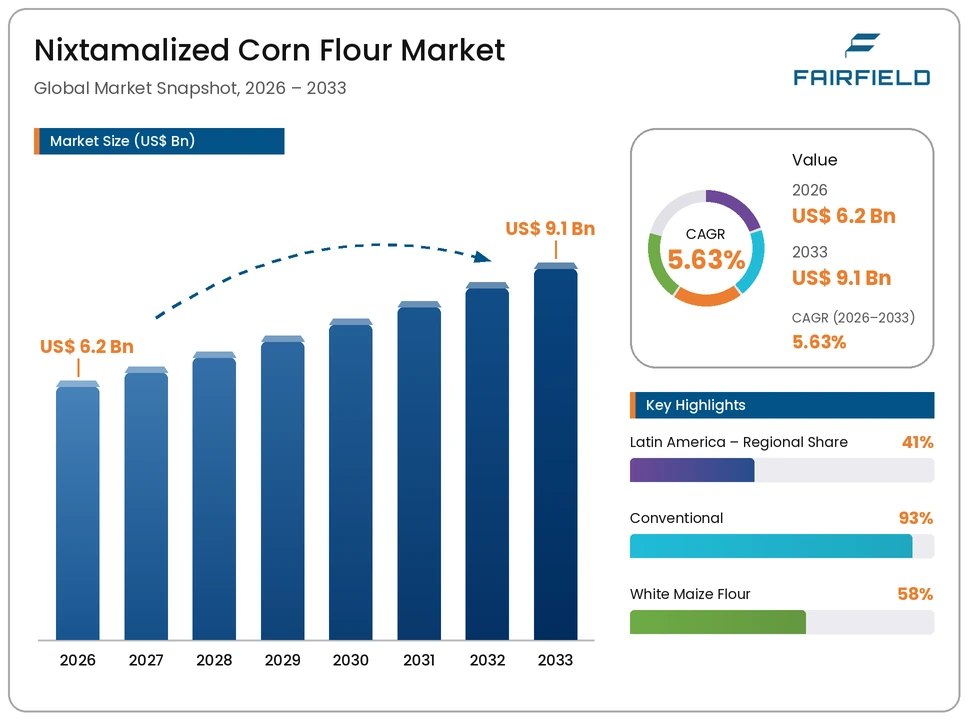
The global nixtamalized corn flour market size is expected to be valued at US$ 6.2 billion in 2026 and projected to reach US$ 9.1 billion by 2033, growing at a CAGR of 5.63% between 2026 and 2033.
Between 2020 and 2025 the instant masa flour business expanded at roughly 4.8% a year, lifted by tortilla demand and by millers converting traditional wet-masa customers to dry flour. Three factors carry growth forward. Industrial tortilla and tostada plants keep replacing on-site nixtamal cooking with purchased flour. Corn chip and snack manufacturers are adding capacity, with Gruma committing MXN 792 million in February 2024 to new snack output in Puebla. Mexican and Central American cuisine continues to spread into grocery aisles well beyond its home markets. The direction is steady, volume-led growth rather than a demand spike, with value gains coming from fortification, pigmented maize and packaged retail formats.
Key Report Takeaways
- By Product Type: White Maize Flour held 58% share in 2026, while Blue and Pigmented Maize Flour is projected to expand at an 8.4% CAGR through 2033, driven by premium tortilla chip launches that use heirloom landrace maize as a visible point of difference.
- By Application: Tortillas and Tostadas held 52% share in 2026, while Snacks and Corn Chips is projected to expand at a 7.1% CAGR through 2033, supported by new extrusion and frying lines commissioned across Mexico and the United States.
- By Nature: Conventional held 93% share in 2026, while Organic is projected to expand at a 9.2% CAGR through 2033, as certified organic maize acreage in Mexico and Argentina finally reaches contract-milling scale.
- By Distribution Channel: Food Processors and Industrial Buyers held 47% share in 2026, while E-commerce is projected to expand at a 10.1% CAGR through 2033, reflecting diaspora households ordering masa harina in multi-kilogram packs online.
- By Geography: Latin America held 41% share in 2026, while Europe is projected to expand at a 7.6% CAGR through 2033, as wrap and tortilla consumption spreads through British, Dutch and Spanish retail bakery ranges.
Global Nixtamalized Corn Flour Market Trends and Insights
Drivers Impact Analysis
Two forces account for most of the incremental demand for instant nixtamalized maize flour through 2033.
| Driver | Impact on CAGR Forecast | Geographic Relevance | Impact Timeline |
| Conversion of tortillerías from wet masa to instant flour | High | Mexico, Guatemala, El Salvador, United States | Long term ≥4 years |
| Capacity additions by corn snack and chip manufacturers | Medium | United States, Mexico, Europe | Medium term 2–4 years |
- Tortillería Conversion From Wet Masa Lifts Nixtamalized Corn Flour Volumes
Small and mid-sized tortilla shops switching away from on-site nixtamal cooking are the single largest source of new flour volume. A tortillería that buys dry flour removes maize steeping tanks, lime handling, grinding stones and the associated effluent from its premises. That makes a modest storefront viable in dense urban areas where water discharge and fuel use are tightly controlled. Each converted outlet becomes a repeat industrial customer rather than a buyer of raw grain.
The mechanism is operational rather than culinary. Wet nixtamalization requires overnight steeping in lime solution, careful cooking control and disposal of nejayote, the alkaline wastewater. Instant masa flour compresses that into hydration at the point of use. Municipal water charges, gas prices and food-safety inspection in Mexican and Central American cities have all tightened, so the cost gap that once favoured traditional molinos has narrowed considerably for smaller operators.
- Corn Snack Capacity Expansion Pulls Through Industrial Masa Harina Demand
Snack manufacturers adding fryers and extruders create large, contracted offtake for nixtamalized maize flour. Unlike tortilla demand, which tracks population, snack demand responds to distribution gains and new flavour launches. A single chip line consumes flour continuously at specified moisture, granulation and alkalinity, which favours suppliers able to guarantee lot-to-lot consistency. These contracts also carry better margins than commodity bagged flour.
Investment evidence is concrete. In February 2024, Gruma announced MXN 792 million over five years for a new corn-based snack plant in the state of Puebla and an expansion of its Mission Foods México plant at Huejotzingo to 70,000 tonnes of annual installed capacity, with 440 direct jobs. Capacity of that scale is committed only where converters expect sustained pull-through, and it anchors regional flour milling volumes for years.
Restraints Impact Analysis
Two constraints hold back faster substitution of traditional masa by dry nixtamalized flour.
| Restraint | Impact on CAGR Forecast | Geographic Relevance | Impact Timeline |
| Entrenched wet-masa molinos and texture preference | High | Mexico, Guatemala, Honduras | Long term ≥4 years |
| Maize price volatility and mycotoxin compliance cost | Medium | Europe, North America, Latin America | Short term ≤2 years |
- Traditional Molinos Cap Instant Flour Penetration in Core Mexican Markets
Wet-masa mills still supply a very large share of Mexican tortillerías, which directly limits how much of the staple pool instant flour can address. Many consumers describe fresh masa tortillas as softer and more aromatic, and tortillerías advertise the distinction openly. Where a molino operates on the same street, the flour-based outlet competes on convenience rather than on the eating quality its customers say they value most.
The underlying cause is cost structure, not nostalgia. A molino buying maize at harvest prices avoids the drying energy, packaging, warehousing and freight embedded in a sack of flour, and in many towns it absorbs labour informally. Drying is the decisive line item: removing moisture after cooking consumes most of the thermal energy in a nixtamalized flour plant. When natural gas or electricity prices rise, the delivered price of flour moves faster than the price of wet masa.
- Maize Cost Swings and Contaminant Compliance Squeeze Milling Margins
Millers absorb grain price moves that they cannot pass through quickly, which compresses margins and slows capacity decisions. Food-grade white maize trades at a premium to feed corn and its supply is thinner, so a poor harvest in a single producing state can move landed cost sharply. Buyers on annual contracts rarely accept mid-term repricing, leaving the mill exposed.
Compliance adds a second, less visible cost. Maize is prone to fumonisin and aflatoxin formation, and Commission Regulation (EU) 2023/915, adopted on 25 April 2023 and in force since 25 May 2023, sets maximum levels for contaminants in food across the European Union. Meeting those levels requires incoming grain testing, optical sorting and rejected-lot losses. Pricing discipline is also scrutinised: in January 2026, Gruma reported the conclusion of an administrative antitrust proceeding covering Mexico’s corn and corn flour markets.
Market Opportunities
- Fortified Nixtamalized Maize Flour Opens Public Health and Institutional Supply
Micronutrient-fortified tortilla flour creates a distinct revenue pool tied to government feeding programmes and institutional catering rather than to retail shelf space. Fortified lines command specification-based pricing, run on long tenders and carry low promotional cost. For millers already operating blending equipment, the incremental capital is small relative to the contract value, which makes this one of the better returns available in corn flour milling.
Capture favours suppliers with audited premix dosing and traceability. The U.S. Food and Drug Administration permits folic acid to be added to corn masa flour, following a food additive petition filed by Gruma Corporation and co-petitioners, which gives United States converters a clear regulatory basis for fortified tortilla products. Public health ministries across Mexico and Central America, school meal programmes and hospital caterers are the demand centres, and they buy on verified nutrient delivery rather than brand.
- Blue and Heirloom Maize Flours Create a Premium Snack and Tortilla Revenue Pool
Pigmented landrace maize gives millers a genuinely premium product in a category otherwise priced as a commodity. Blue, red and purple nixtamalized flours sell at a clear uplift over white flour because the colour is visible in the finished tortilla or chip and cannot be replicated with white maize. Volumes are small today, which is precisely why the margin pool is attractive for mills with flexible, short-run cleaning and milling capability.
The buyers are premium snack brands, chef-led restaurant groups and specialist retail. Demand is driven by menus that name the maize variety and its growing region, a practice now common in Mexican fine dining and in United States fast-casual chains. Securing supply requires contracting directly with smallholder cooperatives in Oaxaca, Puebla, Michoacán and Tlaxcala, so early movers who build those relationships effectively lock competitors out of the raw material.
Segment Analysis
- By Product Type: White Maize Flour Leads While Pigmented Varieties Gain Momentum
White Maize Flour held 58% of the nixtamalized corn flour market in 2026 because it is the default raw material for tortillas, tostadas and arepas across Mexico, Central America and the Andean countries. Its neutral colour and mild flavour suit the widest range of finished products, and white maize supply chains are the best organised. Blue and Pigmented Maize Flour is the fastest-growing product type at an 8.4% CAGR to 2033, starting from a small base. Growth comes from snack brands that use anthocyanin-rich landrace maize as a visual cue for authenticity and from restaurants naming specific maize varieties on menus. Yellow Maize Flour remains important in snack frying, where it delivers a stronger colour after cooking. Fortified and Specialty Blends grow steadily on institutional contracts. For millers, the implication is that growth in value is shifting toward short-run, variety-specific lots that require more flexible cleaning and milling assets.
- By Application: Tortillas and Tostadas Hold Scale While Snacks Accelerate
Tortillas and Tostadas accounted for 52% of nixtamalized maize flour consumption in 2026, reflecting the staple role of the tortilla in Mexican and Central American daily diets and the steady conversion of tortillerías to dry flour. This application sets the baseline volume the entire industry runs on. Snacks and Corn Chips is the fastest-growing application at a 7.1% CAGR, driven by new frying and extrusion capacity, including the Puebla snack plant announced by Gruma in February 2024. Arepas and Regional Flatbreads sustain demand in Colombia and Venezuela and among their diaspora communities. Bakery and Prepared Foods is smaller but widening as manufacturers use masa harina for gluten-free crackers and coatings. The commercial consequence is that snack contracts increasingly determine which mills justify new capacity, even though tortilla flour still carries the volume.
- By Nature: Conventional Dominates as Organic Milling Finally Scales
Conventional flour represented 93% of the market in 2026, a share that reflects price sensitivity in a staple category where the finished tortilla retails for very little. Industrial buyers specify conventional grades because they need year-round availability at predictable cost, and certified maize cannot yet meet that requirement at scale. Organic is the fastest-growing nature segment at a 9.2% CAGR through 2033, as certified organic maize area in Mexico and Argentina reaches volumes that support dedicated contract milling runs rather than occasional batches. Organic tortilla flour sells mainly through natural grocery channels and into premium foodservice. The constraint is segregation: mills must flush lines and document chain of custody, which adds cost per run. The practical implication is that organic will stay a margin play rather than a volume play across the forecast period.
- By Distribution Channel: Industrial Buyers Anchor Volume While Online Sales Compound
Food Processors and Industrial Buyers took 47% of nixtamalized corn flour sales in 2026 because tortilla plants, snack converters and prepared-food manufacturers buy in bulk on annual contracts. These customers dictate specifications on granulation, moisture and water absorption, and they reward suppliers who hold tolerances tightly. E-commerce is the fastest-growing channel at a 10.1% CAGR to 2033, albeit from a very small base, as households outside Latin America order masa harina in multi-kilogram packs that local grocers do not stock. Retail Grocery remains the visible consumer face of the category and carries the strongest brand equity. Foodservice sits between the two, supplying restaurant groups that press their own tortillas. For suppliers, the implication is that pricing power sits with industrial contracts while brand value is built in retail and online.
Geography Analysis
- Hispanic Grocery Growth Sustains North American Demand
North America holds 36% of global nixtamalized maize flour demand in 2026, the second largest position, built on the United States tortilla and corn chip industries. Tortillas are now a mainstream carrier format in American retail rather than a specialty item, and chip manufacturing consumes very large volumes of masa flour continuously. Azteca Milling, the milling arm of Gruma, together with Cargill, Bunge and Ingredion, supplies converters from plants located near Corn Belt and Texas grain supply. The U.S. Food and Drug Administration allows folic acid to be added to corn masa flour, which supports fortified tortilla lines sold into school and institutional channels. Growth here is steady rather than rapid, because household penetration is already high. The main change is premiumisation, with retailers ranging heirloom and organic tortillas alongside standard lines.
- Which Region Is Growing Fastest in the Nixtamalized Corn Flour Market?
Europe is growing fastest in the nixtamalized corn flour market, at a 7.6% CAGR between 2026 and 2033, from a modest 11% share in 2026. The United Kingdom, the Netherlands, Spain, Germany and Italy are the main contributors. Wraps, fajita kits and corn tortilla chips have moved from ethnic aisles into mainstream supermarket ranges, and quick-service chains have added tortilla-based menu items. Gruma operates tortilla and flour plants serving the region, which shortens lead times for retailers that will not hold long inventory. Compliance shapes sourcing here more than elsewhere: Commission Regulation (EU) 2023/915 sets maximum contaminant levels that suppliers must demonstrate on every lot. The emerging change is retailer own-label tortilla ranges, which pull flour demand toward contract millers rather than branded suppliers.
- Food Processing Investment Builds the Asia Pacific Base
Asia Pacific accounted for 8% of nixtamalized maize flour consumption in 2026, the smallest of the major developed demand pools but a steadily expanding one. Australia, Japan, South Korea, Singapore and urban China drive it, mainly through quick-service restaurants, hotel buffets and the growth of casual Mexican dining in large cities. Snack manufacturers in the region have also begun using masa flour for tortilla-style chips sold under local brands. Demand is concentrated in metropolitan centres and in foodservice rather than in households, because maize tortillas are not a traditional staple. Imported flour carries freight and duty, so landed cost is high. The change worth watching is local co-packing: contract manufacturers in Australia and Singapore are starting to run tortilla lines, which converts occasional import orders into regular industrial offtake.
- Which Region Is Leading the Nixtamalized Corn Flour Market?
Latin America leads the nixtamalized corn flour market with 41% share in 2026, because the tortilla is a daily staple there and the region hosts the largest concentration of dedicated maize milling capacity. Mexico is the dominant national market, with Guatemala, El Salvador, Honduras, Colombia and Venezuela adding volume through tortillas, pupusas and arepas. Milling is well established: Gruma and Grupo Minsa operate plants close to maize producing states, which keeps freight cost low relative to product value. Regional barriers are real. Informal wet-masa mills still hold a large share of tortillería supply, white maize harvests vary with rainfall, and competition authorities scrutinise pricing in a politically sensitive staple. The clearest change under way is capacity investment in snack manufacturing, including the MXN 792 million programme announced in Puebla in February 2024.
- Expatriate Demand and Milling Gaps Define Middle East & Africa
Middle East & Africa represented 4% of the market in 2026, the smallest regional share, with demand concentrated in the United Arab Emirates, Saudi Arabia, Qatar, South Africa and Egypt. Hotel groups, international restaurant franchises and expatriate retail account for most volume, while maize milling in the region is overwhelmingly geared to non-nixtamalized staples such as maize meal and ugali flour. That creates an infrastructure gap: there is almost no alkaline cooking capacity, so nixtamalized flour is imported. Barriers include import duties, long supply lines, limited cold-chain-free warehousing in hot climates and very low household familiarity with masa products. The opportunity is tied to tourism and franchising. New hotel and casual-dining openings in Gulf cities create predictable foodservice volumes that justify regional distribution agreements.
Competitive Landscape
The nixtamalized corn flour market is moderately concentrated. A small number of integrated millers account for a large share of industrial supply, while a long tail of regional mills and traditional molinos serves local tortillerías. Gruma is the reference operator globally, with milling and tortilla manufacturing on several continents and a tagline that positions it in corn flour and tortillas. Grupo Minsa competes directly in Mexico and the United States. Diversified grain processors including Cargill, Bunge and Ingredion participate through corn milling and masa-adjacent ingredient portfolios. Consolidation is gradual rather than dramatic, because mills are freight-sensitive assets that rarely travel well across borders.
Competition runs on specification consistency, proximity to maize supply and the ability to hold price across a contract year. Industrial converters test incoming flour for granulation, moisture, water absorption and alkalinity, and they switch suppliers when tolerances drift. Freight economics matter as much as price, since flour is bulky relative to its value. New entrants are mostly specialist operations: regional mills contracting heirloom maize from smallholder cooperatives, and organic-certified millers serving natural grocery. They compete on provenance and variety rather than on cost.
Strategic moves have centred on capacity and compliance. In February 2024, Gruma committed MXN 792 million to a new corn snack plant in Puebla and an expansion of its Mission Foods México site at Huejotzingo, signalling confidence in snack-led demand. In April 2024, the company reported EBITDA growth of 26% for the first quarter, with 82% of it generated outside Mexico, which underlines how much of the industry’s profit now sits in export markets. In January 2026, Gruma confirmed the conclusion of an antitrust proceeding covering Mexico’s corn and corn flour markets.
Strategic direction across the industry is converging on three themes: securing food-grade white maize under contract, investing in drying and sorting technology to meet contaminant limits, and building higher-margin lines in fortified, organic and pigmented flours rather than chasing commodity volume.
Recent Industry Developments
- February 2024: Gruma announced an investment of MXN 792 million over five years to build a new corn-based snack plant in the state of Puebla and expand its Mission Foods México plant at Huejotzingo to 70,000 tonnes of installed annual capacity – signals that snack demand, not tortillas alone, now justifies new nixtamalized milling capacity.
- April 2024: Gruma reported first-quarter EBITDA growth of 26%, with 82% of EBITDA generated by operations outside Mexico – confirms that profitability in corn flour has shifted toward export and overseas tortilla markets.
- January 2026: Gruma reported the successful conclusion of the administrative antitrust proceeding relating to the investigation of Mexico’s corn and corn flour markets – removes a regulatory overhang on pricing in the industry’s largest single national market.
- July 2026: Gruma published its second-quarter 2026 results, maintaining its position as a world leader in corn flour and tortillas – provides the industry’s most visible public benchmark for volume and margin trends.
Companies Covered in the Report
Gruma
Grupo Minsa
Grupo Bimbo
Cargill
Bunge
Ingredion
Azteca Milling
PepsiCo
Nixtamalized Corn Flour Market Report Scope
| Metric | Value |
| Study Period | 2020–2033 |
| Market Size 2026 | US$ 6.2 Billion |
| Market Size 2033 | US$ 9.1 Billion |
| CAGR 2026–2033 | 5.63% |
| Absolute Dollar Opportunity | US$ 2.9 Billion |
| Largest Market | Latin America (41% share in 2026) |
| Fastest-Growing Market | Europe (7.6% CAGR) |
| Market Concentration | Medium |
| Major Players | Gruma, Grupo Minsa, Cargill, Bunge, Ingredion |
Nixtamalized Corn Flour Market Segmentation
Product Type
- White Maize Flour
- Yellow Maize Flour
- Blue and Pigmented Maize Flour
- Fortified and Specialty Blends
Application
- Tortillas and Tostadas
- Snacks and Corn Chips
- Arepas and Regional Flatbreads
- Bakery and Prepared Foods
Nature
- Conventional
- Organic
Distribution Channel
- Food Processors and Industrial Buyers
- Foodservice
- Retail Grocery
- E-commerce
Regions
- North America
- Europe
- Asia Pacific
- Latin America
- Middle East & Africa
- Executive Summary
- Global Nixtamalized Corn Flour Market Snapshot
- Market Size and Trend Analysis 2020–2033
- Historical Growth 2020–2025
- Base Year 2025
- Forecast Outlook 2026–2033
- Key Report Takeaways
- Market Overview
- Market Definition and Report Scope
- Market Dynamics
- Drivers
- Tortillería Conversion From Wet Masa Lifts Nixtamalized Corn Flour Volumes
- Corn Snack Capacity Expansion Pulls Through Industrial Masa Harina Demand
- Restraints
- Traditional Molinos Cap Instant Flour Penetration in Core Mexican Markets
- Maize Cost Swings and Contaminant Compliance Squeeze Milling Margins
- Market Opportunities
- Fortified Nixtamalized Maize Flour Opens Public Health and Institutional Supply
- Blue and Heirloom Maize Flours Create a Premium Snack and Tortilla Revenue Pool
- Drivers
- Segment Analysis
- By Product Type: White Maize Flour Leads While Pigmented Varieties Gain Momentum
- By Application: Tortillas and Tostadas Hold Scale While Snacks Accelerate
- By Nature: Conventional Dominates as Organic Milling Finally Scales
- By Distribution Channel: Industrial Buyers Anchor Volume While Online Sales Compound
- Global Nixtamalized Corn Flour Market Outlook, 2020–2033
- Global Nixtamalized Corn Flour Market Outlook, by Product Type, Value (US$ Billion), 2020–2033
- White Maize Flour
- Yellow Maize Flour
- Blue and Pigmented Maize Flour
- Fortified and Specialty Blends
- Global Nixtamalized Corn Flour Market Outlook, by Application, Value (US$ Billion), 2020–2033
- Tortillas and Tostadas
- Snacks and Corn Chips
- Arepas and Regional Flatbreads
- Bakery and Prepared Foods
- Global Nixtamalized Corn Flour Market Outlook, by Nature, Value (US$ Billion), 2020–2033
- Conventional
- Organic
- Global Nixtamalized Corn Flour Market Outlook, by Distribution Channel, Value (US$ Billion), 2020–2033
- Food Processors and Industrial Buyers
- Foodservice
- Retail Grocery
- E-commerce
- Global Nixtamalized Corn Flour Market Outlook, by Region, Value (US$ Billion), 2020–2033
- North America
- Europe
- Asia Pacific
- Latin America
- Middle East & Africa
- Global Nixtamalized Corn Flour Market Outlook, by Product Type, Value (US$ Billion), 2020–2033
- North America Nixtamalized Corn Flour Market Outlook, 2020–2033
- Hispanic Grocery Growth Sustains North American Demand
- North America Nixtamalized Corn Flour Market Outlook, by Product Type, Value (US$ Billion), 2020–2033
- White Maize Flour
- Yellow Maize Flour
- Blue and Pigmented Maize Flour
- Fortified and Specialty Blends
- North America Nixtamalized Corn Flour Market Outlook, by Application, Value (US$ Billion), 2020–2033
- Tortillas and Tostadas
- Snacks and Corn Chips
- Arepas and Regional Flatbreads
- Bakery and Prepared Foods
- North America Nixtamalized Corn Flour Market Outlook, by Nature, Value (US$ Billion), 2020–2033
- Conventional
- Organic
- North America Nixtamalized Corn Flour Market Outlook, by Distribution Channel, Value (US$ Billion), 2020–2033
- Food Processors and Industrial Buyers
- Foodservice
- Retail Grocery
- E-commerce
- North America Nixtamalized Corn Flour Market Outlook, by Country, Value (US$ Billion), 2020–2033
- United States Nixtamalized Corn Flour Market Outlook, by Product Type, 2020–2033
- United States Nixtamalized Corn Flour Market Outlook, by Application, 2020–2033
- United States Nixtamalized Corn Flour Market Outlook, by Nature, 2020–2033
- United States Nixtamalized Corn Flour Market Outlook, by Distribution Channel, 2020–2033
- Europe Nixtamalized Corn Flour Market Outlook, 2020–2033
- Regional Growth Outlook
- Europe Nixtamalized Corn Flour Market Outlook, by Product Type, Value (US$ Billion), 2020–2033
- White Maize Flour
- Yellow Maize Flour
- Blue and Pigmented Maize Flour
- Fortified and Specialty Blends
- Europe Nixtamalized Corn Flour Market Outlook, by Application, Value (US$ Billion), 2020–2033
- Tortillas and Tostadas
- Snacks and Corn Chips
- Arepas and Regional Flatbreads
- Bakery and Prepared Foods
- Europe Nixtamalized Corn Flour Market Outlook, by Nature, Value (US$ Billion), 2020–2033
- Conventional
- Organic
- Europe Nixtamalized Corn Flour Market Outlook, by Distribution Channel, Value (US$ Billion), 2020–2033
- Food Processors and Industrial Buyers
- Foodservice
- Retail Grocery
- E-commerce
- Europe Nixtamalized Corn Flour Market Outlook, by Country, Value (US$ Billion), 2020–2033
- United Kingdom Nixtamalized Corn Flour Market Outlook, by Product Type, 2020–2033
- United Kingdom Nixtamalized Corn Flour Market Outlook, by Application, 2020–2033
- United Kingdom Nixtamalized Corn Flour Market Outlook, by Nature, 2020–2033
- United Kingdom Nixtamalized Corn Flour Market Outlook, by Distribution Channel, 2020–2033
- Netherlands Nixtamalized Corn Flour Market Outlook, by Product Type, 2020–2033
- Netherlands Nixtamalized Corn Flour Market Outlook, by Application, 2020–2033
- Netherlands Nixtamalized Corn Flour Market Outlook, by Nature, 2020–2033
- Netherlands Nixtamalized Corn Flour Market Outlook, by Distribution Channel, 2020–2033
- Spain Nixtamalized Corn Flour Market Outlook, by Product Type, 2020–2033
- Spain Nixtamalized Corn Flour Market Outlook, by Application, 2020–2033
- Spain Nixtamalized Corn Flour Market Outlook, by Nature, 2020–2033
- Spain Nixtamalized Corn Flour Market Outlook, by Distribution Channel, 2020–2033
- Germany Nixtamalized Corn Flour Market Outlook, by Product Type, 2020–2033
- Germany Nixtamalized Corn Flour Market Outlook, by Application, 2020–2033
- Germany Nixtamalized Corn Flour Market Outlook, by Nature, 2020–2033
- Germany Nixtamalized Corn Flour Market Outlook, by Distribution Channel, 2020–2033
- Italy Nixtamalized Corn Flour Market Outlook, by Product Type, 2020–2033
- Italy Nixtamalized Corn Flour Market Outlook, by Application, 2020–2033
- Italy Nixtamalized Corn Flour Market Outlook, by Nature, 2020–2033
- Italy Nixtamalized Corn Flour Market Outlook, by Distribution Channel, 2020–2033
- Asia Pacific Nixtamalized Corn Flour Market Outlook, 2020–2033
- Food Processing Investment Builds the Asia Pacific Base
- Asia Pacific Nixtamalized Corn Flour Market Outlook, by Product Type, Value (US$ Billion), 2020–2033
- White Maize Flour
- Yellow Maize Flour
- Blue and Pigmented Maize Flour
- Fortified and Specialty Blends
- Asia Pacific Nixtamalized Corn Flour Market Outlook, by Application, Value (US$ Billion), 2020–2033
- Tortillas and Tostadas
- Snacks and Corn Chips
- Arepas and Regional Flatbreads
- Bakery and Prepared Foods
- Asia Pacific Nixtamalized Corn Flour Market Outlook, by Nature, Value (US$ Billion), 2020–2033
- Conventional
- Organic
- Asia Pacific Nixtamalized Corn Flour Market Outlook, by Distribution Channel, Value (US$ Billion), 2020–2033
- Food Processors and Industrial Buyers
- Foodservice
- Retail Grocery
- E-commerce
- Asia Pacific Nixtamalized Corn Flour Market Outlook, by Country, Value (US$ Billion), 2020–2033
- Australia Nixtamalized Corn Flour Market Outlook, by Product Type, 2020–2033
- Australia Nixtamalized Corn Flour Market Outlook, by Application, 2020–2033
- Australia Nixtamalized Corn Flour Market Outlook, by Nature, 2020–2033
- Australia Nixtamalized Corn Flour Market Outlook, by Distribution Channel, 2020–2033
- Japan Nixtamalized Corn Flour Market Outlook, by Product Type, 2020–2033
- Japan Nixtamalized Corn Flour Market Outlook, by Application, 2020–2033
- Japan Nixtamalized Corn Flour Market Outlook, by Nature, 2020–2033
- Japan Nixtamalized Corn Flour Market Outlook, by Distribution Channel, 2020–2033
- South Korea Nixtamalized Corn Flour Market Outlook, by Product Type, 2020–2033
- South Korea Nixtamalized Corn Flour Market Outlook, by Application, 2020–2033
- South Korea Nixtamalized Corn Flour Market Outlook, by Nature, 2020–2033
- South Korea Nixtamalized Corn Flour Market Outlook, by Distribution Channel, 2020–2033
- Singapore Nixtamalized Corn Flour Market Outlook, by Product Type, 2020–2033
- Singapore Nixtamalized Corn Flour Market Outlook, by Application, 2020–2033
- Singapore Nixtamalized Corn Flour Market Outlook, by Nature, 2020–2033
- Singapore Nixtamalized Corn Flour Market Outlook, by Distribution Channel, 2020–2033
- China Nixtamalized Corn Flour Market Outlook, by Product Type, 2020–2033
- China Nixtamalized Corn Flour Market Outlook, by Application, 2020–2033
- China Nixtamalized Corn Flour Market Outlook, by Nature, 2020–2033
- China Nixtamalized Corn Flour Market Outlook, by Distribution Channel, 2020–2033
- Latin America Nixtamalized Corn Flour Market Outlook, 2020–2033
- Regional Market Leadership
- Latin America Nixtamalized Corn Flour Market Outlook, by Product Type, Value (US$ Billion), 2020–2033
- White Maize Flour
- Yellow Maize Flour
- Blue and Pigmented Maize Flour
- Fortified and Specialty Blends
- Latin America Nixtamalized Corn Flour Market Outlook, by Application, Value (US$ Billion), 2020–2033
- Tortillas and Tostadas
- Snacks and Corn Chips
- Arepas and Regional Flatbreads
- Bakery and Prepared Foods
- Latin America Nixtamalized Corn Flour Market Outlook, by Nature, Value (US$ Billion), 2020–2033
- Conventional
- Organic
- Latin America Nixtamalized Corn Flour Market Outlook, by Distribution Channel, Value (US$ Billion), 2020–2033
- Food Processors and Industrial Buyers
- Foodservice
- Retail Grocery
- E-commerce
- Latin America Nixtamalized Corn Flour Market Outlook, by Country, Value (US$ Billion), 2020–2033
- Mexico Nixtamalized Corn Flour Market Outlook, by Product Type, 2020–2033
- Mexico Nixtamalized Corn Flour Market Outlook, by Application, 2020–2033
- Mexico Nixtamalized Corn Flour Market Outlook, by Nature, 2020–2033
- Mexico Nixtamalized Corn Flour Market Outlook, by Distribution Channel, 2020–2033
- Guatemala Nixtamalized Corn Flour Market Outlook, by Product Type, 2020–2033
- Guatemala Nixtamalized Corn Flour Market Outlook, by Application, 2020–2033
- Guatemala Nixtamalized Corn Flour Market Outlook, by Nature, 2020–2033
- Guatemala Nixtamalized Corn Flour Market Outlook, by Distribution Channel, 2020–2033
- El Salvador Nixtamalized Corn Flour Market Outlook, by Product Type, 2020–2033
- El Salvador Nixtamalized Corn Flour Market Outlook, by Application, 2020–2033
- El Salvador Nixtamalized Corn Flour Market Outlook, by Nature, 2020–2033
- El Salvador Nixtamalized Corn Flour Market Outlook, by Distribution Channel, 2020–2033
- Honduras Nixtamalized Corn Flour Market Outlook, by Product Type, 2020–2033
- Honduras Nixtamalized Corn Flour Market Outlook, by Application, 2020–2033
- Honduras Nixtamalized Corn Flour Market Outlook, by Nature, 2020–2033
- Honduras Nixtamalized Corn Flour Market Outlook, by Distribution Channel, 2020–2033
- Colombia Nixtamalized Corn Flour Market Outlook, by Product Type, 2020–2033
- Colombia Nixtamalized Corn Flour Market Outlook, by Application, 2020–2033
- Colombia Nixtamalized Corn Flour Market Outlook, by Nature, 2020–2033
- Colombia Nixtamalized Corn Flour Market Outlook, by Distribution Channel, 2020–2033
- Venezuela Nixtamalized Corn Flour Market Outlook, by Product Type, 2020–2033
- Venezuela Nixtamalized Corn Flour Market Outlook, by Application, 2020–2033
- Venezuela Nixtamalized Corn Flour Market Outlook, by Nature, 2020–2033
- Venezuela Nixtamalized Corn Flour Market Outlook, by Distribution Channel, 2020–2033
- Middle East & Africa Nixtamalized Corn Flour Market Outlook, 2020–2033
- Expatriate Demand and Milling Gaps Define Middle East & Africa
- Middle East & Africa Nixtamalized Corn Flour Market Outlook, by Product Type, Value (US$ Billion), 2020–2033
- White Maize Flour
- Yellow Maize Flour
- Blue and Pigmented Maize Flour
- Fortified and Specialty Blends
- Middle East & Africa Nixtamalized Corn Flour Market Outlook, by Application, Value (US$ Billion), 2020–2033
- Tortillas and Tostadas
- Snacks and Corn Chips
- Arepas and Regional Flatbreads
- Bakery and Prepared Foods
- Middle East & Africa Nixtamalized Corn Flour Market Outlook, by Nature, Value (US$ Billion), 2020–2033
- Conventional
- Organic
- Middle East & Africa Nixtamalized Corn Flour Market Outlook, by Distribution Channel, Value (US$ Billion), 2020–2033
- Food Processors and Industrial Buyers
- Foodservice
- Retail Grocery
- E-commerce
- Middle East & Africa Nixtamalized Corn Flour Market Outlook, by Country, Value (US$ Billion), 2020–2033
- United Arab Emirates Nixtamalized Corn Flour Market Outlook, by Product Type, 2020–2033
- United Arab Emirates Nixtamalized Corn Flour Market Outlook, by Application, 2020–2033
- United Arab Emirates Nixtamalized Corn Flour Market Outlook, by Nature, 2020–2033
- United Arab Emirates Nixtamalized Corn Flour Market Outlook, by Distribution Channel, 2020–2033
- Saudi Arabia Nixtamalized Corn Flour Market Outlook, by Product Type, 2020–2033
- Saudi Arabia Nixtamalized Corn Flour Market Outlook, by Application, 2020–2033
- Saudi Arabia Nixtamalized Corn Flour Market Outlook, by Nature, 2020–2033
- Saudi Arabia Nixtamalized Corn Flour Market Outlook, by Distribution Channel, 2020–2033
- Qatar Nixtamalized Corn Flour Market Outlook, by Product Type, 2020–2033
- Qatar Nixtamalized Corn Flour Market Outlook, by Application, 2020–2033
- Qatar Nixtamalized Corn Flour Market Outlook, by Nature, 2020–2033
- Qatar Nixtamalized Corn Flour Market Outlook, by Distribution Channel, 2020–2033
- South Africa Nixtamalized Corn Flour Market Outlook, by Product Type, 2020–2033
- South Africa Nixtamalized Corn Flour Market Outlook, by Application, 2020–2033
- South Africa Nixtamalized Corn Flour Market Outlook, by Nature, 2020–2033
- South Africa Nixtamalized Corn Flour Market Outlook, by Distribution Channel, 2020–2033
- Egypt Nixtamalized Corn Flour Market Outlook, by Product Type, 2020–2033
- Egypt Nixtamalized Corn Flour Market Outlook, by Application, 2020–2033
- Egypt Nixtamalized Corn Flour Market Outlook, by Nature, 2020–2033
- Egypt Nixtamalized Corn Flour Market Outlook, by Distribution Channel, 2020–2033
- Competitive Landscape
- Market Concentration and Supplier Participation
- Competitive Factors and Strategic Direction
- Recent Industry Developments
- Gruma Puebla Snack Capacity Investment February 2024
- Gruma First Quarter Results April 2024
- Gruma Antitrust Proceeding Conclusion January 2026
- Gruma Second Quarter Results July 2026
- Company Profiles
- Gruma
- Grupo Minsa
- Grupo Bimbo
- Cargill
- Bunge
- Ingredion
- Azteca Milling
- PepsiCo
- Appendix
- Research Methodology
- Report Assumptions
- Acronyms and Abbreviations
Product Type
- White Maize Flour
- Yellow Maize Flour
- Blue and Pigmented Maize Flour
- Fortified and Specialty Blends
Application
- Tortillas and Tostadas
- Snacks and Corn Chips
- Arepas and Regional Flatbreads
- Bakery and Prepared Foods
Nature
- Conventional
- Organic
Distribution Channel
- Food Processors and Industrial Buyers
- Foodservice
- Retail Grocery
- E-commerce
Regions
- North America
- Europe
- Asia Pacific
- Latin America
- Middle East & Africa
Our Research Methodology
Considering the volatility of business today, traditional approaches to strategizing a game plan can be unfruitful if not detrimental. True ambiguity is no way to determine a forecast. A myriad of predetermined factors must be accounted for such as the degree of risk involved, the magnitude of circumstances, as well as conditions or consequences that are not known or unpredictable. To circumvent binary views that cast uncertainty, the application of market research intelligence to strategically posture, move, and enable actionable outcomes is necessary.
View Methodology
Quality Assured
Rigorous Validation Process

Confidentiality Assured
End-to-end Data Security

Custom Research Services
Tailored To Your Objectives
FAQs
The market is valued at US$ 6.2 billion in 2026, covering instant nixtamalized maize flour sold to industrial, foodservice, retail and online buyers worldwide.
The market is projected to reach US$ 9.1 billion by 2033, expanding at a 5.63% CAGR and adding US$ 2.9 billion in absolute value.
Tortillas and Tostadas lead with 52% share in 2026, reflecting the daily staple role of tortillas across Mexico, Central America and the United States.
Europe grows fastest at a 7.6% CAGR through 2033, as wraps and corn tortilla chips move into mainstream supermarket and quick-service ranges.
Concentration is medium: integrated millers such as Gruma and Grupo Minsa dominate industrial supply, while regional mills and traditional molinos serve local outlets.
Related Reports
Annatto Extract Market Size, Share, Insights, Competitive Landscape, and Forecast 2026 to 2033
The annatto extract market is projected to reach US$ 598.1 million by 2033, growing at 6.3% CAGR from US$ 390.0 million in 2026.
Almond Flour Market Insights, Competitive Landscape, and Market Forecast - 2033
Demand for almond flour has shown steady growth in the past few years. Rise in consumer demand for natural or plant-based ingredients is expected to drive the global demand for alternative flours such as banana and almond.
Soil Fertility Testing Market Size, Share, Insights, Competitive Landscape, and Forecast 2026 to 2033
Explore the soil fertility testing market outlook for 2026–2033, covering testing methods, parameters, applications, regional trends, and key companies.
Vegan Drink Mixes Market Size, Share, Insights, Competitive Landscape, and Forecast 2026 to 2033
Explore the vegan drink mixes market outlook for 2026–2033, including product types, ingredients, distribution channels, regions, and competitors.
Natural and Organic Snack Food Market Size, Share, Insights, Competitive Landscape, and Forecast 2026 to 2033
Explore the natural and organic snack food market outlook for 2026–2033, with product trends, label claims, retail channels, regions, and competition.
Miso Flavored Snacks Market Size, Share, Insights, Competitive Landscape, and Forecast 2026 to 2033
Explore the miso flavored snacks market outlook for 2026–2033, including product formats, flavour trends, retail channels, regions, and key players.