



Vegan Drink Mixes Market
Vegan Drink Mixes Market Size, Share, Insights, Competitive Landscape, and Forecast 2026 to 2033
Report Overview
Vegan Drink Mixes Market Size and Trend Analysis
What Is Driving Vegan Drink Mix Sales Higher?
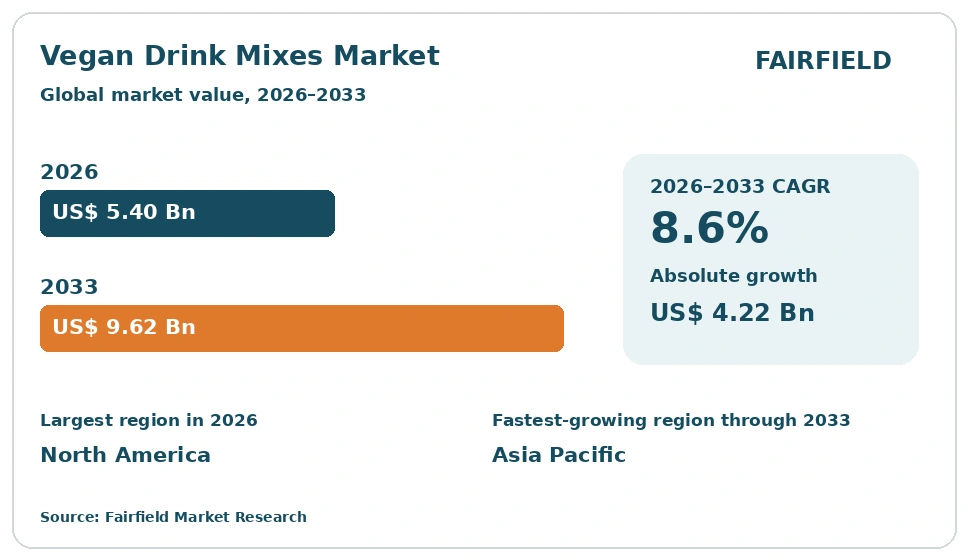
The global Vegan Drink Mixes market size is expected to be valued at US$ 5.4 billion in 2026 and projected to reach US$ 9.62 billion by 2033, growing at a CAGR of 8.6% between 2026 and 2033. Growth rests on three practical shifts. Shoppers now replace dairy powders with pea, oat and soy blends in daily routines. Retailers have moved these mixes from specialty aisles into mainstream grocery. Manufacturers have improved solubility and flavour masking, which lifts repeat purchase. The absolute dollar opportunity across the period reaches US$ 4.22 billion, and historical expansion ran at a 7.1% CAGR between 2020 and 2025.
Key Report Takeaways
- By Product Type: Vegan protein powders led with 38.4% share in 2026, while greens and superfood blends are projected to expand at a 10.2% CAGR through 2033, driven by daily wellness routines that favour single-scoop servings.
- By Ingredient Source: Pea-based formulations led with 29.6% share in 2026, while oat-based mixes are projected to expand at an 11.4% CAGR through 2033, driven by oat’s mild taste and its established northern European supply base.
- By Distribution Channel: Supermarkets and hypermarkets led with 34.2% share in 2026, while online retail is projected to expand at an 11.8% CAGR through 2033, driven by subscription refills that lock in repeat buyers.
- By End User: Household consumers led with 58.3% share in 2026, while foodservice and café chains are projected to expand at a 10.6% CAGR through 2033, driven by barista-format powders that cut cold-chain handling.
- By Geography: North America led with 36.8% share in 2026, while Asia Pacific is projected to expand at an 11.2% CAGR through 2033, driven by rising urban incomes and familiarity with soy beverages.
Market Trends and Insights
Market Growth Drivers
Plant-Based Nutrition Moves Into Everyday Grocery Baskets
Vegan drink mixes have shifted from a niche purchase to a routine grocery item, and that shift lifts volume far faster than price. Buyers who once treated plant protein as sports nutrition now use it in breakfast shakes, coffee and baking. This widens the buying occasion and raises purchase frequency across the year. Retailers respond by granting permanent shelf facings instead of seasonal displays, which steadies reorder patterns for manufacturers.
The underlying trend is dietary flexibility rather than strict veganism. Most buyers still consume dairy but reduce it, so plant mixes sit beside conventional powders in the same basket. Food manufacturers have matched this by reformulating for neutral taste and clean ingredient decks. Private-label programmes in grocery chains have added entry-price options, pulling first-time buyers into the category and expanding the installed base of regular users.
Powder Formats Offer Shelf Stability That Liquids Cannot Match
Powdered and concentrated formats carry a structural cost advantage over ready-to-drink plant beverages, and that advantage converts directly into margin and reach. Removing water cuts shipping weight, storage volume and chilled handling. A sachet or tub travels through ambient distribution, reaches rural retail and holds a long shelf life without refrigeration. These economics let brands enter markets where cold-chain coverage is thin and spoilage losses are high.
Packaging and processing work reinforces the advantage. Agglomeration and instantising steps improve cold-water dispersion, which was the main complaint against early plant powders. Single-serve sticks and resealable pouches reduce waste and support trial at lower price points. Foodservice operators adopt bulk powders to standardise recipes and portion costs across outlets. Together these factors make powder the default format for expanding plant-based beverage access into new geographies.
Restraints Impact Analysis of Market
Taste, Texture and Solubility Still Limit Repeat Purchase
Sensory performance remains the single largest barrier to category growth, because trial rates already exceed repeat rates in most markets. Plant proteins carry earthy, beany or chalky notes that water and heat do not fully hide. Poor dispersion leaves grit and lumps, which shoppers read as a quality failure. A disappointing first serving ends the purchase cycle, so brands lose the subscription revenue that makes the category profitable.
Reformulation work is active but costly. Enzyme treatment, fermentation and careful blending reduce off-notes, while natural flavours and sweeteners mask what remains. Each change requires stability testing and often raises the ingredient bill. Smaller brands lack the sensory panels and pilot lines to iterate quickly. The result is uneven quality across the shelf, which slows category-wide trust and keeps some shoppers tied to dairy powders.
Input Cost Volatility and Narrow Supply Concentration Squeeze Margins
Raw material exposure compresses margins and makes pricing unpredictable, which discourages long shelf commitments from retailers. Pea and oat protein supply is concentrated among a limited set of processors and growing regions. Weather events, crop rotation decisions and export policy shifts move isolate prices sharply within a single season. Brands that hold fixed retail price points absorb the swing themselves, cutting the funds available for marketing and new product work.
Processing capacity adds a second constraint. Protein isolation needs specialised wet or dry fractionation assets, and new lines take years to commission. Smaller brands depend on contract manufacturers and compete for the same slots during peak periods. Freight and energy costs layer on further variability. Companies respond with multi-source formulations and longer supply agreements, but these measures reduce volatility rather than remove it from the cost base.
Market Opportunities
Foodservice and Café Channels Open a New Volume Pool
Cafés, quick-service chains and workplace catering represent the clearest untapped volume for vegan drink mixes, because these outlets already face plant-milk demand they struggle to serve economically. Chilled plant milks occupy scarce fridge space and generate waste when demand is uneven. Powdered latte bases, cocoa mixes and plant milk powders solve both problems. They reconstitute on demand, hold ambient, and give operators consistent dosing across every outlet in a network.
The commercial logic favours suppliers as well. Foodservice contracts move larger pack sizes at steadier volumes than retail, smoothing production planning. Barista-specific formulations that foam reliably and resist curdling in hot coffee have become a distinct product line. Equipment makers now supply dosing and dispensing units suited to powder. As chains standardise menus across borders, a single ambient powder specification simplifies sourcing considerably.
Functional Blends and Regional Flavours Widen the Addressable Base
Blended formulations that combine plant protein with greens, fibre, botanicals or vitamins command higher prices and reach buyers who would not purchase plain protein. These products compete on composition rather than on protein content alone, which loosens the direct price comparison with commodity powders. Daily-use positioning also raises consumption frequency. For manufacturers, this moves the category away from a narrow fitness audience toward general nutrition shoppers across a wider age range.
Regional flavour development compounds the effect. Matcha, horchata, masala chai, ube and date-based profiles turn a generic powder into a locally relevant product. Local sourcing of mung bean, chickpea, sesame or millet protein supports both taste familiarity and supply security. Ingredient suppliers have expanded their plant protein portfolios accordingly. Brands that localise rather than export a single global recipe gain faster shelf acceptance in new markets.
Category-wise Insights
Which Product Type Holds the Largest Share of Vegan Drink Mixes?
Vegan protein powders held the largest position with 38.4% share in 2026, supported by established retail distribution and a buying habit that renews monthly. Protein remains the clearest purchase reason in the category, which keeps these products in steady rotation across sports, weight management and general nutrition use. Greens and superfood blends record the fastest expansion at a 10.2% CAGR through 2033, a different dynamic driven by daily wellness routines rather than training goals.
Meal replacement shakes hold a solid middle position where convenience outweighs ingredient curiosity. Dairy-free latte and cocoa mixes gain from café-style home preparation. Plant milk powders remain smaller but serve ambient distribution needs well. For strategy teams the signal is clear: protein delivers scale today, while blended wellness formats set the growth trajectory.
Pea Leads on Supply Security While Oat Wins on Palatability
Pea-derived formulations led ingredient sourcing with 29.6% share in 2026, reflecting a mature isolate supply chain, a complete amino acid profile and freedom from the major allergen declarations that constrain soy and nut bases. Processors across North America and Europe have built dedicated pea fractionation capacity, which gives brands volume certainty and steadier pricing than newer crops.
Oat-based mixes grow fastest at an 11.4% CAGR through 2033, driven by taste rather than nutrition. Oat delivers natural sweetness, creamy mouthfeel and strong coffee compatibility, which suits latte and cocoa formats directly. Soy retains relevance in Asia Pacific, where consumption is traditional. Rice, almond and multi-source blends fill allergen and texture gaps. Blended systems are becoming standard, since combining sources corrects the flavour and amino acid weaknesses of any single plant.
Grocery Shelves Hold the Volume While Online Captures the Growth
Supermarkets and hypermarkets led distribution with 34.2% share in 2026, because routine grocery trips remain where most households buy nutrition powders. Mainstream chains have moved vegan mixes from specialty sections into main beverage and health aisles, cutting the discovery barrier. Private-label ranges add accessible price points and bring price-sensitive shoppers into the category for the first time.
Online retail grows fastest at an 11.8% CAGR through 2033, led by subscription models that convert a discretionary purchase into recurring revenue. Direct channels also carry the long tail of flavours and functional variants that physical shelves cannot stock. Specialty and health food stores retain influence through staff advice. Pharmacies serve nutrition-focused buyers. The practical implication is a dual model: grocery builds reach, while digital channels defend lifetime value.
Households Anchor Demand While Cafés Set the Growth Pace
Household consumers accounted for 58.3% share in 2026, and this base defines category economics. Home preparation covers breakfast shakes, coffee, baking and post-exercise drinks, which spreads consumption across the week. Pack sizes, resealable formats and flavour variety are tuned to this user, and repeat purchase here funds most brand marketing.
Foodservice and café chains expand fastest at a 10.6% CAGR through 2033, a shift driven by operating economics rather than consumer preference alone. Ambient powders release fridge space, cut waste and standardise drinks across outlets. Sports and fitness facilities continue to drive trial through on-site bars and vending. Institutional and workplace catering adopts plant mixes under sustainability commitments. For manufacturers, household retail remains the revenue core, while professional channels offer volume growth and brand visibility.
Geography Analysis
Which Region Is Leading the Vegan Drink Mixes Market?
North America led the market with 36.8% share in 2026, built on the deepest sports nutrition and meal replacement culture in the world. The United States supplies most of that volume, with Canada adding steady specialty retail demand. Domestic pea and oat processing capacity shortens supply chains and limits import exposure. Mainstream grocers, club stores and pharmacy chains all carry plant mixes, so distribution reach is close to complete. Clear nutrition labelling practice gives shoppers confidence in protein and allergen declarations. Contract manufacturing depth lets new brands launch quickly without owning assets. The combination of established demand, local raw material supply and wide retail access keeps the region ahead on absolute value.
Europe Builds on Label Scrutiny and Private-Label Depth
Europe held 29.4% share in 2026, supported by high flexitarian participation across Germany, the United Kingdom, the Netherlands and the Nordic countries. Shoppers here read ingredient lists closely, which rewards short, recognisable formulations and penalises heavily processed ones. Grocery private-label programmes are unusually strong, putting affordable vegan mixes within reach of mainstream households. Regional oat and pea cultivation supports local sourcing and reduces freight exposure. Strict food labelling and claim rules raise compliance work but also lift consumer trust in the category. Sustainability reporting commitments among large retailers favour plant-based ranges in assortment decisions. These structural conditions make Europe a reliable, standards-driven market rather than a fast-moving one.
Which Region Is Growing Fastest in the Vegan Drink Mixes Market?
Asia Pacific is growing fastest at an 11.2% CAGR through 2033, from a 21.3% share in 2026. The region already has deep familiarity with soy and rice beverages, so plant drinks require no cultural introduction. Rising urban incomes across China, India, Japan and Southeast Asia expand the pool of buyers who can afford packaged nutrition. Lactose intolerance is widespread, which makes dairy-free powders a practical daily choice rather than a lifestyle statement. E-commerce platforms and social commerce give new brands national reach without physical distribution. Local protein crops including mung bean, soy and millet support regional sourcing. Café culture growth adds foodservice demand on top of household consumption.
Latin America Grows on Local Crops and Modern Trade
Latin America accounted for 7.2% share in 2026, with Brazil and Mexico generating most of the demand. Regional agriculture supplies soy and rice protein locally, which shortens supply lines and softens currency exposure on imported isolates. Modern trade formats have expanded into mid-sized cities, bringing packaged nutrition to shoppers who previously relied on traditional stores. Gym membership growth in urban centres drives protein powder trial among younger consumers. Ambient distribution suits a region where chilled logistics coverage is uneven outside major corridors. Price sensitivity keeps single-serve sachets and smaller packs commercially important. Local flavour profiles built on cocoa, coconut and tropical fruit improve acceptance against imported recipes.
Middle East & Africa Advances Through Imports and Urban Retail
Middle East & Africa held 5.3% share in 2026, the smallest regional position but a steadily developing one. Gulf markets including the United Arab Emirates and Saudi Arabia lead, supported by high urbanisation, organised retail and a large expatriate population familiar with the category. South Africa anchors demand on the African continent through established health food retail. Most product arrives through import channels, so shelf-stable powders suit the long distribution routes and warm climate better than chilled beverages. Fitness and wellness investment in Gulf cities supports sports nutrition demand. Halal certification frameworks are a routine requirement for market entry. Limited local processing capacity remains the main constraint on faster growth.
Competitive Landscape
The vegan drink mixes market is moderately fragmented. Large food and nutrition groups hold the broadest distribution and the deepest formulation resources, while a long tail of independent brands competes on specialisation, flavour innovation and direct consumer relationships. Multinational companies have entered mainly by acquiring established plant-based brands rather than building from scratch, which has lifted concentration at the top without removing competitive intensity below it.
Competition centres on sensory performance, ingredient transparency and supply reliability. Taste and solubility decide repeat purchase, so sensory development capability is a genuine differentiator rather than a marketing claim. Brands also compete on clean, short ingredient decks, allergen positioning and certification credentials that retailers increasingly require. Cost control through multi-source protein strategies determines who can hold price points when isolate markets move. Smaller entrants compete on speed, launching regional flavours and functional blends faster than large portfolios can.
Strategic activity concentrates on securing ingredient supply, widening manufacturing access and expanding into adjacent formats. Companies invest in contract manufacturing relationships and long-term protein supply agreements to protect margin and continuity. Product development has shifted toward barista and foodservice specifications, which opens professional channels without disturbing retail pricing. Investment in flavour and texture technology continues, since this remains the clearest route to converting trial into habit.
Overall competitive direction favours companies that combine formulation depth with channel breadth. Retail shelf access, subscription infrastructure and foodservice contracts each require different capabilities, and few competitors hold all three today. Sustainability credentials and sourcing traceability are becoming entry requirements rather than points of advantage.
Industry Leaders
- Danone S.A.
- Nestlé S.A.
- Glanbia plc
- Herbalife Ltd.
- Amway Corporation
- The Hain Celestial Group, Inc.
Companies Covered in the Report
- Danone S.A.
- Nestlé S.A.
- Glanbia plc
- Herbalife Ltd.
- Amway Corporation
- The Hain Celestial Group, Inc.
- Orgain, Inc.
- Huel Ltd.
- Oatly Group AB
- Laird Superfood, Inc.
- NOW Health Group, Inc.
- Garden of Life, LLC
- THG plc
- Sunwarrior
- Nutiva, Inc.
Vegan Drink Mixes Market Report Scope
The vegan drink mixes market is segmented by product type, ingredient source, distribution channel, end user and region.
| By Product Type | Vegan Protein Powders, Meal Replacement and Nutritional Shake Mixes, Greens and Superfood Blends, Dairy-Free Latte, Coffee and Cocoa Mixes, Plant Milk Powders |
| By Ingredient Source | Pea, Soy, Oat, Rice and Other Grains, Almond and Other Nuts, Blended and Multi-Source |
| By Distribution Channel | Supermarkets and Hypermarkets, Online Retail, Specialty and Health Food Stores, Convenience Stores, Pharmacies and Drugstores |
| By End User | Household Consumers, Foodservice and Café Chains, Sports and Fitness Facilities, Institutional and Workplace Catering |
| By Region | North America, Europe, Asia Pacific, Latin America, Middle East & Africa |
1. Executive Summary
1.1 Vegan Drink Mixes Market Snapshot
1.2 Future Projections
1.3 Key Industry Highlights
1.4 Geographical Snapshot
2. Market Overview
2.1 Market Definition and Segmentation
2.2 Historical Market Trends
2.3 Market Dynamics
2.3.1 Drivers
2.3.1.1 Plant-Based Nutrition Moves Into Everyday Grocery Baskets
2.3.1.2 Powder Formats Offer Shelf Stability That Liquids Cannot Match
2.3.2 Restraints
2.3.2.1 Taste, Texture and Solubility Still Limit Repeat Purchase
2.3.2.2 Input Cost Volatility and Narrow Supply Concentration Squeeze Margins
2.3.3 Market Opportunities
2.3.3.1 Foodservice and Café Channels Open a New Volume Pool
2.3.3.2 Functional Blends and Regional Flavours Widen the Addressable Base
3. Global Vegan Drink Mixes Market Outlook, 2026–2033
3.1 Global Vegan Drink Mixes Market Outlook, by Product Type, Value (US$ Billion), 2026–2033
3.1.1 Vegan Protein Powders
3.1.2 Meal Replacement and Nutritional Shake Mixes
3.1.3 Greens and Superfood Blends
3.1.4 Dairy-Free Latte, Coffee and Cocoa Mixes
3.1.5 Plant Milk Powders
3.2 Global Vegan Drink Mixes Market Outlook, by Ingredient Source, Value (US$ Billion), 2026–2033
3.2.1 Pea
3.2.2 Soy
3.2.3 Oat
3.2.4 Rice and Other Grains
3.2.5 Almond and Other Nuts
3.2.6 Blended and Multi-Source
3.3 Global Vegan Drink Mixes Market Outlook, by Distribution Channel, Value (US$ Billion), 2026–2033
3.3.1 Supermarkets and Hypermarkets
3.3.2 Online Retail
3.3.3 Specialty and Health Food Stores
3.3.4 Convenience Stores
3.3.5 Pharmacies and Drugstores
3.4 Global Vegan Drink Mixes Market Outlook, by End User, Value (US$ Billion), 2026–2033
3.4.1 Household Consumers
3.4.2 Foodservice and Café Chains
3.4.3 Sports and Fitness Facilities
3.4.4 Institutional and Workplace Catering
3.5 Global Vegan Drink Mixes Market Outlook, by Region, Value (US$ Billion), 2026–2033
3.5.1 North America
3.5.2 Europe
3.5.3 Asia Pacific
3.5.4 Latin America
3.5.5 Middle East & Africa
4. North America Vegan Drink Mixes Market Outlook, 2026–2033
4.1 North America Vegan Drink Mixes Market Outlook, by Product Type, Value (US$ Billion), 2026–2033
4.1.1 Vegan Protein Powders
4.1.2 Meal Replacement and Nutritional Shake Mixes
4.1.3 Greens and Superfood Blends
4.1.4 Dairy-Free Latte, Coffee and Cocoa Mixes
4.1.5 Plant Milk Powders
4.2 North America Vegan Drink Mixes Market Outlook, by Ingredient Source, Value (US$ Billion), 2026–2033
4.2.1 Pea
4.2.2 Soy
4.2.3 Oat
4.2.4 Rice and Other Grains
4.2.5 Almond and Other Nuts
4.2.6 Blended and Multi-Source
4.3 North America Vegan Drink Mixes Market Outlook, by Distribution Channel, Value (US$ Billion), 2026–2033
4.3.1 Supermarkets and Hypermarkets
4.3.2 Online Retail
4.3.3 Specialty and Health Food Stores
4.3.4 Convenience Stores
4.3.5 Pharmacies and Drugstores
4.4 North America Vegan Drink Mixes Market Outlook, by End User, Value (US$ Billion), 2026–2033
4.4.1 Household Consumers
4.4.2 Foodservice and Café Chains
4.4.3 Sports and Fitness Facilities
4.4.4 Institutional and Workplace Catering
4.5 North America Vegan Drink Mixes Market Outlook, by Country, Value (US$ Billion), 2026–2033
4.5.1 United States Vegan Drink Mixes Market Outlook, by Product Type, 2026–2033
4.5.2 United States Vegan Drink Mixes Market Outlook, by Ingredient Source, 2026–2033
4.5.3 United States Vegan Drink Mixes Market Outlook, by Distribution Channel, 2026–2033
4.5.4 United States Vegan Drink Mixes Market Outlook, by End User, 2026–2033
4.5.5 Canada Vegan Drink Mixes Market Outlook, by Product Type, 2026–2033
4.5.6 Canada Vegan Drink Mixes Market Outlook, by Ingredient Source, 2026–2033
4.5.7 Canada Vegan Drink Mixes Market Outlook, by Distribution Channel, 2026–2033
4.5.8 Canada Vegan Drink Mixes Market Outlook, by End User, 2026–2033
5. Europe Vegan Drink Mixes Market Outlook, 2026–2033
5.1 Europe Vegan Drink Mixes Market Outlook, by Product Type, Value (US$ Billion), 2026–2033
5.1.1 Vegan Protein Powders
5.1.2 Meal Replacement and Nutritional Shake Mixes
5.1.3 Greens and Superfood Blends
5.1.4 Dairy-Free Latte, Coffee and Cocoa Mixes
5.1.5 Plant Milk Powders
5.2 Europe Vegan Drink Mixes Market Outlook, by Ingredient Source, Value (US$ Billion), 2026–2033
5.2.1 Pea
5.2.2 Soy
5.2.3 Oat
5.2.4 Rice and Other Grains
5.2.5 Almond and Other Nuts
5.2.6 Blended and Multi-Source
5.3 Europe Vegan Drink Mixes Market Outlook, by Distribution Channel, Value (US$ Billion), 2026–2033
5.3.1 Supermarkets and Hypermarkets
5.3.2 Online Retail
5.3.3 Specialty and Health Food Stores
5.3.4 Convenience Stores
5.3.5 Pharmacies and Drugstores
5.4 Europe Vegan Drink Mixes Market Outlook, by End User, Value (US$ Billion), 2026–2033
5.4.1 Household Consumers
5.4.2 Foodservice and Café Chains
5.4.3 Sports and Fitness Facilities
5.4.4 Institutional and Workplace Catering
5.5 Europe Vegan Drink Mixes Market Outlook, by Country and Subregion, Value (US$ Billion), 2026–2033
5.5.1 Germany Vegan Drink Mixes Market Outlook, by Product Type, 2026–2033
5.5.2 Germany Vegan Drink Mixes Market Outlook, by Ingredient Source, 2026–2033
5.5.3 Germany Vegan Drink Mixes Market Outlook, by Distribution Channel, 2026–2033
5.5.4 Germany Vegan Drink Mixes Market Outlook, by End User, 2026–2033
5.5.5 United Kingdom Vegan Drink Mixes Market Outlook, by Product Type, 2026–2033
5.5.6 United Kingdom Vegan Drink Mixes Market Outlook, by Ingredient Source, 2026–2033
5.5.7 United Kingdom Vegan Drink Mixes Market Outlook, by Distribution Channel, 2026–2033
5.5.8 United Kingdom Vegan Drink Mixes Market Outlook, by End User, 2026–2033
5.5.9 Netherlands Vegan Drink Mixes Market Outlook, by Product Type, 2026–2033
5.5.10 Netherlands Vegan Drink Mixes Market Outlook, by Ingredient Source, 2026–2033
5.5.11 Netherlands Vegan Drink Mixes Market Outlook, by Distribution Channel, 2026–2033
5.5.12 Netherlands Vegan Drink Mixes Market Outlook, by End User, 2026–2033
5.5.13 Nordic countries Vegan Drink Mixes Market Outlook, by Product Type, 2026–2033
5.5.14 Nordic countries Vegan Drink Mixes Market Outlook, by Ingredient Source, 2026–2033
5.5.15 Nordic countries Vegan Drink Mixes Market Outlook, by Distribution Channel, 2026–2033
5.5.16 Nordic countries Vegan Drink Mixes Market Outlook, by End User, 2026–2033
6. Asia Pacific Vegan Drink Mixes Market Outlook, 2026–2033
6.1 Asia Pacific Vegan Drink Mixes Market Outlook, by Product Type, Value (US$ Billion), 2026–2033
6.1.1 Vegan Protein Powders
6.1.2 Meal Replacement and Nutritional Shake Mixes
6.1.3 Greens and Superfood Blends
6.1.4 Dairy-Free Latte, Coffee and Cocoa Mixes
6.1.5 Plant Milk Powders
6.2 Asia Pacific Vegan Drink Mixes Market Outlook, by Ingredient Source, Value (US$ Billion), 2026–2033
6.2.1 Pea
6.2.2 Soy
6.2.3 Oat
6.2.4 Rice and Other Grains
6.2.5 Almond and Other Nuts
6.2.6 Blended and Multi-Source
6.3 Asia Pacific Vegan Drink Mixes Market Outlook, by Distribution Channel, Value (US$ Billion), 2026–2033
6.3.1 Supermarkets and Hypermarkets
6.3.2 Online Retail
6.3.3 Specialty and Health Food Stores
6.3.4 Convenience Stores
6.3.5 Pharmacies and Drugstores
6.4 Asia Pacific Vegan Drink Mixes Market Outlook, by End User, Value (US$ Billion), 2026–2033
6.4.1 Household Consumers
6.4.2 Foodservice and Café Chains
6.4.3 Sports and Fitness Facilities
6.4.4 Institutional and Workplace Catering
6.5 Asia Pacific Vegan Drink Mixes Market Outlook, by Country, Value (US$ Billion), 2026–2033
6.5.1 China Vegan Drink Mixes Market Outlook, by Product Type, 2026–2033
6.5.2 China Vegan Drink Mixes Market Outlook, by Ingredient Source, 2026–2033
6.5.3 China Vegan Drink Mixes Market Outlook, by Distribution Channel, 2026–2033
6.5.4 China Vegan Drink Mixes Market Outlook, by End User, 2026–2033
6.5.5 India Vegan Drink Mixes Market Outlook, by Product Type, 2026–2033
6.5.6 India Vegan Drink Mixes Market Outlook, by Ingredient Source, 2026–2033
6.5.7 India Vegan Drink Mixes Market Outlook, by Distribution Channel, 2026–2033
6.5.8 India Vegan Drink Mixes Market Outlook, by End User, 2026–2033
6.5.9 Japan Vegan Drink Mixes Market Outlook, by Product Type, 2026–2033
6.5.10 Japan Vegan Drink Mixes Market Outlook, by Ingredient Source, 2026–2033
6.5.11 Japan Vegan Drink Mixes Market Outlook, by Distribution Channel, 2026–2033
6.5.12 Japan Vegan Drink Mixes Market Outlook, by End User, 2026–2033
7. Latin America Vegan Drink Mixes Market Outlook, 2026–2033
7.1 Latin America Vegan Drink Mixes Market Outlook, by Product Type, Value (US$ Billion), 2026–2033
7.1.1 Vegan Protein Powders
7.1.2 Meal Replacement and Nutritional Shake Mixes
7.1.3 Greens and Superfood Blends
7.1.4 Dairy-Free Latte, Coffee and Cocoa Mixes
7.1.5 Plant Milk Powders
7.2 Latin America Vegan Drink Mixes Market Outlook, by Ingredient Source, Value (US$ Billion), 2026–2033
7.2.1 Pea
7.2.2 Soy
7.2.3 Oat
7.2.4 Rice and Other Grains
7.2.5 Almond and Other Nuts
7.2.6 Blended and Multi-Source
7.3 Latin America Vegan Drink Mixes Market Outlook, by Distribution Channel, Value (US$ Billion), 2026–2033
7.3.1 Supermarkets and Hypermarkets
7.3.2 Online Retail
7.3.3 Specialty and Health Food Stores
7.3.4 Convenience Stores
7.3.5 Pharmacies and Drugstores
7.4 Latin America Vegan Drink Mixes Market Outlook, by End User, Value (US$ Billion), 2026–2033
7.4.1 Household Consumers
7.4.2 Foodservice and Café Chains
7.4.3 Sports and Fitness Facilities
7.4.4 Institutional and Workplace Catering
7.5 Latin America Vegan Drink Mixes Market Outlook, by Country, Value (US$ Billion), 2026–2033
7.5.1 Brazil Vegan Drink Mixes Market Outlook, by Product Type, 2026–2033
7.5.2 Brazil Vegan Drink Mixes Market Outlook, by Ingredient Source, 2026–2033
7.5.3 Brazil Vegan Drink Mixes Market Outlook, by Distribution Channel, 2026–2033
7.5.4 Brazil Vegan Drink Mixes Market Outlook, by End User, 2026–2033
7.5.5 Mexico Vegan Drink Mixes Market Outlook, by Product Type, 2026–2033
7.5.6 Mexico Vegan Drink Mixes Market Outlook, by Ingredient Source, 2026–2033
7.5.7 Mexico Vegan Drink Mixes Market Outlook, by Distribution Channel, 2026–2033
7.5.8 Mexico Vegan Drink Mixes Market Outlook, by End User, 2026–2033
8. Middle East & Africa Vegan Drink Mixes Market Outlook, 2026–2033
8.1 Middle East & Africa Vegan Drink Mixes Market Outlook, by Product Type, Value (US$ Billion), 2026–2033
8.1.1 Vegan Protein Powders
8.1.2 Meal Replacement and Nutritional Shake Mixes
8.1.3 Greens and Superfood Blends
8.1.4 Dairy-Free Latte, Coffee and Cocoa Mixes
8.1.5 Plant Milk Powders
8.2 Middle East & Africa Vegan Drink Mixes Market Outlook, by Ingredient Source, Value (US$ Billion), 2026–2033
8.2.1 Pea
8.2.2 Soy
8.2.3 Oat
8.2.4 Rice and Other Grains
8.2.5 Almond and Other Nuts
8.2.6 Blended and Multi-Source
8.3 Middle East & Africa Vegan Drink Mixes Market Outlook, by Distribution Channel, Value (US$ Billion), 2026–2033
8.3.1 Supermarkets and Hypermarkets
8.3.2 Online Retail
8.3.3 Specialty and Health Food Stores
8.3.4 Convenience Stores
8.3.5 Pharmacies and Drugstores
8.4 Middle East & Africa Vegan Drink Mixes Market Outlook, by End User, Value (US$ Billion), 2026–2033
8.4.1 Household Consumers
8.4.2 Foodservice and Café Chains
8.4.3 Sports and Fitness Facilities
8.4.4 Institutional and Workplace Catering
8.5 Middle East & Africa Vegan Drink Mixes Market Outlook, by Country, Value (US$ Billion), 2026–2033
8.5.1 United Arab Emirates Vegan Drink Mixes Market Outlook, by Product Type, 2026–2033
8.5.2 United Arab Emirates Vegan Drink Mixes Market Outlook, by Ingredient Source, 2026–2033
8.5.3 United Arab Emirates Vegan Drink Mixes Market Outlook, by Distribution Channel, 2026–2033
8.5.4 United Arab Emirates Vegan Drink Mixes Market Outlook, by End User, 2026–2033
8.5.5 Saudi Arabia Vegan Drink Mixes Market Outlook, by Product Type, 2026–2033
8.5.6 Saudi Arabia Vegan Drink Mixes Market Outlook, by Ingredient Source, 2026–2033
8.5.7 Saudi Arabia Vegan Drink Mixes Market Outlook, by Distribution Channel, 2026–2033
8.5.8 Saudi Arabia Vegan Drink Mixes Market Outlook, by End User, 2026–2033
8.5.9 South Africa Vegan Drink Mixes Market Outlook, by Product Type, 2026–2033
8.5.10 South Africa Vegan Drink Mixes Market Outlook, by Ingredient Source, 2026–2033
8.5.11 South Africa Vegan Drink Mixes Market Outlook, by Distribution Channel, 2026–2033
8.5.12 South Africa Vegan Drink Mixes Market Outlook, by End User, 2026–2033
9. Competitive Landscape
9.1 Industry Leaders
9.2 Company Profiles
9.2.1 Danone S.A.
9.2.2 Nestlé S.A.
9.2.3 Glanbia plc
9.2.4 Herbalife Ltd.
9.2.5 Amway Corporation
9.2.6 The Hain Celestial Group, Inc.
9.2.7 Orgain, Inc.
9.2.8 Huel Ltd.
9.2.9 Oatly Group AB
9.2.10 Laird Superfood, Inc.
9.2.11 NOW Health Group, Inc.
9.2.12 Garden of Life, LLC
9.2.13 THG plc
9.2.14 Sunwarrior
9.2.15 Nutiva, Inc.
10. Appendix
10.1 Research Methodology
10.2 Report Assumptions
10.3 Acronyms and Abbreviations
| By Product Type | Vegan Protein Powders, Meal Replacement and Nutritional Shake Mixes, Greens and Superfood Blends, Dairy-Free Latte, Coffee and Cocoa Mixes, Plant Milk Powders |
| By Ingredient Source | Pea, Soy, Oat, Rice and Other Grains, Almond and Other Nuts, Blended and Multi-Source |
| By Distribution Channel | Supermarkets and Hypermarkets, Online Retail, Specialty and Health Food Stores, Convenience Stores, Pharmacies and Drugstores |
| By End User | Household Consumers, Foodservice and Café Chains, Sports and Fitness Facilities, Institutional and Workplace Catering |
| By Region | North America, Europe, Asia Pacific, Latin America, Middle East & Africa |
Our Research Methodology
Considering the volatility of business today, traditional approaches to strategizing a game plan can be unfruitful if not detrimental. True ambiguity is no way to determine a forecast. A myriad of predetermined factors must be accounted for such as the degree of risk involved, the magnitude of circumstances, as well as conditions or consequences that are not known or unpredictable. To circumvent binary views that cast uncertainty, the application of market research intelligence to strategically posture, move, and enable actionable outcomes is necessary.
View Methodology
Quality Assured
Rigorous Validation Process

Confidentiality Assured
End-to-end Data Security

Custom Research Services
Tailored To Your Objectives
FAQs
The market is valued at US$ 5.4 billion in 2026 and is projected to reach US$ 9.62 billion by 2033, growing at an 8.6% CAGR.
Vegan protein powders lead with 38.4% share in 2026, while greens and superfood blends grow fastest at a 10.2% CAGR through 2033.
Asia Pacific grows fastest at an 11.2% CAGR through 2033, while North America leads on value with 36.8% share in 2026.
The market is moderately fragmented, with large nutrition groups holding distribution strength and independent brands competing on flavour, formulation speed and direct consumer relationships.
Growth is supported by wider adoption of plant-based nutrition, mainstream grocery distribution, and improvements in flavour and solubility.
Related Reports
Natural and Organic Snack Food Market Size, Share, Insights, Competitive Landscape, and Forecast 2026 to 2033
Explore the natural and organic snack food market outlook for 2026–2033, with product trends, label claims, retail channels, regions, and competition.
Miso Flavored Snacks Market Size, Share, Insights, Competitive Landscape, and Forecast 2026 to 2033
Explore the miso flavored snacks market outlook for 2026–2033, including product formats, flavour trends, retail channels, regions, and key players.
Coconut Sugar Market Size, Share, Insights, Competitive Landscape, and Forecast 2026 to 2033
Explore the coconut sugar market outlook for 2026–2033, with organic sourcing, product formats, application trends, regional insights, and competition.
Baby Infant Formula Market Size, Share, Insights, Competitive Landscape, and Forecast 2026 to 2033
Explore the baby infant formula market outlook for 2026–2033, including product trends, ingredient bases, regional insights, and competitive analysis.
Margarine Market Size, Share, Insights, Competitive Landscape, and Forecast 2026 to 2033
The margarine market is projected to grow from US$23.5 billion in 2026 to US$27.0 billion by 2033 at a 2.0% CAGR.
Low Fat Cheese Market Size, Share, Insights, Competitive Landscape, and Forecast 2026 to 2033
The global low fat cheese market is valued at US$6.8 billion in 2026, reaching US$9.2 billion by 2033, growing at a 4.4% CAGR