



Coconut Sugar Market
Coconut Sugar Market Size, Share, Insights, Competitive Landscape, and Forecast 2026 to 2033
Report Overview
Coconut Sugar Market Size and Trend Analysis
How Fast Will the Coconut Sugar Market Grow?
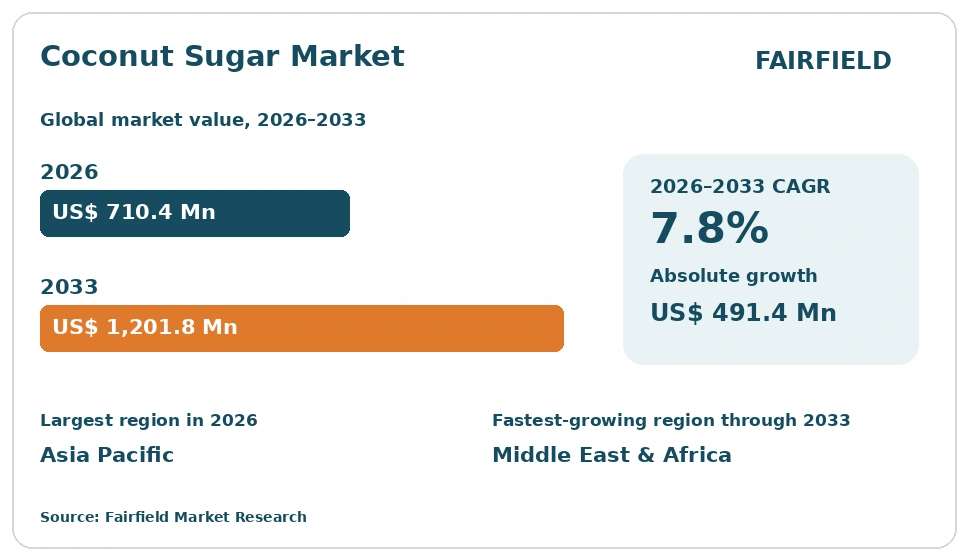
The global Coconut Sugar market size is expected to be valued at US$ 710.4 million in 2026 and projected to reach US$ 1,201.8 million by 2033, growing at a CAGR of 7.8% between 2026 and 2033. Growth rests on steady reformulation work by food and beverage makers who want unrefined, plant-derived sweeteners with a short ingredient list. Expanding certified acreage in Indonesia and the Philippines, wider supermarket listings and stronger online grocery reach are lifting volumes well beyond specialty aisles. The market gained value at a 6.4% CAGR between 2020 and 2025, and the absolute dollar opportunity through 2033 stands at US$ 491.4 million.
Key Report Takeaways
- By Nature: Conventional coconut sugar led with a 57.4% share in 2026, while organic is projected to expand at a 9.3% CAGR through 2033, driven by group certification schemes that make compliance workable for village-level smallholder tappers.
- By Form: Granulated led with a 61.8% share in 2026, while syrup is projected to expand at a 9.6% CAGR through 2033, driven by simpler dosing through the metering pumps already installed on beverage and sauce lines.
- By Application: Retail and household table use led with a 34.6% share in 2026, while beverages are projected to expand at a 9.8% CAGR through 2033, driven by café syrup menus and bottled plant-based drink launches.
- By Distribution Channel: Supermarkets and hypermarkets led with a 30.8% share in 2026, while online retail is projected to expand at an 11.2% CAGR through 2033, driven by subscription pantry models and direct-from-origin brand storefronts.
- By Region: Asia Pacific led with a 46.8% share in 2026, while Middle East & Africa is projected to expand at a 9.6% CAGR through 2033, driven by the fast build-out of modern grocery and premium café formats in Gulf cities.
Market Trends and Insights
Market Growth Drivers
Clean-Label Reformulation Pulls Coconut Sugar Into Mainstream Food Manufacturing
Clean-label reformulation is the strongest single pull on coconut sugar demand today. Packaged food companies are replacing refined cane sugar on ingredient decks with sweeteners that shoppers read as minimally processed. Coconut sugar fits that brief because it is palm sap that has been boiled and crystallised, with no bleaching stage. Bakery, cereal and snack brands use it in granola, cookies and bars, where its caramel note works with the base recipe rather than against it.
The shift shows up in product development pipelines across North America and Europe. Contract manufacturers now hold coconut sugar as a standing raw material rather than a special order. Ingredient distributors have added food-grade granulated and powdered grades with set particle sizes, which makes substitution easier on existing dosing lines. Glycaemic positioning is used in category marketing, though the claim is contested, and brands increasingly lead on sourcing and processing detail instead.
Organic Certification and Export Infrastructure Widen Reliable Supply
Certification and better export infrastructure have turned an artisanal product into a dependable supply line. Buyers who once faced inconsistent moisture, colour and particle size can now contract against written specifications. That reliability has carried coconut sugar from niche health retail into industrial purchase agreements. Large food companies list an ingredient only when supply, documentation and food-safety audits hold steady across several consecutive seasons, and the category now clears that bar.
Processing capacity in Indonesia and the Philippines has gathered around centralised drying, sieving and packing facilities fed by village-level tappers. Organic and fair-trade certification frameworks have pushed group certification, farmer registers and lot traceability through these chains. Export-oriented plants run metal detection, moisture control and microbiological testing to satisfy importer requirements. Those systems lower rejection rates and give buyers the audit trail their own retail customers demand.
Restraints Impact Analysis of Market
Price Gap Against Cane and Beet Sugar Limits Volume Use
Price remains the clearest brake on volume growth in this market. Coconut sugar sells at a substantial premium to refined cane and beet sugar, which caps its use in cost-sensitive categories. Mass-market soft drinks, industrial bakery and high-throughput confectionery lines built on commodity sweetener economics cannot absorb that gap. Demand stays concentrated in premium, organic and better-for-you products where the ingredient earns back its cost on the front of pack.
The premium reflects real production economics rather than margin stacking by traders. Sap is tapped by hand from individual palm inflorescences, collected twice daily and boiled within hours before fermentation sets in. Yields per tree are modest and the process stays labour-intensive at every step. Smallholder farmers who tap for sugar give up the nut harvest, so the switch only pays when sugar prices hold firm. Those constraints keep unit costs high.
Harvest Concentration and Sap Collection Labour Constrain Scale
Supply concentration places a second ceiling on growth. The great majority of traded coconut sugar originates in Indonesia and the Philippines, so weather, pest pressure and local labour conditions in two countries set global availability. Typhoons, drought and ageing palm stands can tighten supply within a single season. Buyers who need multi-year contracts treat that concentration as a sourcing risk and cap the share of their recipes committed to it.
Labour supply is the tighter constraint behind the scenes. Tapping requires climbing palms twice a day in heat, and younger rural workers often prefer other employment. Replanting cycles are long, since a coconut palm takes several years to reach tapping maturity. Training, safety equipment and reliable farmgate prices all shape whether tapper numbers hold steady. Where those conditions slip, collection volumes fall before processors see any clear warning signal.
Market Opportunities
Liquid and Syrup Formats Open Beverage and Food Service Accounts
Liquid formats open accounts that granulated sugar cannot reach on its own. Coffee chains, bubble-tea operators and beverage co-packers dose sweetener through pumps and metering systems, which suits syrup rather than crystals. A coconut sugar syrup drops into that equipment without plant changes. Sauce, marinade and dressing producers follow the same handling logic. Converting these users adds steady contracted volume at order sizes far above what retail packs deliver.
Syrup also settles a formulation problem. Dissolving granulated coconut sugar in cold beverages leaves sediment and colour variation, which a properly filtered syrup avoids. Processors are investing in evaporation and filtration steps that hold a consistent Brix level and stable colour across lots. Shelf-stable bag-in-box and bulk drum packaging suits food service logistics. Each step moves the product from a retail speciality toward a working industrial sweetening input.
Traceable, Farmer-Linked Supply Chains Create Premium Positioning
Traceable, farmer-linked supply chains are becoming a commercial asset rather than a compliance cost. Brands that can name the cooperative, district or processing site behind a lot win better shelf positions and defend higher prices. Retail buyers in Europe and North America increasingly request sourcing documentation before they agree to list a product. Coconut sugar suits this model because production is already organised around identifiable village collection groups.
Smallholder livelihoods sit at the centre of that story. Sap tapping gives farming households more frequent income than annual copra sales, and organised buying groups shorten the chain between farm and processor. Fair-trade and organic certification frameworks support farmer premiums, training and record keeping. Companies investing in tapping equipment, safety gear and replanting programmes protect their own supply while lifting farm incomes. That alignment is the most durable growth route available here.
Category-wise Insights
Conventional Supply Holds Volume While Organic Captures Premium Demand
Conventional coconut sugar led with a 57.4% share in 2026, carried by domestic consumption across Indonesia, the Philippines and neighbouring markets where block and granulated sugar are everyday kitchen staples. That base is price-led and moves largely through traditional trade. Organic coconut sugar is the growth leader, set to expand at a 9.3% CAGR between 2026 and 2033. Export buyers in North America and Europe specify certified organic lots almost by default, and group certification has made compliance workable for smallholder tappers. The split matters for strategy: volume sits in conventional supply, while margin and contract security sit in certified lots. Processors running both streams through a single facility capture domestic turnover and export premiums without duplicating capital spending on drying, sieving and packing equipment.
Granulated Form Anchors Sales as Syrup Builds Beverage Share
Granulated coconut sugar held 61.8% of the market in 2026, since it substitutes one-for-one in recipes and ships as a dry, shelf-stable solid. Retail packs, bakery blends and cereal applications all draw on this format. Syrup is the fastest-growing form at a 9.6% CAGR through 2033. Beverage makers and food service operators dose liquid sweetener through existing pumps, and syrup dissolves cleanly in cold drinks where crystals leave sediment. Block coconut sugar stays important in Southeast Asian home cooking and traditional sweets, while paste serves confectionery fillings. The practical reading for investors is that processors now need drying lines and evaporation capacity side by side. Facilities built only for crystallised output will miss the beverage and food service demand forming around liquid sweeteners.
Which Application Is Growing Fastest in the Coconut Sugar Market?
Beverages are the fastest-growing application, set to expand at a 9.8% CAGR between 2026 and 2033. Coffee chains, tea houses and bottled plant-based drink brands use coconut sugar syrups for a caramel note that pairs well with oat and almond bases. Retail and household table use still leads with a 34.6% share in 2026, concentrated in producing countries where block and granulated sugar go into daily cooking. Bakery and confectionery follows, using the ingredient in cookies, bars and granola. Dairy, frozen desserts, sauces and dressings take the remainder. For suppliers, the beverage channel means shifting from case-pack retail logistics toward bulk liquid delivery, hands-on technical support on dosing rates, and specification sheets that hold Brix and colour steady from one production lot to the next.
Supermarkets Lead Reach While Online Retail Scales Quickest
Supermarkets and hypermarkets led distribution with a 30.8% share in 2026, giving coconut sugar the shelf visibility it needs to reach past committed health-food buyers. Business-to-business and food service sales follow, supplying bakeries, beverage makers and contract manufacturers. Online retail is the fastest-growing channel at an 11.2% CAGR through 2033. Subscription pantry models, marketplace listings and direct-from-origin brand stores let small producers reach export consumers without a distributor. Traditional and wet markets still move substantial volume in producing countries, and specialty health food stores anchor premium organic lots. The pattern tells brands to split their commercial effort in two: grocery listings build scale and household trial, while online channels carry the sourcing story, farmer detail and certification evidence that justify a higher shelf price.
Geography Analysis
North America Builds Demand Through Clean-Label Packaged Food
North America held the second-largest regional position with a 23.1% share in 2026 and is set to grow at a 7.2% CAGR through 2033. The United States accounts for most of that demand, with Canada adding steady natural-foods volume. Growth comes from packaged food reformulation, where bakery, snack bar and cereal brands list coconut sugar to support clean-label positioning. Natural grocery chains and mainstream supermarkets now both carry retail packs. Importers favour certified organic lots and keep documentation that satisfies U.S. Food and Drug Administration food-safety expectations and National Organic Program certification requirements. Private-label ranges from large grocers have widened the price ladder, pulling the ingredient past its original specialty-store base.
Europe Pairs Organic Certification With Fair Trade Sourcing
Europe accounted for a 19.4% share in 2026 and is set to grow at a 7.6% CAGR through 2033. Germany, the United Kingdom, the Netherlands and France lead consumption, and Dutch and German importers act as the main entry point for Asian supply. Demand is shaped by organic retail chains and by buyers who ask for fair-trade style sourcing evidence alongside certification marks. European Union organic import rules push documented chains of custody, which favours processors that already hold group certification. Bakery ingredient suppliers and private-label grocers both list coconut sugar, and syrup formats have started appearing in café supply catalogues across the region.
Which Region Is Leading the Coconut Sugar Market?
Asia Pacific leads the coconut sugar market with a 46.8% share in 2026 and is set to grow at a 7.9% CAGR through 2033. Indonesia and the Philippines supply most of the world’s traded volume and consume large quantities at home, where block and granulated sugar are kitchen basics. India, Thailand, Sri Lanka and Viet Nam add tapping and processing capacity. Leadership rests on three things: the palm resource base, a tapping workforce built over generations, and processing plants sited close to collection points so sap is boiled before it ferments. Government and industry association programmes supporting coconut replanting and farmer organisation reinforce that position.
Latin America Adds Volume Through Regional Specialty Retail
Latin America held a 5.9% share in 2026 and is projected to grow at an 8.3% CAGR through 2033. Brazil and Mexico account for most regional consumption, supported by specialty grocery formats and natural-products retailers in large cities. The region has its own unrefined sweetener traditions, including panela and piloncillo, which makes block-form coconut sugar familiar to shoppers and cooks. Most volume arrives as imports from Asia, though coastal coconut-growing areas run small-scale tapping activity. Growth tracks the widening premium grocery footprint, broader e-commerce delivery coverage, and the bakery and café operators who want an unrefined sweetener with a recognisable flavour profile.
Which Region Is Growing Fastest in the Coconut Sugar Market?
Middle East & Africa is the fastest-growing region, set to expand at a 9.6% CAGR between 2026 and 2033 from a 4.8% share in 2026. The United Arab Emirates, Saudi Arabia and South Africa lead demand, where modern grocery formats and health-focused retail concepts have expanded quickly in major cities. A large expatriate population familiar with Southeast Asian cooking supports steady retail turnover. Hotel and café operators in Gulf cities list unrefined sweeteners on premium menus. East African coconut-growing areas, including coastal Tanzania, Mozambique and Kenya, have begun small tapping and processing projects that could add regional supply over the forecast period.
Competitive Landscape
The coconut sugar market is fragmented. Supply is split between a small group of export-oriented processors in Indonesia and the Philippines, a wide base of village-level producer groups, and consumer brands in North America and Europe that buy and repack rather than process. No single company controls a decisive share. Gradual consolidation is visible as larger organic ingredient traders bring village collection networks under contract, which signals a market moving from spot trading toward committed, audited supply.
Competition turns on supply security, certification and product consistency rather than price alone. Buyers compare moisture content, particle size, colour stability and microbiological results lot by lot. Firms that hold those specifications across seasons win repeat industrial contracts. Organic and fair-trade certification frameworks are now table stakes for export sales. Newer entrants compete on format range, adding syrups, powders and blends with other unrefined sweeteners to reach beverage and food service buyers.
Strategic activity centres on vertical control. Processors are extending backwards into farmer registration, tapping equipment supply and training so they can guarantee traceability and committed volume. Brand owners are moving the other way, signing direct supply agreements with origin processors to shorten the chain and protect their sourcing claims. Investment in drying, filtration and packing capacity near collection areas cuts spoilage and raises usable yield per litre of sap.
Competitive direction is set by three themes: traceable farmer-linked sourcing, format diversification beyond granulated sugar, and documented food-safety systems that satisfy industrial buyers. Fairfield Market Research observes that companies combining origin control with dependable specifications are best placed as the market shifts from specialty retail toward mainstream food manufacturing.
Industry Leaders
- Big Tree Farms
- Franklin Baker Company, Inc.
- Celebes Coconut Corporation
- Tradin Organic Agriculture B.V.
- Wholesome Sweeteners, Inc.
- Madhava Natural Sweeteners
Companies Covered in the Report
- Big Tree Farms
- Franklin Baker Company, Inc.
- Celebes Coconut Corporation
- Peter Paul Philippine Corporation
- Tradin Organic Agriculture B.V.
- SunOpta Inc.
- Wholesome Sweeteners, Inc.
- Madhava Natural Sweeteners
- Nutiva, Inc.
- Navitas Organics
- NOW Health Group, Inc.
- Bob’s Red Mill Natural Foods, Inc.
- Terrasoul Superfoods
- Urmatt Ltd.
- The Coconut Company (UK) Ltd.
Coconut Sugar Market Report Scope
The coconut sugar market is segmented by nature, form, application and distribution channel, across five regions.
| By Nature | Conventional, Organic |
| By Form | Granulated, Block, Syrup, Paste |
| By Application | Retail and Household Table Use, Bakery and Confectionery, Beverages, Dairy and Frozen Desserts, Sauces and Dressings |
| By Distribution Channel | Supermarkets and Hypermarkets, Business-to-Business and Food Service, Traditional and Wet Markets, Specialty and Health Food Stores, Online Retail |
| By Region | North America, Europe, Asia Pacific, Latin America, Middle East & Africa |
1. Executive Summary
1.1 Coconut Sugar Market Snapshot
1.2 Future Projections
1.3 Key Industry Highlights
1.4 Geographical Snapshot
2. Market Overview
2.1 Market Definition and Segmentation
2.2 Historical Market Trends
2.3 Market Dynamics
2.3.1 Drivers
2.3.1.1 Clean-Label Reformulation Pulls Coconut Sugar Into Mainstream Food Manufacturing
2.3.1.2 Organic Certification and Export Infrastructure Widen Reliable Supply
2.3.2 Restraints
2.3.2.1 Price Gap Against Cane and Beet Sugar Limits Volume Use
2.3.2.2 Harvest Concentration and Sap Collection Labour Constrain Scale
2.3.3 Market Opportunities
2.3.3.1 Liquid and Syrup Formats Open Beverage and Food Service Accounts
2.3.3.2 Traceable, Farmer-Linked Supply Chains Create Premium Positioning
3. Global Coconut Sugar Market Outlook, 2026–2033
3.1 Global Coconut Sugar Market Outlook, by Nature, Value (US$ Million), 2026–2033
3.1.1 Conventional
3.1.2 Organic
3.2 Global Coconut Sugar Market Outlook, by Form, Value (US$ Million), 2026–2033
3.2.1 Granulated
3.2.2 Block
3.2.3 Syrup
3.2.4 Paste
3.3 Global Coconut Sugar Market Outlook, by Application, Value (US$ Million), 2026–2033
3.3.1 Retail and Household Table Use
3.3.2 Bakery and Confectionery
3.3.3 Beverages
3.3.4 Dairy and Frozen Desserts
3.3.5 Sauces and Dressings
3.4 Global Coconut Sugar Market Outlook, by Distribution Channel, Value (US$ Million), 2026–2033
3.4.1 Supermarkets and Hypermarkets
3.4.2 Business-to-Business and Food Service
3.4.3 Traditional and Wet Markets
3.4.4 Specialty and Health Food Stores
3.4.5 Online Retail
3.5 Global Coconut Sugar Market Outlook, by Region, Value (US$ Million), 2026–2033
3.5.1 North America
3.5.2 Europe
3.5.3 Asia Pacific
3.5.4 Latin America
3.5.5 Middle East & Africa
4. North America Coconut Sugar Market Outlook, 2026–2033
4.1 North America Coconut Sugar Market Outlook, by Nature, Value (US$ Million), 2026–2033
4.1.1 Conventional
4.1.2 Organic
4.2 North America Coconut Sugar Market Outlook, by Form, Value (US$ Million), 2026–2033
4.2.1 Granulated
4.2.2 Block
4.2.3 Syrup
4.2.4 Paste
4.3 North America Coconut Sugar Market Outlook, by Application, Value (US$ Million), 2026–2033
4.3.1 Retail and Household Table Use
4.3.2 Bakery and Confectionery
4.3.3 Beverages
4.3.4 Dairy and Frozen Desserts
4.3.5 Sauces and Dressings
4.4 North America Coconut Sugar Market Outlook, by Distribution Channel, Value (US$ Million), 2026–2033
4.4.1 Supermarkets and Hypermarkets
4.4.2 Business-to-Business and Food Service
4.4.3 Traditional and Wet Markets
4.4.4 Specialty and Health Food Stores
4.4.5 Online Retail
4.5 North America Coconut Sugar Market Outlook, by Country, Value (US$ Million), 2026–2033
4.5.1 United States Coconut Sugar Market Outlook, by Nature, 2026–2033
4.5.2 United States Coconut Sugar Market Outlook, by Form, 2026–2033
4.5.3 United States Coconut Sugar Market Outlook, by Application, 2026–2033
4.5.4 United States Coconut Sugar Market Outlook, by Distribution Channel, 2026–2033
4.5.5 Canada Coconut Sugar Market Outlook, by Nature, 2026–2033
4.5.6 Canada Coconut Sugar Market Outlook, by Form, 2026–2033
4.5.7 Canada Coconut Sugar Market Outlook, by Application, 2026–2033
4.5.8 Canada Coconut Sugar Market Outlook, by Distribution Channel, 2026–2033
5. Europe Coconut Sugar Market Outlook, 2026–2033
5.1 Europe Coconut Sugar Market Outlook, by Nature, Value (US$ Million), 2026–2033
5.1.1 Conventional
5.1.2 Organic
5.2 Europe Coconut Sugar Market Outlook, by Form, Value (US$ Million), 2026–2033
5.2.1 Granulated
5.2.2 Block
5.2.3 Syrup
5.2.4 Paste
5.3 Europe Coconut Sugar Market Outlook, by Application, Value (US$ Million), 2026–2033
5.3.1 Retail and Household Table Use
5.3.2 Bakery and Confectionery
5.3.3 Beverages
5.3.4 Dairy and Frozen Desserts
5.3.5 Sauces and Dressings
5.4 Europe Coconut Sugar Market Outlook, by Distribution Channel, Value (US$ Million), 2026–2033
5.4.1 Supermarkets and Hypermarkets
5.4.2 Business-to-Business and Food Service
5.4.3 Traditional and Wet Markets
5.4.4 Specialty and Health Food Stores
5.4.5 Online Retail
5.5 Europe Coconut Sugar Market Outlook, by Country, Value (US$ Million), 2026–2033
5.5.1 Germany Coconut Sugar Market Outlook, by Nature, 2026–2033
5.5.2 Germany Coconut Sugar Market Outlook, by Form, 2026–2033
5.5.3 Germany Coconut Sugar Market Outlook, by Application, 2026–2033
5.5.4 Germany Coconut Sugar Market Outlook, by Distribution Channel, 2026–2033
5.5.5 United Kingdom Coconut Sugar Market Outlook, by Nature, 2026–2033
5.5.6 United Kingdom Coconut Sugar Market Outlook, by Form, 2026–2033
5.5.7 United Kingdom Coconut Sugar Market Outlook, by Application, 2026–2033
5.5.8 United Kingdom Coconut Sugar Market Outlook, by Distribution Channel, 2026–2033
5.5.9 Netherlands Coconut Sugar Market Outlook, by Nature, 2026–2033
5.5.10 Netherlands Coconut Sugar Market Outlook, by Form, 2026–2033
5.5.11 Netherlands Coconut Sugar Market Outlook, by Application, 2026–2033
5.5.12 Netherlands Coconut Sugar Market Outlook, by Distribution Channel, 2026–2033
5.5.13 France Coconut Sugar Market Outlook, by Nature, 2026–2033
5.5.14 France Coconut Sugar Market Outlook, by Form, 2026–2033
5.5.15 France Coconut Sugar Market Outlook, by Application, 2026–2033
5.5.16 France Coconut Sugar Market Outlook, by Distribution Channel, 2026–2033
6. Asia Pacific Coconut Sugar Market Outlook, 2026–2033
6.1 Asia Pacific Coconut Sugar Market Outlook, by Nature, Value (US$ Million), 2026–2033
6.1.1 Conventional
6.1.2 Organic
6.2 Asia Pacific Coconut Sugar Market Outlook, by Form, Value (US$ Million), 2026–2033
6.2.1 Granulated
6.2.2 Block
6.2.3 Syrup
6.2.4 Paste
6.3 Asia Pacific Coconut Sugar Market Outlook, by Application, Value (US$ Million), 2026–2033
6.3.1 Retail and Household Table Use
6.3.2 Bakery and Confectionery
6.3.3 Beverages
6.3.4 Dairy and Frozen Desserts
6.3.5 Sauces and Dressings
6.4 Asia Pacific Coconut Sugar Market Outlook, by Distribution Channel, Value (US$ Million), 2026–2033
6.4.1 Supermarkets and Hypermarkets
6.4.2 Business-to-Business and Food Service
6.4.3 Traditional and Wet Markets
6.4.4 Specialty and Health Food Stores
6.4.5 Online Retail
6.5 Asia Pacific Coconut Sugar Market Outlook, by Country, Value (US$ Million), 2026–2033
6.5.1 Indonesia Coconut Sugar Market Outlook, by Nature, 2026–2033
6.5.2 Indonesia Coconut Sugar Market Outlook, by Form, 2026–2033
6.5.3 Indonesia Coconut Sugar Market Outlook, by Application, 2026–2033
6.5.4 Indonesia Coconut Sugar Market Outlook, by Distribution Channel, 2026–2033
6.5.5 Philippines Coconut Sugar Market Outlook, by Nature, 2026–2033
6.5.6 Philippines Coconut Sugar Market Outlook, by Form, 2026–2033
6.5.7 Philippines Coconut Sugar Market Outlook, by Application, 2026–2033
6.5.8 Philippines Coconut Sugar Market Outlook, by Distribution Channel, 2026–2033
6.5.9 India Coconut Sugar Market Outlook, by Nature, 2026–2033
6.5.10 India Coconut Sugar Market Outlook, by Form, 2026–2033
6.5.11 India Coconut Sugar Market Outlook, by Application, 2026–2033
6.5.12 India Coconut Sugar Market Outlook, by Distribution Channel, 2026–2033
6.5.13 Thailand Coconut Sugar Market Outlook, by Nature, 2026–2033
6.5.14 Thailand Coconut Sugar Market Outlook, by Form, 2026–2033
6.5.15 Thailand Coconut Sugar Market Outlook, by Application, 2026–2033
6.5.16 Thailand Coconut Sugar Market Outlook, by Distribution Channel, 2026–2033
7. Latin America Coconut Sugar Market Outlook, 2026–2033
7.1 Latin America Coconut Sugar Market Outlook, by Nature, Value (US$ Million), 2026–2033
7.1.1 Conventional
7.1.2 Organic
7.2 Latin America Coconut Sugar Market Outlook, by Form, Value (US$ Million), 2026–2033
7.2.1 Granulated
7.2.2 Block
7.2.3 Syrup
7.2.4 Paste
7.3 Latin America Coconut Sugar Market Outlook, by Application, Value (US$ Million), 2026–2033
7.3.1 Retail and Household Table Use
7.3.2 Bakery and Confectionery
7.3.3 Beverages
7.3.4 Dairy and Frozen Desserts
7.3.5 Sauces and Dressings
7.4 Latin America Coconut Sugar Market Outlook, by Distribution Channel, Value (US$ Million), 2026–2033
7.4.1 Supermarkets and Hypermarkets
7.4.2 Business-to-Business and Food Service
7.4.3 Traditional and Wet Markets
7.4.4 Specialty and Health Food Stores
7.4.5 Online Retail
7.5 Latin America Coconut Sugar Market Outlook, by Country, Value (US$ Million), 2026–2033
7.5.1 Brazil Coconut Sugar Market Outlook, by Nature, 2026–2033
7.5.2 Brazil Coconut Sugar Market Outlook, by Form, 2026–2033
7.5.3 Brazil Coconut Sugar Market Outlook, by Application, 2026–2033
7.5.4 Brazil Coconut Sugar Market Outlook, by Distribution Channel, 2026–2033
7.5.5 Mexico Coconut Sugar Market Outlook, by Nature, 2026–2033
7.5.6 Mexico Coconut Sugar Market Outlook, by Form, 2026–2033
7.5.7 Mexico Coconut Sugar Market Outlook, by Application, 2026–2033
7.5.8 Mexico Coconut Sugar Market Outlook, by Distribution Channel, 2026–2033
8. Middle East & Africa Coconut Sugar Market Outlook, 2026–2033
8.1 Middle East & Africa Coconut Sugar Market Outlook, by Nature, Value (US$ Million), 2026–2033
8.1.1 Conventional
8.1.2 Organic
8.2 Middle East & Africa Coconut Sugar Market Outlook, by Form, Value (US$ Million), 2026–2033
8.2.1 Granulated
8.2.2 Block
8.2.3 Syrup
8.2.4 Paste
8.3 Middle East & Africa Coconut Sugar Market Outlook, by Application, Value (US$ Million), 2026–2033
8.3.1 Retail and Household Table Use
8.3.2 Bakery and Confectionery
8.3.3 Beverages
8.3.4 Dairy and Frozen Desserts
8.3.5 Sauces and Dressings
8.4 Middle East & Africa Coconut Sugar Market Outlook, by Distribution Channel, Value (US$ Million), 2026–2033
8.4.1 Supermarkets and Hypermarkets
8.4.2 Business-to-Business and Food Service
8.4.3 Traditional and Wet Markets
8.4.4 Specialty and Health Food Stores
8.4.5 Online Retail
8.5 Middle East & Africa Coconut Sugar Market Outlook, by Country, Value (US$ Million), 2026–2033
8.5.1 United Arab Emirates Coconut Sugar Market Outlook, by Nature, 2026–2033
8.5.2 United Arab Emirates Coconut Sugar Market Outlook, by Form, 2026–2033
8.5.3 United Arab Emirates Coconut Sugar Market Outlook, by Application, 2026–2033
8.5.4 United Arab Emirates Coconut Sugar Market Outlook, by Distribution Channel, 2026–2033
8.5.5 Saudi Arabia Coconut Sugar Market Outlook, by Nature, 2026–2033
8.5.6 Saudi Arabia Coconut Sugar Market Outlook, by Form, 2026–2033
8.5.7 Saudi Arabia Coconut Sugar Market Outlook, by Application, 2026–2033
8.5.8 Saudi Arabia Coconut Sugar Market Outlook, by Distribution Channel, 2026–2033
8.5.9 South Africa Coconut Sugar Market Outlook, by Nature, 2026–2033
8.5.10 South Africa Coconut Sugar Market Outlook, by Form, 2026–2033
8.5.11 South Africa Coconut Sugar Market Outlook, by Application, 2026–2033
8.5.12 South Africa Coconut Sugar Market Outlook, by Distribution Channel, 2026–2033
8.5.13 Kenya Coconut Sugar Market Outlook, by Nature, 2026–2033
8.5.14 Kenya Coconut Sugar Market Outlook, by Form, 2026–2033
8.5.15 Kenya Coconut Sugar Market Outlook, by Application, 2026–2033
8.5.16 Kenya Coconut Sugar Market Outlook, by Distribution Channel, 2026–2033
9. Competitive Landscape
9.1 Industry Leaders
9.2 Company Profiles
9.2.1 Big Tree Farms
9.2.2 Franklin Baker Company, Inc.
9.2.3 Celebes Coconut Corporation
9.2.4 Peter Paul Philippine Corporation
9.2.5 Tradin Organic Agriculture B.V.
9.2.6 SunOpta Inc.
9.2.7 Wholesome Sweeteners, Inc.
9.2.8 Madhava Natural Sweeteners
9.2.9 Nutiva, Inc.
9.2.10 Navitas Organics
9.2.11 NOW Health Group, Inc.
9.2.12 Bob's Red Mill Natural Foods, Inc.
9.2.13 Terrasoul Superfoods
9.2.14 Urmatt Ltd.
9.2.15 The Coconut Company (UK) Ltd.
10. Appendix
10.1 Research Methodology
10.2 Report Assumptions
10.3 Acronyms and Abbreviations
| By Nature | Conventional, Organic |
| By Form | Granulated, Block, Syrup, Paste |
| By Application | Retail and Household Table Use, Bakery and Confectionery, Beverages, Dairy and Frozen Desserts, Sauces and Dressings |
| By Distribution Channel | Supermarkets and Hypermarkets, Business-to-Business and Food Service, Traditional and Wet Markets, Specialty and Health Food Stores, Online Retail |
| By Region | North America, Europe, Asia Pacific, Latin America, Middle East & Africa |
Our Research Methodology
Considering the volatility of business today, traditional approaches to strategizing a game plan can be unfruitful if not detrimental. True ambiguity is no way to determine a forecast. A myriad of predetermined factors must be accounted for such as the degree of risk involved, the magnitude of circumstances, as well as conditions or consequences that are not known or unpredictable. To circumvent binary views that cast uncertainty, the application of market research intelligence to strategically posture, move, and enable actionable outcomes is necessary.
View Methodology
Quality Assured
Rigorous Validation Process

Confidentiality Assured
End-to-end Data Security

Custom Research Services
Tailored To Your Objectives
FAQs
The global coconut sugar market is valued at US$ 710.4 million in 2026 and is projected to reach US$ 1,201.8 million by 2033.
The market is forecast to grow at a 7.8% CAGR between 2026 and 2033, adding an absolute opportunity of US$ 491.4 million.
Retail and household table use leads with a 34.6% share in 2026, while beverages grow fastest at a 9.8% CAGR through 2033.
Asia Pacific leads with a 46.8% share in 2026, while Middle East & Africa grows fastest at a 9.6% CAGR through 2033.
Yes, the market is fragmented, split between origin processors in Indonesia and the Philippines, village producer groups, and consumer brands that repack imported sugar.
Related Reports
Baby Infant Formula Market Size, Share, Insights, Competitive Landscape, and Forecast 2026 to 2033
Explore the baby infant formula market outlook for 2026–2033, including product trends, ingredient bases, regional insights, and competitive analysis.
Margarine Market Size, Share, Insights, Competitive Landscape, and Forecast 2026 to 2033
The margarine market is projected to grow from US$23.5 billion in 2026 to US$27.0 billion by 2033 at a 2.0% CAGR.
Low Fat Cheese Market Size, Share, Insights, Competitive Landscape, and Forecast 2026 to 2033
The global low fat cheese market is valued at US$6.8 billion in 2026, reaching US$9.2 billion by 2033, growing at a 4.4% CAGR
Instant Beverage Premix Market Size, Share, Insights, Competitive Landscape, and Forecast 2026 to 2033
The global instant beverage premix market is valued at US$24.0 billion in 2026, reaching US$36.5 billion by 2033, growing at a 6.2% CAGR
Infant Nutrition Market Size, Share, Insights, Competitive Landscape, and Forecast 2026 to 2033
The global infant nutrition market is valued at US$103.18 billion in 2026, reaching US$153.09 billion by 2033, growing at a 5.8% CAGR
Yeast Protein Market Size, Share, Insights, Competitive Landscape, and Forecast 2026 to 2033
The global yeast protein market is valued at US$0.9 billion in 2026, reaching US$2.0 billion by 2033, growing at a 12.1% CAGR