



Yeast Protein Market
Yeast Protein Market Size, Share, Insights, Competitive Landscape, and Forecast 2026 to 2033
Yeast Protein Market Size and Trend Analysis
How Large Is the Yeast Protein Market in 2026?
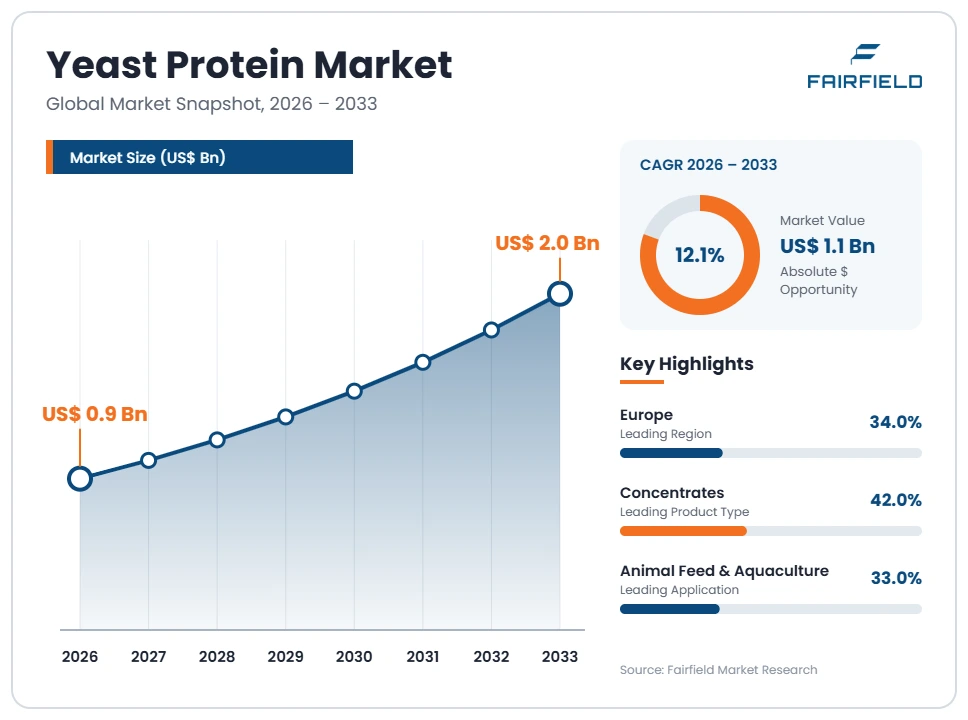
The global Yeast Protein market size is expected to be valued at US$ 0.9 billion in 2026 and projected to reach US$ 2.0 billion by 2033, growing at a CAGR of 12.1% between 2026 and 2033.
The category grew at roughly 14% a year between 2020 and 2025, ending that period near US$ 0.8 billion from a very small base, with feed and pet food taking most of the tonnage. Three forces shape the outlook. Protein grown in a fermenter is not exposed to acreage, weather or harvest, which appeals to buyers managing supply risk. Aquaculture and pet food formulators qualify new protein ingredients in months, while human food brands take years. Better deflavouring and decolouring is widening the range of recipes that can carry yeast protein at useful inclusion levels. Growth is fast in percentage terms but starts small, and regulatory market access rather than fermentation capacity sets the pace.
Key Report Takeaways
- By Product Type: Yeast protein concentrates held 42% share in 2026, while precision-fermented proteins made in yeast hosts are projected to expand at a 16.5% CAGR through 2033, as authorisation dossiers clear and contract fermentation capacity becomes available.
- By Source Biomass: Purpose-grown yeast held 56% share in 2026, while ethanol and distillery sidestream yeast is projected to grow at a 14.9% CAGR through 2033, because the raw material has already been paid for by another process.
- By Form: Powder held 78% share in 2026, while textured and extruded grades are projected to advance at a 15.4% CAGR through 2033, as meat analogue formulators look for fibrous structure from fermentation-derived inputs.
- By Application: Animal feed and aquaculture held 33% share in 2026, while pet food is projected to rise at a 15.8% CAGR through 2033, because premium pet brands accept new protein ingredients faster than packaged food brands.
- By Geography: Europe led with 34% share in 2026, while Asia Pacific is projected to grow at a 13.9% CAGR through 2033, as aquaculture feed demand and fermentation capacity expand across China, Vietnam and India.
Global Yeast Protein Market Trends and Insights
Drivers Impact Analysis
Both drivers rest on where the protein is made rather than on what it replaces on a label.
| Driver | Impact on CAGR Forecast | Geographic Relevance | Impact Timeline |
| Fermenter-grown protein supply that is independent of acreage and harvest | High | Global, led by Europe and North America | Long term ≥4 years |
| Aquaculture feed demand for alternatives to marine protein | High | Asia Pacific, Latin America and Europe | Medium term 2–4 years |
Fermenter-Grown Protein Decouples Yeast Protein Supply From Farmland and Harvest
Yeast protein’s structural argument is that it separates protein supply from farmland. A fermenter converts sugar into protein in days inside a building, so output does not depend on acreage, rainfall, growing season or harvest outcome. Volumes can be planned precisely, composition varies little between batches, and plants can be sited next to the customer rather than next to a crop. For buyers who have lived through harvest failures, freight disruption and export restrictions, that predictability is the purchase reason.
The mechanism is industrial rather than agricultural. Yeast grows quickly on glucose, molasses or other sugar streams, reaching high cell densities in standard stainless fermenters of a type already common across the brewing, baking and ethanol industries. Because the input is a sugar, a plant can run on whichever carbohydrate is cheapest locally. Food and feed manufacturers now write supply-risk criteria into sourcing policy, and fermentation answers them directly.
Aquaculture Feed Demand Pulls Yeast Protein to Commercial Inclusion Levels
Aquaculture feed takes the largest tonnage of yeast protein today, because fish and shrimp diets need concentrated protein and the traditional marine source is capped. Wild fishmeal supply is limited by catch quotas and varies with ocean conditions, while farmed output keeps rising. Feed formulators therefore qualify alternative protein ingredients continuously, and yeast biomass meets the amino acid profile and palatability requirements of several farmed species at commercial inclusion levels.
The enabling change is regulatory and commercial at once. Feed-grade material reaches the market through the EU feed materials catalogue and the feed additives framework, a far shorter route than human food authorisation. Certification schemes used by salmon and shrimp producers reward reduced reliance on wild-caught inputs, giving buyers a documented reason to switch. Norway, Chile, Vietnam and China host the farming industries making these substitutions at scale.
Restraints Impact Analysis
The two constraints are a processing problem and a market access problem, and both are costly.
| Restraint | Impact on CAGR Forecast | Geographic Relevance | Impact Timeline |
| Savoury, bitter and colour carryover in yeast protein preparations | High | Global | Short term ≤2 years |
| Novel food authorisation and equivalent clearance timelines | High | Europe, North America and Asia Pacific | Medium term 2–4 years |
Savoury, Bitter and Colour Carryover Caps Yeast Protein Inclusion Rates
The native material tastes strongly of yeast, and that caps how much of it a recipe can carry. Disrupted yeast biomass carries savoury, bitter and sulphurous notes together with a beige to brown colour, both inherited from the cell contents that processing is trying to separate. In neutral applications such as beverages, bakery and white meat analogues, inclusion rates sit well below what the protein content would otherwise allow, which holds back addressable volume and keeps suppliers out of the largest formats.
The cost sits in removing it. Deflavouring and decolouring need extra washing, isoelectric precipitation, adsorption, enzymatic treatment or solvent steps, each consuming water, energy and yield. Nucleic acid content is a further recognised compositional consideration in single-cell protein, and the processing used to reduce it adds similar cost. Sugar feedstock and electricity supply the rest, and together they decide whether fermented protein prices against crop protein.
Novel Food Authorisation Timelines Set the Pace of Market Access, Not Plant Capacity
Regulatory clearance, not fermentation capacity, sets how fast this market grows. Several yeast protein preparations and the organisms behind them require novel food authorisation in the European Union before they may be sold for human consumption, and comparable clearance applies in other jurisdictions. The process runs for years and absorbs management time and cash, so a company can hold product, capacity and willing customers and still be unable to sell into its target market.
The cause is the dossier itself. An applicant must characterise the organism and the production process, specify composition including protein and nucleic acid content, supply stability and toxicological data, and set out proposed uses and labelling. EFSA assesses it, and qualified presumption of safety status for a food-grade yeast species shortens the work without removing it. Allergen and cross-reactivity questions are handled inside the dossier, which adds analytical cost.
Market Opportunities
Pet Food Qualification Opens the First Scalable Revenue Pool for Yeast Protein
Pet food is the revenue pool that opens first, because it pays food-grade prices without carrying food-grade label sensitivity. Premium pet brands already buy yeast-derived ingredients, and their technical teams qualify new protein sources in months rather than years. Yeast protein suits the category on palatability, consistent batch composition and a savoury profile that sits comfortably with meat flavours, while the beige colour that constrains beverage use is simply irrelevant in a brown kibble or wet recipe.
Producers with existing yeast fermentation assets can capture it without new technology, because pet food accepts concentrate grades that need far less deflavouring than human food isolates. Demand comes from premium and specialty brands building protein diversity into recipes, and from private-label manufacturers serving them. Market access runs through animal feed rules rather than novel food authorisation, which removes the longest delay.
Spent Brewing and Ethanol Yeast Turns a Disposal Cost Into Protein Raw Material
Spent brewing and ethanol yeast converts a disposal cost into a protein raw material. Breweries and fuel ethanol plants generate very large volumes of surplus yeast that is sold cheaply as liquid feed or paid away for removal. Upgrading that biomass into protein concentrate captures the gap between a near-zero feedstock value and an ingredient price, which is the strongest margin structure available anywhere in this market.
Yeast ingredient companies and ethanol producers are both placed to capture it, and several already run drying and separation plants beside fermentation sites. Demand comes from feed and pet food buyers first, because sidestream material carries more flavour and colour carryover than purpose-grown biomass. The constraints are logistics and consistency: spent yeast is perishable, varies with the parent process and must be stabilised quickly, so plants sit next to the source.
Segment Analysis
- By Product Type: Concentrates Lead Today While Precision-Fermented Grades Set the Pace
Yeast protein concentrates held 42% share in 2026, because they are the cheapest route to a usable protein ingredient and they serve feed, pet food and savoury applications where some residual flavour is acceptable. Isolates rank second and command higher prices, since the extra separation and washing raises protein content and lowers colour. Hydrolysates and whole-cell single-cell protein grades, including torula, fill specialist roles. Precision-fermented proteins made in yeast hosts are the fastest-growing product type at a 16.5% CAGR to 2033, counted here where yeast is the production organism and the protein itself is the ingredient sold. Growth is gated by authorisation rather than capacity, since most of these proteins are new to the regulatory system. The implication for suppliers is that downstream purification capability, not fermenter volume, separates the price tiers.
- By Source Biomass: Purpose-Grown Yeast Dominates as Ethanol Sidestreams Scale Fastest
Purpose-grown yeast held 56% share in 2026, cultivated specifically for protein on controlled sugar feedstock, which gives the consistent composition and lighter colour that higher-value grades require. Spent brewer’s yeast supplies a long-established second stream, recovered from breweries and already familiar to feed buyers. Ethanol and distillery sidestream yeast is the fastest-growing source at a 14.9% CAGR to 2033, because fuel ethanol plants produce surplus yeast at very large scale and the material costs almost nothing at the gate. Capturing it requires stabilisation and drying close to the plant, since the biomass degrades quickly. The business implication is a widening cost spread between producers who pay for sugar and producers who collect a residue, which is beginning to shape where new protein recovery capacity is built.
- By Form: Powder Carries Distribution While Textured Grades Expand Quickest
Powder held 78% share in 2026, because spray-dried protein ships without refrigeration, holds long shelf life and doses easily into dry blends, feed premixes and pet food recipes. Liquid and paste grades serve local customers who can take tanker or tote deliveries and avoid the energy cost and flavour loss of drying. Textured and extruded grades are the fastest-growing form at a 15.4% CAGR to 2033, driven by meat analogue formulators who need fibrous structure rather than only protein content, and who increasingly blend yeast protein with plant proteins in hybrid recipes. Texturising requires extrusion assets and a protein that holds together under shear, so relatively few suppliers offer it. For producers, the implication is that form capability now decides which customer conversations are even possible.
- By Application: Feed and Aquaculture Anchor Volume While Pet Food Grows Fastest
Animal feed and aquaculture held 33% share in 2026, the largest application, because feed buyers accept fermentation-derived protein readily and the route to market is comparatively short. Alternative protein and meat analogue formulation ranks second, followed by sports and active nutrition, where yeast protein is positioned on amino acid profile and solubility, and by bakery, snacks and beverages, where inclusion rates remain modest. Pet food is the fastest-growing application at a 15.8% CAGR to 2033, as premium brands build protein diversity into recipes and qualify ingredients far faster than packaged food companies can. The commercial implication is that near-term revenue sits in categories where labelling is less contested, while human food volumes depend on authorisation timelines that no supplier controls.
Geography Analysis
- North America Builds Yeast Protein Volume on Pet Food and a Faster Clearance Route
North America held 28% share in 2026 and is forecast to grow at an 11.6% CAGR to 2033. The United States drives regional demand through the world’s largest premium pet food industry, a substantial sports nutrition sector and a fuel ethanol industry that generates spent yeast at very large scale. Canada adds fermentation capacity and aquaculture feed demand. The regulatory position helps: the US Food and Drug Administration GRAS notification route is generally faster and more predictable than authorisation elsewhere, so suppliers often seek clearance here first. Consumer unfamiliarity with fermentation-derived ingredients remains a brand-level concern in retail food. The defining regional change is protein recovery investment at ethanol sites, which turns an existing residue stream into an ingredient.
- Which Region Is Leading the Yeast Protein Market?
Europe leads the yeast protein market with 34% share in 2026, growing at an 11.3% CAGR to 2033. Leadership reflects production rather than consumption alone. France, Germany, Belgium, the Netherlands and Denmark host the fermentation groups, brewing industry and drying capacity that supply most of the world’s yeast-derived protein, and the regional feed sector absorbs a large share of output. Feed-grade material moves through the feed materials catalogue without novel food authorisation, which is why feed and pet food dominate regional volume. Human food growth is slower here precisely because the novel food route is demanding. High industrial energy prices press on margins. The defining change is the authorisation pipeline, which will decide how much of this capacity can serve food.
- Which Region Is Growing Fastest in the Yeast Protein Market?
Asia Pacific is the fastest-growing region in the yeast protein market, advancing at a 13.9% CAGR to 2033 from 25% share in 2026. Three factors drive it. China has built very large fermentation capacity and is both a major producer and a major consumer of yeast-derived ingredients. Vietnam, Indonesia, Thailand and India operate fast-growing aquaculture industries that need concentrated protein and are actively reducing dependence on imported fishmeal. Japan and Korea add demand for high-specification food grades. Sugar and molasses feedstock is locally available in several countries, which supports competitive production cost. The decisive change is that regional producers are moving from supplying feed biomass toward supplying purified protein grades for export.
- Latin America Converts Sugarcane and Ethanol Yeast Into Feed Protein Supply
Latin America accounted for 8% share in 2026 and is projected to grow at an 11.0% CAGR to 2033. Brazil is central, because its sugarcane ethanol industry produces surplus yeast at a scale matched almost nowhere else, and local companies have long experience upgrading that biomass into feed and pet food ingredients. Chile adds salmon feed demand that is actively substituting marine protein, while Argentina and Mexico contribute pet food and feed volume. Barriers include currency volatility, long inland freight and limited domestic purification capacity for higher-value food grades. The clearest opportunity is export-oriented protein concentrate, since feedstock and fermentation know-how already exist and the gap is downstream separation and drying investment.
- Middle East & Africa Starts From Imports While Aquaculture and Pet Food Build Demand
Middle East & Africa represented 5% share in 2026 and is expected to grow at a 10.4% CAGR to 2033, the slowest regional rate but from the smallest base. Demand is led by aquaculture and poultry feed in Egypt, Saudi Arabia, Turkey, Nigeria and South Africa, and by a small but expanding premium pet food trade in the Gulf states. Almost all yeast protein is imported, which exposes buyers to freight cost and currency availability. Halal certification is a commercial requirement rather than an option for suppliers serving much of the region. The opportunity lies in local recovery of brewery and distillery yeast, which several feed producers are beginning to evaluate as an import substitute.
Competitive Landscape
The yeast protein market is moderately concentrated and unusually mixed in composition. A handful of established global fermentation groups hold most of the manufacturing capability, because they already own propagation, separation, drying and quality systems and can add protein fractionation as an incremental step rather than a greenfield project. Alongside them sits a much larger number of small, venture-funded entrants that hold technology or authorisation dossiers but little capacity, and that rely on contract fermentation. A third group, ethanol and brewing companies, enters from the raw material side rather than the ingredient side. Consolidation so far has mostly taken the form of established groups acquiring or partnering with technology holders to buy time on the regulatory path.
Competition is decided by two capabilities. The first is downstream processing quality: how completely a supplier removes savoury notes, bitterness and colour while holding protein yield and keeping cost per kilogram defensible. That single step separates a feed-grade concentrate from an isolate a beverage formulator will consider, and it is where most proprietary know-how sits. The second is regulatory position, because an authorised preparation with an assessed production organism can be sold while an unauthorised equivalent cannot, whatever its technical merit. Certification breadth covering halal, kosher and non-genetically-modified status frequently decides qualification. New entrants typically arrive from precision fermentation backgrounds, treating yeast as a host organism rather than as a biomass source.
Strategic activity clusters around securing low-cost sugar or sidestream feedstock, building or booking fermentation and drying capacity, and filing authorisation dossiers early enough that regulatory review does not become the critical path.
Strategic direction converges on entering through feed and pet food, funding the slower human food authorisations from that revenue, and investing in the deflavouring step that determines which applications remain open.
Recent Industry Developments
- 2007: The European Food Safety Authority introduced the qualified presumption of safety approach for microorganisms used in food and feed – it created the mechanism that shortens safety assessment for well-characterised food-grade yeasts and remains central to yeast protein dossiers today.
- 2013: The European Commission established the European Union catalogue of feed materials – it gave yeast biomass recognised feed material entries, which is why feed-grade yeast protein reaches market without the novel food route.
- 2015: The European Union adopted its novel foods regulation, replacing the earlier regime with a centralised authorisation procedure – it set the market access gate that yeast protein preparations and new production organisms must clear before human food sale.
- August 2016: The US Food and Drug Administration published its final rule on substances generally recognized as safe, formalising the voluntary GRAS notification procedure – it established the documented route that yeast protein ingredients now use for United States market access.
Companies Covered in the Report
- Lesaffre
- Angel Yeast Co., Ltd.
- Lallemand Inc.
- Leiber GmbH
- Ohly GmbH
- Associated British Foods plc
- Alltech, Inc.
- Biorigin
- ICC Brazil
- Prosol S.p.A.
- Oriental Yeast Co., Ltd.
- Arbiom
Yeast Protein Market Report Scope
| Metric | Value |
| Study Period | 2020–2033 |
| Market Size 2026 | US$ 0.9 Billion |
| Market Size 2033 | US$ 2.0 Billion |
| CAGR 2026–2033 | 12.1% |
| Absolute Dollar Opportunity | US$ 1.1 Billion |
| Largest Market | Europe (34% share in 2026) |
| Fastest-Growing Market | Asia Pacific (13.9% CAGR) |
| Market Concentration | Medium |
| Major Players | Lesaffre, Angel Yeast Co., Ltd., Lallemand Inc., Leiber GmbH, Alltech, Inc. |
Yeast Protein Market Segmentation
Product Type
- Yeast protein concentrates
- Yeast protein isolates
- Yeast protein hydrolysates
- Whole-cell single-cell protein
- Precision-fermented proteins made in yeast hosts
Source Biomass
- Purpose-grown yeast
- Spent brewer’s yeast
- Ethanol and distillery sidestream yeast
Form
- Powder
- Liquid and paste
- Textured and extruded
Application
- Animal feed and aquaculture
- Alternative protein and meat analogues
- Sports and active nutrition
- Bakery, snacks and beverages
- Pet food
Regions
- North America
- Europe
- Asia Pacific
- Latin America
- Middle East & Africa
- Executive Summary
- Global Yeast Protein Market Snapshot
- Future Projections, 2026-2033
- Key Market Trends
- Regional Snapshot
- Market Overview
- Market Definition and Report Scope
- Historical Market Trends, 2020-2025
- Market Dynamics
- Drivers Impact Analysis
- Fermenter-Grown Protein Decouples Yeast Protein Supply From Farmland and Harvest
- Aquaculture Feed Demand Pulls Yeast Protein to Commercial Inclusion Levels
- Restraints Impact Analysis
- Savoury, Bitter and Colour Carryover Caps Yeast Protein Inclusion Rates
- Novel Food Authorisation Timelines Set the Pace of Market Access, Not Plant Capacity
- Market Opportunities
- Pet Food Qualification Opens the First Scalable Revenue Pool for Yeast Protein
- Spent Brewing and Ethanol Yeast Turns a Disposal Cost Into Protein Raw Material
- Drivers Impact Analysis
- Global Yeast Protein Market Outlook, 2020-2033
- Global Yeast Protein Market Outlook, by Product Type, Value (US$ Billion), 2020-2033
- Yeast protein concentrates
- Yeast protein isolates
- Yeast protein hydrolysates
- Whole-cell single-cell protein
- Precision-fermented proteins made in yeast hosts
- Global Yeast Protein Market Outlook, by Source Biomass, Value (US$ Billion), 2020-2033
- Purpose-grown yeast
- Spent brewer's yeast
- Ethanol and distillery sidestream yeast
- Global Yeast Protein Market Outlook, by Form, Value (US$ Billion), 2020-2033
- Powder
- Liquid and paste
- Textured and extruded
- Global Yeast Protein Market Outlook, by Application, Value (US$ Billion), 2020-2033
- Animal feed and aquaculture
- Alternative protein and meat analogues
- Sports and active nutrition
- Bakery, snacks and beverages
- Pet food
- Global Yeast Protein Market Outlook, by Region, Value (US$ Billion), 2020-2033
- North America
- Europe
- Asia Pacific
- Latin America
- Middle East & Africa
- Global Yeast Protein Market Outlook, by Product Type, Value (US$ Billion), 2020-2033
- North America Yeast Protein Market Outlook, 2020-2033
- North America Yeast Protein Market Outlook, by Product Type, Value (US$ Billion), 2020-2033
- Yeast protein concentrates
- Yeast protein isolates
- Yeast protein hydrolysates
- Whole-cell single-cell protein
- Precision-fermented proteins made in yeast hosts
- North America Yeast Protein Market Outlook, by Source Biomass, Value (US$ Billion), 2020-2033
- Purpose-grown yeast
- Spent brewer's yeast
- Ethanol and distillery sidestream yeast
- North America Yeast Protein Market Outlook, by Form, Value (US$ Billion), 2020-2033
- Powder
- Liquid and paste
- Textured and extruded
- North America Yeast Protein Market Outlook, by Application, Value (US$ Billion), 2020-2033
- Animal feed and aquaculture
- Alternative protein and meat analogues
- Sports and active nutrition
- Bakery, snacks and beverages
- Pet food
- North America Yeast Protein Market Outlook, by Country, Value (US$ Billion), 2020-2033
- United States Yeast Protein Market Outlook, by Product Type, 2020-2033
- United States Yeast Protein Market Outlook, by Source Biomass, 2020-2033
- United States Yeast Protein Market Outlook, by Form, 2020-2033
- United States Yeast Protein Market Outlook, by Application, 2020-2033
- Canada Yeast Protein Market Outlook, by Product Type, 2020-2033
- Canada Yeast Protein Market Outlook, by Source Biomass, 2020-2033
- Canada Yeast Protein Market Outlook, by Form, 2020-2033
- Canada Yeast Protein Market Outlook, by Application, 2020-2033
- North America Yeast Protein Market Outlook, by Product Type, Value (US$ Billion), 2020-2033
- Europe Yeast Protein Market Outlook, 2020-2033
- Europe Yeast Protein Market Outlook, by Product Type, Value (US$ Billion), 2020-2033
- Yeast protein concentrates
- Yeast protein isolates
- Yeast protein hydrolysates
- Whole-cell single-cell protein
- Precision-fermented proteins made in yeast hosts
- Europe Yeast Protein Market Outlook, by Source Biomass, Value (US$ Billion), 2020-2033
- Purpose-grown yeast
- Spent brewer's yeast
- Ethanol and distillery sidestream yeast
- Europe Yeast Protein Market Outlook, by Form, Value (US$ Billion), 2020-2033
- Powder
- Liquid and paste
- Textured and extruded
- Europe Yeast Protein Market Outlook, by Application, Value (US$ Billion), 2020-2033
- Animal feed and aquaculture
- Alternative protein and meat analogues
- Sports and active nutrition
- Bakery, snacks and beverages
- Pet food
- Europe Yeast Protein Market Outlook, by Country, Value (US$ Billion), 2020-2033
- France Yeast Protein Market Outlook, by Product Type, 2020-2033
- France Yeast Protein Market Outlook, by Source Biomass, 2020-2033
- France Yeast Protein Market Outlook, by Form, 2020-2033
- France Yeast Protein Market Outlook, by Application, 2020-2033
- Germany Yeast Protein Market Outlook, by Product Type, 2020-2033
- Germany Yeast Protein Market Outlook, by Source Biomass, 2020-2033
- Germany Yeast Protein Market Outlook, by Form, 2020-2033
- Germany Yeast Protein Market Outlook, by Application, 2020-2033
- Belgium Yeast Protein Market Outlook, by Product Type, 2020-2033
- Belgium Yeast Protein Market Outlook, by Source Biomass, 2020-2033
- Belgium Yeast Protein Market Outlook, by Form, 2020-2033
- Belgium Yeast Protein Market Outlook, by Application, 2020-2033
- Netherlands Yeast Protein Market Outlook, by Product Type, 2020-2033
- Netherlands Yeast Protein Market Outlook, by Source Biomass, 2020-2033
- Netherlands Yeast Protein Market Outlook, by Form, 2020-2033
- Netherlands Yeast Protein Market Outlook, by Application, 2020-2033
- Denmark Yeast Protein Market Outlook, by Product Type, 2020-2033
- Denmark Yeast Protein Market Outlook, by Source Biomass, 2020-2033
- Denmark Yeast Protein Market Outlook, by Form, 2020-2033
- Denmark Yeast Protein Market Outlook, by Application, 2020-2033
- Europe Yeast Protein Market Outlook, by Product Type, Value (US$ Billion), 2020-2033
- Asia Pacific Yeast Protein Market Outlook, 2020-2033
- Asia Pacific Yeast Protein Market Outlook, by Product Type, Value (US$ Billion), 2020-2033
- Yeast protein concentrates
- Yeast protein isolates
- Yeast protein hydrolysates
- Whole-cell single-cell protein
- Precision-fermented proteins made in yeast hosts
- Asia Pacific Yeast Protein Market Outlook, by Source Biomass, Value (US$ Billion), 2020-2033
- Purpose-grown yeast
- Spent brewer's yeast
- Ethanol and distillery sidestream yeast
- Asia Pacific Yeast Protein Market Outlook, by Form, Value (US$ Billion), 2020-2033
- Powder
- Liquid and paste
- Textured and extruded
- Asia Pacific Yeast Protein Market Outlook, by Application, Value (US$ Billion), 2020-2033
- Animal feed and aquaculture
- Alternative protein and meat analogues
- Sports and active nutrition
- Bakery, snacks and beverages
- Pet food
- Asia Pacific Yeast Protein Market Outlook, by Country, Value (US$ Billion), 2020-2033
- China Yeast Protein Market Outlook, by Product Type, 2020-2033
- China Yeast Protein Market Outlook, by Source Biomass, 2020-2033
- China Yeast Protein Market Outlook, by Form, 2020-2033
- China Yeast Protein Market Outlook, by Application, 2020-2033
- Vietnam Yeast Protein Market Outlook, by Product Type, 2020-2033
- Vietnam Yeast Protein Market Outlook, by Source Biomass, 2020-2033
- Vietnam Yeast Protein Market Outlook, by Form, 2020-2033
- Vietnam Yeast Protein Market Outlook, by Application, 2020-2033
- Indonesia Yeast Protein Market Outlook, by Product Type, 2020-2033
- Indonesia Yeast Protein Market Outlook, by Source Biomass, 2020-2033
- Indonesia Yeast Protein Market Outlook, by Form, 2020-2033
- Indonesia Yeast Protein Market Outlook, by Application, 2020-2033
- Thailand Yeast Protein Market Outlook, by Product Type, 2020-2033
- Thailand Yeast Protein Market Outlook, by Source Biomass, 2020-2033
- Thailand Yeast Protein Market Outlook, by Form, 2020-2033
- Thailand Yeast Protein Market Outlook, by Application, 2020-2033
- India Yeast Protein Market Outlook, by Product Type, 2020-2033
- India Yeast Protein Market Outlook, by Source Biomass, 2020-2033
- India Yeast Protein Market Outlook, by Form, 2020-2033
- India Yeast Protein Market Outlook, by Application, 2020-2033
- Japan Yeast Protein Market Outlook, by Product Type, 2020-2033
- Japan Yeast Protein Market Outlook, by Source Biomass, 2020-2033
- Japan Yeast Protein Market Outlook, by Form, 2020-2033
- Japan Yeast Protein Market Outlook, by Application, 2020-2033
- Korea Yeast Protein Market Outlook, by Product Type, 2020-2033
- Korea Yeast Protein Market Outlook, by Source Biomass, 2020-2033
- Korea Yeast Protein Market Outlook, by Form, 2020-2033
- Korea Yeast Protein Market Outlook, by Application, 2020-2033
- Asia Pacific Yeast Protein Market Outlook, by Product Type, Value (US$ Billion), 2020-2033
- Latin America Yeast Protein Market Outlook, 2020-2033
- Latin America Yeast Protein Market Outlook, by Product Type, Value (US$ Billion), 2020-2033
- Yeast protein concentrates
- Yeast protein isolates
- Yeast protein hydrolysates
- Whole-cell single-cell protein
- Precision-fermented proteins made in yeast hosts
- Latin America Yeast Protein Market Outlook, by Source Biomass, Value (US$ Billion), 2020-2033
- Purpose-grown yeast
- Spent brewer's yeast
- Ethanol and distillery sidestream yeast
- Latin America Yeast Protein Market Outlook, by Form, Value (US$ Billion), 2020-2033
- Powder
- Liquid and paste
- Textured and extruded
- Latin America Yeast Protein Market Outlook, by Application, Value (US$ Billion), 2020-2033
- Animal feed and aquaculture
- Alternative protein and meat analogues
- Sports and active nutrition
- Bakery, snacks and beverages
- Pet food
- Latin America Yeast Protein Market Outlook, by Country, Value (US$ Billion), 2020-2033
- Brazil Yeast Protein Market Outlook, by Product Type, 2020-2033
- Brazil Yeast Protein Market Outlook, by Source Biomass, 2020-2033
- Brazil Yeast Protein Market Outlook, by Form, 2020-2033
- Brazil Yeast Protein Market Outlook, by Application, 2020-2033
- Chile Yeast Protein Market Outlook, by Product Type, 2020-2033
- Chile Yeast Protein Market Outlook, by Source Biomass, 2020-2033
- Chile Yeast Protein Market Outlook, by Form, 2020-2033
- Chile Yeast Protein Market Outlook, by Application, 2020-2033
- Argentina Yeast Protein Market Outlook, by Product Type, 2020-2033
- Argentina Yeast Protein Market Outlook, by Source Biomass, 2020-2033
- Argentina Yeast Protein Market Outlook, by Form, 2020-2033
- Argentina Yeast Protein Market Outlook, by Application, 2020-2033
- Mexico Yeast Protein Market Outlook, by Product Type, 2020-2033
- Mexico Yeast Protein Market Outlook, by Source Biomass, 2020-2033
- Mexico Yeast Protein Market Outlook, by Form, 2020-2033
- Mexico Yeast Protein Market Outlook, by Application, 2020-2033
- Latin America Yeast Protein Market Outlook, by Product Type, Value (US$ Billion), 2020-2033
- Middle East & Africa Yeast Protein Market Outlook, 2020-2033
- Middle East & Africa Yeast Protein Market Outlook, by Product Type, Value (US$ Billion), 2020-2033
- Yeast protein concentrates
- Yeast protein isolates
- Yeast protein hydrolysates
- Whole-cell single-cell protein
- Precision-fermented proteins made in yeast hosts
- Middle East & Africa Yeast Protein Market Outlook, by Source Biomass, Value (US$ Billion), 2020-2033
- Purpose-grown yeast
- Spent brewer's yeast
- Ethanol and distillery sidestream yeast
- Middle East & Africa Yeast Protein Market Outlook, by Form, Value (US$ Billion), 2020-2033
- Powder
- Liquid and paste
- Textured and extruded
- Middle East & Africa Yeast Protein Market Outlook, by Application, Value (US$ Billion), 2020-2033
- Animal feed and aquaculture
- Alternative protein and meat analogues
- Sports and active nutrition
- Bakery, snacks and beverages
- Pet food
- Middle East & Africa Yeast Protein Market Outlook, by Country and Subregion, Value (US$ Billion), 2020-2033
- Egypt Yeast Protein Market Outlook, by Product Type, 2020-2033
- Egypt Yeast Protein Market Outlook, by Source Biomass, 2020-2033
- Egypt Yeast Protein Market Outlook, by Form, 2020-2033
- Egypt Yeast Protein Market Outlook, by Application, 2020-2033
- Saudi Arabia Yeast Protein Market Outlook, by Product Type, 2020-2033
- Saudi Arabia Yeast Protein Market Outlook, by Source Biomass, 2020-2033
- Saudi Arabia Yeast Protein Market Outlook, by Form, 2020-2033
- Saudi Arabia Yeast Protein Market Outlook, by Application, 2020-2033
- Turkey Yeast Protein Market Outlook, by Product Type, 2020-2033
- Turkey Yeast Protein Market Outlook, by Source Biomass, 2020-2033
- Turkey Yeast Protein Market Outlook, by Form, 2020-2033
- Turkey Yeast Protein Market Outlook, by Application, 2020-2033
- Nigeria Yeast Protein Market Outlook, by Product Type, 2020-2033
- Nigeria Yeast Protein Market Outlook, by Source Biomass, 2020-2033
- Nigeria Yeast Protein Market Outlook, by Form, 2020-2033
- Nigeria Yeast Protein Market Outlook, by Application, 2020-2033
- South Africa Yeast Protein Market Outlook, by Product Type, 2020-2033
- South Africa Yeast Protein Market Outlook, by Source Biomass, 2020-2033
- South Africa Yeast Protein Market Outlook, by Form, 2020-2033
- South Africa Yeast Protein Market Outlook, by Application, 2020-2033
- Gulf states Yeast Protein Market Outlook, by Product Type, 2020-2033
- Gulf states Yeast Protein Market Outlook, by Source Biomass, 2020-2033
- Gulf states Yeast Protein Market Outlook, by Form, 2020-2033
- Gulf states Yeast Protein Market Outlook, by Application, 2020-2033
- Middle East & Africa Yeast Protein Market Outlook, by Product Type, Value (US$ Billion), 2020-2033
- Competitive Landscape
- Market Concentration and Industry Leaders
- Competitive Differentiation
- Strategic Initiatives
- Recent Industry Developments
- Company Profiles
- Lesaffre
- Angel Yeast Co., Ltd.
- Lallemand Inc.
- Leiber GmbH
- Ohly GmbH
- Associated British Foods plc
- Alltech, Inc.
- Biorigin
- ICC Brazil
- Prosol S.p.A.
- Oriental Yeast Co., Ltd.
- Arbiom
- Appendix
- Research Methodology
- Report Assumptions
- Acronyms and Abbreviations
Product Type
- Yeast protein concentrates
- Yeast protein isolates
- Yeast protein hydrolysates
- Whole-cell single-cell protein
- Precision-fermented proteins made in yeast hosts
Source Biomass
- Purpose-grown yeast
- Spent brewer’s yeast
- Ethanol and distillery sidestream yeast
Form
- Powder
- Liquid and paste
- Textured and extruded
Application
- Animal feed and aquaculture
- Alternative protein and meat analogues
- Sports and active nutrition
- Bakery, snacks and beverages
- Pet food
Regions
- North America
- Europe
- Asia Pacific
- Latin America
- Middle East & Africa
Our Research Methodology
Considering the volatility of business today, traditional approaches to strategizing a game plan can be unfruitful if not detrimental. True ambiguity is no way to determine a forecast. A myriad of predetermined factors must be accounted for such as the degree of risk involved, the magnitude of circumstances, as well as conditions or consequences that are not known or unpredictable. To circumvent binary views that cast uncertainty, the application of market research intelligence to strategically posture, move, and enable actionable outcomes is necessary.
View Methodology
Quality Assured
Rigorous Validation Process

Confidentiality Assured
End-to-end Data Security

Custom Research Services
Tailored To Your Objectives
FAQs
The yeast protein market is valued at US$ 0.9 billion in 2026, covering concentrates, isolates, hydrolysates, single-cell protein and precision-fermented yeast-host proteins.
The market is projected to reach US$ 2.0 billion by 2033, growing at a 12.1% CAGR and adding US$ 1.1 billion in absolute value.
Yeast protein concentrates lead with 42% share in 2026, because they are the lowest-cost usable grade for feed, pet food and savoury applications.
Pet food grows fastest at a 15.8% CAGR to 2033, because premium brands qualify new protein ingredients far quicker than packaged food companies.
Europe holds 34% share in 2026, because the region concentrates fermentation, brewing and drying capacity alongside a large feed sector.
Related Reports
Starch Derivatives Market Size, Share, Insights, Competitive Landscape, and Forecast 2026 to 2033
The global starch derivatives market is valued at US$62.5 billion in 2026, reaching US$88.0 billion by 2033, growing at a 5.0% CAGR
Quick Service Restaurants Market Size, Share, Insights, Competitive Landscape, and Forecast 2026 to 2033
The global quick service restaurants market is valued at US$1,090.0 billion in 2026, reaching US$1,556.0 billion by 2033, growing at a 5.2% CAGR
Plant Extracts Market Size, Share, Insights, Competitive Landscape, and Forecast 2026 to 2033
The global plant extracts market is valued at US$42.0 billion in 2026, reaching US$68.5 billion by 2033, growing at a 7.2% CAGR
Kombucha Market Size, Share, Insights, Competitive Landscape, and Forecast 2026 to 2033
The Kombucha Market is projected to grow from US$ 3.2 billion in 2026 to US$ 4.8 billion by 2033 at a 6.0% CAGR. Explore trends and leading segments.
Insect Protein Market Size, Share, Insights, Competitive Landscape, and Forecast 2026 to 2033
Insect Protein Market is projected to grow from US$ 1.03 billion in 2026 to US$ 3.17 billion by 2033 at a 17.4% CAGR. Explore trends and key segments.
Functional Mushroom Market Size, Share, Insights, Competitive Landscape, and Forecast 2026 to 2033
Explore the Functional Mushroom Market, projected to grow from US$ 2.6 billion in 2026 to US$ 4.4 billion by 2033 at a 7.8% CAGR. See trends and segments.