



Insect Protein Market
Insect Protein Market Size, Share, Insights, Competitive Landscape, and Forecast 2026 to 2033
How Fast Is the Insect Protein Market Growing?
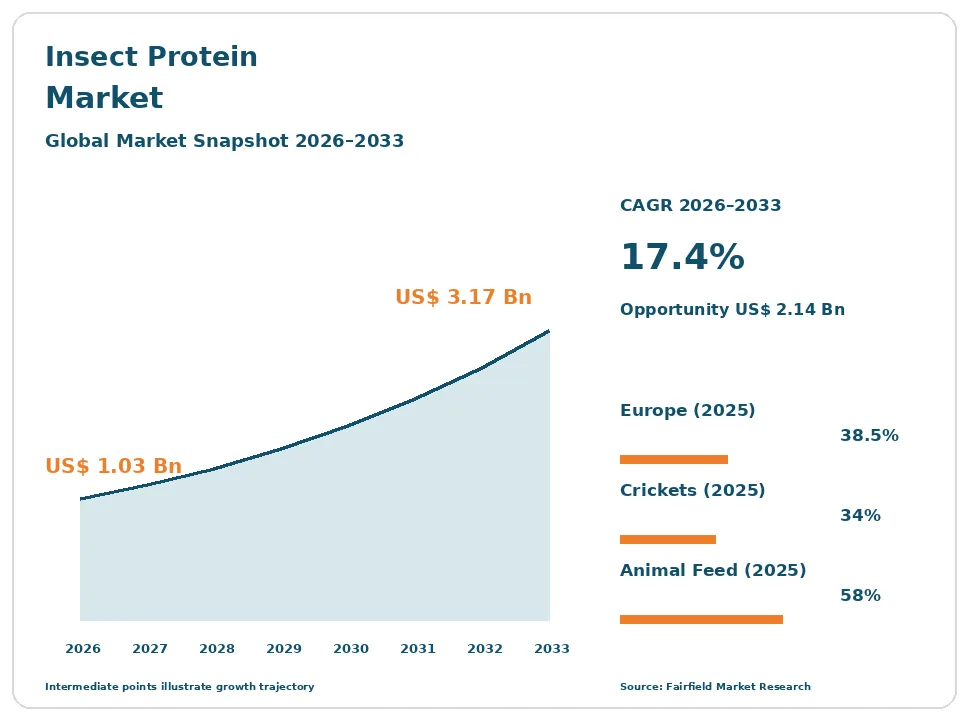
The global insect protein market size is expected to be valued at US$ 1.03 billion in 2026 and projected to reach US$ 3.17 billion by 2033, growing at a CAGR of 17.4% between 2026 and 2033.
Between 2020 and 2025, the market grew at a CAGR of about 21.5%, from a small base, as investors funded large insect farms and regulators in Europe approved insect proteins for poultry, pig, and fish feed and several insects for human food. The insect protein market covers protein meals, powders, isolates, and whole insects from black soldier fly larvae, mealworms, crickets, grasshoppers, and other species, used in aquaculture feed, poultry and pig feed, pet food, human food, and supplements. Insects convert food waste and by-products into high-quality protein with a low land and water footprint. Growth comes from rising demand for sustainable feed protein, fishmeal and soy price volatility, and circular economy policies. The market is consolidating after some high-profile failures, as companies focus on cost reduction and feed and pet food sales. In June 2026, Innovafeed raised €51 million to expand larva-based feed products.
Key Report Takeaways
- By Insect Type: Crickets held about 34% share in 2025, while Black Soldier Fly is projected to expand at a 19.8% CAGR through 2033, driven by fast larval growth on organic waste streams and large-scale production for aquaculture, poultry, and pet food.
- By Application: Animal Feed held about 58% share in 2025, while Pet Food is projected to expand at a 19.5% CAGR through 2033, driven by premium hypoallergenic formulas, sustainability claims, and pet owners seeking novel protein sources for sensitive pets.
- By Form: Insect Meal held about 52% share in 2025, while Protein Isolates are projected to expand at a 20.1% CAGR through 2033, driven by demand for high-purity, neutral-tasting ingredients for human food, sports nutrition, and functional products.
- By Region: Europe held 38.5% share in 2025, while Asia Pacific is projected to expand at a 19.2% CAGR through 2033, driven by large aquaculture industries, abundant organic waste, low production costs, and long traditions of eating insects.
Global Insect Protein Market Trends and Insights
Drivers Impact Analysis
Two drivers carry the strongest influence on insect protein market demand during the forecast period.
Sustainable Feed Demand Is Driving the Insect Protein Market
Rising demand for sustainable feed protein is the strongest driver of the insect protein market. Feed makers need alternatives to fishmeal and soy.
The mechanism is pressure on traditional protein sources. Aquaculture is the fastest-growing animal protein sector, and it depends heavily on fishmeal made from wild-caught fish, whose supply is limited and prices are volatile. Soybean meal is linked to deforestation in Brazil, and new European Union rules on deforestation-free supply chains raise scrutiny. Insect meal from black soldier fly larvae offers a protein content of around 40% to 60%, a good amino acid profile, and natural compounds such as lauric acid and chitin that may support animal gut health. Salmon, shrimp, trout, poultry, and pig feed makers are testing and adopting insect meal. Partnerships between insect producers and feed companies are growing, supporting steady demand.
Circular Economy Policies Are Expanding the Insect Protein Market
Circular economy and waste valorization policies are expanding the insect protein market. Insects turn waste into protein.
The cause is government efforts to cut food waste and emissions. Black soldier fly larvae can grow on brewery grains, fruit and vegetable waste, and food processing by-products, turning low-value streams into protein, oil, and fertilizer called frass. The European Union, France, the Netherlands, and Singapore support insect farming through grants and research programs. Food processors gain a new outlet for by-products. Insect frass is being approved as an organic fertilizer. Food retailers and brewers in Europe now sign supply deals with insect farms to cut disposal costs. Life cycle studies show insect meal can have a lower carbon footprint than some conventional proteins when produced on waste with renewable energy. These policies lower feedstock costs and support demand for insect protein and related products.
| Driver | Impact on CAGR Forecast | Geographic Relevance | Impact Timeline |
| Rising demand for sustainable feed protein | High | Global, strongest in Europe and Asia Pacific | Long term (≥4 years) |
| Circular economy and waste valorization policies | Medium | Europe, North America | Medium term (2-4 years) |
Restraints Impact Analysis
Two restraints limit how quickly the insect protein market grows.
High Production Costs Slow the Insect Protein Market
High production costs and difficult scale-up slow the insect protein market. Insect meal often costs more than fishmeal.
The specific causes are energy, automation, and capital intensity. Insect farms need climate-controlled buildings, automated rearing systems, and processing equipment, requiring large investments before revenue arrives. Energy for heating and drying is costly in Europe. Scaling biology is harder than expected, and yields can vary. Ÿnsect, once one of the best-funded insect companies, went bankrupt in 2025 after raising about US$ 600 million, showing the risks. Investors have become cautious, and funding for new plants is harder to secure. Insect meal prices remain above fishmeal and soy in many markets, limiting adoption to premium feed and pet food until costs fall further through better automation and larger plants.
Consumer Resistance Restricts the Insect Protein Market
Consumer resistance and regulatory limits restrict the insect protein market. Many people in Western countries dislike eating insects.
The underlying causes are cultural attitudes and rules. Surveys show many consumers in North America and Europe are unwilling to eat insects, limiting human food sales. Feed rules restrict which waste streams insects can eat, excluding manure and catering waste in many countries. Novel food approvals take years and cost money. Labeling requirements and allergy warnings for people with shellfish allergies add complexity. Several edible insect protein startups in North America and Europe have closed or pivoted to pet food since 2022 because sales were slower than expected. Prices for cricket powder remain much higher than whey or pea protein. Misinformation online about insects in food has also fueled resistance. These limits slow growth in human food applications, although hidden uses in powders and pasta may help.
| Restraint | Impact on CAGR Forecast | Geographic Relevance | Impact Timeline |
| High production costs and difficult scale-up | High | Global | Long term (≥4 years) |
| Consumer resistance and regulatory limits | Medium | North America, Europe | Medium term (2-4 years) |
Market Opportunities
Pet Food and Aquaculture Partnerships Open a Fast-Growth Revenue Pool
Pet food and aquaculture partnerships open a fast-growth revenue pool in the insect protein market. These buyers pay premium prices.
Insect producers can capture this opportunity. Pet owners are willing to pay more for hypoallergenic and sustainable pet foods, and insect protein suits dogs and cats with allergies to common proteins. Brands in Europe, North America, and Asia Pacific have launched insect-based pet foods and treats. Aquaculture companies producing salmon, trout, and shrimp seek lower-carbon feed ingredients. Long-term supply agreements with feed and pet food companies give producers stable demand and help secure financing. Protix, Innovafeed, and Entobel have built such partnerships with feed and black soldier fly protein buyers. Companies that secure offtake contracts can scale faster and lower their cost of capital.
Asia Pacific Production Hubs Create a Growth Revenue Pool
Asia Pacific production hubs create a growth revenue pool in the insect protein market. Lower costs and warm climates help.
Producers can capture this opportunity. Vietnam, Indonesia, Thailand, Malaysia, and China offer warm climates that reduce heating costs, abundant organic waste, and large aquaculture industries nearby. Entobel and Nutrition Technologies operate black soldier fly plants in the region. Edible insects are already eaten in Thailand and China. Shrimp and fish farms in Vietnam, Indonesia, and Thailand are among the world’s largest, giving producers nearby customers. Palm oil and food processing by-products provide cheap feedstock. Governments in Singapore, South Korea, and Thailand have approved insects for food and support the sector. Companies building low-cost plants close to feed customers can win share quickly.
Segment Analysis
By Insect Type: Crickets Lead While Black Soldier Fly Grows Fastest
Crickets held about 34% share in 2025. Cricket powder, flour, and protein are the best-known insect ingredients for human food, used in protein bars, pasta, snacks, baked goods, and sports nutrition. Aspire Food Group and Entomo Farms are major cricket producers. Higher prices per kilogram give crickets a large value share despite smaller volumes, and edible insect protein from crickets dominates snack sales.
Black Soldier Fly is the fastest-growing insect type, expanding at a 19.8% CAGR through 2033. Larvae grow quickly on organic waste and are well suited to industrial production, providing protein meal, oil, and frass for feed and fertilizer. Mealworms, grasshoppers, and other insects form other types. For the market, black soldier fly growth drives volume and cost reduction.
By Application: Animal Feed Leads While Pet Food Grows Fastest
Animal Feed held about 58% share in 2025. Aquaculture, poultry, and pig feed use insect meal as a sustainable replacement for fishmeal and soy, and European Union rules now allow insect protein in these feeds. Volume demand is large, and feed trials in salmon, shrimp, broilers, and laying hens show good growth and health results. Prices must fall further to win mainstream feed formulations at scale.
Pet Food is the fastest-growing application, expanding at a 19.5% CAGR through 2033. Insect-based dog and cat foods and treats are growing quickly because they offer novel proteins for pets with allergies and appeal to environmentally aware owners. Human food and supplements form other applications. For the market, pet food growth raises average selling prices.
By Form: Insect Meal Leads While Protein Isolates Grow Fastest
Insect Meal held about 52% share in 2025. Defatted meal is the main product for feed and pet food, offering high protein and easy handling. It is made by drying and pressing larvae to remove oil, which is sold separately as a feed ingredient rich in lauric acid. Feed mills can blend meal easily with other ingredients, supporting large-volume sales to aquaculture and poultry producers.
Protein Isolates are the fastest-growing form, expanding at a 20.1% CAGR through 2033. Purified insect proteins with neutral taste and color are easier to use in human food, sports nutrition, and functional products. Whole insects, powders, and oils form other forms. Advances in extraction and deodorization are improving quality. For the market, isolate growth opens higher-value uses.
Geography Analysis
Insect Protein Market in North America Is Driven by Pet Food and Cricket Producers
North America held about 27% share in 2025. The United States and Canada host cricket farms such as Aspire Food Group in Ontario and Entomo Farms, and black soldier fly producers such as EnviroFlight and Chapul Farms. Innovafeed has announced plans for a large plant in Illinois. Pet food is a key application, with several brands launching insect-based products. The U.S. Food and Drug Administration and state feed regulators are expanding approvals for insect meal in feed. Key barriers include consumer resistance and high costs. One change shaping the region is insect-based pet food growth.
Which Region Is Leading the Insect Protein Market?
Europe is leading the insect protein market with a 38.5% share in 2025. France, the Netherlands, Belgium, Germany, and Denmark host many of the world’s largest insect producers, including Innovafeed and Protix. The European Union approved insect proteins for aquaculture in 2017 and for poultry and pig feed in 2021, and authorized several insects as novel foods. Strong sustainability policies and research funding support the industry. The bankruptcy of Ÿnsect in 2025 showed the risks, but surviving players are scaling efficiently. Key barriers include high energy costs. One change shaping the region is industry consolidation.
Which Region Is Growing Fastest in the Insect Protein Market?
Asia Pacific is growing fastest in the insect protein market, expanding at a 19.2% CAGR through 2033. China, Vietnam, Thailand, Indonesia, Malaysia, South Korea, and Australia have large aquaculture and livestock industries, abundant organic waste, and lower production costs. Edible insects are traditional foods in Thailand and parts of China. Entobel and Nutrition Technologies run large black soldier fly plants in Vietnam and Malaysia. Lower energy and labor costs give regional producers a cost advantage, and China has many small farms. Key barriers include fragmented regulation. One change shaping the region is rising aquaculture demand.
Latin America Grows the Insect Protein Market Through Aquaculture and Poultry
Latin America is a growing insect protein market. Brazil, Mexico, Chile, Colombia, and Peru have large poultry, salmon, and shrimp industries that need sustainable feed. Mexico has a long tradition of eating insects such as grasshoppers. Small insect farms are growing, and startups in Brazil and Colombia are building black soldier fly plants that use agricultural by-products such as fruit pulp and brewery grains. Feed mills are testing insect meal in shrimp and poultry diets. Regulators in Brazil are clarifying rules for insect feed. Key barriers include limited investment and low fishmeal prices in some countries. One opportunity is salmon feed in Chile.
Middle East & Africa Develops the Insect Protein Market Through Food Security Projects
Middle East & Africa is a developing insect protein market. South Africa, Kenya, Ghana, the United Arab Emirates, and Saudi Arabia are exploring insect farming for feed and food security. Kenya and Ghana have many small black soldier fly farms that supply local poultry and fish farmers, often supported by development agencies. South Africa has larger commercial producers. Investors in the United Arab Emirates and Saudi Arabia are funding insect farms that use date and food waste. Key barriers include limited capital, weak regulation, and inconsistent quality. One change shaping the region is food security investment.
Competitive Landscape
The insect protein market is fragmented. Innovafeed, Protix, Entobel, Aspire Food Group, and Nutrition Technologies are leading players, while Entomo Farms, EnviroFlight, Beta Hatch, Hexafly, nextProtein, Tebrio, and Chapul Farms compete across regions. Many small farms serve local customers. The market has gone through a shakeout since 2023, as several well-funded startups failed or merged, leaving fewer but stronger players. Large feed and agribusiness companies such as ADM and Cargill have partnered with insect producers instead of building their own farms.
Companies compete on production cost, scale, product quality, consistency, regulatory approvals, and long-term supply agreements. Black soldier fly producers focus on feed and pet food, while cricket and mealworm producers target human food and pet treats. Automation, genetics, and feedstock access are key cost drivers. Producers that co-locate plants with food processors or ethanol plants gain cheap feedstock and waste heat, reducing costs. Product consistency and safety certifications help win large feed contracts.
Strategic moves show how competition is changing. In December 2025, Ÿnsect declared bankruptcy after years of financial difficulty. In January 2026, Protix launched functional insect protein ingredients for pet food and aquaculture. In June 2026, Innovafeed raised €51 million and cut research jobs to focus on commercial growth.
Three themes shape vendor strategy. First, companies are focusing on cost reduction and profitability. Second, they are securing offtake agreements with feed and pet food companies. Third, they are building plants in Asia Pacific and North America, closer to large feed customers and cheaper feedstock. Some are licensing technology to partners instead of owning every plant.
Insect Protein Market Industry Leaders
- Innovafeed
- Protix
- Entobel
- Aspire Food Group
- Nutrition Technologies
Recent Industry Developments
- June 2026: Innovafeed raised €51 million in new funding, bringing its total to about €490 million, while cutting about 60 research jobs to focus on commercial development - signals a shift toward profitable scale-up in black soldier fly protein.
- January 2026: Protix launched insect-derived functional protein ingredients for premium pet food and aquaculture - expands higher-value uses of insect protein.
- December 2025: Ÿnsect declared bankruptcy after raising about US$ 600 million and failing to secure new funding - shows the scale-up and cost challenges in the insect protein market.
Companies Covered in the Report
- Innovafeed
- Protix
- Entobel
- Aspire Food Group
- Nutrition Technologies
- Entomo Farms
- EnviroFlight
- Beta Hatch
- Hexafly
- nextProtein
- Tebrio
- Chapul Farms
Insect Protein Market Scope
This report covers the insect protein market, including protein from crickets, black soldier fly, mealworms, grasshoppers, and other insects, in the form of insect meal, powder, protein isolates, and whole insects, used in animal feed, pet food, human food, and supplements. The base year is 2025, and the forecast period runs from 2026 to 2033. All values are expressed in US$ Billion.
Insect Type
- Crickets
- Black Soldier Fly
- Mealworms
- Grasshoppers
- Others
Application
- Animal Feed
- Pet Food
- Human Food
- Supplements
Form
- Insect Meal
- Powder
- Protein Isolates
- Whole Insects
Regions
- North America
- Europe
- Asia Pacific
- Latin America
- Middle East & Africa
1. Executive Summary
1.1. Global Insect Protein Market Snapshot
1.2. Future Projections, 2026-2033
1.3. Key Market Trends
1.4. Regional Snapshot
2. Market Overview
2.1. Market Definition and Report Scope
2.2. Historical Market Trends, 2020-2025
2.3. Market Dynamics
2.3.1. Drivers Impact Analysis
2.3.1.1. Sustainable Feed Demand Is Driving the Insect Protein Market
2.3.1.2. Circular Economy Policies Are Expanding the Insect Protein Market
2.3.2. Restraints Impact Analysis
2.3.2.1. High Production Costs Slow the Insect Protein Market
2.3.2.2. Consumer Resistance Restricts the Insect Protein Market
2.3.3. Market Opportunities
2.3.3.1. Pet Food and Aquaculture Partnerships Open a Fast-Growth Revenue Pool
2.3.3.2. Asia Pacific Production Hubs Create a Growth Revenue Pool
3. Global Insect Protein Market Outlook, 2020-2033
3.1. Global Insect Protein Market Outlook, by Insect Type, Value (US$ Billion), 2020-2033
3.1.1. Crickets
3.1.2. Black Soldier Fly
3.1.3. Mealworms
3.1.4. Grasshoppers
3.1.5. Others
3.2. Global Insect Protein Market Outlook, by Application, Value (US$ Billion), 2020-2033
3.2.1. Animal Feed
3.2.2. Pet Food
3.2.3. Human Food
3.2.4. Supplements
3.3. Global Insect Protein Market Outlook, by Form, Value (US$ Billion), 2020-2033
3.3.1. Insect Meal
3.3.2. Powder
3.3.3. Protein Isolates
3.3.4. Whole Insects
3.4. Global Insect Protein Market Outlook, by Region, Value (US$ Billion), 2020-2033
3.4.1. North America
3.4.2. Europe
3.4.3. Asia Pacific
3.4.4. Latin America
3.4.5. Middle East & Africa
4. North America Insect Protein Market Outlook, 2020-2033
4.1. North America Insect Protein Market Outlook, by Insect Type, Value (US$ Billion), 2020-2033
4.1.1. Crickets
4.1.2. Black Soldier Fly
4.1.3. Mealworms
4.1.4. Grasshoppers
4.1.5. Others
4.2. North America Insect Protein Market Outlook, by Application, Value (US$ Billion), 2020-2033
4.2.1. Animal Feed
4.2.2. Pet Food
4.2.3. Human Food
4.2.4. Supplements
4.3. North America Insect Protein Market Outlook, by Form, Value (US$ Billion), 2020-2033
4.3.1. Insect Meal
4.3.2. Powder
4.3.3. Protein Isolates
4.3.4. Whole Insects
4.4. North America Insect Protein Market Outlook, by Country, Value (US$ Billion), 2020-2033
4.4.1. United States Insect Protein Market Outlook, by Insect Type, 2020-2033
4.4.2. United States Insect Protein Market Outlook, by Application, 2020-2033
4.4.3. United States Insect Protein Market Outlook, by Form, 2020-2033
4.4.4. Canada Insect Protein Market Outlook, by Insect Type, 2020-2033
4.4.5. Canada Insect Protein Market Outlook, by Application, 2020-2033
4.4.6. Canada Insect Protein Market Outlook, by Form, 2020-2033
5. Europe Insect Protein Market Outlook, 2020-2033
5.1. Europe Insect Protein Market Outlook, by Insect Type, Value (US$ Billion), 2020-2033
5.1.1. Crickets
5.1.2. Black Soldier Fly
5.1.3. Mealworms
5.1.4. Grasshoppers
5.1.5. Others
5.2. Europe Insect Protein Market Outlook, by Application, Value (US$ Billion), 2020-2033
5.2.1. Animal Feed
5.2.2. Pet Food
5.2.3. Human Food
5.2.4. Supplements
5.3. Europe Insect Protein Market Outlook, by Form, Value (US$ Billion), 2020-2033
5.3.1. Insect Meal
5.3.2. Powder
5.3.3. Protein Isolates
5.3.4. Whole Insects
5.4. Europe Insect Protein Market Outlook, by Country, Value (US$ Billion), 2020-2033
5.4.1. France Insect Protein Market Outlook, by Insect Type, 2020-2033
5.4.2. France Insect Protein Market Outlook, by Application, 2020-2033
5.4.3. France Insect Protein Market Outlook, by Form, 2020-2033
5.4.4. Netherlands Insect Protein Market Outlook, by Insect Type, 2020-2033
5.4.5. Netherlands Insect Protein Market Outlook, by Application, 2020-2033
5.4.6. Netherlands Insect Protein Market Outlook, by Form, 2020-2033
5.4.7. Belgium Insect Protein Market Outlook, by Insect Type, 2020-2033
5.4.8. Belgium Insect Protein Market Outlook, by Application, 2020-2033
5.4.9. Belgium Insect Protein Market Outlook, by Form, 2020-2033
5.4.10. Germany Insect Protein Market Outlook, by Insect Type, 2020-2033
5.4.11. Germany Insect Protein Market Outlook, by Application, 2020-2033
5.4.12. Germany Insect Protein Market Outlook, by Form, 2020-2033
5.4.13. Denmark Insect Protein Market Outlook, by Insect Type, 2020-2033
5.4.14. Denmark Insect Protein Market Outlook, by Application, 2020-2033
5.4.15. Denmark Insect Protein Market Outlook, by Form, 2020-2033
6. Asia Pacific Insect Protein Market Outlook, 2020-2033
6.1. Asia Pacific Insect Protein Market Outlook, by Insect Type, Value (US$ Billion), 2020-2033
6.1.1. Crickets
6.1.2. Black Soldier Fly
6.1.3. Mealworms
6.1.4. Grasshoppers
6.1.5. Others
6.2. Asia Pacific Insect Protein Market Outlook, by Application, Value (US$ Billion), 2020-2033
6.2.1. Animal Feed
6.2.2. Pet Food
6.2.3. Human Food
6.2.4. Supplements
6.3. Asia Pacific Insect Protein Market Outlook, by Form, Value (US$ Billion), 2020-2033
6.3.1. Insect Meal
6.3.2. Powder
6.3.3. Protein Isolates
6.3.4. Whole Insects
6.4. Asia Pacific Insect Protein Market Outlook, by Country, Value (US$ Billion), 2020-2033
6.4.1. China Insect Protein Market Outlook, by Insect Type, 2020-2033
6.4.2. China Insect Protein Market Outlook, by Application, 2020-2033
6.4.3. China Insect Protein Market Outlook, by Form, 2020-2033
6.4.4. Vietnam Insect Protein Market Outlook, by Insect Type, 2020-2033
6.4.5. Vietnam Insect Protein Market Outlook, by Application, 2020-2033
6.4.6. Vietnam Insect Protein Market Outlook, by Form, 2020-2033
6.4.7. Thailand Insect Protein Market Outlook, by Insect Type, 2020-2033
6.4.8. Thailand Insect Protein Market Outlook, by Application, 2020-2033
6.4.9. Thailand Insect Protein Market Outlook, by Form, 2020-2033
6.4.10. Indonesia Insect Protein Market Outlook, by Insect Type, 2020-2033
6.4.11. Indonesia Insect Protein Market Outlook, by Application, 2020-2033
6.4.12. Indonesia Insect Protein Market Outlook, by Form, 2020-2033
6.4.13. Malaysia Insect Protein Market Outlook, by Insect Type, 2020-2033
6.4.14. Malaysia Insect Protein Market Outlook, by Application, 2020-2033
6.4.15. Malaysia Insect Protein Market Outlook, by Form, 2020-2033
6.4.16. South Korea Insect Protein Market Outlook, by Insect Type, 2020-2033
6.4.17. South Korea Insect Protein Market Outlook, by Application, 2020-2033
6.4.18. South Korea Insect Protein Market Outlook, by Form, 2020-2033
6.4.19. Australia Insect Protein Market Outlook, by Insect Type, 2020-2033
6.4.20. Australia Insect Protein Market Outlook, by Application, 2020-2033
6.4.21. Australia Insect Protein Market Outlook, by Form, 2020-2033
7. Latin America Insect Protein Market Outlook, 2020-2033
7.1. Latin America Insect Protein Market Outlook, by Insect Type, Value (US$ Billion), 2020-2033
7.1.1. Crickets
7.1.2. Black Soldier Fly
7.1.3. Mealworms
7.1.4. Grasshoppers
7.1.5. Others
7.2. Latin America Insect Protein Market Outlook, by Application, Value (US$ Billion), 2020-2033
7.2.1. Animal Feed
7.2.2. Pet Food
7.2.3. Human Food
7.2.4. Supplements
7.3. Latin America Insect Protein Market Outlook, by Form, Value (US$ Billion), 2020-2033
7.3.1. Insect Meal
7.3.2. Powder
7.3.3. Protein Isolates
7.3.4. Whole Insects
7.4. Latin America Insect Protein Market Outlook, by Country, Value (US$ Billion), 2020-2033
7.4.1. Brazil Insect Protein Market Outlook, by Insect Type, 2020-2033
7.4.2. Brazil Insect Protein Market Outlook, by Application, 2020-2033
7.4.3. Brazil Insect Protein Market Outlook, by Form, 2020-2033
7.4.4. Mexico Insect Protein Market Outlook, by Insect Type, 2020-2033
7.4.5. Mexico Insect Protein Market Outlook, by Application, 2020-2033
7.4.6. Mexico Insect Protein Market Outlook, by Form, 2020-2033
7.4.7. Chile Insect Protein Market Outlook, by Insect Type, 2020-2033
7.4.8. Chile Insect Protein Market Outlook, by Application, 2020-2033
7.4.9. Chile Insect Protein Market Outlook, by Form, 2020-2033
7.4.10. Colombia Insect Protein Market Outlook, by Insect Type, 2020-2033
7.4.11. Colombia Insect Protein Market Outlook, by Application, 2020-2033
7.4.12. Colombia Insect Protein Market Outlook, by Form, 2020-2033
7.4.13. Peru Insect Protein Market Outlook, by Insect Type, 2020-2033
7.4.14. Peru Insect Protein Market Outlook, by Application, 2020-2033
7.4.15. Peru Insect Protein Market Outlook, by Form, 2020-2033
8. Middle East & Africa Insect Protein Market Outlook, 2020-2033
8.1. Middle East & Africa Insect Protein Market Outlook, by Insect Type, Value (US$ Billion), 2020-2033
8.1.1. Crickets
8.1.2. Black Soldier Fly
8.1.3. Mealworms
8.1.4. Grasshoppers
8.1.5. Others
8.2. Middle East & Africa Insect Protein Market Outlook, by Application, Value (US$ Billion), 2020-2033
8.2.1. Animal Feed
8.2.2. Pet Food
8.2.3. Human Food
8.2.4. Supplements
8.3. Middle East & Africa Insect Protein Market Outlook, by Form, Value (US$ Billion), 2020-2033
8.3.1. Insect Meal
8.3.2. Powder
8.3.3. Protein Isolates
8.3.4. Whole Insects
8.4. Middle East & Africa Insect Protein Market Outlook, by Country, Value (US$ Billion), 2020-2033
8.4.1. South Africa Insect Protein Market Outlook, by Insect Type, 2020-2033
8.4.2. South Africa Insect Protein Market Outlook, by Application, 2020-2033
8.4.3. South Africa Insect Protein Market Outlook, by Form, 2020-2033
8.4.4. Kenya Insect Protein Market Outlook, by Insect Type, 2020-2033
8.4.5. Kenya Insect Protein Market Outlook, by Application, 2020-2033
8.4.6. Kenya Insect Protein Market Outlook, by Form, 2020-2033
8.4.7. Ghana Insect Protein Market Outlook, by Insect Type, 2020-2033
8.4.8. Ghana Insect Protein Market Outlook, by Application, 2020-2033
8.4.9. Ghana Insect Protein Market Outlook, by Form, 2020-2033
8.4.10. United Arab Emirates Insect Protein Market Outlook, by Insect Type, 2020-2033
8.4.11. United Arab Emirates Insect Protein Market Outlook, by Application, 2020-2033
8.4.12. United Arab Emirates Insect Protein Market Outlook, by Form, 2020-2033
8.4.13. Saudi Arabia Insect Protein Market Outlook, by Insect Type, 2020-2033
8.4.14. Saudi Arabia Insect Protein Market Outlook, by Application, 2020-2033
8.4.15. Saudi Arabia Insect Protein Market Outlook, by Form, 2020-2033
9. Competitive Landscape
9.1. Market Concentration and Industry Leaders
9.2. Competitive Differentiation
9.3. Strategic Initiatives
9.4. Recent Industry Developments
9.5. Company Profiles
9.5.1. Innovafeed
9.5.2. Protix
9.5.3. Entobel
9.5.4. Aspire Food Group
9.5.5. Nutrition Technologies
9.5.6. Entomo Farms
9.5.7. EnviroFlight
9.5.8. Beta Hatch
9.5.9. Hexafly
9.5.10. nextProtein
9.5.11. Tebrio
9.5.12. Chapul Farms
10. Appendix
10.1. Research Methodology
10.2. Report Assumptions
10.3. Acronyms and Abbreviations
| Insect Type | Crickets, Black Soldier Fly, Mealworms, Grasshoppers, Others |
| Application | Animal Feed, Pet Food, Human Food, Supplements |
| Form | Insect Meal, Powder, Protein Isolates, Whole Insects |
| Regions | North America, Europe, Asia Pacific, Latin America, Middle East & Africa |
Our Research Methodology
Considering the volatility of business today, traditional approaches to strategizing a game plan can be unfruitful if not detrimental. True ambiguity is no way to determine a forecast. A myriad of predetermined factors must be accounted for such as the degree of risk involved, the magnitude of circumstances, as well as conditions or consequences that are not known or unpredictable. To circumvent binary views that cast uncertainty, the application of market research intelligence to strategically posture, move, and enable actionable outcomes is necessary.
View Methodology
Quality Assured
Rigorous Validation Process

Confidentiality Assured
End-to-end Data Security

Custom Research Services
Tailored To Your Objectives
FAQs
The insect protein market is valued at US$ 1.03 billion in 2026, led by animal feed applications and Europe.
The market is projected to reach US$ 3.17 billion by 2033, growing at a 17.4% CAGR and adding US$ 2.14 billion.
Black soldier fly is growing fastest at a 19.8% CAGR through 2033, driven by low-cost waste feeding and large-scale feed production.
Asia Pacific is growing fastest at a 19.2% CAGR through 2033, driven by aquaculture demand, organic waste supply, and lower production costs.
Europe holds the largest share at 38.5% in 2025, supported by early feed approvals, strong policies, and leading insect producers.
Related Reports
Kombucha Market Size, Share, Insights, Competitive Landscape, and Forecast 2026 to 2033
The Kombucha Market is projected to grow from US$ 3.2 billion in 2026 to US$ 4.8 billion by 2033 at a 6.0% CAGR. Explore trends and leading segments.
Functional Mushroom Market Size, Share, Insights, Competitive Landscape, and Forecast 2026 to 2033
Explore the Functional Mushroom Market, projected to grow from US$ 2.6 billion in 2026 to US$ 4.4 billion by 2033 at a 7.8% CAGR. See trends and segments.
Food Preservatives Market Size, Share, Insights, Competitive Landscape, and Forecast 2026 to 2033
The food preservatives market is valued at US$ 3.67 billion in 2026 and projected to reach US$ 4.97 billion by 2033 at a CAGR of 4.4%.
Beeswax Market Size, Share, Insights, Competitive Landscape, and Forecast 2026 to 2033
The beeswax market is valued at US$ 0.7 billion in 2026 and projected to reach US$ 1.0 billion by 2033 at a CAGR of 5.2%.
Adaptogens Market Size, Share, Insights, Competitive Landscape, and Forecast 2026 to 2033
The adaptogens market is valued at US$ 17.09 billion in 2026 and projected to reach US$ 29.08 billion by 2033, growing at a CAGR of 7.9%.
Spearmint Oil Market Size, Share, Insights, Competitive Landscape, and Forecast 2026 to 2033
The global spearmint oil market is valued at US$0.4 billion in 2026, reaching US$0.6 billion by 2033, growing at a 6.0% CAGR