



Spearmint Oil Market
Spearmint Oil Market Size, Share, Insights, Competitive Landscape, and Forecast 2026 to 2033
Spearmint Oil Market Size and Trend Analysis
How Big Is the Spearmint Oil Market Today?
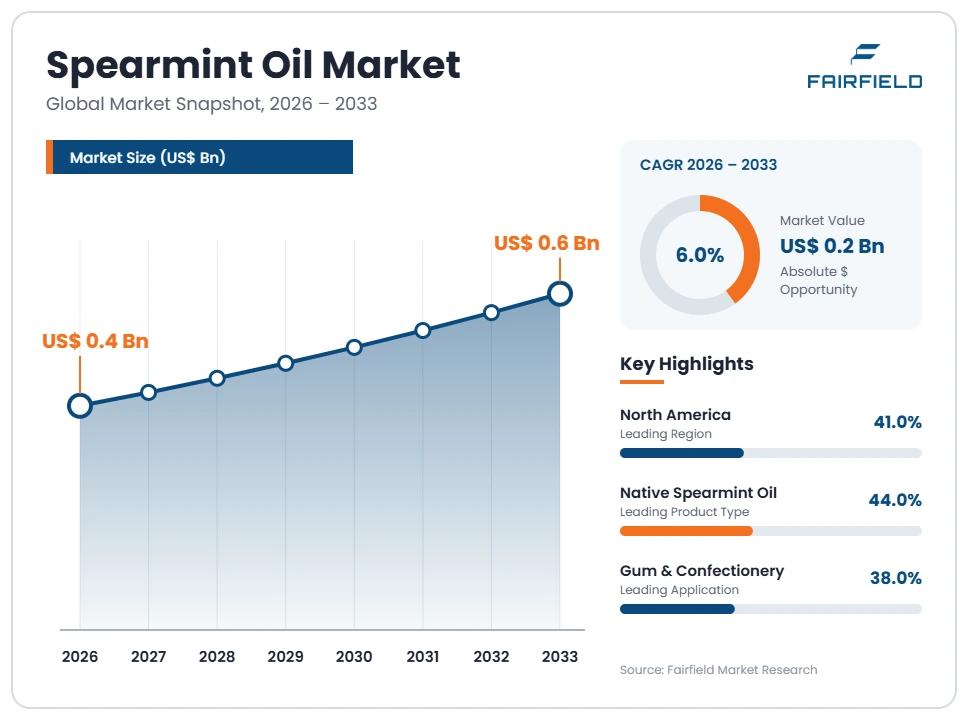
The global spearmint oil market size is expected to be valued at US$ 0.4 billion in 2026 and projected to reach US$ 0.6 billion by 2033, growing at a CAGR of 6.0% between 2026 and 2033.
Between 2020 and 2025 the market grew at a slower 4.4%, because contracted acreage in the United States mint belt moved up and down with grain and potato prices. Three forces shape the outlook. Chewing gum, confectionery and oral care brands buy distilled oil on multi-season contracts, which holds the volume base steady. Flavour houses are specifying distilled material where a label must declare natural flavour. Distillers are also selling more carvone and folded fractions into fragrance, personal care and household products. The direction is steady, contract-led volume growth, with price set less by demand than by how many acres growers commit each spring against competing row crops.
Key Report Takeaways
- By Product Type: Native spearmint oil held 44% share in 2026, while carvone and derived isolates are projected to expand at a 7.6% CAGR through 2033, as buyers outside flavour applications purchase single molecules rather than whole oil.
- By Cultivation System: Conventional supply held 78% share in 2026, while organic supply is projected to expand at a 9.1% CAGR through 2033, supported by certified organic acreage in India and the United States.
- By Application: Chewing gum and confectionery held 38% share in 2026, while pharmaceutical excipient and flavouring use is projected to expand at a 7.2% CAGR through 2033, on tighter documentation of flavour inputs.
- By Distribution Channel: Flavour and fragrance houses held 46% share in 2026, while ingredient distributors and traders are projected to expand at a 6.9% CAGR through 2033, as mid-sized brands buy smaller, blended lots.
- By Geography: North America held 41% share in 2026, while Asia Pacific is projected to expand at a 7.8% CAGR through 2033, led by distillation capacity and planted area in India and China.
Global Spearmint Oil Market Trends and Insights
Drivers Impact Analysis
Two forces carry most of the measurable growth in distilled spearmint oil demand through 2033.
| Driver | Impact on CAGR Forecast | Geographic Relevance | Impact Timeline |
| Contracted chewing gum, confectionery and oral care volumes | High | North America, Europe, Asia Pacific | Long term (≥4 years) |
| Natural flavour declarations in packaged food and beverages | Medium | North America, Europe | Medium term (2–4 years) |
Long-Term Gum and Oral Care Contracts Hold Spearmint Oil Volumes Steady
A small group of chewing gum, confectionery and oral care manufacturers buys most of the spearmint oil distilled each year. These buyers purchase on contracts that run for one to three seasons, agreed before planting rather than after harvest. That structure gives distillers visible demand, finances the crop, and keeps annual volumes from swinging with consumer sentiment. It also makes the demand side slow to move, because a qualified oil stays in a formula for years.
Qualification is the mechanism. Buyers write specifications covering carvone content, optical rotation, colour and residue limits, then audit the distiller against them. Changing origin means re-running sensory panels and stability work on every affected product. Because that effort is expensive, approved lots are repurchased season after season, and the contracted base of the market renews itself with little negotiation over substance.
Natural Flavour Declarations Pull Formulators Toward Distilled Spearmint Oil
Reformulation toward label-friendly ingredients moves volume from synthetic aroma chemicals to distilled oil. Where a product carries a natural flavour declaration, the flavouring must come from a plant or animal source, which rules out synthetic carvone blends. Brands reworking gum, mouthwash, dentifrice and beverage lines for cleaner declarations buy more natural spearmint oil per unit, even when the synthetic alternative performs the same in sensory testing.
The rules define the boundary. The United States Food and Drug Administration treats essential oils and their isolates as flavouring substances, with industry status confirmed through the Flavor and Extract Manufacturers Association expert panel. The European Union flavouring regulation and its Union list of flavouring substances set the parallel European position. Both frameworks make the source of the carvone, not its chemistry, the deciding factor in what a label may say.
Restraints Impact Analysis
Two constraints limit how quickly distilled spearmint oil supply and pricing can respond to buyers.
| Restraint | Impact on CAGR Forecast | Geographic Relevance | Impact Timeline |
| Acreage competition with corn, potatoes and other row crops | High | North America, Asia Pacific | Short term (≤2 years) |
| Synthetic carvone as a lower-cost substitute | Medium | Global | Long term (≥4 years) |
Acreage Competition With Corn and Potatoes Caps Spearmint Oil Supply
Spearmint is a contract-farmed industrial crop, not a wild-harvested botanical, and that single fact governs supply. Growers in the United States Pacific Northwest and Midwest run mechanised rotations and reallocate fields every season against corn, wheat, potatoes, onions and seed crops. When grain or potato returns look strong, mint acres come out of the plan regardless of what flavour houses need, and the oil carried over from prior seasons sets the price.
The cause is margin arithmetic rather than weather. Mint requires a dedicated distillation tub, irrigation and a longer commitment than an annual row crop, so it must beat the alternative on expected return per acre. Soil disease adds to the calculation, since verticillium wilt and nematode pressure force long rotations and remove fields from repeated mint use, shrinking the area where spearmint can be grown economically at all.
Synthetic Carvone Sets a Price Ceiling on Natural Spearmint Oil
Synthetic carvone caps what buyers will pay for distilled oil in any application where the label does not require natural material. Household cleaners, some fragrance compounds and industrial applications can be built from manufactured carvone at a lower and far more stable cost. That substitution is always available, so when natural oil prices rise after a short crop, volume leaves rather than paying through, and distillers lose the upside that scarcity would otherwise deliver.
Production economics explain the gap. Steam distillation consumes fuel, water and labour to recover a small percentage of oil from a large mass of green hay, and the plant runs only during a short harvest window. Manufactured carvone is produced continuously from terpene feedstocks at consistent purity. Residue testing, documentation and storage costs on exported natural oil widen the difference further.
Market Opportunities
Two revenue pools sit outside the contracted flavour volumes that define today’s trade in spearmint essential oil.
Certified Organic and Traceable Spearmint Oil Opens a Premium Contract Pool
Organic and identity-preserved supply is the clearest premium opening in the mint oil trade. Brands rebuilding gum, oral care and beverage ranges around certified ingredients need oil carried under an unbroken chain of custody from a named field to a named still. Very little spearmint is grown this way, so certified lots clear at a premium over conventional material and are usually committed before the season starts.
Growers and distillers with contiguous organic ground capture this first, because certification applies to the land rather than the equipment. Demand comes from multinational confectionery and personal care buyers who must evidence sourcing claims to retailers and auditors. Organic certification standards for essential oil crops, together with third-party traceability schemes, give the documentation those buyers require, and give distillers a reason to hold acreage through a weak conventional price year.
Derived Carvone and Folded Fractions Open Revenue Beyond Flavour Houses
Fractionation turns a commodity oil into several priced products and opens customers who never buy whole oil. Carvone recovered from spearmint, along with terpeneless and folded grades, sells into fragrance compounds, personal care, household products and fine chemical synthesis. Each fraction carries its own specification and price, so a distiller with separation capacity earns more from the same tonnage of hay than one shipping only crude oil.
Fragrance compounders and household product formulators create this demand, since they need consistent single components rather than a seasonal natural profile. IFRA standards govern how spearmint oil and carvone are used in fragrance, which pushes compounders toward characterised, documented fractions. Investment in on-site fractionation also lets distillers place terpene side-streams, improving recovery from each harvest and softening exposure to one flavour contract.
Segment Analysis
- By Product Type: Native Spearmint Oil Leads While Carvone Isolates Gain Pace
Native spearmint oil distilled from Mentha spicata held 44% of revenue in 2026, because it is the reference profile written into most gum, confectionery and oral care specifications and is produced at the largest scale. Scotch spearmint oil from Mentha gracilis follows, valued for a rounder, less herbaceous note that several long-standing formulas still require.
Carvone and derived isolates are the fastest-growing product line at a 7.6% CAGR to 2033. Buyers outside flavour work increasingly want a defined molecule with a stable specification rather than a seasonal oil. Terpeneless and folded grades grow for the same reason, giving beverage and personal care formulators higher strength and better solubility. For distillers, the implication is that separation capacity, not planted area alone, now determines how much value each harvest returns.
- By Cultivation System: Conventional Volume Dominates as Organic Supply Scales Fastest
Conventional cultivation supplied 78% of spearmint oil revenue in 2026. Mechanised contract farming under conventional practice delivers the yield per acre and the cost base that large flavour contracts assume, and most approved specifications were written against conventionally grown material.
Organic supply is expanding fastest at a 9.1% CAGR through 2033, from a small base. Certified acreage is growing in India and in parts of the United States mint belt, and buyers pay a premium that offsets lower yields. Certified-traceable conventional supply sits between the two, offering chain-of-custody documentation without organic agronomy. Growth here is limited by land rather than demand, since organic status attaches to fields that must stay in rotation for years. Distillers that secure certified ground early hold a durable position in the natural flavour ingredients trade.
- By Application: Chewing Gum and Confectionery Lead as Pharmaceutical Flavouring Accelerates
Chewing gum and confectionery accounted for 38% of spearmint oil demand in 2026, the single largest outlet and the one that sets quality benchmarks for the whole trade. Oral care follows closely, with flavour and beverage, fragrance and personal care, and household products dividing most of the balance.
Pharmaceutical excipient and flavouring use is the fastest-growing application at a 7.2% CAGR to 2033. Oral dosage forms and oral rinses use flavouring substances that must be documented to a defined specification, and spearmint oil already carries that documentation. Household products grow more slowly, since synthetic carvone competes directly there. The concentration of volume in gum and oral care leaves distillers exposed when one large customer reformulates, which is why application diversification has become a stated commercial objective.
- By Distribution Channel: Flavour Houses Buy Most While Distributors Expand Quickest
Flavour and fragrance houses bought 46% of spearmint oil volume in 2026. They sit between the distiller and the brand, blend oil into compounds, and carry the qualification work that end users rely on. Direct contracts between distillers and large gum or oral care manufacturers take the next share, usually covering the best-characterised lots.
Ingredient distributors and traders are growing fastest at a 6.9% CAGR through 2033. Mid-sized confectionery, beverage and personal care brands want small, documented lots without a season-long commitment, and distributors carry the inventory risk that distillers will not. Specialty retail remains a minor outlet. The practical implication is that distillers increasingly serve two different customers, a handful of contract buyers and a long tail reached through traders, each with different pricing and documentation expectations.
Geography Analysis
- Which Region Leads the Spearmint Oil Market?
North America leads the spearmint oil market with 41% share in 2026, because the crop is grown there as a mechanised industrial rotation rather than a smallholder botanical. Washington, Idaho and Oregon in the Pacific Northwest, together with Indiana, Michigan and Wisconsin in the Midwest, supply most of the region’s oil from irrigated, contracted fields with on-farm distillation.
Proximity to the world’s largest chewing gum and oral care manufacturers keeps that structure intact, since buyers can audit fields and stills directly. The same structure creates the region’s main vulnerability. Growers switch acreage against corn, potatoes and seed crops each spring, so regional output can fall in a season of strong grain prices. Carry-over inventory and multi-year contracts absorb part of that swing, and fractionation capacity adds value when volumes tighten.
- Europe Buys Spearmint Oil to a Residue Standard That Shapes Global Trade
Europe is a buyer rather than a grower, and its purchasing rules set the compliance bar for exporters worldwide. Flavour and fragrance houses in France, Switzerland, Germany and the United Kingdom compound most of the oil used in European gum, confectionery, oral care and beverage products, importing crude oil and fractions for that work.
Maximum residue levels for pesticides are the decisive commercial factor. A consignment that exceeds a residue limit loses market access, so European buyers specify tested, documented lots and favour origins with established testing discipline. The flavouring regulation and the Union list of flavouring substances define what may be used and declared, while IFRA standards govern fragrance applications. Demand growth is modest and steady, concentrated in reformulation toward natural declarations and in certified organic material for premium oral care and confectionery ranges.
- Which Region Is Growing Fastest in the Spearmint Oil Market?
Asia Pacific is growing fastest in the spearmint oil market at a 7.8% CAGR between 2026 and 2033, supported by planted area, distillation capacity and rising domestic consumption. India is the centre of that growth, with the mint belt of Uttar Pradesh supplying oil and isolates through an established network of distillers, processors and exporters.
China adds further capacity and is a significant source of both oil and manufactured carvone. Domestic demand is the second engine, as confectionery, oral care and beverage consumption grows across India, China, Indonesia and Japan, pulling oil into local manufacturing rather than export. The regional constraint is consistency. Fragmented holdings and variable post-harvest practice make residue compliance harder, so exporters investing in testing, aggregation and traceability capture the largest share of the growth.
- Latin America Builds Spearmint Oil Demand Around Brazilian Flavour Manufacturing
Latin America is a modest but steady consuming region, with Brazil accounting for most demand through its confectionery, beverage and personal care manufacturing base. Mexico and Argentina follow, supplied largely by imported oil and compounds rather than domestic distillation.
Local mint cultivation exists but is small and directed mainly at regional buyers. The barriers are currency volatility, import duties and freight cost, all of which make imported natural oil expensive relative to synthetic alternatives in price-sensitive categories such as household products. Growth comes from premium oral care and sugar-free gum lines, where brands match specifications used in other regions. Distributors holding local inventory in bonded warehouses reduce the lead-time penalty, and that service model is becoming the main route into the regional flavour ingredients trade.
- Middle East & Africa Depends on Imported Spearmint Oil for Gum and Oral Care
Middle East & Africa is the smallest regional market and is served almost entirely by imports. Demand concentrates in gum, confectionery and oral care manufacturing in Saudi Arabia, the United Arab Emirates, Egypt, Türkiye and South Africa, where regional production hubs supply surrounding markets.
The constraints are real. Limited local distillation, high logistics costs and fragmented regulatory requirements across markets slow adoption of premium natural grades, and halal certification requirements add a documentation layer for carriers and solvents used in compounded flavours. Growth is supported by expanding domestic food manufacturing and by investment in confectionery capacity across the Gulf. Traders holding certified, residue-tested stock close to those plants are best placed, since buyers value supply reliability more than a marginal difference in oil price.
Competitive Landscape
The spearmint oil market is moderately concentrated, with a clear split between the people who grow and distil the crop and the companies that sell flavour and fragrance solutions built from it. Upstream, a limited number of grower cooperatives, independent distillers and processors in the United States, India and China control physical supply. Downstream, a small group of global flavour and fragrance houses buys a large share of that supply and holds the customer relationships with gum, confectionery and oral care brands. Consolidation has been steady rather than dramatic, mostly through flavour houses securing processing assets and long-term grower relationships.
Competition runs on specification reliability more than on price. Vendors compete on carvone content and sensory consistency, residue and contaminant compliance, traceability documentation, security of multi-year supply, and the ability to deliver fractions and folded grades alongside crude oil. Certification status has become a competitive asset in its own right, since organic and identity-preserved lots cannot be created at short notice. New entrants come mainly from Indian and Chinese processors moving from bulk oil into characterised isolates, and from specialist traders offering small, documented lots to mid-sized brands.
Strategic activity centres on control of physical supply and on moving up the value chain. Participants invest in on-site fractionation and distillation efficiency, extend grower contracts to stabilise acreage, build testing and traceability systems that satisfy importing-country residue rules, and develop organic programmes with dedicated land. Several processors are also placing terpene and carvone side-streams into fragrance and household applications to reduce dependence on a single flavour contract.
The direction of vendor strategy is toward documentation, fractionation and origin diversification. Companies increasingly treat the crop as an industrial input to be scheduled, audited and separated rather than a seasonal natural product to be traded.
Recent Industry Developments
- October 2024: The United States Food and Drug Administration brought its unified Human Foods Program into effect, consolidating oversight of food ingredient and flavouring substance safety – a single reporting point for suppliers of natural flavouring materials.
- November 2024: The Codex Alimentarius Commission adopted new and revised maximum residue limits for pesticides at its annual session – updating the international reference points that importing countries apply to crops distilled for essential oils.
- January 2025: The European Union completed the move of organic imports onto its compliance-based control system, requiring certifiers operating in exporting countries to work to European organic rules – raising the documentation burden on organic mint oil consignments.
Companies Covered in the Report
- Symrise AG
- Givaudan SA
- International Flavors & Fragrances Inc.
- Takasago International Corporation
- dsm-firmenich AG
- Mane SA
- Robertet Group
- Archer Daniels Midland Company
- Mentha & Allied Products Pvt. Ltd.
- Ultra International B.V.
- Bhagat Aromatics Limited
- Silverline Chemicals Limited
- Berjé Inc.
Spearmint Oil Market Report Scope
| Metric | Value |
| Study Period | 2020–2033 |
| Market Size 2026 | US$ 0.4 Billion |
| Market Size 2033 | US$ 0.6 Billion |
| CAGR 2026–2033 | 6.0% |
| Absolute Dollar Opportunity | US$ 0.2 Billion |
| Largest Market | North America (41% share in 2026) |
| Fastest-Growing Market | Asia Pacific (7.8% CAGR) |
| Market Concentration | Medium |
| Major Players | Symrise AG, Givaudan SA, International Flavors & Fragrances Inc., Takasago International Corporation |
Spearmint Oil Market Segmentation
Product Type
- Native Spearmint Oil (Mentha spicata)
- Scotch Spearmint Oil (Mentha gracilis)
- Carvone and Derived Isolates
- Terpeneless and Folded Grades
Cultivation System
- Conventional
- Organic
- Certified-Traceable
Application
- Chewing Gum and Confectionery
- Oral Care
- Flavour and Beverage
- Fragrance and Personal Care
- Pharmaceutical Excipient and Flavouring
- Household Products
Distribution Channel
- Flavour and Fragrance Houses
- Direct Contracts with Distillers
- Ingredient Distributors and Traders
- Specialty Retail
Regions
- North America
- Europe
- Asia Pacific
- Latin America
- Middle East & Africa
- Executive Summary
- Global Spearmint Oil Market Snapshot
- Future Projections, 2026-2033
- Key Market Trends
- Regional Snapshot
- Market Overview
- Market Definition and Report Scope
- Historical Market Trends, 2020-2025
- Market Dynamics
- Drivers Impact Analysis
- Long-Term Gum and Oral Care Contracts Hold Spearmint Oil Volumes Steady
- Natural Flavour Declarations Pull Formulators Toward Distilled Spearmint Oil
- Restraints Impact Analysis
- Acreage Competition With Corn and Potatoes Caps Spearmint Oil Supply
- Synthetic Carvone Sets a Price Ceiling on Natural Spearmint Oil
- Market Opportunities
- Certified Organic and Traceable Spearmint Oil Opens a Premium Contract Pool
- Derived Carvone and Folded Fractions Open Revenue Beyond Flavour Houses
- Drivers Impact Analysis
- Global Spearmint Oil Market Outlook, 2020-2033
- Global Spearmint Oil Market Outlook, by Product Type, Value (US$ Billion), 2020-2033
- Native Spearmint Oil (Mentha spicata)
- Scotch Spearmint Oil (Mentha gracilis)
- Carvone and Derived Isolates
- Terpeneless and Folded Grades
- Global Spearmint Oil Market Outlook, by Cultivation System, Value (US$ Billion), 2020-2033
- Conventional
- Organic
- Certified-Traceable
- Global Spearmint Oil Market Outlook, by Application, Value (US$ Billion), 2020-2033
- Chewing Gum and Confectionery
- Oral Care
- Flavour and Beverage
- Fragrance and Personal Care
- Pharmaceutical Excipient and Flavouring
- Household Products
- Global Spearmint Oil Market Outlook, by Distribution Channel, Value (US$ Billion), 2020-2033
- Flavour and Fragrance Houses
- Direct Contracts with Distillers
- Ingredient Distributors and Traders
- Specialty Retail
- Global Spearmint Oil Market Outlook, by Region, Value (US$ Billion), 2020-2033
- North America
- Europe
- Asia Pacific
- Latin America
- Middle East & Africa
- Global Spearmint Oil Market Outlook, by Product Type, Value (US$ Billion), 2020-2033
- North America Spearmint Oil Market Outlook, 2020-2033
- North America Spearmint Oil Market Outlook, by Product Type, Value (US$ Billion), 2020-2033
- Native Spearmint Oil (Mentha spicata)
- Scotch Spearmint Oil (Mentha gracilis)
- Carvone and Derived Isolates
- Terpeneless and Folded Grades
- North America Spearmint Oil Market Outlook, by Cultivation System, Value (US$ Billion), 2020-2033
- Conventional
- Organic
- Certified-Traceable
- North America Spearmint Oil Market Outlook, by Application, Value (US$ Billion), 2020-2033
- Chewing Gum and Confectionery
- Oral Care
- Flavour and Beverage
- Fragrance and Personal Care
- Pharmaceutical Excipient and Flavouring
- Household Products
- North America Spearmint Oil Market Outlook, by Distribution Channel, Value (US$ Billion), 2020-2033
- Flavour and Fragrance Houses
- Direct Contracts with Distillers
- Ingredient Distributors and Traders
- Specialty Retail
- North America Spearmint Oil Market Outlook, by State, Value (US$ Billion), 2020-2033
- Washington Spearmint Oil Market Outlook, by Product Type, 2020-2033
- Washington Spearmint Oil Market Outlook, by Cultivation System, 2020-2033
- Washington Spearmint Oil Market Outlook, by Application, 2020-2033
- Washington Spearmint Oil Market Outlook, by Distribution Channel, 2020-2033
- Idaho Spearmint Oil Market Outlook, by Product Type, 2020-2033
- Idaho Spearmint Oil Market Outlook, by Cultivation System, 2020-2033
- Idaho Spearmint Oil Market Outlook, by Application, 2020-2033
- Idaho Spearmint Oil Market Outlook, by Distribution Channel, 2020-2033
- Oregon Spearmint Oil Market Outlook, by Product Type, 2020-2033
- Oregon Spearmint Oil Market Outlook, by Cultivation System, 2020-2033
- Oregon Spearmint Oil Market Outlook, by Application, 2020-2033
- Oregon Spearmint Oil Market Outlook, by Distribution Channel, 2020-2033
- Indiana Spearmint Oil Market Outlook, by Product Type, 2020-2033
- Indiana Spearmint Oil Market Outlook, by Cultivation System, 2020-2033
- Indiana Spearmint Oil Market Outlook, by Application, 2020-2033
- Indiana Spearmint Oil Market Outlook, by Distribution Channel, 2020-2033
- Michigan Spearmint Oil Market Outlook, by Product Type, 2020-2033
- Michigan Spearmint Oil Market Outlook, by Cultivation System, 2020-2033
- Michigan Spearmint Oil Market Outlook, by Application, 2020-2033
- Michigan Spearmint Oil Market Outlook, by Distribution Channel, 2020-2033
- Wisconsin Spearmint Oil Market Outlook, by Product Type, 2020-2033
- Wisconsin Spearmint Oil Market Outlook, by Cultivation System, 2020-2033
- Wisconsin Spearmint Oil Market Outlook, by Application, 2020-2033
- Wisconsin Spearmint Oil Market Outlook, by Distribution Channel, 2020-2033
- North America Spearmint Oil Market Outlook, by Product Type, Value (US$ Billion), 2020-2033
- Europe Spearmint Oil Market Outlook, 2020-2033
- Europe Spearmint Oil Market Outlook, by Product Type, Value (US$ Billion), 2020-2033
- Native Spearmint Oil (Mentha spicata)
- Scotch Spearmint Oil (Mentha gracilis)
- Carvone and Derived Isolates
- Terpeneless and Folded Grades
- Europe Spearmint Oil Market Outlook, by Cultivation System, Value (US$ Billion), 2020-2033
- Conventional
- Organic
- Certified-Traceable
- Europe Spearmint Oil Market Outlook, by Application, Value (US$ Billion), 2020-2033
- Chewing Gum and Confectionery
- Oral Care
- Flavour and Beverage
- Fragrance and Personal Care
- Pharmaceutical Excipient and Flavouring
- Household Products
- Europe Spearmint Oil Market Outlook, by Distribution Channel, Value (US$ Billion), 2020-2033
- Flavour and Fragrance Houses
- Direct Contracts with Distillers
- Ingredient Distributors and Traders
- Specialty Retail
- Europe Spearmint Oil Market Outlook, by Country, Value (US$ Billion), 2020-2033
- France Spearmint Oil Market Outlook, by Product Type, 2020-2033
- France Spearmint Oil Market Outlook, by Cultivation System, 2020-2033
- France Spearmint Oil Market Outlook, by Application, 2020-2033
- France Spearmint Oil Market Outlook, by Distribution Channel, 2020-2033
- Switzerland Spearmint Oil Market Outlook, by Product Type, 2020-2033
- Switzerland Spearmint Oil Market Outlook, by Cultivation System, 2020-2033
- Switzerland Spearmint Oil Market Outlook, by Application, 2020-2033
- Switzerland Spearmint Oil Market Outlook, by Distribution Channel, 2020-2033
- Germany Spearmint Oil Market Outlook, by Product Type, 2020-2033
- Germany Spearmint Oil Market Outlook, by Cultivation System, 2020-2033
- Germany Spearmint Oil Market Outlook, by Application, 2020-2033
- Germany Spearmint Oil Market Outlook, by Distribution Channel, 2020-2033
- United Kingdom Spearmint Oil Market Outlook, by Product Type, 2020-2033
- United Kingdom Spearmint Oil Market Outlook, by Cultivation System, 2020-2033
- United Kingdom Spearmint Oil Market Outlook, by Application, 2020-2033
- United Kingdom Spearmint Oil Market Outlook, by Distribution Channel, 2020-2033
- Europe Spearmint Oil Market Outlook, by Product Type, Value (US$ Billion), 2020-2033
- Asia Pacific Spearmint Oil Market Outlook, 2020-2033
- Asia Pacific Spearmint Oil Market Outlook, by Product Type, Value (US$ Billion), 2020-2033
- Native Spearmint Oil (Mentha spicata)
- Scotch Spearmint Oil (Mentha gracilis)
- Carvone and Derived Isolates
- Terpeneless and Folded Grades
- Asia Pacific Spearmint Oil Market Outlook, by Cultivation System, Value (US$ Billion), 2020-2033
- Conventional
- Organic
- Certified-Traceable
- Asia Pacific Spearmint Oil Market Outlook, by Application, Value (US$ Billion), 2020-2033
- Chewing Gum and Confectionery
- Oral Care
- Flavour and Beverage
- Fragrance and Personal Care
- Pharmaceutical Excipient and Flavouring
- Household Products
- Asia Pacific Spearmint Oil Market Outlook, by Distribution Channel, Value (US$ Billion), 2020-2033
- Flavour and Fragrance Houses
- Direct Contracts with Distillers
- Ingredient Distributors and Traders
- Specialty Retail
- Asia Pacific Spearmint Oil Market Outlook, by Country, Value (US$ Billion), 2020-2033
- India Spearmint Oil Market Outlook, by Product Type, 2020-2033
- India Spearmint Oil Market Outlook, by Cultivation System, 2020-2033
- India Spearmint Oil Market Outlook, by Application, 2020-2033
- India Spearmint Oil Market Outlook, by Distribution Channel, 2020-2033
- China Spearmint Oil Market Outlook, by Product Type, 2020-2033
- China Spearmint Oil Market Outlook, by Cultivation System, 2020-2033
- China Spearmint Oil Market Outlook, by Application, 2020-2033
- China Spearmint Oil Market Outlook, by Distribution Channel, 2020-2033
- Indonesia Spearmint Oil Market Outlook, by Product Type, 2020-2033
- Indonesia Spearmint Oil Market Outlook, by Cultivation System, 2020-2033
- Indonesia Spearmint Oil Market Outlook, by Application, 2020-2033
- Indonesia Spearmint Oil Market Outlook, by Distribution Channel, 2020-2033
- Japan Spearmint Oil Market Outlook, by Product Type, 2020-2033
- Japan Spearmint Oil Market Outlook, by Cultivation System, 2020-2033
- Japan Spearmint Oil Market Outlook, by Application, 2020-2033
- Japan Spearmint Oil Market Outlook, by Distribution Channel, 2020-2033
- Asia Pacific Spearmint Oil Market Outlook, by Product Type, Value (US$ Billion), 2020-2033
- Latin America Spearmint Oil Market Outlook, 2020-2033
- Latin America Spearmint Oil Market Outlook, by Product Type, Value (US$ Billion), 2020-2033
- Native Spearmint Oil (Mentha spicata)
- Scotch Spearmint Oil (Mentha gracilis)
- Carvone and Derived Isolates
- Terpeneless and Folded Grades
- Latin America Spearmint Oil Market Outlook, by Cultivation System, Value (US$ Billion), 2020-2033
- Conventional
- Organic
- Certified-Traceable
- Latin America Spearmint Oil Market Outlook, by Application, Value (US$ Billion), 2020-2033
- Chewing Gum and Confectionery
- Oral Care
- Flavour and Beverage
- Fragrance and Personal Care
- Pharmaceutical Excipient and Flavouring
- Household Products
- Latin America Spearmint Oil Market Outlook, by Distribution Channel, Value (US$ Billion), 2020-2033
- Flavour and Fragrance Houses
- Direct Contracts with Distillers
- Ingredient Distributors and Traders
- Specialty Retail
- Latin America Spearmint Oil Market Outlook, by Country, Value (US$ Billion), 2020-2033
- Brazil Spearmint Oil Market Outlook, by Product Type, 2020-2033
- Brazil Spearmint Oil Market Outlook, by Cultivation System, 2020-2033
- Brazil Spearmint Oil Market Outlook, by Application, 2020-2033
- Brazil Spearmint Oil Market Outlook, by Distribution Channel, 2020-2033
- Mexico Spearmint Oil Market Outlook, by Product Type, 2020-2033
- Mexico Spearmint Oil Market Outlook, by Cultivation System, 2020-2033
- Mexico Spearmint Oil Market Outlook, by Application, 2020-2033
- Mexico Spearmint Oil Market Outlook, by Distribution Channel, 2020-2033
- Argentina Spearmint Oil Market Outlook, by Product Type, 2020-2033
- Argentina Spearmint Oil Market Outlook, by Cultivation System, 2020-2033
- Argentina Spearmint Oil Market Outlook, by Application, 2020-2033
- Argentina Spearmint Oil Market Outlook, by Distribution Channel, 2020-2033
- Latin America Spearmint Oil Market Outlook, by Product Type, Value (US$ Billion), 2020-2033
- Middle East & Africa Spearmint Oil Market Outlook, 2020-2033
- Middle East & Africa Spearmint Oil Market Outlook, by Product Type, Value (US$ Billion), 2020-2033
- Native Spearmint Oil (Mentha spicata)
- Scotch Spearmint Oil (Mentha gracilis)
- Carvone and Derived Isolates
- Terpeneless and Folded Grades
- Middle East & Africa Spearmint Oil Market Outlook, by Cultivation System, Value (US$ Billion), 2020-2033
- Conventional
- Organic
- Certified-Traceable
- Middle East & Africa Spearmint Oil Market Outlook, by Application, Value (US$ Billion), 2020-2033
- Chewing Gum and Confectionery
- Oral Care
- Flavour and Beverage
- Fragrance and Personal Care
- Pharmaceutical Excipient and Flavouring
- Household Products
- Middle East & Africa Spearmint Oil Market Outlook, by Distribution Channel, Value (US$ Billion), 2020-2033
- Flavour and Fragrance Houses
- Direct Contracts with Distillers
- Ingredient Distributors and Traders
- Specialty Retail
- Middle East & Africa Spearmint Oil Market Outlook, by Country, Value (US$ Billion), 2020-2033
- Saudi Arabia Spearmint Oil Market Outlook, by Product Type, 2020-2033
- Saudi Arabia Spearmint Oil Market Outlook, by Cultivation System, 2020-2033
- Saudi Arabia Spearmint Oil Market Outlook, by Application, 2020-2033
- Saudi Arabia Spearmint Oil Market Outlook, by Distribution Channel, 2020-2033
- United Arab Emirates Spearmint Oil Market Outlook, by Product Type, 2020-2033
- United Arab Emirates Spearmint Oil Market Outlook, by Cultivation System, 2020-2033
- United Arab Emirates Spearmint Oil Market Outlook, by Application, 2020-2033
- United Arab Emirates Spearmint Oil Market Outlook, by Distribution Channel, 2020-2033
- Egypt Spearmint Oil Market Outlook, by Product Type, 2020-2033
- Egypt Spearmint Oil Market Outlook, by Cultivation System, 2020-2033
- Egypt Spearmint Oil Market Outlook, by Application, 2020-2033
- Egypt Spearmint Oil Market Outlook, by Distribution Channel, 2020-2033
- Türkiye Spearmint Oil Market Outlook, by Product Type, 2020-2033
- Türkiye Spearmint Oil Market Outlook, by Cultivation System, 2020-2033
- Türkiye Spearmint Oil Market Outlook, by Application, 2020-2033
- Türkiye Spearmint Oil Market Outlook, by Distribution Channel, 2020-2033
- South Africa Spearmint Oil Market Outlook, by Product Type, 2020-2033
- South Africa Spearmint Oil Market Outlook, by Cultivation System, 2020-2033
- South Africa Spearmint Oil Market Outlook, by Application, 2020-2033
- South Africa Spearmint Oil Market Outlook, by Distribution Channel, 2020-2033
- Middle East & Africa Spearmint Oil Market Outlook, by Product Type, Value (US$ Billion), 2020-2033
- Competitive Landscape
- Market Concentration and Industry Leaders
- Competitive Differentiation
- Strategic Initiatives
- Recent Industry Developments
- Company Profiles
- Symrise AG
- Givaudan SA
- International Flavors & Fragrances Inc.
- Takasago International Corporation
- dsm-firmenich AG
- Mane SA
- Robertet Group
- Archer Daniels Midland Company
- Mentha & Allied Products Pvt. Ltd.
- Ultra International B.V.
- Bhagat Aromatics Limited
- Silverline Chemicals Limited
- Berjé Inc.
- Appendix
- Research Methodology
- Report Assumptions
- Acronyms and Abbreviations
Product Type
- Native Spearmint Oil (Mentha spicata)
- Scotch Spearmint Oil (Mentha gracilis)
- Carvone and Derived Isolates
- Terpeneless and Folded Grades
Cultivation System
- Conventional
- Organic
- Certified-Traceable
Application
- Chewing Gum and Confectionery
- Oral Care
- Flavour and Beverage
- Fragrance and Personal Care
- Pharmaceutical Excipient and Flavouring
- Household Products
Distribution Channel
- Flavour and Fragrance Houses
- Direct Contracts with Distillers
- Ingredient Distributors and Traders
- Specialty Retail
Regions
- North America
- Europe
- Asia Pacific
- Latin America
- Middle East & Africa
Our Research Methodology
Considering the volatility of business today, traditional approaches to strategizing a game plan can be unfruitful if not detrimental. True ambiguity is no way to determine a forecast. A myriad of predetermined factors must be accounted for such as the degree of risk involved, the magnitude of circumstances, as well as conditions or consequences that are not known or unpredictable. To circumvent binary views that cast uncertainty, the application of market research intelligence to strategically posture, move, and enable actionable outcomes is necessary.
View Methodology
Quality Assured
Rigorous Validation Process

Confidentiality Assured
End-to-end Data Security

Custom Research Services
Tailored To Your Objectives
FAQs
The spearmint oil market is valued at US$ 0.4 billion in 2026, covering distilled native and Scotch oils plus derived fractions and isolates.
The market is projected to reach US$ 0.6 billion by 2033, growing at a 6.0% CAGR and adding US$ 0.2 billion over the period.
Chewing gum and confectionery is the largest application, at 38% of spearmint oil demand in 2026, followed closely by oral care products.
Asia Pacific is growing fastest at a 7.8% CAGR to 2033, driven by planted area, distillation capacity and consumption in India and China.
Concentration is medium, with limited grower and distiller supply upstream and a small group of flavour and fragrance houses buying most volume downstream.
Related Reports
Food Glazing Agents Market Size, Share, Insights, Competitive Landscape, and Forecast 2026 to 2033
Explore the food glazing agents market, projected to reach US$ 4.4 billion by 2033 at a 5.1% CAGR, with product, source and regional insights.
Bio Vanillin Market Size, Share, Insights, Competitive Landscape, and Forecast 2026 to 2033
Explore the bio vanillin market, projected to reach US$ 720.0 million by 2033 at a 10.9% CAGR, with source, application and regional insights.
Weight Loss Supplement Market Size, Share, Insights, Competitive Landscape, and Forecast 2026 to 2033
Weight loss supplement market to grow from US$ 39.0 billion in 2026 to US$ 55.0 billion by 2033 at a 5.0% CAGR. Explore products, channels and regional trends.
Milk Ingredients Market Size, Share, Insights, Competitive Landscape, and Forecast 2026 to 2033
The milk ingredients market is projected to grow from US$68.4 billion in 2026 to US$101.2 billion by 2033, at a 5.8% CAGR. Explore segments and key trends.
A2 Milk Market Size, Share, Insights, Competitive Landscape, and Forecast 2026 to 2033
The global A2 milk market is valued at US$21.20 billion in 2026, reaching US$52.31 billion by 2033, growing at a 13.8% CAGR
Tilapia Market Size, Share, Insights, Competitive Landscape, and Forecast 2026 to 2033
The tilapia market is projected to grow from US$14.60 billion in 2026 to US$20.10 billion by 2033, at a 4.7% CAGR, driven by protein demand and aquaculture.