



Food Glazing Agents Market
Food Glazing Agents Market Size, Share, Insights, Competitive Landscape, and Forecast 2026 to 2033
Food Glazing Agents Market Size, Share, Insights, Competitive Landscape, and Forecast 2026 to 2033
What Is the Growth Outlook for Food Glazing Agents?
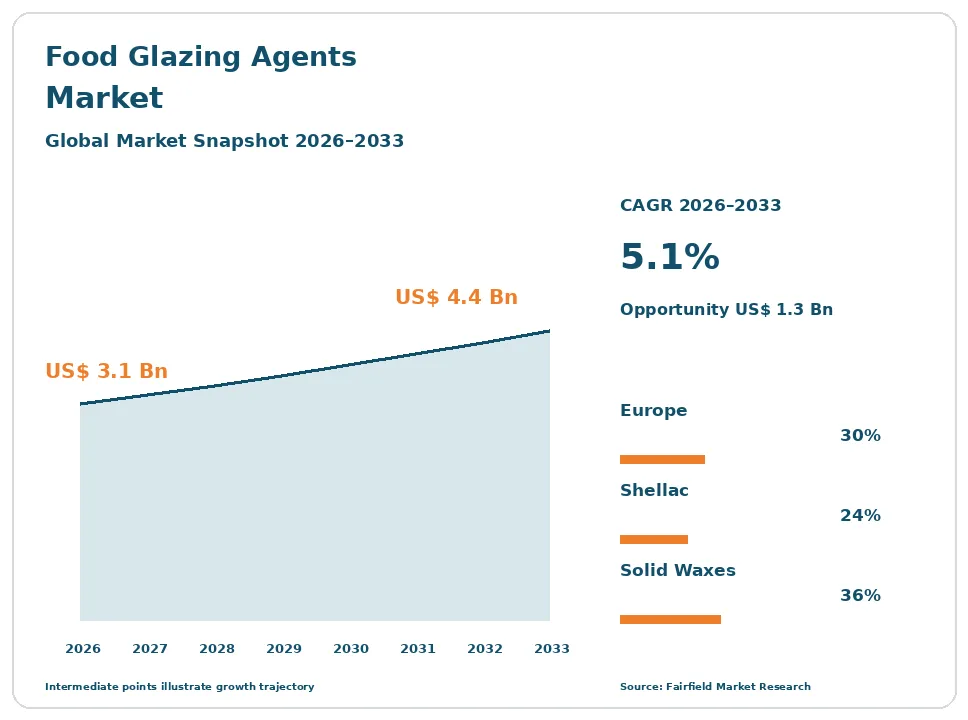
The global food glazing agents market size is expected to be valued at US$ 3.1 billion in 2026 and projected to reach US$ 4.4 billion by 2033, growing at a CAGR of 5.1% between 2026 and 2033.
The market expanded at a 4.2% rate between 2020 and 2025, held back by volatile shellac and carnauba prices and by slow reformulation cycles in confectionery. Three forces shape the outlook. Brands are rebuilding coating systems around plant-derived waxes to meet vegan, vegetarian, halal and kosher positioning. Post-harvest coating of fresh produce is being bought on weight-loss prevention and shelf life rather than appearance. Pharmaceutical and nutraceutical tablet coating adds steady, specification-driven volume. The direction is moderate growth with a clear shift in mix, from insect- and animal-derived resins toward plant waxes and aqueous systems.
Key Report Takeaways
- By Product Type: Shellac held 24% share in 2026, while candelilla wax is projected to expand at a 7.6% CAGR through 2033, as confectionery brands qualify plant-derived replacements for insect-secreted resin.
- By Source: Animal and insect-derived materials held 36% share in 2026, while plant-derived materials are projected to expand at a 7.7% CAGR through 2033, on vegan, vegetarian, halal and kosher positioning.
- By Form: Solid waxes and flakes held 36% share in 2026, while aqueous emulsions and dispersions are projected to expand at a 7.8% CAGR through 2033, as solvent handling costs and workplace rules rise.
- By Application: Confectionery and chewing gum held 31% share in 2026, while fresh fruit and vegetable coatings are projected to expand at a 7.5% CAGR through 2033, on food waste reduction targets in retail supply chains.
- By Geography: Europe held 30% share in 2026, while Asia Pacific is projected to expand at a 6.9% CAGR through 2033, supported by confectionery capacity and fresh produce exports.
Global Food Glazing Agents Market Trends and Insights
Drivers Impact Analysis
| Driver | Impact on CAGR Forecast | Geographic Relevance | Impact Timeline |
| Reformulation toward plant-derived and certification-compliant coatings | High | Europe, North America, Middle East & Africa | Medium term (2–4 years) |
| Post-harvest coating of fresh produce for shelf life in export chains | High | Asia Pacific, Latin America | Long term (≥4 years) |
Two forces account for most of the measurable growth in surface coating and polishing agents through 2033.
Vegan and Certification-Led Reformulation Lifts Plant Wax Coating Demand
Diet and certification positioning is moving coating volume from insect- and animal-derived materials to plant waxes. Shellac is secreted by the lac insect and beeswax comes from hives, so products carrying vegan or vegetarian claims cannot use them. Halal and kosher programmes add further sourcing and processing requirements. Brands that adopt these claims across a confectionery or supplement range convert the whole coating line at once, which moves volume in large, single steps rather than gradually.
Label transparency is the mechanism. Glazing agents must be declared on the ingredient list in most markets, which makes the coating visible to consumers who screen for animal-derived components. Carnauba, candelilla and rice bran wax give formulators a plant-derived answer to that question. Each behaves differently in panning and polishing and costs more per kilogram, so suppliers that solve the performance gap win the reformulation work.
Export Produce Shelf Life Pulls Post-Harvest Coatings Into Volume Growth
Post-harvest coating of fresh fruit and vegetables is growing on a commercial argument that has nothing to do with appearance. Coatings slow moisture loss and respiration, so packers ship more saleable weight and lose fewer units to shrink across long export routes. Retailers and exporters buy that outcome directly, which makes the purchase a supply chain cost decision rather than a product design one.
Trade structure drives it. Citrus, apple, avocado and banana exporters shipping across hemispheres need weeks of transit life, and packhouses apply wax at the line as standard practice. Food waste reduction targets adopted by major retailers reinforce the spend, and organic certification rules define which coatings may be used on certified produce. That separates post-harvest coating from confectionery glazing as a distinct business with its own customers and rules.
Restraints Impact Analysis
| Restraint | Impact on CAGR Forecast | Geographic Relevance | Impact Timeline |
| Supply concentration and price volatility in shellac and carnauba | High | Asia Pacific, Latin America | Short term (≤2 years) |
| Regulatory scrutiny of mineral hydrocarbons in food | Medium | Europe | Medium term (2–4 years) |
Two constraints limit pricing and formulation freedom across the food coating and polishing trade.
Shellac and Carnauba Supply Concentration Drives Sharp Price Swings
The two benchmark materials in this market come from narrow geographic sources, and that concentration produces price swings buyers cannot plan around. Shellac depends on lac insect cultivation in a limited belt of India, Thailand and neighbouring countries, while carnauba is harvested from palm leaves in a small number of states in north-eastern Brazil. A weak crop year in either source moves prices sharply, and coating formulators absorb the volatility because requalification takes longer than the price cycle.
The cause is biological and seasonal. Both materials come from natural sources with fixed harvest windows, limited area and no quick way to add capacity when prices rise. Collection depends on dispersed rural labour, grading varies by lot, and refining recovery differs with quality. Buyers respond by holding inventory and dual-qualifying grades, both of which add working capital cost to the finished coating.
Mineral Hydrocarbon Scrutiny Narrows Paraffin Wax Use in Food Coatings
Regulatory attention to mineral oil hydrocarbons restricts where paraffin and microcrystalline waxes can be used on food. The European Food Safety Authority has assessed mineral oil hydrocarbons in food and distinguished saturated from aromatic fractions, with the aromatic fraction treated as the greater concern. That assessment has pushed European manufacturers to limit or replace mineral-derived coatings in direct food contact and to demand tighter purity documentation from wax suppliers.
Purity control is the cost driver. Food-grade mineral waxes must be refined to defined specifications, with analytical methods that separate hydrocarbon classes and documentation that follows each lot. Testing capacity for these analyses is limited and expensive. Formulators facing that burden often move to plant or insect-derived systems instead, which narrows the addressable volume for petroleum-derived glazing materials in regulated markets.
Market Opportunities
Two revenue pools sit outside the confectionery polishing work that has traditionally defined this ingredient category.
Vegan-Certified Coating Systems Open a Premium Confectionery Revenue Pool
Certified plant-based coating systems are the clearest premium opening in food surface treatment. Rather than selling raw carnauba or candelilla, suppliers are formulating complete systems with defined gloss, hardness, anti-sticking behaviour and process windows, backed by vegan, halal and kosher certification. Those systems sell at a higher value per kilogram than the base wax, because the customer is buying qualification work and a performance guarantee.
Confectionery, chewing gum, bakery and nutraceutical brands create this demand, since each must match the gloss and anti-tack performance that shellac delivered. Capture favours suppliers with applications laboratories and panning trial capability rather than those trading raw materials. European and North American brand owners move first, with certification bodies and retailer audit programmes providing the documentation that makes a plant-derived claim defensible at shelf.
Aqueous Coating Systems Open Replacement Demand for Solvent-Based Glazes
The shift from solvent-based to aqueous systems creates a replacement cycle across installed coating lines. Traditional shellac glazes are supplied in ethanol solutions, which require solvent recovery, ventilation and explosion-protected equipment. Aqueous emulsions and dispersions remove most of that burden, and plants converting their lines buy new coating chemistry, new application equipment and new technical support at the same time.
Contract manufacturers and large confectionery and pharmaceutical coating operations drive the demand, because they carry the heaviest solvent handling costs and the strictest workplace exposure obligations. Suppliers with emulsion formulation capability capture it, since stable aqueous dispersions of hard waxes are difficult to make and to keep stable through months of storage and transport. Post-harvest packhouses follow the same path, where water-based coatings simplify handling of fresh produce at the line and cut the fire protection cost of the packing shed.
Segment Analysis
By Product Type: Shellac Holds the Lead as Candelilla Wax Scales Quickly
Shellac accounted for 24% of food glazing agent revenue in 2026, the largest single product line, because it remains the technical benchmark for gloss, hardness and moisture barrier on panned confectionery and tablets. Carnauba wax follows, with beeswax, paraffin and microcrystalline waxes, stearic acid and stearates, and montan and rice bran wax dividing the balance.
Candelilla wax is the fastest-growing product at a 7.6% CAGR to 2033, as confectionery and supplement brands qualify a plant-derived alternative to insect-secreted resin. Rice bran wax grows for similar reasons, supported by a byproduct supply base that is not limited to one harvest region. The commercial implication is that product mix is shifting faster than total volume, so suppliers holding only one raw material position face share loss even in a growing category.
By Source: Animal and Insect Materials Lead While Plant-Derived Supply Grows Fastest
Animal and insect-derived materials, principally shellac and beeswax, supplied 36% of revenue in 2026. They retain the lead because existing confectionery, bakery and tablet specifications were written around their performance, and requalification is slow and costly.
Plant-derived materials are the fastest-growing source at a 7.7% CAGR through 2033. Vegan, vegetarian, halal and kosher positioning drives the substitution, with carnauba, candelilla and rice bran wax taking the replacement volume. Mineral-derived materials grow slowly under hydrocarbon scrutiny, while synthetic and modified waxes hold a technical niche. This is the central commercial tension in the category: the best-performing materials are the ones a growing share of customers will not specify, and suppliers must bridge the resulting performance gap through formulation rather than raw material choice.
By Form: Solid Waxes Lead as Aqueous Emulsions and Dispersions Advance Fastest
Solid waxes and flakes held 36% of revenue in 2026, reflecting the way raw materials are traded, refined and shipped. Solvent-based solutions follow, still standard for high-gloss shellac glazing on confectionery and pharmaceutical tablets.
Aqueous emulsions and dispersions are the fastest-growing form at a 7.8% CAGR to 2033. Converting a coating line away from ethanol removes solvent recovery equipment, ventilation cost and workplace exposure obligations, and packhouses applying post-harvest coatings prefer water-based handling at the line. Powders and micronised grades serve anti-sticking and dusting applications in bakery and tablet manufacture, where the coating must be metered as a dry addition rather than sprayed. Because emulsion stability is technically demanding, this shift rewards suppliers with formulation capability and penalises pure raw material traders, moving value from the wax itself to the system it is sold in.
By Application: Confectionery Leads While Post-Harvest Produce Coatings Grow Fastest
Confectionery and chewing gum took 31% of food glazing agent demand in 2026, the largest application, where polishing agents deliver gloss, prevent sticking and protect sugar shells against moisture. Bakery, coffee beans, nuts and dried fruit, pharmaceutical and nutraceutical tablets and capsules, and pet treats share most of the remaining volume.
Fresh fruit and vegetable coatings are the fastest-growing application at a 7.5% CAGR through 2033. This is a separate business from confectionery glazing, sold to packers and exporters on weight-loss prevention and shelf life rather than appearance, and governed by different rules on permitted coatings and residues. Suppliers serving both must run two commercial models, one qualifying into brand recipes and one selling measurable shrink reduction into produce supply chains.
Geography Analysis
North America Pairs Confectionery Coating Demand With Post-Harvest Packhouse Volume
North America holds a substantial share of food glazing agent demand, split between confectionery and supplement coating in the United States and large post-harvest operations serving apple, citrus and avocado packers. Canada and Mexico add bakery and produce volume, with cross-border fresh produce trade supporting steady coating use.
The United States Food and Drug Administration treats shellac, carnauba wax, beeswax and candelilla wax as permitted substances under food additive and generally recognized as safe provisions, with separate rules for food contact substances and colour additives. That clarity supports stable formulation practice. Nutraceutical and supplement tablet coating is the main growth area, alongside clean-label reformulation in confectionery. The barrier is cost, since plant-derived systems remain more expensive than the insect-derived materials they replace.
Which Region Is Leading the Food Glazing Agents Market?
Europe leads the food glazing agents market with 30% share in 2026, because its regulatory framework is the most detailed and its confectionery, bakery and supplement manufacturing base is the most reformulation-driven. Germany, France, Italy, the United Kingdom and the Netherlands account for most regional consumption.
The European Union food additive framework authorises glazing agents including E 901 beeswax, E 902 candelilla wax, E 903 carnauba wax and E 904 shellac, and the European Food Safety Authority re-evaluation programme for food additives has reassessed several of them. Mandatory declaration on ingredient lists makes coatings visible to consumers, which accelerates substitution toward plant-derived materials. Scrutiny of mineral oil hydrocarbons limits paraffin use. Growth is slower than in developing markets but carries the highest value per kilogram, since certified systems command premium pricing.
Which Region Is Growing Fastest in the Food Glazing Agents Market?
Asia Pacific is growing fastest in the food glazing agents market at a 6.9% CAGR between 2026 and 2033, driven by confectionery manufacturing capacity, fresh produce exports and the region’s position as the source of shellac. China, India, Indonesia, Thailand, Japan and Australia all contribute.
Two engines operate at once. Domestic confectionery, bakery and supplement production is expanding with packaged food consumption, and horticultural exporters are adopting post-harvest coatings to reach distant markets with saleable fruit. Processing capacity is also moving upstream, with more refining and bleaching of shellac performed close to collection rather than overseas. The constraint is specification variability between local and export-grade material, so suppliers investing in consistent grading and documentation capture the export-facing demand.
Latin America Supplies Carnauba Wax While Building Its Own Coating Demand
Latin America occupies an unusual position, supplying the world’s carnauba wax from north-eastern Brazil while also consuming coatings in its own confectionery and fresh produce sectors. Brazil, Mexico, Chile and Peru are the main markets, with fruit exporters applying post-harvest coatings on citrus, grapes, avocado and bananas.
Barriers include currency volatility, the informal structure of carnauba leaf collection, and limited local capability in refined coating formulation, which leaves higher-value systems to imports. Sustainability and labour-practice scrutiny in the carnauba supply chain has pushed buyers toward traceable sourcing programmes. The regional opportunity is to move from exporting raw wax to supplying refined grades and finished emulsions, capturing value that currently leaves the region with unprocessed material.
Middle East & Africa Grows From a Small Base on Confectionery and Fruit Exports
Middle East & Africa is the smallest regional market, served largely by imports of refined wax and finished coating systems. Demand concentrates in confectionery and bakery manufacturing in Saudi Arabia, the United Arab Emirates, Egypt and Türkiye, and in citrus and table grape export packing in Egypt, Morocco and South Africa.
Barriers are the absence of local refining, fragmented additive rules between markets, and logistics costs that make small-volume specialty systems expensive to source. Halal certification requirements favour plant-derived coatings and the documentation that supports them, which has become a practical advantage for suppliers of carnauba and candelilla systems. Growth comes from investment in regional confectionery capacity and from fruit exporters upgrading packhouse lines to hold quality on long shipping routes.
Competitive Landscape
The food glazing agents market is moderately concentrated and splits into two groups that rarely compete directly. Specialist resin and wax refiners supply shellac, beeswax, carnauba and candelilla into food, pharmaceutical and cosmetic coating applications, holding positions built on decades of grading and purification know-how. Petroleum and synthetic wax producers supply paraffin, microcrystalline and modified grades, usually as part of a broader industrial wax portfolio. A third group, post-harvest coating specialists, sells formulated systems to fruit and vegetable packers and competes on agronomic and supply chain outcomes rather than on ingredient specification. Consolidation has been steady, with coating formulators acquiring application know-how and distribution rather than raw material capacity.
Competition rests on performance consistency and on documentation. Vendors are judged on gloss and hardness delivered at a given coating weight, anti-sticking behaviour through panning and packaging, lot-to-lot consistency from a natural raw material, purity data, allergen and certification status, and the technical service that gets a system running on a customer’s line. Certification is now a competitive instrument in itself, as vegan, halal, kosher and organic approvals decide which systems can be specified. New entrants are emerging from rice bran wax and other byproduct streams, and from formulators building water-based alternatives to solvent glazes.
Strategic activity concentrates on raw material security, formulation capability and traceability. Participants invest in refining capacity close to collection regions, develop traceable carnauba and shellac sourcing programmes to meet customer audit requirements, build applications laboratories for panning and tablet coating trials, and extend aqueous emulsion ranges to replace solvent systems.
The clear direction of vendor strategy is to sell complete coating systems with certification and technical support attached, rather than refined raw materials priced against a volatile natural commodity.
Food Glazing Agents Industry Leaders
- Stroever GmbH & Co. KG
- Mantrose-Haeuser Co., Inc.
- Koster Keunen, LLC
- Sasol Limited
- AgroFresh Solutions, Inc.
Recent Industry Developments
- November 2024: The Codex Alimentarius Commission adopted further revisions to the General Standard for Food Additives at its annual session – updating the international reference provisions that national regulators apply to glazing and anti-sticking agents.
- January 2025: The United States Food and Drug Administration issued a final rule revoking the colour additive authorisation for FD&C Red No. 3 in food and ingested drugs – forcing reformulation work on coated and panned confectionery lines that also carry glazing agents.
- January 2025: The European Union published its packaging and packaging waste regulation, which applies from August 2026 – increasing commercial interest in surface coatings that extend produce shelf life and reduce packaging-related waste.
Companies Covered in the Report
- Stroever GmbH & Co. KG
- Mantrose-Haeuser Co., Inc.
- Koster Keunen, LLC
- Kahl GmbH & Co. KG
- Strahl & Pitsch, Inc.
- Poth Hille & Co Ltd
- Sasol Limited
- The International Group, Inc.
- Sonneborn LLC
- Capol GmbH
- Pace International, LLC
- AgroFresh Solutions, Inc.
- Decco Worldwide Post-Harvest Holdings B.V.
Food Glazing Agents Market Report Scope
This study covers substances applied to food surfaces for gloss, protective coating and moisture or sticking control, including shellac, carnauba, beeswax, candelilla, paraffin and microcrystalline waxes, stearates, montan and rice bran wax, and the emulsions, dispersions and solvent and aqueous systems supplying them. Edible films sold as packaging and preservation-marketed shelf-life technologies are noted but excluded. The base year is 2025, with a 2026 to 2033 forecast in US$ Billion.
Product Type
- Shellac
- Carnauba Wax
- Beeswax
- Candelilla Wax
- Paraffin and Microcrystalline Waxes
- Stearic Acid and Stearates
- Montan and Rice Bran Wax
Source
- Animal and Insect-Derived
- Plant-Derived
- Mineral-Derived
- Synthetic and Modified Waxes
Form
- Solid Waxes and Flakes
- Solvent-Based Solutions
- Aqueous Emulsions and Dispersions
- Powders and Micronised Grades
Application
- Confectionery and Chewing Gum
- Bakery
- Fresh Fruit and Vegetables
- Coffee Beans, Nuts and Dried Fruit
- Pharmaceutical and Nutraceutical Tablets and Capsules
- Pet Treats
Regions
- North America
- Europe
- Asia Pacific
- Latin America
- Middle East & Africa
Key Questions Answered in the Report
How big is the food glazing agents market in 2026?
The food glazing agents market is valued at US$ 3.1 billion in 2026, covering glazing, polishing and anti-sticking agents and the systems supplying them.
What is the food glazing agents market forecast to 2033?
The market is projected to reach US$ 4.4 billion by 2033, expanding at a 5.1% CAGR and adding US$ 1.3 billion across the forecast period.
Which product type leads the food glazing agents market?
Shellac leads with 24% of revenue in 2026, reflecting its benchmark gloss, hardness and moisture barrier performance on panned confectionery and tablets.
Which application is growing fastest for food glazing agents?
Fresh fruit and vegetable coatings grow fastest at a 7.5% CAGR to 2033, bought on shelf life and weight-loss prevention in export supply chains.
Which region leads the food glazing agents market?
Europe leads with 30% share in 2026, supported by detailed additive rules, mandatory labelling and reformulation-driven confectionery and supplement manufacturing.
1. Executive Summary
1.1. Global Food Glazing Agents Market Snapshot
1.2. Future Projections, 2026-2033
1.3. Key Market Trends
1.4. Regional Snapshot
2. Market Overview
2.1. Market Definition and Report Scope
2.2. Historical Market Trends, 2020-2025
2.3. Market Dynamics
2.3.1. Drivers Impact Analysis
2.3.1.1. Vegan and Certification-Led Reformulation Lifts Plant Wax Coating Demand
2.3.1.2. Export Produce Shelf Life Pulls Post-Harvest Coatings Into Volume Growth
2.3.2. Restraints Impact Analysis
2.3.2.1. Shellac and Carnauba Supply Concentration Drives Sharp Price Swings
2.3.2.2. Mineral Hydrocarbon Scrutiny Narrows Paraffin Wax Use in Food Coatings
2.3.3. Market Opportunities
2.3.3.1. Vegan-Certified Coating Systems Open a Premium Confectionery Revenue Pool
2.3.3.2. Aqueous Coating Systems Open Replacement Demand for Solvent-Based Glazes
3. Global Food Glazing Agents Market Outlook, 2020-2033
3.1. Global Food Glazing Agents Market Outlook, by Product Type, Value (US$ Billion), 2020-2033
3.1.1. Shellac
3.1.2. Carnauba Wax
3.1.3. Beeswax
3.1.4. Candelilla Wax
3.1.5. Paraffin and Microcrystalline Waxes
3.1.6. Stearic Acid and Stearates
3.1.7. Montan and Rice Bran Wax
3.2. Global Food Glazing Agents Market Outlook, by Source, Value (US$ Billion), 2020-2033
3.2.1. Animal and Insect-Derived
3.2.2. Plant-Derived
3.2.3. Mineral-Derived
3.2.4. Synthetic and Modified Waxes
3.3. Global Food Glazing Agents Market Outlook, by Form, Value (US$ Billion), 2020-2033
3.3.1. Solid Waxes and Flakes
3.3.2. Solvent-Based Solutions
3.3.3. Aqueous Emulsions and Dispersions
3.3.4. Powders and Micronised Grades
3.4. Global Food Glazing Agents Market Outlook, by Application, Value (US$ Billion), 2020-2033
3.4.1. Confectionery and Chewing Gum
3.4.2. Bakery
3.4.3. Fresh Fruit and Vegetables
3.4.4. Coffee Beans, Nuts and Dried Fruit
3.4.5. Pharmaceutical and Nutraceutical Tablets and Capsules
3.4.6. Pet Treats
3.5. Global Food Glazing Agents Market Outlook, by Region, Value (US$ Billion), 2020-2033
3.5.1. North America
3.5.2. Europe
3.5.3. Asia Pacific
3.5.4. Latin America
3.5.5. Middle East & Africa
4. North America Food Glazing Agents Market Outlook, 2020-2033
4.1. North America Food Glazing Agents Market Outlook, by Product Type, Value (US$ Billion), 2020-2033
4.1.1. Shellac
4.1.2. Carnauba Wax
4.1.3. Beeswax
4.1.4. Candelilla Wax
4.1.5. Paraffin and Microcrystalline Waxes
4.1.6. Stearic Acid and Stearates
4.1.7. Montan and Rice Bran Wax
4.2. North America Food Glazing Agents Market Outlook, by Source, Value (US$ Billion), 2020-2033
4.2.1. Animal and Insect-Derived
4.2.2. Plant-Derived
4.2.3. Mineral-Derived
4.2.4. Synthetic and Modified Waxes
4.3. North America Food Glazing Agents Market Outlook, by Form, Value (US$ Billion), 2020-2033
4.3.1. Solid Waxes and Flakes
4.3.2. Solvent-Based Solutions
4.3.3. Aqueous Emulsions and Dispersions
4.3.4. Powders and Micronised Grades
4.4. North America Food Glazing Agents Market Outlook, by Application, Value (US$ Billion), 2020-2033
4.4.1. Confectionery and Chewing Gum
4.4.2. Bakery
4.4.3. Fresh Fruit and Vegetables
4.4.4. Coffee Beans, Nuts and Dried Fruit
4.4.5. Pharmaceutical and Nutraceutical Tablets and Capsules
4.4.6. Pet Treats
4.5. North America Food Glazing Agents Market Outlook, by Country, Value (US$ Billion), 2020-2033
4.5.1. United States Food Glazing Agents Market Outlook, by Product Type, 2020-2033
4.5.2. United States Food Glazing Agents Market Outlook, by Source, 2020-2033
4.5.3. United States Food Glazing Agents Market Outlook, by Form, 2020-2033
4.5.4. United States Food Glazing Agents Market Outlook, by Application, 2020-2033
4.5.5. Canada Food Glazing Agents Market Outlook, by Product Type, 2020-2033
4.5.6. Canada Food Glazing Agents Market Outlook, by Source, 2020-2033
4.5.7. Canada Food Glazing Agents Market Outlook, by Form, 2020-2033
4.5.8. Canada Food Glazing Agents Market Outlook, by Application, 2020-2033
4.5.9. Mexico Food Glazing Agents Market Outlook, by Product Type, 2020-2033
4.5.10. Mexico Food Glazing Agents Market Outlook, by Source, 2020-2033
4.5.11. Mexico Food Glazing Agents Market Outlook, by Form, 2020-2033
4.5.12. Mexico Food Glazing Agents Market Outlook, by Application, 2020-2033
5. Europe Food Glazing Agents Market Outlook, 2020-2033
5.1. Europe Food Glazing Agents Market Outlook, by Product Type, Value (US$ Billion), 2020-2033
5.1.1. Shellac
5.1.2. Carnauba Wax
5.1.3. Beeswax
5.1.4. Candelilla Wax
5.1.5. Paraffin and Microcrystalline Waxes
5.1.6. Stearic Acid and Stearates
5.1.7. Montan and Rice Bran Wax
5.2. Europe Food Glazing Agents Market Outlook, by Source, Value (US$ Billion), 2020-2033
5.2.1. Animal and Insect-Derived
5.2.2. Plant-Derived
5.2.3. Mineral-Derived
5.2.4. Synthetic and Modified Waxes
5.3. Europe Food Glazing Agents Market Outlook, by Form, Value (US$ Billion), 2020-2033
5.3.1. Solid Waxes and Flakes
5.3.2. Solvent-Based Solutions
5.3.3. Aqueous Emulsions and Dispersions
5.3.4. Powders and Micronised Grades
5.4. Europe Food Glazing Agents Market Outlook, by Application, Value (US$ Billion), 2020-2033
5.4.1. Confectionery and Chewing Gum
5.4.2. Bakery
5.4.3. Fresh Fruit and Vegetables
5.4.4. Coffee Beans, Nuts and Dried Fruit
5.4.5. Pharmaceutical and Nutraceutical Tablets and Capsules
5.4.6. Pet Treats
5.5. Europe Food Glazing Agents Market Outlook, by Country, Value (US$ Billion), 2020-2033
5.5.1. Germany Food Glazing Agents Market Outlook, by Product Type, 2020-2033
5.5.2. Germany Food Glazing Agents Market Outlook, by Source, 2020-2033
5.5.3. Germany Food Glazing Agents Market Outlook, by Form, 2020-2033
5.5.4. Germany Food Glazing Agents Market Outlook, by Application, 2020-2033
5.5.5. France Food Glazing Agents Market Outlook, by Product Type, 2020-2033
5.5.6. France Food Glazing Agents Market Outlook, by Source, 2020-2033
5.5.7. France Food Glazing Agents Market Outlook, by Form, 2020-2033
5.5.8. France Food Glazing Agents Market Outlook, by Application, 2020-2033
5.5.9. Italy Food Glazing Agents Market Outlook, by Product Type, 2020-2033
5.5.10. Italy Food Glazing Agents Market Outlook, by Source, 2020-2033
5.5.11. Italy Food Glazing Agents Market Outlook, by Form, 2020-2033
5.5.12. Italy Food Glazing Agents Market Outlook, by Application, 2020-2033
5.5.13. United Kingdom Food Glazing Agents Market Outlook, by Product Type, 2020-2033
5.5.14. United Kingdom Food Glazing Agents Market Outlook, by Source, 2020-2033
5.5.15. United Kingdom Food Glazing Agents Market Outlook, by Form, 2020-2033
5.5.16. United Kingdom Food Glazing Agents Market Outlook, by Application, 2020-2033
5.5.17. Netherlands Food Glazing Agents Market Outlook, by Product Type, 2020-2033
5.5.18. Netherlands Food Glazing Agents Market Outlook, by Source, 2020-2033
5.5.19. Netherlands Food Glazing Agents Market Outlook, by Form, 2020-2033
5.5.20. Netherlands Food Glazing Agents Market Outlook, by Application, 2020-2033
6. Asia Pacific Food Glazing Agents Market Outlook, 2020-2033
6.1. Asia Pacific Food Glazing Agents Market Outlook, by Product Type, Value (US$ Billion), 2020-2033
6.1.1. Shellac
6.1.2. Carnauba Wax
6.1.3. Beeswax
6.1.4. Candelilla Wax
6.1.5. Paraffin and Microcrystalline Waxes
6.1.6. Stearic Acid and Stearates
6.1.7. Montan and Rice Bran Wax
6.2. Asia Pacific Food Glazing Agents Market Outlook, by Source, Value (US$ Billion), 2020-2033
6.2.1. Animal and Insect-Derived
6.2.2. Plant-Derived
6.2.3. Mineral-Derived
6.2.4. Synthetic and Modified Waxes
6.3. Asia Pacific Food Glazing Agents Market Outlook, by Form, Value (US$ Billion), 2020-2033
6.3.1. Solid Waxes and Flakes
6.3.2. Solvent-Based Solutions
6.3.3. Aqueous Emulsions and Dispersions
6.3.4. Powders and Micronised Grades
6.4. Asia Pacific Food Glazing Agents Market Outlook, by Application, Value (US$ Billion), 2020-2033
6.4.1. Confectionery and Chewing Gum
6.4.2. Bakery
6.4.3. Fresh Fruit and Vegetables
6.4.4. Coffee Beans, Nuts and Dried Fruit
6.4.5. Pharmaceutical and Nutraceutical Tablets and Capsules
6.4.6. Pet Treats
6.5. Asia Pacific Food Glazing Agents Market Outlook, by Country, Value (US$ Billion), 2020-2033
6.5.1. China Food Glazing Agents Market Outlook, by Product Type, 2020-2033
6.5.2. China Food Glazing Agents Market Outlook, by Source, 2020-2033
6.5.3. China Food Glazing Agents Market Outlook, by Form, 2020-2033
6.5.4. China Food Glazing Agents Market Outlook, by Application, 2020-2033
6.5.5. India Food Glazing Agents Market Outlook, by Product Type, 2020-2033
6.5.6. India Food Glazing Agents Market Outlook, by Source, 2020-2033
6.5.7. India Food Glazing Agents Market Outlook, by Form, 2020-2033
6.5.8. India Food Glazing Agents Market Outlook, by Application, 2020-2033
6.5.9. Indonesia Food Glazing Agents Market Outlook, by Product Type, 2020-2033
6.5.10. Indonesia Food Glazing Agents Market Outlook, by Source, 2020-2033
6.5.11. Indonesia Food Glazing Agents Market Outlook, by Form, 2020-2033
6.5.12. Indonesia Food Glazing Agents Market Outlook, by Application, 2020-2033
6.5.13. Thailand Food Glazing Agents Market Outlook, by Product Type, 2020-2033
6.5.14. Thailand Food Glazing Agents Market Outlook, by Source, 2020-2033
6.5.15. Thailand Food Glazing Agents Market Outlook, by Form, 2020-2033
6.5.16. Thailand Food Glazing Agents Market Outlook, by Application, 2020-2033
6.5.17. Japan Food Glazing Agents Market Outlook, by Product Type, 2020-2033
6.5.18. Japan Food Glazing Agents Market Outlook, by Source, 2020-2033
6.5.19. Japan Food Glazing Agents Market Outlook, by Form, 2020-2033
6.5.20. Japan Food Glazing Agents Market Outlook, by Application, 2020-2033
6.5.21. Australia Food Glazing Agents Market Outlook, by Product Type, 2020-2033
6.5.22. Australia Food Glazing Agents Market Outlook, by Source, 2020-2033
6.5.23. Australia Food Glazing Agents Market Outlook, by Form, 2020-2033
6.5.24. Australia Food Glazing Agents Market Outlook, by Application, 2020-2033
7. Latin America Food Glazing Agents Market Outlook, 2020-2033
7.1. Latin America Food Glazing Agents Market Outlook, by Product Type, Value (US$ Billion), 2020-2033
7.1.1. Shellac
7.1.2. Carnauba Wax
7.1.3. Beeswax
7.1.4. Candelilla Wax
7.1.5. Paraffin and Microcrystalline Waxes
7.1.6. Stearic Acid and Stearates
7.1.7. Montan and Rice Bran Wax
7.2. Latin America Food Glazing Agents Market Outlook, by Source, Value (US$ Billion), 2020-2033
7.2.1. Animal and Insect-Derived
7.2.2. Plant-Derived
7.2.3. Mineral-Derived
7.2.4. Synthetic and Modified Waxes
7.3. Latin America Food Glazing Agents Market Outlook, by Form, Value (US$ Billion), 2020-2033
7.3.1. Solid Waxes and Flakes
7.3.2. Solvent-Based Solutions
7.3.3. Aqueous Emulsions and Dispersions
7.3.4. Powders and Micronised Grades
7.4. Latin America Food Glazing Agents Market Outlook, by Application, Value (US$ Billion), 2020-2033
7.4.1. Confectionery and Chewing Gum
7.4.2. Bakery
7.4.3. Fresh Fruit and Vegetables
7.4.4. Coffee Beans, Nuts and Dried Fruit
7.4.5. Pharmaceutical and Nutraceutical Tablets and Capsules
7.4.6. Pet Treats
7.5. Latin America Food Glazing Agents Market Outlook, by Country, Value (US$ Billion), 2020-2033
7.5.1. Brazil Food Glazing Agents Market Outlook, by Product Type, 2020-2033
7.5.2. Brazil Food Glazing Agents Market Outlook, by Source, 2020-2033
7.5.3. Brazil Food Glazing Agents Market Outlook, by Form, 2020-2033
7.5.4. Brazil Food Glazing Agents Market Outlook, by Application, 2020-2033
7.5.5. Mexico Food Glazing Agents Market Outlook, by Product Type, 2020-2033
7.5.6. Mexico Food Glazing Agents Market Outlook, by Source, 2020-2033
7.5.7. Mexico Food Glazing Agents Market Outlook, by Form, 2020-2033
7.5.8. Mexico Food Glazing Agents Market Outlook, by Application, 2020-2033
7.5.9. Chile Food Glazing Agents Market Outlook, by Product Type, 2020-2033
7.5.10. Chile Food Glazing Agents Market Outlook, by Source, 2020-2033
7.5.11. Chile Food Glazing Agents Market Outlook, by Form, 2020-2033
7.5.12. Chile Food Glazing Agents Market Outlook, by Application, 2020-2033
7.5.13. Peru Food Glazing Agents Market Outlook, by Product Type, 2020-2033
7.5.14. Peru Food Glazing Agents Market Outlook, by Source, 2020-2033
7.5.15. Peru Food Glazing Agents Market Outlook, by Form, 2020-2033
7.5.16. Peru Food Glazing Agents Market Outlook, by Application, 2020-2033
8. Middle East & Africa Food Glazing Agents Market Outlook, 2020-2033
8.1. Middle East & Africa Food Glazing Agents Market Outlook, by Product Type, Value (US$ Billion), 2020-2033
8.1.1. Shellac
8.1.2. Carnauba Wax
8.1.3. Beeswax
8.1.4. Candelilla Wax
8.1.5. Paraffin and Microcrystalline Waxes
8.1.6. Stearic Acid and Stearates
8.1.7. Montan and Rice Bran Wax
8.2. Middle East & Africa Food Glazing Agents Market Outlook, by Source, Value (US$ Billion), 2020-2033
8.2.1. Animal and Insect-Derived
8.2.2. Plant-Derived
8.2.3. Mineral-Derived
8.2.4. Synthetic and Modified Waxes
8.3. Middle East & Africa Food Glazing Agents Market Outlook, by Form, Value (US$ Billion), 2020-2033
8.3.1. Solid Waxes and Flakes
8.3.2. Solvent-Based Solutions
8.3.3. Aqueous Emulsions and Dispersions
8.3.4. Powders and Micronised Grades
8.4. Middle East & Africa Food Glazing Agents Market Outlook, by Application, Value (US$ Billion), 2020-2033
8.4.1. Confectionery and Chewing Gum
8.4.2. Bakery
8.4.3. Fresh Fruit and Vegetables
8.4.4. Coffee Beans, Nuts and Dried Fruit
8.4.5. Pharmaceutical and Nutraceutical Tablets and Capsules
8.4.6. Pet Treats
8.5. Middle East & Africa Food Glazing Agents Market Outlook, by Country, Value (US$ Billion), 2020-2033
8.5.1. Saudi Arabia Food Glazing Agents Market Outlook, by Product Type, 2020-2033
8.5.2. Saudi Arabia Food Glazing Agents Market Outlook, by Source, 2020-2033
8.5.3. Saudi Arabia Food Glazing Agents Market Outlook, by Form, 2020-2033
8.5.4. Saudi Arabia Food Glazing Agents Market Outlook, by Application, 2020-2033
8.5.5. United Arab Emirates Food Glazing Agents Market Outlook, by Product Type, 2020-2033
8.5.6. United Arab Emirates Food Glazing Agents Market Outlook, by Source, 2020-2033
8.5.7. United Arab Emirates Food Glazing Agents Market Outlook, by Form, 2020-2033
8.5.8. United Arab Emirates Food Glazing Agents Market Outlook, by Application, 2020-2033
8.5.9. Egypt Food Glazing Agents Market Outlook, by Product Type, 2020-2033
8.5.10. Egypt Food Glazing Agents Market Outlook, by Source, 2020-2033
8.5.11. Egypt Food Glazing Agents Market Outlook, by Form, 2020-2033
8.5.12. Egypt Food Glazing Agents Market Outlook, by Application, 2020-2033
8.5.13. Türkiye Food Glazing Agents Market Outlook, by Product Type, 2020-2033
8.5.14. Türkiye Food Glazing Agents Market Outlook, by Source, 2020-2033
8.5.15. Türkiye Food Glazing Agents Market Outlook, by Form, 2020-2033
8.5.16. Türkiye Food Glazing Agents Market Outlook, by Application, 2020-2033
8.5.17. Morocco Food Glazing Agents Market Outlook, by Product Type, 2020-2033
8.5.18. Morocco Food Glazing Agents Market Outlook, by Source, 2020-2033
8.5.19. Morocco Food Glazing Agents Market Outlook, by Form, 2020-2033
8.5.20. Morocco Food Glazing Agents Market Outlook, by Application, 2020-2033
8.5.21. South Africa Food Glazing Agents Market Outlook, by Product Type, 2020-2033
8.5.22. South Africa Food Glazing Agents Market Outlook, by Source, 2020-2033
8.5.23. South Africa Food Glazing Agents Market Outlook, by Form, 2020-2033
8.5.24. South Africa Food Glazing Agents Market Outlook, by Application, 2020-2033
9. Competitive Landscape
9.1. Market Concentration and Industry Leaders
9.2. Competitive Differentiation
9.3. Strategic Initiatives
9.4. Recent Industry Developments
9.5. Company Profiles
9.5.1. Stroever GmbH & Co. KG
9.5.2. Mantrose-Haeuser Co., Inc.
9.5.3. Koster Keunen, LLC
9.5.4. Kahl GmbH & Co. KG
9.5.5. Strahl & Pitsch, Inc.
9.5.6. Poth Hille & Co Ltd
9.5.7. Sasol Limited
9.5.8. The International Group, Inc.
9.5.9. Sonneborn LLC
9.5.10. Capol GmbH
9.5.11. Pace International, LLC
9.5.12. AgroFresh Solutions, Inc.
9.5.13. Decco Worldwide Post-Harvest Holdings B.V.
10. Appendix
10.1. Research Methodology
10.2. Report Assumptions
10.3. Acronyms and Abbreviations
| Product Type | Shellac, Carnauba Wax, Beeswax, Candelilla Wax, Paraffin and Microcrystalline Waxes, Stearic Acid and Stearates, Montan and Rice Bran Wax |
| Source | Animal and Insect-Derived, Plant-Derived, Mineral-Derived, Synthetic and Modified Waxes |
| Form | Solid Waxes and Flakes, Solvent-Based Solutions, Aqueous Emulsions and Dispersions, Powders and Micronised Grades |
| Application | Confectionery and Chewing Gum, Bakery, Fresh Fruit and Vegetables, Coffee Beans, Nuts and Dried Fruit, Pharmaceutical and Nutraceutical Tablets and Capsules, Pet Treats |
| Regions | North America, Europe, Asia Pacific, Latin America, Middle East & Africa |
Our Research Methodology
Considering the volatility of business today, traditional approaches to strategizing a game plan can be unfruitful if not detrimental. True ambiguity is no way to determine a forecast. A myriad of predetermined factors must be accounted for such as the degree of risk involved, the magnitude of circumstances, as well as conditions or consequences that are not known or unpredictable. To circumvent binary views that cast uncertainty, the application of market research intelligence to strategically posture, move, and enable actionable outcomes is necessary.
View Methodology
Quality Assured
Rigorous Validation Process

Confidentiality Assured
End-to-end Data Security

Custom Research Services
Tailored To Your Objectives
FAQs
The food glazing agents market is valued at US$ 3.1 billion in 2026, covering glazing, polishing and anti-sticking agents and the systems supplying them.
The market is projected to reach US$ 4.4 billion by 2033, expanding at a 5.1% CAGR and adding US$ 1.3 billion across the forecast period.
Shellac leads with 24% of revenue in 2026, reflecting its benchmark gloss, hardness and moisture barrier performance on panned confectionery and tablets.
Fresh fruit and vegetable coatings grow fastest at a 7.5% CAGR to 2033, bought on shelf life and weight-loss prevention in export supply chains.
Europe leads with 30% share in 2026, supported by detailed additive rules, mandatory labelling and reformulation-driven confectionery and supplement manufacturing.
Related Reports
Spearmint Oil Market Size, Share, Insights, Competitive Landscape, and Forecast 2026 to 2033
The global spearmint oil market is valued at US$0.4 billion in 2026, reaching US$0.6 billion by 2033, growing at a 6.0% CAGR
Bio Vanillin Market Size, Share, Insights, Competitive Landscape, and Forecast 2026 to 2033
Explore the bio vanillin market, projected to reach US$ 720.0 million by 2033 at a 10.9% CAGR, with source, application and regional insights.
Weight Loss Supplement Market Size, Share, Insights, Competitive Landscape, and Forecast 2026 to 2033
Weight loss supplement market to grow from US$ 39.0 billion in 2026 to US$ 55.0 billion by 2033 at a 5.0% CAGR. Explore products, channels and regional trends.
Milk Ingredients Market Size, Share, Insights, Competitive Landscape, and Forecast 2026 to 2033
The milk ingredients market is projected to grow from US$68.4 billion in 2026 to US$101.2 billion by 2033, at a 5.8% CAGR. Explore segments and key trends.
A2 Milk Market Size, Share, Insights, Competitive Landscape, and Forecast 2026 to 2033
The global A2 milk market is valued at US$21.20 billion in 2026, reaching US$52.31 billion by 2033, growing at a 13.8% CAGR
Tilapia Market Size, Share, Insights, Competitive Landscape, and Forecast 2026 to 2033
The tilapia market is projected to grow from US$14.60 billion in 2026 to US$20.10 billion by 2033, at a 4.7% CAGR, driven by protein demand and aquaculture.