



Weight Loss Supplement Market
Weight Loss Supplement Market Size, Share, Insights, Competitive Landscape, and Forecast 2026 to 2033
Weight Loss Supplement Market Size and Trend Analysis
What Is the Outlook for the Weight Loss Supplement Market?
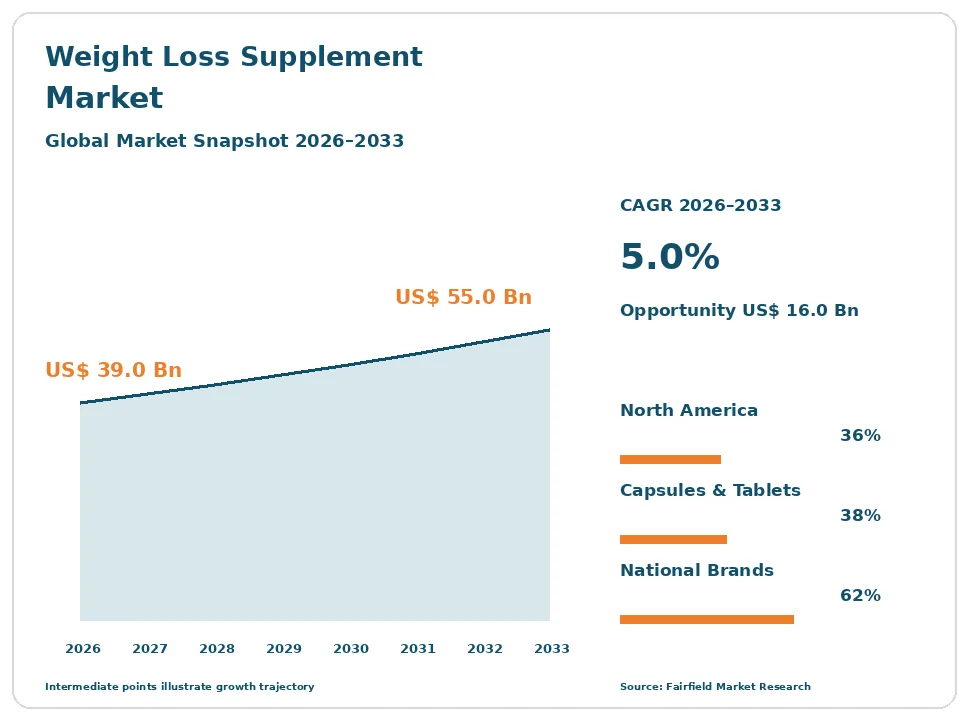
The global weight loss supplement market size is expected to be valued at US$ 39.0 billion in 2026 and projected to reach US$ 55.0 billion by 2033, growing at a CAGR of 5.0% between 2026 and 2033.
The category grew at close to a 4.1% CAGR between 2020 and 2025, with online supply expanding while traditional direct selling contracted. Three commercial factors set the forecast. Retail and platform distribution keeps widening the addressable buyer base, particularly in Asia Pacific. Format migration toward protein, meal replacement and bar products moves revenue into mainstream grocery shelves. Regulatory and advertising constraints cap claim-led marketing, which holds the growth rate below that of general consumer nutrition. The direction of travel is a slower, compliance-constrained category in which distribution scale and brand durability matter more than product formulation. Prescription obesity medicines and the associated telehealth services are separate markets and are examined separately.
Key Report Takeaways
- By Product Type: Meal replacement and protein-based products held 31% share in 2026, while probiotic and gut-targeted formats are projected to expand at a 7.2% CAGR through 2033, as manufacturers shift positioning toward general nutrition categories.
- By Form: Capsules and tablets held 38% share in 2026, while gummies are projected to expand at a 6.8% CAGR through 2033, reflecting contract manufacturing capacity additions rather than any change in regulatory status.
- By Distribution Channel: Online retail held 33% share in 2026, while pharmacy and drug stores are projected to expand at a 6.6% CAGR through 2033, because pharmacy listing requirements act as a quality signal buyers can verify.
- By Brand Structure: National and international brands held 62% share in 2026, while private label is projected to expand at a 6.3% CAGR through 2033, as grocery and pharmacy chains extend own-label ranges into the category.
- By Geography: North America held 36% share in 2026, while Asia Pacific is projected to expand at a 6.4% CAGR through 2033, driven by China, India, Japan and Indonesia and by platform-based cross-border supply.
Global Weight Loss Supplement Market Trends and Insights
Drivers Impact Analysis
| Driver | Impact on CAGR Forecast | Geographic Relevance | Impact Timeline |
| Online and marketplace distribution lowering entry cost for brands | High | Global, strongest in Asia Pacific and North America | Short term (≤2 years) |
| Migration of revenue into mainstream protein and meal replacement formats | Medium | North America, Europe | Medium term (2–4 years) |
Two commercial factors account for most of the forecast expansion in this category.
Marketplace Distribution Lowers Entry Costs Across the Weight Loss Supplement Category
Online marketplaces are the main reason unit volume keeps rising. A brand can reach national distribution without retail listings, shelf fees or a field sales force, which compresses the capital needed to launch. The result is a long tail of small brands and private-label entrants competing alongside established manufacturers, and a steady rise in the number of distinct products offered in the weight-management category.
The mechanism is cost structure. Contract manufacturers supply finished goods in capsule, powder, gummy and bar formats at low minimum order quantities, so formulation is rarely proprietary. Spending moves to customer acquisition instead. Cross-border fulfilment extends this further, letting sellers reach markets where they hold no local notification or registration. That same route is where regulators have concentrated enforcement attention, which makes distribution both the growth engine and the principal compliance exposure.
Protein and Meal Replacement Formats Move Weight Loss Supplement Revenue Into Grocery Channels
Format migration is changing where this category’s revenue is booked. Protein powders, ready-to-drink shakes, meal replacement products and bars are stocked as mainstream nutrition rather than as supplements, which gives them grocery and club-store distribution, larger basket sizes and fewer advertising restrictions. Manufacturers with food-grade capacity are moving volume in this direction, because the regulatory and reputational exposure is lower than for claim-led capsule products.
The causal driver is labelling freedom. A protein product sold on composition rather than on an outcome needs no authorised health claim, so marketing can proceed without the substantiation burden that attaches to weight-management claims. Glanbia, BellRing Brands and The Simply Good Foods Company operate largely in this part of the category. The shift also suits retailers, who prefer stocking products that carry less risk of regulatory challenge or consumer complaint.
Restraints Impact Analysis
| Restraint | Impact on CAGR Forecast | Geographic Relevance | Impact Timeline |
| Very limited authorised weight-management health claims and advertising enforcement | High | European Union, United Kingdom, North America | Long term (≥4 years) |
| Undeclared pharmaceutical ingredients identified in products sold in this category | High | Global, concentrated in cross-border online supply | Medium term (2–4 years) |
Regulatory and reputational exposure, rather than cost or capacity, constrains this market.
Restricted Claims Narrow the Marketing Space for Weight Loss Supplement Brands
Claim restriction is the defining commercial constraint on this category. In the European Union the register of authorised health claims contains very few entries relating to weight management, and anything outside that list may not be used. Brands instead sell on composition, format and price rather than on outcome, which removes the strongest marketing lever a consumer product can have and holds category growth below that of general nutrition.
The cause is the structure of the claims framework. The Nutrition and Health Claims Regulation requires pre-authorisation of health claims, and Commission Regulation (EU) No 432/2012 sets the permitted list. National authorities and advertising self-regulatory bodies act against claims outside it. In the United States, products are notified rather than approved, and the Federal Trade Commission applies substantiation standards after the fact, so the exposure arrives as enforcement rather than as refusal.
Undeclared Pharmaceutical Ingredients Create Market-Integrity Risk for Weight Loss Supplement Supply
Adulteration findings are a documented structural problem for this category. Regulators in several jurisdictions have repeatedly identified undeclared pharmaceutical ingredients in products marketed for weight management, and public alert lists are maintained on an ongoing basis. The commercial consequence is that large retailers, manufacturers and payment platforms treat the category as heightened risk, which restricts listings, raises due-diligence costs and depresses valuation multiples for brands operating in it.
The underlying cause is supply-chain structure. Low barriers to entry, contract manufacturing in multiple jurisdictions and direct cross-border shipment to consumers mean many products never pass through an importer subject to local oversight. Testing and traceability costs fall on compliant manufacturers that are not the source of the problem. The US Food and Drug Administration maintains current good manufacturing practice requirements for dietary supplements, but enforcement reaches overseas direct-to-consumer sellers unevenly.
Market Opportunities
Two revenue pools favour operators that treat compliance as an asset rather than a cost.
Compliance-Led Positioning Opens Pharmacy Channel Revenue in the Weight Loss Supplement Category
The pharmacy channel is the clearest underserved pool for manufacturers able to document compliance. Pharmacy chains apply listing criteria covering manufacturing standards, ingredient documentation and claim wording, which most long-tail online sellers cannot satisfy. Meeting those criteria converts regulatory investment into a distribution advantage and supports higher realised prices than marketplace listings, where competition is on price alone.
Established manufacturers with audited facilities and regulatory affairs capability are positioned to capture this, and pharmacy buyers create the demand because they need category revenue without the complaint exposure that marketplace products carry. Tightly regulated markets work the same way at national scale: where notification regimes under the Food Supplements Directive and national rules are actively enforced, compliant suppliers face fewer undercutting competitors. Compliance cost becomes a barrier protecting incumbents rather than a pure overhead.
General Nutrition Positioning During Medication Use Creates an Adjacent Weight Loss Supplement Pool
The arrival of prescription obesity medications has changed what buyers expect from this category, and that has opened an adjacent commercial pool. Products positioned around general nutrition during medication use, principally protein and micronutrient formats sold on composition, address a buyer group that pharmacies and grocers already serve. This is a market observation about demand expectations, with no comparative claim about any product or medicine.
Manufacturers with protein and meal replacement capacity are best placed, because the formats already exist and require no new claim authorisation. Retailers and pharmacies create the demand by seeking adjacent range extensions for an expanding customer group. Prescription obesity medicines and the telehealth services that supply them are separate markets covered separately, and the opportunity described here is confined to food supplement and nutrition products sold through conventional retail channels.
Segment Analysis
By Product Type: Meal Replacement Formats Lead While Gut-Targeted Products Grow Fastest
Meal replacement and protein-based products held 31% of 2026 revenue, the largest block, because they carry grocery and club-store distribution and are sold on composition rather than on outcome claims. Fibre and satiety products, including glucomannan-based formats, hold the one position supported by an authorised European Union claim, which gives them unusual regulatory standing. Botanical and plant extract products and thermogenic formulations containing caffeine remain significant by volume but carry the heaviest advertising scrutiny. Fat and carbohydrate absorption products form a smaller block. Probiotic and gut-targeted formats are the fastest-growing type at a 7.2% CAGR through 2033, mainly because manufacturers are repositioning them within general digestive and nutrition ranges. Vitamin and mineral blends sold into this category round out the mix.
By Form: Capsules and Tablets Hold the Base While Gummy Formats Expand Quickest
Capsules and tablets accounted for 38% of 2026 revenue, a position built on low unit cost, long shelf life and the simplest contract manufacturing route. Powders follow, carried by the protein and meal replacement products that dominate the largest product type. Liquids and bars occupy smaller positions, with bars benefiting from grocery placement. Gummies are the fastest-growing form at a 6.8% CAGR to 2033, driven by contract manufacturing capacity additions and retailer appetite for differentiated shelf presentation, not by any change in regulatory treatment. Form choice carries direct commercial consequences for manufacturers. Gummy and bar production requires food-grade lines, tighter stability control and cold-chain-sensitive storage in warm markets, which raises cost of goods relative to simple encapsulation and shifts the economics toward manufacturers that already own food assets rather than supplement contract capacity.
By Distribution Channel: Online Retail Leads as Pharmacy Distribution Gains Share Fastest
Online retail held 33% of 2026 sales, the leading channel, because marketplace listing requires no shelf negotiation and supports cross-border supply. Grocery and mass retail follow, carrying the protein and meal replacement formats. Specialist health retail holds a durable position built on staff advice and own-label ranges, while direct selling has contracted from its earlier share as Herbalife, Amway and Nature’s Sunshine Products face recruitment pressure. Pharmacy and drug stores are the fastest-growing channel at a 6.6% CAGR through 2033, because listing criteria function as a verifiable quality signal in a category where buyers cannot assess products themselves. Channel mix now predicts regulatory exposure: online-weighted sellers carry the adulteration and claim risk that pharmacy-weighted suppliers have largely designed out.
By Brand Structure: National Brands Retain Scale While Private Label Advances Rapidly
National and international brands held 62% of 2026 revenue, supported by media spend, retail relationships and the compliance infrastructure that large listings demand. Practitioner and pharmacy-exclusive brands hold a smaller, higher-priced block sold through professional channels. Private label is the fastest-growing structure at a 6.3% CAGR to 2033, as grocery and pharmacy chains extend own-label nutrition ranges into weight-management adjacent products, using their own supplier audit processes to manage risk. The retailer captures the margin and controls claim wording directly, which removes one layer of compliance risk from the shelf. For branded manufacturers the implication is sustained margin pressure in mainstream formats and a stronger incentive to compete on documented manufacturing standards, ingredient traceability, audit history and supply reliability rather than on formulation novelty that competitors can copy within a season.
Geography Analysis
Which Region Is Leading the Weight Loss Supplement Market?
North America leads with 36% share in 2026, concentrated in the United States and Canada. The Dietary Supplement Health and Education Act framework allows products to reach market on notification rather than approval, which supports a wide product range and rapid launch cycles. Oversight arrives afterwards: the US Food and Drug Administration enforces current good manufacturing practice and operates a new dietary ingredient notification process, while the Federal Trade Commission applies substantiation standards to advertising and the National Advertising Division issues self-regulatory rulings. Retail structure is mature, with pharmacy, club, grocery and specialist chains all carrying the category. The regional change worth tracking is retailer tightening of supplier documentation requirements, which raises the cost of shelf access for smaller brands.
Europe Operates the Tightest Claim Regime in the Weight Loss Supplement Category
Europe holds 24% of 2026 revenue, led by Germany, the United Kingdom, France, Italy and Poland. The region’s defining feature is claim restriction. The Nutrition and Health Claims Regulation and Commission Regulation (EU) No 432/2012 permit only a short list of authorised claims, and the weight-management entries on it are very few. National authorities and advertising self-regulatory bodies act against unauthorised claims, and several member states additionally restrict specific botanical ingredients. The Food Supplements Directive sets the framework for composition and labelling, with national notification required in most member states. The commercial effect is a smaller, slower, more concentrated market in which compliant manufacturers face fewer undercutting entrants than elsewhere.
Which Region Is Growing Fastest in the Weight Loss Supplement Market?
Asia Pacific is the fastest-growing region at a 6.4% CAGR between 2026 and 2033, led by China, India, Japan, South Korea and Indonesia. Growth comes from retail modernisation, platform distribution and rising discretionary nutrition spending rather than from claim-led marketing. Regulatory frameworks differ widely: China operates a registration and filing system for health foods, Japan runs notified foods with function claims, and India applies nutraceutical regulations with defined ingredient lists. Cross-border e-commerce routes substantial volume around domestic registration requirements, which is where regulators have concentrated attention. The region also hosts much of the contract manufacturing capacity supplying other markets, so policy changes here affect global supply as well as local demand.
Latin America Expands Through Pharmacy Chains Despite Registration Delays
Latin America accounts for 7% of 2026 revenue, concentrated in Brazil, Mexico, Argentina and Colombia. Pharmacy chains are the dominant channel, which gives the category more regulatory discipline than marketplace-led markets. Barriers are specific. Product registration and import clearance can take months, and requirements differ between countries, so regional launches are sequential rather than simultaneous. Currency volatility raises the landed cost of imported ingredients and finished goods. Enforcement capacity against informal and imported product is limited, so compliant suppliers compete with untracked supply. The change shaping the region is harmonisation work on supplement categories and labelling, which would reduce duplicated registration cost for manufacturers selling across several national markets.
Middle East & Africa Demand Concentrates in Gulf Retail With Uneven Oversight Elsewhere
Middle East & Africa holds 5% of 2026 revenue, the smallest block. Saudi Arabia, the United Arab Emirates, Egypt and South Africa account for most of it. Gulf markets have organised pharmacy and grocery retail, registration requirements administered by national food and drug authorities, and import-dependent supply with high brand awareness. Barriers dominate elsewhere: limited registration infrastructure, constrained consumer spending and widespread informal retail that sits outside any oversight. Counterfeit and undeclared-ingredient products are a recognised problem in markets with weak border testing capacity. The opportunity is registration-led: suppliers that complete Gulf approvals gain access to organised retail chains that are expanding regionally and prefer documented, registered product ranges.
Competitive Landscape
The weight loss supplement market is fragmented and concentration is low. No manufacturer holds a double-digit global share, and the category carries a long tail of small brands, private-label products and cross-border online sellers alongside a smaller group of multinational manufacturers. Four structural groups compete: direct selling organisations such as Herbalife, Amway, USANA Health Sciences and Nature’s Sunshine Products; food and nutrition manufacturers including Glanbia, Nestlé Health Science, BellRing Brands and The Simply Good Foods Company; programme-based businesses such as Medifast; and retailers with own-label ranges, including GNC Holdings and Holland & Barrett. Consolidation is slow because brand assets depreciate quickly in a high-churn category.
Competition runs on distribution and brand durability rather than on formulation, which is rarely proprietary and is widely available from contract manufacturers. The practical points of differentiation are retail listings, marketing efficiency, manufacturing documentation and the ability to satisfy retailer and platform compliance requirements. New entry is continuous and cheap, arriving mainly through marketplaces and social commerce, but survival rates are low and customer acquisition cost rises as platform advertising policies restrict promotion of weight-management products.
Strategic direction across the larger companies is defensive and compliance-oriented. The visible themes are repositioning portfolios toward protein, meal replacement and general nutrition formats that sit outside claim-restricted marketing, investing in manufacturing audits and ingredient traceability to retain retail and pharmacy listings, and reducing reliance on direct selling as recruitment models weaken. Retailers are extending private label with supplier audit programmes attached. Across the group, regulatory exposure rather than production cost is treated as the principal business risk, and strategy is organised around containing it.
Weight Loss Supplement Industry Leaders
- Herbalife
- Glanbia
- Amway
- Medifast
- The Simply Good Foods Company
Recent Industry Developments
- June 2002: The European Union adopted the Food Supplements Directive, harmonising rules on vitamin and mineral sources, labelling and national notification for food supplements – it established the baseline compliance framework under which this category is sold across member states.
- December 2006: The European Union adopted the Nutrition and Health Claims Regulation, requiring pre-authorisation of health claims on foods and supplements – it removed outcome-based marketing as a general option for this category in Europe.
- December 2012: Commission Regulation (EU) No 432/2012 establishing the list of permitted health claims became applicable, with very few authorised entries relating to weight management – it fixed the narrow claim space that still defines European commercial strategy.
- December 2022: The Federal Trade Commission issued updated health products compliance guidance, replacing its earlier advertising guide for dietary supplements and restating substantiation expectations for weight-loss advertising – it raised the documented evidentiary bar for claims made in the United States.
- March 2023: The US Food and Drug Administration launched a public dietary supplement ingredient directory consolidating its statements on ingredients used in supplements – it gave retailers and importers a single reference point when screening products in this category.
Companies Covered in the Report
- Herbalife
- Amway
- USANA Health Sciences
- Glanbia
- Nestlé Health Science
- GNC Holdings
- Holland & Barrett
- BellRing Brands
- Medifast
- The Simply Good Foods Company
- NOW Health Group
- Nature’s Sunshine Products
Weight Loss Supplement Market Report Scope
This report covers products sold as food or dietary supplements in the weight-management category: meal replacement and protein-based products, fibre and satiety products, botanical extracts, thermogenic and stimulant-containing formulations, absorption products, probiotic formats and vitamin and mineral blends, in capsule, tablet, powder, liquid, gummy and bar forms. Prescription obesity medicines, medical foods and associated telehealth services are excluded. The base year is 2025 and the forecast period runs from 2026 to 2033 in US$ Billion.
Product Type
- Meal Replacement and Protein-Based Products
- Fibre and Satiety Products
- Botanical and Plant Extract Products
- Thermogenic and Stimulant-Containing Formulations
- Fat and Carbohydrate Absorption Products
- Probiotic and Gut-Targeted Formats
- Vitamin and Mineral Blends
Form
- Capsules and Tablets
- Powders
- Liquids
- Gummies
- Bars
Distribution Channel
- Pharmacy and Drug Stores
- Grocery and Mass Retail
- Specialist Health Retail
- Direct Selling
- Online Retail
Brand Structure
- National and International Brands
- Private Label
- Practitioner and Pharmacy-Exclusive Brands
Regions
- North America
- Europe
- Asia Pacific
- Latin America
- Middle East & Africa
Key Questions Answered in the Report
How large is the weight loss supplement market in 2026?
The weight loss supplement market is valued at US$ 39.0 billion in 2026, making it one of the larger consumer supplement categories by retail value.
What growth is forecast for the weight loss supplement market to 2033?
The market is projected to reach US$ 55.0 billion by 2033 at a 5.0% CAGR, adding US$ 16.0 billion of absolute dollar opportunity.
Which product type leads the weight loss supplement market?
Meal replacement and protein-based products lead with 31% share in 2026, because they are distributed and marketed as mainstream nutrition rather than as claim-led supplements.
Which region is growing fastest in the weight loss supplement market?
Asia Pacific is growing fastest at a 6.4% CAGR through 2033, supported by retail modernisation and platform distribution across China, India and Indonesia.
How concentrated is the weight loss supplement market?
Concentration is low. Direct sellers, food manufacturers, programme businesses and own-label retailers compete alongside a long tail of small online brands.
1. Executive Summary
1.1. Global Weight Loss Supplement Market Snapshot
1.2. Future Projections
1.3. Key Report Takeaways
1.4. Regional Snapshot
2. Market Overview
2.1. Market Definition and Report Scope
2.2. Historical Trends 2020–2025
2.3. Market Dynamics
2.3.1. Drivers
2.3.1.1. Marketplace Distribution Lowers Entry Costs Across the Weight Loss Supplement Category
2.3.1.2. Protein and Meal Replacement Formats Move Weight Loss Supplement Revenue Into Grocery Channels
2.3.2. Restraints
2.3.2.1. Restricted Claims Narrow the Marketing Space for Weight Loss Supplement Brands
2.3.2.2. Undeclared Pharmaceutical Ingredients Create Market-Integrity Risk for Weight Loss Supplement Supply
2.3.3. Market Opportunities
2.3.3.1. Compliance-Led Positioning Opens Pharmacy Channel Revenue in the Weight Loss Supplement Category
2.3.3.2. General Nutrition Positioning During Medication Use Creates an Adjacent Weight Loss Supplement Pool
3. Global Weight Loss Supplement Market Outlook, 2020–2033
3.1. Global Weight Loss Supplement Market Outlook, by Product Type, Value (US$ Billion), 2020–2033
3.1.1. Meal Replacement and Protein-Based Products
3.1.2. Fibre and Satiety Products
3.1.3. Botanical and Plant Extract Products
3.1.4. Thermogenic and Stimulant-Containing Formulations
3.1.5. Fat and Carbohydrate Absorption Products
3.1.6. Probiotic and Gut-Targeted Formats
3.1.7. Vitamin and Mineral Blends
3.2. Global Weight Loss Supplement Market Outlook, by Form, Value (US$ Billion), 2020–2033
3.2.1. Capsules and Tablets
3.2.2. Powders
3.2.3. Liquids
3.2.4. Gummies
3.2.5. Bars
3.3. Global Weight Loss Supplement Market Outlook, by Distribution Channel, Value (US$ Billion), 2020–2033
3.3.1. Pharmacy and Drug Stores
3.3.2. Grocery and Mass Retail
3.3.3. Specialist Health Retail
3.3.4. Direct Selling
3.3.5. Online Retail
3.4. Global Weight Loss Supplement Market Outlook, by Brand Structure, Value (US$ Billion), 2020–2033
3.4.1. National and International Brands
3.4.2. Private Label
3.4.3. Practitioner and Pharmacy-Exclusive Brands
3.5. Global Weight Loss Supplement Market Outlook, by Region, Value (US$ Billion), 2020–2033
3.5.1. North America
3.5.2. Europe
3.5.3. Asia Pacific
3.5.4. Latin America
3.5.5. Middle East & Africa
4. North America Weight Loss Supplement Market Outlook, 2020–2033
4.1. North America Weight Loss Supplement Market Outlook, by Product Type, Value (US$ Billion), 2020–2033
4.1.1. Meal Replacement and Protein-Based Products
4.1.2. Fibre and Satiety Products
4.1.3. Botanical and Plant Extract Products
4.1.4. Thermogenic and Stimulant-Containing Formulations
4.1.5. Fat and Carbohydrate Absorption Products
4.1.6. Probiotic and Gut-Targeted Formats
4.1.7. Vitamin and Mineral Blends
4.2. North America Weight Loss Supplement Market Outlook, by Form, Value (US$ Billion), 2020–2033
4.2.1. Capsules and Tablets
4.2.2. Powders
4.2.3. Liquids
4.2.4. Gummies
4.2.5. Bars
4.3. North America Weight Loss Supplement Market Outlook, by Distribution Channel, Value (US$ Billion), 2020–2033
4.3.1. Pharmacy and Drug Stores
4.3.2. Grocery and Mass Retail
4.3.3. Specialist Health Retail
4.3.4. Direct Selling
4.3.5. Online Retail
4.4. North America Weight Loss Supplement Market Outlook, by Brand Structure, Value (US$ Billion), 2020–2033
4.4.1. National and International Brands
4.4.2. Private Label
4.4.3. Practitioner and Pharmacy-Exclusive Brands
4.5. North America Weight Loss Supplement Market Outlook, by Country, Value (US$ Billion), 2020–2033
4.5.1. United States Weight Loss Supplement Market Outlook, by Product Type, 2020–2033
4.5.2. United States Weight Loss Supplement Market Outlook, by Form, 2020–2033
4.5.3. United States Weight Loss Supplement Market Outlook, by Distribution Channel, 2020–2033
4.5.4. United States Weight Loss Supplement Market Outlook, by Brand Structure, 2020–2033
4.5.5. Canada Weight Loss Supplement Market Outlook, by Product Type, 2020–2033
4.5.6. Canada Weight Loss Supplement Market Outlook, by Form, 2020–2033
4.5.7. Canada Weight Loss Supplement Market Outlook, by Distribution Channel, 2020–2033
4.5.8. Canada Weight Loss Supplement Market Outlook, by Brand Structure, 2020–2033
5. Europe Weight Loss Supplement Market Outlook, 2020–2033
5.1. Europe Weight Loss Supplement Market Outlook, by Product Type, Value (US$ Billion), 2020–2033
5.1.1. Meal Replacement and Protein-Based Products
5.1.2. Fibre and Satiety Products
5.1.3. Botanical and Plant Extract Products
5.1.4. Thermogenic and Stimulant-Containing Formulations
5.1.5. Fat and Carbohydrate Absorption Products
5.1.6. Probiotic and Gut-Targeted Formats
5.1.7. Vitamin and Mineral Blends
5.2. Europe Weight Loss Supplement Market Outlook, by Form, Value (US$ Billion), 2020–2033
5.2.1. Capsules and Tablets
5.2.2. Powders
5.2.3. Liquids
5.2.4. Gummies
5.2.5. Bars
5.3. Europe Weight Loss Supplement Market Outlook, by Distribution Channel, Value (US$ Billion), 2020–2033
5.3.1. Pharmacy and Drug Stores
5.3.2. Grocery and Mass Retail
5.3.3. Specialist Health Retail
5.3.4. Direct Selling
5.3.5. Online Retail
5.4. Europe Weight Loss Supplement Market Outlook, by Brand Structure, Value (US$ Billion), 2020–2033
5.4.1. National and International Brands
5.4.2. Private Label
5.4.3. Practitioner and Pharmacy-Exclusive Brands
5.5. Europe Weight Loss Supplement Market Outlook, by Country, Value (US$ Billion), 2020–2033
5.5.1. Germany Weight Loss Supplement Market Outlook, by Product Type, 2020–2033
5.5.2. Germany Weight Loss Supplement Market Outlook, by Form, 2020–2033
5.5.3. Germany Weight Loss Supplement Market Outlook, by Distribution Channel, 2020–2033
5.5.4. Germany Weight Loss Supplement Market Outlook, by Brand Structure, 2020–2033
5.5.5. United Kingdom Weight Loss Supplement Market Outlook, by Product Type, 2020–2033
5.5.6. United Kingdom Weight Loss Supplement Market Outlook, by Form, 2020–2033
5.5.7. United Kingdom Weight Loss Supplement Market Outlook, by Distribution Channel, 2020–2033
5.5.8. United Kingdom Weight Loss Supplement Market Outlook, by Brand Structure, 2020–2033
5.5.9. France Weight Loss Supplement Market Outlook, by Product Type, 2020–2033
5.5.10. France Weight Loss Supplement Market Outlook, by Form, 2020–2033
5.5.11. France Weight Loss Supplement Market Outlook, by Distribution Channel, 2020–2033
5.5.12. France Weight Loss Supplement Market Outlook, by Brand Structure, 2020–2033
5.5.13. Italy Weight Loss Supplement Market Outlook, by Product Type, 2020–2033
5.5.14. Italy Weight Loss Supplement Market Outlook, by Form, 2020–2033
5.5.15. Italy Weight Loss Supplement Market Outlook, by Distribution Channel, 2020–2033
5.5.16. Italy Weight Loss Supplement Market Outlook, by Brand Structure, 2020–2033
5.5.17. Poland Weight Loss Supplement Market Outlook, by Product Type, 2020–2033
5.5.18. Poland Weight Loss Supplement Market Outlook, by Form, 2020–2033
5.5.19. Poland Weight Loss Supplement Market Outlook, by Distribution Channel, 2020–2033
5.5.20. Poland Weight Loss Supplement Market Outlook, by Brand Structure, 2020–2033
6. Asia Pacific Weight Loss Supplement Market Outlook, 2020–2033
6.1. Asia Pacific Weight Loss Supplement Market Outlook, by Product Type, Value (US$ Billion), 2020–2033
6.1.1. Meal Replacement and Protein-Based Products
6.1.2. Fibre and Satiety Products
6.1.3. Botanical and Plant Extract Products
6.1.4. Thermogenic and Stimulant-Containing Formulations
6.1.5. Fat and Carbohydrate Absorption Products
6.1.6. Probiotic and Gut-Targeted Formats
6.1.7. Vitamin and Mineral Blends
6.2. Asia Pacific Weight Loss Supplement Market Outlook, by Form, Value (US$ Billion), 2020–2033
6.2.1. Capsules and Tablets
6.2.2. Powders
6.2.3. Liquids
6.2.4. Gummies
6.2.5. Bars
6.3. Asia Pacific Weight Loss Supplement Market Outlook, by Distribution Channel, Value (US$ Billion), 2020–2033
6.3.1. Pharmacy and Drug Stores
6.3.2. Grocery and Mass Retail
6.3.3. Specialist Health Retail
6.3.4. Direct Selling
6.3.5. Online Retail
6.4. Asia Pacific Weight Loss Supplement Market Outlook, by Brand Structure, Value (US$ Billion), 2020–2033
6.4.1. National and International Brands
6.4.2. Private Label
6.4.3. Practitioner and Pharmacy-Exclusive Brands
6.5. Asia Pacific Weight Loss Supplement Market Outlook, by Country, Value (US$ Billion), 2020–2033
6.5.1. China Weight Loss Supplement Market Outlook, by Product Type, 2020–2033
6.5.2. China Weight Loss Supplement Market Outlook, by Form, 2020–2033
6.5.3. China Weight Loss Supplement Market Outlook, by Distribution Channel, 2020–2033
6.5.4. China Weight Loss Supplement Market Outlook, by Brand Structure, 2020–2033
6.5.5. India Weight Loss Supplement Market Outlook, by Product Type, 2020–2033
6.5.6. India Weight Loss Supplement Market Outlook, by Form, 2020–2033
6.5.7. India Weight Loss Supplement Market Outlook, by Distribution Channel, 2020–2033
6.5.8. India Weight Loss Supplement Market Outlook, by Brand Structure, 2020–2033
6.5.9. Japan Weight Loss Supplement Market Outlook, by Product Type, 2020–2033
6.5.10. Japan Weight Loss Supplement Market Outlook, by Form, 2020–2033
6.5.11. Japan Weight Loss Supplement Market Outlook, by Distribution Channel, 2020–2033
6.5.12. Japan Weight Loss Supplement Market Outlook, by Brand Structure, 2020–2033
6.5.13. South Korea Weight Loss Supplement Market Outlook, by Product Type, 2020–2033
6.5.14. South Korea Weight Loss Supplement Market Outlook, by Form, 2020–2033
6.5.15. South Korea Weight Loss Supplement Market Outlook, by Distribution Channel, 2020–2033
6.5.16. South Korea Weight Loss Supplement Market Outlook, by Brand Structure, 2020–2033
6.5.17. Indonesia Weight Loss Supplement Market Outlook, by Product Type, 2020–2033
6.5.18. Indonesia Weight Loss Supplement Market Outlook, by Form, 2020–2033
6.5.19. Indonesia Weight Loss Supplement Market Outlook, by Distribution Channel, 2020–2033
6.5.20. Indonesia Weight Loss Supplement Market Outlook, by Brand Structure, 2020–2033
7. Latin America Weight Loss Supplement Market Outlook, 2020–2033
7.1. Latin America Weight Loss Supplement Market Outlook, by Product Type, Value (US$ Billion), 2020–2033
7.1.1. Meal Replacement and Protein-Based Products
7.1.2. Fibre and Satiety Products
7.1.3. Botanical and Plant Extract Products
7.1.4. Thermogenic and Stimulant-Containing Formulations
7.1.5. Fat and Carbohydrate Absorption Products
7.1.6. Probiotic and Gut-Targeted Formats
7.1.7. Vitamin and Mineral Blends
7.2. Latin America Weight Loss Supplement Market Outlook, by Form, Value (US$ Billion), 2020–2033
7.2.1. Capsules and Tablets
7.2.2. Powders
7.2.3. Liquids
7.2.4. Gummies
7.2.5. Bars
7.3. Latin America Weight Loss Supplement Market Outlook, by Distribution Channel, Value (US$ Billion), 2020–2033
7.3.1. Pharmacy and Drug Stores
7.3.2. Grocery and Mass Retail
7.3.3. Specialist Health Retail
7.3.4. Direct Selling
7.3.5. Online Retail
7.4. Latin America Weight Loss Supplement Market Outlook, by Brand Structure, Value (US$ Billion), 2020–2033
7.4.1. National and International Brands
7.4.2. Private Label
7.4.3. Practitioner and Pharmacy-Exclusive Brands
7.5. Latin America Weight Loss Supplement Market Outlook, by Country, Value (US$ Billion), 2020–2033
7.5.1. Brazil Weight Loss Supplement Market Outlook, by Product Type, 2020–2033
7.5.2. Brazil Weight Loss Supplement Market Outlook, by Form, 2020–2033
7.5.3. Brazil Weight Loss Supplement Market Outlook, by Distribution Channel, 2020–2033
7.5.4. Brazil Weight Loss Supplement Market Outlook, by Brand Structure, 2020–2033
7.5.5. Mexico Weight Loss Supplement Market Outlook, by Product Type, 2020–2033
7.5.6. Mexico Weight Loss Supplement Market Outlook, by Form, 2020–2033
7.5.7. Mexico Weight Loss Supplement Market Outlook, by Distribution Channel, 2020–2033
7.5.8. Mexico Weight Loss Supplement Market Outlook, by Brand Structure, 2020–2033
7.5.9. Argentina Weight Loss Supplement Market Outlook, by Product Type, 2020–2033
7.5.10. Argentina Weight Loss Supplement Market Outlook, by Form, 2020–2033
7.5.11. Argentina Weight Loss Supplement Market Outlook, by Distribution Channel, 2020–2033
7.5.12. Argentina Weight Loss Supplement Market Outlook, by Brand Structure, 2020–2033
7.5.13. Colombia Weight Loss Supplement Market Outlook, by Product Type, 2020–2033
7.5.14. Colombia Weight Loss Supplement Market Outlook, by Form, 2020–2033
7.5.15. Colombia Weight Loss Supplement Market Outlook, by Distribution Channel, 2020–2033
7.5.16. Colombia Weight Loss Supplement Market Outlook, by Brand Structure, 2020–2033
8. Middle East & Africa Weight Loss Supplement Market Outlook, 2020–2033
8.1. Middle East & Africa Weight Loss Supplement Market Outlook, by Product Type, Value (US$ Billion), 2020–2033
8.1.1. Meal Replacement and Protein-Based Products
8.1.2. Fibre and Satiety Products
8.1.3. Botanical and Plant Extract Products
8.1.4. Thermogenic and Stimulant-Containing Formulations
8.1.5. Fat and Carbohydrate Absorption Products
8.1.6. Probiotic and Gut-Targeted Formats
8.1.7. Vitamin and Mineral Blends
8.2. Middle East & Africa Weight Loss Supplement Market Outlook, by Form, Value (US$ Billion), 2020–2033
8.2.1. Capsules and Tablets
8.2.2. Powders
8.2.3. Liquids
8.2.4. Gummies
8.2.5. Bars
8.3. Middle East & Africa Weight Loss Supplement Market Outlook, by Distribution Channel, Value (US$ Billion), 2020–2033
8.3.1. Pharmacy and Drug Stores
8.3.2. Grocery and Mass Retail
8.3.3. Specialist Health Retail
8.3.4. Direct Selling
8.3.5. Online Retail
8.4. Middle East & Africa Weight Loss Supplement Market Outlook, by Brand Structure, Value (US$ Billion), 2020–2033
8.4.1. National and International Brands
8.4.2. Private Label
8.4.3. Practitioner and Pharmacy-Exclusive Brands
8.5. Middle East & Africa Weight Loss Supplement Market Outlook, by Country, Value (US$ Billion), 2020–2033
8.5.1. Saudi Arabia Weight Loss Supplement Market Outlook, by Product Type, 2020–2033
8.5.2. Saudi Arabia Weight Loss Supplement Market Outlook, by Form, 2020–2033
8.5.3. Saudi Arabia Weight Loss Supplement Market Outlook, by Distribution Channel, 2020–2033
8.5.4. Saudi Arabia Weight Loss Supplement Market Outlook, by Brand Structure, 2020–2033
8.5.5. United Arab Emirates Weight Loss Supplement Market Outlook, by Product Type, 2020–2033
8.5.6. United Arab Emirates Weight Loss Supplement Market Outlook, by Form, 2020–2033
8.5.7. United Arab Emirates Weight Loss Supplement Market Outlook, by Distribution Channel, 2020–2033
8.5.8. United Arab Emirates Weight Loss Supplement Market Outlook, by Brand Structure, 2020–2033
8.5.9. Egypt Weight Loss Supplement Market Outlook, by Product Type, 2020–2033
8.5.10. Egypt Weight Loss Supplement Market Outlook, by Form, 2020–2033
8.5.11. Egypt Weight Loss Supplement Market Outlook, by Distribution Channel, 2020–2033
8.5.12. Egypt Weight Loss Supplement Market Outlook, by Brand Structure, 2020–2033
8.5.13. South Africa Weight Loss Supplement Market Outlook, by Product Type, 2020–2033
8.5.14. South Africa Weight Loss Supplement Market Outlook, by Form, 2020–2033
8.5.15. South Africa Weight Loss Supplement Market Outlook, by Distribution Channel, 2020–2033
8.5.16. South Africa Weight Loss Supplement Market Outlook, by Brand Structure, 2020–2033
9. Competitive Landscape
9.1. Market Concentration and Industry Leaders
9.2. Competitive Differentiation
9.3. Strategic Moves and Market Direction
9.4. Recent Industry Developments
9.5. Company Profiles
9.5.1. Herbalife
9.5.2. Amway
9.5.3. USANA Health Sciences
9.5.4. Glanbia
9.5.5. Nestlé Health Science
9.5.6. GNC Holdings
9.5.7. Holland & Barrett
9.5.8. BellRing Brands
9.5.9. Medifast
9.5.10. The Simply Good Foods Company
9.5.11. NOW Health Group
9.5.12. Nature's Sunshine Products
10. Appendix
10.1. Research Methodology
10.2. Report Assumptions
10.3. Acronyms and Abbreviations
| Product Type | Meal Replacement and Protein-Based Products, Fibre and Satiety Products, Botanical and Plant Extract Products, Thermogenic and Stimulant-Containing Formulations, Fat and Carbohydrate Absorption Products, Probiotic and Gut-Targeted Formats, Vitamin and Mineral Blends |
| Form | Capsules and Tablets, Powders, Liquids, Gummies, Bars |
| Distribution Channel | Pharmacy and Drug Stores, Grocery and Mass Retail, Specialist Health Retail, Direct Selling, Online Retail |
| Brand Structure | National and International Brands, Private Label, Practitioner and Pharmacy-Exclusive Brands |
| Regions | North America, Europe, Asia Pacific, Latin America, Middle East & Africa |
Our Research Methodology
Considering the volatility of business today, traditional approaches to strategizing a game plan can be unfruitful if not detrimental. True ambiguity is no way to determine a forecast. A myriad of predetermined factors must be accounted for such as the degree of risk involved, the magnitude of circumstances, as well as conditions or consequences that are not known or unpredictable. To circumvent binary views that cast uncertainty, the application of market research intelligence to strategically posture, move, and enable actionable outcomes is necessary.
View Methodology
Quality Assured
Rigorous Validation Process

Confidentiality Assured
End-to-end Data Security

Custom Research Services
Tailored To Your Objectives
FAQs
The weight loss supplement market is valued at US$ 39.0 billion in 2026, making it one of the larger consumer supplement categories by retail value.
The market is projected to reach US$ 55.0 billion by 2033 at a 5.0% CAGR, adding US$ 16.0 billion of absolute dollar opportunity.
Meal replacement and protein-based products lead with 31% share in 2026, because they are distributed and marketed as mainstream nutrition rather than as claim-led supplements.
Asia Pacific is growing fastest at a 6.4% CAGR through 2033, supported by retail modernisation and platform distribution across China, India and Indonesia.
Concentration is low. Direct sellers, food manufacturers, programme businesses and own-label retailers compete alongside a long tail of small online brands.
Related Reports
Bio Vanillin Market Size, Share, Insights, Competitive Landscape, and Forecast 2026 to 2033
Explore the bio vanillin market, projected to reach US$ 720.0 million by 2033 at a 10.9% CAGR, with source, application and regional insights.
Milk Ingredients Market Size, Share, Insights, Competitive Landscape, and Forecast 2026 to 2033
The milk ingredients market is projected to grow from US$68.4 billion in 2026 to US$101.2 billion by 2033, at a 5.8% CAGR. Explore segments and key trends.
A2 Milk Market Size, Share, Insights, Competitive Landscape, and Forecast 2026 to 2033
The global A2 milk market is valued at US$21.20 billion in 2026, reaching US$52.31 billion by 2033, growing at a 13.8% CAGR
Tilapia Market Size, Share, Insights, Competitive Landscape, and Forecast 2026 to 2033
The tilapia market is projected to grow from US$14.60 billion in 2026 to US$20.10 billion by 2033, at a 4.7% CAGR, driven by protein demand and aquaculture.
Quillaja Extract Market Size, Share, Insights, Competitive Landscape, and Forecast 2026 to 2033
The quillaja extract market is projected to grow from US$397.5 million in 2026 to US$712.7 million by 2033, at an 8.7% CAGR, led by food and vaccine uses.
Organic Tobacco Market Size, Share, Insights, Competitive Landscape, and Forecast 2026 to 2033
The organic tobacco market is projected to grow from US$143.8 million in 2026 to US$193.1 million by 2033, at a 4.3% CAGR, shaped by sourcing and regulation.