



Quillaja Extract Market
Quillaja Extract Market Size, Share, Insights, Competitive Landscape, and Forecast 2026 to 2033
Quillaja Extract Market Size and Trend Analysis
How Fast Is the Quillaja Extract Market Growing?
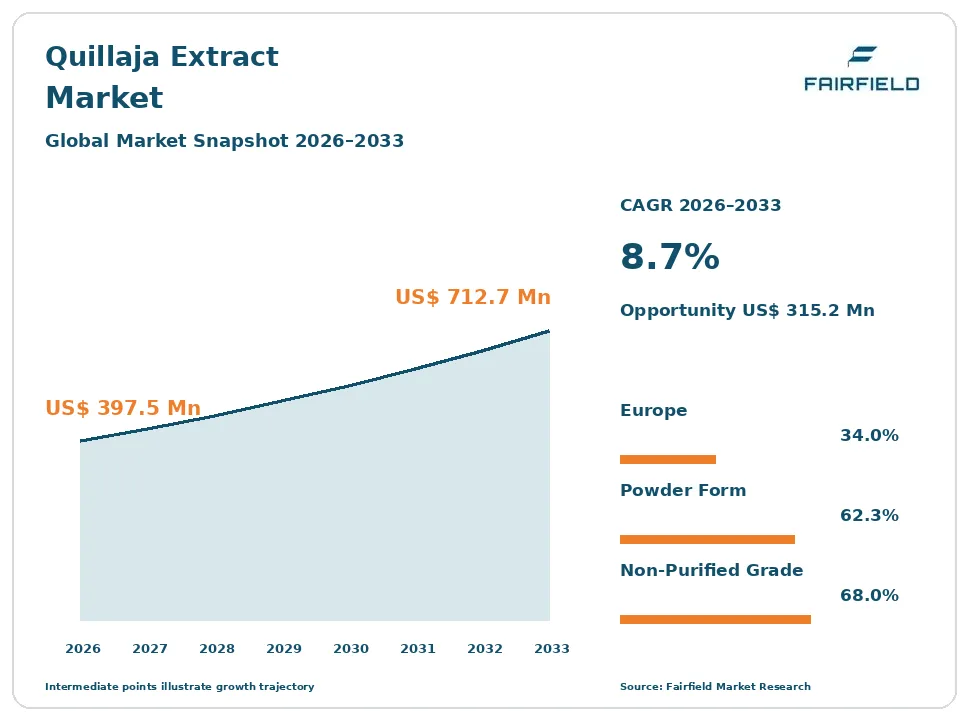
The global quillaja extract market size is expected to be valued at US$ 397.5 million in 2026 and projected to reach US$ 712.7 million by 2033, growing at a CAGR of 8.7% between 2026 and 2033.
Between 2020 and 2025, the market grew at a CAGR of about 7.6%, as food and drink makers looked for plant-based ingredients and vaccine makers used more quillaja-based adjuvants. Quillaja extract comes from the bark and wood of the soapbark tree, Quillaja saponaria, which grows mainly in Chile. It is rich in saponins, natural compounds that create foam and help mix oil and water. Three factors now drive growth: demand for clean label foods and drinks that use a natural emulsifier instead of synthetic additives, the use of purified saponins such as QS-21 as a vaccine adjuvant, and growing use in animal feed, cosmetics, and agriculture. The market is shifting toward high-purity extracts, sustainable harvesting from managed plantations, and lab-grown saponins made by plant cell culture.
Key Report Takeaways
- By Form: Powder held 62.3% share in 2026, while Liquid is projected to expand at a 9.4% CAGR through 2033, driven by beverage makers that prefer ready-to-use solutions for drinks and foams.
- By Grade: Non-Purified (Type 1) held 68.0% share in 2026, while Purified (Type 2) is projected to expand at a 10.3% CAGR through 2033, driven by vaccine, pharmaceutical, and high-end cosmetic uses.
- By Application: Food and Beverage held 32.5% share in 2026, while Pharmaceuticals are projected to expand at an 11.2% CAGR through 2033, driven by saponin-based adjuvants in new vaccines.
- By Region: Europe held 34.0% share in 2026, while Asia Pacific is projected to expand at a 10.6% CAGR through 2033, driven by beverage, feed, and vaccine demand in China, India, and Japan.
Global Quillaja Extract Market Trends and Insights
Drivers Impact Analysis
| Driver | Impact on CAGR Forecast | Geographic Relevance | Impact Timeline |
| Clean label demand in food and beverages | High | Europe, North America, Asia Pacific | Medium term (2-4 years) |
| Use of saponins as vaccine adjuvants | High | Global | Long term (≥4 years) |
Two drivers carry the strongest influence on quillaja extract demand during the forecast period.
Clean Label Demand Is Driving the Quillaja Extract Market
Demand for clean label foods and drinks is the strongest driver of the quillaja extract market. Consumers want short ingredient lists with natural, plant-based items.
The mechanism is replacing synthetic additives. Quillaja extract works as a natural emulsifier and foaming agent in soft drinks, root beer, cream soda, cocktail mixers, and beer, and it helps stabilize flavors and vitamins in clear drinks. It is approved as a food additive (E999) in Europe and is generally recognized as safe in the United States, which supports wide use. Plant-based dairy alternatives, such as oat and almond drinks, use it to improve texture and foam. Vegan foods use it to replace egg whites in some recipes. Major flavor and ingredient firms, including Naturex, now part of Givaudan, and Ingredion, offer quillaja products. These factors increase use across food and beverage categories.
Vaccine Adjuvants Are Expanding the Quillaja Extract Market
The use of quillaja saponins as a vaccine adjuvant is expanding the quillaja extract market. Adjuvants boost the immune response to vaccines.
The cause is the strong performance of saponin-based adjuvants. QS-21, a purified saponin from quillaja, is part of the AS01 adjuvant in GSK’s Shingrix shingles vaccine and Arexvy RSV vaccine, and Arexvy’s use was expanded to more adults in 2024. Novavax’s Matrix-M adjuvant, also based on quillaja saponins, is used in its COVID-19 vaccine and malaria vaccines. In May 2024, Sanofi signed a deal with Novavax that includes rights to use Matrix-M in its own vaccines. Many cancer and infectious disease vaccines in development also use saponin adjuvants. Pharmaceutical-grade saponins command very high prices per gram. These trends raise demand for purified extracts.
Restraints Impact Analysis
| Restraint | Impact on CAGR Forecast | Geographic Relevance | Impact Timeline |
| Limited raw material supply and sustainability concerns | High | Latin America, Global | Long term (≥4 years) |
| Price volatility and competition from other emulsifiers | Medium | Global | Short term (≤2 years) |
Two restraints limit how quickly the quillaja extract market grows.
Supply Limits Slow the Quillaja Extract Market
Limited raw material supply and sustainability concerns slow the quillaja extract market. The soapbark tree grows naturally in only a few places.
The specific causes are geography and harvesting rules. Most quillaja comes from central Chile, with smaller amounts from Peru and Bolivia. Trees grow slowly, and older harvesting methods that stripped bark from wild trees damaged forests. Chile now regulates harvesting and promotes managed plantations and pruning, which limits fast increases in supply. Wildfires and droughts in Chile threaten tree stocks. Purifying QS-21 is complex and yields only small amounts, creating supply bottlenecks for vaccine makers. Export controls and certification requirements add paperwork for suppliers. Traceability demands from food and drug makers require proof of legal and sustainable harvesting. These factors limit how fast supply can grow and keep prices high.
Price Competition Restricts the Quillaja Extract Market
Price volatility and competition from other emulsifiers restrict the quillaja extract market. Buyers can choose cheaper alternatives.
The underlying causes are cost and substitutes. Synthetic emulsifiers and other natural options widely used in food, such as gum arabic, lecithin, yucca extract, and modified starches, can be cheaper and more widely available. Quillaja extract has a bitter, astringent taste at high doses, limiting use levels in some foods. Prices can rise sharply when supply is short or demand from vaccine makers increases. Smaller food makers may not see enough benefit to switch from familiar ingredients. Regulatory limits on maximum use levels in some countries also apply. Some consumers are also unfamiliar with quillaja and may question an unknown ingredient on labels. These factors cap growth in price-sensitive food segments and in emerging markets.
Market Opportunities
Lab-Grown Saponins Open a Pharmaceutical Revenue Pool
Lab-grown saponins open a pharmaceutical revenue pool in the quillaja extract market. New methods can produce QS-21 without harvesting trees.
Biotech firms and ingredient suppliers can capture this opportunity. Phyton Biotech published research in 2024 showing that QS-21 can be made through plant cell fermentation, and Botanical Solution is developing sustainable QS-21 production with Croda International. These methods offer steady supply, consistent quality, and less pressure on forests. Vaccine makers want secure, scalable sources of adjuvants for new vaccines against shingles, RSV, malaria, influenza, and cancer. Long-term supply contracts with drug makers provide high-value revenue. Regulatory approval of lab-grown QS-21 in a licensed vaccine would be a major milestone. Companies that combine extraction expertise with biotech production can serve both food and pharmaceutical buyers.
Animal Feed and Agriculture Create a Sustainable Revenue Pool
Animal feed and agriculture create a sustainable revenue pool in the quillaja extract market. Farmers want natural alternatives to antibiotics and chemicals.
Feed additive and crop input companies can capture this opportunity. Quillaja saponins added to animal feed can improve gut health, reduce ammonia emissions, and support growth in poultry, pigs, and cattle, and they may help control parasites. Restrictions on antibiotic growth promoters in Europe and other regions support steady demand. In crop farming, quillaja-based products act as natural biostimulants, wetting agents, and nematicides that control soil pests. Aquaculture also uses saponins in fish and shrimp feed. These uses support steady volume growth. Livestock producers facing climate rules are interested in feed additives that cut emissions. Organic farming rules allow some quillaja-based crop products, widening demand.
Segment Analysis
By Form: Powder Leads While Liquid Grows Fastest
Powder held 62.3% share in 2026. Powdered quillaja extract is easy to store, transport, and mix into dry foods, supplements, feed premixes, and cosmetics. It has a longer shelf life than liquid forms and lower shipping costs. Most purified saponins for pharmaceutical use are also supplied as powders. Supplement makers use powdered quillaja in capsules and tablets for digestive and cholesterol support.
Liquid is the fastest-growing form, expanding at a 9.4% CAGR through 2033. Liquid extracts are ready to use in soft drinks, beer, cocktail mixers, and plant-based beverages, saving processing time for drink makers. Beverage innovation in North America and Asia Pacific, including new sodas and functional drinks, supports demand. Liquid forms also suit cosmetics such as shampoos and cleansers. For the market, liquid growth supports beverage use.
By Grade: Non-Purified Leads While Purified Grows Fastest
Non-Purified (Type 1) held 68.0% share in 2026. Type 1 extracts contain saponins along with other natural compounds and are widely used as foaming agents and emulsifiers in food, beverages, and animal feed. They are cheaper to produce and meet food additive standards in most countries.
Purified (Type 2) is the fastest-growing grade, expanding at a 10.3% CAGR through 2033. Highly purified saponin fractions are used in vaccines, pharmaceuticals, and premium cosmetics, where consistency and purity are critical. Prices are many times higher than for food grades. Purification requires advanced chromatography and strict quality control. Croda International and specialist firms supply pharmaceutical-grade material. For the market, purified growth raises value.
By Application: Food and Beverage Lead While Pharmaceuticals Grow Fastest
Food and Beverage held 32.5% share in 2026. Soft drinks, beer, cocktail mixers, plant-based drinks, and confectionery use quillaja extract for foam and emulsion. The clean label trend keeps demand steady, and craft beer and premium mixers use quillaja as a foaming agent for better head and texture. Plant-based dairy brands are also important buyers.
Pharmaceuticals are the fastest-growing application, expanding at an 11.2% CAGR through 2033. Saponin adjuvants are used in approved vaccines and many vaccines in development, including several cancer vaccines. Personal care uses quillaja in natural shampoos and soaps, while animal feed and agriculture are other important applications. For the market, pharmaceutical growth adds high-value demand.
Geography Analysis
North America Advances the Quillaja Extract Market Through Beverages and Vaccines
North America is a major quillaja extract market. The United States uses quillaja extract in root beer, cream soda, and other soft drinks, as well as in plant-based beverages and supplements. Desert King International, based in California, is a leading supplier with operations in Chile. Vaccine makers such as GSK and Novavax have large operations in the region. Canada hosts Phyton Biotech’s research on plant cell production of saponins. Plant-based drink brands and supplement makers add demand. Key barriers include competition from cheaper emulsifiers. One change shaping the region is vaccine demand for shingles and RSV shots.
Which Region Is Leading the Quillaja Extract Market?
Europe is leading the quillaja extract market with a 34.0% share in 2026. Germany, the United Kingdom, France, Italy, the Netherlands, and Switzerland have large food, beverage, cosmetics, and pharmaceutical industries that prefer natural ingredients. Quillaja extract is approved as additive E999 across the European Union. Croda International and Givaudan, which owns Naturex, are based here. The EU ban on antibiotic growth promoters supports quillaja use in feed. Cosmetics makers in France use it in natural skincare. Key barriers include strict additive rules. One change shaping the region is natural feed additives.
Which Region Is Growing Fastest in the Quillaja Extract Market?
Asia Pacific is growing fastest in the quillaja extract market at a 10.6% CAGR through 2033. China and India have rapidly growing beverage, feed, and vaccine industries, and India is a major vaccine producer through firms such as Serum Institute of India. Japan has a long history of using quillaja in food, drinks, and cosmetics. South Korea and Australia use it in cosmetics, supplements, and animal feed. Large poultry and aquaculture sectors in China, Vietnam, and Indonesia use saponins in feed. Key barriers include price sensitivity and limited awareness. One change shaping the region is vaccine production.
Latin America Supplies the Quillaja Extract Market Through Chilean Production
Latin America is the main supply region for the quillaja extract market. Chile produces most of the world’s quillaja raw material, and companies such as Natural Response, Desert King, and Chile Botanics process extracts locally near forest areas. Brazil and Mexico have growing beverage, feed, and cosmetics demand. Peru and Bolivia have smaller supplies of trees and raw bark. Government rules in Chile promote sustainable harvesting through pruning instead of cutting whole trees. Most extract is exported to North America, Europe, and Asia Pacific. Key barriers include wildfires and drought. One opportunity is plantation expansion.
Middle East & Africa Expands the Quillaja Extract Market Through Food and Feed
Middle East & Africa is a small but growing quillaja extract market. Saudi Arabia, the United Arab Emirates, and Egypt have growing beverage, dairy, and food processing industries. South Africa has animal feed and beverage demand, and Morocco has a growing food processing sector. Israel has food technology and plant-based startups interested in natural ingredients. Halal-certified natural ingredients are in strong demand across the region. Poultry farms in Saudi Arabia and Egypt are adopting natural feed additives. Key barriers include limited awareness, import costs, and small local demand. One opportunity is natural feed additives for poultry.
Competitive Landscape
The quillaja extract market is moderately concentrated. Desert King International, Naturex (part of Givaudan), Ingredion, Natural Response, Chile Botanics, Baja Yucca, and Garuda International are leading suppliers of food and feed grades. Croda International, Phyton Biotech, Botanical Solution, and Quillaja Green Biosolutions focus on high-purity and sustainable saponins.
Companies compete on purity, consistency, sustainable sourcing, supply security, regulatory approvals, technical support, and price. Access to raw material in Chile is a key advantage, and suppliers with their own plantations or harvesting agreements have more stable supply. Food-grade suppliers compete on price, flavor neutrality, and technical support for beverage makers, while pharmaceutical suppliers compete on purity and regulatory documentation. Partnerships between extractors, biotech firms, and vaccine makers are increasing, such as the work between Croda International and Botanical Solution on sustainable QS-21.
Strategic moves show how competition is changing. In March 2024, Phyton Biotech published research on QS-21 made by plant cell fermentation. In May 2024, Sanofi signed a co-exclusive licensing deal with Novavax that includes rights to the Matrix-M adjuvant. In June 2024, the U.S. Food and Drug Administration expanded approval of GSK’s Arexvy, which uses a QS-21 adjuvant. These moves show competition shifting toward high-value pharmaceutical uses.
Three themes shape vendor strategy. First, companies are securing sustainable supply through plantations and harvesting agreements. Second, they are developing lab-grown saponins. Third, they are targeting vaccine makers with pharmaceutical-grade products.
Quillaja Extract Market Industry Leaders
- Desert King International
- Naturex
- Ingredion
- Natural Response
- Croda International
Recent Industry Developments
- June 2024: The U.S. Food and Drug Administration expanded approval of GSK’s Arexvy RSV vaccine, which uses a QS-21-based adjuvant, to adults aged 50 to 59 at increased risk - raises demand for vaccine adjuvant saponins.
- May 2024: Sanofi and Novavax signed a co-exclusive licensing agreement worth up to US$ 1.2 billion, including rights to use the quillaja-based Matrix-M adjuvant - increases the value of saponin adjuvants.
- March 2024: Phyton Biotech published research in iScience showing QS-21 can be produced by plant cell fermentation at commercial scale - supports sustainable, tree-free saponin supply.
Companies Covered in the Report
- Desert King International
- Naturex
- Ingredion
- Natural Response
- Croda International
- Chile Botanics
- Baja Yucca
- Garuda International
- Phyton Biotech
- Botanical Solution
- Quillaja Green Biosolutions
- Alfa Chemicals
Quillaja Extract Market Report Scope
This report covers quillaja extracts in powder and liquid forms, including non-purified and purified grades, used in food and beverages, pharmaceuticals and vaccines, personal care and cosmetics, animal feed, agriculture, and other applications. It includes extracts from harvested trees and saponins made by plant cell culture. The base year is 2025, and the forecast period runs from 2026 to 2033. All values are expressed in US$ Million.
Form
- Powder
- Liquid
Grade
- Non-Purified (Type 1)
- Purified (Type 2)
Application
- Food and Beverage
- Pharmaceuticals
- Personal Care and Cosmetics
- Animal Feed
- Agriculture
- Others
Regions
- North America
- Europe
- Asia Pacific
- Latin America
- Middle East & Africa
Key Questions Answered in the Report
How big is the quillaja extract market in 2026?
The quillaja extract market is valued at US$ 397.5 million in 2026, led by powder form and Europe.
What is the quillaja extract market forecast to 2033?
The market is projected to reach US$ 712.7 million by 2033, growing at an 8.7% CAGR and adding US$ 315.2 million.
Which application is growing fastest in the quillaja extract market?
Pharmaceuticals are growing fastest at an 11.2% CAGR through 2033, driven by saponin-based adjuvants used in new vaccines.
Which region is growing fastest in the quillaja extract market?
Asia Pacific is growing fastest at a 10.6% CAGR through 2033, driven by beverage, feed, and vaccine demand in China and India.
Which region holds the largest quillaja extract market share?
Europe holds the largest share at 34.0% in 2026, supported by strong demand for natural food, cosmetic, and pharmaceutical ingredients.
1. Executive Summary
1.1. Global Quillaja Extract Market Snapshot
1.2. Future Projections
1.3. Key Report Takeaways
1.4. Regional Snapshot
2. Market Overview
2.1. Market Definition and Report Scope
2.2. Historical Trends 2020–2025
2.3. Market Dynamics
2.3.1. Drivers
2.3.1.1. Clean Label Demand Is Driving the Quillaja Extract Market
2.3.1.2. Vaccine Adjuvants Are Expanding the Quillaja Extract Market
2.3.2. Restraints
2.3.2.1. Supply Limits Slow the Quillaja Extract Market
2.3.2.2. Price Competition Restricts the Quillaja Extract Market
2.3.3. Market Opportunities
2.3.3.1. Lab-Grown Saponins Open a Pharmaceutical Revenue Pool
2.3.3.2. Animal Feed and Agriculture Create a Sustainable Revenue Pool
3. Global Quillaja Extract Market Outlook, 2020-2033
3.1. Global Quillaja Extract Market Outlook, by Form, Value (US$ Million), 2020-2033
3.1.1. Powder
3.1.2. Liquid
3.2. Global Quillaja Extract Market Outlook, by Grade, Value (US$ Million), 2020-2033
3.2.1. Non-Purified (Type 1)
3.2.2. Purified (Type 2)
3.3. Global Quillaja Extract Market Outlook, by Application, Value (US$ Million), 2020-2033
3.3.1. Food and Beverage
3.3.2. Pharmaceuticals
3.3.3. Personal Care and Cosmetics
3.3.4. Animal Feed
3.3.5. Agriculture
3.3.6. Others
3.4. Global Quillaja Extract Market Outlook, by Region, Value (US$ Million), 2020-2033
3.4.1. North America
3.4.2. Europe
3.4.3. Asia Pacific
3.4.4. Latin America
3.4.5. Middle East & Africa
4. North America Quillaja Extract Market Outlook, 2020-2033
4.1. North America Quillaja Extract Market Outlook, by Form, Value (US$ Million), 2020-2033
4.1.1. Powder
4.1.2. Liquid
4.2. North America Quillaja Extract Market Outlook, by Grade, Value (US$ Million), 2020-2033
4.2.1. Non-Purified (Type 1)
4.2.2. Purified (Type 2)
4.3. North America Quillaja Extract Market Outlook, by Application, Value (US$ Million), 2020-2033
4.3.1. Food and Beverage
4.3.2. Pharmaceuticals
4.3.3. Personal Care and Cosmetics
4.3.4. Animal Feed
4.3.5. Agriculture
4.3.6. Others
4.4. North America Quillaja Extract Market Outlook, by Country, Value (US$ Million), 2020-2033
4.4.1. United States Quillaja Extract Market Outlook, by Form, 2020-2033
4.4.2. United States Quillaja Extract Market Outlook, by Grade, 2020-2033
4.4.3. United States Quillaja Extract Market Outlook, by Application, 2020-2033
4.4.4. Canada Quillaja Extract Market Outlook, by Form, 2020-2033
4.4.5. Canada Quillaja Extract Market Outlook, by Grade, 2020-2033
4.4.6. Canada Quillaja Extract Market Outlook, by Application, 2020-2033
5. Europe Quillaja Extract Market Outlook, 2020-2033
5.1. Europe Quillaja Extract Market Outlook, by Form, Value (US$ Million), 2020-2033
5.1.1. Powder
5.1.2. Liquid
5.2. Europe Quillaja Extract Market Outlook, by Grade, Value (US$ Million), 2020-2033
5.2.1. Non-Purified (Type 1)
5.2.2. Purified (Type 2)
5.3. Europe Quillaja Extract Market Outlook, by Application, Value (US$ Million), 2020-2033
5.3.1. Food and Beverage
5.3.2. Pharmaceuticals
5.3.3. Personal Care and Cosmetics
5.3.4. Animal Feed
5.3.5. Agriculture
5.3.6. Others
5.4. Europe Quillaja Extract Market Outlook, by Country, Value (US$ Million), 2020-2033
5.4.1. Germany Quillaja Extract Market Outlook, by Form, 2020-2033
5.4.2. Germany Quillaja Extract Market Outlook, by Grade, 2020-2033
5.4.3. Germany Quillaja Extract Market Outlook, by Application, 2020-2033
5.4.4. United Kingdom Quillaja Extract Market Outlook, by Form, 2020-2033
5.4.5. United Kingdom Quillaja Extract Market Outlook, by Grade, 2020-2033
5.4.6. United Kingdom Quillaja Extract Market Outlook, by Application, 2020-2033
5.4.7. France Quillaja Extract Market Outlook, by Form, 2020-2033
5.4.8. France Quillaja Extract Market Outlook, by Grade, 2020-2033
5.4.9. France Quillaja Extract Market Outlook, by Application, 2020-2033
5.4.10. Italy Quillaja Extract Market Outlook, by Form, 2020-2033
5.4.11. Italy Quillaja Extract Market Outlook, by Grade, 2020-2033
5.4.12. Italy Quillaja Extract Market Outlook, by Application, 2020-2033
5.4.13. Netherlands Quillaja Extract Market Outlook, by Form, 2020-2033
5.4.14. Netherlands Quillaja Extract Market Outlook, by Grade, 2020-2033
5.4.15. Netherlands Quillaja Extract Market Outlook, by Application, 2020-2033
5.4.16. Switzerland Quillaja Extract Market Outlook, by Form, 2020-2033
5.4.17. Switzerland Quillaja Extract Market Outlook, by Grade, 2020-2033
5.4.18. Switzerland Quillaja Extract Market Outlook, by Application, 2020-2033
6. Asia Pacific Quillaja Extract Market Outlook, 2020-2033
6.1. Asia Pacific Quillaja Extract Market Outlook, by Form, Value (US$ Million), 2020-2033
6.1.1. Powder
6.1.2. Liquid
6.2. Asia Pacific Quillaja Extract Market Outlook, by Grade, Value (US$ Million), 2020-2033
6.2.1. Non-Purified (Type 1)
6.2.2. Purified (Type 2)
6.3. Asia Pacific Quillaja Extract Market Outlook, by Application, Value (US$ Million), 2020-2033
6.3.1. Food and Beverage
6.3.2. Pharmaceuticals
6.3.3. Personal Care and Cosmetics
6.3.4. Animal Feed
6.3.5. Agriculture
6.3.6. Others
6.4. Asia Pacific Quillaja Extract Market Outlook, by Country, Value (US$ Million), 2020-2033
6.4.1. China Quillaja Extract Market Outlook, by Form, 2020-2033
6.4.2. China Quillaja Extract Market Outlook, by Grade, 2020-2033
6.4.3. China Quillaja Extract Market Outlook, by Application, 2020-2033
6.4.4. India Quillaja Extract Market Outlook, by Form, 2020-2033
6.4.5. India Quillaja Extract Market Outlook, by Grade, 2020-2033
6.4.6. India Quillaja Extract Market Outlook, by Application, 2020-2033
6.4.7. Japan Quillaja Extract Market Outlook, by Form, 2020-2033
6.4.8. Japan Quillaja Extract Market Outlook, by Grade, 2020-2033
6.4.9. Japan Quillaja Extract Market Outlook, by Application, 2020-2033
6.4.10. South Korea Quillaja Extract Market Outlook, by Form, 2020-2033
6.4.11. South Korea Quillaja Extract Market Outlook, by Grade, 2020-2033
6.4.12. South Korea Quillaja Extract Market Outlook, by Application, 2020-2033
6.4.13. Australia Quillaja Extract Market Outlook, by Form, 2020-2033
6.4.14. Australia Quillaja Extract Market Outlook, by Grade, 2020-2033
6.4.15. Australia Quillaja Extract Market Outlook, by Application, 2020-2033
6.4.16. Vietnam Quillaja Extract Market Outlook, by Form, 2020-2033
6.4.17. Vietnam Quillaja Extract Market Outlook, by Grade, 2020-2033
6.4.18. Vietnam Quillaja Extract Market Outlook, by Application, 2020-2033
6.4.19. Indonesia Quillaja Extract Market Outlook, by Form, 2020-2033
6.4.20. Indonesia Quillaja Extract Market Outlook, by Grade, 2020-2033
6.4.21. Indonesia Quillaja Extract Market Outlook, by Application, 2020-2033
7. Latin America Quillaja Extract Market Outlook, 2020-2033
7.1. Latin America Quillaja Extract Market Outlook, by Form, Value (US$ Million), 2020-2033
7.1.1. Powder
7.1.2. Liquid
7.2. Latin America Quillaja Extract Market Outlook, by Grade, Value (US$ Million), 2020-2033
7.2.1. Non-Purified (Type 1)
7.2.2. Purified (Type 2)
7.3. Latin America Quillaja Extract Market Outlook, by Application, Value (US$ Million), 2020-2033
7.3.1. Food and Beverage
7.3.2. Pharmaceuticals
7.3.3. Personal Care and Cosmetics
7.3.4. Animal Feed
7.3.5. Agriculture
7.3.6. Others
7.4. Latin America Quillaja Extract Market Outlook, by Country, Value (US$ Million), 2020-2033
7.4.1. Chile Quillaja Extract Market Outlook, by Form, 2020-2033
7.4.2. Chile Quillaja Extract Market Outlook, by Grade, 2020-2033
7.4.3. Chile Quillaja Extract Market Outlook, by Application, 2020-2033
7.4.4. Brazil Quillaja Extract Market Outlook, by Form, 2020-2033
7.4.5. Brazil Quillaja Extract Market Outlook, by Grade, 2020-2033
7.4.6. Brazil Quillaja Extract Market Outlook, by Application, 2020-2033
7.4.7. Mexico Quillaja Extract Market Outlook, by Form, 2020-2033
7.4.8. Mexico Quillaja Extract Market Outlook, by Grade, 2020-2033
7.4.9. Mexico Quillaja Extract Market Outlook, by Application, 2020-2033
7.4.10. Peru Quillaja Extract Market Outlook, by Form, 2020-2033
7.4.11. Peru Quillaja Extract Market Outlook, by Grade, 2020-2033
7.4.12. Peru Quillaja Extract Market Outlook, by Application, 2020-2033
8. Middle East & Africa Quillaja Extract Market Outlook, 2020-2033
8.1. Middle East & Africa Quillaja Extract Market Outlook, by Form, Value (US$ Million), 2020-2033
8.1.1. Powder
8.1.2. Liquid
8.2. Middle East & Africa Quillaja Extract Market Outlook, by Grade, Value (US$ Million), 2020-2033
8.2.1. Non-Purified (Type 1)
8.2.2. Purified (Type 2)
8.3. Middle East & Africa Quillaja Extract Market Outlook, by Application, Value (US$ Million), 2020-2033
8.3.1. Food and Beverage
8.3.2. Pharmaceuticals
8.3.3. Personal Care and Cosmetics
8.3.4. Animal Feed
8.3.5. Agriculture
8.3.6. Others
8.4. Middle East & Africa Quillaja Extract Market Outlook, by Country, Value (US$ Million), 2020-2033
8.4.1. Saudi Arabia Quillaja Extract Market Outlook, by Form, 2020-2033
8.4.2. Saudi Arabia Quillaja Extract Market Outlook, by Grade, 2020-2033
8.4.3. Saudi Arabia Quillaja Extract Market Outlook, by Application, 2020-2033
8.4.4. United Arab Emirates Quillaja Extract Market Outlook, by Form, 2020-2033
8.4.5. United Arab Emirates Quillaja Extract Market Outlook, by Grade, 2020-2033
8.4.6. United Arab Emirates Quillaja Extract Market Outlook, by Application, 2020-2033
8.4.7. Egypt Quillaja Extract Market Outlook, by Form, 2020-2033
8.4.8. Egypt Quillaja Extract Market Outlook, by Grade, 2020-2033
8.4.9. Egypt Quillaja Extract Market Outlook, by Application, 2020-2033
8.4.10. South Africa Quillaja Extract Market Outlook, by Form, 2020-2033
8.4.11. South Africa Quillaja Extract Market Outlook, by Grade, 2020-2033
8.4.12. South Africa Quillaja Extract Market Outlook, by Application, 2020-2033
8.4.13. Morocco Quillaja Extract Market Outlook, by Form, 2020-2033
8.4.14. Morocco Quillaja Extract Market Outlook, by Grade, 2020-2033
8.4.15. Morocco Quillaja Extract Market Outlook, by Application, 2020-2033
8.4.16. Israel Quillaja Extract Market Outlook, by Form, 2020-2033
8.4.17. Israel Quillaja Extract Market Outlook, by Grade, 2020-2033
8.4.18. Israel Quillaja Extract Market Outlook, by Application, 2020-2033
9. Competitive Landscape
9.1. Market Concentration and Industry Leaders
9.2. Competitive Differentiation
9.3. Strategic Moves and Market Direction
9.4. Recent Industry Developments
9.5. Company Profiles
9.5.1. Desert King International
9.5.2. Naturex
9.5.3. Ingredion
9.5.4. Natural Response
9.5.5. Croda International
9.5.6. Chile Botanics
9.5.7. Baja Yucca
9.5.8. Garuda International
9.5.9. Phyton Biotech
9.5.10. Botanical Solution
9.5.11. Quillaja Green Biosolutions
9.5.12. Alfa Chemicals
10. Appendix
10.1. Research Methodology
10.2. Report Assumptions
10.3. Acronyms and Abbreviations
| Form | Powder, Liquid |
| Grade | Non-Purified (Type 1), Purified (Type 2) |
| Application | Food and Beverage, Pharmaceuticals, Personal Care and Cosmetics, Animal Feed, Agriculture, Others |
| Regions | North America, Europe, Asia Pacific, Latin America, Middle East & Africa |
Our Research Methodology
Considering the volatility of business today, traditional approaches to strategizing a game plan can be unfruitful if not detrimental. True ambiguity is no way to determine a forecast. A myriad of predetermined factors must be accounted for such as the degree of risk involved, the magnitude of circumstances, as well as conditions or consequences that are not known or unpredictable. To circumvent binary views that cast uncertainty, the application of market research intelligence to strategically posture, move, and enable actionable outcomes is necessary.
View Methodology
Quality Assured
Rigorous Validation Process

Confidentiality Assured
End-to-end Data Security

Custom Research Services
Tailored To Your Objectives
FAQs
The quillaja extract market is valued at US$ 397.5 million in 2026, led by powder form and Europe.
The market is projected to reach US$ 712.7 million by 2033, growing at an 8.7% CAGR and adding US$ 315.2 million.
Pharmaceuticals are growing fastest at an 11.2% CAGR through 2033, driven by saponin-based adjuvants used in new vaccines.
Asia Pacific is growing fastest at a 10.6% CAGR through 2033, driven by beverage, feed, and vaccine demand in China and India.
Europe holds the largest share at 34.0% in 2026, supported by strong demand for natural food, cosmetic, and pharmaceutical ingredients.
Related Reports
Kombucha Market Size, Share, Insights, Competitive Landscape, and Forecast 2026 to 2033
The Kombucha Market is projected to grow from US$ 3.2 billion in 2026 to US$ 4.8 billion by 2033 at a 6.0% CAGR. Explore trends and leading segments.
Insect Protein Market Size, Share, Insights, Competitive Landscape, and Forecast 2026 to 2033
Insect Protein Market is projected to grow from US$ 1.03 billion in 2026 to US$ 3.17 billion by 2033 at a 17.4% CAGR. Explore trends and key segments.
Functional Mushroom Market Size, Share, Insights, Competitive Landscape, and Forecast 2026 to 2033
Explore the Functional Mushroom Market, projected to grow from US$ 2.6 billion in 2026 to US$ 4.4 billion by 2033 at a 7.8% CAGR. See trends and segments.
Food Preservatives Market Size, Share, Insights, Competitive Landscape, and Forecast 2026 to 2033
The food preservatives market is valued at US$ 3.67 billion in 2026 and projected to reach US$ 4.97 billion by 2033 at a CAGR of 4.4%.
Beeswax Market Size, Share, Insights, Competitive Landscape, and Forecast 2026 to 2033
The beeswax market is valued at US$ 0.7 billion in 2026 and projected to reach US$ 1.0 billion by 2033 at a CAGR of 5.2%.
Adaptogens Market Size, Share, Insights, Competitive Landscape, and Forecast 2026 to 2033
The adaptogens market is valued at US$ 17.09 billion in 2026 and projected to reach US$ 29.08 billion by 2033, growing at a CAGR of 7.9%.