



Organic Tobacco Market
Organic Tobacco Market Size, Share, Insights, Competitive Landscape, and Forecast 2026 to 2033
Organic Tobacco Market Size and Trend Analysis
How Fast Is the Organic Tobacco Market Growing?
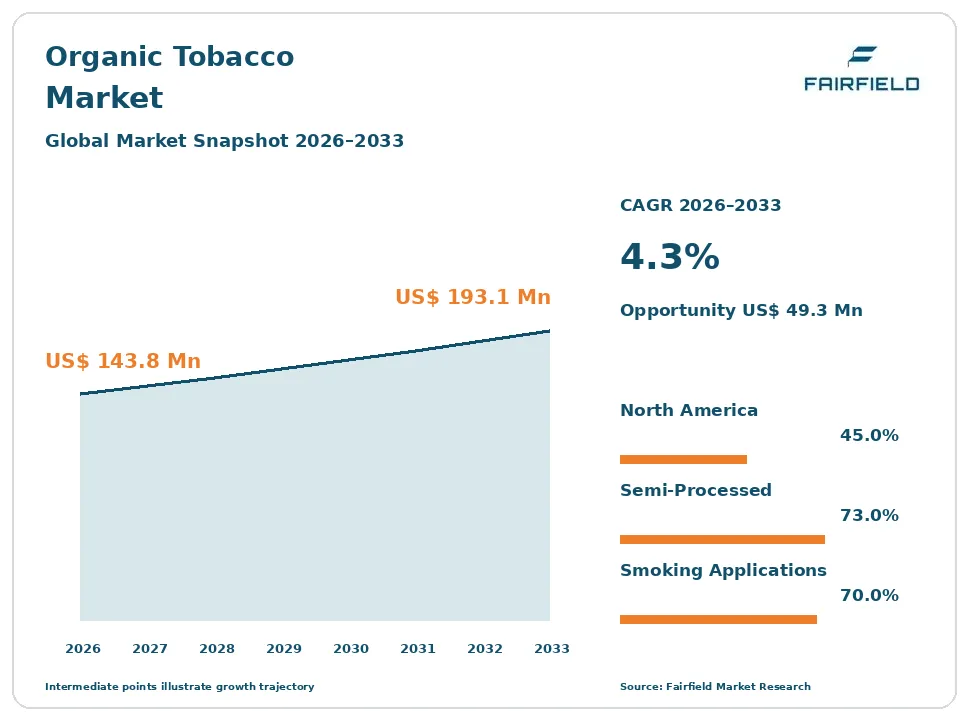
The global organic tobacco market size is expected to be valued at US$ 143.8 million in 2026 and projected to reach US$ 193.1 million by 2033, growing at a CAGR of 4.3% between 2026 and 2033.
Between 2020 and 2025, the market grew at a CAGR of about 3.8%, as a small group of smokers and cigar users chose products made from tobacco grown without synthetic pesticides or fertilizers. Organic tobacco is grown on certified farms using pesticide-free farming methods, crop rotation, and natural inputs, and it is often sold as additive-free tobacco. Three factors shape demand: consumer interest in products marketed as natural, the premium cigar and roll-your-own segments, and leaf buyers seeking sustainable supply chains. Tobacco companies must state clearly that natural cigarettes and organic products are not safer than other tobacco, and regulators in the United States have limited “natural” claims. The market is shifting toward stricter organic certification, traceable leaf from contract growers, and organic flue-cured tobacco from Brazil, India, and the United States, while overall smoking continues to decline.
Key Report Takeaways
- By Type: Flue-Cured held 48.3% share in 2026, while Sun-Cured is projected to expand at a 5.0% CAGR through 2033, driven by low-cost organic production in India and Indonesia.
- By Application: Smoking held 70.0% share in 2026, while Smokeless is projected to expand at a 5.1% CAGR through 2033, driven by organic chewing tobacco and snus-style products.
- By Form: Semi-Processed held 73.0% share in 2026, while Processed is projected to expand at a 4.9% CAGR through 2033, driven by branded loose tobacco and premium cigar fillers.
- By Region: North America held 45.0% share in 2026, while Asia Pacific is projected to expand at a 5.6% CAGR through 2033, driven by organic leaf farming and export growth in India and China.
Global Organic Tobacco Market Trends and Insights
Drivers Impact Analysis
| Driver | Impact on CAGR Forecast | Geographic Relevance | Impact Timeline |
| Consumer preference for natural and additive-free products | Medium | North America, Europe | Medium term (2-4 years) |
| Sustainable sourcing and stricter residue rules | Medium | Europe, Asia Pacific, Latin America | Long term (≥4 years) |
Two drivers carry the strongest influence on organic tobacco demand during the forecast period.
Natural Product Preference Is Driving the Organic Tobacco Market
Consumer preference for natural and additive-free products is the main driver of the organic tobacco market. Some adult tobacco users choose products with fewer added ingredients.
The mechanism is the wider trend toward organic products. Consumers who buy organic food and personal care items may also prefer additive-free tobacco for smoking, rolling, or pipes. Brands such as Natural American Spirit, made by Santa Fe Natural Tobacco Company, list only tobacco and water as ingredients, and some styles use certified organic leaf. Premium cigar makers and roll-your-own brands also offer organic lines. Under an agreement with the U.S. Food and Drug Administration, packaging must say these cigarettes are not safer than others. Organic tobacco sells at higher prices, which supports value growth even as volumes stay small. These factors keep a niche but steady demand.
Sustainable Sourcing Is Expanding the Organic Tobacco Market
Sustainable sourcing and stricter pesticide residue rules are expanding the organic tobacco market. Leaf buyers want clean, traceable supply.
The cause is regulatory and corporate pressure. The European Union has tightened maximum residue limits on agricultural imports, including tobacco, pushing exporters toward organic methods. Large tobacco companies have sustainability targets that include reducing chemical use and improving farmer welfare. In India, NPOP organic rules updated in 2024 took effect in January 2025, tightening checks on certified farmers. Reynolds American reported 46 organic contract growers on more than 1,300 acres in 2023, showing long-term commitment. Organic certification gives exporters access to premium buyers. These trends support organic leaf production.
Restraints Impact Analysis
| Restraint | Impact on CAGR Forecast | Geographic Relevance | Impact Timeline |
| Tobacco control laws and declining smoking rates | High | Global | Long term (≥4 years) |
| Higher costs and lower yields of organic farming | Medium | Global | Medium term (2-4 years) |
Two restraints limit how quickly the organic tobacco market grows.
Tobacco Control Slows the Organic Tobacco Market
Tobacco control laws and declining smoking rates slow the organic tobacco market. All tobacco products cause serious harm, organic or not.
The specific causes are public health policy and changing habits. The World Health Organization reported that the number of tobacco users fell to about 1.2 billion in 2024, as taxes, advertising bans, plain packaging, and smoke-free laws reduce use. In January 2025, the U.S. Food and Drug Administration proposed limiting nicotine levels in cigarettes. The United Kingdom is moving to ban tobacco sales to people born after a set date. Regulators also restrict claims such as “natural” and “organic” that may suggest lower risk. Many smokers are switching to vapes, heated tobacco, and nicotine pouches. These factors cap long-term demand.
Farming Costs Restrict the Organic Tobacco Market
Higher costs and lower yields of organic farming restrict the organic tobacco market. Organic tobacco is harder and costlier to grow.
The underlying causes are pests and certification. Tobacco is vulnerable to insects, diseases, and weeds, and without synthetic chemicals, yields are often lower and losses higher. Farms need several years to convert to organic status, and certification and inspections add costs. Organic growers must use crop rotation, which limits how often tobacco can be planted on the same land. Farm labor is also costly. Small premiums may not cover these extra costs for some farmers. Weather risks, such as drought and heavy rain, hit organic farms harder because they have fewer tools to protect crops. Many leaf buyers also prefer conventional leaf because it is cheaper and more consistent. These factors limit supply growth.
Market Opportunities
Premium Cigars and Roll-Your-Own Open a Premium Revenue Pool
Premium cigars and roll-your-own products open a premium revenue pool in the organic tobacco market. These segments value craft and natural positioning.
Cigar makers and loose tobacco brands can capture this opportunity. Premium cigar smokers often pay high prices for distinctive leaf, and some brands use organic filler and wrapper from Dominican Republic, Nicaragua, and Ecuador. Roll-your-own and pipe tobacco users look for additive-free blends. These segments face fewer volume declines than mass-market cigarettes in some countries. Small batch and traceable products support brand stories. Higher margins help offset small volumes. Specialty tobacco shops and online retailers, where rules allow, give these brands direct access to adult buyers. Organic certification also supports exports to buyers in Europe.
Organic Leaf Exports Create a Grower Revenue Pool
Organic leaf exports create a grower revenue pool in the organic tobacco market. Growers in emerging economies can earn premium prices.
Leaf merchants and farmer groups can capture this opportunity. Brazil, India, China, Indonesia, and Malawi supply international buyers, and organic certification can raise farm income. Leaf merchants such as Universal Corporation and Pyxus International run contract programs that provide seeds, training, and guaranteed purchases. Organic methods also improve soil health and reduce chemical exposure for farm workers. Buyers in Europe and North America prefer traceable leaf. Digital tracking tools let buyers follow leaf from farm to factory, supporting certification. Farmer training programs help improve yields under organic methods. Diversifying into food crops during rotation years can also stabilize farm income.
Segment Analysis
By Type: Flue-Cured Leads While Sun-Cured Grows Fastest
Flue-Cured held 48.3% share in 2026. Flue-cured tobacco, also called Virginia tobacco, is dried in heated barns and is the main type used in cigarettes. Organic flue-cured leaf is grown in the United States, Brazil, and India under contract programs. Its bright color and mild taste suit premium cigarette and roll-your-own brands.
Sun-Cured is the fastest-growing type, expanding at a 5.0% CAGR through 2033. Sun-cured tobacco is dried in open air and sunlight without fuel, making it cheaper and easier to grow organically. It is common in India and other parts of Asia Pacific for smokeless and local smoking products. Air-cured and fire-cured types serve cigars and pipe tobacco. For the market, sun-cured growth adds low-cost supply.
By Application: Smoking Leads While Smokeless Grows Fastest
Smoking held 70.0% share in 2026. Cigarettes, cigars, pipe tobacco, and roll-your-own products account for most organic tobacco use. Natural American Spirit is the best-known brand of natural cigarettes, with organic leaf styles. Organic pipe and cigar tobacco serve smaller groups of older, higher-income users. Roll-your-own users often buy organic loose tobacco to avoid additives.
Smokeless is the fastest-growing application, expanding at a 5.1% CAGR through 2033. Organic chewing tobacco, snuff, and snus-style products attract some users seeking alternatives to smoking, though they are also harmful. Smokeless products are common in India and Sweden, and organic versions are a small but growing niche. Health warnings and tax rules apply to smokeless products as well. For the market, smokeless growth diversifies demand.
By Form: Semi-Processed Leads While Processed Grows Fastest
Semi-Processed held 73.0% share in 2026. Most organic tobacco is traded as cured, threshed, or stemmed leaf sold by growers and leaf merchants to manufacturers. This form supports flexible blending and lets manufacturers control final product quality. Leaf merchants manage grading, storage, and shipping for buyers around the world.
Processed is the fastest-growing form, expanding at a 4.9% CAGR through 2033. Processed products include cut tobacco for rolling, cigar fillers, and finished blends. Branded products earn higher margins and build customer loyalty. Small producers sell organic loose tobacco directly to specialty shops. For the market, processed growth raises value.
Geography Analysis
Which Region Is Leading the Organic Tobacco Market?
North America is leading the organic tobacco market with a 45.0% share in 2026. The United States is home to Santa Fe Natural Tobacco Company and the Natural American Spirit brand, which sources organic leaf from contract growers. North Carolina, Kentucky, and Virginia grow most US tobacco, and the United States produced about 359 million pounds of tobacco in 2025. Canada has a small market with strict tobacco laws. Organic farms must meet USDA organic standards and annual inspections. Key barriers include FDA rules and high taxes. One change shaping the region is falling smoking rates among young adults.
Europe Builds the Organic Tobacco Market Through Sustainability Rules
Europe is the second-largest organic tobacco market. Germany, Italy, Spain, the Netherlands, and Switzerland have adult consumers who buy organic and additive-free tobacco products in specialty shops, and Japan Tobacco International sells Natural American Spirit in many European countries. EU residue rules push imports toward organic leaf, and the EU Tobacco Products Directive limits additives and claims. France and the United Kingdom have very high tobacco taxes that reduce overall demand. Key barriers include strict tobacco laws and advertising bans. One opportunity is roll-your-own, which is popular in several European countries such as Germany.
Which Region Is Growing Fastest in the Organic Tobacco Market?
Asia Pacific is growing fastest in the organic tobacco market at a 5.6% CAGR through 2033. India has a large number of certified organic farmers and grows flue-cured and sun-cured tobacco, and China is the world’s largest tobacco producer. Indonesia and the Philippines grow tobacco for local and export use. Japan has demand for premium imported products. Government programs in India support organic farming in several states, and leaf exporters see organic tobacco as a way to meet buyer demands. Key barriers include certification gaps and fragmented farms. One change shaping the region is organic export programs.
Latin America Grows the Organic Tobacco Market Through Leaf Exports
Latin America is an important organic tobacco supply region. Brazil is the world’s largest leaf tobacco exporter, with companies such as Hi Brasil Tobacco growing organic leaf, and the Dominican Republic, Nicaragua, and Honduras make premium cigars. Argentina and Ecuador grow leaf for cigarettes and cigars, and Colombia has small organic projects using pesticide-free farming. Contract farming programs in Brazil give growers technical help, seeds, and guaranteed buyers. Premium cigar makers in Nicaragua and the Dominican Republic are testing organic filler leaf. Key barriers include higher costs and weather risks. One opportunity is organic cigar leaf.
Middle East & Africa Expands the Organic Tobacco Market Through Leaf Production
Middle East & Africa is a small organic tobacco market. Zimbabwe, Malawi, Mozambique, and Tanzania grow large amounts of tobacco, mainly for export to Asia Pacific and Europe. Egypt has a large cigarette market led by Eastern Company, and South Africa has a regulated tobacco sector with high taxes. Smallholder farmers in Malawi and Zimbabwe grow much of the leaf, and some programs promote reduced chemical use. Smoking rates are rising in parts of the region, though many countries are adopting tobacco control laws. Key barriers include limited certification and weak infrastructure. One opportunity is organic leaf exports.
Competitive Landscape
The organic tobacco market is moderately concentrated. Santa Fe Natural Tobacco Company, part of Reynolds American and British American Tobacco, leads in branded organic cigarettes in the United States, while Japan Tobacco International sells Natural American Spirit in other countries. Leaf merchants Universal Corporation and Pyxus International source organic leaf, and smaller firms such as Hi Brasil Tobacco, Mother Earth Tobacco, Scandinavian Tobacco Group, and Royal Agio serve niche segments.
Companies compete on leaf quality, certified supply, brand reputation, traceability, and price. Large firms have advantages in distribution and contract farming, while small brands compete on craft positioning. Leaf merchants act as key links between thousands of farmers and manufacturers. Strict marketing rules limit how companies can promote organic products, so packaging and retail presence matter more. Some firms are shifting investment toward heated tobacco and nicotine pouches, which may limit spending on organic cigarette lines over time.
Strategic moves show how the market is changing. In May 2024, Reynolds American highlighted its organic contract grower program. In January 2025, India’s updated NPOP organic rules took effect, and the U.S. Food and Drug Administration proposed a nicotine limit for cigarettes. In January 2026, the U.S. Department of Agriculture reported 2025 US tobacco output. These moves show a niche shaped by regulation.
Three themes shape vendor strategy. First, companies are securing certified leaf through contract growers. Second, they are improving traceability from farm to factory. Third, they are adapting to stricter regulation and labeling rules.
Organic Tobacco Market Industry Leaders
- Santa Fe Natural Tobacco Company
- Japan Tobacco International
- British American Tobacco
- Universal Corporation
- Pyxus International
Recent Industry Developments
- January 2026: The U.S. Department of Agriculture reported 2025 US tobacco production of about 359 million pounds, including 277 million pounds of flue-cured tobacco - sets the supply base for US organic leaf.
- January 2025: India’s updated NPOP organic regulations took effect, requiring more testing of certified operators and farmer groups - tightens organic certification.
- January 2025: The U.S. Food and Drug Administration proposed a rule to limit nicotine levels in cigarettes - adds regulatory pressure on all cigarette products.
- May 2024: Reynolds American reported that Santa Fe Natural Tobacco Company worked with 46 organic contract growers on more than 1,300 acres - shows ongoing organic leaf sourcing.
Companies Covered in the Report
- Santa Fe Natural Tobacco Company
- Japan Tobacco International
- British American Tobacco
- Universal Corporation
- Pyxus International
- Philip Morris International
- Imperial Brands
- Scandinavian Tobacco Group
- Royal Agio
- Hi Brasil Tobacco
- Mother Earth Tobacco
- ITC Limited
Organic Tobacco Market Report Scope
This report covers certified organic tobacco, including flue-cured, sun-cured, air-cured, and fire-cured types, in semi-processed and processed forms, used in smoking products such as cigarettes, cigars, pipe, and roll-your-own tobacco, and smokeless products. It includes leaf and branded product sales. The base year is 2025, and the forecast period runs from 2026 to 2033. All values are expressed in US$ Million.
Type
- Flue-Cured
- Sun-Cured
- Air-Cured
- Fire-Cured
Application
- Smoking
- Smokeless
Form
- Semi-Processed
- Processed
Regions
- North America
- Europe
- Asia Pacific
- Latin America
- Middle East & Africa
Key Questions Answered in the Report
How big is the organic tobacco market in 2026?
The organic tobacco market is valued at US$ 143.8 million in 2026, led by flue-cured tobacco and North America.
What is the organic tobacco market forecast to 2033?
The market is projected to reach US$ 193.1 million by 2033, growing at a 4.3% CAGR and adding US$ 49.3 million.
Which type is growing fastest in the organic tobacco market?
Sun-cured tobacco is growing fastest at a 5.0% CAGR through 2033, driven by low-cost organic production in India and Indonesia.
Which region is growing fastest in the organic tobacco market?
Asia Pacific is growing fastest at a 5.6% CAGR through 2033, driven by organic leaf farming and exports in India and China.
Which region holds the largest organic tobacco market share?
North America holds the largest share at 45.0% in 2026, supported by the Natural American Spirit brand and US organic contract growers.
1. Executive Summary
1.1. Global Organic Tobacco Market Snapshot
1.2. Future Projections
1.3. Key Report Takeaways
1.4. Regional Snapshot
2. Market Overview
2.1. Market Definition and Report Scope
2.2. Historical Trends 2020–2025
2.3. Market Dynamics
2.3.1. Drivers
2.3.1.1. Natural Product Preference Is Driving the Organic Tobacco Market
2.3.1.2. Sustainable Sourcing Is Expanding the Organic Tobacco Market
2.3.2. Restraints
2.3.2.1. Tobacco Control Slows the Organic Tobacco Market
2.3.2.2. Farming Costs Restrict the Organic Tobacco Market
2.3.3. Market Opportunities
2.3.3.1. Premium Cigars and Roll-Your-Own Open a Premium Revenue Pool
2.3.3.2. Organic Leaf Exports Create a Grower Revenue Pool
3. Global Organic Tobacco Market Outlook, 2020-2033
3.1. Global Organic Tobacco Market Outlook, by Type, Value (US$ Million), 2020-2033
3.1.1. Flue-Cured
3.1.2. Sun-Cured
3.1.3. Air-Cured
3.1.4. Fire-Cured
3.2. Global Organic Tobacco Market Outlook, by Application, Value (US$ Million), 2020-2033
3.2.1. Smoking
3.2.2. Smokeless
3.3. Global Organic Tobacco Market Outlook, by Form, Value (US$ Million), 2020-2033
3.3.1. Semi-Processed
3.3.2. Processed
3.4. Global Organic Tobacco Market Outlook, by Region, Value (US$ Million), 2020-2033
3.4.1. North America
3.4.2. Europe
3.4.3. Asia Pacific
3.4.4. Latin America
3.4.5. Middle East & Africa
4. North America Organic Tobacco Market Outlook, 2020-2033
4.1. North America Organic Tobacco Market Outlook, by Type, Value (US$ Million), 2020-2033
4.1.1. Flue-Cured
4.1.2. Sun-Cured
4.1.3. Air-Cured
4.1.4. Fire-Cured
4.2. North America Organic Tobacco Market Outlook, by Application, Value (US$ Million), 2020-2033
4.2.1. Smoking
4.2.2. Smokeless
4.3. North America Organic Tobacco Market Outlook, by Form, Value (US$ Million), 2020-2033
4.3.1. Semi-Processed
4.3.2. Processed
4.4. North America Organic Tobacco Market Outlook, by Country, Value (US$ Million), 2020-2033
4.4.1. United States Organic Tobacco Market Outlook, by Type, 2020-2033
4.4.2. United States Organic Tobacco Market Outlook, by Application, 2020-2033
4.4.3. United States Organic Tobacco Market Outlook, by Form, 2020-2033
4.4.4. Canada Organic Tobacco Market Outlook, by Type, 2020-2033
4.4.5. Canada Organic Tobacco Market Outlook, by Application, 2020-2033
4.4.6. Canada Organic Tobacco Market Outlook, by Form, 2020-2033
5. Europe Organic Tobacco Market Outlook, 2020-2033
5.1. Europe Organic Tobacco Market Outlook, by Type, Value (US$ Million), 2020-2033
5.1.1. Flue-Cured
5.1.2. Sun-Cured
5.1.3. Air-Cured
5.1.4. Fire-Cured
5.2. Europe Organic Tobacco Market Outlook, by Application, Value (US$ Million), 2020-2033
5.2.1. Smoking
5.2.2. Smokeless
5.3. Europe Organic Tobacco Market Outlook, by Form, Value (US$ Million), 2020-2033
5.3.1. Semi-Processed
5.3.2. Processed
5.4. Europe Organic Tobacco Market Outlook, by Country, Value (US$ Million), 2020-2033
5.4.1. Germany Organic Tobacco Market Outlook, by Type, 2020-2033
5.4.2. Germany Organic Tobacco Market Outlook, by Application, 2020-2033
5.4.3. Germany Organic Tobacco Market Outlook, by Form, 2020-2033
5.4.4. Italy Organic Tobacco Market Outlook, by Type, 2020-2033
5.4.5. Italy Organic Tobacco Market Outlook, by Application, 2020-2033
5.4.6. Italy Organic Tobacco Market Outlook, by Form, 2020-2033
5.4.7. Spain Organic Tobacco Market Outlook, by Type, 2020-2033
5.4.8. Spain Organic Tobacco Market Outlook, by Application, 2020-2033
5.4.9. Spain Organic Tobacco Market Outlook, by Form, 2020-2033
5.4.10. Netherlands Organic Tobacco Market Outlook, by Type, 2020-2033
5.4.11. Netherlands Organic Tobacco Market Outlook, by Application, 2020-2033
5.4.12. Netherlands Organic Tobacco Market Outlook, by Form, 2020-2033
5.4.13. Switzerland Organic Tobacco Market Outlook, by Type, 2020-2033
5.4.14. Switzerland Organic Tobacco Market Outlook, by Application, 2020-2033
5.4.15. Switzerland Organic Tobacco Market Outlook, by Form, 2020-2033
5.4.16. France Organic Tobacco Market Outlook, by Type, 2020-2033
5.4.17. France Organic Tobacco Market Outlook, by Application, 2020-2033
5.4.18. France Organic Tobacco Market Outlook, by Form, 2020-2033
5.4.19. United Kingdom Organic Tobacco Market Outlook, by Type, 2020-2033
5.4.20. United Kingdom Organic Tobacco Market Outlook, by Application, 2020-2033
5.4.21. United Kingdom Organic Tobacco Market Outlook, by Form, 2020-2033
6. Asia Pacific Organic Tobacco Market Outlook, 2020-2033
6.1. Asia Pacific Organic Tobacco Market Outlook, by Type, Value (US$ Million), 2020-2033
6.1.1. Flue-Cured
6.1.2. Sun-Cured
6.1.3. Air-Cured
6.1.4. Fire-Cured
6.2. Asia Pacific Organic Tobacco Market Outlook, by Application, Value (US$ Million), 2020-2033
6.2.1. Smoking
6.2.2. Smokeless
6.3. Asia Pacific Organic Tobacco Market Outlook, by Form, Value (US$ Million), 2020-2033
6.3.1. Semi-Processed
6.3.2. Processed
6.4. Asia Pacific Organic Tobacco Market Outlook, by Country, Value (US$ Million), 2020-2033
6.4.1. India Organic Tobacco Market Outlook, by Type, 2020-2033
6.4.2. India Organic Tobacco Market Outlook, by Application, 2020-2033
6.4.3. India Organic Tobacco Market Outlook, by Form, 2020-2033
6.4.4. China Organic Tobacco Market Outlook, by Type, 2020-2033
6.4.5. China Organic Tobacco Market Outlook, by Application, 2020-2033
6.4.6. China Organic Tobacco Market Outlook, by Form, 2020-2033
6.4.7. Indonesia Organic Tobacco Market Outlook, by Type, 2020-2033
6.4.8. Indonesia Organic Tobacco Market Outlook, by Application, 2020-2033
6.4.9. Indonesia Organic Tobacco Market Outlook, by Form, 2020-2033
6.4.10. Philippines Organic Tobacco Market Outlook, by Type, 2020-2033
6.4.11. Philippines Organic Tobacco Market Outlook, by Application, 2020-2033
6.4.12. Philippines Organic Tobacco Market Outlook, by Form, 2020-2033
6.4.13. Japan Organic Tobacco Market Outlook, by Type, 2020-2033
6.4.14. Japan Organic Tobacco Market Outlook, by Application, 2020-2033
6.4.15. Japan Organic Tobacco Market Outlook, by Form, 2020-2033
7. Latin America Organic Tobacco Market Outlook, 2020-2033
7.1. Latin America Organic Tobacco Market Outlook, by Type, Value (US$ Million), 2020-2033
7.1.1. Flue-Cured
7.1.2. Sun-Cured
7.1.3. Air-Cured
7.1.4. Fire-Cured
7.2. Latin America Organic Tobacco Market Outlook, by Application, Value (US$ Million), 2020-2033
7.2.1. Smoking
7.2.2. Smokeless
7.3. Latin America Organic Tobacco Market Outlook, by Form, Value (US$ Million), 2020-2033
7.3.1. Semi-Processed
7.3.2. Processed
7.4. Latin America Organic Tobacco Market Outlook, by Country, Value (US$ Million), 2020-2033
7.4.1. Brazil Organic Tobacco Market Outlook, by Type, 2020-2033
7.4.2. Brazil Organic Tobacco Market Outlook, by Application, 2020-2033
7.4.3. Brazil Organic Tobacco Market Outlook, by Form, 2020-2033
7.4.4. Dominican Republic Organic Tobacco Market Outlook, by Type, 2020-2033
7.4.5. Dominican Republic Organic Tobacco Market Outlook, by Application, 2020-2033
7.4.6. Dominican Republic Organic Tobacco Market Outlook, by Form, 2020-2033
7.4.7. Nicaragua Organic Tobacco Market Outlook, by Type, 2020-2033
7.4.8. Nicaragua Organic Tobacco Market Outlook, by Application, 2020-2033
7.4.9. Nicaragua Organic Tobacco Market Outlook, by Form, 2020-2033
7.4.10. Honduras Organic Tobacco Market Outlook, by Type, 2020-2033
7.4.11. Honduras Organic Tobacco Market Outlook, by Application, 2020-2033
7.4.12. Honduras Organic Tobacco Market Outlook, by Form, 2020-2033
7.4.13. Argentina Organic Tobacco Market Outlook, by Type, 2020-2033
7.4.14. Argentina Organic Tobacco Market Outlook, by Application, 2020-2033
7.4.15. Argentina Organic Tobacco Market Outlook, by Form, 2020-2033
7.4.16. Ecuador Organic Tobacco Market Outlook, by Type, 2020-2033
7.4.17. Ecuador Organic Tobacco Market Outlook, by Application, 2020-2033
7.4.18. Ecuador Organic Tobacco Market Outlook, by Form, 2020-2033
7.4.19. Colombia Organic Tobacco Market Outlook, by Type, 2020-2033
7.4.20. Colombia Organic Tobacco Market Outlook, by Application, 2020-2033
7.4.21. Colombia Organic Tobacco Market Outlook, by Form, 2020-2033
8. Middle East & Africa Organic Tobacco Market Outlook, 2020-2033
8.1. Middle East & Africa Organic Tobacco Market Outlook, by Type, Value (US$ Million), 2020-2033
8.1.1. Flue-Cured
8.1.2. Sun-Cured
8.1.3. Air-Cured
8.1.4. Fire-Cured
8.2. Middle East & Africa Organic Tobacco Market Outlook, by Application, Value (US$ Million), 2020-2033
8.2.1. Smoking
8.2.2. Smokeless
8.3. Middle East & Africa Organic Tobacco Market Outlook, by Form, Value (US$ Million), 2020-2033
8.3.1. Semi-Processed
8.3.2. Processed
8.4. Middle East & Africa Organic Tobacco Market Outlook, by Country, Value (US$ Million), 2020-2033
8.4.1. Zimbabwe Organic Tobacco Market Outlook, by Type, 2020-2033
8.4.2. Zimbabwe Organic Tobacco Market Outlook, by Application, 2020-2033
8.4.3. Zimbabwe Organic Tobacco Market Outlook, by Form, 2020-2033
8.4.4. Malawi Organic Tobacco Market Outlook, by Type, 2020-2033
8.4.5. Malawi Organic Tobacco Market Outlook, by Application, 2020-2033
8.4.6. Malawi Organic Tobacco Market Outlook, by Form, 2020-2033
8.4.7. Mozambique Organic Tobacco Market Outlook, by Type, 2020-2033
8.4.8. Mozambique Organic Tobacco Market Outlook, by Application, 2020-2033
8.4.9. Mozambique Organic Tobacco Market Outlook, by Form, 2020-2033
8.4.10. Tanzania Organic Tobacco Market Outlook, by Type, 2020-2033
8.4.11. Tanzania Organic Tobacco Market Outlook, by Application, 2020-2033
8.4.12. Tanzania Organic Tobacco Market Outlook, by Form, 2020-2033
8.4.13. Egypt Organic Tobacco Market Outlook, by Type, 2020-2033
8.4.14. Egypt Organic Tobacco Market Outlook, by Application, 2020-2033
8.4.15. Egypt Organic Tobacco Market Outlook, by Form, 2020-2033
8.4.16. South Africa Organic Tobacco Market Outlook, by Type, 2020-2033
8.4.17. South Africa Organic Tobacco Market Outlook, by Application, 2020-2033
8.4.18. South Africa Organic Tobacco Market Outlook, by Form, 2020-2033
9. Competitive Landscape
9.1. Market Concentration and Industry Leaders
9.2. Competitive Differentiation
9.3. Strategic Moves and Market Direction
9.4. Recent Industry Developments
9.5. Company Profiles
9.5.1. Santa Fe Natural Tobacco Company
9.5.2. Japan Tobacco International
9.5.3. British American Tobacco
9.5.4. Universal Corporation
9.5.5. Pyxus International
9.5.6. Philip Morris International
9.5.7. Imperial Brands
9.5.8. Scandinavian Tobacco Group
9.5.9. Royal Agio
9.5.10. Hi Brasil Tobacco
9.5.11. Mother Earth Tobacco
9.5.12. ITC Limited
10. Appendix
10.1. Research Methodology
10.2. Report Assumptions
10.3. Acronyms and Abbreviations
| Type | Flue-Cured, Sun-Cured, Air-Cured, Fire-Cured |
| Application | Smoking, Smokeless |
| Form | Semi-Processed, Processed |
| Regions | North America, Europe, Asia Pacific, Latin America, Middle East & Africa |
Our Research Methodology
Considering the volatility of business today, traditional approaches to strategizing a game plan can be unfruitful if not detrimental. True ambiguity is no way to determine a forecast. A myriad of predetermined factors must be accounted for such as the degree of risk involved, the magnitude of circumstances, as well as conditions or consequences that are not known or unpredictable. To circumvent binary views that cast uncertainty, the application of market research intelligence to strategically posture, move, and enable actionable outcomes is necessary.
View Methodology
Quality Assured
Rigorous Validation Process

Confidentiality Assured
End-to-end Data Security

Custom Research Services
Tailored To Your Objectives
FAQs
The organic tobacco market is valued at US$ 143.8 million in 2026, led by flue-cured tobacco and North America.
The market is projected to reach US$ 193.1 million by 2033, growing at a 4.3% CAGR and adding US$ 49.3 million.
Sun-cured tobacco is growing fastest at a 5.0% CAGR through 2033, driven by low-cost organic production in India and Indonesia.
Asia Pacific is growing fastest at a 5.6% CAGR through 2033, driven by organic leaf farming and exports in India and China.
North America holds the largest share at 45.0% in 2026, supported by the Natural American Spirit brand and US organic contract growers.
Related Reports
Tilapia Market Size, Share, Insights, Competitive Landscape, and Forecast 2026 to 2033
The tilapia market is projected to grow from US$14.60 billion in 2026 to US$20.10 billion by 2033, at a 4.7% CAGR, driven by protein demand and aquaculture.
Quillaja Extract Market Size, Share, Insights, Competitive Landscape, and Forecast 2026 to 2033
The quillaja extract market is projected to grow from US$397.5 million in 2026 to US$712.7 million by 2033, at an 8.7% CAGR, led by food and vaccine uses.
Green Cardamom Market Size, Share, Insights, Competitive Landscape, and Forecast 2026 to 2033
Green cardamom market to grow from US$1.6 Bn in 2026 to US$2.3 Bn by 2033 at 5.3% CAGR. Explore forms, grades, applications and regional growth trends.
GMO Testing Market Size, Share, Insights, Competitive Landscape, and Forecast 2026 to 2033
GMO testing market to grow from US$2.2 Bn in 2026 to US$3.6 Bn by 2033 at 7.3% CAGR. Explore testing services, technologies, samples and regional trends.
Glutinous Rice Flour Market Size, Share, Insights, Competitive Landscape, and Forecast 2026 to 2033
Glutinous rice flour market to grow from US$2.4 Bn in 2026 to US$3.5 Bn by 2033 at 5.5% CAGR. Explore products, milling, applications and regions.
Oat Milk Market Size, Share, Insights, Competitive Landscape, and Forecast 2026 to 2033
Oat milk market to reach US$ 13.72 billion by 2033 at a 16.8% CAGR. Explore product types, organic demand, distribution channels and regional trends.