



A2 Milk Market
A2 Milk Market Size, Share, Insights, Competitive Landscape, and Forecast 2026 to 2033
A2 Milk Market Size and Trend Analysis
How Fast Is the A2 Milk Market Growing?
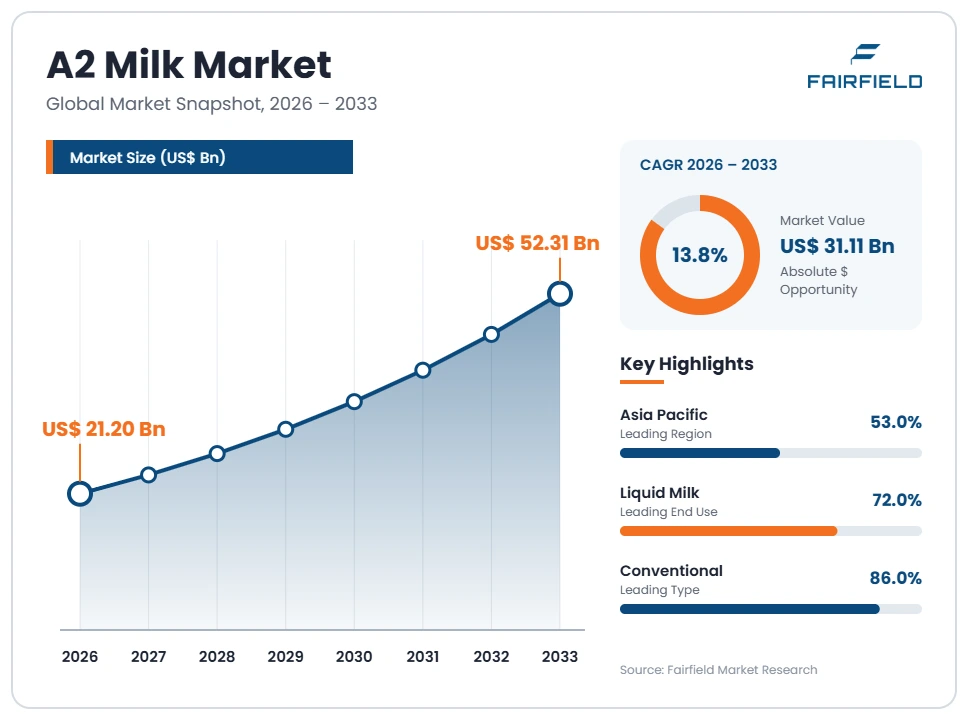
The global A2 milk market size is expected to be valued at US$ 21.20 billion in 2026 and projected to reach US$ 52.31 billion by 2033, growing at a CAGR of 13.8% between 2026 and 2033.
Between 2020 and 2025, the market grew at a CAGR of about 12.9%, as parents in China bought more premium infant formula, shoppers in Australia, New Zealand, and the United States tried A2 milk for comfort, and dairy farmers in India promoted milk from native cow breeds. A2 milk comes from cows that naturally produce only the A2 beta-casein protein and not the A1 protein found in most ordinary milk. Some people report that A2 milk causes less stomach discomfort, although scientific evidence is still developing and A2 milk still contains lactose. Three factors now drive growth: consumer interest in digestive health, premium infant nutrition demand, and wider retail and online availability. The market is shifting toward A2 yogurt, cheese, butter, ghee, and protein drinks, organic A2 lines, and genetic testing that helps farmers build A2 herds. In August 2026, The a2 Milk Company reported fiscal 2026 revenue up 12.4% to NZ$ 1.97 billion.
Key Report Takeaways
- By End Use: Liquid Milk held 72.0% share in 2026, while Infant Formula is projected to expand at a 15.4% CAGR through 2033, driven by premium nutrition demand in China, the United States, and the United Kingdom.
- By Type: Conventional held 86.0% share in 2026, while Organic is projected to expand at a 16.1% CAGR through 2033, driven by shoppers who combine digestive health with clean-label and animal welfare preferences.
- By Distribution Channel: Supermarkets & Hypermarkets held 46.0% share in 2026, while Online Retail is projected to expand at a 17.0% CAGR through 2033, driven by cross-border e-commerce and dairy subscriptions.
- By Region: Asia Pacific held 53.0% share in 2026, while China is projected to expand at a 16.2% CAGR through 2033, driven by premium infant formula demand and wider retail and online sales of A2 milk.
Global A2 Milk Market Trends and Insights
Drivers Impact Analysis
Two drivers carry the strongest influence on A2 milk demand during the forecast period.
| Driver | Impact on CAGR Forecast | Geographic Relevance | Impact Timeline |
| Consumer focus on digestive health | High | Global | Long term (≥4 years) |
| Premium infant nutrition demand | High | Asia Pacific, North America | Medium term (2–4 years) |
Digestive Health Interest Is Driving the A2 Milk Market
Consumer focus on digestive health is the strongest driver of the A2 milk market. Many people want milk that feels easier on the stomach.
The mechanism is changing consumer behavior around dairy. Some people who feel bloated or uncomfortable after drinking ordinary milk report feeling better with A2 milk. Researchers have linked the A1 protein to the release of a peptide during digestion that may cause discomfort in some people, and several small studies support this, though larger trials are still needed. Unlike lactose-free milk, A2 milk is not processed differently, which appeals to shoppers looking for natural products. Brands such as The a2 Milk Company market the difference clearly on packs and in advertising. Gut health is a major wellness trend, and consumers are willing to pay more for products they believe support it. These factors keep demand rising.
Infant Nutrition Demand Is Expanding the A2 Milk Market
Premium infant nutrition demand is expanding the A2 milk market. Parents want the best formula for their babies.
The cause is strong spending on infant products, especially in China. Chinese parents have favored imported and premium infant formula since food safety scandals in 2008, and A2-based formula has become a leading premium brand. The a2 Milk Company sells China-label and English-label formula through retail, mother-and-baby stores, and cross-border e-commerce. In the United States, a formula shortage in 2022 opened the market to new brands, including A2 formula. Parents link A2 protein with gentler digestion for babies. The a2 Milk Company agreed to buy a formula plant in Pokeno, New Zealand, in August 2025 to secure supply. Infant formula sells at high prices, which boosts market value.
Restraints Impact Analysis
Two restraints limit how quickly the A2 milk market grows.
| Restraint | Impact on CAGR Forecast | Geographic Relevance | Impact Timeline |
| Premium pricing and limited scientific consensus | Medium | Global | Long term (≥4 years) |
| Falling birth rates and supply constraints | Medium | Asia Pacific | Medium term (2–4 years) |
Premium Prices Slow the A2 Milk Market
Premium pricing and limited scientific consensus slow the A2 milk market. A2 milk usually costs more than regular milk.
The specific causes are higher production costs and debate over benefits. Farmers must test cows and build herds that produce only A2 protein, which takes years and requires separate milk collection and processing. These costs lead to retail prices well above ordinary milk. When food inflation rises, some shoppers switch back to cheaper milk. Health authorities and food regulators in some countries have said evidence is not strong enough to support broad health claims, which limits marketing. Critics argue that benefits may be overstated. Competition from lactose-free and plant-based milks also attracts people with digestive concerns. These factors limit growth among price-sensitive shoppers and in lower-income markets.
Birth Rate Declines Restrict the A2 Milk Market
Falling birth rates and supply constraints restrict the A2 milk market. The infant formula segment faces a shrinking customer base in key markets.
The underlying causes are demographic and operational. Births in China have fallen sharply in recent years, reducing the number of babies who need formula, and competition from local brands is intense. Chinese regulations require infant formula to be registered, which limits the number of brands and products. The a2 Milk Company faced supply issues with China-label formula in mid 2026. Building A2 herds takes several years, so supply cannot rise quickly. Weather and feed costs affect milk output. These factors create volatility in the high-value formula segment. Companies are responding by expanding in other countries, launching adult nutrition products, and building more flexible manufacturing.
Market Opportunities
A2 Dairy Products Beyond Milk Open a Fast-Growth Revenue Pool
A2 dairy products beyond liquid milk open a fast-growth revenue pool in the A2 milk market. Brands can extend A2 benefits to more categories.
Dairy processors can capture this opportunity. A2 yogurt, cheese, butter, ice cream, ghee, milk powder, and protein drinks give consumers more ways to choose A2 products. In India, dairy cooperatives and startups sell A2 ghee and milk from native breeds such as Gir and Sahiwal at premium prices. Adult nutrition, sports, and senior health products made with A2 protein are growing. Ready-to-drink coffees and smoothies can use A2 milk. New product launches keep shelves fresh and attract new and younger buyers. Brands that build trust in A2 claims can extend across the dairy aisle and into food service, cafés, and coffee chains.
Herd Conversion and Genetic Testing Create a Supply Revenue Pool
Herd conversion and genetic testing create a supply revenue pool in the A2 milk market. More A2 milk supply can lower costs and expand availability.
Genetics companies, farmers, and processors can capture this opportunity. Genomic testing for A1 and A2 genes has become cheaper and faster, helping farmers select A2 bulls and cows. Breeding programs can convert herds over several generations. Processors can pay premiums to farmers for A2 milk, encouraging conversion. In India, programs that promote native breeds support A2 supply. Larger supply allows wider distribution and lower prices, opening mass-market sales. Companies that secure long-term A2 milk supply gain a lasting advantage. Genomic tests now cost far less than a few years ago, which makes it practical for small and mid-sized farms to test whole herds and plan conversions.
Segment Analysis
- By End Use: Liquid Milk Leads While Infant Formula Grows Fastest
Liquid Milk held 72.0% share in 2026. Fresh and long-life A2 milk is sold in supermarkets, convenience stores, and online, mainly in Australia, New Zealand, the United States, the United Kingdom, and India. The a2 Milk Company, Bega Cheese, and Amul sell leading A2 milk brands.
Infant Formula is the fastest-growing end use, expanding at a 15.4% CAGR through 2033. Premium A2 formula sells strongly in China and is growing in the United States, the United Kingdom, and other markets. English-label products are sold through cross-border channels. Other products include yogurt, cheese, ghee, butter, and powders. For the market, formula growth adds high-value sales.
- By Type: Conventional Leads While Organic Grows Fastest
Conventional held 86.0% share in 2026. Most A2 milk comes from conventional dairy farms that have converted herds to A2 cows, offering a lower price than organic options.
Organic is the fastest-growing type, expanding at a 16.1% CAGR through 2033. Shoppers who buy organic food are adding A2 milk to their baskets, and Organic Valley and other brands offer organic A2 lines. Grass-fed claims add appeal. For the market, organic growth supports premium pricing. Organic A2 milk typically sells at the highest price point in the dairy aisle, attracting affluent, health-focused families. Farms that combine organic certification, grass feeding, and A2 genetics can earn strong premiums, though they need longer conversion periods and stricter farming practices.
- By Distribution Channel: Supermarkets & Hypermarkets Lead While Online Retail Grows Fastest
Supermarkets & Hypermarkets held 46.0% share in 2026. Large retailers stock A2 milk alongside regular milk and lactose-free products, giving brands wide reach.
Online Retail is the fastest-growing channel, expanding at a 17.0% CAGR through 2033. Cross-border e-commerce is important for infant formula in China, and dairy subscription services deliver A2 milk in India. Convenience stores, grocery stores, pharmacies, and mother-and-baby stores are other channels. For the market, online growth expands reach. Direct-to-home dairy startups in India deliver fresh A2 milk daily by subscription, while e-commerce platforms in China sell imported formula with authenticity guarantees. Brands use online data to target new parents and health-focused shoppers.
Geography Analysis
- Why Is North America Important to the A2 Milk Market?
North America is an important and growing A2 milk market. The a2 Milk Company sells A2 milk and infant formula across the United States, where its revenue grew 28.6% in fiscal 2026 and the business reached break-even in the second half. Organic Valley and other dairy brands offer A2 products. Canada has growing interest. A2 milk is widely available in major grocery chains and through club stores. Key barriers include high prices compared with regular and private-label milk, and competition from lactose-free brands. One opportunity is infant formula, where A2 brands are gaining shelf space after the 2022 shortage.
- Europe Builds the A2 Milk Market Through Premium Dairy
Europe is a developing A2 milk market. The United Kingdom sells A2 milk in major supermarkets, while Germany, the Netherlands, and France have farmers converting herds. Lactalis is a major dairy group. The a2 Milk Company has sold A2 milk in British supermarkets for years, and local dairies in Ireland and the Netherlands have launched A2 lines. The European Food Safety Authority has said evidence does not support specific health claims about A1 and A2 proteins, which limits marketing claims. Key barriers include regulatory limits on health claims. One opportunity is organic A2 milk sold to premium shoppers.
- Which Region Is Leading the A2 Milk Market?
Asia Pacific is leading the A2 milk market with a 53.0% share in 2026. Australia and New Zealand pioneered A2 milk, and China is the largest market for A2 infant formula, growing at a 16.2% CAGR through 2033. India has a large A2 market based on native cows, with Amul and startups selling A2 milk and ghee. The a2 Milk Company is headquartered in New Zealand, and Bega Cheese sells A2 milk in Australia. Key barriers include falling births in China and strong local competition. One change shaping the region is A2 dairy products such as ghee, yogurt, and adult milk powder.
- Latin America Grows the A2 Milk Market Through Dairy Innovation
Latin America is a growing A2 milk market. Brazil has native and Gir-cross herds that often produce A2 milk, and Mexico and Colombia are seeing new A2 brands. Dairy farmers in Brazil and Colombia are testing herds for A2 genetics, and processors are launching A2 milk and yogurt in major cities. Growing middle-class interest in premium and digestive-friendly foods supports demand. Imported A2 formula is sold in pharmacies and online, and Mexico has seen rising interest from health-conscious parents. Key barriers include price sensitivity and limited awareness. One opportunity is local herds that already carry A2 genetics.
- Middle East & Africa Expands the A2 Milk Market Through Premium Imports
Middle East & Africa is an emerging A2 milk market. The United Arab Emirates and Saudi Arabia import premium dairy and formula. South Africa has some A2 brands. Retailers in Dubai and Riyadh stock imported A2 milk and formula for affluent and expatriate shoppers. Large dairy groups in Saudi Arabia are studying A2 herd programs. Kenya and Egypt have growing premium dairy markets, and some local breeds naturally produce milk rich in A2 beta-casein, which could support future local A2 brands. Key barriers include low awareness, import costs, and hot-climate logistics. One opportunity is formula sold through pharmacies and online.
Competitive Landscape
The A2 milk market is moderately concentrated. The a2 Milk Company is the global leader in A2 milk and formula, while Amul, Bega Cheese, Lactalis, Organic Valley, and Noumi sell A2 products in key markets. Many regional dairies and startups in India, the United States, and Europe offer local A2 brands.
Companies compete on brand trust, milk supply, product range, price, regulatory registrations, and distribution reach. Securing A2 milk supply is critical, because herds take years to convert and processing must be kept separate from ordinary milk. The a2 Milk Company holds trademarks and strong brand recognition built over two decades. Cooperatives such as Amul benefit from large farmer networks. Startups in India compete through direct-to-home delivery and native breed stories. Large dairy groups can enter by converting their own supply.
Strategic moves show how competition is changing. In August 2025, The a2 Milk Company agreed to buy the Pokeno formula plant. In July 2026, it reported China-label formula supply issues. In August 2026, it reported 12.4% revenue growth. These moves show competition shifting toward supply control, manufacturing ownership, and geographic diversification beyond the volatile Chinese formula market.
Three themes shape vendor strategy. First, companies are securing milk and manufacturing supply. Second, they are launching new A2 dairy products. Third, they are expanding in the United States and other new markets. Vendors that combine secure supply, trusted brands, and broad product ranges are best placed to win share.
Recent Industry Developments
- August 2026: The a2 Milk Company reported fiscal 2026 revenue up 12.4% to NZ$ 1.97 billion, with US revenue up 28.6% – shows strong demand outside China.
- July 2026: The a2 Milk Company reported supply chain disruption in China-label infant formula during the fourth quarter – highlights supply risks.
- August 2025: The a2 Milk Company agreed to acquire Yashili New Zealand Dairy and its Pokeno formula plant from China Mengniu Dairy’s Yashili unit – strengthens formula supply.
Companies Covered in the Report
- The a2 Milk Company
- Amul
- Lactalis
- Bega Cheese
- Organic Valley
- Noumi
- Provilac Dairy Farms
- Akshayakalpa Organic
- Fonterra
- Nestlé
- Danone
- Synlait Milk
A2 Milk Market Report Scope
| Metric | Value |
| Study Period | 2020–2033 |
| Market Size 2026 | US$ 21.20 Billion |
| Market Size 2033 | US$ 52.31 Billion |
| CAGR 2026–2033 | 13.8% |
| Absolute Dollar Opportunity | US$ 31.11 Billion |
| Largest Market | Asia Pacific |
| Fastest-Growing Market | China (Asia Pacific) |
| Market Concentration | Moderate |
| Major Players | The a2 Milk Company, Amul, Lactalis, Bega Cheese, Organic Valley |
A2 Milk Market Segmentation
End Use
- Liquid Milk
- Infant Formula
- Others
Type
- Conventional
- Organic
Distribution Channel
- Supermarkets & Hypermarkets
- Convenience & Grocery Stores
- Online Retail
- Others
Regions
- North America
- Europe
- Asia Pacific
- Latin America
- Middle East & Africa
- Executive Summary
- Global A2 Milk Market Snapshot
- Future Projections
- Key Report Takeaways
- Regional Snapshot
- Market Overview
- Market Definition and Report Scope
- Historical Trends 2020–2025
- Market Dynamics
- Drivers
- Digestive Health Interest Is Driving the A2 Milk Market
- Infant Nutrition Demand Is Expanding the A2 Milk Market
- Restraints
- Premium Prices Slow the A2 Milk Market
- Birth Rate Declines Restrict the A2 Milk Market
- Market Opportunities
- A2 Dairy Products Beyond Milk Open a Fast-Growth Revenue Pool
- Herd Conversion and Genetic Testing Create a Supply Revenue Pool
- Drivers
- Global A2 Milk Market Outlook, 2020-2033
- Global A2 Milk Market Outlook, by End Use, Value (US$ Billion), 2020-2033
- Liquid Milk
- Infant Formula
- Others
- Global A2 Milk Market Outlook, by Type, Value (US$ Billion), 2020-2033
- Conventional
- Organic
- Global A2 Milk Market Outlook, by Distribution Channel, Value (US$ Billion), 2020-2033
- Supermarkets & Hypermarkets
- Convenience & Grocery Stores
- Online Retail
- Others
- Global A2 Milk Market Outlook, by Region, Value (US$ Billion), 2020-2033
- North America
- Europe
- Asia Pacific
- Latin America
- Middle East & Africa
- Global A2 Milk Market Outlook, by End Use, Value (US$ Billion), 2020-2033
- North America A2 Milk Market Outlook, 2020-2033
- North America A2 Milk Market Outlook, by End Use, Value (US$ Billion), 2020-2033
- Liquid Milk
- Infant Formula
- Others
- North America A2 Milk Market Outlook, by Type, Value (US$ Billion), 2020-2033
- Conventional
- Organic
- North America A2 Milk Market Outlook, by Distribution Channel, Value (US$ Billion), 2020-2033
- Supermarkets & Hypermarkets
- Convenience & Grocery Stores
- Online Retail
- Others
- North America A2 Milk Market Outlook, by Country, Value (US$ Billion), 2020-2033
- United States A2 Milk Market Outlook, by End Use, 2020-2033
- United States A2 Milk Market Outlook, by Type, 2020-2033
- United States A2 Milk Market Outlook, by Distribution Channel, 2020-2033
- Canada A2 Milk Market Outlook, by End Use, 2020-2033
- Canada A2 Milk Market Outlook, by Type, 2020-2033
- Canada A2 Milk Market Outlook, by Distribution Channel, 2020-2033
- North America A2 Milk Market Outlook, by End Use, Value (US$ Billion), 2020-2033
- Europe A2 Milk Market Outlook, 2020-2033
- Europe A2 Milk Market Outlook, by End Use, Value (US$ Billion), 2020-2033
- Liquid Milk
- Infant Formula
- Others
- Europe A2 Milk Market Outlook, by Type, Value (US$ Billion), 2020-2033
- Conventional
- Organic
- Europe A2 Milk Market Outlook, by Distribution Channel, Value (US$ Billion), 2020-2033
- Supermarkets & Hypermarkets
- Convenience & Grocery Stores
- Online Retail
- Others
- Europe A2 Milk Market Outlook, by Country, Value (US$ Billion), 2020-2033
- United Kingdom A2 Milk Market Outlook, by End Use, 2020-2033
- United Kingdom A2 Milk Market Outlook, by Type, 2020-2033
- United Kingdom A2 Milk Market Outlook, by Distribution Channel, 2020-2033
- Germany A2 Milk Market Outlook, by End Use, 2020-2033
- Germany A2 Milk Market Outlook, by Type, 2020-2033
- Germany A2 Milk Market Outlook, by Distribution Channel, 2020-2033
- Netherlands A2 Milk Market Outlook, by End Use, 2020-2033
- Netherlands A2 Milk Market Outlook, by Type, 2020-2033
- Netherlands A2 Milk Market Outlook, by Distribution Channel, 2020-2033
- France A2 Milk Market Outlook, by End Use, 2020-2033
- France A2 Milk Market Outlook, by Type, 2020-2033
- France A2 Milk Market Outlook, by Distribution Channel, 2020-2033
- Ireland A2 Milk Market Outlook, by End Use, 2020-2033
- Ireland A2 Milk Market Outlook, by Type, 2020-2033
- Ireland A2 Milk Market Outlook, by Distribution Channel, 2020-2033
- Europe A2 Milk Market Outlook, by End Use, Value (US$ Billion), 2020-2033
- Asia Pacific A2 Milk Market Outlook, 2020-2033
- Asia Pacific A2 Milk Market Outlook, by End Use, Value (US$ Billion), 2020-2033
- Liquid Milk
- Infant Formula
- Others
- Asia Pacific A2 Milk Market Outlook, by Type, Value (US$ Billion), 2020-2033
- Conventional
- Organic
- Asia Pacific A2 Milk Market Outlook, by Distribution Channel, Value (US$ Billion), 2020-2033
- Supermarkets & Hypermarkets
- Convenience & Grocery Stores
- Online Retail
- Others
- Asia Pacific A2 Milk Market Outlook, by Country, Value (US$ Billion), 2020-2033
- Australia A2 Milk Market Outlook, by End Use, 2020-2033
- Australia A2 Milk Market Outlook, by Type, 2020-2033
- Australia A2 Milk Market Outlook, by Distribution Channel, 2020-2033
- New Zealand A2 Milk Market Outlook, by End Use, 2020-2033
- New Zealand A2 Milk Market Outlook, by Type, 2020-2033
- New Zealand A2 Milk Market Outlook, by Distribution Channel, 2020-2033
- China A2 Milk Market Outlook, by End Use, 2020-2033
- China A2 Milk Market Outlook, by Type, 2020-2033
- China A2 Milk Market Outlook, by Distribution Channel, 2020-2033
- India A2 Milk Market Outlook, by End Use, 2020-2033
- India A2 Milk Market Outlook, by Type, 2020-2033
- India A2 Milk Market Outlook, by Distribution Channel, 2020-2033
- Asia Pacific A2 Milk Market Outlook, by End Use, Value (US$ Billion), 2020-2033
- Latin America A2 Milk Market Outlook, 2020-2033
- Latin America A2 Milk Market Outlook, by End Use, Value (US$ Billion), 2020-2033
- Liquid Milk
- Infant Formula
- Others
- Latin America A2 Milk Market Outlook, by Type, Value (US$ Billion), 2020-2033
- Conventional
- Organic
- Latin America A2 Milk Market Outlook, by Distribution Channel, Value (US$ Billion), 2020-2033
- Supermarkets & Hypermarkets
- Convenience & Grocery Stores
- Online Retail
- Others
- Latin America A2 Milk Market Outlook, by Country, Value (US$ Billion), 2020-2033
- Brazil A2 Milk Market Outlook, by End Use, 2020-2033
- Brazil A2 Milk Market Outlook, by Type, 2020-2033
- Brazil A2 Milk Market Outlook, by Distribution Channel, 2020-2033
- Mexico A2 Milk Market Outlook, by End Use, 2020-2033
- Mexico A2 Milk Market Outlook, by Type, 2020-2033
- Mexico A2 Milk Market Outlook, by Distribution Channel, 2020-2033
- Colombia A2 Milk Market Outlook, by End Use, 2020-2033
- Colombia A2 Milk Market Outlook, by Type, 2020-2033
- Colombia A2 Milk Market Outlook, by Distribution Channel, 2020-2033
- Latin America A2 Milk Market Outlook, by End Use, Value (US$ Billion), 2020-2033
- Middle East & Africa A2 Milk Market Outlook, 2020-2033
- Middle East & Africa A2 Milk Market Outlook, by End Use, Value (US$ Billion), 2020-2033
- Liquid Milk
- Infant Formula
- Others
- Middle East & Africa A2 Milk Market Outlook, by Type, Value (US$ Billion), 2020-2033
- Conventional
- Organic
- Middle East & Africa A2 Milk Market Outlook, by Distribution Channel, Value (US$ Billion), 2020-2033
- Supermarkets & Hypermarkets
- Convenience & Grocery Stores
- Online Retail
- Others
- Middle East & Africa A2 Milk Market Outlook, by Country, Value (US$ Billion), 2020-2033
- United Arab Emirates A2 Milk Market Outlook, by End Use, 2020-2033
- United Arab Emirates A2 Milk Market Outlook, by Type, 2020-2033
- United Arab Emirates A2 Milk Market Outlook, by Distribution Channel, 2020-2033
- Saudi Arabia A2 Milk Market Outlook, by End Use, 2020-2033
- Saudi Arabia A2 Milk Market Outlook, by Type, 2020-2033
- Saudi Arabia A2 Milk Market Outlook, by Distribution Channel, 2020-2033
- South Africa A2 Milk Market Outlook, by End Use, 2020-2033
- South Africa A2 Milk Market Outlook, by Type, 2020-2033
- South Africa A2 Milk Market Outlook, by Distribution Channel, 2020-2033
- Kenya A2 Milk Market Outlook, by End Use, 2020-2033
- Kenya A2 Milk Market Outlook, by Type, 2020-2033
- Kenya A2 Milk Market Outlook, by Distribution Channel, 2020-2033
- Egypt A2 Milk Market Outlook, by End Use, 2020-2033
- Egypt A2 Milk Market Outlook, by Type, 2020-2033
- Egypt A2 Milk Market Outlook, by Distribution Channel, 2020-2033
- Middle East & Africa A2 Milk Market Outlook, by End Use, Value (US$ Billion), 2020-2033
- Competitive Landscape
- Market Concentration and Industry Leaders
- Competitive Differentiation
- Strategic Moves and Market Direction
- Recent Industry Developments
- Company Profiles
- The a2 Milk Company
- Amul
- Lactalis
- Bega Cheese
- Organic Valley
- Noumi
- Provilac Dairy Farms
- Akshayakalpa Organic
- Fonterra
- Nestlé
- Danone
- Synlait Milk
- Appendix
- Research Methodology
- Report Assumptions
- Acronyms and Abbreviations
End Use
- Liquid Milk
- Infant Formula
- Others
Type
- Conventional
- Organic
Distribution Channel
- Supermarkets & Hypermarkets
- Convenience & Grocery Stores
- Online Retail
- Others
Regions
- North America
- Europe
- Asia Pacific
- Latin America
- Middle East & Africa
Our Research Methodology
Considering the volatility of business today, traditional approaches to strategizing a game plan can be unfruitful if not detrimental. True ambiguity is no way to determine a forecast. A myriad of predetermined factors must be accounted for such as the degree of risk involved, the magnitude of circumstances, as well as conditions or consequences that are not known or unpredictable. To circumvent binary views that cast uncertainty, the application of market research intelligence to strategically posture, move, and enable actionable outcomes is necessary.
View Methodology
Quality Assured
Rigorous Validation Process

Confidentiality Assured
End-to-end Data Security

Custom Research Services
Tailored To Your Objectives
FAQs
The A2 milk market is valued at US$ 21.20 billion in 2026, led by liquid milk and Asia Pacific, its largest market.
The market is projected to reach US$ 52.31 billion by 2033, growing at a 13.8% CAGR and adding US$ 31.11 billion.
Infant formula is growing fastest at a 15.4% CAGR through 2033, driven by premium nutrition demand in China and the United States.
China is growing fastest at a 16.2% CAGR through 2033, driven by premium infant formula demand and wider online sales.
Asia Pacific holds the largest share at 53.0% in 2026, supported by strong demand in Australia, China, and India.
Related Reports
Milk Ingredients Market Size, Share, Insights, Competitive Landscape, and Forecast 2026 to 2033
The milk ingredients market is projected to grow from US$68.4 billion in 2026 to US$101.2 billion by 2033, at a 5.8% CAGR. Explore segments and key trends.
Tilapia Market Size, Share, Insights, Competitive Landscape, and Forecast 2026 to 2033
The tilapia market is projected to grow from US$14.60 billion in 2026 to US$20.10 billion by 2033, at a 4.7% CAGR, driven by protein demand and aquaculture.
Quillaja Extract Market Size, Share, Insights, Competitive Landscape, and Forecast 2026 to 2033
The quillaja extract market is projected to grow from US$397.5 million in 2026 to US$712.7 million by 2033, at an 8.7% CAGR, led by food and vaccine uses.
Organic Tobacco Market Size, Share, Insights, Competitive Landscape, and Forecast 2026 to 2033
The organic tobacco market is projected to grow from US$143.8 million in 2026 to US$193.1 million by 2033, at a 4.3% CAGR, shaped by sourcing and regulation.
Green Cardamom Market Size, Share, Insights, Competitive Landscape, and Forecast 2026 to 2033
Green cardamom market to grow from US$1.6 Bn in 2026 to US$2.3 Bn by 2033 at 5.3% CAGR. Explore forms, grades, applications and regional growth trends.
GMO Testing Market Size, Share, Insights, Competitive Landscape, and Forecast 2026 to 2033
GMO testing market to grow from US$2.2 Bn in 2026 to US$3.6 Bn by 2033 at 7.3% CAGR. Explore testing services, technologies, samples and regional trends.