



Green Cardamom Market
Green Cardamom Market Size, Share, Insights, Competitive Landscape, and Forecast 2026 to 2033
Green Cardamom Market Size and Trend Analysis
What Is the Growth Outlook for Green Cardamom?
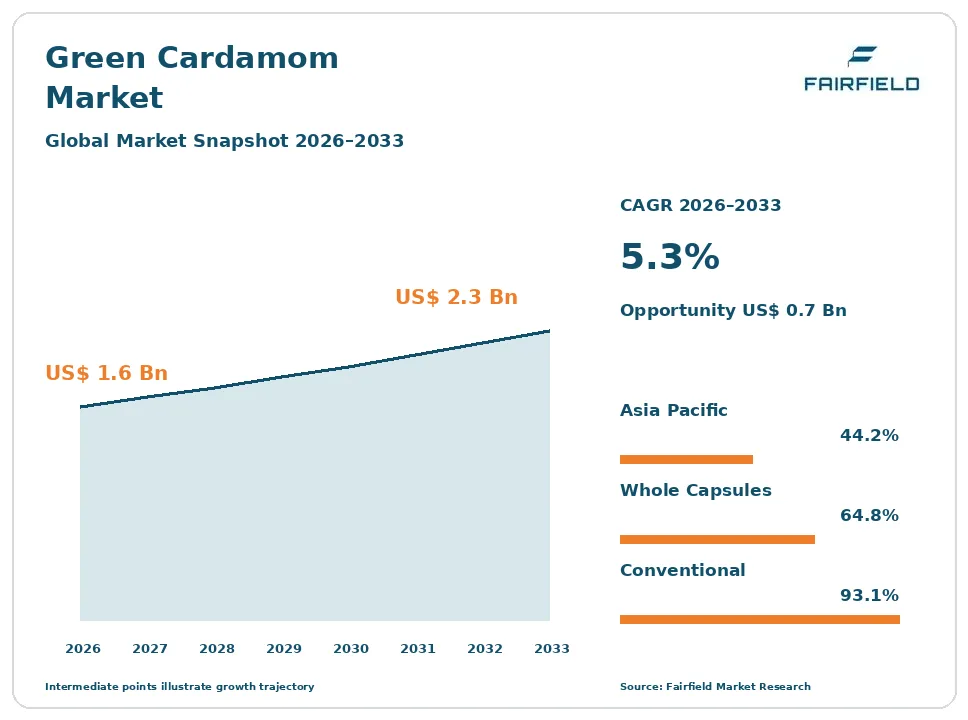
The global green cardamom market size is expected to be valued at US$ 1.6 billion in 2026 and projected to reach US$ 2.3 billion by 2033, growing at a CAGR of 5.3% between 2026 and 2033.
Two origins decide almost everything in this trade. Guatemala and India supply the overwhelming majority of world output, with Guatemala the dominant exporter and India both a major producer and the largest single consuming market. Between 2020 and 2025 the market grew at roughly a 4.6% CAGR, but that average conceals violent price swings. Growth through 2033 rests on industrial food and beverage use outside household cooking, on steady Gulf consumption, and on certified organic and extract forms that command premiums. Volumes expand slowly, because planted area responds to price with a lag of several years. Value therefore moves far more than tonnage in any given season.
Key Report Takeaways
- By Form: Whole green cardamom capsules held 64.8% share in 2026, while cardamom oleoresin and essential oil is projected to expand at a 7.6% CAGR through 2033, because extracts deliver batch-to-batch consistency that whole spice cannot guarantee.
- By Grade: Bold capsules of 7 to 8 mm held 38.5% share in 2026, while extra bold capsules above 8 mm are projected to grow at a 6.5% CAGR through 2033, supported by gift and premium retail packaging demand.
- By Cultivation Type: Conventional cultivation held 93.1% share in 2026, while certified organic cardamom is projected to advance at a 9.2% CAGR through 2033, as buyers use certification to manage residue compliance risk.
- By Application: Culinary and household use held 52.6% share in 2026, while food and beverage manufacturing is projected to rise at a 6.8% CAGR through 2033, led by flavoured bakery, confectionery and ready-to-drink beverage launches.
- By Geography: Asia Pacific held 44.2% share in 2026, while Middle East & Africa is projected to grow at a 6.6% CAGR through 2033, driven by Gulf consumption and large re-export trade through regional hubs.
Global Green Cardamom Market Trends and Insights
Drivers Impact Analysis
| Driver | Impact on CAGR Forecast | Geographic Relevance | Impact Timeline |
| Industrial food, beverage and flavour manufacturing adoption | High | North America, Europe, Asia Pacific | Medium term (2–4 years) |
| Gulf consumption and regional re-export trade | High | Middle East & Africa | Short term (≤2 years) |
Two demand forces explain most of the forecast value growth through 2033.
Beverage and Bakery Manufacturers Move Cardamom From the Spice Rack Into Formulated Products
Industrial buyers are reshaping where cardamom volume goes. Manufacturers of flavoured coffee, chai concentrates, ready-to-drink beverages, biscuits, ice cream and confectionery now purchase against written specifications for volatile oil content, moisture and residue limits. That buying behaviour differs fundamentally from household purchasing, because it is contracted, forecast in advance and far less sensitive to seasonal retail cycles.
The mechanism is product development outside the traditional consuming markets. Café chains and beverage brands in North America and Europe have adopted cardamom as a recognisable flavour in seasonal and premium lines, while Scandinavian bakery traditions sustain steady year-round use in Sweden, Norway and Finland. Each formulated launch converts a spice-rack purchase into a contracted ingredient line, and manufacturers specifying consistency increasingly buy ground spice or extract rather than whole capsules.
Gulf Coffee Culture and Re-Export Hubs Anchor the Largest Import Demand in the Trade
Gulf consumption is the most dependable demand pillar in the cardamom trade. Saudi Arabia is the world’s largest importer, where cardamom is added to coffee as a daily social custom rather than an occasional flavouring, and the United Arab Emirates, Kuwait and Qatar follow the same pattern. Because the use is habitual, volumes hold up even when prices rise sharply, which makes this demand unusually price-inelastic.
Re-export compounds the effect. Dubai and Jebel Ali function as consolidation and redistribution points, moving Guatemalan and Indian cardamom onward to Iraq, Iran, Egypt and parts of Africa. Population growth, expanding modern grocery formats and a large expatriate workforce from cardamom-using food cultures all add volume. Guatemalan exporters have historically oriented their bold green grades specifically toward these buyers’ colour and size preferences.
Restraints Impact Analysis
| Restraint | Impact on CAGR Forecast | Geographic Relevance | Impact Timeline |
| Extreme price volatility driven by weather and disease in two origins | High | Global, Latin America, Asia Pacific | Short term (≤2 years) |
| Residue and contaminant rejections compounded by smallholder fragmentation | High | Europe, North America | Medium term (2–4 years) |
Two constraints dominate commercial risk for every buyer in this chain.
Two-Origin Concentration Makes Cardamom One of the Most Price-Volatile Spices Traded
Price volatility is the defining commercial risk in cardamom, and it follows directly from origin concentration. With Guatemala and India supplying most of world output, a single weather event or disease outbreak in either country can move the world price by a multiple within one season. Buyers have seen auction prices double and then halve inside two years, which makes annual contracting and menu pricing genuinely difficult.
The causes are agronomic. Cardamom is a shade-grown perennial that needs reliable rainfall and cool highland conditions, so drought, unseasonal rain or heat during flowering cuts yields immediately. Disease pressure, including viral and rot problems in Indian plantations, removes productive acreage for years. New planting takes three to four seasons to bear, so supply cannot respond quickly. Processors and brand owners absorb the gap, compressing margins whenever prices spike.
Residue Rejections and Fragmented Smallholder Supply Raise the Cost of Serving Export Markets
Compliance failure is a recurring and expensive trade barrier in cardamom. Consignments are rejected at import for exceeding pesticide residue limits, and the use of ethylene oxide as a fumigant has triggered repeated alerts and product withdrawals in Europe, where the substance is not authorised for food treatment. Limits on aflatoxins and heavy metals in spices add a further layer of testing and documentation for every lot.
The underlying cause is supply structure. Most cardamom is grown by smallholders on fragmented plots, pooled through village collectors and auctions before reaching exporters, so a single export lot may combine material from many farms with different spraying practices. That makes traceability genuinely hard and certification schemes expensive to administer. Exporters therefore carry the cost of segregated warehousing, pre-shipment laboratory testing and rejected consignments that cannot be resold.
Market Opportunities
Two revenue pools sit outside the conventional whole-capsule trade.
Certified Organic and Traceable Cardamom Programmes Command a Durable Price Premium
Certified organic and fully traceable cardamom is the clearest premium opportunity in this market. Because residue rejection is the buyer’s main fear, certification functions as risk insurance as much as a marketing claim, and importers in Europe and North America pay materially above conventional prices for documented lots. Supply is scarce relative to enquiry, so contracted organic volume is defensible for several seasons.
Capture favours exporters that can organise growers into verified groups and carry the audit cost. The pulling customers are organic retail brands, natural food manufacturers and private-label programmes with supplier codes that require residue testing. Fair trade and organic certification standards supply the framework, and Guatemalan and Indian cooperative structures provide a workable route. Processors that invest early in grower training and segregated handling can lock in supply before competitors reach the same growers.
Oleoresin and Essential Oil Extraction Opens a Consistency-Led Industrial Revenue Pool
Cardamom oleoresin and essential oil represent the fastest-expanding value pool in this trade. Extraction converts variable agricultural material into a standardised product with declared volatile oil content, which is exactly what industrial formulators need. Extract sells on specification rather than appearance, so processors can use capsules that would be discounted in whole-spice grading, improving yield from the same raw purchase.
The demand comes from beverage manufacturers, flavour and fragrance houses, confectionery producers and personal care formulators who cannot tolerate batch variation. Capture requires extraction capability, analytical laboratories and the ability to hold raw stock through price cycles, which favours established extract houses in Kerala and large ingredient companies. Growth in ready-to-drink beverages and in premium fragrance supports the pool, and extract buyers typically contract annually rather than purchasing spot.
Segment Analysis
By Form: Whole Capsules Still Dominate as Extracts Take the Growth
Whole green cardamom capsules accounted for 64.8% of 2026 revenue, because appearance, aroma and capsule integrity remain how most buyers judge quality. Whole capsules also store and travel better than ground spice, which loses volatile aroma quickly once milled. Cardamom seed and ground cardamom together take the next largest share, serving household and foodservice users who want convenience. Cardamom oleoresin and essential oil is the fastest-growing form at a 7.6% CAGR through 2033, because extraction delivers declared volatile oil content and removes the batch variation that frustrates industrial formulators. Extracts also let processors monetise capsules that grade poorly on size or colour. For the wider trade, this shift moves value from appearance-based grading toward analytical specification, favouring companies with extraction plants and laboratories over pure traders.
By Grade: Bold Capsules Carry the Trade While Extra Bold Gains Premium Share
Bold capsules of 7 to 8 mm held 38.5% of 2026 revenue, the working grade for most retail packs, foodservice and manufacturing use, with enough size and colour to satisfy buyers without the premium attached to the largest capsules. Superior grades of 6 to 7 mm and light or mixed grades below 6 mm supply grinding, extraction and price-sensitive channels. Extra bold capsules above 8 mm are the fastest-growing grade at a 6.5% CAGR through 2033, pulled by gift packaging, premium retail jars and Gulf buyers who pay for visible size and deep green colour. Grading follows the Spices Board of India framework and ISO 882 specifications for cardamom. Because grade mix determines realised price, drying and sorting discipline at origin is now a direct commercial lever for exporters.
By Cultivation Type: Conventional Supply Dominates While Certified Organic Expands Fastest
Conventional cultivation represented 93.1% of the market in 2026, reflecting the reality that most cardamom comes from smallholder plots with no certification and limited record keeping. Conventional material also clears the bulk of Gulf and domestic Indian demand, where certification carries little price advantage. Certified organic cardamom is the fastest-growing cultivation type at a 9.2% CAGR through 2033, from a small base. Growth is driven less by consumer preference than by importer risk management, since certified and audited supply chains reduce the chance of a residue rejection at the European border. Organic certification standards and fair trade schemes supply the verification structure. The implication is that certification is becoming a trade access tool rather than a marketing option, and exporters without it face narrowing entry into premium markets.
By Application: Household Cooking Leads While Manufactured Food and Beverage Grows Faster
Culinary and household use held 52.6% of 2026 revenue, covering domestic cooking, coffee and tea preparation and foodservice kitchens across the traditional consuming markets. This is the most stable but slowest-moving part of the trade. Food and beverage manufacturing, covering bakery, confectionery and beverages, is the fastest-growing application at a 6.8% CAGR through 2033, as brands formulate cardamom into ready-to-drink products, seasonal bakery lines and premium chocolate. Flavour and fragrance use takes a smaller but high-value share, buying mainly extract rather than whole spice, while traditional and personal care applications remain a steady niche. The business implication is that purchasing is professionalising. Manufacturers demand specifications, certificates of analysis and continuity of supply, which rewards exporters able to deliver documented quality across volatile seasons.
Geography Analysis
North America Converts Cardamom Into a Formulated Ingredient Rather Than a Pantry Spice
North America held 9.8% of 2026 revenue and is growing at roughly 6.2% annually, with the United States and Canada both expanding. Demand is unusual in that it is led by manufacturers and foodservice rather than home cooking. Coffee chains, craft bakeries, ice cream brands and spice blenders have adopted cardamom as a recognisable premium flavour, and retail growth follows diaspora grocery alongside mainstream specialty ranges.
Buying is heavily compliance-led. Importers require residue testing documentation and prefer suppliers with certification, which concentrates volume among a few established trading houses. The main barrier is price exposure, since the region holds no production and is fully dependent on imported material at whatever the season dictates. The clearest opportunity is in extracts, which give beverage formulators consistency and simplify dosing.
Europe Makes Residue Compliance the Decisive Condition of Market Access
Europe accounted for 13.5% of 2026 revenue, growing at close to 4.5% annually, the slowest regional pace but one of the highest value per tonne. Germany, the United Kingdom, Sweden, Norway and the Netherlands are the principal markets, with Rotterdam and Hamburg acting as import and distribution points. Nordic bakery tradition sustains unusually high per capita use.
Regulation shapes everything here. Maximum residue levels for pesticides, the prohibition on ethylene oxide treatment with its associated alert and import control measures, and limits on aflatoxins and heavy metals in spices together determine which exporters can supply. Rejections are frequent enough to influence sourcing decisions directly. Growth is therefore constrained less by appetite than by the availability of compliant lots, and certified organic supply is the main route to expansion.
Which Region Is Leading the Green Cardamom Market?
Asia Pacific leads the green cardamom market with 44.2% of global revenue in 2026, growing at about 4.9% annually. India is the centre of gravity, being simultaneously a major producer, the largest single consuming country and the holder of the trade’s main auction and grading infrastructure through the Spices Board of India. Cardamom is embedded in everyday cooking, confectionery, tea preparation and festival use, which gives the region a volume base no other market approaches.
Kerala, Karnataka and Tamil Nadu supply most Indian output from shade-grown highland plantations. Sri Lanka, Nepal, Indonesia and Papua New Guinea add smaller volumes. The region also hosts the largest concentration of extract manufacturers. The dominant change underway is the shift from auction spot buying toward contracted, residue-tested supply for export-facing brands.
Latin America Supplies the Export Trade From a Single Dominant Origin
Latin America held 7.9% of 2026 revenue on a consumption basis and is growing at roughly 4.6% annually, but its real significance is production. Guatemala is the dominant global exporter, with cardamom grown largely by smallholders in the Alta Verapaz highlands and shipped through Puerto Barrios toward Gulf and Asian buyers. Honduras and Costa Rica contribute marginal volumes.
Local consumption is minimal, so the region is a supply story rather than a demand one. Barriers are real: growers are fragmented and often remote, farm-gate price transmission is poor, post-harvest drying is inconsistent, and traceability systems are thin. Those weaknesses show up as quality variability at destination. The opportunity lies in organised grower programmes and improved drying infrastructure, which would raise realised grade mix and open certified channels.
Which Region Is Growing Fastest in the Green Cardamom Market?
Middle East & Africa is the fastest-growing geography in this market, advancing at a 6.6% CAGR between 2026 and 2033 from a 24.6% revenue share in 2026. Saudi Arabia is the world’s largest importing country, where cardamom-infused coffee is a daily social ritual, and the United Arab Emirates, Kuwait, Qatar, Oman and Iraq follow similar consumption patterns. Habitual use makes demand resilient to price spikes.
Re-export through Dubai and Jebel Ali moves significant volume onward into Egypt, the Levant and East African markets. Growth drivers include population expansion, modern grocery penetration and a large expatriate workforce. Barriers include dependence on imported supply, exposure to origin price swings and uneven quality control among smaller traders. Branded, packaged cardamom gaining shelf space in Gulf supermarkets is the most visible structural change.
Competitive Landscape
The green cardamom market is fragmented with low concentration, and no company controls a meaningful share of global supply. The base of the pyramid is tens of thousands of smallholder growers in Guatemala and India, whose output is aggregated by collectors, auction centres and exporters. Above them sit international spice traders, extract manufacturers and branded consumer spice companies, each capturing value at a different point. Consolidation has occurred mainly among ingredient houses and extract processors rather than at origin, where fragmentation persists because cardamom is a perennial smallholder crop with no plantation economics favouring scale.
Competition rests on four capabilities: securing volume at origin through grower relationships, demonstrating residue and contaminant compliance with credible laboratory data, holding inventory through severe price cycles without failing contracts, and offering the right form, whether whole capsule, ground, oleoresin or essential oil. Branded spice companies compete additionally on packaging, shelf presence and consumer trust. Newer entrants include traceability-focused direct sourcing businesses and organic cooperative exporters that sell verified provenance as their differentiator.
Strategic activity concentrates on vertical reach and quality assurance. Exporters are investing in in-house testing laboratories, grower training and segregated warehousing to protect against rejections. Extract houses are expanding analytical and formulation support to serve beverage and fragrance customers. Traders are lengthening contract horizons with manufacturers to smooth the effect of origin price swings on both sides.
Strategic direction across the sector favours documented supply chains. Companies that can evidence origin, residue status and consistent grade are gaining access to the buyers that pay best, while undifferentiated spot trading is increasingly confined to price-driven channels.
Green Cardamom Industry Leaders
- McCormick & Company, Incorporated
- Olam Food Ingredients (ofi)
- Synthite Industries Private Limited
- Nedspice Group
- ITC Limited
Recent Industry Developments
- 1993: The International Organization for Standardization published ISO 882, specifying requirements for cardamom in whole capsule and seed form — still the reference point for grade and quality disputes in international contracts.
- 2014: The Codex Alimentarius Commission adopted a revised code of hygienic practice for spices and dried aromatic plants — setting the baseline handling, drying and storage expectations that importers now audit against.
- September 2020: Notifications of ethylene oxide residues in spice and seed consignments entering the European Union began a sustained wave of alerts and product withdrawals — making fumigation practice at origin a condition of market access.
- May 2023: The European Union’s consolidated contaminant regulation became applicable, carrying maximum levels for aflatoxins and heavy metals in spices — standardising the testing panel exporters must satisfy before shipment.
- May 2024: The Spices Board of India made testing for ethylene oxide residues mandatory for spice consignments exported to Singapore and Hong Kong — formalising pre-shipment analysis as a routine export cost.
Companies Covered in the Report
- McCormick & Company, Incorporated
- Olam Food Ingredients (ofi)
- Nedspice Group
- ITC Limited
- Everest Food Products Private Limited
- Mahashian Di Hatti Private Limited
- Dharampal Satyapal Group
- Synthite Industries Private Limited
- Plant Lipids Private Limited
- Kancor Ingredients Limited
- AVT Natural Products Limited
- Elite Spice, Inc.
- Givaudan SA
- Symrise AG
Green Cardamom Market Report Scope
This report covers whole green cardamom capsules of Elettaria cardamomum, together with cardamom seed, ground cardamom, oleoresin and essential oil where these form part of the trade. It spans capsule grades, conventional and certified organic cultivation, and culinary, manufacturing, flavour, fragrance and personal care applications. Black or large cardamom is a different species and is excluded. The base year is 2025, and the forecast period runs from 2026 to 2033, with values in US$ Billion.
Form
- Whole Green Cardamom Capsules
- Cardamom Seed
- Ground Cardamom
- Cardamom Oleoresin and Essential Oil
Grade
- Extra Bold (Above 8 mm)
- Bold (7 to 8 mm)
- Superior (6 to 7 mm)
- Light and Mixed Grades (Below 6 mm)
Cultivation Type
- Conventional
- Certified Organic
Application
- Culinary and Household Use
- Food and Beverage Manufacturing
- Flavour and Fragrance
- Traditional and Personal Care
Regions
- North America
- Europe
- Asia Pacific
- Latin America
- Middle East & Africa
Key Questions Answered in the Report
How big is the green cardamom market in 2026?
The green cardamom market is valued at US$ 1.6 billion in 2026, covering whole capsules, seed, ground spice, oleoresin and essential oil.
What is the forecast size and growth rate for green cardamom?
The market is projected to reach US$ 2.3 billion by 2033, growing at a 5.3% CAGR and adding US$ 0.7 billion across the period.
Which application segment leads the green cardamom market?
Culinary and household use leads with 52.6% of 2026 revenue, covering domestic cooking, coffee and tea preparation and foodservice kitchens.
Which segment and region are growing fastest in this market?
Certified organic cardamom grows fastest among segments at 9.2%, while Middle East & Africa is the fastest-growing region at 6.6%.
Which region holds the largest share of the green cardamom market?
Asia Pacific holds 44.2% of 2026 revenue, led by India as both a major producer and the largest single consuming country.
1. Executive Summary
1.1. Global Green Cardamom Market Snapshot
1.2. Future Projections
1.3. Key Report Takeaways
1.4. Regional Snapshot
2. Market Overview
2.1. Market Definition and Report Scope
2.2. Historical Trends 2020–2025
2.3. Market Dynamics
2.3.1. Drivers
2.3.1.1. Beverage and Bakery Manufacturers Move Cardamom From the Spice Rack Into Formulated Products
2.3.1.2. Gulf Coffee Culture and Re-Export Hubs Anchor the Largest Import Demand in the Trade
2.3.2. Restraints
2.3.2.1. Two-Origin Concentration Makes Cardamom One of the Most Price-Volatile Spices Traded
2.3.2.2. Residue Rejections and Fragmented Smallholder Supply Raise the Cost of Serving Export Markets
2.3.3. Market Opportunities
2.3.3.1. Certified Organic and Traceable Cardamom Programmes Command a Durable Price Premium
2.3.3.2. Oleoresin and Essential Oil Extraction Opens a Consistency-Led Industrial Revenue Pool
3. Global Green Cardamom Market Outlook, 2020–2033
3.1. Global Green Cardamom Market Outlook, by Form, Value (US$ Billion), 2020–2033
3.1.1. Whole Green Cardamom Capsules
3.1.2. Cardamom Seed
3.1.3. Ground Cardamom
3.1.4. Cardamom Oleoresin and Essential Oil
3.2. Global Green Cardamom Market Outlook, by Grade, Value (US$ Billion), 2020–2033
3.2.1. Extra Bold (Above 8 mm)
3.2.2. Bold (7 to 8 mm)
3.2.3. Superior (6 to 7 mm)
3.2.4. Light and Mixed Grades (Below 6 mm)
3.3. Global Green Cardamom Market Outlook, by Cultivation Type, Value (US$ Billion), 2020–2033
3.3.1. Conventional
3.3.2. Certified Organic
3.4. Global Green Cardamom Market Outlook, by Application, Value (US$ Billion), 2020–2033
3.4.1. Culinary and Household Use
3.4.2. Food and Beverage Manufacturing
3.4.3. Flavour and Fragrance
3.4.4. Traditional and Personal Care
3.5. Global Green Cardamom Market Outlook, by Region, Value (US$ Billion), 2020–2033
3.5.1. North America
3.5.2. Europe
3.5.3. Asia Pacific
3.5.4. Latin America
3.5.5. Middle East & Africa
4. North America Green Cardamom Market Outlook, 2020–2033
4.1. North America Green Cardamom Market Outlook, by Form, Value (US$ Billion), 2020–2033
4.1.1. Whole Green Cardamom Capsules
4.1.2. Cardamom Seed
4.1.3. Ground Cardamom
4.1.4. Cardamom Oleoresin and Essential Oil
4.2. North America Green Cardamom Market Outlook, by Grade, Value (US$ Billion), 2020–2033
4.2.1. Extra Bold (Above 8 mm)
4.2.2. Bold (7 to 8 mm)
4.2.3. Superior (6 to 7 mm)
4.2.4. Light and Mixed Grades (Below 6 mm)
4.3. North America Green Cardamom Market Outlook, by Cultivation Type, Value (US$ Billion), 2020–2033
4.3.1. Conventional
4.3.2. Certified Organic
4.4. North America Green Cardamom Market Outlook, by Application, Value (US$ Billion), 2020–2033
4.4.1. Culinary and Household Use
4.4.2. Food and Beverage Manufacturing
4.4.3. Flavour and Fragrance
4.4.4. Traditional and Personal Care
4.5. North America Green Cardamom Market Outlook, by Country, Value (US$ Billion), 2020–2033
4.5.1. United States Green Cardamom Market Outlook, by Form, 2020–2033
4.5.2. United States Green Cardamom Market Outlook, by Grade, 2020–2033
4.5.3. United States Green Cardamom Market Outlook, by Cultivation Type, 2020–2033
4.5.4. United States Green Cardamom Market Outlook, by Application, 2020–2033
4.5.5. Canada Green Cardamom Market Outlook, by Form, 2020–2033
4.5.6. Canada Green Cardamom Market Outlook, by Grade, 2020–2033
4.5.7. Canada Green Cardamom Market Outlook, by Cultivation Type, 2020–2033
4.5.8. Canada Green Cardamom Market Outlook, by Application, 2020–2033
5. Europe Green Cardamom Market Outlook, 2020–2033
5.1. Europe Green Cardamom Market Outlook, by Form, Value (US$ Billion), 2020–2033
5.1.1. Whole Green Cardamom Capsules
5.1.2. Cardamom Seed
5.1.3. Ground Cardamom
5.1.4. Cardamom Oleoresin and Essential Oil
5.2. Europe Green Cardamom Market Outlook, by Grade, Value (US$ Billion), 2020–2033
5.2.1. Extra Bold (Above 8 mm)
5.2.2. Bold (7 to 8 mm)
5.2.3. Superior (6 to 7 mm)
5.2.4. Light and Mixed Grades (Below 6 mm)
5.3. Europe Green Cardamom Market Outlook, by Cultivation Type, Value (US$ Billion), 2020–2033
5.3.1. Conventional
5.3.2. Certified Organic
5.4. Europe Green Cardamom Market Outlook, by Application, Value (US$ Billion), 2020–2033
5.4.1. Culinary and Household Use
5.4.2. Food and Beverage Manufacturing
5.4.3. Flavour and Fragrance
5.4.4. Traditional and Personal Care
5.5. Europe Green Cardamom Market Outlook, by Country, Value (US$ Billion), 2020–2033
5.5.1. Germany Green Cardamom Market Outlook, by Form, 2020–2033
5.5.2. Germany Green Cardamom Market Outlook, by Grade, 2020–2033
5.5.3. Germany Green Cardamom Market Outlook, by Cultivation Type, 2020–2033
5.5.4. Germany Green Cardamom Market Outlook, by Application, 2020–2033
5.5.5. United Kingdom Green Cardamom Market Outlook, by Form, 2020–2033
5.5.6. United Kingdom Green Cardamom Market Outlook, by Grade, 2020–2033
5.5.7. United Kingdom Green Cardamom Market Outlook, by Cultivation Type, 2020–2033
5.5.8. United Kingdom Green Cardamom Market Outlook, by Application, 2020–2033
5.5.9. Sweden Green Cardamom Market Outlook, by Form, 2020–2033
5.5.10. Sweden Green Cardamom Market Outlook, by Grade, 2020–2033
5.5.11. Sweden Green Cardamom Market Outlook, by Cultivation Type, 2020–2033
5.5.12. Sweden Green Cardamom Market Outlook, by Application, 2020–2033
5.5.13. Norway Green Cardamom Market Outlook, by Form, 2020–2033
5.5.14. Norway Green Cardamom Market Outlook, by Grade, 2020–2033
5.5.15. Norway Green Cardamom Market Outlook, by Cultivation Type, 2020–2033
5.5.16. Norway Green Cardamom Market Outlook, by Application, 2020–2033
5.5.17. Netherlands Green Cardamom Market Outlook, by Form, 2020–2033
5.5.18. Netherlands Green Cardamom Market Outlook, by Grade, 2020–2033
5.5.19. Netherlands Green Cardamom Market Outlook, by Cultivation Type, 2020–2033
5.5.20. Netherlands Green Cardamom Market Outlook, by Application, 2020–2033
6. Asia Pacific Green Cardamom Market Outlook, 2020–2033
6.1. Asia Pacific Green Cardamom Market Outlook, by Form, Value (US$ Billion), 2020–2033
6.1.1. Whole Green Cardamom Capsules
6.1.2. Cardamom Seed
6.1.3. Ground Cardamom
6.1.4. Cardamom Oleoresin and Essential Oil
6.2. Asia Pacific Green Cardamom Market Outlook, by Grade, Value (US$ Billion), 2020–2033
6.2.1. Extra Bold (Above 8 mm)
6.2.2. Bold (7 to 8 mm)
6.2.3. Superior (6 to 7 mm)
6.2.4. Light and Mixed Grades (Below 6 mm)
6.3. Asia Pacific Green Cardamom Market Outlook, by Cultivation Type, Value (US$ Billion), 2020–2033
6.3.1. Conventional
6.3.2. Certified Organic
6.4. Asia Pacific Green Cardamom Market Outlook, by Application, Value (US$ Billion), 2020–2033
6.4.1. Culinary and Household Use
6.4.2. Food and Beverage Manufacturing
6.4.3. Flavour and Fragrance
6.4.4. Traditional and Personal Care
6.5. Asia Pacific Green Cardamom Market Outlook, by Country, Value (US$ Billion), 2020–2033
6.5.1. India Green Cardamom Market Outlook, by Form, 2020–2033
6.5.2. India Green Cardamom Market Outlook, by Grade, 2020–2033
6.5.3. India Green Cardamom Market Outlook, by Cultivation Type, 2020–2033
6.5.4. India Green Cardamom Market Outlook, by Application, 2020–2033
6.5.5. Sri Lanka Green Cardamom Market Outlook, by Form, 2020–2033
6.5.6. Sri Lanka Green Cardamom Market Outlook, by Grade, 2020–2033
6.5.7. Sri Lanka Green Cardamom Market Outlook, by Cultivation Type, 2020–2033
6.5.8. Sri Lanka Green Cardamom Market Outlook, by Application, 2020–2033
6.5.9. Nepal Green Cardamom Market Outlook, by Form, 2020–2033
6.5.10. Nepal Green Cardamom Market Outlook, by Grade, 2020–2033
6.5.11. Nepal Green Cardamom Market Outlook, by Cultivation Type, 2020–2033
6.5.12. Nepal Green Cardamom Market Outlook, by Application, 2020–2033
6.5.13. Indonesia Green Cardamom Market Outlook, by Form, 2020–2033
6.5.14. Indonesia Green Cardamom Market Outlook, by Grade, 2020–2033
6.5.15. Indonesia Green Cardamom Market Outlook, by Cultivation Type, 2020–2033
6.5.16. Indonesia Green Cardamom Market Outlook, by Application, 2020–2033
6.5.17. Papua New Guinea Green Cardamom Market Outlook, by Form, 2020–2033
6.5.18. Papua New Guinea Green Cardamom Market Outlook, by Grade, 2020–2033
6.5.19. Papua New Guinea Green Cardamom Market Outlook, by Cultivation Type, 2020–2033
6.5.20. Papua New Guinea Green Cardamom Market Outlook, by Application, 2020–2033
7. Latin America Green Cardamom Market Outlook, 2020–2033
7.1. Latin America Green Cardamom Market Outlook, by Form, Value (US$ Billion), 2020–2033
7.1.1. Whole Green Cardamom Capsules
7.1.2. Cardamom Seed
7.1.3. Ground Cardamom
7.1.4. Cardamom Oleoresin and Essential Oil
7.2. Latin America Green Cardamom Market Outlook, by Grade, Value (US$ Billion), 2020–2033
7.2.1. Extra Bold (Above 8 mm)
7.2.2. Bold (7 to 8 mm)
7.2.3. Superior (6 to 7 mm)
7.2.4. Light and Mixed Grades (Below 6 mm)
7.3. Latin America Green Cardamom Market Outlook, by Cultivation Type, Value (US$ Billion), 2020–2033
7.3.1. Conventional
7.3.2. Certified Organic
7.4. Latin America Green Cardamom Market Outlook, by Application, Value (US$ Billion), 2020–2033
7.4.1. Culinary and Household Use
7.4.2. Food and Beverage Manufacturing
7.4.3. Flavour and Fragrance
7.4.4. Traditional and Personal Care
7.5. Latin America Green Cardamom Market Outlook, by Country, Value (US$ Billion), 2020–2033
7.5.1. Guatemala Green Cardamom Market Outlook, by Form, 2020–2033
7.5.2. Guatemala Green Cardamom Market Outlook, by Grade, 2020–2033
7.5.3. Guatemala Green Cardamom Market Outlook, by Cultivation Type, 2020–2033
7.5.4. Guatemala Green Cardamom Market Outlook, by Application, 2020–2033
7.5.5. Honduras Green Cardamom Market Outlook, by Form, 2020–2033
7.5.6. Honduras Green Cardamom Market Outlook, by Grade, 2020–2033
7.5.7. Honduras Green Cardamom Market Outlook, by Cultivation Type, 2020–2033
7.5.8. Honduras Green Cardamom Market Outlook, by Application, 2020–2033
7.5.9. Costa Rica Green Cardamom Market Outlook, by Form, 2020–2033
7.5.10. Costa Rica Green Cardamom Market Outlook, by Grade, 2020–2033
7.5.11. Costa Rica Green Cardamom Market Outlook, by Cultivation Type, 2020–2033
7.5.12. Costa Rica Green Cardamom Market Outlook, by Application, 2020–2033
8. Middle East & Africa Green Cardamom Market Outlook, 2020–2033
8.1. Middle East & Africa Green Cardamom Market Outlook, by Form, Value (US$ Billion), 2020–2033
8.1.1. Whole Green Cardamom Capsules
8.1.2. Cardamom Seed
8.1.3. Ground Cardamom
8.1.4. Cardamom Oleoresin and Essential Oil
8.2. Middle East & Africa Green Cardamom Market Outlook, by Grade, Value (US$ Billion), 2020–2033
8.2.1. Extra Bold (Above 8 mm)
8.2.2. Bold (7 to 8 mm)
8.2.3. Superior (6 to 7 mm)
8.2.4. Light and Mixed Grades (Below 6 mm)
8.3. Middle East & Africa Green Cardamom Market Outlook, by Cultivation Type, Value (US$ Billion), 2020–2033
8.3.1. Conventional
8.3.2. Certified Organic
8.4. Middle East & Africa Green Cardamom Market Outlook, by Application, Value (US$ Billion), 2020–2033
8.4.1. Culinary and Household Use
8.4.2. Food and Beverage Manufacturing
8.4.3. Flavour and Fragrance
8.4.4. Traditional and Personal Care
8.5. Middle East & Africa Green Cardamom Market Outlook, by Country, Value (US$ Billion), 2020–2033
8.5.1. Saudi Arabia Green Cardamom Market Outlook, by Form, 2020–2033
8.5.2. Saudi Arabia Green Cardamom Market Outlook, by Grade, 2020–2033
8.5.3. Saudi Arabia Green Cardamom Market Outlook, by Cultivation Type, 2020–2033
8.5.4. Saudi Arabia Green Cardamom Market Outlook, by Application, 2020–2033
8.5.5. United Arab Emirates Green Cardamom Market Outlook, by Form, 2020–2033
8.5.6. United Arab Emirates Green Cardamom Market Outlook, by Grade, 2020–2033
8.5.7. United Arab Emirates Green Cardamom Market Outlook, by Cultivation Type, 2020–2033
8.5.8. United Arab Emirates Green Cardamom Market Outlook, by Application, 2020–2033
8.5.9. Kuwait Green Cardamom Market Outlook, by Form, 2020–2033
8.5.10. Kuwait Green Cardamom Market Outlook, by Grade, 2020–2033
8.5.11. Kuwait Green Cardamom Market Outlook, by Cultivation Type, 2020–2033
8.5.12. Kuwait Green Cardamom Market Outlook, by Application, 2020–2033
8.5.13. Qatar Green Cardamom Market Outlook, by Form, 2020–2033
8.5.14. Qatar Green Cardamom Market Outlook, by Grade, 2020–2033
8.5.15. Qatar Green Cardamom Market Outlook, by Cultivation Type, 2020–2033
8.5.16. Qatar Green Cardamom Market Outlook, by Application, 2020–2033
8.5.17. Oman Green Cardamom Market Outlook, by Form, 2020–2033
8.5.18. Oman Green Cardamom Market Outlook, by Grade, 2020–2033
8.5.19. Oman Green Cardamom Market Outlook, by Cultivation Type, 2020–2033
8.5.20. Oman Green Cardamom Market Outlook, by Application, 2020–2033
8.5.21. Iraq Green Cardamom Market Outlook, by Form, 2020–2033
8.5.22. Iraq Green Cardamom Market Outlook, by Grade, 2020–2033
8.5.23. Iraq Green Cardamom Market Outlook, by Cultivation Type, 2020–2033
8.5.24. Iraq Green Cardamom Market Outlook, by Application, 2020–2033
8.5.25. Egypt Green Cardamom Market Outlook, by Form, 2020–2033
8.5.26. Egypt Green Cardamom Market Outlook, by Grade, 2020–2033
8.5.27. Egypt Green Cardamom Market Outlook, by Cultivation Type, 2020–2033
8.5.28. Egypt Green Cardamom Market Outlook, by Application, 2020–2033
9. Competitive Landscape
9.1. Market Concentration and Industry Leaders
9.2. Competitive Differentiation
9.3. Strategic Moves and Market Direction
9.4. Recent Industry Developments
9.5. Company Profiles
9.5.1. McCormick & Company, Incorporated
9.5.2. Olam Food Ingredients (ofi)
9.5.3. Nedspice Group
9.5.4. ITC Limited
9.5.5. Everest Food Products Private Limited
9.5.6. Mahashian Di Hatti Private Limited
9.5.7. Dharampal Satyapal Group
9.5.8. Synthite Industries Private Limited
9.5.9. Plant Lipids Private Limited
9.5.10. Kancor Ingredients Limited
9.5.11. AVT Natural Products Limited
9.5.12. Elite Spice, Inc.
9.5.13. Givaudan SA
9.5.14. Symrise AG
10. Appendix
10.1. Research Methodology
10.2. Report Assumptions
10.3. Acronyms and Abbreviations
| Form | Whole Green Cardamom Capsules, Cardamom Seed, Ground Cardamom, Cardamom Oleoresin and Essential Oil |
| Grade | Extra Bold (Above 8 mm), Bold (7 to 8 mm), Superior (6 to 7 mm), Light and Mixed Grades (Below 6 mm) |
| Cultivation Type | Conventional, Certified Organic |
| Application | Culinary and Household Use, Food and Beverage Manufacturing, Flavour and Fragrance, Traditional and Personal Care |
| Regions | North America, Europe, Asia Pacific, Latin America, Middle East & Africa |
Our Research Methodology
Considering the volatility of business today, traditional approaches to strategizing a game plan can be unfruitful if not detrimental. True ambiguity is no way to determine a forecast. A myriad of predetermined factors must be accounted for such as the degree of risk involved, the magnitude of circumstances, as well as conditions or consequences that are not known or unpredictable. To circumvent binary views that cast uncertainty, the application of market research intelligence to strategically posture, move, and enable actionable outcomes is necessary.
View Methodology
Quality Assured
Rigorous Validation Process

Confidentiality Assured
End-to-end Data Security

Custom Research Services
Tailored To Your Objectives
FAQs
The green cardamom market is valued at US$ 1.6 billion in 2026, covering whole capsules, seed, ground spice, oleoresin and essential oil.
The market is projected to reach US$ 2.3 billion by 2033, growing at a 5.3% CAGR and adding US$ 0.7 billion across the period.
Culinary and household use leads with 52.6% of 2026 revenue, covering domestic cooking, coffee and tea preparation and foodservice kitchens.
Certified organic cardamom grows fastest among segments at 9.2%, while Middle East & Africa is the fastest-growing region at 6.6%.
Asia Pacific holds 44.2% of 2026 revenue, led by India as both a major producer and the largest single consuming country.
Related Reports
GMO Testing Market Size, Share, Insights, Competitive Landscape, and Forecast 2026 to 2033
GMO testing market to grow from US$2.2 Bn in 2026 to US$3.6 Bn by 2033 at 7.3% CAGR. Explore testing services, technologies, samples and regional trends.
Glutinous Rice Flour Market Size, Share, Insights, Competitive Landscape, and Forecast 2026 to 2033
Glutinous rice flour market to grow from US$2.4 Bn in 2026 to US$3.5 Bn by 2033 at 5.5% CAGR. Explore products, milling, applications and regions.
Oat Milk Market Size, Share, Insights, Competitive Landscape, and Forecast 2026 to 2033
Oat milk market to reach US$ 13.72 billion by 2033 at a 16.8% CAGR. Explore product types, organic demand, distribution channels and regional trends.
Low Glycemic Index Rice Market Size, Share, Insights, Competitive Landscape, and Forecast 2026 to 2033
Low glycemic index rice market to reach US$ 18.01 billion by 2033 at a 7.5% CAGR. Explore rice types, applications, channels and regional trends.
Yeast Ingredient Market Size, Share, Insights, Competitive Landscape, and Forecast 2026 to 2033
Explore the yeast ingredient market, reaching US$ 16.5 billion by 2033 at 6.2% CAGR, with product, application and regional insights.
Vegan Yoghurt Market Size, Share, Insights, Competitive Landscape, and Forecast 2026 to 2033
Explore the vegan yoghurt market, reaching US$ 6.0 billion by 2033 at 6.3% CAGR, with base types, formats, distribution and regional insights.