



Glutinous Rice Flour Market
Glutinous Rice Flour Market Size, Share, Insights, Competitive Landscape, and Forecast 2026 to 2033
Glutinous Rice Flour Market Size and Trend Analysis
Glutinous rice flour contains no gluten. The name describes the glue-like stickiness of cooked waxy rice, not the wheat protein, and the distinction is a commercial issue rather than a trivia point. Buyers in gluten-free retail channels still hesitate over the word, even though the flour qualifies for gluten-free labelling under the relevant rules. This report treats that purely as a naming and labelling matter.
How Fast Is the Glutinous Rice Flour Market Growing?
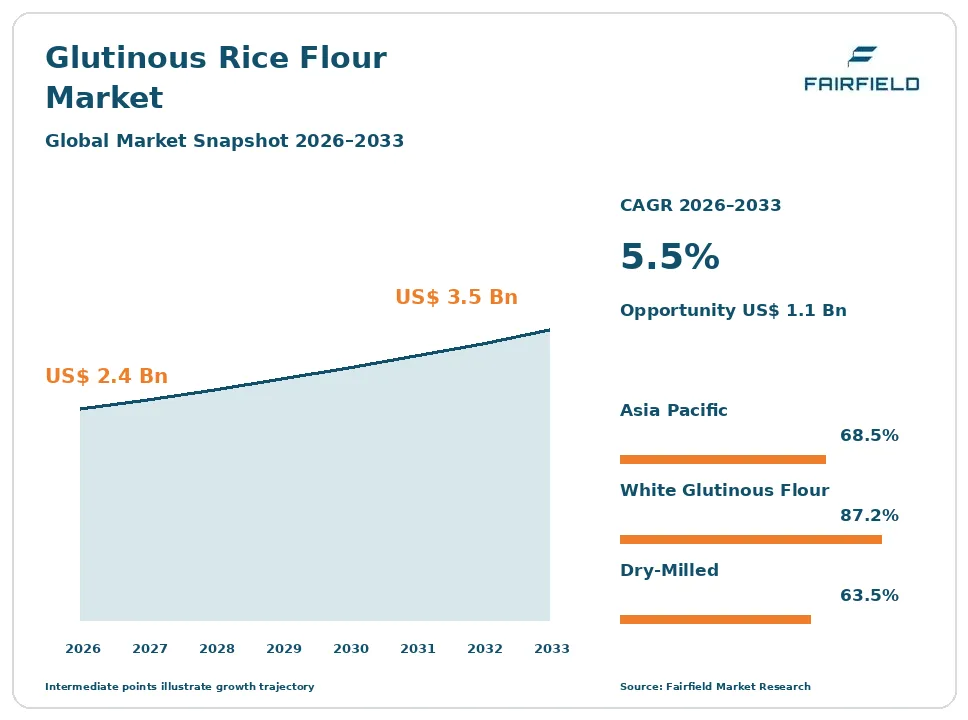
The global glutinous rice flour market size is expected to be valued at US$ 2.4 billion in 2026 and projected to reach US$ 3.5 billion by 2033, growing at a CAGR of 5.5% between 2026 and 2033.
Between 2020 and 2025 the market expanded at roughly a 4.8% CAGR, as waxy rice milling shifted from village mills toward industrial lines. Three factors carry the forecast. First, makers of frozen mochi, tangyuan, dumplings and filled rice cakes are scaling output for supermarket freezer cabinets. Second, grocery chains outside Asia now stock the flour as a standing baking-aisle item rather than an occasional import. Third, food formulators use its cohesive texture and freeze-thaw stability as a single recognisable texturiser in place of declared additives. The direction is steady rather than sharp. Volumes track packaged food manufacturing output far more closely than they track home baking fashion.
Key Report Takeaways
- By Product Type: White glutinous rice flour held 87.2% share in 2026, while black and purple glutinous rice flour is projected to expand at a 7.4% CAGR through 2033, as bakers use its natural colour instead of added colourants.
- By Milling Process: Dry-milled flour held 63.5% share in 2026, while wet-milled flour is projected to grow at a 6.4% CAGR through 2033, because its finer particle size produces the smoother eating quality traditional confectionery buyers specify.
- By Form: Native flour held 74.8% share in 2026, while pre-gelatinised grades are projected to advance at a 7.9% CAGR through 2033, reflecting demand from instant dessert mixes that need cold-water thickening without cooking.
- By Application: Traditional Asian confectionery and desserts held 41.2% share in 2026, while gluten-free formulation is projected to rise at an 8.1% CAGR through 2033, supported by wider free-from ranges in mainstream supermarkets.
- By Geography: Asia Pacific held 68.5% share in 2026, while North America is projected to grow at a 7.6% CAGR through 2033, led by frozen Asian dessert manufacturing and diaspora retail distribution in the United States.
Global Glutinous Rice Flour Market Trends and Insights
Drivers Impact Analysis
| Driver | Impact on CAGR Forecast | Geographic Relevance | Impact Timeline |
| Industrial production of packaged and frozen waxy rice confectionery | High | Asia Pacific, North America | Medium term (2–4 years) |
| Freeze-thaw stable texturising in chilled and frozen manufactured foods | Medium | North America, Europe, Asia Pacific | Long term (≥4 years) |
Two forces account for most of the incremental volume forecast through 2033.
Factory-Made Mochi and Frozen Rice Desserts Shift Waxy Flour Demand From Kitchens to Mills
Packaged confectionery manufacturing is the single largest source of new glutinous rice flour volume. Products that households once made fresh, including mochi, tangyuan, nian gao and filled rice dumplings, are now produced on automated lines and sold frozen or shelf-stable. Industrial buyers purchase in tonnes against written particle-size and moisture specifications, which converts scattered household demand into contracted mill offtake.
The mechanism is cold chain plus retail format. Freezer capacity in modern grocery formats across Japan, China, Thailand, Vietnam and the United States lets manufacturers ship rice-based desserts far beyond their point of production. Ice-cream filled mochi balls, sold in multipacks, created a year-round category where a seasonal festival food once existed. Each line conversion replaces artisanal milling with repeatable industrial supply and raises quality expectations across the chain.
Freeze-Thaw Stability Makes Waxy Rice Flour a Single-Ingredient Texturiser for Chilled Foods
Food manufacturers are specifying glutinous rice flour in sauces, soups, fillings and ready meals because of how it behaves after freezing. High-amylopectin starch resists retrogradation, so pastes made with it hold their texture through freeze-thaw cycles instead of weeping water. That performance opens applications well outside traditional confectionery and gives mills a second, more stable revenue stream.
The commercial driver behind this is label simplification. Retailer own-brand specifications increasingly discourage modified starch declarations, and a milled cereal ingredient reads more plainly on a pack than a chemically modified alternative. Chilled dim sum, frozen sauces, gravies, bakery fillings and dairy desserts are the main beneficiaries of the switch. Reformulation cycles are slow, usually tied to annual own-brand tenders and supplier audits, so this driver builds volume gradually rather than producing step changes in demand.
Restraints Impact Analysis
| Restraint | Impact on CAGR Forecast | Geographic Relevance | Impact Timeline |
| Narrow waxy paddy origins, acreage competition and export policy intervention | High | Asia Pacific, global trade | Short term (≤2 years) |
| Inorganic arsenic compliance costs and wet-milled quality variability | Medium | Europe, North America | Medium term (2–4 years) |
Two structural constraints hold the growth rate in mid single digits.
Thin Waxy Paddy Acreage and Rice Export Restrictions Keep Flour Costs Unpredictable
Raw material risk is the most serious commercial constraint in this market. Waxy paddy is grown in a narrow set of origins, principally northeastern Thailand, Laos, Vietnam, southern China and parts of Japan and Korea. It competes for the same land, labour and irrigation as ordinary long-grain rice, so a better price for conventional paddy pulls acreage away within a single planting decision.
Policy intervention compounds the field-level risk. Rice-exporting governments periodically restrict shipments to protect domestic prices, and those measures reach milled products as well as whole grain. India restricted non-basmati white rice exports in July 2023 and lifted the measure in September 2024, a sequence that moved world rice reference prices sharply in both directions. Millers holding fixed-price contracts absorb that volatility, which discourages long contracts and suppresses margins.
Arsenic Limits and Short-Lived Wet-Milled Grades Raise the Cost of Serving Export Markets
Compliance and shelf life together limit how freely mills can sell into premium export channels. Regulators set maximum levels for inorganic arsenic in rice and rice-based products, so exporters must select origins, test incoming paddy and retain certificates of analysis for each lot. That is a documented regulatory limit and a direct cost of doing business, borne per consignment rather than spread across annual volume.
Process economics add a second constraint. Wet-milled flour delivers the fine, smooth texture that traditional confectionery specifies, but it carries higher moisture, needs energy-intensive drying and has a shorter usable life than dry-milled flour. Mills serving distant markets therefore ship dry-milled grades and accept a texture penalty, or invest in drying and packaging capability. Smaller mills frequently cannot fund that step, which keeps export supply concentrated among a few processors.
Market Opportunities
Two revenue pools sit outside the established confectionery trade.
Pre-Gelatinised and Modified Waxy Rice Grades Open an Instant-Mix Revenue Pool
Pre-gelatinised glutinous rice flour is the clearest margin opportunity in this market. Because it hydrates and thickens in cold or warm water without cooking, it enables instant dessert mixes, filling powders, coating systems and dry sauce bases. These grades sell at a premium over native flour and are bought on functional specification, which insulates them from the price-led bidding that governs commodity flour sales.
Capture favours processors with drum-drying or extrusion capability and an applications laboratory. The pulling customer groups are instant food manufacturers in Japan, South Korea and China, bakery premix houses, and foodservice operators who need consistent results from low-skilled kitchen staff. Private-label dessert programmes in Europe and the United States add a second wave. Supporting this, retailers increasingly award own-brand contracts on demonstrated functional performance rather than on the lowest delivered price alone.
Black and Purple Glutinous Rice Flour Creates a Premium Colour-Carrying Line
Black and purple waxy rice varieties support a premium product line that white flour cannot serve. Milled from pigmented grain, they deliver a deep natural colour and a distinct flavour, allowing bakers and beverage makers to achieve visual impact without a separate colourant declaration. Pricing typically sits well above white glutinous flour, and supply is limited, so early contracted volume is defensible.
The buyers are craft bakeries, dessert chains, bubble tea operators and snack manufacturers in Thailand, Vietnam, the Philippines, Japan and increasingly the United States and United Kingdom. Capture requires origin relationships, because pigmented waxy paddy is grown on small acreages and needs segregated milling to avoid cross-contact with white flour. Processors that fund dedicated milling runs and verifiable origin records can hold the category while supply remains tight.
Segment Analysis
By Product Type: White Glutinous Rice Flour Dominates While Pigmented Varieties Gain Ground
White glutinous rice flour held 87.2% of revenue in 2026 because it is the default input for nearly every traditional application, from mochi and tangyuan to rice cakes and thickened sauces. Its neutral colour, wide origin base and lower price make it the reference grade against which all other material is quoted. Black and purple glutinous rice flour is the fastest-growing product type at a 7.4% CAGR through 2033, from a much smaller base. Growth comes from bakery, dessert chains and beverage operators that want colour and visual distinction from the grain itself rather than from an added ingredient. Pigmented paddy is grown on limited acreage and needs segregated milling, so availability, not demand, caps the pace. For the broader market, the pigmented line is where premium pricing and brand differentiation now sit.
By Milling Process: Dry Milling Carries Volume as Wet Milling Wins Texture-Critical Business
Dry-milled flour accounted for 63.5% of 2026 revenue, reflecting lower processing cost, longer shelf life and far simpler logistics for export. Mills can run it on conventional equipment, package it in standard bags and ship it long distances without refrigeration, which suits bulk industrial and retail demand. Wet-milled flour is the faster-growing route at a 6.4% CAGR through 2033. Soaking and grinding the grain in water produces a finer, less damaged particle with the smoother, more elastic eating quality that premium confectionery manufacturers specify. The constraint is cost: wet milling needs clean water, effluent handling and energy-intensive drying. As manufacturers in Japan, Taiwan, Thailand and China compete on eating quality rather than price, wet-milled volume grows faster even though dry milling will continue to supply most tonnage.
By Form: Native Flour Holds the Base While Pre-Gelatinised Grades Scale Quickly
Native glutinous rice flour represented 74.8% of the market in 2026, since most industrial and household recipes call for untreated flour that is cooked or steamed during preparation. It is the cheapest form, the most widely stocked and the easiest for a mill to produce without additional capital equipment. Pre-gelatinised grades are expanding fastest at a 7.9% CAGR through 2033, driven by instant dessert mixes, cold-prepared fillings, coating systems and dry sauce bases that must thicken without heat. Modified grades, tailored for specific viscosity or process tolerance, occupy a smaller niche where a processing line demands tightly controlled behaviour. The practical implication is that value is migrating toward processors who can offer functional grades, because those products are specified on performance and are far harder for a commodity miller to displace on price.
By Application: Traditional Confectionery Leads While Gluten-Free Formulation Accelerates
Traditional Asian confectionery and desserts held 41.2% of 2026 revenue, covering mochi, tangyuan, nian gao, dumplings and steamed rice cakes made at industrial scale. Bakery and snacks, sauces and soups, and processed and ready meals account for most of the remainder, with retail packs and foodservice distribution splitting the route to the user. Gluten-free formulation is the fastest-growing application at an 8.1% CAGR through 2033, as supermarkets widen free-from ranges and formulators look for a flour that contributes stickiness and binding. The naming confusion remains a real friction here, since buyers must be shown that the product is eligible for gluten-free labelling. Manufacturers that address that directly on pack are converting shelf space faster than those that leave the question unanswered.
Geography Analysis
Which Region Is Growing Fastest in the Glutinous Rice Flour Market?
North America is the fastest-growing region in this market, advancing at a 7.6% CAGR between 2026 and 2033 from a 12.4% revenue share in 2026. Growth rests on two distinct channels. Frozen dessert manufacturers in the United States and Canada have built mochi ice cream and filled rice cake production into a mainstream freezer category stocked by national grocery chains. Separately, retail distribution has widened well beyond specialty importers, with sweet rice flour now carried as a standing line in conventional baking aisles.
Demand is also institutional. Foodservice operators, bakery premix houses and free-from brand owners buy in bulk against written specifications, which favours suppliers able to document origin and testing. The main barrier is import dependence, since almost all material arrives from Asian mills and is exposed to freight cost, shipment timing and origin price swings.
Europe Builds Demand Through Free-From Retail and Asian Food Manufacturing
Europe accounted for 11.2% of 2026 revenue and is growing at close to 6.1% annually, a pace set by retail range expansion rather than by traditional consumption. The United Kingdom, Germany, France, the Netherlands and Italy are the main demand centres. Two customer groups drive volume: free-from brand owners that use the flour as a binding and texturising base, and manufacturers producing chilled and frozen Asian foods for European supermarkets.
Compliance shapes supplier selection more here than anywhere else. Contaminant limits for inorganic arsenic in rice and rice-based products, allergen and origin labelling rules, and organic certification requirements mean importers favour mills with established testing programmes and traceable paddy sourcing. The opportunity lies in certified organic material, where supply remains tight and buyers accept a clear premium for documented provenance.
Which Region Is Leading the Glutinous Rice Flour Market?
Asia Pacific leads the glutinous rice flour market with 68.5% of global revenue in 2026, growing at about 4.9% annually. Leadership follows production and consumption together. Thailand, Vietnam, China, Japan, South Korea, Indonesia and the Philippines grow the waxy paddy, host most of the milling capacity and contain the food cultures in which these products are everyday items rather than specialities.
Thailand is the export anchor, supplying both branded retail packs and bulk industrial flour. Japan and Korea represent the highest-value demand, with manufacturers specifying wet-milled grades for confectionery texture. China combines enormous domestic consumption with rapid growth in packaged frozen desserts. The region’s growth rate is lower than elsewhere only because the base is mature. The change now underway is consolidation of fragmented village milling into fewer, audited industrial plants.
Latin America Builds Niche Demand Around Free-From Bakery and Asian Food Retail
Latin America held 4.3% of 2026 revenue and is expanding at roughly 5.4% annually, making it a small but genuine growth market. Brazil, Mexico, Peru and Chile account for most consumption, split between Asian grocery retail serving established communities and free-from bakery producers seeking alternative flours. Specialty food importers rather than large ingredient distributors handle most volume.
Barriers are substantial. Import duties, long shipping routes from Asian mills and currency volatility all raise landed cost, and limited local milling means almost nothing is produced in the region. Retail awareness is also thin outside major cities, so the flour is often absent from mainstream grocery assortments. The opportunity sits with regional food manufacturers that could formulate with the flour for frozen desserts, provided a reliable, reasonably priced import channel develops.
Middle East & Africa Demand Follows Expatriate Retail and Premium Hotel Kitchens
Middle East & Africa represented 3.6% of 2026 revenue, growing at close to 5.8% annually, the smallest regional pool but one with clear structure. The United Arab Emirates, Saudi Arabia, Qatar and South Africa concentrate demand, led by large expatriate populations from rice-eating food cultures and by hotel and restaurant kitchens serving Asian menus. Gulf re-export hubs also move volume onward into neighbouring markets.
Constraints are practical rather than regulatory. Warehousing in high ambient temperatures shortens usable life, cold chain coverage is uneven outside the major cities, and import volumes are too small to command favourable freight terms. Growth will depend on modern grocery expansion and on distributors willing to hold the stock range. Dessert chains and bubble tea operators opening across Gulf shopping centres represent the most visible near-term demand change.
Competitive Landscape
The glutinous rice flour market is highly fragmented, with low concentration and no supplier holding a commanding global share. Production sits close to the paddy, so the supply base is dominated by Asian millers of widely differing scale, from small regional operations serving local wet markets to integrated rice processors running specification-grade export lines. Branded retail packs are more concentrated than bulk industrial flour, because shelf presence in diaspora and mainstream grocery requires marketing investment that commodity millers rarely make. Consolidation is gradual and mostly takes the form of larger processors absorbing the trade of mills that cannot meet export documentation requirements.
Competition turns on four things: consistency of particle size and moisture, food safety documentation, price against fluctuating paddy costs, and the ability to supply either dry-milled or wet-milled grades to specification. Industrial buyers increasingly audit suppliers directly and expect contaminant testing records with each lot, which quietly excludes smaller mills. New entrants are appearing from two directions, namely gluten-free brand owners that source and repack under their own labels, and Western ingredient distributors that contract Asian mills for private-label production.
Strategic activity concentrates on capability rather than scale. Processors are adding wet-milling and drying capacity to reach texture-critical confectionery customers, building applications support to sell functional grades, and pursuing organic and food safety certifications that open European and North American accounts. Several are also investing in segregated milling for pigmented varieties, where supply is short and pricing is favourable.
Direction of travel is toward documented, specification-led supply. The suppliers gaining ground are those that can prove origin, hold stable quality across seasons and offer more than one milling route, rather than those competing on delivered price alone.
Glutinous Rice Flour Industry Leaders
- Erawan Marketing Company Limited
- Cho Heng Rice Vermicelli Factory Co., Ltd.
- Koda Farms, Inc.
- NIPPN Corporation
- Bob’s Red Mill Natural Foods, Inc.
Recent Industry Developments
- August 2013: The US Food and Drug Administration issued its final rule on gluten-free labelling, setting a threshold of less than 20 parts per million of gluten — the framework under which naturally gluten-free rice flours may carry the claim.
- August 2020: The US Food and Drug Administration finalised requirements covering gluten-free claims on fermented and hydrolysed foods — extending documentation duties to processors making cultured and enzyme-treated rice preparations.
- May 2023: The European Union’s consolidated regulation on maximum levels of contaminants in food became applicable, carrying limits for inorganic arsenic in rice and rice-based products — fixing the testing burden importers of rice flours must now budget for.
- July 2023: The Government of India restricted exports of non-basmati white rice — a measure that lifted global rice reference prices and raised replacement costs across the milled rice complex.
- September 2024: The Government of India lifted that export restriction — easing world rice prices and restoring a degree of predictability to flour procurement contracts.
Companies Covered in the Report
- Erawan Marketing Company Limited
- Cho Heng Rice Vermicelli Factory Co., Ltd.
- Thai Flour Industry Co., Ltd.
- Koda Farms, Inc.
- Bob’s Red Mill Natural Foods, Inc.
- NIPPN Corporation
- Nisshin Seifun Group Inc.
- Shinmei Co., Ltd.
- Vinh Thuan Trading Production Co., Ltd.
- Ingredion Incorporated
- Wilmar International Limited
- Lotus Foods, Inc.
Glutinous Rice Flour Market Report Scope
This report covers flour milled from glutinous or waxy rice, the high-amylopectin and very low-amylose types, in white and in black or purple varieties. It spans dry-milled and wet-milled routes, native, pre-gelatinised and modified forms, and retail, foodservice and industrial channels. Ordinary rice flour, rice starch and other starches are excluded. The base year is 2025, and the forecast period runs from 2026 to 2033, with all values in US$ Billion.
Product Type
- White Glutinous Rice Flour
- Black and Purple Glutinous Rice Flour
Milling Process
- Dry-Milled
- Wet-Milled
Form
- Native Flour
- Pre-Gelatinised
- Modified Grades
Application
- Traditional Asian Confectionery and Desserts
- Bakery and Snacks
- Sauces and Soups
- Processed and Ready Meals
- Gluten-Free Formulation
Regions
- North America
- Europe
- Asia Pacific
- Latin America
- Middle East & Africa
Key Questions Answered in the Report
How big is the glutinous rice flour market in 2026?
The glutinous rice flour market is valued at US$ 2.4 billion in 2026, measured across retail, foodservice and industrial channels in all five regions.
What is the forecast size and growth rate of the glutinous rice flour market?
The market is projected to reach US$ 3.5 billion by 2033, growing at a 5.5% CAGR and adding US$ 1.1 billion over the period.
Which application leads the glutinous rice flour market?
Traditional Asian confectionery and desserts lead with 41.2% of 2026 revenue, covering industrially produced mochi, tangyuan, nian gao, dumplings and steamed rice cakes.
Which segment and region are growing fastest in this market?
Gluten-free formulation grows fastest among applications at 8.1%, while North America is the fastest-growing region at a 7.6% CAGR.
How concentrated is the glutinous rice flour supply base?
Concentration is low and the supply base is fragmented, with many Asian millers of differing scale and no supplier holding a commanding global share.
1. Executive Summary
1.1. Global Glutinous Rice Flour Market Snapshot
1.2. Future Projections
1.3. Key Report Takeaways
1.4. Regional Snapshot
2. Market Overview
2.1. Market Definition and Report Scope
2.2. Historical Trends 2020–2025
2.3. Market Dynamics
2.3.1. Drivers
2.3.1.1. Factory-Made Mochi and Frozen Rice Desserts Shift Waxy Flour Demand From Kitchens to Mills
2.3.1.2. Freeze-Thaw Stability Makes Waxy Rice Flour a Single-Ingredient Texturiser for Chilled Foods
2.3.2. Restraints
2.3.2.1. Thin Waxy Paddy Acreage and Rice Export Restrictions Keep Flour Costs Unpredictable
2.3.2.2. Arsenic Limits and Short-Lived Wet-Milled Grades Raise the Cost of Serving Export Markets
2.3.3. Market Opportunities
2.3.3.1. Pre-Gelatinised and Modified Waxy Rice Grades Open an Instant-Mix Revenue Pool
2.3.3.2. Black and Purple Glutinous Rice Flour Creates a Premium Colour-Carrying Line
3. Global Glutinous Rice Flour Market Outlook, 2020–2033
3.1. Global Glutinous Rice Flour Market Outlook, by Product Type, Value (US$ Billion), 2020–2033
3.1.1. White Glutinous Rice Flour
3.1.2. Black and Purple Glutinous Rice Flour
3.2. Global Glutinous Rice Flour Market Outlook, by Milling Process, Value (US$ Billion), 2020–2033
3.2.1. Dry-Milled
3.2.2. Wet-Milled
3.3. Global Glutinous Rice Flour Market Outlook, by Form, Value (US$ Billion), 2020–2033
3.3.1. Native Flour
3.3.2. Pre-Gelatinised
3.3.3. Modified Grades
3.4. Global Glutinous Rice Flour Market Outlook, by Application, Value (US$ Billion), 2020–2033
3.4.1. Traditional Asian Confectionery and Desserts
3.4.2. Bakery and Snacks
3.4.3. Sauces and Soups
3.4.4. Processed and Ready Meals
3.4.5. Gluten-Free Formulation
3.5. Global Glutinous Rice Flour Market Outlook, by Region, Value (US$ Billion), 2020–2033
3.5.1. North America
3.5.2. Europe
3.5.3. Asia Pacific
3.5.4. Latin America
3.5.5. Middle East & Africa
4. North America Glutinous Rice Flour Market Outlook, 2020–2033
4.1. North America Glutinous Rice Flour Market Outlook, by Product Type, Value (US$ Billion), 2020–2033
4.1.1. White Glutinous Rice Flour
4.1.2. Black and Purple Glutinous Rice Flour
4.2. North America Glutinous Rice Flour Market Outlook, by Milling Process, Value (US$ Billion), 2020–2033
4.2.1. Dry-Milled
4.2.2. Wet-Milled
4.3. North America Glutinous Rice Flour Market Outlook, by Form, Value (US$ Billion), 2020–2033
4.3.1. Native Flour
4.3.2. Pre-Gelatinised
4.3.3. Modified Grades
4.4. North America Glutinous Rice Flour Market Outlook, by Application, Value (US$ Billion), 2020–2033
4.4.1. Traditional Asian Confectionery and Desserts
4.4.2. Bakery and Snacks
4.4.3. Sauces and Soups
4.4.4. Processed and Ready Meals
4.4.5. Gluten-Free Formulation
4.5. North America Glutinous Rice Flour Market Outlook, by Country, Value (US$ Billion), 2020–2033
4.5.1. United States Glutinous Rice Flour Market Outlook, by Product Type, 2020–2033
4.5.2. United States Glutinous Rice Flour Market Outlook, by Milling Process, 2020–2033
4.5.3. United States Glutinous Rice Flour Market Outlook, by Form, 2020–2033
4.5.4. United States Glutinous Rice Flour Market Outlook, by Application, 2020–2033
4.5.5. Canada Glutinous Rice Flour Market Outlook, by Product Type, 2020–2033
4.5.6. Canada Glutinous Rice Flour Market Outlook, by Milling Process, 2020–2033
4.5.7. Canada Glutinous Rice Flour Market Outlook, by Form, 2020–2033
4.5.8. Canada Glutinous Rice Flour Market Outlook, by Application, 2020–2033
5. Europe Glutinous Rice Flour Market Outlook, 2020–2033
5.1. Europe Glutinous Rice Flour Market Outlook, by Product Type, Value (US$ Billion), 2020–2033
5.1.1. White Glutinous Rice Flour
5.1.2. Black and Purple Glutinous Rice Flour
5.2. Europe Glutinous Rice Flour Market Outlook, by Milling Process, Value (US$ Billion), 2020–2033
5.2.1. Dry-Milled
5.2.2. Wet-Milled
5.3. Europe Glutinous Rice Flour Market Outlook, by Form, Value (US$ Billion), 2020–2033
5.3.1. Native Flour
5.3.2. Pre-Gelatinised
5.3.3. Modified Grades
5.4. Europe Glutinous Rice Flour Market Outlook, by Application, Value (US$ Billion), 2020–2033
5.4.1. Traditional Asian Confectionery and Desserts
5.4.2. Bakery and Snacks
5.4.3. Sauces and Soups
5.4.4. Processed and Ready Meals
5.4.5. Gluten-Free Formulation
5.5. Europe Glutinous Rice Flour Market Outlook, by Country, Value (US$ Billion), 2020–2033
5.5.1. United Kingdom Glutinous Rice Flour Market Outlook, by Product Type, 2020–2033
5.5.2. United Kingdom Glutinous Rice Flour Market Outlook, by Milling Process, 2020–2033
5.5.3. United Kingdom Glutinous Rice Flour Market Outlook, by Form, 2020–2033
5.5.4. United Kingdom Glutinous Rice Flour Market Outlook, by Application, 2020–2033
5.5.5. Germany Glutinous Rice Flour Market Outlook, by Product Type, 2020–2033
5.5.6. Germany Glutinous Rice Flour Market Outlook, by Milling Process, 2020–2033
5.5.7. Germany Glutinous Rice Flour Market Outlook, by Form, 2020–2033
5.5.8. Germany Glutinous Rice Flour Market Outlook, by Application, 2020–2033
5.5.9. France Glutinous Rice Flour Market Outlook, by Product Type, 2020–2033
5.5.10. France Glutinous Rice Flour Market Outlook, by Milling Process, 2020–2033
5.5.11. France Glutinous Rice Flour Market Outlook, by Form, 2020–2033
5.5.12. France Glutinous Rice Flour Market Outlook, by Application, 2020–2033
5.5.13. Netherlands Glutinous Rice Flour Market Outlook, by Product Type, 2020–2033
5.5.14. Netherlands Glutinous Rice Flour Market Outlook, by Milling Process, 2020–2033
5.5.15. Netherlands Glutinous Rice Flour Market Outlook, by Form, 2020–2033
5.5.16. Netherlands Glutinous Rice Flour Market Outlook, by Application, 2020–2033
5.5.17. Italy Glutinous Rice Flour Market Outlook, by Product Type, 2020–2033
5.5.18. Italy Glutinous Rice Flour Market Outlook, by Milling Process, 2020–2033
5.5.19. Italy Glutinous Rice Flour Market Outlook, by Form, 2020–2033
5.5.20. Italy Glutinous Rice Flour Market Outlook, by Application, 2020–2033
6. Asia Pacific Glutinous Rice Flour Market Outlook, 2020–2033
6.1. Asia Pacific Glutinous Rice Flour Market Outlook, by Product Type, Value (US$ Billion), 2020–2033
6.1.1. White Glutinous Rice Flour
6.1.2. Black and Purple Glutinous Rice Flour
6.2. Asia Pacific Glutinous Rice Flour Market Outlook, by Milling Process, Value (US$ Billion), 2020–2033
6.2.1. Dry-Milled
6.2.2. Wet-Milled
6.3. Asia Pacific Glutinous Rice Flour Market Outlook, by Form, Value (US$ Billion), 2020–2033
6.3.1. Native Flour
6.3.2. Pre-Gelatinised
6.3.3. Modified Grades
6.4. Asia Pacific Glutinous Rice Flour Market Outlook, by Application, Value (US$ Billion), 2020–2033
6.4.1. Traditional Asian Confectionery and Desserts
6.4.2. Bakery and Snacks
6.4.3. Sauces and Soups
6.4.4. Processed and Ready Meals
6.4.5. Gluten-Free Formulation
6.5. Asia Pacific Glutinous Rice Flour Market Outlook, by Country, Value (US$ Billion), 2020–2033
6.5.1. Thailand Glutinous Rice Flour Market Outlook, by Product Type, 2020–2033
6.5.2. Thailand Glutinous Rice Flour Market Outlook, by Milling Process, 2020–2033
6.5.3. Thailand Glutinous Rice Flour Market Outlook, by Form, 2020–2033
6.5.4. Thailand Glutinous Rice Flour Market Outlook, by Application, 2020–2033
6.5.5. Vietnam Glutinous Rice Flour Market Outlook, by Product Type, 2020–2033
6.5.6. Vietnam Glutinous Rice Flour Market Outlook, by Milling Process, 2020–2033
6.5.7. Vietnam Glutinous Rice Flour Market Outlook, by Form, 2020–2033
6.5.8. Vietnam Glutinous Rice Flour Market Outlook, by Application, 2020–2033
6.5.9. China Glutinous Rice Flour Market Outlook, by Product Type, 2020–2033
6.5.10. China Glutinous Rice Flour Market Outlook, by Milling Process, 2020–2033
6.5.11. China Glutinous Rice Flour Market Outlook, by Form, 2020–2033
6.5.12. China Glutinous Rice Flour Market Outlook, by Application, 2020–2033
6.5.13. Japan Glutinous Rice Flour Market Outlook, by Product Type, 2020–2033
6.5.14. Japan Glutinous Rice Flour Market Outlook, by Milling Process, 2020–2033
6.5.15. Japan Glutinous Rice Flour Market Outlook, by Form, 2020–2033
6.5.16. Japan Glutinous Rice Flour Market Outlook, by Application, 2020–2033
6.5.17. South Korea Glutinous Rice Flour Market Outlook, by Product Type, 2020–2033
6.5.18. South Korea Glutinous Rice Flour Market Outlook, by Milling Process, 2020–2033
6.5.19. South Korea Glutinous Rice Flour Market Outlook, by Form, 2020–2033
6.5.20. South Korea Glutinous Rice Flour Market Outlook, by Application, 2020–2033
6.5.21. Indonesia Glutinous Rice Flour Market Outlook, by Product Type, 2020–2033
6.5.22. Indonesia Glutinous Rice Flour Market Outlook, by Milling Process, 2020–2033
6.5.23. Indonesia Glutinous Rice Flour Market Outlook, by Form, 2020–2033
6.5.24. Indonesia Glutinous Rice Flour Market Outlook, by Application, 2020–2033
6.5.25. Philippines Glutinous Rice Flour Market Outlook, by Product Type, 2020–2033
6.5.26. Philippines Glutinous Rice Flour Market Outlook, by Milling Process, 2020–2033
6.5.27. Philippines Glutinous Rice Flour Market Outlook, by Form, 2020–2033
6.5.28. Philippines Glutinous Rice Flour Market Outlook, by Application, 2020–2033
7. Latin America Glutinous Rice Flour Market Outlook, 2020–2033
7.1. Latin America Glutinous Rice Flour Market Outlook, by Product Type, Value (US$ Billion), 2020–2033
7.1.1. White Glutinous Rice Flour
7.1.2. Black and Purple Glutinous Rice Flour
7.2. Latin America Glutinous Rice Flour Market Outlook, by Milling Process, Value (US$ Billion), 2020–2033
7.2.1. Dry-Milled
7.2.2. Wet-Milled
7.3. Latin America Glutinous Rice Flour Market Outlook, by Form, Value (US$ Billion), 2020–2033
7.3.1. Native Flour
7.3.2. Pre-Gelatinised
7.3.3. Modified Grades
7.4. Latin America Glutinous Rice Flour Market Outlook, by Application, Value (US$ Billion), 2020–2033
7.4.1. Traditional Asian Confectionery and Desserts
7.4.2. Bakery and Snacks
7.4.3. Sauces and Soups
7.4.4. Processed and Ready Meals
7.4.5. Gluten-Free Formulation
7.5. Latin America Glutinous Rice Flour Market Outlook, by Country, Value (US$ Billion), 2020–2033
7.5.1. Brazil Glutinous Rice Flour Market Outlook, by Product Type, 2020–2033
7.5.2. Brazil Glutinous Rice Flour Market Outlook, by Milling Process, 2020–2033
7.5.3. Brazil Glutinous Rice Flour Market Outlook, by Form, 2020–2033
7.5.4. Brazil Glutinous Rice Flour Market Outlook, by Application, 2020–2033
7.5.5. Mexico Glutinous Rice Flour Market Outlook, by Product Type, 2020–2033
7.5.6. Mexico Glutinous Rice Flour Market Outlook, by Milling Process, 2020–2033
7.5.7. Mexico Glutinous Rice Flour Market Outlook, by Form, 2020–2033
7.5.8. Mexico Glutinous Rice Flour Market Outlook, by Application, 2020–2033
7.5.9. Peru Glutinous Rice Flour Market Outlook, by Product Type, 2020–2033
7.5.10. Peru Glutinous Rice Flour Market Outlook, by Milling Process, 2020–2033
7.5.11. Peru Glutinous Rice Flour Market Outlook, by Form, 2020–2033
7.5.12. Peru Glutinous Rice Flour Market Outlook, by Application, 2020–2033
7.5.13. Chile Glutinous Rice Flour Market Outlook, by Product Type, 2020–2033
7.5.14. Chile Glutinous Rice Flour Market Outlook, by Milling Process, 2020–2033
7.5.15. Chile Glutinous Rice Flour Market Outlook, by Form, 2020–2033
7.5.16. Chile Glutinous Rice Flour Market Outlook, by Application, 2020–2033
8. Middle East & Africa Glutinous Rice Flour Market Outlook, 2020–2033
8.1. Middle East & Africa Glutinous Rice Flour Market Outlook, by Product Type, Value (US$ Billion), 2020–2033
8.1.1. White Glutinous Rice Flour
8.1.2. Black and Purple Glutinous Rice Flour
8.2. Middle East & Africa Glutinous Rice Flour Market Outlook, by Milling Process, Value (US$ Billion), 2020–2033
8.2.1. Dry-Milled
8.2.2. Wet-Milled
8.3. Middle East & Africa Glutinous Rice Flour Market Outlook, by Form, Value (US$ Billion), 2020–2033
8.3.1. Native Flour
8.3.2. Pre-Gelatinised
8.3.3. Modified Grades
8.4. Middle East & Africa Glutinous Rice Flour Market Outlook, by Application, Value (US$ Billion), 2020–2033
8.4.1. Traditional Asian Confectionery and Desserts
8.4.2. Bakery and Snacks
8.4.3. Sauces and Soups
8.4.4. Processed and Ready Meals
8.4.5. Gluten-Free Formulation
8.5. Middle East & Africa Glutinous Rice Flour Market Outlook, by Country, Value (US$ Billion), 2020–2033
8.5.1. United Arab Emirates Glutinous Rice Flour Market Outlook, by Product Type, 2020–2033
8.5.2. United Arab Emirates Glutinous Rice Flour Market Outlook, by Milling Process, 2020–2033
8.5.3. United Arab Emirates Glutinous Rice Flour Market Outlook, by Form, 2020–2033
8.5.4. United Arab Emirates Glutinous Rice Flour Market Outlook, by Application, 2020–2033
8.5.5. Saudi Arabia Glutinous Rice Flour Market Outlook, by Product Type, 2020–2033
8.5.6. Saudi Arabia Glutinous Rice Flour Market Outlook, by Milling Process, 2020–2033
8.5.7. Saudi Arabia Glutinous Rice Flour Market Outlook, by Form, 2020–2033
8.5.8. Saudi Arabia Glutinous Rice Flour Market Outlook, by Application, 2020–2033
8.5.9. Qatar Glutinous Rice Flour Market Outlook, by Product Type, 2020–2033
8.5.10. Qatar Glutinous Rice Flour Market Outlook, by Milling Process, 2020–2033
8.5.11. Qatar Glutinous Rice Flour Market Outlook, by Form, 2020–2033
8.5.12. Qatar Glutinous Rice Flour Market Outlook, by Application, 2020–2033
8.5.13. South Africa Glutinous Rice Flour Market Outlook, by Product Type, 2020–2033
8.5.14. South Africa Glutinous Rice Flour Market Outlook, by Milling Process, 2020–2033
8.5.15. South Africa Glutinous Rice Flour Market Outlook, by Form, 2020–2033
8.5.16. South Africa Glutinous Rice Flour Market Outlook, by Application, 2020–2033
9. Competitive Landscape
9.1. Market Concentration and Industry Leaders
9.2. Competitive Differentiation
9.3. Strategic Moves and Market Direction
9.4. Recent Industry Developments
9.5. Company Profiles
9.5.1. Erawan Marketing Company Limited
9.5.2. Cho Heng Rice Vermicelli Factory Co., Ltd.
9.5.3. Thai Flour Industry Co., Ltd.
9.5.4. Koda Farms, Inc.
9.5.5. Bob's Red Mill Natural Foods, Inc.
9.5.6. NIPPN Corporation
9.5.7. Nisshin Seifun Group Inc.
9.5.8. Shinmei Co., Ltd.
9.5.9. Vinh Thuan Trading Production Co., Ltd.
9.5.10. Ingredion Incorporated
9.5.11. Wilmar International Limited
9.5.12. Lotus Foods, Inc.
10. Appendix
10.1. Research Methodology
10.2. Report Assumptions
10.3. Acronyms and Abbreviations
| Product Type | White Glutinous Rice Flour, Black and Purple Glutinous Rice Flour |
| Milling Process | Dry-Milled, Wet-Milled |
| Form | Native Flour, Pre-Gelatinised, Modified Grades |
| Application | Traditional Asian Confectionery and Desserts, Bakery and Snacks, Sauces and Soups, Processed and Ready Meals, Gluten-Free Formulation |
| Regions | North America, Europe, Asia Pacific, Latin America, Middle East & Africa |
Our Research Methodology
Considering the volatility of business today, traditional approaches to strategizing a game plan can be unfruitful if not detrimental. True ambiguity is no way to determine a forecast. A myriad of predetermined factors must be accounted for such as the degree of risk involved, the magnitude of circumstances, as well as conditions or consequences that are not known or unpredictable. To circumvent binary views that cast uncertainty, the application of market research intelligence to strategically posture, move, and enable actionable outcomes is necessary.
View Methodology
Quality Assured
Rigorous Validation Process

Confidentiality Assured
End-to-end Data Security

Custom Research Services
Tailored To Your Objectives
FAQs
The glutinous rice flour market is valued at US$ 2.4 billion in 2026, measured across retail, foodservice and industrial channels in all five regions.
The market is projected to reach US$ 3.5 billion by 2033, growing at a 5.5% CAGR and adding US$ 1.1 billion over the period.
Traditional Asian confectionery and desserts lead with 41.2% of 2026 revenue, covering industrially produced mochi, tangyuan, nian gao, dumplings and steamed rice cakes.
Gluten-free formulation grows fastest among applications at 8.1%, while North America is the fastest-growing region at a 7.6% CAGR.
Concentration is low and the supply base is fragmented, with many Asian millers of differing scale and no supplier holding a commanding global share.
Related Reports
Green Cardamom Market Size, Share, Insights, Competitive Landscape, and Forecast 2026 to 2033
Green cardamom market to grow from US$1.6 Bn in 2026 to US$2.3 Bn by 2033 at 5.3% CAGR. Explore forms, grades, applications and regional growth trends.
GMO Testing Market Size, Share, Insights, Competitive Landscape, and Forecast 2026 to 2033
GMO testing market to grow from US$2.2 Bn in 2026 to US$3.6 Bn by 2033 at 7.3% CAGR. Explore testing services, technologies, samples and regional trends.
Oat Milk Market Size, Share, Insights, Competitive Landscape, and Forecast 2026 to 2033
Oat milk market to reach US$ 13.72 billion by 2033 at a 16.8% CAGR. Explore product types, organic demand, distribution channels and regional trends.
Low Glycemic Index Rice Market Size, Share, Insights, Competitive Landscape, and Forecast 2026 to 2033
Low glycemic index rice market to reach US$ 18.01 billion by 2033 at a 7.5% CAGR. Explore rice types, applications, channels and regional trends.
Yeast Ingredient Market Size, Share, Insights, Competitive Landscape, and Forecast 2026 to 2033
Explore the yeast ingredient market, reaching US$ 16.5 billion by 2033 at 6.2% CAGR, with product, application and regional insights.
Vegan Yoghurt Market Size, Share, Insights, Competitive Landscape, and Forecast 2026 to 2033
Explore the vegan yoghurt market, reaching US$ 6.0 billion by 2033 at 6.3% CAGR, with base types, formats, distribution and regional insights.