



Adaptogens Market
Adaptogens Market Size, Share, Insights, Competitive Landscape, and Forecast 2026 to 2033
How Fast Is the Adaptogens Market Growing?
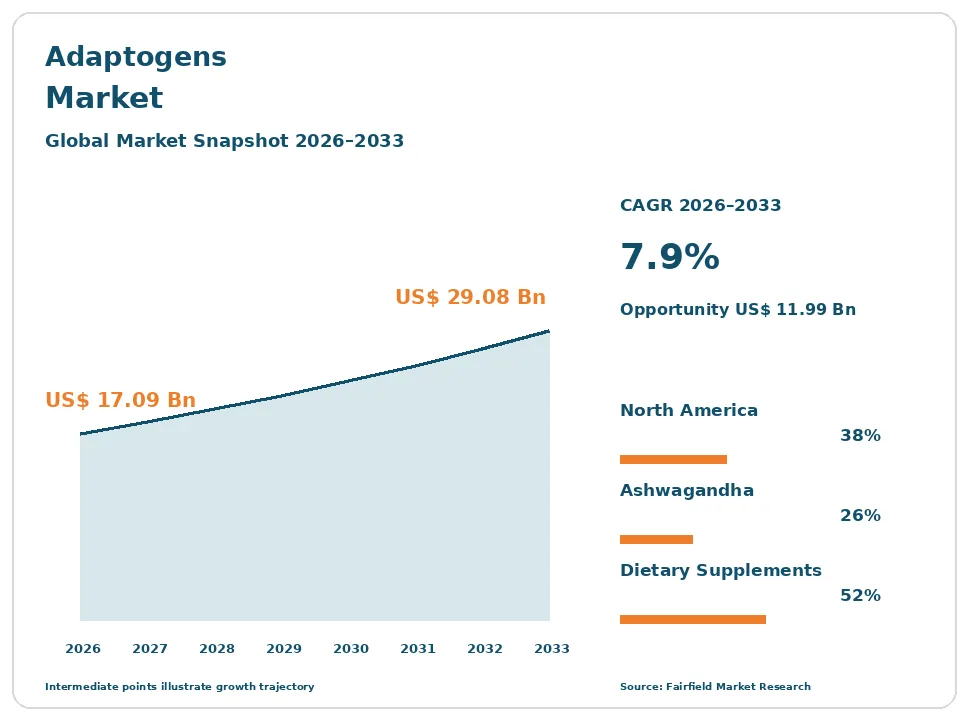
The global adaptogens market size is expected to be valued at US$ 17.09 billion in 2026 and projected to reach US$ 29.08 billion by 2033, growing at a CAGR of 7.9% between 2026 and 2033.
Between 2020 and 2025, the market grew at a CAGR of about 8.5%, as the pandemic raised interest in stress, sleep, and immune support, and consumers turned to herbal and natural wellness products. Adaptogens are herbs, roots, and mushrooms traditionally used to help the body cope with physical and mental stress, including ashwagandha, holy basil, ginseng, rhodiola, maca, schisandra, and functional mushrooms such as reishi, lion’s mane, cordyceps, and chaga. They come from traditional systems such as Ayurveda and traditional Chinese medicine and are now sold as herbal supplements, teas, powders, gummies, drinks, and skincare. Growth comes from rising stress and burnout, interest in natural health, clean-label trends, and social media wellness culture. The market is shifting toward adaptogenic drinks, gummies, and functional mushroom blends, along with clinically studied branded extracts. In May 2026, Nevis Brands launched OOMRA adaptogen and nootropic beverages with functional mushroom extracts.
Key Report Takeaways
- By Type: Ashwagandha held 26.0% share in 2026, while Mushroom-Based Adaptogens are projected to expand at a 10.1% CAGR through 2033, driven by lion’s mane, reishi, and cordyceps use in coffee, drinks, and focus and energy products.
- By Form: Capsules & Tablets held 37.0% share in 2026, while Gummies are projected to expand at a 10.4% CAGR through 2033, driven by convenient, tasty formats that attract younger consumers and first-time supplement users.
- By End Use: Dietary Supplements held 52.0% share in 2026, while Functional Food & Beverages are projected to expand at a 9.6% CAGR through 2033, driven by adaptogenic sparkling drinks, mocktails, coffees, and snack bars.
- By Region: North America held 38.0% share in 2026, while Asia Pacific is projected to expand at a 9.2% CAGR through 2033, driven by traditional herbal use, rising incomes, and booming wellness markets in India, China, and Japan.
Global Adaptogens Market Trends and Insights
Drivers Impact Analysis
| Driver | Impact on CAGR Forecast | Geographic Relevance | Impact Timeline |
| Rising stress and demand for natural wellness | High | Global | Long term (≥4 years) |
| Product innovation in drinks, gummies, and functional foods | High | North America, Europe, Asia Pacific | Medium term (2-4 years) |
Two drivers carry the strongest influence on adaptogens demand during the forecast period.
Natural Wellness Demand Is Driving the Adaptogens Market
Rising stress and demand for natural wellness are the strongest driver of the adaptogens market. Consumers want gentle, plant-based support.
The mechanism is a change in how people manage everyday health. Surveys in many countries show high levels of stress, anxiety, poor sleep, and burnout, especially among younger adults and working parents, and many people prefer natural options they see as gentle and holistic. Adaptogens are marketed for stress balance, energy, focus, sleep, and immune support, and some branded extracts such as KSM-66 and Sensoril ashwagandha have clinical studies behind them. Social media influencers, wellness podcasts, and celebrities have made ashwagandha and functional mushrooms widely known. Consumers also want to cut caffeine, alcohol, and sugar, and adaptogenic drinks offer alternatives. Pharmacies, supermarkets, and online stores now stock wide ranges of herbal supplements. These trends keep adaptogens among the fastest-growing natural product categories.
Product Innovation Is Expanding the Adaptogens Market
Product innovation in drinks, gummies, and functional foods is expanding the adaptogens market. Adaptogens are moving beyond capsules.
The cause is brand competition for new consumers. Companies are adding adaptogens to sparkling teas, non-alcoholic spritzes, mocktails, coffee blends, energy drinks, protein powders, chocolates, and snack bars. De Soi, Juni, Josie Beverages, and Melting Forest launched new adaptogenic drinks in 2026, and Barker Wellness brought mushroom gummies to Target stores. Gummies and drink powders make daily use easy and enjoyable. Skincare brands add adaptogens to creams and serums. Pet supplement makers are also testing adaptogens for calming and mobility products. Shorter product development cycles and online launches let small brands test ideas quickly and scale winners. Large consumer goods companies are entering through launches and acquisitions. These launches widen the customer base and keep the category fresh.
Restraints Impact Analysis
| Restraint | Impact on CAGR Forecast | Geographic Relevance | Impact Timeline |
| Limited clinical evidence and regulatory scrutiny of claims | High | North America, Europe | Long term (≥4 years) |
| Quality, adulteration, and safety concerns | Medium | Global | Medium term (2-4 years) |
Two restraints limit how quickly the adaptogens market grows.
Regulatory Scrutiny Slows the Adaptogens Market
Limited clinical evidence and regulatory scrutiny of claims slow the adaptogens market. Regulators restrict what brands can say.
The specific causes are mixed research and strict claim rules. While some adaptogens have small clinical trials, many products lack strong evidence, and results vary by extract, dose, and study design. The U.S. Food and Drug Administration prohibits supplement makers from claiming to treat diseases, and the Federal Trade Commission requires evidence for health claims. The European Union has strict rules on botanical health claims, and some countries limit certain herbs in food. Denmark and other countries have reviewed ashwagandha safety. Scientific skepticism in the media can reduce trust. Some doctors remain cautious about recommending adaptogens because of limited long-term safety data. These factors limit marketing claims and slow mainstream adoption.
Quality Concerns Restrict the Adaptogens Market
Quality, adulteration, and safety concerns restrict the adaptogens market. Not all products contain what labels say.
The underlying causes are complex supply chains and uneven testing. Herbs are grown and harvested in many countries, and some products are adulterated with cheaper plants, contain low levels of active compounds, or are contaminated with heavy metals or pesticides. Mushroom products may use mycelium grown on grain rather than fruiting bodies, which can affect quality. Some adaptogens may interact with medicines or are unsuitable for pregnant women. Independent tests by consumer groups have found wide differences between labels and actual content in some products. Supply shortages after demand spikes can tempt suppliers to cut corners. Brands must invest in third-party testing, supplier audits, and certifications such as USP and NSF to prove quality. These concerns reduce trust and increase testing costs across the industry.
Market Opportunities
Functional Beverages Open a Fast-Growth Revenue Pool
Adaptogenic drinks and functional beverages open a fast-growth revenue pool in the adaptogens market. Drinks attract mainstream shoppers who may never buy a supplement.
Beverage companies and ingredient suppliers can capture this opportunity. Non-alcoholic spirits, sparkling teas, functional sodas, mocktails, coffee alternatives, hot cocoa blends, and energy drinks with adaptogens appeal to consumers who want to cut alcohol, sugar, and caffeine while still enjoying a social drink or a daily ritual. Sober-curious trends among younger adults support strong demand, and bars and restaurants are adding adaptogenic mocktails to menus. Large beverage companies are watching small brands closely and may acquire successful ones. Ingredient suppliers that offer water-soluble, good-tasting extracts make formulation easier. Retailers give functional drinks more shelf space each year. Companies that combine good taste, attractive branding, and credible ingredient doses can win shelf space and loyal customers.
Clinically Studied Branded Extracts Create a Premium Revenue Pool
Clinically studied branded extracts create a premium revenue pool in the adaptogens market. Brands and consumers want proof behind products.
Ingredient makers can capture this opportunity. Standardized, patented extracts with published clinical studies, such as branded ashwagandha and rhodiola extracts, let supplement and beverage brands make stronger structure and function claims and stand out from generic powders. Certifications for organic, regenerative, and sustainable sourcing add value, and Organic India received regenerative organic certification for its ashwagandha in January 2025. Testing for purity and active compounds builds trust with retailers and consumers. Partnerships between ingredient makers and universities support new research on sleep, stress, sports recovery, and cognitive health. Companies that invest in research, quality control, and transparent sourcing can earn premium prices and long-term supply contracts with major brands.
Segment Analysis
By Type: Ashwagandha Leads While Mushroom-Based Adaptogens Grow Fastest
Ashwagandha held 26.0% share in 2026. Ashwagandha is the best-known adaptogen in North America and Europe, widely used for stress and sleep support, and it has the strongest base of clinical research among adaptogens. India grows most of the world’s supply, and branded extracts from Ixoreal Biomed and others are used by many supplement brands.
Mushroom-Based Adaptogens are the fastest-growing type, expanding at a 10.1% CAGR through 2033. Lion’s mane, reishi, cordyceps, chaga, and turkey tail are popular for focus, energy, and immune support and are easy to add to coffee, cocoa, and drinks. Brands such as Four Sigmatic and Om Mushroom Superfood helped make them mainstream. Ginseng, holy basil, rhodiola, and maca form other types. For the market, mushroom growth reflects beverage innovation.
By Form: Capsules & Tablets Lead While Gummies Grow Fastest
Capsules & Tablets held 37.0% share in 2026. Capsules and tablets offer precise doses, long shelf life, and familiar use for regular supplement buyers, and they are the main format in pharmacies and health stores.
Gummies are the fastest-growing form, expanding at a 10.4% CAGR through 2033. Gummies taste good, are easy to carry, feel like a treat, and appeal to younger consumers and first-time supplement users who dislike pills. Mass retailers now stock many adaptogen gummies, often placed near sleep and stress products, and sugar-free versions are gaining popularity. Powders, liquids, tinctures, and teas form other formats, with powders popular for mixing into drinks. For the market, gummy growth broadens the consumer base and lifts repeat purchases.
By End Use: Dietary Supplements Lead While Functional Food & Beverages Grow Fastest
Dietary Supplements held 52.0% share in 2026. Supplements are the traditional and largest use of adaptogens, sold through pharmacies, health food stores, practitioners, and online.
Functional Food & Beverages are the fastest-growing end use, expanding at a 9.6% CAGR through 2033. Adaptogenic drinks, coffees, teas, snack bars, chocolates, and protein powders bring adaptogens into daily food habits, often sold in supermarkets and cafes rather than supplement aisles. Brands use adaptogens to differentiate products in crowded beverage and snack categories. Cosmetics and personal care use adaptogens in skincare products marketed for stressed or tired skin, and pharmaceuticals use some herbs in traditional medicines, especially in India and China. For the market, food and beverage growth widens reach.
Geography Analysis
Which Region Is Leading the Adaptogens Market?
North America is leading the adaptogens market with a 38.0% share in 2026. The United States has a large dietary supplement industry, high consumer interest in stress, sleep, and focus products, and a strong culture of wellness trends spread through social media. Gaia Herbs, NOW Foods, Nature’s Way, Four Sigmatic, and Moon Juice are major brands, and new adaptogenic drink brands are launching in supermarkets and convenience stores. Canada has a regulated natural health products market. Key barriers include strict rules on health claims. One change shaping the region is the rapid rise of adaptogenic beverages.
Europe Advances the Adaptogens Market Through Natural Health Trends
Europe is a major adaptogens market. The United Kingdom, Germany, France, the Netherlands, and Sweden have strong demand for herbal supplements and natural wellness products, and traditional rhodiola use in Sweden and Finland adds awareness. The European Union has strict rules on health claims and novel foods, which shapes product launches. Organic and sustainably sourced products are popular, and pharmacies in Germany and France sell herbal products alongside medicines. Online sales are growing quickly. Key barriers include regulatory limits and safety reviews of some herbs. One opportunity is functional drinks and mocktails as alcohol consumption declines among young adults.
Which Region Is Growing Fastest in the Adaptogens Market?
Asia Pacific is growing fastest in the adaptogens market at a 9.2% CAGR through 2033. India is the home of Ayurveda and the main source of ashwagandha and holy basil, with brands such as Himalaya Wellness, Organic India, and Dabur. China and South Korea have long traditions of ginseng and medicinal mushrooms, and Japan has a large functional food market. Rising incomes, urban stress, and e-commerce platforms boost demand across the region. Key barriers include quality and adulteration concerns. One change shaping the region is the growing export of branded, clinically studied extracts to global brands.
Latin America Grows the Adaptogens Market Through Wellness Trends
Latin America is a growing adaptogens market. Brazil, Mexico, Chile, and Colombia have growing middle classes interested in natural health, and Peru is the main source of maca, a popular adaptogen root. Online stores and pharmacies are expanding supplement ranges, and fitness and wellness culture is spreading quickly among young urban consumers. International brands enter through e-commerce and local distributors, while local companies offer traditional herbs from the Andes and the Amazon. Key barriers include slow product registration rules and price sensitivity. One opportunity is the global promotion of local herbs such as maca and guayusa.
Middle East & Africa Develops the Adaptogens Market Through Health Awareness
Middle East & Africa is a developing adaptogens market. The United Arab Emirates and Saudi Arabia have rising wellness spending, fitness culture, and demand for premium imported supplements. South Africa has a growing natural products market and strong traditions of herbal medicine, with local plants such as rooibos used in wellness products. Pharmacies and online stores in the region are adding international adaptogen brands, and halal certification can matter for some buyers in the region. Key barriers include regulatory approvals, import rules, and limited awareness. One change shaping the region is the rapid growth of online wellness retail and gyms.
Competitive Landscape
The adaptogens market is fragmented. Himalaya Wellness, Gaia Herbs, Organic India, NOW Foods, and Nature’s Way are leading players, while Four Sigmatic, Ancient Nutrition, Herbalife, Glanbia Nutritionals, Ixoreal Biomed, PLT Health Solutions, and Moon Juice compete strongly. Hundreds of small brands and startups sell online and through specialty stores, cafes, and gyms.
Companies compete on ingredient quality and purity, clinical evidence, taste, format innovation, branding, certifications, price, and retail distribution. Ingredient suppliers compete mainly on standardized extracts, supply reliability, and research, while consumer brands compete on marketing and convenience. Social media marketing and influencer partnerships are important, and direct-to-consumer subscriptions build loyalty. Large food, beverage, and nutrition companies are entering through acquisitions of fast-growing small brands. Retail buyers favor brands with third-party testing, clear labeling, and proven sales, which raises the bar for new entrants seeking shelf space.
Strategic moves show how competition is changing. In January 2026, Josie Beverages launched adaptogen energy drinks. In April 2026, Barker Wellness launched mushroom adaptogen gummies at Target. In May 2026, Nevis Brands launched OOMRA beverages, and in August 2026, De Soi launched Social Spritz. These moves show competition shifting toward functional beverages, gummies, and mass retail distribution.
Three main themes shape vendor strategy today. First, companies are launching drinks, gummies, and other convenient formats. Second, they are investing in clinically studied branded extracts. Third, they are improving sourcing transparency and quality testing.
Adaptogens Market Industry Leaders
- Himalaya Wellness
- Gaia Herbs
- Organic India
- NOW Foods
- Nature’s Way
Recent Industry Developments
- August 2026: De Soi launched Social Spritz, a non-alcoholic sparkling beverage line in three flavors - expands adaptogenic drinks for sober-curious consumers.
- May 2026: Nevis Brands launched OOMRA adaptogen and nootropic beverages with functional mushroom extracts - adds mushroom-based adaptogens to functional drinks.
- April 2026: Barker Wellness launched mushroom adaptogen gummies nationwide at Target - brings herbal supplements in gummy form to mass retail.
- January 2026: Josie Beverages launched an adaptogen energy drink line in the United States combining caffeine with lion’s mane and cordyceps - widens adaptogen use in energy drinks.
Companies Covered in the Report
- Himalaya Wellness
- Gaia Herbs
- Organic India
- NOW Foods
- Nature’s Way
- Four Sigmatic
- Ancient Nutrition
- Herbalife
- Glanbia Nutritionals
- Ixoreal Biomed
- PLT Health Solutions
- Moon Juice
Adaptogens Market Report Scope
This report covers adaptogens, including ashwagandha, ginseng, holy basil, rhodiola, maca, mushroom-based adaptogens, and other herbs, in capsule and tablet, powder, gummy, liquid, and other forms, for dietary supplements, functional food and beverages, cosmetics and personal care, and pharmaceutical uses. The base year is 2025, and the forecast period runs from 2026 to 2033. All values are expressed in US$ Billion.
Type
- Ashwagandha
- Ginseng
- Holy Basil
- Rhodiola
- Mushroom-Based Adaptogens
- Others
Form
- Capsules & Tablets
- Powders
- Gummies
- Liquids & Others
End Use
- Dietary Supplements
- Functional Food & Beverages
- Cosmetics & Personal Care
- Pharmaceuticals
Regions
- North America
- Europe
- Asia Pacific
- Latin America
- Middle East & Africa
Key Questions Answered in the Report
How big is the adaptogens market in 2026?
The adaptogens market is valued at US$ 17.09 billion in 2026, led by dietary supplements and North America.
What is the adaptogens market forecast to 2033?
The market is projected to reach US$ 29.08 billion by 2033, growing at a 7.9% CAGR and adding US$ 11.99 billion.
Which form is growing fastest in the adaptogens market?
Gummies are growing fastest at a 10.4% CAGR through 2033, driven by convenient, tasty formats that attract younger consumers.
Which region is growing fastest in the adaptogens market?
Asia Pacific is growing fastest at a 9.2% CAGR through 2033, driven by traditional herbal use and rising wellness spending in India.
Which region holds the largest adaptogens market share?
North America holds the largest share at 38.0% in 2026, supported by strong supplement use and innovative functional beverages.
1. Executive Summary
1.1. Global Adaptogens Market Snapshot
1.2. Future Projections, 2026-2033
1.3. Key Market Trends
1.4. Regional Snapshot
2. Market Overview
2.1. Market Definition and Report Scope
2.2. Historical Market Trends, 2020-2025
2.3. Market Dynamics
2.3.1. Drivers Impact Analysis
2.3.1.1. Natural Wellness Demand Is Driving the Adaptogens Market
2.3.1.2. Product Innovation Is Expanding the Adaptogens Market
2.3.2. Restraints Impact Analysis
2.3.2.1. Regulatory Scrutiny Slows the Adaptogens Market
2.3.2.2. Quality Concerns Restrict the Adaptogens Market
2.3.3. Market Opportunities
2.3.3.1. Functional Beverages Open a Fast-Growth Revenue Pool
2.3.3.2. Clinically Studied Branded Extracts Create a Premium Revenue Pool
3. Global Adaptogens Market Outlook, 2020-2033
3.1. Global Adaptogens Market Outlook, by Type, Value (US$ Billion), 2020-2033
3.1.1. Ashwagandha
3.1.2. Ginseng
3.1.3. Holy Basil
3.1.4. Rhodiola
3.1.5. Mushroom-Based Adaptogens
3.1.6. Others
3.2. Global Adaptogens Market Outlook, by Form, Value (US$ Billion), 2020-2033
3.2.1. Capsules & Tablets
3.2.2. Powders
3.2.3. Gummies
3.2.4. Liquids & Others
3.3. Global Adaptogens Market Outlook, by End Use, Value (US$ Billion), 2020-2033
3.3.1. Dietary Supplements
3.3.2. Functional Food & Beverages
3.3.3. Cosmetics & Personal Care
3.3.4. Pharmaceuticals
3.4. Global Adaptogens Market Outlook, by Region, Value (US$ Billion), 2020-2033
3.4.1. North America
3.4.2. Europe
3.4.3. Asia Pacific
3.4.4. Latin America
3.4.5. Middle East & Africa
4. North America Adaptogens Market Outlook, 2020-2033
4.1. North America Adaptogens Market Outlook, by Type, Value (US$ Billion), 2020-2033
4.1.1. Ashwagandha
4.1.2. Ginseng
4.1.3. Holy Basil
4.1.4. Rhodiola
4.1.5. Mushroom-Based Adaptogens
4.1.6. Others
4.2. North America Adaptogens Market Outlook, by Form, Value (US$ Billion), 2020-2033
4.2.1. Capsules & Tablets
4.2.2. Powders
4.2.3. Gummies
4.2.4. Liquids & Others
4.3. North America Adaptogens Market Outlook, by End Use, Value (US$ Billion), 2020-2033
4.3.1. Dietary Supplements
4.3.2. Functional Food & Beverages
4.3.3. Cosmetics & Personal Care
4.3.4. Pharmaceuticals
4.4. North America Adaptogens Market Outlook, by Country, Value (US$ Billion), 2020-2033
4.4.1. United States Adaptogens Market Outlook, by Type, 2020-2033
4.4.2. United States Adaptogens Market Outlook, by Form, 2020-2033
4.4.3. United States Adaptogens Market Outlook, by End Use, 2020-2033
4.4.4. Canada Adaptogens Market Outlook, by Type, 2020-2033
4.4.5. Canada Adaptogens Market Outlook, by Form, 2020-2033
4.4.6. Canada Adaptogens Market Outlook, by End Use, 2020-2033
5. Europe Adaptogens Market Outlook, 2020-2033
5.1. Europe Adaptogens Market Outlook, by Type, Value (US$ Billion), 2020-2033
5.1.1. Ashwagandha
5.1.2. Ginseng
5.1.3. Holy Basil
5.1.4. Rhodiola
5.1.5. Mushroom-Based Adaptogens
5.1.6. Others
5.2. Europe Adaptogens Market Outlook, by Form, Value (US$ Billion), 2020-2033
5.2.1. Capsules & Tablets
5.2.2. Powders
5.2.3. Gummies
5.2.4. Liquids & Others
5.3. Europe Adaptogens Market Outlook, by End Use, Value (US$ Billion), 2020-2033
5.3.1. Dietary Supplements
5.3.2. Functional Food & Beverages
5.3.3. Cosmetics & Personal Care
5.3.4. Pharmaceuticals
5.4. Europe Adaptogens Market Outlook, by Country, Value (US$ Billion), 2020-2033
5.4.1. United Kingdom Adaptogens Market Outlook, by Type, 2020-2033
5.4.2. United Kingdom Adaptogens Market Outlook, by Form, 2020-2033
5.4.3. United Kingdom Adaptogens Market Outlook, by End Use, 2020-2033
5.4.4. Germany Adaptogens Market Outlook, by Type, 2020-2033
5.4.5. Germany Adaptogens Market Outlook, by Form, 2020-2033
5.4.6. Germany Adaptogens Market Outlook, by End Use, 2020-2033
5.4.7. France Adaptogens Market Outlook, by Type, 2020-2033
5.4.8. France Adaptogens Market Outlook, by Form, 2020-2033
5.4.9. France Adaptogens Market Outlook, by End Use, 2020-2033
5.4.10. Netherlands Adaptogens Market Outlook, by Type, 2020-2033
5.4.11. Netherlands Adaptogens Market Outlook, by Form, 2020-2033
5.4.12. Netherlands Adaptogens Market Outlook, by End Use, 2020-2033
5.4.13. Sweden Adaptogens Market Outlook, by Type, 2020-2033
5.4.14. Sweden Adaptogens Market Outlook, by Form, 2020-2033
5.4.15. Sweden Adaptogens Market Outlook, by End Use, 2020-2033
5.4.16. Finland Adaptogens Market Outlook, by Type, 2020-2033
5.4.17. Finland Adaptogens Market Outlook, by Form, 2020-2033
5.4.18. Finland Adaptogens Market Outlook, by End Use, 2020-2033
6. Asia Pacific Adaptogens Market Outlook, 2020-2033
6.1. Asia Pacific Adaptogens Market Outlook, by Type, Value (US$ Billion), 2020-2033
6.1.1. Ashwagandha
6.1.2. Ginseng
6.1.3. Holy Basil
6.1.4. Rhodiola
6.1.5. Mushroom-Based Adaptogens
6.1.6. Others
6.2. Asia Pacific Adaptogens Market Outlook, by Form, Value (US$ Billion), 2020-2033
6.2.1. Capsules & Tablets
6.2.2. Powders
6.2.3. Gummies
6.2.4. Liquids & Others
6.3. Asia Pacific Adaptogens Market Outlook, by End Use, Value (US$ Billion), 2020-2033
6.3.1. Dietary Supplements
6.3.2. Functional Food & Beverages
6.3.3. Cosmetics & Personal Care
6.3.4. Pharmaceuticals
6.4. Asia Pacific Adaptogens Market Outlook, by Country, Value (US$ Billion), 2020-2033
6.4.1. India Adaptogens Market Outlook, by Type, 2020-2033
6.4.2. India Adaptogens Market Outlook, by Form, 2020-2033
6.4.3. India Adaptogens Market Outlook, by End Use, 2020-2033
6.4.4. China Adaptogens Market Outlook, by Type, 2020-2033
6.4.5. China Adaptogens Market Outlook, by Form, 2020-2033
6.4.6. China Adaptogens Market Outlook, by End Use, 2020-2033
6.4.7. South Korea Adaptogens Market Outlook, by Type, 2020-2033
6.4.8. South Korea Adaptogens Market Outlook, by Form, 2020-2033
6.4.9. South Korea Adaptogens Market Outlook, by End Use, 2020-2033
6.4.10. Japan Adaptogens Market Outlook, by Type, 2020-2033
6.4.11. Japan Adaptogens Market Outlook, by Form, 2020-2033
6.4.12. Japan Adaptogens Market Outlook, by End Use, 2020-2033
7. Latin America Adaptogens Market Outlook, 2020-2033
7.1. Latin America Adaptogens Market Outlook, by Type, Value (US$ Billion), 2020-2033
7.1.1. Ashwagandha
7.1.2. Ginseng
7.1.3. Holy Basil
7.1.4. Rhodiola
7.1.5. Mushroom-Based Adaptogens
7.1.6. Others
7.2. Latin America Adaptogens Market Outlook, by Form, Value (US$ Billion), 2020-2033
7.2.1. Capsules & Tablets
7.2.2. Powders
7.2.3. Gummies
7.2.4. Liquids & Others
7.3. Latin America Adaptogens Market Outlook, by End Use, Value (US$ Billion), 2020-2033
7.3.1. Dietary Supplements
7.3.2. Functional Food & Beverages
7.3.3. Cosmetics & Personal Care
7.3.4. Pharmaceuticals
7.4. Latin America Adaptogens Market Outlook, by Country, Value (US$ Billion), 2020-2033
7.4.1. Brazil Adaptogens Market Outlook, by Type, 2020-2033
7.4.2. Brazil Adaptogens Market Outlook, by Form, 2020-2033
7.4.3. Brazil Adaptogens Market Outlook, by End Use, 2020-2033
7.4.4. Mexico Adaptogens Market Outlook, by Type, 2020-2033
7.4.5. Mexico Adaptogens Market Outlook, by Form, 2020-2033
7.4.6. Mexico Adaptogens Market Outlook, by End Use, 2020-2033
7.4.7. Chile Adaptogens Market Outlook, by Type, 2020-2033
7.4.8. Chile Adaptogens Market Outlook, by Form, 2020-2033
7.4.9. Chile Adaptogens Market Outlook, by End Use, 2020-2033
7.4.10. Colombia Adaptogens Market Outlook, by Type, 2020-2033
7.4.11. Colombia Adaptogens Market Outlook, by Form, 2020-2033
7.4.12. Colombia Adaptogens Market Outlook, by End Use, 2020-2033
7.4.13. Peru Adaptogens Market Outlook, by Type, 2020-2033
7.4.14. Peru Adaptogens Market Outlook, by Form, 2020-2033
7.4.15. Peru Adaptogens Market Outlook, by End Use, 2020-2033
8. Middle East & Africa Adaptogens Market Outlook, 2020-2033
8.1. Middle East & Africa Adaptogens Market Outlook, by Type, Value (US$ Billion), 2020-2033
8.1.1. Ashwagandha
8.1.2. Ginseng
8.1.3. Holy Basil
8.1.4. Rhodiola
8.1.5. Mushroom-Based Adaptogens
8.1.6. Others
8.2. Middle East & Africa Adaptogens Market Outlook, by Form, Value (US$ Billion), 2020-2033
8.2.1. Capsules & Tablets
8.2.2. Powders
8.2.3. Gummies
8.2.4. Liquids & Others
8.3. Middle East & Africa Adaptogens Market Outlook, by End Use, Value (US$ Billion), 2020-2033
8.3.1. Dietary Supplements
8.3.2. Functional Food & Beverages
8.3.3. Cosmetics & Personal Care
8.3.4. Pharmaceuticals
8.4. Middle East & Africa Adaptogens Market Outlook, by Country, Value (US$ Billion), 2020-2033
8.4.1. United Arab Emirates Adaptogens Market Outlook, by Type, 2020-2033
8.4.2. United Arab Emirates Adaptogens Market Outlook, by Form, 2020-2033
8.4.3. United Arab Emirates Adaptogens Market Outlook, by End Use, 2020-2033
8.4.4. Saudi Arabia Adaptogens Market Outlook, by Type, 2020-2033
8.4.5. Saudi Arabia Adaptogens Market Outlook, by Form, 2020-2033
8.4.6. Saudi Arabia Adaptogens Market Outlook, by End Use, 2020-2033
8.4.7. South Africa Adaptogens Market Outlook, by Type, 2020-2033
8.4.8. South Africa Adaptogens Market Outlook, by Form, 2020-2033
8.4.9. South Africa Adaptogens Market Outlook, by End Use, 2020-2033
9. Competitive Landscape
9.1. Market Concentration and Industry Leaders
9.2. Competitive Differentiation
9.3. Strategic Initiatives
9.4. Recent Industry Developments
9.5. Company Profiles
9.5.1. Himalaya Wellness
9.5.2. Gaia Herbs
9.5.3. Organic India
9.5.4. NOW Foods
9.5.5. Nature's Way
9.5.6. Four Sigmatic
9.5.7. Ancient Nutrition
9.5.8. Herbalife
9.5.9. Glanbia Nutritionals
9.5.10. Ixoreal Biomed
9.5.11. PLT Health Solutions
9.5.12. Moon Juice
10. Appendix
10.1. Research Methodology
10.2. Report Assumptions
10.3. Acronyms and Abbreviations
| Type | Ashwagandha, Ginseng, Holy Basil, Rhodiola, Mushroom-Based Adaptogens, Others |
| Form | Capsules & Tablets, Powders, Gummies, Liquids & Others |
| End Use | Dietary Supplements, Functional Food & Beverages, Cosmetics & Personal Care, Pharmaceuticals |
| Regions | North America, Europe, Asia Pacific, Latin America, Middle East & Africa |
Our Research Methodology
Considering the volatility of business today, traditional approaches to strategizing a game plan can be unfruitful if not detrimental. True ambiguity is no way to determine a forecast. A myriad of predetermined factors must be accounted for such as the degree of risk involved, the magnitude of circumstances, as well as conditions or consequences that are not known or unpredictable. To circumvent binary views that cast uncertainty, the application of market research intelligence to strategically posture, move, and enable actionable outcomes is necessary.
View Methodology
Quality Assured
Rigorous Validation Process

Confidentiality Assured
End-to-end Data Security

Custom Research Services
Tailored To Your Objectives
FAQs
The adaptogens market is valued at US$ 17.09 billion in 2026, led by dietary supplements and North America.
The market is projected to reach US$ 29.08 billion by 2033, growing at a 7.9% CAGR and adding US$ 11.99 billion.
Gummies are growing fastest at a 10.4% CAGR through 2033, driven by convenient, tasty formats that attract younger consumers.
Asia Pacific is growing fastest at a 9.2% CAGR through 2033, driven by traditional herbal use and rising wellness spending in India.
North America holds the largest share at 38.0% in 2026, supported by strong supplement use and innovative functional beverages.
Related Reports
Kombucha Market Size, Share, Insights, Competitive Landscape, and Forecast 2026 to 2033
The Kombucha Market is projected to grow from US$ 3.2 billion in 2026 to US$ 4.8 billion by 2033 at a 6.0% CAGR. Explore trends and leading segments.
Insect Protein Market Size, Share, Insights, Competitive Landscape, and Forecast 2026 to 2033
Insect Protein Market is projected to grow from US$ 1.03 billion in 2026 to US$ 3.17 billion by 2033 at a 17.4% CAGR. Explore trends and key segments.
Functional Mushroom Market Size, Share, Insights, Competitive Landscape, and Forecast 2026 to 2033
Explore the Functional Mushroom Market, projected to grow from US$ 2.6 billion in 2026 to US$ 4.4 billion by 2033 at a 7.8% CAGR. See trends and segments.
Food Preservatives Market Size, Share, Insights, Competitive Landscape, and Forecast 2026 to 2033
The food preservatives market is valued at US$ 3.67 billion in 2026 and projected to reach US$ 4.97 billion by 2033 at a CAGR of 4.4%.
Beeswax Market Size, Share, Insights, Competitive Landscape, and Forecast 2026 to 2033
The beeswax market is valued at US$ 0.7 billion in 2026 and projected to reach US$ 1.0 billion by 2033 at a CAGR of 5.2%.
Spearmint Oil Market Size, Share, Insights, Competitive Landscape, and Forecast 2026 to 2033
The global spearmint oil market is valued at US$0.4 billion in 2026, reaching US$0.6 billion by 2033, growing at a 6.0% CAGR