



Sports Nutrition Market
Sports Nutrition Market Insights, Competitive Landscape, and Market Forecast - 2033
Global Sports Nutrition Market Forecast
-
The Sports Nutrition Market is valued at USD 29.6 Bn in 2026 and is projected to reach USD 48.6 Bn, growing at a CAGR of 7% by 2033.
- The global sports nutrition market is rapidly evolving beyond traditional demographics, driven by rising wellness consciousness, clean-label preferences, and demand for functional convenience.
Sports Nutrition Market Insights
- Sports nutrition is expanding beyond elite athletes to include casual gym-goers and wellness-focused consumers.
- Convenient, nutrient-dense shakes are replacing traditional meals among busy professionals and fitness enthusiasts.
- Online retailers are driving sports nutrition purchases, offering convenience, personalization, and subscription-based loyalty models.
- Creative flavor options such as dessert-inspired proteins are helping brands capture a wider and more diverse consumer base.
- Brands using eco-friendly packaging and responsibly sourced ingredients are aligning with conscious consumers.
- Protein bars, cookies, and chips are replacing pills and powders for on-the-go functionality.
A Look Back and a Look Forward - Comparative Analysis
The global sports nutrition market has witnessed significant growth over the past decade, driven by the increasing health consciousness among consumers and the rising demand for performance-enhancing products. Historically, the market was primarily focused on athletes and bodybuilders, but in recent years, it has expanded to include fitness enthusiasts and individuals seeking healthier lifestyles. Innovations in product formulations, such as plant-based proteins, pre-workout drinks, and meal replacements, have further fueled market expansion. Additionally, the integration of clean-label and sustainable ingredients into sports nutrition products has resonated with health-conscious consumers.
Looking ahead, the market is expected to continue its upward trajectory, with a forecasted shift toward personalized nutrition, catering to specific health and fitness goals. Advances in technology and data analytics will play a significant role in this evolution, allowing tailored products based on individual needs and preferences. Moreover, the rise of omnichannel sales strategies and increased demand for e-commerce platforms will provide greater accessibility to a global audience. As consumers prioritize convenience, health, and sustainability, the market is poised for continuous growth, with both established and emerging brands capitalizing on these trends.
Key Growth Determinants
- A surge in interest towards physical wellness is spurring the growth of sports nutrition demand.
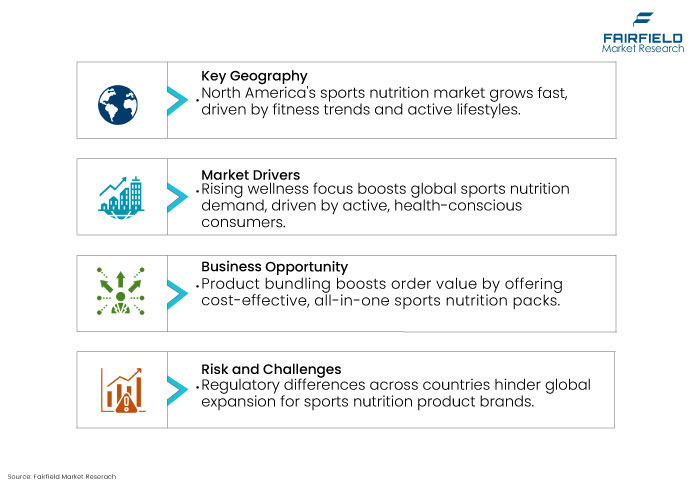
A surge in interest toward physical wellness is significantly driving the growth of the global sports nutrition market. As consumers increasingly prioritize health and fitness, they seek products that support their active lifestyles. According to the Centers for Disease Control and Prevention (CDC), in 2020, 24.2% of U.S. adults aged 18 and over met the 2018 Physical Activity Guidelines for both aerobic and muscle-strengthening activities. This growing engagement in physical activity correlates with a heightened demand for sports nutrition products that aid in performance enhancement, recovery, and overall health maintenance. The market is witnessing an influx of innovative offerings, including plant-based proteins, functional beverages, and clean-label supplements, catering to the evolving preferences of health-conscious consumers. This trend underscores a shift from traditional sports nutrition users to a broader demographic seeking to optimize their physical well-being, thereby expanding the market's reach and fostering its sustained growth.
Key Growth Barriers
- Varying regulations across countries
Varying regulations across countries pose a significant challenge for the global sports nutrition market, particularly when it comes to product formulations, ingredient approvals, and marketing strategies. Products that are compliant in one region may face delays or rejections in others due to differing regulatory standards. For instance, in 2020, the European Food Safety Authority (EFSA) rejected several claims made by sports nutrition brands about the benefits of certain ingredients such as creatine and caffeine, leading to regulatory setbacks for companies seeking to market these products in the EU. These inconsistencies across markets complicate international expansion for sports nutrition brands.
Sports Nutrition Market Trends and Opportunities
- Bundles encourage consumers to purchase more items, boosting the average order value for brands
Bundling complementary sports nutrition products presents a significant opportunity for brands to increase the average order value by encouraging consumers to purchase multiple items in one go. This strategy offers added value, as customers perceive bundles as cost-effective, especially when compared to purchasing individual products. For example, Myprotein has successfully leveraged product bundling by offering various packages that combine protein powders, vitamins, and snacks, catering to the diverse needs of fitness enthusiasts. Such bundles not only streamline the buying process but also increase the overall cart size, benefiting both consumers and brands. Moreover, bundling helps to introduce customers to a wider product range, enhancing their overall experience and driving customer loyalty.
- Convenience-driven consumers are gravitating towards ready-to-consume sports drinks and shakes
Convenience-driven consumers are increasingly gravitating toward ready-to-consume (RTC) sports drinks and shakes, which provide an easy and quick solution to meet their nutritional needs. With busy lifestyles, many individuals prefer products that require minimal preparation and can be consumed on the go, particularly after workouts or throughout the day. RTC beverages, such as protein shakes, energy drinks, and electrolyte solutions, cater to this demand by offering portability and immediate convenience. Brands are responding by developing single-serve packaging, making them ideal for consumers looking to optimize their nutrition without time-consuming preparation. The growing appeal of RTC products aligns with the broader trend towards on-the-go health and wellness, fueling their continued growth in the global sports nutrition market. This shift highlights the importance of meeting consumer demands for efficiency and convenience while delivering quality and performance.
Leading Segment Overview
- Pre-Workout Leads on Energy and Performance Appeal
Pre-workout is expected to hold approximately 36% share of the Sports Nutrition market in 2025 due to their strong association with immediate performance benefits such as enhanced energy, endurance, and mental focus. These supplements are specifically formulated to prime the body before intense physical activity, making them highly appealing to athletes and fitness enthusiasts aiming to maximize workout efficiency. The inclusion of ingredients like caffeine, beta-alanine, and nitric oxide boosters caters to users seeking instant physiological effects, thus driving repeat purchases. Additionally, the growing culture of high-intensity training, CrossFit, and performance-based fitness routines has further fueled the demand for pre-workout supplements.
- High Protein Intake Synonymous with Fitness Goals
Proteins are expected to account for approximately 60% of the Sports Nutrition market in 2025, driven by their foundational role in muscle recovery, strength development, and body composition management. For both professional athletes and fitness-conscious consumers, protein is no longer a supplement, it's a daily nutritional cornerstone. It supports tissue repair post-exercise, enhances muscle synthesis, and contributes to satiety, aiding weight management efforts. As awareness of these benefits grows, especially through fitness influencers and wellness platforms, consumers increasingly prioritize high-protein diets to align with their performance or physique objectives. The popularity of high-protein meal plans like keto and paleo further cements protein’s status in fitness culture. This demand has spurred innovation in protein-enriched products, from shakes to snacks, meeting both convenience and performance expectations in today’s fast-paced lifestyles.
Regional Analysis
- North America region dominates the Sports Nutrition Market
The North American sports nutrition market is currently experiencing robust growth, fueled by a confluence of factors. The U.S., with its large population of sports enthusiasts and a significant rise in health-conscious consumers, represents a major market. This is further amplified by the increasing craze for bodybuilding and fitness activities across the region. Notably, a survey by Fairfield Market Research indicated that a substantial 68% of Canadians reported exercising at least once or twice a week, highlighting a strong inclination towards physical activity and thus, a potential consumer base for sports nutrition products.
The market is also characterized by strong emphasis on research and development, leading to continuous flavor innovation and product diversification. Regulatory backing ensures quality and consumer trust, further bolstering market growth. This dynamic landscape, driven by both serious athletes and everyday individuals seeking healthier lifestyles, positions North America as a key region in the global sports nutrition market.
- Consumer Demand and Innovation Shape the European Sports Nutrition Landscape
The European sports nutrition market is witnessing substantial growth, fueled by increasing health awareness and a shift toward fitness-oriented lifestyles. This trend now extends beyond athletes to recreational users and lifestyle consumers seeking to improve their overall well-being. Aggressive marketing strategies, including athlete endorsements and event sponsorships, boost the visibility and appeal of sports nutrition products, particularly in key markets like the UK, Germany, Spain, and France, which together account for over 75% of the market share. Consumer demand for clean label products, prioritizing natural and organic ingredients, is driving innovation and sustainable sourcing. A strong distribution network, spanning supermarkets, specialty stores, and online retail platforms, ensures broad accessibility, supporting the market's continued growth and evolution.
Competitive Landscape
The competitive landscape of the global sports nutrition market is highly dynamic, characterized by the presence of both established and emerging players. Key industry giants dominate the market with diverse product portfolios, robust distribution networks, and strong brand recognition. However, new entrants are making their mark by offering innovative, niche products, such as plant-based or clean-label sports nutrition options, which cater to evolving consumer preferences for healthier and more sustainable alternatives. Competition is further intensified by aggressive marketing strategies, strategic partnerships, sponsorships, and athlete endorsements. Additionally, advancements in research and development are enabling companies to introduce novel products tailored to specific consumer needs, such as energy, recovery, and muscle-building formulations.
- In May 2025, Müller Yogurt & Desserts and Myprotein extended their partnership by launching a ready-to-drink (RTD) protein shake and a pair of high-protein yogurts, catering to the growing demand for convenient and protein-enriched nutritional products.
- In April 2025, The Quality Group acquired a majority stake in Raw Nutrition, a prominent US-based sports nutrition company, expanding its footprint in the competitive sports nutrition market and diversifying its product portfolio.
- In February 2025, Nutrabolt's C4® Energy was named the official energy drink of the New York Knicks, enhancing its brand visibility and further solidifying its position in the energy drink segment of the sports nutrition market.
Key Companies
- Glanbia PLC
- Herbalife International, Inc.
- GNC Holdings, LLC
- Nestlé S.A.
- Mondelēz International
- THG Nutrition Limited
- Nutrabolt
- Amway
- The Quality Group
- BioTechUSA Group
- QNT
- Sponser Sport Food AG.
- Peak Performance Products S.A.
- Others
Expert Opinion
- Companies are investing in R&D to develop function-specific and science-backed products, which is key to standing out in a crowded market.
- Startups are successfully carving out space by focusing on plant-based, clean-label, and sustainably sourced sports nutrition products.
- Collaborations with athletes, fitness influencers, and retailers are expanding product visibility and consumer trust.
The Global Sports Nutrition Market is Segmented as
By Function
- Energy Boost
- Weight Management
- Rehydration
- Recovery
- Pre-workout
By Form
- Powder
- Liquid
- Bar
- Tablets/Capsules
By Flavor
- Natural
- Artificial
By Micronutrients
- Proteins
- Minerals
- Vitamins
- Trace Elements
- Others
By Sales Channel
- Hypermarket/Supermarket
- Convenience Store
- Specialty Store
- Pharmacy Store
- Online Retail
- Others
By Region
- North America
- Europe
- Asia Pacific
- Latin America
- The Middle East & Africa
- Executive Summary
- Global Sports Nutrition Market Snapshot
- Future Projections
- Key Market Trends
- Regional Snapshot, by Value, 2026
- Analyst Recommendations
- Market Overview
- Market Definitions and Segmentations
- Market Dynamics
- Drivers
- Restraints
- Market Opportunities
- Value Chain Analysis
- COVID-19 Impact Analysis
- Porter's Five Forces Analysis
- Impact of Russia-Ukraine Conflict
- PESTLE Analysis
- Regulatory Analysis
- Price Trend Analysis
- Current Prices and Future Projections, 2025-2033
- Price Impact Factors
- Global Sports Nutrition Market Outlook, 2020 - 2033
- Global Sports Nutrition Market Outlook, by Function, Value (US$ Mn), 2020-2033
- Energy Boost
- Weight Management
- Rehydration
- Recovery
- Pre-workout
- Global Sports Nutrition Market Outlook, by Form, Value (US$ Mn), 2020-2033
- Powder
- Liquid
- Bar
- Tablets/Capsules
- Global Sports Nutrition Market Outlook, by Flavor, Value (US$ Mn), 2020-2033
- Natural
- Artificial
- Global Sports Nutrition Market Outlook, by Micronutrients, Value (US$ Mn), 2020-2033
- Proteins
- Minerals
- Vitamins
- Trace Elements
- Others
- Global Sports Nutrition Market Outlook, by Sales Channel, Value (US$ Mn), 2020-2033
- Hypermarket/Supermarket
- Convenience Store
- Specialty Store
- Pharmacy Store
- Online Retail
- Others
- Global Sports Nutrition Market Outlook, by Region, Value (US$ Mn), 2020-2033
- North America
- Europe
- Asia Pacific
- Latin America
- Middle East & Africa
- Global Sports Nutrition Market Outlook, by Function, Value (US$ Mn), 2020-2033
- North America Sports Nutrition Market Outlook, 2020 - 2033
- North America Sports Nutrition Market Outlook, by Function, Value (US$ Mn), 2020-2033
- Energy Boost
- Weight Management
- Rehydration
- Recovery
- Pre-workout
- North America Sports Nutrition Market Outlook, by Form, Value (US$ Mn), 2020-2033
- Powder
- Liquid
- Bar
- Tablets/Capsules
- North America Sports Nutrition Market Outlook, by Flavor, Value (US$ Mn), 2020-2033
- Natural
- Artificial
- North America Sports Nutrition Market Outlook, by Micronutrients, Value (US$ Mn), 2020-2033
- Proteins
- Minerals
- Vitamins
- Trace Elements
- Others
- North America Sports Nutrition Market Outlook, by Sales Channel, Value (US$ Mn), 2020-2033
- Hypermarket/Supermarket
- Convenience Store
- Specialty Store
- Pharmacy Store
- Online Retail
- Others
- North America Sports Nutrition Market Outlook, by Country, Value (US$ Mn), 2020-2033
- U.S. Sports Nutrition Market Outlook, by Function, 2020-2033
- U.S. Sports Nutrition Market Outlook, by Form, 2020-2033
- U.S. Sports Nutrition Market Outlook, by Flavor, 2020-2033
- U.S. Sports Nutrition Market Outlook, by Micronutrients, 2020-2033
- U.S. Sports Nutrition Market Outlook, by Sales Channel, 2020-2033
- Canada Sports Nutrition Market Outlook, by Function, 2020-2033
- Canada Sports Nutrition Market Outlook, by Form, 2020-2033
- Canada Sports Nutrition Market Outlook, by Flavor, 2020-2033
- Canada Sports Nutrition Market Outlook, by Micronutrients, 2020-2033
- Canada Sports Nutrition Market Outlook, by Sales Channel, 2020-2033
- BPS Analysis/Market Attractiveness Analysis
- North America Sports Nutrition Market Outlook, by Function, Value (US$ Mn), 2020-2033
- Europe Sports Nutrition Market Outlook, 2020 - 2033
- Europe Sports Nutrition Market Outlook, by Function, Value (US$ Mn), 2020-2033
- Energy Boost
- Weight Management
- Rehydration
- Recovery
- Pre-workout
- Europe Sports Nutrition Market Outlook, by Form, Value (US$ Mn), 2020-2033
- Powder
- Liquid
- Bar
- Tablets/Capsules
- Europe Sports Nutrition Market Outlook, by Flavor, Value (US$ Mn), 2020-2033
- Natural
- Artificial
- Europe Sports Nutrition Market Outlook, by Micronutrients, Value (US$ Mn), 2020-2033
- Proteins
- Minerals
- Vitamins
- Trace Elements
- Others
- Europe Sports Nutrition Market Outlook, by Sales Channel, Value (US$ Mn), 2020-2033
- Hypermarket/Supermarket
- Convenience Store
- Specialty Store
- Pharmacy Store
- Online Retail
- Others
- Europe Sports Nutrition Market Outlook, by Country, Value (US$ Mn), 2020-2033
- Germany Sports Nutrition Market Outlook, by Function, 2020-2033
- Germany Sports Nutrition Market Outlook, by Form, 2020-2033
- Germany Sports Nutrition Market Outlook, by Flavor, 2020-2033
- Germany Sports Nutrition Market Outlook, by Micronutrients, 2020-2033
- Germany Sports Nutrition Market Outlook, by Sales Channel, 2020-2033
- Italy Sports Nutrition Market Outlook, by Function, 2020-2033
- Italy Sports Nutrition Market Outlook, by Form, 2020-2033
- Italy Sports Nutrition Market Outlook, by Flavor, 2020-2033
- Italy Sports Nutrition Market Outlook, by Micronutrients, 2020-2033
- Italy Sports Nutrition Market Outlook, by Sales Channel, 2020-2033
- France Sports Nutrition Market Outlook, by Function, 2020-2033
- France Sports Nutrition Market Outlook, by Form, 2020-2033
- France Sports Nutrition Market Outlook, by Flavor, 2020-2033
- France Sports Nutrition Market Outlook, by Micronutrients, 2020-2033
- France Sports Nutrition Market Outlook, by Sales Channel, 2020-2033
- U.K. Sports Nutrition Market Outlook, by Function, 2020-2033
- U.K. Sports Nutrition Market Outlook, by Form, 2020-2033
- U.K. Sports Nutrition Market Outlook, by Flavor, 2020-2033
- U.K. Sports Nutrition Market Outlook, by Micronutrients, 2020-2033
- U.K. Sports Nutrition Market Outlook, by Sales Channel, 2020-2033
- Spain Sports Nutrition Market Outlook, by Function, 2020-2033
- Spain Sports Nutrition Market Outlook, by Form, 2020-2033
- Spain Sports Nutrition Market Outlook, by Flavor, 2020-2033
- Spain Sports Nutrition Market Outlook, by Micronutrients, 2020-2033
- Spain Sports Nutrition Market Outlook, by Sales Channel, 2020-2033
- Russia Sports Nutrition Market Outlook, by Function, 2020-2033
- Russia Sports Nutrition Market Outlook, by Form, 2020-2033
- Russia Sports Nutrition Market Outlook, by Flavor, 2020-2033
- Russia Sports Nutrition Market Outlook, by Micronutrients, 2020-2033
- Russia Sports Nutrition Market Outlook, by Sales Channel, 2020-2033
- Rest of Europe Sports Nutrition Market Outlook, by Function, 2020-2033
- Rest of Europe Sports Nutrition Market Outlook, by Form, 2020-2033
- Rest of Europe Sports Nutrition Market Outlook, by Flavor, 2020-2033
- Rest of Europe Sports Nutrition Market Outlook, by Micronutrients, 2020-2033
- Rest of Europe Sports Nutrition Market Outlook, by Sales Channel, 2020-2033
- BPS Analysis/Market Attractiveness Analysis
- Europe Sports Nutrition Market Outlook, by Function, Value (US$ Mn), 2020-2033
- Asia Pacific Sports Nutrition Market Outlook, 2020 - 2033
- Asia Pacific Sports Nutrition Market Outlook, by Function, Value (US$ Mn), 2020-2033
- Energy Boost
- Weight Management
- Rehydration
- Recovery
- Pre-workout
- Asia Pacific Sports Nutrition Market Outlook, by Form, Value (US$ Mn), 2020-2033
- Powder
- Liquid
- Bar
- Tablets/Capsules
- Asia Pacific Sports Nutrition Market Outlook, by Flavor, Value (US$ Mn), 2020-2033
- Natural
- Artificial
- Asia Pacific Sports Nutrition Market Outlook, by Micronutrients, Value (US$ Mn), 2020-2033
- Proteins
- Minerals
- Vitamins
- Trace Elements
- Others
- Asia Pacific Sports Nutrition Market Outlook, by Sales Channel, Value (US$ Mn), 2020-2033
- Hypermarket/Supermarket
- Convenience Store
- Specialty Store
- Pharmacy Store
- Online Retail
- Others
- Asia Pacific Sports Nutrition Market Outlook, by Country, Value (US$ Mn), 2020-2033
- China Sports Nutrition Market Outlook, by Function, 2020-2033
- China Sports Nutrition Market Outlook, by Form, 2020-2033
- China Sports Nutrition Market Outlook, by Flavor, 2020-2033
- China Sports Nutrition Market Outlook, by Micronutrients, 2020-2033
- China Sports Nutrition Market Outlook, by Sales Channel, 2020-2033
- Japan Sports Nutrition Market Outlook, by Function, 2020-2033
- Japan Sports Nutrition Market Outlook, by Form, 2020-2033
- Japan Sports Nutrition Market Outlook, by Flavor, 2020-2033
- Japan Sports Nutrition Market Outlook, by Micronutrients, 2020-2033
- Japan Sports Nutrition Market Outlook, by Sales Channel, 2020-2033
- South Korea Sports Nutrition Market Outlook, by Function, 2020-2033
- South Korea Sports Nutrition Market Outlook, by Form, 2020-2033
- South Korea Sports Nutrition Market Outlook, by Flavor, 2020-2033
- South Korea Sports Nutrition Market Outlook, by Micronutrients, 2020-2033
- South Korea Sports Nutrition Market Outlook, by Sales Channel, 2020-2033
- India Sports Nutrition Market Outlook, by Function, 2020-2033
- India Sports Nutrition Market Outlook, by Form, 2020-2033
- India Sports Nutrition Market Outlook, by Flavor, 2020-2033
- India Sports Nutrition Market Outlook, by Micronutrients, 2020-2033
- India Sports Nutrition Market Outlook, by Sales Channel, 2020-2033
- Southeast Asia Sports Nutrition Market Outlook, by Function, 2020-2033
- Southeast Asia Sports Nutrition Market Outlook, by Form, 2020-2033
- Southeast Asia Sports Nutrition Market Outlook, by Flavor, 2020-2033
- Southeast Asia Sports Nutrition Market Outlook, by Micronutrients, 2020-2033
- Southeast Asia Sports Nutrition Market Outlook, by Sales Channel, 2020-2033
- Rest of SAO Sports Nutrition Market Outlook, by Function, 2020-2033
- Rest of SAO Sports Nutrition Market Outlook, by Form, 2020-2033
- Rest of SAO Sports Nutrition Market Outlook, by Flavor, 2020-2033
- Rest of SAO Sports Nutrition Market Outlook, by Micronutrients, 2020-2033
- Rest of SAO Sports Nutrition Market Outlook, by Sales Channel, 2020-2033
- BPS Analysis/Market Attractiveness Analysis
- Asia Pacific Sports Nutrition Market Outlook, by Function, Value (US$ Mn), 2020-2033
- Latin America Sports Nutrition Market Outlook, 2020 - 2033
- Latin America Sports Nutrition Market Outlook, by Function, Value (US$ Mn), 2020-2033
- Energy Boost
- Weight Management
- Rehydration
- Recovery
- Pre-workout
- Latin America Sports Nutrition Market Outlook, by Form, Value (US$ Mn), 2020-2033
- Powder
- Liquid
- Bar
- Tablets/Capsules
- Latin America Sports Nutrition Market Outlook, by Flavor, Value (US$ Mn), 2020-2033
- Natural
- Artificial
- Latin America Sports Nutrition Market Outlook, by Micronutrients, Value (US$ Mn), 2020-2033
- Proteins
- Minerals
- Vitamins
- Trace Elements
- Others
- Latin America Sports Nutrition Market Outlook, by Sales Channel, Value (US$ Mn), 2020-2033
- Hypermarket/Supermarket
- Convenience Store
- Specialty Store
- Pharmacy Store
- Online Retail
- Others
- Latin America Sports Nutrition Market Outlook, by Country, Value (US$ Mn), 2020-2033
- Brazil Sports Nutrition Market Outlook, by Function, 2020-2033
- Brazil Sports Nutrition Market Outlook, by Form, 2020-2033
- Brazil Sports Nutrition Market Outlook, by Flavor, 2020-2033
- Brazil Sports Nutrition Market Outlook, by Micronutrients, 2020-2033
- Brazil Sports Nutrition Market Outlook, by Sales Channel, 2020-2033
- Mexico Sports Nutrition Market Outlook, by Function, 2020-2033
- Mexico Sports Nutrition Market Outlook, by Form, 2020-2033
- Mexico Sports Nutrition Market Outlook, by Flavor, 2020-2033
- Mexico Sports Nutrition Market Outlook, by Micronutrients, 2020-2033
- Mexico Sports Nutrition Market Outlook, by Sales Channel, 2020-2033
- Argentina Sports Nutrition Market Outlook, by Function, 2020-2033
- Argentina Sports Nutrition Market Outlook, by Form, 2020-2033
- Argentina Sports Nutrition Market Outlook, by Flavor, 2020-2033
- Argentina Sports Nutrition Market Outlook, by Micronutrients, 2020-2033
- Argentina Sports Nutrition Market Outlook, by Sales Channel, 2020-2033
- Rest of LATAM Sports Nutrition Market Outlook, by Function, 2020-2033
- Rest of LATAM Sports Nutrition Market Outlook, by Form, 2020-2033
- Rest of LATAM Sports Nutrition Market Outlook, by Flavor, 2020-2033
- Rest of LATAM Sports Nutrition Market Outlook, by Micronutrients, 2020-2033
- Rest of LATAM Sports Nutrition Market Outlook, by Sales Channel, 2020-2033
- BPS Analysis/Market Attractiveness Analysis
- Latin America Sports Nutrition Market Outlook, by Function, Value (US$ Mn), 2020-2033
- Middle East & Africa Sports Nutrition Market Outlook, 2020 - 2033
- Middle East & Africa Sports Nutrition Market Outlook, by Function, Value (US$ Mn), 2020-2033
- Energy Boost
- Weight Management
- Rehydration
- Recovery
- Pre-workout
- Middle East & Africa Sports Nutrition Market Outlook, by Form, Value (US$ Mn), 2020-2033
- Powder
- Liquid
- Bar
- Tablets/Capsules
- Middle East & Africa Sports Nutrition Market Outlook, by Flavor, Value (US$ Mn), 2020-2033
- Natural
- Artificial
- Middle East & Africa Sports Nutrition Market Outlook, by Micronutrients, Value (US$ Mn), 2020-2033
- Proteins
- Minerals
- Vitamins
- Trace Elements
- Others
- Middle East & Africa Sports Nutrition Market Outlook, by Sales Channel, Value (US$ Mn), 2020-2033
- Hypermarket/Supermarket
- Convenience Store
- Specialty Store
- Pharmacy Store
- Online Retail
- Others
- Middle East & Africa Sports Nutrition Market Outlook, by Country, Value (US$ Mn), 2020-2033
- GCC Sports Nutrition Market Outlook, by Function, 2020-2033
- GCC Sports Nutrition Market Outlook, by Form, 2020-2033
- GCC Sports Nutrition Market Outlook, by Flavor, 2020-2033
- GCC Sports Nutrition Market Outlook, by Micronutrients, 2020-2033
- GCC Sports Nutrition Market Outlook, by Sales Channel, 2020-2033
- South Africa Sports Nutrition Market Outlook, by Function, 2020-2033
- South Africa Sports Nutrition Market Outlook, by Form, 2020-2033
- South Africa Sports Nutrition Market Outlook, by Flavor, 2020-2033
- South Africa Sports Nutrition Market Outlook, by Micronutrients, 2020-2033
- South Africa Sports Nutrition Market Outlook, by Sales Channel, 2020-2033
- Egypt Sports Nutrition Market Outlook, by Function, 2020-2033
- Egypt Sports Nutrition Market Outlook, by Form, 2020-2033
- Egypt Sports Nutrition Market Outlook, by Flavor, 2020-2033
- Egypt Sports Nutrition Market Outlook, by Micronutrients, 2020-2033
- Egypt Sports Nutrition Market Outlook, by Sales Channel, 2020-2033
- Nigeria Sports Nutrition Market Outlook, by Function, 2020-2033
- Nigeria Sports Nutrition Market Outlook, by Form, 2020-2033
- Nigeria Sports Nutrition Market Outlook, by Flavor, 2020-2033
- Nigeria Sports Nutrition Market Outlook, by Micronutrients, 2020-2033
- Nigeria Sports Nutrition Market Outlook, by Sales Channel, 2020-2033
- Rest of Middle East Sports Nutrition Market Outlook, by Function, 2020-2033
- Rest of Middle East Sports Nutrition Market Outlook, by Form, 2020-2033
- Rest of Middle East Sports Nutrition Market Outlook, by Flavor, 2020-2033
- Rest of Middle East Sports Nutrition Market Outlook, by Micronutrients, 2020-2033
- Rest of Middle East Sports Nutrition Market Outlook, by Sales Channel, 2020-2033
- BPS Analysis/Market Attractiveness Analysis
- Middle East & Africa Sports Nutrition Market Outlook, by Function, Value (US$ Mn), 2020-2033
- Competitive Landscape
- Company Vs Segment Heatmap
- Company Market Share Analysis, 2025
- Competitive Dashboard
- Company Profiles
- Glanbia PLC
- Company Overview
- Product Portfolio
- Financial Overview
- Business Strategies and Developments
- Herbalife International, Inc.
- GNC Holdings, LLC
- Nestlé S.A.
- Mondelēz International
- THG Nutrition Limited
- Nutrabolt
- Amway
- The Quality Group
- BioTechUSA Group
- Glanbia PLC
- Appendix
- Research Methodology
- Report Assumptions
- Acronyms and Abbreviations
|
BASE YEAR |
HISTORICAL DATA |
FORECAST PERIOD |
UNITS |
|||
 |
2025 |
 |
2019 - 2025 |
 |
2026 - 2033 |
Value: US$ Million |
|
REPORT FEATURES |
DETAILS |
|
Function |
|
|
Form |
|
|
Flavor |
|
|
Micronutrients |
|
|
Sales Channel |
|
|
Geographical Coverage |
|
|
Leading Companies |
|
|
Report Highlights |
Key Market Indicators, Macro-micro economic impact analysis, Technological Roadmap, Key Trends, Driver, Restraints, and Future Opportunities & Revenue Pockets, Porter’s 5 Forces Analysis, Historical Trend (2019-2024), Market Estimates and Forecast, Market Dynamics, Industry Trends, Competition Landscape, Category, Region, Country-wise Trends & Analysis, COVID-19 Impact Analysis (Demand and Supply Chain) |
Our Research Methodology
Considering the volatility of business today, traditional approaches to strategizing a game plan can be unfruitful if not detrimental. True ambiguity is no way to determine a forecast. A myriad of predetermined factors must be accounted for such as the degree of risk involved, the magnitude of circumstances, as well as conditions or consequences that are not known or unpredictable. To circumvent binary views that cast uncertainty, the application of market research intelligence to strategically posture, move, and enable actionable outcomes is necessary.
View Methodology
Quality Assured
Rigorous Validation Process

Confidentiality Assured
End-to-end Data Security

Custom Research Services
Tailored To Your Objectives
FAQs
The Sports Nutrition Market is expected to be valued at USD 29.6 Bn in 2026.
A surge in interest toward physical wellness is significantly propelling the sports nutrition market.
Glanbia PLC, GNC Holdings, LLC, Nestlé S.A., THG Nutrition Limited, The Quality Group, and QNT are some of the leading industry players.
The market is projected to record a CAGR of 7% during the forecast period from 2026 to 2033.
Bundles encourage consumers to purchase more items, boosting the average order value for brands is a prominent opportunity for the Sports Nutrition Market.
Related Reports
Plant Based Meals Market Size, Share, Insights, Competitive Landscape, and Forecast 2026 to 2033
The plant-based meals market is valued at US$19.4 billion in 2026 and is projected to reach US$29.2 billion by 2033, growing at 6.02% CAGR
Grain Alcohol Market Size, Share, Insights, Competitive Landscape, and Forecast 2026 to 2033
The global grain alcohol market is valued at US$13.2 billion in 2026 and is projected to reach US$20.1 billion by 2033, growing at 6.2% CAGR
Nixtamalized Corn Flour Market Size, Share, Insights, Competitive Landscape, and Forecast 2026 to 2033
The nixtamalized corn flour market is projected to grow from US$6.2 billion in 2026 to US$9.1 billion by 2033, at a 5.63% CAGR
Fruit-flavour Drink Compounds Market Size, Share, Insights, Competitive Landscape, and Forecast 2026 to 2033
The fruit-flavour drink compounds market is projected to grow from US$7.4 billion in 2026 to US$11.9 billion by 2033, at a 7.0% CAGR
Protein Fat-Mimic Systems Market Size, Share, Insights, Competitive Landscape, and Forecast 2026 to 2033
The protein fat-mimic systems market, valued at US$ 2.2 billion in 2026 and projected to reach US$ 4.48 billion by 2033, growing at a 10.7% CAGR
Additive-Free Dairy Powders Market Size, Share, Insights, Competitive Landscape, and Forecast 2026 to 2033
The additive-Free Dairy Powders Market is valued at US$ 1.50 billion in 2026 and projected to reach US$ 2.83 billion by 2033, growing at a 9.5% CAGR