



Starch Derivatives Market
Starch Derivatives Market Size, Share, Insights, Competitive Landscape, and Forecast 2026 to 2033
Starch Derivatives Market Size and Trend Analysis
What Is the Growth Outlook for Starch Derivatives to 2033?
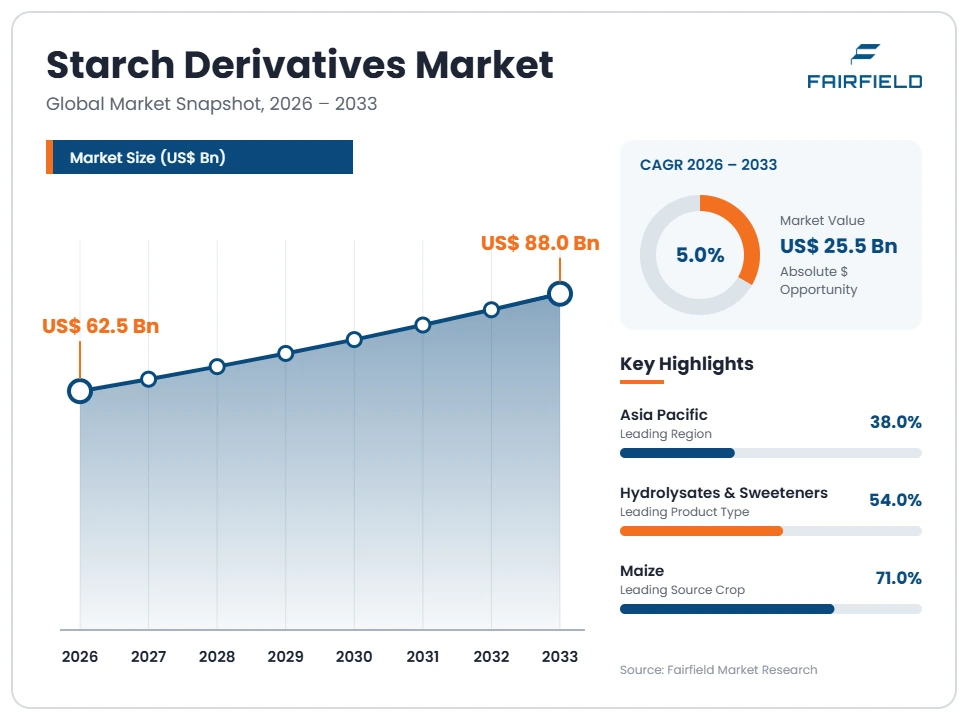
The global Starch Derivatives market size is expected to be valued at US$ 62.5 billion in 2026 and projected to reach US$ 88.0 billion by 2033, growing at a CAGR of 5.0% between 2026 and 2033.
The category grew at about 3.9% a year between 2020 and 2025, closing that period near US$ 59.6 billion, as flat sweetener tonnage in mature markets offset steady gains in modified starches and fermentation feedstock. Three forces shape the outlook. Industrial fermentation keeps absorbing more glucose, because sugar is the carbon source most bio-based production runs on. Centrally manufactured chilled, frozen and ambient food keeps pulling modified starches into texture and stability roles. Wet mills continue shifting output toward derivatives that earn more per tonne than native starch. The direction is mid single-digit growth, with value migrating away from bulk sweeteners toward fermentation inputs, specialty modified grades, polyols and starch-derived fibres.
Key Report Takeaways
- By Product Type: Starch hydrolysates and sweeteners held 54% share in 2026, while resistant dextrins and starch-derived fibres are projected to expand at an 8.2% CAGR through 2033, as carbohydrate labelling rules push formulators toward soluble starch-based ingredients.
- By Source Crop: Maize held 71% share in 2026, while cassava starch bases are projected to grow at a 6.5% CAGR through 2033, supported by new conversion capacity close to root supply in Thailand, Vietnam and Indonesia.
- By Process Route: Enzymatic hydrolysis held 52% share in 2026, while physical modification is projected to advance at an 8.7% CAGR through 2033, because retailer clean-label specifications increasingly exclude chemically modified starch declarations.
- By Application: Food and beverages held 48% share in 2026, while industrial fermentation is projected to rise at a 7.9% CAGR through 2033, as amino acid, organic acid and bio-based polymer plants buy glucose as a bulk carbon source.
- By Geography: Asia Pacific led with 38% share in 2026, while Middle East & Africa is projected to grow at a 6.3% CAGR through 2033, as glucose and sweetener plants are built closer to beverage and confectionery demand.
Global Starch Derivatives Market Trends and Insights
Drivers Impact Analysis
Two forces explain why derivative volumes are growing faster than the native starch behind them.
| Driver | Impact on CAGR Forecast | Geographic Relevance | Impact Timeline |
| Industrial fermentation demand for glucose as a carbon feedstock | High | Global, led by Asia Pacific and North America | Medium term 2–4 years |
| Modified starch use in centrally manufactured chilled and frozen food | Medium | Global, strongest in Asia Pacific and Europe | Short term ≤2 years |
Industrial Fermentation Has Made Glucose the Default Carbon Source for Bio-Based Production
Industrial fermentation is the fastest-moving outlet in this market, because glucose is the sugar most fermentation processes run on. Amino acid, organic acid, enzyme, vitamin and bio-based polymer plants buy dextrose syrup or crystalline dextrose by the tanker, and their volumes are rising while sweetener tonnage is not. For a wet mill, this demand arrives as bulk liquid glucose with low selling cost, which makes it a genuine alternative to the sweetener contract it competes against.
The mechanism is substitution of fermentation for chemical synthesis. Producers of lysine, threonine, lactic acid, citric acid, succinic acid and polylactic acid convert starch sugars into products once made from petrochemicals. Bioplastic capacity additions in China, Thailand and the United States consume starch sugar directly, and fuel ethanol plants draw on the same stream. Each new fermentation plant effectively signs a long-term glucose offtake close to a wet mill.
Modified Starches Hold Texture and Process Stability Across Longer Food Supply Chains
Modified starches are growing because food supply chains have become longer and harsher, and native starch does not survive them. Retort sterilisation, freeze-thaw cycling, acid sauces, high-shear pumping and months of chilled shelf life break down unmodified granules, producing syneresis and texture loss. Manufacturers therefore specify acetylated, cross-linked, hydroxypropylated and pregelatinised grades, which hold viscosity under those conditions and sell well above the native starch they are made from.
The change sits in manufacturing, not in taste. Ready meals, chilled desserts, instant soups, sauces, batters and petfood gravies are produced centrally and shipped long distances, so process tolerance has become a written specification. Modified starches appear in the EU food additive framework under the E 1400 series, which gives formulators a defined set of permitted treatments with published purity criteria. Codex Alimentarius standards for modified starches serve the same purpose elsewhere.
Restraints Impact Analysis
Both constraints are economic rather than technical, and both bear on the sweetener base of the business.
| Restraint | Impact on CAGR Forecast | Geographic Relevance | Impact Timeline |
| Grain and energy cost pass-through in a low-margin conversion business | High | Global, acute in Europe | Short term ≤2 years |
| Sugar reduction policy and sweetened beverage taxes | Medium | North America, Europe and Latin America | Long term ≥4 years |
Grain and Energy Costs Pass Straight Through a Low-Margin Starch Conversion Business
Grain and energy prices move directly into derivative margins, because conversion adds thin value and contracts reprice slowly. A starch derivative plant captures relatively little per tonne over the maize, wheat or potato it buys, so a swing in grain cost changes profitability far more than a swing in demand does. When grain and gas rise together, as they have across Europe, annual industrial supply contracts cannot absorb the increase, and some conversion lines run below capacity rather than sell at a loss.
The cost sources are specific. Steeping, separation, evaporation, hydrogenation and spray drying are energy intensive, and syrup concentration consumes large quantities of thermal energy. Liquefaction and saccharification enzymes are a further purchased input. Wet milling also generates high-strength effluent that must be treated under discharge permits. Because the same plant buys a commodity and sells a commodity, producers hedge inputs rather than expect pricing power.
Sugar Reduction Policy and Beverage Taxes Have Flattened High Fructose Syrup Volumes
Sugar reduction policy has flattened the largest product line in this market. High fructose syrup and glucose-fructose syrup volumes have stopped growing in mature markets, because soft drink makers have reformulated recipes, reduced pack sizes or moved to high-intensity sweeteners. That matters disproportionately. Sweeteners are the volume base of the derivative business, so a static beverage outlet caps the growth rate of the whole category even while specialty grades expand quickly.
The policy mechanism is explicit rather than reputational. Sweetened beverage taxes now operate in more than fifty countries, usually tiered by sugar content, giving manufacturers a direct financial reason to reformulate. Added sugars must be declared on the United States Nutrition Facts label, and front-of-pack schemes in several European countries score products on sugar content. The World Health Organization guideline on free sugars is the reference most national programmes cite.
Market Opportunities
Physically Modified and Functional Native Grades Open a Premium Clean-Label Revenue Pool
Physically modified and functional native starches are the clearest premium pool here, because they sell at specialty prices into accounts that have excluded chemical modification. Retailer and brand clean-label standards increasingly refuse E-numbered modified starch declarations, yet the underlying processing requirement has not gone away. Grades produced by heat-moisture treatment, annealing, extrusion or controlled drum drying deliver much of the same stability while allowing a simple starch declaration, which is exactly what the buyer pays for.
Wet millers with thermal and extrusion assets are best placed to capture it, because the step is a processing investment rather than a new crop base. Demand comes from chilled dairy, sauces, infant food and private-label ranges, where ingredient declarations are negotiated with retailers. The economics hold because physical routes cost more per tonne than chemical treatment, supporting a premium instead of eroding one.
Cyclodextrins and Specialty Polyols Create the Highest Value Per Tonne of Wet Mill Output
Cyclodextrins and specialty polyols turn a small share of wet mill output into the highest value per tonne in the derivative range. Cyclodextrins are produced enzymatically from starch and are used to carry flavours, stabilise actives and remove unwanted compounds across food, pharmaceutical, personal care and household formulations. Specialty polyols such as maltitol, mannitol and hydrogenated starch hydrolysates serve confectionery, oral care and tabletting. Both sell on specification and documentation rather than delivered cost.
Producers with enzyme technology, crystallisation capability and pharmaceutical quality systems can capture this pool, because the barrier is qualification rather than capacity. Demand comes from pharmaceutical formulators buying mannitol and dextrose against excipient monographs, and from flavour houses buying cyclodextrin carriers. Food contact compliance and monograph conformity are the gating requirements, and a single mill can serve them from existing starch milk.
Segment Analysis
- By Product Type: Hydrolysates and Sweeteners Lead While Starch-Derived Fibres Set the Pace
Starch hydrolysates and sweeteners held 54% share in 2026, covering glucose and dextrose syrups, dextrose monohydrate and anhydrous, high fructose syrups, maltose syrups, maltodextrins and glucose-fructose syrups. They lead because they absorb the largest share of converted starch by tonnage across beverages, confectionery, bakery, brewing and fermentation. Modified starches rank second by value, followed by polyols, cyclodextrins and starch-derived fibres. Resistant dextrins and starch-derived fibres are the fastest-growing product type at an 8.2% CAGR to 2033, expanding from a small base as carbohydrate declaration rules and reformulation briefs move formulators toward soluble starch-based ingredients. Several newer fibre grades require authorisation in the European Union under the novel food route before launch. The implication is a widening value gap between a mature bulk sweetener core and a specialty layer growing at roughly twice the market rate.
- By Source Crop: Maize Dominates the Feedstock Base as Cassava Conversion Expands Fastest
Maize held 71% share in 2026, reflecting the scale, yield and steady supply of the corn wet-milling industry and the fact that maize starch converts economically into every derivative in the range. Wheat starch supplies European and Australian derivative plants, potato starch supports specialty modified grades, and rice and pea starch bases serve niche formulation needs. Native starches from each crop are analysed in separate reports and are counted here only as the input to conversion. Cassava is the fastest-growing source crop at a 6.5% CAGR to 2033, as sweetener, maltodextrin and fermentation glucose capacity is built close to root supply in Thailand, Vietnam, Indonesia and Nigeria. The commercial consequence is that feedstock choice increasingly follows conversion economics and local policy rather than simple starch availability.
- By Process Route: Enzymatic Hydrolysis Carries Volume While Physical Modification Accelerates
Enzymatic hydrolysis held 52% share in 2026, because every syrup, dextrose and maltodextrin grade passes through liquefaction and saccharification with alpha-amylase and glucoamylase. Chemical modification ranks second, producing the acetylated, oxidised, cross-linked, hydroxypropylated and octenyl succinic anhydride treated grades listed in additive frameworks. Hydrogenation produces sorbitol, maltitol and mannitol, while enzymatic cyclisation yields cyclodextrins. Physical modification is the fastest-growing route at an 8.7% CAGR to 2033, covering heat-moisture treatment, annealing, extrusion and drum drying, which avoid an additive declaration. Growth here is driven by retailer specifications rather than by performance parity, since physically treated grades generally deliver less process tolerance than chemically modified equivalents. For producers, the implication is capital allocation toward thermal and extrusion assets rather than additional chemical reaction capacity.
- By Application: Food and Beverages Anchor Demand While Industrial Fermentation Grows Quickest
Food and beverages held 48% share in 2026, spanning soft drinks, confectionery, bakery, dairy, sauces, soups and processed meat, where sweeteners and modified starches do most of the work. Paper and corrugating remains a large non-food outlet for oxidised and cationic grades, followed by animal feed, pharmaceuticals, textiles, adhesives and personal care. Industrial fermentation is the fastest-growing application at a 7.9% CAGR to 2033, as amino acid, organic acid, enzyme and bio-based polymer producers buy glucose as a bulk carbon source, and as bioplastic and biofuel capacity expands. This divergence is the defining feature of the market. The sweetener half faces reformulation pressure while the fermentation half grows, so a wet mill’s profitability now depends on how quickly it can redirect the same tonne of starch between the two.
Geography Analysis
- North America Runs the World’s Largest Integrated Corn Wet-Milling Base
North America held 27% share in 2026 and is forecast to grow at 3.7% to 2033, the slowest regional rate in this market. The United States dominates through a mature corn wet-milling industry that produces high fructose syrup, dextrose, maltodextrins, modified starches and fermentation glucose at very large scale. Canada and Mexico add sweetener and modified starch capacity serving food and beverage manufacturing. Growth is held back by the sweetener base: beverage reformulation and added sugars labelling have left high fructose syrup volumes flat for years. The offsetting change is industrial. Fermentation buyers, including lactic acid, amino acid and bio-based polymer plants, are absorbing a rising share of dextrose output, which is where incremental regional volume is now going.
- Europe Converts Wheat and Potato Starch Into High-Specification Derivatives
Europe accounted for 21% share in 2026 and is projected to grow at 3.6% to 2033. The region’s distinctive feature is feedstock diversity: France, Germany, Belgium and the Netherlands convert wheat and potato starch alongside maize, which supports a strong position in specialty modified starches, polyols and pharmaceutical excipient grades. The additive framework, with its published specifications for each permitted modified starch, makes documentation a competitive asset for regional suppliers. High industrial energy prices are the principal pressure on margins, and several conversion lines have been rationalised. The defining regional change is the move toward physically modified and functional native grades, driven by retailer clean-label specifications that are stricter here than almost anywhere else.
- Which Region Is Leading the Starch Derivatives Market?
Asia Pacific leads the starch derivatives market with 38% share in 2026, growing at a 5.9% CAGR to 2033. China operates the largest corn processing complex in the world, supplying glucose, maltodextrin, polyols, modified starches and fermentation feedstock to domestic amino acid, organic acid and bioplastic producers. India converts maize into liquid glucose, sorbitol and dextrose for confectionery, pharmaceuticals and oral care. Thailand, Vietnam and Indonesia convert cassava starch into syrups and modified grades, while Japan and Korea sustain demand for high-specification food and pharmaceutical derivatives. Leadership rests on co-located fermentation industries that consume glucose on the same industrial estates. The main regional change is a steady shift from exporting native starch toward exporting converted derivatives.
- Latin America Builds Regional Sweetener and Fermentation Supply From Maize and Cassava
Latin America represented 8% share in 2026 and is expected to grow at 5.2% to 2033. Brazil, Mexico and Argentina account for most conversion capacity, supplying glucose and fructose syrups, maltodextrins and modified starches to beverage, confectionery and bakery manufacturers. Brazil combines maize wet milling with cassava processing and an established fermentation industry, which creates demand for glucose as a carbon source alongside its sugarcane base. Barriers include currency volatility, long inland freight routes and sweetened beverage taxes that have slowed syrup demand in several countries. The clearest opportunity is import substitution in specialty modified starches and polyols, which are still largely brought in rather than produced locally.
- Which Region Is Growing Fastest in the Starch Derivatives Market?
Middle East & Africa is the fastest-growing region in the starch derivatives market, advancing at a 6.3% CAGR to 2033 from 6% share in 2026. Growth comes from a low base and from new conversion capacity built close to demand. Turkey has an established corn wet-milling industry supplying syrups and modified starches to food manufacturers and to export customers. Saudi Arabia, Egypt and the United Arab Emirates are adding glucose and sweetener capacity to serve beverage, confectionery and dairy production. Nigeria and South Africa convert local maize and cassava into syrups and industrial grades. Barriers include grain import dependence, foreign exchange availability and utility reliability. The opportunity is local conversion replacing imported syrup and maltodextrin.
Competitive Landscape
The starch derivatives market is highly concentrated, with a small group of global wet millers holding most worldwide conversion capacity. Concentration follows directly from the technology. A corn wet mill is a large, continuous, capital-intensive plant with steeping, separation, saccharification, refining, evaporation and drying trains, and it only earns a return when every output stream finds a buyer. That requirement favours operators with scale, multiple derivative lines and the marketing reach to place starch, sweeteners, gluten, germ, fibre and steep liquor simultaneously. Below the global tier sit strong regional millers serving domestic food industries, plus specialists in polyols, cyclodextrins or pharmaceutical excipients who buy starch rather than mill it.
Competition is fought differently at each point in the range. In syrups, maltodextrins and dextrose, vendors compete on delivered cost, freight radius, consistency and contract reliability, because the product is a specification commodity. In modified starches, polyols and cyclodextrins, the basis shifts to application laboratories, functional performance, regulatory documentation and co-development with a customer’s product team. Across both, the decisive internal capability is optionality: the ability to redirect the same starch slurry between native sales, syrup, hydrogenation, chemical modification or fermentation feedstock as relative prices move. New entrants rarely build greenfield mills. They arrive instead as downstream converters, enzyme technology suppliers or fermentation companies integrating backwards into their own sugar supply.
Strategic activity in the industry clusters around three themes. Producers are adding downstream conversion so that a larger share of starch leaves the gate as a specialty rather than a commodity. They are investing in physical modification and clean-label capability to answer retailer specifications. They are also securing energy and grain cost positions, since those inputs decide regional competitiveness.
Strategic direction converges on moving the output mix up the value chain, deepening fermentation feedstock relationships, and building the regulatory and food contact documentation that specialty derivative customers require.
Recent Industry Developments
- March 2015: The World Health Organization issued its guideline on sugars intake for adults and children, recommending reduced intake of free sugars – it became the reference point that national sugar reduction programmes and beverage taxes now cite, and it set the direction of travel for syrup demand.
- May 2016: The US Food and Drug Administration published its final rule revising the Nutrition Facts label, introducing a mandatory added sugars declaration – it gave beverage and confectionery manufacturers a visible labelling reason to cut syrup inclusion rates.
- October 2017: France formally adopted the Nutri-Score front-of-pack nutrition label by ministerial order – it created a scoring system that penalises sugar content and has since been taken up voluntarily in several other European countries.
- April 2018: The United Kingdom Soft Drinks Industry Levy came into force with tiered rates based on sugar content – it demonstrated that a tiered tax reformulates recipes rather than simply raising revenue, and it has been copied widely.
Companies Covered in the Report
- Cargill, Incorporated
- Archer-Daniels-Midland Company
- Ingredion Incorporated
- Tate & Lyle PLC
- Roquette Frères
- Tereos
- Primient
- Grain Processing Corporation
- Agrana Beteiligungs-AG
- Royal Avebe U.A.
- Emsland Group
- Südzucker AG
- Gulshan Polyols Limited
- Thai Wah Public Company Limited
Starch Derivatives Market Report Scope
| Metric | Value |
| Study Period | 2020–2033 |
| Market Size 2026 | US$ 62.5 Billion |
| Market Size 2033 | US$ 88.0 Billion |
| CAGR 2026–2033 | 5.0% |
| Absolute Dollar Opportunity | US$ 25.5 Billion |
| Largest Market | Asia Pacific (38% share in 2026) |
| Fastest-Growing Market | Middle East & Africa (6.3% CAGR) |
| Market Concentration | High |
| Major Players | Cargill, Incorporated, Archer-Daniels-Midland Company, Ingredion Incorporated, Tate & Lyle PLC, Roquette Frères |
Starch Derivatives Market Segmentation
Product Type
- Starch hydrolysates and sweeteners
- Modified starches
- Polyols
- Cyclodextrins
- Resistant dextrins and starch-derived fibres
Source Crop
- Maize
- Wheat
- Potato
- Cassava
- Rice, pea and other starches
Process Route
- Enzymatic hydrolysis
- Chemical modification
- Physical modification
- Hydrogenation
- Enzymatic cyclisation
Application
- Food and beverages
- Industrial fermentation
- Animal feed
- Pharmaceuticals
- Paper and corrugating
- Textiles and adhesives
- Personal care
Regions
- North America
- Europe
- Asia Pacific
- Latin America
- Middle East & Africa
- Executive Summary
- Global Starch Derivatives Market Snapshot
- Future Projections, 2026-2033
- Key Market Trends
- Regional Snapshot
- Market Overview
- Market Definition and Report Scope
- Historical Market Trends, 2020-2025
- Market Dynamics
- Drivers Impact Analysis
- Industrial Fermentation Has Made Glucose the Default Carbon Source for Bio-Based Production
- Modified Starches Hold Texture and Process Stability Across Longer Food Supply Chains
- Restraints Impact Analysis
- Grain and Energy Costs Pass Straight Through a Low-Margin Starch Conversion Business
- Sugar Reduction Policy and Beverage Taxes Have Flattened High Fructose Syrup Volumes
- Market Opportunities
- Physically Modified and Functional Native Grades Open a Premium Clean-Label Revenue Pool
- Cyclodextrins and Specialty Polyols Create the Highest Value Per Tonne of Wet Mill Output
- Drivers Impact Analysis
- Global Starch Derivatives Market Outlook, 2020-2033
- Global Starch Derivatives Market Outlook, by Product Type, Value (US$ Billion), 2020-2033
- Starch hydrolysates and sweeteners
- Modified starches
- Polyols
- Cyclodextrins
- Resistant dextrins and starch-derived fibres
- Global Starch Derivatives Market Outlook, by Source Crop, Value (US$ Billion), 2020-2033
- Maize
- Wheat
- Potato
- Cassava
- Rice, pea and other starches
- Global Starch Derivatives Market Outlook, by Process Route, Value (US$ Billion), 2020-2033
- Enzymatic hydrolysis
- Chemical modification
- Physical modification
- Hydrogenation
- Enzymatic cyclisation
- Global Starch Derivatives Market Outlook, by Application, Value (US$ Billion), 2020-2033
- Food and beverages
- Industrial fermentation
- Animal feed
- Pharmaceuticals
- Paper and corrugating
- Textiles and adhesives
- Personal care
- Global Starch Derivatives Market Outlook, by Region, Value (US$ Billion), 2020-2033
- North America
- Europe
- Asia Pacific
- Latin America
- Middle East & Africa
- Global Starch Derivatives Market Outlook, by Product Type, Value (US$ Billion), 2020-2033
- North America Starch Derivatives Market Outlook, 2020-2033
- North America Starch Derivatives Market Outlook, by Product Type, Value (US$ Billion), 2020-2033
- Starch hydrolysates and sweeteners
- Modified starches
- Polyols
- Cyclodextrins
- Resistant dextrins and starch-derived fibres
- North America Starch Derivatives Market Outlook, by Source Crop, Value (US$ Billion), 2020-2033
- Maize
- Wheat
- Potato
- Cassava
- Rice, pea and other starches
- North America Starch Derivatives Market Outlook, by Process Route, Value (US$ Billion), 2020-2033
- Enzymatic hydrolysis
- Chemical modification
- Physical modification
- Hydrogenation
- Enzymatic cyclisation
- North America Starch Derivatives Market Outlook, by Application, Value (US$ Billion), 2020-2033
- Food and beverages
- Industrial fermentation
- Animal feed
- Pharmaceuticals
- Paper and corrugating
- Textiles and adhesives
- Personal care
- North America Starch Derivatives Market Outlook, by Country, Value (US$ Billion), 2020-2033
- United States Starch Derivatives Market Outlook, by Product Type, 2020-2033
- United States Starch Derivatives Market Outlook, by Source Crop, 2020-2033
- United States Starch Derivatives Market Outlook, by Process Route, 2020-2033
- United States Starch Derivatives Market Outlook, by Application, 2020-2033
- Canada Starch Derivatives Market Outlook, by Product Type, 2020-2033
- Canada Starch Derivatives Market Outlook, by Source Crop, 2020-2033
- Canada Starch Derivatives Market Outlook, by Process Route, 2020-2033
- Canada Starch Derivatives Market Outlook, by Application, 2020-2033
- Mexico Starch Derivatives Market Outlook, by Product Type, 2020-2033
- Mexico Starch Derivatives Market Outlook, by Source Crop, 2020-2033
- Mexico Starch Derivatives Market Outlook, by Process Route, 2020-2033
- Mexico Starch Derivatives Market Outlook, by Application, 2020-2033
- North America Starch Derivatives Market Outlook, by Product Type, Value (US$ Billion), 2020-2033
- Europe Starch Derivatives Market Outlook, 2020-2033
- Europe Starch Derivatives Market Outlook, by Product Type, Value (US$ Billion), 2020-2033
- Starch hydrolysates and sweeteners
- Modified starches
- Polyols
- Cyclodextrins
- Resistant dextrins and starch-derived fibres
- Europe Starch Derivatives Market Outlook, by Source Crop, Value (US$ Billion), 2020-2033
- Maize
- Wheat
- Potato
- Cassava
- Rice, pea and other starches
- Europe Starch Derivatives Market Outlook, by Process Route, Value (US$ Billion), 2020-2033
- Enzymatic hydrolysis
- Chemical modification
- Physical modification
- Hydrogenation
- Enzymatic cyclisation
- Europe Starch Derivatives Market Outlook, by Application, Value (US$ Billion), 2020-2033
- Food and beverages
- Industrial fermentation
- Animal feed
- Pharmaceuticals
- Paper and corrugating
- Textiles and adhesives
- Personal care
- Europe Starch Derivatives Market Outlook, by Country, Value (US$ Billion), 2020-2033
- France Starch Derivatives Market Outlook, by Product Type, 2020-2033
- France Starch Derivatives Market Outlook, by Source Crop, 2020-2033
- France Starch Derivatives Market Outlook, by Process Route, 2020-2033
- France Starch Derivatives Market Outlook, by Application, 2020-2033
- Germany Starch Derivatives Market Outlook, by Product Type, 2020-2033
- Germany Starch Derivatives Market Outlook, by Source Crop, 2020-2033
- Germany Starch Derivatives Market Outlook, by Process Route, 2020-2033
- Germany Starch Derivatives Market Outlook, by Application, 2020-2033
- Belgium Starch Derivatives Market Outlook, by Product Type, 2020-2033
- Belgium Starch Derivatives Market Outlook, by Source Crop, 2020-2033
- Belgium Starch Derivatives Market Outlook, by Process Route, 2020-2033
- Belgium Starch Derivatives Market Outlook, by Application, 2020-2033
- Netherlands Starch Derivatives Market Outlook, by Product Type, 2020-2033
- Netherlands Starch Derivatives Market Outlook, by Source Crop, 2020-2033
- Netherlands Starch Derivatives Market Outlook, by Process Route, 2020-2033
- Netherlands Starch Derivatives Market Outlook, by Application, 2020-2033
- Europe Starch Derivatives Market Outlook, by Product Type, Value (US$ Billion), 2020-2033
- Asia Pacific Starch Derivatives Market Outlook, 2020-2033
- Asia Pacific Starch Derivatives Market Outlook, by Product Type, Value (US$ Billion), 2020-2033
- Starch hydrolysates and sweeteners
- Modified starches
- Polyols
- Cyclodextrins
- Resistant dextrins and starch-derived fibres
- Asia Pacific Starch Derivatives Market Outlook, by Source Crop, Value (US$ Billion), 2020-2033
- Maize
- Wheat
- Potato
- Cassava
- Rice, pea and other starches
- Asia Pacific Starch Derivatives Market Outlook, by Process Route, Value (US$ Billion), 2020-2033
- Enzymatic hydrolysis
- Chemical modification
- Physical modification
- Hydrogenation
- Enzymatic cyclisation
- Asia Pacific Starch Derivatives Market Outlook, by Application, Value (US$ Billion), 2020-2033
- Food and beverages
- Industrial fermentation
- Animal feed
- Pharmaceuticals
- Paper and corrugating
- Textiles and adhesives
- Personal care
- Asia Pacific Starch Derivatives Market Outlook, by Country, Value (US$ Billion), 2020-2033
- China Starch Derivatives Market Outlook, by Product Type, 2020-2033
- China Starch Derivatives Market Outlook, by Source Crop, 2020-2033
- China Starch Derivatives Market Outlook, by Process Route, 2020-2033
- China Starch Derivatives Market Outlook, by Application, 2020-2033
- India Starch Derivatives Market Outlook, by Product Type, 2020-2033
- India Starch Derivatives Market Outlook, by Source Crop, 2020-2033
- India Starch Derivatives Market Outlook, by Process Route, 2020-2033
- India Starch Derivatives Market Outlook, by Application, 2020-2033
- Thailand Starch Derivatives Market Outlook, by Product Type, 2020-2033
- Thailand Starch Derivatives Market Outlook, by Source Crop, 2020-2033
- Thailand Starch Derivatives Market Outlook, by Process Route, 2020-2033
- Thailand Starch Derivatives Market Outlook, by Application, 2020-2033
- Vietnam Starch Derivatives Market Outlook, by Product Type, 2020-2033
- Vietnam Starch Derivatives Market Outlook, by Source Crop, 2020-2033
- Vietnam Starch Derivatives Market Outlook, by Process Route, 2020-2033
- Vietnam Starch Derivatives Market Outlook, by Application, 2020-2033
- Indonesia Starch Derivatives Market Outlook, by Product Type, 2020-2033
- Indonesia Starch Derivatives Market Outlook, by Source Crop, 2020-2033
- Indonesia Starch Derivatives Market Outlook, by Process Route, 2020-2033
- Indonesia Starch Derivatives Market Outlook, by Application, 2020-2033
- Japan Starch Derivatives Market Outlook, by Product Type, 2020-2033
- Japan Starch Derivatives Market Outlook, by Source Crop, 2020-2033
- Japan Starch Derivatives Market Outlook, by Process Route, 2020-2033
- Japan Starch Derivatives Market Outlook, by Application, 2020-2033
- Korea Starch Derivatives Market Outlook, by Product Type, 2020-2033
- Korea Starch Derivatives Market Outlook, by Source Crop, 2020-2033
- Korea Starch Derivatives Market Outlook, by Process Route, 2020-2033
- Korea Starch Derivatives Market Outlook, by Application, 2020-2033
- Asia Pacific Starch Derivatives Market Outlook, by Product Type, Value (US$ Billion), 2020-2033
- Latin America Starch Derivatives Market Outlook, 2020-2033
- Latin America Starch Derivatives Market Outlook, by Product Type, Value (US$ Billion), 2020-2033
- Starch hydrolysates and sweeteners
- Modified starches
- Polyols
- Cyclodextrins
- Resistant dextrins and starch-derived fibres
- Latin America Starch Derivatives Market Outlook, by Source Crop, Value (US$ Billion), 2020-2033
- Maize
- Wheat
- Potato
- Cassava
- Rice, pea and other starches
- Latin America Starch Derivatives Market Outlook, by Process Route, Value (US$ Billion), 2020-2033
- Enzymatic hydrolysis
- Chemical modification
- Physical modification
- Hydrogenation
- Enzymatic cyclisation
- Latin America Starch Derivatives Market Outlook, by Application, Value (US$ Billion), 2020-2033
- Food and beverages
- Industrial fermentation
- Animal feed
- Pharmaceuticals
- Paper and corrugating
- Textiles and adhesives
- Personal care
- Latin America Starch Derivatives Market Outlook, by Country, Value (US$ Billion), 2020-2033
- Brazil Starch Derivatives Market Outlook, by Product Type, 2020-2033
- Brazil Starch Derivatives Market Outlook, by Source Crop, 2020-2033
- Brazil Starch Derivatives Market Outlook, by Process Route, 2020-2033
- Brazil Starch Derivatives Market Outlook, by Application, 2020-2033
- Mexico Starch Derivatives Market Outlook, by Product Type, 2020-2033
- Mexico Starch Derivatives Market Outlook, by Source Crop, 2020-2033
- Mexico Starch Derivatives Market Outlook, by Process Route, 2020-2033
- Mexico Starch Derivatives Market Outlook, by Application, 2020-2033
- Argentina Starch Derivatives Market Outlook, by Product Type, 2020-2033
- Argentina Starch Derivatives Market Outlook, by Source Crop, 2020-2033
- Argentina Starch Derivatives Market Outlook, by Process Route, 2020-2033
- Argentina Starch Derivatives Market Outlook, by Application, 2020-2033
- Latin America Starch Derivatives Market Outlook, by Product Type, Value (US$ Billion), 2020-2033
- Middle East & Africa Starch Derivatives Market Outlook, 2020-2033
- Middle East & Africa Starch Derivatives Market Outlook, by Product Type, Value (US$ Billion), 2020-2033
- Starch hydrolysates and sweeteners
- Modified starches
- Polyols
- Cyclodextrins
- Resistant dextrins and starch-derived fibres
- Middle East & Africa Starch Derivatives Market Outlook, by Source Crop, Value (US$ Billion), 2020-2033
- Maize
- Wheat
- Potato
- Cassava
- Rice, pea and other starches
- Middle East & Africa Starch Derivatives Market Outlook, by Process Route, Value (US$ Billion), 2020-2033
- Enzymatic hydrolysis
- Chemical modification
- Physical modification
- Hydrogenation
- Enzymatic cyclisation
- Middle East & Africa Starch Derivatives Market Outlook, by Application, Value (US$ Billion), 2020-2033
- Food and beverages
- Industrial fermentation
- Animal feed
- Pharmaceuticals
- Paper and corrugating
- Textiles and adhesives
- Personal care
- Middle East & Africa Starch Derivatives Market Outlook, by Country, Value (US$ Billion), 2020-2033
- Turkey Starch Derivatives Market Outlook, by Product Type, 2020-2033
- Turkey Starch Derivatives Market Outlook, by Source Crop, 2020-2033
- Turkey Starch Derivatives Market Outlook, by Process Route, 2020-2033
- Turkey Starch Derivatives Market Outlook, by Application, 2020-2033
- Saudi Arabia Starch Derivatives Market Outlook, by Product Type, 2020-2033
- Saudi Arabia Starch Derivatives Market Outlook, by Source Crop, 2020-2033
- Saudi Arabia Starch Derivatives Market Outlook, by Process Route, 2020-2033
- Saudi Arabia Starch Derivatives Market Outlook, by Application, 2020-2033
- Egypt Starch Derivatives Market Outlook, by Product Type, 2020-2033
- Egypt Starch Derivatives Market Outlook, by Source Crop, 2020-2033
- Egypt Starch Derivatives Market Outlook, by Process Route, 2020-2033
- Egypt Starch Derivatives Market Outlook, by Application, 2020-2033
- United Arab Emirates Starch Derivatives Market Outlook, by Product Type, 2020-2033
- United Arab Emirates Starch Derivatives Market Outlook, by Source Crop, 2020-2033
- United Arab Emirates Starch Derivatives Market Outlook, by Process Route, 2020-2033
- United Arab Emirates Starch Derivatives Market Outlook, by Application, 2020-2033
- Nigeria Starch Derivatives Market Outlook, by Product Type, 2020-2033
- Nigeria Starch Derivatives Market Outlook, by Source Crop, 2020-2033
- Nigeria Starch Derivatives Market Outlook, by Process Route, 2020-2033
- Nigeria Starch Derivatives Market Outlook, by Application, 2020-2033
- South Africa Starch Derivatives Market Outlook, by Product Type, 2020-2033
- South Africa Starch Derivatives Market Outlook, by Source Crop, 2020-2033
- South Africa Starch Derivatives Market Outlook, by Process Route, 2020-2033
- South Africa Starch Derivatives Market Outlook, by Application, 2020-2033
- Middle East & Africa Starch Derivatives Market Outlook, by Product Type, Value (US$ Billion), 2020-2033
- Competitive Landscape
- Market Concentration and Industry Leaders
- Competitive Differentiation
- Strategic Initiatives
- Recent Industry Developments
- Company Profiles
- Cargill, Incorporated
- Archer-Daniels-Midland Company
- Ingredion Incorporated
- Tate & Lyle PLC
- Roquette Frères
- Tereos
- Primient
- Grain Processing Corporation
- Agrana Beteiligungs-AG
- Royal Avebe U.A.
- Emsland Group
- Südzucker AG
- Gulshan Polyols Limited
- Thai Wah Public Company Limited
- Appendix
- Research Methodology
- Report Assumptions
- Acronyms and Abbreviations
Product Type
- Starch hydrolysates and sweeteners
- Modified starches
- Polyols
- Cyclodextrins
- Resistant dextrins and starch-derived fibres
Source Crop
- Maize
- Wheat
- Potato
- Cassava
- Rice, pea and other starches
Process Route
- Enzymatic hydrolysis
- Chemical modification
- Physical modification
- Hydrogenation
- Enzymatic cyclisation
Application
- Food and beverages
- Industrial fermentation
- Animal feed
- Pharmaceuticals
- Paper and corrugating
- Textiles and adhesives
- Personal care
Regions
- North America
- Europe
- Asia Pacific
- Latin America
- Middle East & Africa
Our Research Methodology
Considering the volatility of business today, traditional approaches to strategizing a game plan can be unfruitful if not detrimental. True ambiguity is no way to determine a forecast. A myriad of predetermined factors must be accounted for such as the degree of risk involved, the magnitude of circumstances, as well as conditions or consequences that are not known or unpredictable. To circumvent binary views that cast uncertainty, the application of market research intelligence to strategically posture, move, and enable actionable outcomes is necessary.
View Methodology
Quality Assured
Rigorous Validation Process

Confidentiality Assured
End-to-end Data Security

Custom Research Services
Tailored To Your Objectives
FAQs
The starch derivatives market is valued at US$ 62.5 billion in 2026, covering sweeteners, modified starches, polyols, cyclodextrins and fermentation-grade glucose.
The market is projected to reach US$ 88.0 billion by 2033, growing at a 5.0% CAGR and adding US$ 25.5 billion in absolute value.
Starch hydrolysates and sweeteners lead with 54% share in 2026, because they absorb the largest tonnage of converted starch across food and beverage manufacturing.
Industrial fermentation grows fastest among applications at a 7.9% CAGR, while Middle East & Africa leads regional growth at 6.3% to 2033.
Concentration is high, because wet milling is capital intensive and only pays when every co-product stream is placed with a buyer.
Related Reports
Yeast Protein Market Size, Share, Insights, Competitive Landscape, and Forecast 2026 to 2033
The global yeast protein market is valued at US$0.9 billion in 2026, reaching US$2.0 billion by 2033, growing at a 12.1% CAGR
Quick Service Restaurants Market Size, Share, Insights, Competitive Landscape, and Forecast 2026 to 2033
The global quick service restaurants market is valued at US$1,090.0 billion in 2026, reaching US$1,556.0 billion by 2033, growing at a 5.2% CAGR
Plant Extracts Market Size, Share, Insights, Competitive Landscape, and Forecast 2026 to 2033
The global plant extracts market is valued at US$42.0 billion in 2026, reaching US$68.5 billion by 2033, growing at a 7.2% CAGR
Kombucha Market Size, Share, Insights, Competitive Landscape, and Forecast 2026 to 2033
The Kombucha Market is projected to grow from US$ 3.2 billion in 2026 to US$ 4.8 billion by 2033 at a 6.0% CAGR. Explore trends and leading segments.
Insect Protein Market Size, Share, Insights, Competitive Landscape, and Forecast 2026 to 2033
Insect Protein Market is projected to grow from US$ 1.03 billion in 2026 to US$ 3.17 billion by 2033 at a 17.4% CAGR. Explore trends and key segments.
Functional Mushroom Market Size, Share, Insights, Competitive Landscape, and Forecast 2026 to 2033
Explore the Functional Mushroom Market, projected to grow from US$ 2.6 billion in 2026 to US$ 4.4 billion by 2033 at a 7.8% CAGR. See trends and segments.