



Plant Extracts Market
Plant Extracts Market Size, Share, Insights, Competitive Landscape, and Forecast 2026 to 2033
Plant Extracts Market Size and Trend Analysis
How Big Is the Global Plant Extracts Market in 2026?
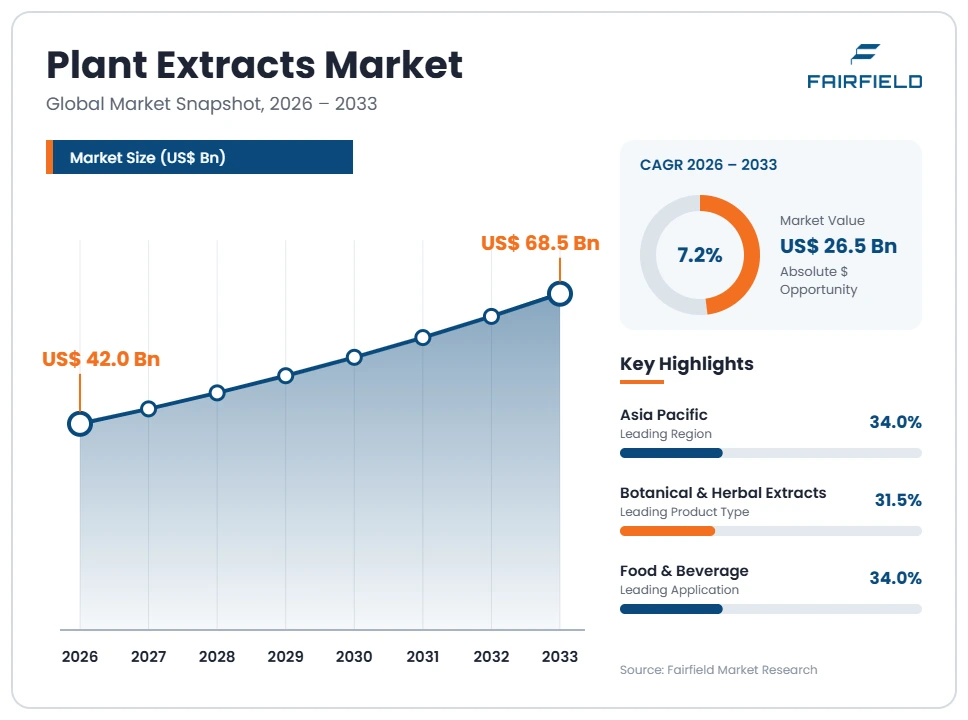
The global Plant Extracts market size is expected to be valued at US$ 42.0 billion in 2026 and projected to reach US$ 68.5 billion by 2033, growing at a CAGR of 7.2% between 2026 and 2033.
Botanical extract sales grew at close to 6.4% a year between 2020 and 2025, reaching roughly US$ 39.2 billion in the base year. Three factors explain the step up. Food and beverage manufacturers are reformulating away from synthetic colours after regulators withdrew several authorisations. Supplement, pharmaceutical and cosmetic buyers increasingly specify standardised fractions instead of crude material, which lifts value per kilogram. Extraction capacity is also moving toward supercritical carbon dioxide and aqueous routes that leave fewer solvent residues. Growth stays steady rather than sudden, because each extract inherits the agricultural risk of the crop behind it, and harvest variability limits how quickly supply can expand in any single botanical.
Key Report Takeaways
- By Product Type: Botanical and herbal extracts held 31.5% share in 2026, while phytochemical isolates and standardised actives are projected to expand at a 9.1% CAGR through 2033, as pharmaceutical and supplement buyers specify defined marker compounds instead of crude material.
- By Extraction Technology: Solvent extraction held 44.0% share in 2026, while supercritical carbon dioxide extraction is projected to expand at a 10.3% CAGR through 2033, because residue limits and clean-label specifications rule out some conventional solvents.
- By Form: Liquid extracts held 38.0% share in 2026, while encapsulated forms are projected to expand at a 9.6% CAGR through 2033, reflecting stability and dosing requirements in dry beverage powders, sachets and tablet formats.
- By Application: Food and beverage held 34.0% share in 2026, while cosmetics and personal care is projected to expand at a 9.4% CAGR through 2033, as brands substitute botanical actives for petrochemical-derived ingredients in skin and hair formulations.
- By Geography: Asia Pacific held 34.0% share in 2026, while Latin America is projected to expand at an 8.9% CAGR through 2033, supported by Andean and Amazonian raw material supply and Brazil’s large personal care manufacturing base.
Global Plant Extracts Market Trends and Insights
Drivers Impact Analysis
Two structural forces set the pace of this category: where the plant material comes from, and how it is extracted.
| Driver | Impact on CAGR Forecast | Geographic Relevance | Impact Timeline |
| Buyers consolidating purchases onto suppliers with multi-origin botanical portfolios | High | Global, strongest in Asia Pacific and Europe | Medium term (2–4 years) |
| Migration to supercritical carbon dioxide, aqueous and enzymatic extraction routes | High | North America and Europe | Long term (≥4 years) |
Crop Risk Pushes Plant Extract Buyers Toward Multi-Origin Suppliers
Supply reliability now wins botanical extract contracts more often than price does. Every extract carries the agricultural risk of one crop, so a formulator buying thirty botanicals holds thirty unrelated risks at once. Drought in one growing region, a disease outbreak in another and an export restriction in a third can arrive in the same quarter. Buyers have responded by concentrating volume on suppliers that hold several qualified origins for each botanical and can move between them without changing the specification.
The mechanism behind this is qualification cost. Changing origin usually shifts the marker profile, colour and taste of the finished extract, which forces the customer to revalidate the formula. Suppliers that pre-qualify alternate origins, carry inventory across two harvests and run contract farming programmes absorb that work. Testing in ISO 17025 accredited laboratories makes the substitution defensible to a quality department, turning agronomic depth into commercial advantage.
Choice of Extraction Route Now Decides Cost, Residue Profile and Label Claims
The extraction method has become the central technical decision in the industry, and it sets economics as firmly as the crop does. Route selection determines yield per tonne of biomass, energy and solvent cost, residue profile, and what a customer may print on a pack. Processors that run several routes in one plant can quote a food-grade, a supplement-grade and a cosmetic-grade version of the same botanical, widening the customer base without new raw material.
Regulation and retailer specifications drive the migration. The European Union directive on extraction solvents used in the production of foodstuffs sets which solvents are permitted and the residues allowed in finished food. Supercritical carbon dioxide leaves no solvent residue, while enzymatic pre-treatment and membrane concentration raise recovery from the same biomass. Both cost more in capital but reduce rejection risk, which matters when one failed lot can halt a customer’s production line.
Restraints Impact Analysis
Two issues hold the botanical extracts industry back, and both are structural rather than cyclical.
| Restraint | Impact on CAGR Forecast | Geographic Relevance | Impact Timeline |
| Adulteration and inconsistent standardisation of botanical extracts | High | Global | Short term (≤2 years) |
| Fragmented regulatory classification and unresolved botanical claim status | Medium | Europe and North America | Long term (≥4 years) |
Adulteration and Weak Standardisation Raise Buyer Testing Costs Across the Category
Adulteration is a documented, industry-wide problem and it slows purchasing decisions throughout the plant extract trade. Concentrated botanicals are easy to dilute with cheaper plant material or carriers, or to spike with a synthetic version of the marker compound. Buyers now treat authentication as a purchasing requirement rather than an audit step, which adds laboratory cost, lengthens supplier approval and excludes smaller processors from regulated customers.
The underlying cause is analytical. A botanical extract is a complex mixture, yet it is usually bought against a single marker percentage, so a lot can meet specification while bearing little resemblance to the plant. Closing that gap requires layered methods: chromatographic fingerprinting, DNA barcoding of incoming raw material, and comparison against pharmacopoeial monographs such as those of the United States Pharmacopeia and the American Herbal Pharmacopoeia. Running this work in ISO 17025 accredited laboratories adds a real cost to every lot sold.
Fragmented Classification Rules Limit How Botanical Extracts Can Be Sold and Marketed
A single extract can be a food ingredient in one country, a dietary supplement in another, a cosmetic ingredient in a third and a regulated medicine in a fourth. That fragmentation prevents one dossier, one specification and one pack from serving several markets, and it forces suppliers to maintain parallel documentation. The cost falls hardest on mid-sized processors, who often withdraw from a jurisdiction rather than fund a new submission for an ingredient they already sell elsewhere.
Claim status compounds the problem in Europe. Under the European Union Nutrition and Health Claims Regulation, claims relating to botanical substances remain on hold, so the category is marketed largely on tradition and provenance. The Novel Food Regulation and its catalogue add a second gate for extracts without a history of consumption. Exported botanical material must also satisfy pesticide residue and contaminant limits, and sourcing must document access and benefit-sharing under the Nagoya Protocol.
Market Opportunities
Two revenue pools sit outside the category’s traditional supplement base and carry materially better margins.
Synthetic Additive Withdrawals Open a Colour and Flavour Replacement Pool
Reformulation away from synthetic additives is the largest new revenue pool in the plant extract industry. As regulators withdraw authorisations for individual synthetic dyes, confectionery, bakery, dairy, snack and beverage manufacturers must find plant-derived replacements for shades they have used for decades. Replacement material sells at several times the price of the synthetic it displaces, and volumes are contracted years ahead because a colour change requires line trials, stability testing and artwork revision.
Colour houses with fermentation and horticultural supply programmes are best placed to capture this. The technical demand comes from food manufacturers who need plant-derived shades that survive heat, light and low pH without shifting hue across a product’s shelf life. Supporting this shift, the United States Food and Drug Administration revoked the authorisation for FD&C Red No. 3 in foods in January 2025, and several jurisdictions have since tightened rules on individual synthetic colourants in packaged products.
Cosmetic Actives Give Botanical Extract Makers a Higher-Value Revenue Pool
Cosmetics and personal care is the highest-value outlet available to botanical extract producers. Personal care formulators buy small volumes at high prices, accept standardised fractions rather than crude material, and reward documentation on origin, naturalness and traceability. Upcycled fractions recovered from food processing streams, such as press cakes, seed residues and peels, can be sold into this channel at margins the food ingredient business rarely supports.
Suppliers with cosmetic-grade quality systems and sustainability documentation will take most of this pool. Demand comes from brand owners in Brazil, France, Japan and Korea who formulate around naturally derived ingredients and must substantiate those positions. The ISO 16128 natural-origin framework and COSMOS certification give purchasers a common vocabulary, while access and benefit-sharing documentation under the Nagoya Protocol has become a routine condition for using material collected in biodiversity-rich countries.
Segment Analysis
- By Product Type: Botanical and Herbal Extracts Lead While Phytochemical Isolates Scale Fastest
Botanical and herbal extracts held 31.5% of plant extract revenue in 2026, the widest base in the category. The segment covers leaf, root, bark, flower and seed preparations sold in liquid and dried form, and it leads because the same material serves food, supplement and cosmetic customers with modest reformulation. Spice and herb oleoresins, plant-derived colours, plant-derived flavours and aroma concentrates, essential oils sold as extracts and functional plant fractions make up the remainder.
Phytochemical isolates and standardised actives form the fastest-growing type at a 9.1% CAGR to 2033. Growth comes from pharmaceutical and supplement formulators who specify a defined marker percentage, a known impurity profile and a monograph reference rather than a botanical name. Individual extracts including citrus, curcumin, spearmint and functional mushroom preparations are examined in separate reports. The implication is that value is migrating from crude extraction toward purification, with margin following analytical capability.
- By Extraction Technology: Solvent Routes Dominate as Supercritical Carbon Dioxide Advances Quickly
Solvent extraction held 44.0% share in 2026 and remains the default industrial route. Ethanol and water-ethanol systems recover a wide range of compounds at low capital cost, equipment is widely installed in China, India and Eastern Europe, and most pharmacopoeial preparations assume this route. Aqueous extraction, supercritical carbon dioxide, enzymatic processing and membrane concentration divide the balance, usually chosen for a specific compound class or a residue-sensitive customer.
Supercritical carbon dioxide extraction is expanding fastest at a 10.3% CAGR through 2033. It leaves no solvent residue, runs at low temperature and suits volatile aroma and lipophilic fractions, which makes it attractive where solvent rules or retailer specifications are strict. Capital intensity remains the barrier, since vessels and compression are costly and throughput is lower. Processors are therefore installing carbon dioxide capacity alongside existing ethanol lines rather than replacing them outright.
- By Form: Liquid Concentrates Hold the Base While Encapsulated Grades Accelerate
Liquid extracts held 38.0% of the market in 2026. Beverage, pharmaceutical and personal care customers dose liquids directly into wet systems, avoiding the energy cost of drying and the loss of volatile compounds that drying causes. Soft or paste extracts, dry powders, spray-dried grades and encapsulated products complete the segment, with spray-dried material dominating where freight cost and shelf life matter more than aroma retention.
Encapsulated extracts are growing fastest at a 9.6% CAGR to 2033. Encapsulation protects sensitive actives from oxygen, light and moisture, masks bitterness and allows a botanical to survive in a dry powder beverage, a sachet or a compressed tablet. The technique lets manufacturers of herbal extracts move into formats that free liquids cannot serve. For suppliers, encapsulation adds a processing step they can own, which keeps more of the finished value inside the extract business.
- By Application: Food and Beverage Anchors Volume While Cosmetics Grows Quickest
Food and beverage took 34.0% of plant extract demand in 2026, the largest single application. Colour, flavour, aroma and preservation uses consume high tonnage, and reformulation programmes in beverages, bakery, dairy and confectionery keep volumes steady. Dietary supplements and nutraceuticals follow closely, with pharmaceuticals, cosmetics and personal care, animal feed and pet products, and household and industrial uses sharing the balance.
Cosmetics and personal care is the fastest-growing application at a 9.4% CAGR through 2033. Brand owners are substituting plant-derived actives for petrochemical-derived ingredients across skin, hair and cleansing formats, and they pay for traceability and standardisation rather than tonnage. Feed and pet applications grow more slowly but steadily, as livestock producers trial botanical ingredients in place of other additives. For suppliers, the practical consequence is that a single botanical now needs several grades to reach its full market.
Geography Analysis
- North America Converts Additive Reformulation Into Botanical Extract Demand
North America accounted for 28.0% of plant extract revenue in 2026, led by the United States with meaningful contributions from Canada and Mexico. The region consumes far more extract than it grows, so it is a net importer that competes on formulation and brand rather than cultivation. Demand concentrates in dietary supplements, functional beverages and personal care, where standardised botanical ingredients command premium pricing and documented sourcing is a purchasing condition.
The reformulation of synthetic colourants is the region’s defining change. Manufacturers replacing withdrawn dyes need plant-derived shades at commercial scale, which has pulled long-term supply agreements into the colour business. Oversight of dietary supplements and food ingredients by the United States Food and Drug Administration keeps documentation standards high, and pharmacopoeial monographs are widely specified in contracts. The main constraint is import dependence, which leaves regional buyers exposed to harvest and freight disruption overseas.
- Europe Markets Botanicals on Tradition Under the Strictest Claim Rules
Europe held 25.5% of the market in 2026, with Germany, France, Italy, Poland and Spain forming the core. The region combines a long herbal manufacturing tradition with the most demanding regulatory environment in the category. Because claims relating to botanical substances remain on hold under the European Union Nutrition and Health Claims Regulation, products are sold on provenance, heritage and quality rather than on stated benefits, which shapes how suppliers position their portfolios.
That environment favours documented, analytically supported supply. German and Italian processors have built positions in standardised plant extracts for pharmaceutical and cosmetic customers, supported by pharmacopoeial compliance and accredited testing. Organic certification is widely held, and buyers increasingly request access and benefit-sharing records for imported material. The limiting factor is cost: pesticide residue limits, novel food assessment and authentication testing raise the landed price of botanicals entering the bloc.
- Which Region Is Leading the Plant Extracts Market?
Asia Pacific is leading the plant extracts market with 34.0% share in 2026, because it combines the raw material base with the processing capacity. China and India cultivate and extract an enormous range of botanicals, Indonesia and Vietnam supply spice and aromatic crops, and Japan and Korea consume high-specification grades for food and cosmetic use. Regional processors supply crude and standardised extracts to customers worldwide, and many global ingredient houses source from contract plants here.
Scale and integration explain the position. Extraction plants sit close to growing areas, which shortens the time between harvest and processing and protects yield. Domestic demand is large in its own right, through traditional medicine systems, herbal beverages and a fast-expanding personal care sector. The region’s challenge is consistency: residue compliance, authentication and documentation vary widely between suppliers, and buyers increasingly audit plants directly before approving a source.
- Which Region Is Growing Fastest in the Plant Extracts Market?
Latin America is growing fastest in the plant extracts market, at an 8.9% CAGR between 2026 and 2033, from a 7.0% share in 2026. Brazil, Peru, Colombia, Chile and Mexico combine unusual botanical diversity with a personal care and food industry large enough to consume what they produce. Brazil in particular supports one of the world’s biggest cosmetics manufacturing bases, which pulls local demand for plant-derived actives and natural colourants.
Growth is shifting from raw material export toward local processing. Producers are adding extraction and spray-drying capacity so value is captured before shipment, and exporters are building the residue testing and traceability records that importing markets require. Barriers remain real: logistics costs are high, laboratory infrastructure is uneven, and access and benefit-sharing obligations for native species require careful contracting with collecting communities before commercial supply can begin.
- Middle East & Africa Builds Processing Capacity Behind Its Aromatic Crop Base
Middle East & Africa held 5.5% of plant extract revenue in 2026, the smallest regional share but a significant source of raw material. Morocco, Egypt, Tunisia, Kenya, South Africa and Madagascar supply aromatic and botanical crops that are largely exported unprocessed. Gulf states consume imported finished ingredients for food manufacturing and a rapidly growing personal care sector, with halal certification a common purchasing requirement.
The change under way is downstream investment. Development agencies and private processors are funding distillation and extraction plants so that producing countries sell extract rather than biomass, which multiplies export value per tonne. Barriers are substantial: power reliability, cold chain, certification cost and limited accredited testing capacity all restrict access to regulated export markets. Smallholder aggregation and organic certification programmes are the practical route by which regional supply becomes contractable.
Competitive Landscape
The plant extracts market is fragmented, with low overall concentration. Thousands of processors operate worldwide, most of them specialised in a handful of botanicals or a single extraction route, and no supplier approaches a double-digit global share. A small group of flavour, fragrance and nutrition houses sits above this base, assembling broad portfolios through acquisition of regional extractors. Consolidation has been steady rather than dramatic, usually driven by the wish to secure origin access or a specific technical capability rather than to buy volume.
Competition rests on four things that buyers test directly. The first is supply reliability across origins and harvests. The second is analytical depth, since customers now expect fingerprinting, identity testing and traceability documentation with every lot. The third is breadth of grade, because the same botanical must be offered as a food ingredient, a standardised supplement active and a cosmetic-grade fraction. The fourth is regulatory support, particularly dossier preparation for novel food assessment and access and benefit-sharing records. New entrants rarely compete on price; they arrive with a specific technology, such as supercritical carbon dioxide, enzymatic release or membrane concentration, or with privileged access to a growing region.
Strategic activity concentrates on upstream control and testing capability. Suppliers invest in contract farming, regional collection networks and in-house laboratories because these reduce rejection risk, which is what regulated customers actually buy. Capacity additions tend to favour multi-route plants that can switch between ethanol, water and carbon dioxide extraction on the same raw material.
The strategic direction across the industry is consistent. Firms are moving from selling crude extracts toward selling specified, authenticated fractions with documentation attached, and they are widening botanical range so a single crop failure cannot close a customer account.
Recent Industry Developments
- October 2024: The United States Food and Drug Administration brought its unified Human Foods Program into effect, consolidating food safety, ingredient review and dietary supplement oversight under one structure – it concentrates the authority that governs how botanical ingredients enter the United States food supply.
- December 2024: The European Union postponed the application of its deforestation due-diligence rules by one year – the delay gave suppliers of affected commodity-linked plant materials additional time to build geolocation and traceability records that buyers now request across botanical sourcing generally.
- January 2025: The United States Food and Drug Administration revoked the authorisation for FD&C Red No. 3 in food, setting reformulation deadlines later in the decade – it converted colour replacement from a marketing preference into a compliance task and lifted contracted demand for plant-derived colourants.
- March 2025: The United States Food and Drug Administration extended compliance dates for its food traceability rule by thirty months – the extension eased near-term record-keeping pressure on handlers of listed foods, including fresh herbs used as extraction feedstock, without changing the eventual obligation.
Companies Covered in the Report
- Givaudan SA
- International Flavors & Fragrances Inc.
- Symrise AG
- Kerry Group plc
- dsm-firmenich AG
- Döhler GmbH
- Sensient Technologies Corporation
- Indena S.p.A.
- Martin Bauer Group
- Synthite Industries Ltd.
- Kalsec Inc.
- Oterra A/S
- Takasago International Corporation
- Layn Natural Ingredients Corp.
Plant Extracts Market Report Scope
| Metric | Value |
| Study Period | 2020–2033 |
| Market Size 2026 | US$ 42.0 Billion |
| Market Size 2033 | US$ 68.5 Billion |
| CAGR 2026–2033 | 7.2% |
| Absolute Dollar Opportunity | US$ 26.5 Billion |
| Largest Market | Asia Pacific |
| Fastest-Growing Market | Latin America |
| Market Concentration | Low |
| Major Players | Givaudan SA, International Flavors & Fragrances Inc., Symrise AG, Kerry Group plc, dsm-firmenich AG |
Plant Extracts Market Segmentation
Product Type
- Botanical and Herbal Extracts
- Spice and Herb Oleoresins
- Essential Oils Sold as Extracts
- Plant-Derived Colours
- Plant-Derived Flavours and Aroma Concentrates
- Phytochemical Isolates and Standardised Actives
- Functional Plant Fractions
Extraction Technology
- Solvent Extraction
- Aqueous Extraction
- Supercritical Carbon Dioxide Extraction
- Enzymatic Extraction
- Membrane and Ultrafiltration
Form
- Liquid
- Soft and Paste
- Dry Powder
- Spray-Dried
- Encapsulated
Application
- Food and Beverage
- Dietary Supplements and Nutraceuticals
- Pharmaceuticals
- Cosmetics and Personal Care
- Animal Feed and Pet
- Household and Industrial
Regions
- North America
- Europe
- Asia Pacific
- Latin America
- Middle East & Africa
- Executive Summary
- Global Plant Extracts Market Snapshot
- Future Projections, 2026-2033
- Key Market Trends
- Regional Snapshot
- Market Overview
- Market Definition and Report Scope
- Historical Market Trends, 2020-2025
- Market Dynamics
- Drivers Impact Analysis
- Crop Risk Pushes Plant Extract Buyers Toward Multi-Origin Suppliers
- Choice of Extraction Route Now Decides Cost, Residue Profile and Label Claims
- Restraints Impact Analysis
- Adulteration and Weak Standardisation Raise Buyer Testing Costs Across the Category
- Fragmented Classification Rules Limit How Botanical Extracts Can Be Sold and Marketed
- Market Opportunities
- Synthetic Additive Withdrawals Open a Colour and Flavour Replacement Pool
- Cosmetic Actives Give Botanical Extract Makers a Higher-Value Revenue Pool
- Drivers Impact Analysis
- Global Plant Extracts Market Outlook, 2020-2033
- Global Plant Extracts Market Outlook, by Product Type, Value (US$ Billion), 2020-2033
- Botanical and Herbal Extracts
- Spice and Herb Oleoresins
- Essential Oils Sold as Extracts
- Plant-Derived Colours
- Plant-Derived Flavours and Aroma Concentrates
- Phytochemical Isolates and Standardised Actives
- Functional Plant Fractions
- Global Plant Extracts Market Outlook, by Extraction Technology, Value (US$ Billion), 2020-2033
- Solvent Extraction
- Aqueous Extraction
- Supercritical Carbon Dioxide Extraction
- Enzymatic Extraction
- Membrane and Ultrafiltration
- Global Plant Extracts Market Outlook, by Form, Value (US$ Billion), 2020-2033
- Liquid
- Soft and Paste
- Dry Powder
- Spray-Dried
- Encapsulated
- Global Plant Extracts Market Outlook, by Application, Value (US$ Billion), 2020-2033
- Food and Beverage
- Dietary Supplements and Nutraceuticals
- Pharmaceuticals
- Cosmetics and Personal Care
- Animal Feed and Pet
- Household and Industrial
- Global Plant Extracts Market Outlook, by Region, Value (US$ Billion), 2020-2033
- North America
- Europe
- Asia Pacific
- Latin America
- Middle East & Africa
- Global Plant Extracts Market Outlook, by Product Type, Value (US$ Billion), 2020-2033
- North America Plant Extracts Market Outlook, 2020-2033
- North America Plant Extracts Market Outlook, by Product Type, Value (US$ Billion), 2020-2033
- Botanical and Herbal Extracts
- Spice and Herb Oleoresins
- Essential Oils Sold as Extracts
- Plant-Derived Colours
- Plant-Derived Flavours and Aroma Concentrates
- Phytochemical Isolates and Standardised Actives
- Functional Plant Fractions
- North America Plant Extracts Market Outlook, by Extraction Technology, Value (US$ Billion), 2020-2033
- Solvent Extraction
- Aqueous Extraction
- Supercritical Carbon Dioxide Extraction
- Enzymatic Extraction
- Membrane and Ultrafiltration
- North America Plant Extracts Market Outlook, by Form, Value (US$ Billion), 2020-2033
- Liquid
- Soft and Paste
- Dry Powder
- Spray-Dried
- Encapsulated
- North America Plant Extracts Market Outlook, by Application, Value (US$ Billion), 2020-2033
- Food and Beverage
- Dietary Supplements and Nutraceuticals
- Pharmaceuticals
- Cosmetics and Personal Care
- Animal Feed and Pet
- Household and Industrial
- North America Plant Extracts Market Outlook, by Country, Value (US$ Billion), 2020-2033
- United States Plant Extracts Market Outlook, by Product Type, 2020-2033
- United States Plant Extracts Market Outlook, by Extraction Technology, 2020-2033
- United States Plant Extracts Market Outlook, by Form, 2020-2033
- United States Plant Extracts Market Outlook, by Application, 2020-2033
- Canada Plant Extracts Market Outlook, by Product Type, 2020-2033
- Canada Plant Extracts Market Outlook, by Extraction Technology, 2020-2033
- Canada Plant Extracts Market Outlook, by Form, 2020-2033
- Canada Plant Extracts Market Outlook, by Application, 2020-2033
- Mexico Plant Extracts Market Outlook, by Product Type, 2020-2033
- Mexico Plant Extracts Market Outlook, by Extraction Technology, 2020-2033
- Mexico Plant Extracts Market Outlook, by Form, 2020-2033
- Mexico Plant Extracts Market Outlook, by Application, 2020-2033
- North America Plant Extracts Market Outlook, by Product Type, Value (US$ Billion), 2020-2033
- Europe Plant Extracts Market Outlook, 2020-2033
- Europe Plant Extracts Market Outlook, by Product Type, Value (US$ Billion), 2020-2033
- Botanical and Herbal Extracts
- Spice and Herb Oleoresins
- Essential Oils Sold as Extracts
- Plant-Derived Colours
- Plant-Derived Flavours and Aroma Concentrates
- Phytochemical Isolates and Standardised Actives
- Functional Plant Fractions
- Europe Plant Extracts Market Outlook, by Extraction Technology, Value (US$ Billion), 2020-2033
- Solvent Extraction
- Aqueous Extraction
- Supercritical Carbon Dioxide Extraction
- Enzymatic Extraction
- Membrane and Ultrafiltration
- Europe Plant Extracts Market Outlook, by Form, Value (US$ Billion), 2020-2033
- Liquid
- Soft and Paste
- Dry Powder
- Spray-Dried
- Encapsulated
- Europe Plant Extracts Market Outlook, by Application, Value (US$ Billion), 2020-2033
- Food and Beverage
- Dietary Supplements and Nutraceuticals
- Pharmaceuticals
- Cosmetics and Personal Care
- Animal Feed and Pet
- Household and Industrial
- Europe Plant Extracts Market Outlook, by Country, Value (US$ Billion), 2020-2033
- Germany Plant Extracts Market Outlook, by Product Type, 2020-2033
- Germany Plant Extracts Market Outlook, by Extraction Technology, 2020-2033
- Germany Plant Extracts Market Outlook, by Form, 2020-2033
- Germany Plant Extracts Market Outlook, by Application, 2020-2033
- France Plant Extracts Market Outlook, by Product Type, 2020-2033
- France Plant Extracts Market Outlook, by Extraction Technology, 2020-2033
- France Plant Extracts Market Outlook, by Form, 2020-2033
- France Plant Extracts Market Outlook, by Application, 2020-2033
- Italy Plant Extracts Market Outlook, by Product Type, 2020-2033
- Italy Plant Extracts Market Outlook, by Extraction Technology, 2020-2033
- Italy Plant Extracts Market Outlook, by Form, 2020-2033
- Italy Plant Extracts Market Outlook, by Application, 2020-2033
- Poland Plant Extracts Market Outlook, by Product Type, 2020-2033
- Poland Plant Extracts Market Outlook, by Extraction Technology, 2020-2033
- Poland Plant Extracts Market Outlook, by Form, 2020-2033
- Poland Plant Extracts Market Outlook, by Application, 2020-2033
- Spain Plant Extracts Market Outlook, by Product Type, 2020-2033
- Spain Plant Extracts Market Outlook, by Extraction Technology, 2020-2033
- Spain Plant Extracts Market Outlook, by Form, 2020-2033
- Spain Plant Extracts Market Outlook, by Application, 2020-2033
- Europe Plant Extracts Market Outlook, by Product Type, Value (US$ Billion), 2020-2033
- Asia Pacific Plant Extracts Market Outlook, 2020-2033
- Asia Pacific Plant Extracts Market Outlook, by Product Type, Value (US$ Billion), 2020-2033
- Botanical and Herbal Extracts
- Spice and Herb Oleoresins
- Essential Oils Sold as Extracts
- Plant-Derived Colours
- Plant-Derived Flavours and Aroma Concentrates
- Phytochemical Isolates and Standardised Actives
- Functional Plant Fractions
- Asia Pacific Plant Extracts Market Outlook, by Extraction Technology, Value (US$ Billion), 2020-2033
- Solvent Extraction
- Aqueous Extraction
- Supercritical Carbon Dioxide Extraction
- Enzymatic Extraction
- Membrane and Ultrafiltration
- Asia Pacific Plant Extracts Market Outlook, by Form, Value (US$ Billion), 2020-2033
- Liquid
- Soft and Paste
- Dry Powder
- Spray-Dried
- Encapsulated
- Asia Pacific Plant Extracts Market Outlook, by Application, Value (US$ Billion), 2020-2033
- Food and Beverage
- Dietary Supplements and Nutraceuticals
- Pharmaceuticals
- Cosmetics and Personal Care
- Animal Feed and Pet
- Household and Industrial
- Asia Pacific Plant Extracts Market Outlook, by Country, Value (US$ Billion), 2020-2033
- China Plant Extracts Market Outlook, by Product Type, 2020-2033
- China Plant Extracts Market Outlook, by Extraction Technology, 2020-2033
- China Plant Extracts Market Outlook, by Form, 2020-2033
- China Plant Extracts Market Outlook, by Application, 2020-2033
- India Plant Extracts Market Outlook, by Product Type, 2020-2033
- India Plant Extracts Market Outlook, by Extraction Technology, 2020-2033
- India Plant Extracts Market Outlook, by Form, 2020-2033
- India Plant Extracts Market Outlook, by Application, 2020-2033
- Indonesia Plant Extracts Market Outlook, by Product Type, 2020-2033
- Indonesia Plant Extracts Market Outlook, by Extraction Technology, 2020-2033
- Indonesia Plant Extracts Market Outlook, by Form, 2020-2033
- Indonesia Plant Extracts Market Outlook, by Application, 2020-2033
- Vietnam Plant Extracts Market Outlook, by Product Type, 2020-2033
- Vietnam Plant Extracts Market Outlook, by Extraction Technology, 2020-2033
- Vietnam Plant Extracts Market Outlook, by Form, 2020-2033
- Vietnam Plant Extracts Market Outlook, by Application, 2020-2033
- Japan Plant Extracts Market Outlook, by Product Type, 2020-2033
- Japan Plant Extracts Market Outlook, by Extraction Technology, 2020-2033
- Japan Plant Extracts Market Outlook, by Form, 2020-2033
- Japan Plant Extracts Market Outlook, by Application, 2020-2033
- Korea Plant Extracts Market Outlook, by Product Type, 2020-2033
- Korea Plant Extracts Market Outlook, by Extraction Technology, 2020-2033
- Korea Plant Extracts Market Outlook, by Form, 2020-2033
- Korea Plant Extracts Market Outlook, by Application, 2020-2033
- Asia Pacific Plant Extracts Market Outlook, by Product Type, Value (US$ Billion), 2020-2033
- Latin America Plant Extracts Market Outlook, 2020-2033
- Latin America Plant Extracts Market Outlook, by Product Type, Value (US$ Billion), 2020-2033
- Botanical and Herbal Extracts
- Spice and Herb Oleoresins
- Essential Oils Sold as Extracts
- Plant-Derived Colours
- Plant-Derived Flavours and Aroma Concentrates
- Phytochemical Isolates and Standardised Actives
- Functional Plant Fractions
- Latin America Plant Extracts Market Outlook, by Extraction Technology, Value (US$ Billion), 2020-2033
- Solvent Extraction
- Aqueous Extraction
- Supercritical Carbon Dioxide Extraction
- Enzymatic Extraction
- Membrane and Ultrafiltration
- Latin America Plant Extracts Market Outlook, by Form, Value (US$ Billion), 2020-2033
- Liquid
- Soft and Paste
- Dry Powder
- Spray-Dried
- Encapsulated
- Latin America Plant Extracts Market Outlook, by Application, Value (US$ Billion), 2020-2033
- Food and Beverage
- Dietary Supplements and Nutraceuticals
- Pharmaceuticals
- Cosmetics and Personal Care
- Animal Feed and Pet
- Household and Industrial
- Latin America Plant Extracts Market Outlook, by Country, Value (US$ Billion), 2020-2033
- Brazil Plant Extracts Market Outlook, by Product Type, 2020-2033
- Brazil Plant Extracts Market Outlook, by Extraction Technology, 2020-2033
- Brazil Plant Extracts Market Outlook, by Form, 2020-2033
- Brazil Plant Extracts Market Outlook, by Application, 2020-2033
- Peru Plant Extracts Market Outlook, by Product Type, 2020-2033
- Peru Plant Extracts Market Outlook, by Extraction Technology, 2020-2033
- Peru Plant Extracts Market Outlook, by Form, 2020-2033
- Peru Plant Extracts Market Outlook, by Application, 2020-2033
- Colombia Plant Extracts Market Outlook, by Product Type, 2020-2033
- Colombia Plant Extracts Market Outlook, by Extraction Technology, 2020-2033
- Colombia Plant Extracts Market Outlook, by Form, 2020-2033
- Colombia Plant Extracts Market Outlook, by Application, 2020-2033
- Chile Plant Extracts Market Outlook, by Product Type, 2020-2033
- Chile Plant Extracts Market Outlook, by Extraction Technology, 2020-2033
- Chile Plant Extracts Market Outlook, by Form, 2020-2033
- Chile Plant Extracts Market Outlook, by Application, 2020-2033
- Mexico Plant Extracts Market Outlook, by Product Type, 2020-2033
- Mexico Plant Extracts Market Outlook, by Extraction Technology, 2020-2033
- Mexico Plant Extracts Market Outlook, by Form, 2020-2033
- Mexico Plant Extracts Market Outlook, by Application, 2020-2033
- Latin America Plant Extracts Market Outlook, by Product Type, Value (US$ Billion), 2020-2033
- Middle East & Africa Plant Extracts Market Outlook, 2020-2033
- Middle East & Africa Plant Extracts Market Outlook, by Product Type, Value (US$ Billion), 2020-2033
- Botanical and Herbal Extracts
- Spice and Herb Oleoresins
- Essential Oils Sold as Extracts
- Plant-Derived Colours
- Plant-Derived Flavours and Aroma Concentrates
- Phytochemical Isolates and Standardised Actives
- Functional Plant Fractions
- Middle East & Africa Plant Extracts Market Outlook, by Extraction Technology, Value (US$ Billion), 2020-2033
- Solvent Extraction
- Aqueous Extraction
- Supercritical Carbon Dioxide Extraction
- Enzymatic Extraction
- Membrane and Ultrafiltration
- Middle East & Africa Plant Extracts Market Outlook, by Form, Value (US$ Billion), 2020-2033
- Liquid
- Soft and Paste
- Dry Powder
- Spray-Dried
- Encapsulated
- Middle East & Africa Plant Extracts Market Outlook, by Application, Value (US$ Billion), 2020-2033
- Food and Beverage
- Dietary Supplements and Nutraceuticals
- Pharmaceuticals
- Cosmetics and Personal Care
- Animal Feed and Pet
- Household and Industrial
- Middle East & Africa Plant Extracts Market Outlook, by Country and Subregion, Value (US$ Billion), 2020-2033
- Morocco Plant Extracts Market Outlook, by Product Type, 2020-2033
- Morocco Plant Extracts Market Outlook, by Extraction Technology, 2020-2033
- Morocco Plant Extracts Market Outlook, by Form, 2020-2033
- Morocco Plant Extracts Market Outlook, by Application, 2020-2033
- Egypt Plant Extracts Market Outlook, by Product Type, 2020-2033
- Egypt Plant Extracts Market Outlook, by Extraction Technology, 2020-2033
- Egypt Plant Extracts Market Outlook, by Form, 2020-2033
- Egypt Plant Extracts Market Outlook, by Application, 2020-2033
- Tunisia Plant Extracts Market Outlook, by Product Type, 2020-2033
- Tunisia Plant Extracts Market Outlook, by Extraction Technology, 2020-2033
- Tunisia Plant Extracts Market Outlook, by Form, 2020-2033
- Tunisia Plant Extracts Market Outlook, by Application, 2020-2033
- Kenya Plant Extracts Market Outlook, by Product Type, 2020-2033
- Kenya Plant Extracts Market Outlook, by Extraction Technology, 2020-2033
- Kenya Plant Extracts Market Outlook, by Form, 2020-2033
- Kenya Plant Extracts Market Outlook, by Application, 2020-2033
- South Africa Plant Extracts Market Outlook, by Product Type, 2020-2033
- South Africa Plant Extracts Market Outlook, by Extraction Technology, 2020-2033
- South Africa Plant Extracts Market Outlook, by Form, 2020-2033
- South Africa Plant Extracts Market Outlook, by Application, 2020-2033
- Madagascar Plant Extracts Market Outlook, by Product Type, 2020-2033
- Madagascar Plant Extracts Market Outlook, by Extraction Technology, 2020-2033
- Madagascar Plant Extracts Market Outlook, by Form, 2020-2033
- Madagascar Plant Extracts Market Outlook, by Application, 2020-2033
- Gulf states Plant Extracts Market Outlook, by Product Type, 2020-2033
- Gulf states Plant Extracts Market Outlook, by Extraction Technology, 2020-2033
- Gulf states Plant Extracts Market Outlook, by Form, 2020-2033
- Gulf states Plant Extracts Market Outlook, by Application, 2020-2033
- Middle East & Africa Plant Extracts Market Outlook, by Product Type, Value (US$ Billion), 2020-2033
- Competitive Landscape
- Market Concentration and Industry Leaders
- Competitive Differentiation
- Strategic Initiatives
- Recent Industry Developments
- Company Profiles
- Givaudan SA
- International Flavors & Fragrances Inc.
- Symrise AG
- Kerry Group plc
- dsm-firmenich AG
- Döhler GmbH
- Sensient Technologies Corporation
- Indena S.p.A.
- Martin Bauer Group
- Synthite Industries Ltd.
- Kalsec Inc.
- Oterra A/S
- Takasago International Corporation
- Layn Natural Ingredients Corp.
- Appendix
- Research Methodology
- Report Assumptions
- Acronyms and Abbreviations
Product Type
- Botanical and Herbal Extracts
- Spice and Herb Oleoresins
- Essential Oils Sold as Extracts
- Plant-Derived Colours
- Plant-Derived Flavours and Aroma Concentrates
- Phytochemical Isolates and Standardised Actives
- Functional Plant Fractions
Extraction Technology
- Solvent Extraction
- Aqueous Extraction
- Supercritical Carbon Dioxide Extraction
- Enzymatic Extraction
- Membrane and Ultrafiltration
Form
- Liquid
- Soft and Paste
- Dry Powder
- Spray-Dried
- Encapsulated
Application
- Food and Beverage
- Dietary Supplements and Nutraceuticals
- Pharmaceuticals
- Cosmetics and Personal Care
- Animal Feed and Pet
- Household and Industrial
Regions
- North America
- Europe
- Asia Pacific
- Latin America
- Middle East & Africa
Our Research Methodology
Considering the volatility of business today, traditional approaches to strategizing a game plan can be unfruitful if not detrimental. True ambiguity is no way to determine a forecast. A myriad of predetermined factors must be accounted for such as the degree of risk involved, the magnitude of circumstances, as well as conditions or consequences that are not known or unpredictable. To circumvent binary views that cast uncertainty, the application of market research intelligence to strategically posture, move, and enable actionable outcomes is necessary.
View Methodology
Quality Assured
Rigorous Validation Process

Confidentiality Assured
End-to-end Data Security

Custom Research Services
Tailored To Your Objectives
FAQs
The global plant extracts market is valued at US$ 42.0 billion in 2026, measured across food, supplement, pharmaceutical, cosmetic, feed and industrial applications worldwide.
Plant extract revenue is projected to reach US$ 68.5 billion by 2033, expanding at a 7.2% CAGR and adding US$ 26.5 billion over the forecast period.
Botanical and herbal extracts lead with 31.5% share in 2026, because the same preparations serve food, supplement and cosmetic customers with limited reformulation work.
Supercritical carbon dioxide extraction grows fastest at a 10.3% CAGR to 2033, since it leaves no solvent residue and suits residue-sensitive food and cosmetic customers.
Asia Pacific holds the largest share at 34.0% in 2026, combining broad cultivation, installed extraction capacity and large domestic herbal and personal care demand.
Related Reports
Quick Service Restaurants Market Size, Share, Insights, Competitive Landscape, and Forecast 2026 to 2033
The global quick service restaurants market is valued at US$1,090.0 billion in 2026, reaching US$1,556.0 billion by 2033, growing at a 5.2% CAGR
Kombucha Market Size, Share, Insights, Competitive Landscape, and Forecast 2026 to 2033
The Kombucha Market is projected to grow from US$ 3.2 billion in 2026 to US$ 4.8 billion by 2033 at a 6.0% CAGR. Explore trends and leading segments.
Insect Protein Market Size, Share, Insights, Competitive Landscape, and Forecast 2026 to 2033
Insect Protein Market is projected to grow from US$ 1.03 billion in 2026 to US$ 3.17 billion by 2033 at a 17.4% CAGR. Explore trends and key segments.
Functional Mushroom Market Size, Share, Insights, Competitive Landscape, and Forecast 2026 to 2033
Explore the Functional Mushroom Market, projected to grow from US$ 2.6 billion in 2026 to US$ 4.4 billion by 2033 at a 7.8% CAGR. See trends and segments.
Food Preservatives Market Size, Share, Insights, Competitive Landscape, and Forecast 2026 to 2033
The food preservatives market is valued at US$ 3.67 billion in 2026 and projected to reach US$ 4.97 billion by 2033 at a CAGR of 4.4%.
Beeswax Market Size, Share, Insights, Competitive Landscape, and Forecast 2026 to 2033
The beeswax market is valued at US$ 0.7 billion in 2026 and projected to reach US$ 1.0 billion by 2033 at a CAGR of 5.2%.