



Dietary Supplements Market
Dietary Supplements Market Insights, Competitive Landscape, and Market Forecast 2026–2033
Global Dietary Supplements Market Forecast
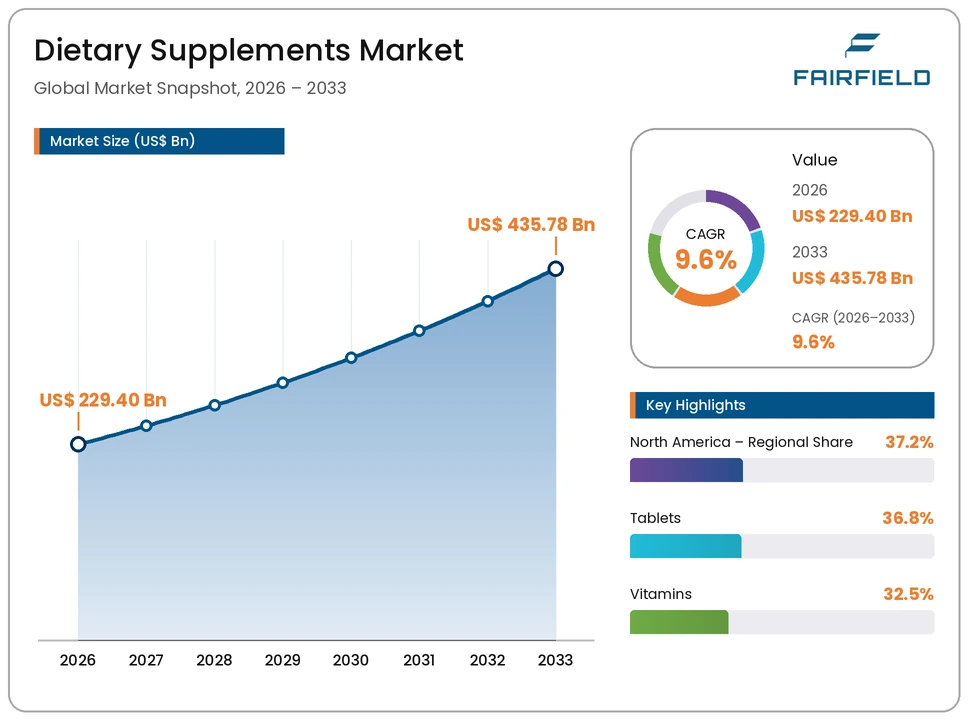
The global dietary supplements market is expected to be valued at US$ 229.40 Billion in 2026 and is projected to reach US$ 435.78 Billion by 2033, growing at a CAGR of 9.6% between 2026 and 2033. This trajectory reflects both volume expansion and premiumisation consumers are trading up to condition-specific, clinically substantiated formulations. The World Health Organization (WHO)'s sustained emphasis on non-communicable disease prevention through nutritional intervention reinforces policy tailwinds across multiple geographies, lending institutional credibility to a market that private equity and strategic acquirers are now treating as a durable growth asset.
Key Highlights
- North America leads the dietary supplements market with a value of US$ 85.34 billion, supported by strong consumer adoption, a favorable regulatory environment, and well-established retail and e-commerce distribution channels.
- Asia Pacific is the fastest-growing regional market with a 12.1% CAGR, driven by China's Healthy China 2030 initiative, rising disposable incomes, and expanding health awareness across the region.
- Vitamins account for 32.5% of global dietary supplements revenue, supported by widespread physician recommendations, strong consumer trust, and consistent repeat purchases.
- Gummies are the fastest-growing delivery format, driven by increasing consumer preference for convenient and easy-to-consume supplements among adults and older populations.
- Precision nutrition, combining biomarker testing, microbiome analysis, and AI-driven personalized supplement recommendations, represents the most significant growth opportunity through 2033.
Key Growth Determinants
- Preventive Healthcare Adoption and Shifting Consumer Health Paradigms
Consumers across income brackets are increasingly self-managing health rather than relying exclusively on reactive clinical care. The U.S. Centers for Disease Control and Prevention (CDC) reports that six in ten American adults live with at least one chronic disease, a figure that has intensified consumer interest in nutritional interventions targeting metabolic function, cardiovascular health, and cognitive longevity. Retail pharmacy chains including Walgreens Boots Alliance have responded by expanding dedicated nutraceutical planogram space, while direct-to-consumer supplement brands now routinely deploy personalised nutrient assessments at the point of sale. This demand-pull dynamic is self-reinforcing: as mainstream distribution widens, category awareness grows, drawing first-time buyers into the dietary supplements space at younger life stages.
Key Growth Barriers
- Regulatory Complexity and Evolving Labelling Standards
The dietary supplements industry operates under a fragmented and tightening global regulatory architecture. In the U.S., the Food and Drug Administration (FDA) enforces Current Good Manufacturing Practice (cGMP) regulations under 21 CFR Part 111, while the European Food Safety Authority (EFSA) applies a substantially more restrictive health claims framework that limits permissible structure-function language on packaging. Compliance costs particularly for companies pursuing simultaneous market authorisation across the U.S., EU, and Asia Pacific can constitute a meaningful portion of a small manufacturer's operating budget, effectively raising barriers to entry and slowing product launch velocity for growth-stage brands.
Dietary Supplements Market Opportunities
- Personalized Nutrition and Precision Supplementation
The convergence of genomics, microbiome science, and wearable health technology is opening a substantively new tier of demand within the dietary supplements landscape. Companies such as Nestlé Health Science, through its acquisition of Persona Nutrition in 2019 and subsequent platform investment through 2024, are operationalising nutrient recommendations derived from individual biomarker profiles. The cost of at-home microbiome testing has fallen sharply driven by next-generation sequencing economics making precision supplementation commercially viable for a broader consumer base. Brands that successfully integrate biomarker-driven customisation into their subscription infrastructure stand to command significant price premiums and reduce churn relative to category averages.
Market Segmentation Analysis
- Product Type Analysis
Vitamins account for 32.5% of the global dietary supplements market in 2026, equivalent to US$ 74.56 Billion, anchored by their broad clinical recognition and universal consumer accessibility. Primary care physicians routinely recommend Vitamin D supplementation for populations with limited sun exposure particularly in Northern Europe and North America while Vitamin B-complex formulations are widely used by office-based workers managing fatigue and stress-related nutrient depletion. Multivitamin regimens recommended by general practitioners and dispensed through pharmacy channels sustain consistent repurchase behaviour across age cohorts, reinforcing Vitamins' structural dominance.
Herbal Supplements are the fastest-growing product segment, accelerated by rising consumer interest in adaptogens and traditional botanical medicine. Gaia Herbs and MegaFood expanded ashwagandha and turmeric-based product lines significantly through 2023–2024, responding to clinical literature on stress modulation and anti-inflammatory efficacy. European Medicines Agency (EMA) recognition of several herbal monographs has lent regulatory credibility to the segment in key Western markets.
- Form Analysis
Tablets represent 36.8% of the global dietary supplements market in 2026, equivalent to US$ 84.42 Billion, reflecting their established supply chain infrastructure, dosing precision, and long shelf life. Hospital pharmacies and clinical nutrition programmes favour tablet-form micronutrients including iron supplementation protocols managed under WHO anaemia-reduction guidelines because precise mg-level dosing is critical to therapeutic outcomes. Contract manufacturers across India and China have built highly efficient tablet compression capacity serving both branded and private-label clients, sustaining competitive pricing that reinforces the format's market dominance.
Gummies are the fastest-growing delivery format, driven by adult consumers seeking palatability and convenience without the perceived medicinal association of tablets. Olly Nutrition, acquired by Unilever and subsequently integrated into its health and wellbeing portfolio, has demonstrated that premium gummy positioning commands retail price points comparable to capsule formats. Church & Dwight's VITAFUSION brand expanded its gummy line with targeted sleep and immunity SKUs in 2023, capturing incremental shelf space in mass retail channels.
- Application Analysis
General Health & Wellness leads application demand at 34.5% of the global dietary supplements market in 2026, equivalent to US$ 79.14 Billion, reflecting its broad consumer appeal across demographics. Retail buyers from millennials assembling daily supplement stacks to older adults following preventive nutrition regimens primarily cite general wellbeing as their purchasing motivation in Council for Responsible Nutrition (CRN) annual consumer surveys. Workplace wellness programmes operated by large employers, including benefit-integrated supplement allowances offered through platforms such as Virgin Pulse, are further institutionalising everyday supplement use as a healthcare benefit.
Immunity Enhancement is the fastest-growing application segment, catalysed by pandemic-era behaviour change that has proven more durable than many analysts anticipated. Pfizer Inc.'s consumer health division now operating as Haleon following its 2022 demerger accelerated the launch of immune-support formulations featuring Vitamins C and D alongside zinc and elderberry extracts in 2023, targeting pharmacies and grocery channels simultaneously. Post-pandemic demand normalisation has been offset by growing awareness of immune health in older adult populations, sustaining the segment's above-average growth momentum.
Regional Insights
- North America Dietary Supplements Market Trends and Insights
North America accounts for 37.2% of the global dietary supplements market in 2026, representing US$ 85.34 Billion, underpinned by mature retail infrastructure, high per-capita supplement spending, and a regulatory framework under the Dietary Supplement Health and Education Act (DSHEA) of 1994 that enables relatively rapid product innovation. The CRN 2024 Consumer Survey on Dietary Supplements indicated that approximately 74% of U.S. adults use dietary supplements, sustaining category volume even as unit growth moderates. Retail diversification from specialty natural food chains to mass discounters and direct-to-consumer subscription platforms ensures broad consumer access across income segments.
U.S. Dietary Supplements Market Size
The U.S. dietary supplements market represents 87.5% of the North America regional market in 2026, equivalent to US$ 74.67 Billion. Sports nutrition and protein supplement demand among fitness-engaged millennials and Gen Z consumers is a primary volume driver, supported by the proliferation of boutique gym and studio fitness concepts. Continued investment in personalised nutrition platforms and wearable health integration will sustain above-category growth in premium formulation tiers through 2033.
Canada Dietary Supplements Market Size
The Canada dietary supplements market represents 8.9% of the North America regional market in 2026, equivalent to US$ 7.59 Billion. Health Canada's Natural Health Products Directorate, which requires a product licence for all natural health products sold in Canada, enforces among the most rigorous pre-market registration systems globally a regulatory posture that elevates category credibility and supports premium pricing. Growing interest in plant-based and vegan-certified supplement formulations among Canadian consumer’s signals continued premiumisation through the forecast period.
- Asia Pacific Dietary Supplements Market Trends and Insights
Asia Pacific accounts for 31.5% of the global dietary supplements market in 2026, representing US$ 72.26 Billion, and is the standout growth region at an estimated CAGR of 12.1%. Rising disposable incomes, accelerating e-commerce penetration, and a deep cultural heritage of traditional herbal medicine particularly in China, Japan, and South Korea are compressing the adoption timeline for modern supplement formulations. Regional governments are actively investing in nutritional health infrastructure: China's National Health Commission has prioritised nutrition education through its Healthy China 2030 initiative, which directly stimulates consumer supplement uptake.
China Dietary Supplements Market Size
The China dietary supplements market represents 34.2% of the Asia Pacific regional market in 2026, equivalent to US$ 24.71 Billion. Domestic e-commerce platforms Alibaba's Tmall and JD.com have become the dominant distribution channels for supplement brands, enabling international players to reach Chinese health consumers without a physical retail footprint. Regulatory modernisation by the National Medical Products Administration (NMPA) is expected to improve product quality standards and accelerate category legitimisation through the forecast horizon.
Japan Dietary Supplements Market Size
The Japan dietary supplements market represents 21.5% of the Asia Pacific regional market in 2026, equivalent to US$ 15.54 Billion. Japan's Foods with Function Claims (FFC) system, introduced by the Consumer Affairs Agency in 2015 and expanded through subsequent regulatory updates, enables manufacturers to substantiate specific health benefits with clinical evidence a framework that incentivises innovation and supports premium pricing. An exceptionally aged population profile sustains structural demand for bone health, cognitive function, and cardiovascular supplement categories.
India Dietary Supplements Market Size
The India dietary supplements market represents 18.7% of the Asia Pacific regional market in 2026, equivalent to US$ 13.51 Billion. Rapid urbanisation and growing awareness of preventive nutrition among India's young professional population are driving first-time category entry at scale. Investment by Tata Consumer Products and Hindustan Unilever in branded nutraceutical platforms signals that the Indian dietary supplements sector is entering a phase of organised market development that will significantly expand accessible consumer reach through 2033.
Competitive Landscape
The global dietary supplements market is moderately consolidated at the top, with a long and competitive tail of regional and direct-to-consumer challengers. Herbalife Nutrition Ltd., Amway Corp., Abbott, and Bayer AG (through its Consumer Health division) anchor the upper tier through diversified product portfolios, global distribution networks, and established clinical substantiation capabilities.
Competition is decided primarily on three axes: brand trust and third-party certification credentials (particularly NSF International and USP verification), e-commerce channel sophistication, and the speed of innovation in condition-specific and personalised formulation. Private-label growth particularly through retailers such as Costco and Amazon's private brands is pressuring mid-market branded players on price, accelerating a bifurcation between premium clinical brands and value private-label offerings.
Companies Covered in Dietary Supplements Market
- Amway Corp.
- Abbott
- Bayer AG
- Glanbia plc
- Pfizer Inc.
- Archer Daniels Midland
- NU SKIN
- GlaxoSmithKline plc (now Haleon)
- Herbalife Nutrition Ltd.
- Nature's Sunshine Products, Inc.
- XanGo, LLC
- RBK Nutraceuticals Pty Ltd
- American Health
- International Flavors & Fragrances Inc.
- Good Health New Zealand
- Nature's Bounty
- NOW Foods
Market Segmentation
By Product Type
- Vitamins
- Minerals
- Herbal Supplements
- Proteins & Amino Acids
- Probiotics
- Others
By Form
- Tablets
- Capsules
- Powders
- Gummies
- Liquids
- Soft Gels
- Others
By Application
- General Health & Wellness
- Immunity Enhancement
- Sports Nutrition
- Bone & Joint Health
- Digestive Health
- Weight Management
- Others
By Region
- North America
- Europe
- Asia Pacific
- Latin America
- Middle East & Africa
- Executive Summary
- Global Dietary Supplements Market Snapshot
- Future Projections
- Key Market Trends
- Regional Snapshot, by Value, 2026
- Analyst Recommendations
- Market Overview
- Market Definitions and Segmentations
- Market Dynamics
- Drivers
- Restraints
- Market Opportunities
- Value Chain Analysis
- COVID-19 Impact Analysis
- Porter's Five Forces Analysis
- Impact of Russia-Ukraine Conflict
- PESTLE Analysis
- Regulatory Analysis
- Price Trend Analysis
- Current Prices and Future Projections, 2025-2033
- Price Impact Factors
- Global Dietary Supplements Market Outlook, 2020 - 2033
- Global Dietary Supplements Market Outlook, by Product Type, Value (US$ Bn), 2020-2033
- Vitamins
- Minerals
- Herbal Supplements
- Proteins & Amino Acids
- Probiotics
- Others
- Global Dietary Supplements Market Outlook, by Form, Value (US$ Bn), 2020-2033
- Tablets
- Capsules
- Powders
- Gummies
- Liquids
- Soft Gels
- Others
- Global Dietary Supplements Market Outlook, by Application, Value (US$ Bn), 2020-2033
- General Health & Wellness
- Immunity Enhancement
- Sports Nutrition
- Bone & Joint Health
- Digestive Health
- Weight Management
- Others
- Global Dietary Supplements Market Outlook, by Region, Value (US$ Bn), 2020-2033
- North America
- Europe
- Asia Pacific
- Latin America
- Middle East & Africa
- Global Dietary Supplements Market Outlook, by Product Type, Value (US$ Bn), 2020-2033
- North America Dietary Supplements Market Outlook, 2020 - 2033
- North America Dietary Supplements Market Outlook, by Product Type, Value (US$ Bn), 2020-2033
- Vitamins
- Minerals
- Herbal Supplements
- Proteins & Amino Acids
- Probiotics
- Others
- North America Dietary Supplements Market Outlook, by Form, Value (US$ Bn), 2020-2033
- Tablets
- Capsules
- Powders
- Gummies
- Liquids
- Soft Gels
- Others
- North America Dietary Supplements Market Outlook, by Application, Value (US$ Bn), 2020-2033
- General Health & Wellness
- Immunity Enhancement
- Sports Nutrition
- Bone & Joint Health
- Digestive Health
- Weight Management
- Others
- North America Dietary Supplements Market Outlook, by Country, Value (US$ Bn), 2020-2033
- U.S. Dietary Supplements Market Outlook, by Product Type, 2020-2033
- U.S. Dietary Supplements Market Outlook, by Form, 2020-2033
- U.S. Dietary Supplements Market Outlook, by Application, 2020-2033
- Canada Dietary Supplements Market Outlook, by Product Type, 2020-2033
- Canada Dietary Supplements Market Outlook, by Form, 2020-2033
- Canada Dietary Supplements Market Outlook, by Application, 2020-2033
- BPS Analysis/Market Attractiveness Analysis
- North America Dietary Supplements Market Outlook, by Product Type, Value (US$ Bn), 2020-2033
- Europe Dietary Supplements Market Outlook, 2020 - 2033
- Europe Dietary Supplements Market Outlook, by Product Type, Value (US$ Bn), 2020-2033
- Vitamins
- Minerals
- Herbal Supplements
- Proteins & Amino Acids
- Probiotics
- Others
- Europe Dietary Supplements Market Outlook, by Form, Value (US$ Bn), 2020-2033
- Tablets
- Capsules
- Powders
- Gummies
- Liquids
- Soft Gels
- Others
- Europe Dietary Supplements Market Outlook, by Application, Value (US$ Bn), 2020-2033
- General Health & Wellness
- Immunity Enhancement
- Sports Nutrition
- Bone & Joint Health
- Digestive Health
- Weight Management
- Others
- Europe Dietary Supplements Market Outlook, by Country, Value (US$ Bn), 2020-2033
- Germany Dietary Supplements Market Outlook, by Product Type, 2020-2033
- Germany Dietary Supplements Market Outlook, by Form, 2020-2033
- Germany Dietary Supplements Market Outlook, by Application, 2020-2033
- Italy Dietary Supplements Market Outlook, by Product Type, 2020-2033
- Italy Dietary Supplements Market Outlook, by Form, 2020-2033
- Italy Dietary Supplements Market Outlook, by Application, 2020-2033
- France Dietary Supplements Market Outlook, by Product Type, 2020-2033
- France Dietary Supplements Market Outlook, by Form, 2020-2033
- France Dietary Supplements Market Outlook, by Application, 2020-2033
- U.K. Dietary Supplements Market Outlook, by Product Type, 2020-2033
- U.K. Dietary Supplements Market Outlook, by Form, 2020-2033
- U.K. Dietary Supplements Market Outlook, by Application, 2020-2033
- Spain Dietary Supplements Market Outlook, by Product Type, 2020-2033
- Spain Dietary Supplements Market Outlook, by Form, 2020-2033
- Spain Dietary Supplements Market Outlook, by Application, 2020-2033
- Russia Dietary Supplements Market Outlook, by Product Type, 2020-2033
- Russia Dietary Supplements Market Outlook, by Form, 2020-2033
- Russia Dietary Supplements Market Outlook, by Application, 2020-2033
- Rest of Europe Dietary Supplements Market Outlook, by Product Type, 2020-2033
- Rest of Europe Dietary Supplements Market Outlook, by Form, 2020-2033
- Rest of Europe Dietary Supplements Market Outlook, by Application, 2020-2033
- BPS Analysis/Market Attractiveness Analysis
- Europe Dietary Supplements Market Outlook, by Product Type, Value (US$ Bn), 2020-2033
- Asia Pacific Dietary Supplements Market Outlook, 2020 - 2033
- Asia Pacific Dietary Supplements Market Outlook, by Product Type, Value (US$ Bn), 2020-2033
- Vitamins
- Minerals
- Herbal Supplements
- Proteins & Amino Acids
- Probiotics
- Others
- Asia Pacific Dietary Supplements Market Outlook, by Form, Value (US$ Bn), 2020-2033
- Tablets
- Capsules
- Powders
- Gummies
- Liquids
- Soft Gels
- Others
- Asia Pacific Dietary Supplements Market Outlook, by Application, Value (US$ Bn), 2020-2033
- General Health & Wellness
- Immunity Enhancement
- Sports Nutrition
- Bone & Joint Health
- Digestive Health
- Weight Management
- Others
- Asia Pacific Dietary Supplements Market Outlook, by Country, Value (US$ Bn), 2020-2033
- China Dietary Supplements Market Outlook, by Product Type, 2020-2033
- China Dietary Supplements Market Outlook, by Form, 2020-2033
- China Dietary Supplements Market Outlook, by Application, 2020-2033
- Japan Dietary Supplements Market Outlook, by Product Type, 2020-2033
- Japan Dietary Supplements Market Outlook, by Form, 2020-2033
- Japan Dietary Supplements Market Outlook, by Application, 2020-2033
- South Korea Dietary Supplements Market Outlook, by Product Type, 2020-2033
- South Korea Dietary Supplements Market Outlook, by Form, 2020-2033
- South Korea Dietary Supplements Market Outlook, by Application, 2020-2033
- India Dietary Supplements Market Outlook, by Product Type, 2020-2033
- India Dietary Supplements Market Outlook, by Form, 2020-2033
- India Dietary Supplements Market Outlook, by Application, 2020-2033
- Southeast Asia Dietary Supplements Market Outlook, by Product Type, 2020-2033
- Southeast Asia Dietary Supplements Market Outlook, by Form, 2020-2033
- Southeast Asia Dietary Supplements Market Outlook, by Application, 2020-2033
- Rest of SAO Dietary Supplements Market Outlook, by Product Type, 2020-2033
- Rest of SAO Dietary Supplements Market Outlook, by Form, 2020-2033
- Rest of SAO Dietary Supplements Market Outlook, by Application, 2020-2033
- BPS Analysis/Market Attractiveness Analysis
- Asia Pacific Dietary Supplements Market Outlook, by Product Type, Value (US$ Bn), 2020-2033
- Latin America Dietary Supplements Market Outlook, 2020 - 2033
- Latin America Dietary Supplements Market Outlook, by Product Type, Value (US$ Bn), 2020-2033
- Vitamins
- Minerals
- Herbal Supplements
- Proteins & Amino Acids
- Probiotics
- Others
- Latin America Dietary Supplements Market Outlook, by Form, Value (US$ Bn), 2020-2033
- Tablets
- Capsules
- Powders
- Gummies
- Liquids
- Soft Gels
- Others
- Latin America Dietary Supplements Market Outlook, by Application, Value (US$ Bn), 2020-2033
- General Health & Wellness
- Immunity Enhancement
- Sports Nutrition
- Bone & Joint Health
- Digestive Health
- Weight Management
- Others
- Latin America Dietary Supplements Market Outlook, by Country, Value (US$ Bn), 2020-2033
- Brazil Dietary Supplements Market Outlook, by Product Type, 2020-2033
- Brazil Dietary Supplements Market Outlook, by Form, 2020-2033
- Brazil Dietary Supplements Market Outlook, by Application, 2020-2033
- Mexico Dietary Supplements Market Outlook, by Product Type, 2020-2033
- Mexico Dietary Supplements Market Outlook, by Form, 2020-2033
- Mexico Dietary Supplements Market Outlook, by Application, 2020-2033
- Argentina Dietary Supplements Market Outlook, by Product Type, 2020-2033
- Argentina Dietary Supplements Market Outlook, by Form, 2020-2033
- Argentina Dietary Supplements Market Outlook, by Application, 2020-2033
- Rest of LATAM Dietary Supplements Market Outlook, by Product Type, 2020-2033
- Rest of LATAM Dietary Supplements Market Outlook, by Form, 2020-2033
- Rest of LATAM Dietary Supplements Market Outlook, by Application, 2020-2033
- BPS Analysis/Market Attractiveness Analysis
- Latin America Dietary Supplements Market Outlook, by Product Type, Value (US$ Bn), 2020-2033
- Middle East & Africa Dietary Supplements Market Outlook, 2020 - 2033
- Middle East & Africa Dietary Supplements Market Outlook, by Product Type, Value (US$ Bn), 2020-2033
- Vitamins
- Minerals
- Herbal Supplements
- Proteins & Amino Acids
- Probiotics
- Others
- Middle East & Africa Dietary Supplements Market Outlook, by Form, Value (US$ Bn), 2020-2033
- Tablets
- Capsules
- Powders
- Gummies
- Liquids
- Soft Gels
- Others
- Middle East & Africa Dietary Supplements Market Outlook, by Application, Value (US$ Bn), 2020-2033
- General Health & Wellness
- Immunity Enhancement
- Sports Nutrition
- Bone & Joint Health
- Digestive Health
- Weight Management
- Others
- Middle East & Africa Dietary Supplements Market Outlook, by Country, Value (US$ Bn), 2020-2033
- GCC Dietary Supplements Market Outlook, by Product Type, 2020-2033
- GCC Dietary Supplements Market Outlook, by Form, 2020-2033
- GCC Dietary Supplements Market Outlook, by Application, 2020-2033
- South Africa Dietary Supplements Market Outlook, by Product Type, 2020-2033
- South Africa Dietary Supplements Market Outlook, by Form, 2020-2033
- South Africa Dietary Supplements Market Outlook, by Application, 2020-2033
- Egypt Dietary Supplements Market Outlook, by Product Type, 2020-2033
- Egypt Dietary Supplements Market Outlook, by Form, 2020-2033
- Egypt Dietary Supplements Market Outlook, by Application, 2020-2033
- Nigeria Dietary Supplements Market Outlook, by Product Type, 2020-2033
- Nigeria Dietary Supplements Market Outlook, by Form, 2020-2033
- Nigeria Dietary Supplements Market Outlook, by Application, 2020-2033
- Rest of Middle East Dietary Supplements Market Outlook, by Product Type, 2020-2033
- Rest of Middle East Dietary Supplements Market Outlook, by Form, 2020-2033
- Rest of Middle East Dietary Supplements Market Outlook, by Application, 2020-2033
- BPS Analysis/Market Attractiveness Analysis
- Middle East & Africa Dietary Supplements Market Outlook, by Product Type, Value (US$ Bn), 2020-2033
- Competitive Landscape
- Company Vs Segment Heatmap
- Company Market Share Analysis, 2025
- Competitive Dashboard
- Company Profiles
- Amway Corp.
- Company Overview
- Product Portfolio
- Financial Overview
- Business Strategies and Developments
- Abbott
- Bayer AG
- Glanbia plc
- Pfizer Inc.
- Archer Daniels Midland
- NU SKIN
- GlaxoSmithKline plc.
- Herbalife Nutrition Ltd.
- Nature's Sunshine Products, Inc.
- XanGo, LLC
- RBK Nutraceuticals Pty Ltd
- American Health
- International Flavors & Fragrances Inc.
- Good Health New Zealand
- Amway Corp.
- Appendix
- Research Methodology
- Report Assumptions
- Acronyms and Abbreviations
By Product Type
- Vitamins
- Minerals
- Herbal Supplements
- Proteins & Amino Acids
- Probiotics
- Others
By Form
- Tablets
- Capsules
- Powders
- Gummies
- Liquids
- Soft Gels
- Others
By Application
- General Health & Wellness
- Immunity Enhancement
- Sports Nutrition
- Bone & Joint Health
- Digestive Health
- Weight Management
- Others
By Region
- North America
- Europe
- Asia Pacific
- Latin America
- Middle East & Africa
Our Research Methodology
Considering the volatility of business today, traditional approaches to strategizing a game plan can be unfruitful if not detrimental. True ambiguity is no way to determine a forecast. A myriad of predetermined factors must be accounted for such as the degree of risk involved, the magnitude of circumstances, as well as conditions or consequences that are not known or unpredictable. To circumvent binary views that cast uncertainty, the application of market research intelligence to strategically posture, move, and enable actionable outcomes is necessary.
View Methodology
Quality Assured
Rigorous Validation Process

Confidentiality Assured
End-to-end Data Security

Custom Research Services
Tailored To Your Objectives
FAQs
The global dietary supplements market is valued at US$ 229.40 Billion in 2026 and is projected to reach US$ 435.78 Billion by 2033, expanding at a CAGR of 9.6%.
Growth is driven by increasing chronic disease prevalence, rising consumer focus on preventive healthcare, and expanding digital health platforms that support personalized nutrition.
Vitamins lead with a 32.5% market share due to strong physician recommendations, broad consumer acceptance, and their wide range of health applications.
Personalized nutrition based on biomarker, genomic, and microbiome data represents the largest growth opportunity as consumers increasingly seek customized health solutions.
Personalized nutrition based on biomarker, genomic, and microbiome data represents the largest growth opportunity as consumers increasingly seek customized health solutions.
Related Reports
Clean-Label Butter Powders Market Size, Share, Insights, Competitive Landscape, and Forecast 2026 to 2033
The clean-label butter powders market is valued at US$0.882 billion in 2026 and projected to reach US$1.492 billion by 2033, growing at 7.8% CAGR
Black Rice Protein Market Size, Share, Insights, Competitive Landscape, and Forecast 2026 to 2033
The global black rice protein market is valued at US$0.2422 billion in 2026 and is projected to reach US$0.3890 billion by 2033, growing at a 7.0% CAGR
Air-based Foods Market Size, Share, Insights, Competitive Landscape, and Forecast 2026 to 2033
The global air-based foods market is projected to grow from US$4.61 billion in 2026 to US$10.52 billion by 2033, at a 12.5% CAGR
Plant-based Probiotics Market Size, Share, Insights, Competitive Landscape, and Forecast 2026 to 2033
Plant-based probiotics market to grow from US$1.1824 billion in 2026 to US$1.8618 billion by 2033, expanding at a CAGR of 6.7% during 2026–2033.
Probiotic Tea Market Size, Share, Insights, Competitive Landscape, and Forecast 2026 to 2033
The global probiotic tea market, valued at US$ 0.6466 billion in 2026 and projected to reach US$ 0.9722 billion by 2033, growing at 6.0% CAGR
Carbohydrase Food Enzymes Insights, Competitive Landscape, and Market Forecast 2026 to 2033
The global dimethyl sulfoxide market will reach US$ 432.0 Mn by 2033, growing at 5.8% CAGR from 2026-2033, driven by pharmaceutical and industrial demand