



Coffee Syrup Market
Coffee Syrup Market Insights, Competitive Landscape, and Market Forecast - 2033
Coffee Syrup Market Size, Share, and Growth Forecast 2026 - 2033
Key Market Highlights
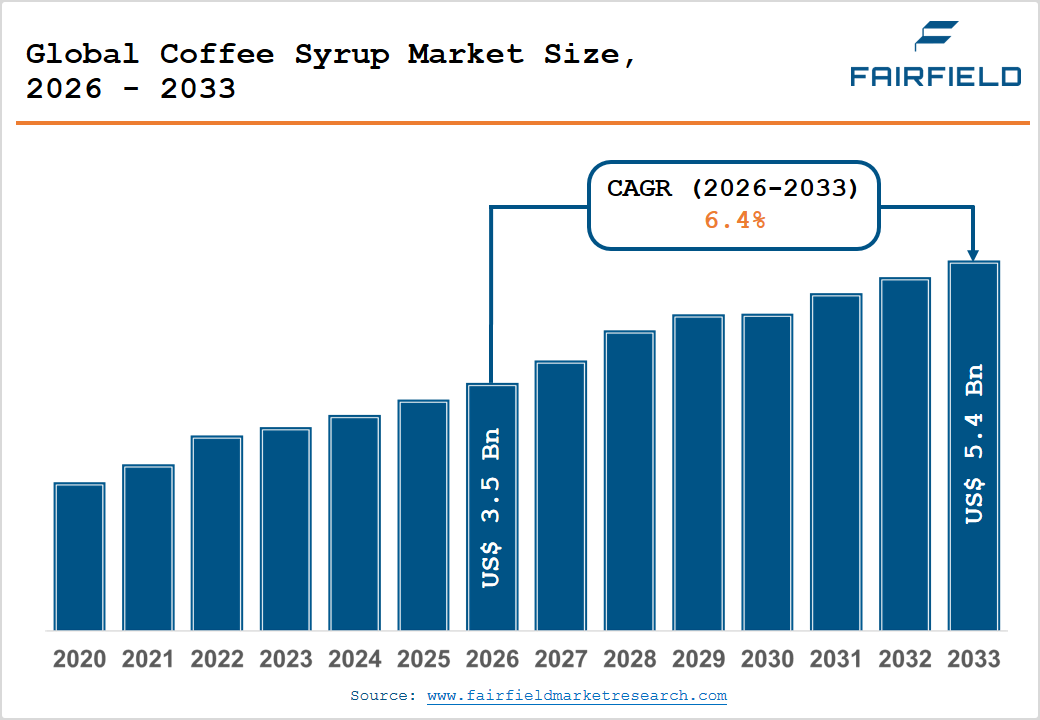
- The global Coffee Syrup Market size is likely to be valued at USD 3.5 billion in 2026 and is expected to reach USD 5.4 billion by 2033, growing at a CAGR of 6.40% during the forecast period from 2026 to 2033.
- Leading Region Market: North America dominates the Coffee Syrup Market with approximately 30% share, driven by surging coffee consumption in U.S. coffee consumption (66% daily drinkers per NCA 2024), strong e-commerce growth, and continuous product innovation by regional incumbents.
- Fastest Growing Region Market: Asia Pacific is the fastest growing Coffee Syrup Market region, fueled by record-high China, Japan, India, and ASEAN markets, alongside rapid café chain expansion and growing middle-class purchasing power.
- Dominant Application Segment: Coffee Beverages commands approximately 52% of application-based market share, driven by global café chain consumption and a thriving at-home brewing culture that necessitates flavored syrup usage.
- Fastest Growing Product Type Segment: The Sugar-Free Syrup segment is witnessing rapid growth, propelled by rising consumer health awareness, WHO sugar reduction guidelines, and expanding product lines by Monin, Torani, and Jordan's Skinny Mixes.
- Key Market Opportunity: The rapid café culture adoption Southeast Asia growing at 4-5% annually per ICO data represents a high-potential opportunity for localized, innovative coffee syrup products targeting new consumer demographics.
Market Dynamics
Market Growth Drivers
- Surging Global Coffee Consumption and Café Culture Expansion
The proliferation of specialty coffee shops and the growing 'third-wave coffee' movement have significantly elevated consumer interest in premium beverage customization, directly driving demand for coffee syrups. According to the Specialty Coffee Association (SCA), the specialty coffee segment accounts for nearly 55% of total U.S. coffee consumption, and this proportion is growing in Europe and Asia Pacific as well. The rise of at-home barista culture, further amplified by the COVID-19 pandemic, has led consumers to invest in flavoring solutions that replicate café-quality beverages. Platforms such as TikTok and Instagram have also popularized visually appealing coffee recipes featuring syrups, creating viral demand. This sustained lifestyle trend continues to support robust market growth.
- Innovation in Health-Oriented and Clean-Label Syrup Formulations
Increasing health awareness among consumers is pushing manufacturers to develop sugar-free, low-calorie, and organic coffee syrup variants, opening a wider consumer base beyond traditional syrup users. The U.S. Food and Drug Administration (FDA) has reinforced clean-label standards, and the European Food Safety Authority (EFSA) has established stringent guidelines on artificial sweetener usage, pushing brands toward stevia- and monk fruit-based alternatives, organic food and beverage sales in the U.S. were substantial in 2023, and functional beverages have become one of the fastest‑growing segments within this market. This shift has encouraged companies like Monin and Torani to expand their sugar-free and organic portfolio, contributing to broader market penetration.
Market Restraints
- Volatility in Raw Material Prices
Coffee syrups rely on core ingredients such as cane sugar, high-fructose corn syrup, natural flavors, and vanilla extracts, all of which are subject to significant price volatility. The Food and Agriculture Organization (FAO) reported that global food commodity prices experienced multiple periods of elevated volatility between 2021 and 2024, with sugar prices rising by over 40% during certain periods due to adverse weather and supply disruptions. This cost pressure directly compresses manufacturer margins, particularly for small and mid-sized producers unable to hedge commodity exposure, potentially constraining product affordability and market accessibility in price-sensitive regions.
- Rising Health Concerns Over High Sugar Content
Traditional coffee syrups contain high levels of added sugars, which face increasing regulatory and consumer scrutiny. The World Health Organization (WHO) recommends limiting free sugar intake to less than 10% of total energy intake, and several national governments have introduced sugar taxes targeting sweetened beverages and syrups. The UK Soft Drinks Industry Levy, implemented in 2018, set a precedent that other markets are following. As consumers become more nutrition-conscious, demand for conventional high-sugar syrups may face moderation, compelling manufacturers to either reformulate products or accept reduced market share in health-conscious segments, which could restrain overall market revenue growth.
Market Opportunities
- Rapid Expansion of Online Retail and Direct-to-Consumer Channels
The accelerating shift toward e-commerce presents a transformative opportunity for coffee syrup brands to reach global consumers without the constraints of physical retail distribution. According to the U.S. Census Bureau, U.S. e-commerce retail sales reached $1.12 trillion in 2023, growing by nearly 8% year-over-year, with food and beverage being among the fastest-growing categories. Brands such as Jordan's Skinny Mixes have already demonstrated the viability of direct-to-consumer digital models, generating strong customer loyalty through subscription offerings and seasonal limited-edition flavors. The online channel also allows niche brands like Amoretti Inc. and Absolute Syrups to compete on a level playing field with larger incumbents, tapping into the growing gourmet-at-home trend.
- Untapped Potential in Asia Pacific Emerging Markets
Emerging markets represents a high-growth frontier for the coffee syrup market, driven by rapid urbanization, rising disposable incomes, and a expanding café culture across key economies. According to the International Coffee Organization (ICO), coffee consumption in the region grew at an annual rate of about 4–5% annually over 2020–2023, far outpacing mature Western markets. In India, the Coffee Board of India reported a significant uptick in café chain expansions across Tier II and Tier III cities. International chains such as Starbucks and domestic café brands are increasingly incorporating flavored syrups in their menus, creating substantial B2B demand. Companies that invest early in localized product offerings such as chai-infused or matcha-coffee fusion syrups can secure a strong competitive position in this high-potential region.
Segmental Insights
- By Product Type Analysis
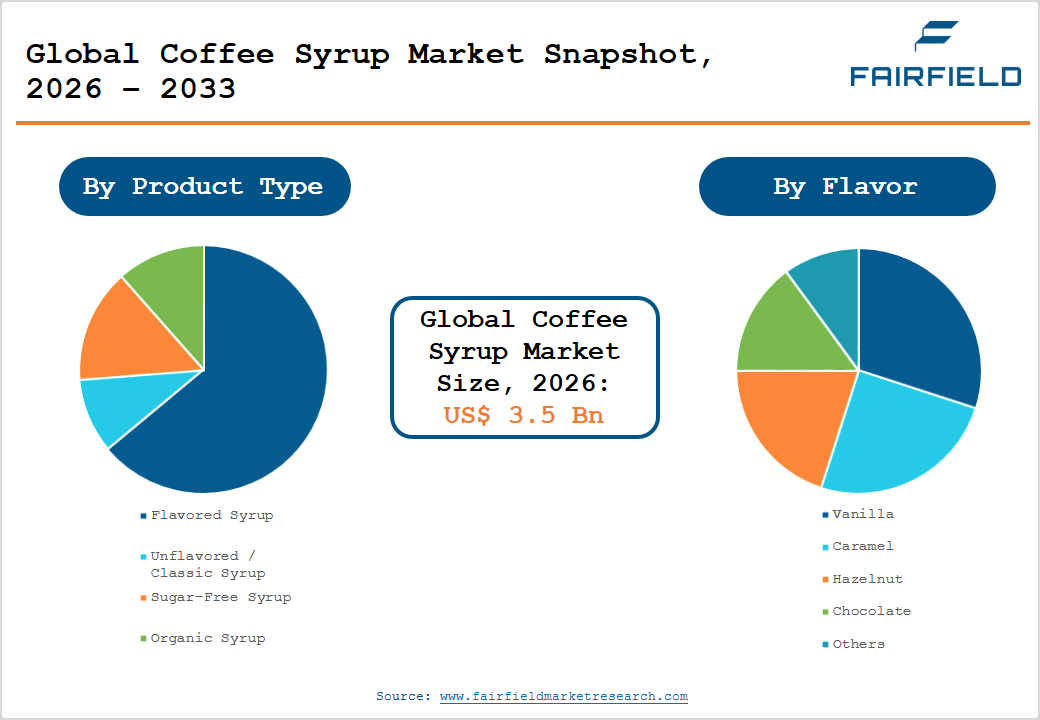
The Flavoured Syrup segment dominates the Coffee Syrup Market by Product type, commanding approximately 45% of the total market share. This leadership is underpinned by its widespread adoption across both retail and foodservice channels, where consumers seek to replicate the complex flavor profiles of specialty café beverages at home. Flavored syrups encompass a broad spectrum from classic vanilla and caramel to exotic lavender and salted toffee variants allowing brands to continuously innovate and attract new consumers. The Specialty Coffee Association (SCA) has noted consistent consumer preference for customized beverages, further reinforcing the primacy of this segment. The availability of flavored syrups in convenient pump-bottle packaging popular in the foodservice segment also bolsters its dominance across all distribution channels globally.
- By Flavor Analysis
Vanilla is the leading flavor segment in the Coffee Syrup Market, holding an estimated share of approximately 28%. Its dominance is attributed to its universal palate appeal, versatility across coffee, bakery, and dairy applications, and its status as a classic flavoring in Western coffee culture. According to McCormick & Company, vanilla consistently ranks as one of the top two most preferred flavors globally across beverage and food categories. Vanilla-flavored coffee syrups serve as an entry-level flavor for new syrup users, and their compatibility with espresso, lattes, cold brews, and specialty drinks ensures perennial demand. Leading brands including Torani and Monin list vanilla as their top-selling SKU, reinforcing its structural dominance within the flavor segment.
- By Application Analysis
The Coffee Beverages segment leads the application category, representing approximately 52% of total market share. This is the most natural and direct application of coffee syrups, as they are formulated specifically to complement the flavor profile of espresso and other coffee drinks. The global café industry bolstered by chains like Starbucks Corporation, Costa Coffee, and thousands of independent specialty coffee shops consumes large volumes of flavored syrups as a core ingredient. Additionally, the growing at-home coffee culture has fueled retail syrup sales to consumers who invest in espresso machines and manual brewing equipment. Data from the National Coffee Association (NCA) indicates that approximately 66% of Americans drink coffee daily, sustaining the high baseline demand for coffee-specific flavoring solutions.
- By Distribution Channel Analysis
Foodservice is the leading distribution channel segment, accounting for approximately 38% of the total Coffee Syrup Market share. Coffee shops, quick-service restaurants, hotels, and institutional food operators represent large-volume, recurring buyers of syrups in bulk or pump-bottle formats. The post-pandemic recovery of the out-of-home dining and hospitality sector has significantly revitalized foodservice volumes. According to the National Restaurant Association (NRA), U.S. restaurant and foodservice industry sales were projected to reach $1.1 trillion in 2024 a record high reflecting strong recovery. Additionally, major coffee chains maintaining global footprints, including Starbucks and Costa Coffee, rely on standardized flavored syrup usage across their menus, driving consistent and large-scale demand through the foodservice distribution channel.
Regional Insights
- North America Coffee Syrup Market Trends
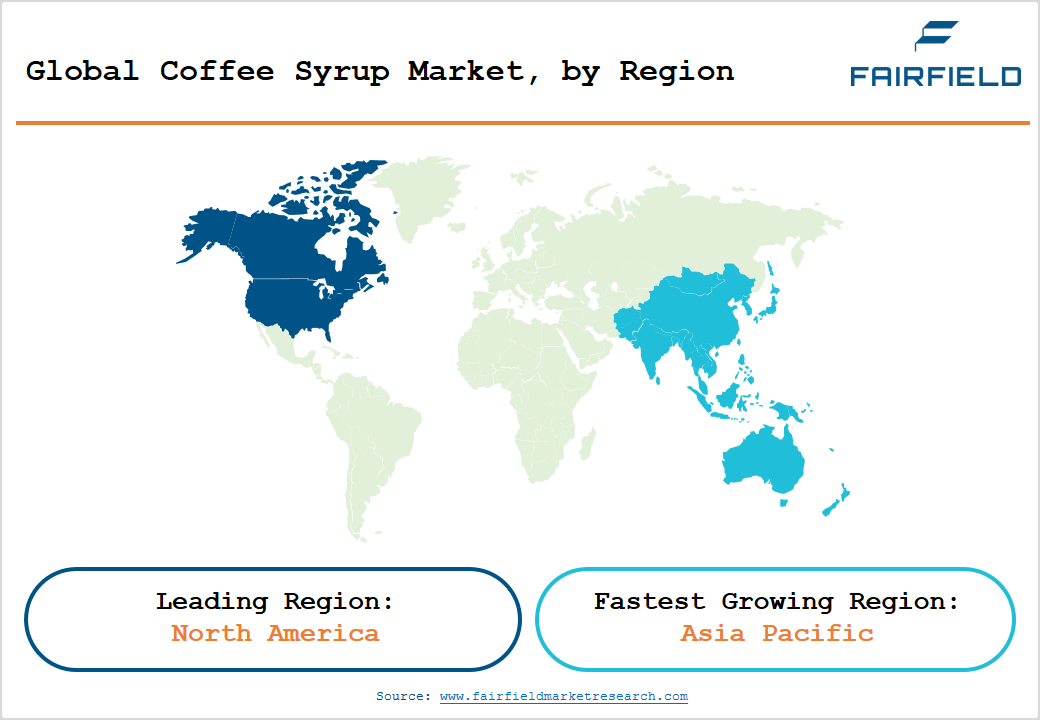
North America is leading region in the global Coffee Syrup Market, commanding approximately 30% of total market share in 2026, driven by the strong café culture rooted in the U.S., a high per-capita coffee consumption rate, and rapid product innovation by regional incumbents. The National Coffee Association (NCA) reported in its 2024 National Coffee Data Trends survey that 66% of American adults consume coffee daily, the highest ever recorded. The foodservice sector continues to be the largest end-user, with major chains like Starbucks and independent specialty cafés significantly contributing to B2B syrup consumption.
At the retail level, e-commerce platforms are reshaping how consumers access premium and specialty syrups. Brands such as Torani (headquartered in San Leandro, California) and DaVinci Gourmet continue to innovate with limited-edition seasonal flavors targeting the at-home barista segment. The U.S. FDA's clean-label guidelines and consumer demand for transparency are accelerating the shift to natural and organic formulations, creating new revenue streams for established and emerging brands across the region.
- Europe Coffee Syrup Market Trends
Europe holds a strong position in the global Coffee Syrup Market, with Germany, the U.K., France, and Spain being the key contributing markets. The well-entrenched café culture in Western Europe, combined with increasing consumer sophistication around coffee quality and customization, supports steady demand. Germany, as Europe's largest coffee consuming nation by volume according to the German Coffee Association (DKV), drives significant demand from both retail consumers and the foodservice sector.
Regulatory harmonization under the European Food Safety Authority (EFSA) is shaping product reformulation strategies across the region, particularly around sugar content, permitted sweeteners, and labeling requirements. The UK Soft Drinks Industry Levy has incentivized manufacturers to develop reduced-sugar syrup variants for the British market. Meanwhile, France and Spain are witnessing growth in artisanal café formats, increasing demand for premium and specialty syrups, with brands like 1883 Maison Routin (France) particularly well-positioned to leverage their heritage.
- Asia Pacific Coffee Syrup Market Trends
Asia Pacific is the fastest growing region in the global Coffee Syrup Market. The region is driven by its large population base, rapid urbanization, rising middle-class incomes, and a transformative shift from tea to coffee consumption across markets including China, Japan, India, and ASEAN nations. The International Coffee Organization (ICO) has cited Asia as the fastest-growing coffee consuming region globally, with annual consumption growth of 4–5%.
China has emerged as a particularly significant growth engine; the China National Coffee Association reported that coffee consumption in China grew at approximately 15% annually in recent years. Japan, with its established vending machine and canned coffee culture, is integrating flavored syrups into premium ready-to-drink segments. In India, the expansion of international café chains and home brewing habits is spurring syrup adoption. UCC Ueshima Coffee Co., Ltd. and regional players are scaling manufacturing capabilities to meet the region's surging demand, reinforcing Asia Pacific's leadership.
Competitive Landscape
The global Coffee Syrup Market exhibits a moderately fragmented competitive structure, with a mix of global players, regional specialists, and niche artisanal brands. Torani, Monin, and DaVinci Gourmet collectively command a significant share of the premium segment, leveraging widespread foodservice partnerships and robust retail distribution networks. Key competitive differentiators include flavor breadth, packaging innovation (e.g., pump bottles, mini bottles), and health-oriented formulations (sugar-free, organic). Companies are increasingly pursuing direct-to-consumer e-commerce strategies, co-branding partnerships with café chains, and geographic expansion into Asia Pacific. Research and development investments are focused on natural sweetener adoption, clean-label certification, and unique regional flavor development to capture evolving consumer preferences.
Key Market Developments
- January 2025: Torani launched an expanded 'Simply Syrup' organic line featuring 10 new naturally flavored varieties targeting health-conscious retail consumers across North America, reinforcing its leadership in clean-label coffee syrup innovation.
- March 2024: Monin, Inc. announced the opening of a new production facility in Southeast Asia to scale manufacturing capacity and strengthen its distribution footprint across the high-growth Asia Pacific market.
- October 2023: Starbucks Corporation extended its at-home syrup range through a strategic retail partnership with Nestlé S.A. under the Starbucks at Home platform, broadening consumer access to branded coffee syrups globally.
Companies Covered in Coffee Syrup Market
- Torani (owned by Torre & Company, Inc.)
- Monin, Inc.
- DaVinci Gourmet (owned by Hain Celestial Group)
- 1883 Maison Routin
- Ghirardelli Chocolate Company
- Jordan's Skinny Mixes
- Bickford's Australia
- Absolute Syrups
- Amoretti Inc.
- Finest Call (by Sazerac Company)
- Coffee Connection Brand
- Daelmans Coffee Syrups
- UCC Ueshima Coffee Co., Ltd.
- Nestlé S.A.
- Starbucks Corporation
- Lavazza S.p.A.
- Routin 1883
- Tate & Lyle PLC
Market Segmentation
By Product Type
- Flavored Syrup
- Unflavored / Classic Syrup
- Sugar-Free Syrup
- Organic Syrup
By Flavor
- Vanilla
- Caramel
- Hazelnut
- Chocolate
- Others
By Application
- Coffee Beverages
- Other Beverages
- Bakery & Confectionery
- Dairy & Frozen Desserts
By Distribution Channel
- Supermarkets / Hypermarkets
- Convenience Stores
- Online Retail
- Foodservice
By Region
- North America
- Europe
- Asia Pacific
- Latin America
- Middle East & Africa
- Executive Summary
- Global Coffee Syrup Market Snapshot
- Future Projections
- Key Market Trends
- Regional Snapshot, by Value, 2026
- Analyst Recommendations
- Market Overview
- Market Definitions and Segmentations
- Market Dynamics
- Drivers
- Restraints
- Market Opportunities
- Value Chain Analysis
- COVID-19 Impact Analysis
- Porter's Five Forces Analysis
- Impact of Russia-Ukraine Conflict
- PESTLE Analysis
- Regulatory Analysis
- Price Trend Analysis
- Current Prices and Future Projections, 2025-2033
- Price Impact Factors
- Global Coffee Syrup Market Outlook, 2020 - 2033
- Global Coffee Syrup Market Outlook, by Product Type, Value (US$ Bn), 2020-2033
- Flavored Syrup
- Unflavored / Classic Syrup
- Sugar-Free Syrup
- Organic Syrup
- Global Coffee Syrup Market Outlook, by Flavor, Value (US$ Bn), 2020-2033
- Vanilla
- Caramel
- Hazelnut
- Chocolate
- OthersApplication
- Global Coffee Syrup Market Outlook, by Application, Value (US$ Bn), 2020-2033
- Coffee Beverages
- Other Beverages
- Bakery & Confectionery
- Dairy & Frozen Desserts
- Global Coffee Syrup Market Outlook, by Region, Value (US$ Bn), 2020-2033
- North America
- Europe
- Asia Pacific
- Latin America
- Middle East & Africa
- Global Coffee Syrup Market Outlook, by Product Type, Value (US$ Bn), 2020-2033
- North America Coffee Syrup Market Outlook, 2020 - 2033
- North America Coffee Syrup Market Outlook, by Product Type, Value (US$ Bn), 2020-2033
- Flavored Syrup
- Unflavored / Classic Syrup
- Sugar-Free Syrup
- Organic Syrup
- North America Coffee Syrup Market Outlook, by Flavor, Value (US$ Bn), 2020-2033
- Vanilla
- Caramel
- Hazelnut
- Chocolate
- OthersApplication
- North America Coffee Syrup Market Outlook, by Application, Value (US$ Bn), 2020-2033
- Coffee Beverages
- Other Beverages
- Bakery & Confectionery
- Dairy & Frozen Desserts
- North America Coffee Syrup Market Outlook, by Country, Value (US$ Bn), 2020-2033
- U.S. Coffee Syrup Market Outlook, by Product Type, 2020-2033
- U.S. Coffee Syrup Market Outlook, by Flavor, 2020-2033
- U.S. Coffee Syrup Market Outlook, by Application, 2020-2033
- Canada Coffee Syrup Market Outlook, by Product Type, 2020-2033
- Canada Coffee Syrup Market Outlook, by Flavor, 2020-2033
- Canada Coffee Syrup Market Outlook, by Application, 2020-2033
- BPS Analysis/Market Attractiveness Analysis
- North America Coffee Syrup Market Outlook, by Product Type, Value (US$ Bn), 2020-2033
- Europe Coffee Syrup Market Outlook, 2020 - 2033
- Europe Coffee Syrup Market Outlook, by Product Type, Value (US$ Bn), 2020-2033
- Flavored Syrup
- Unflavored / Classic Syrup
- Sugar-Free Syrup
- Organic Syrup
- Europe Coffee Syrup Market Outlook, by Flavor, Value (US$ Bn), 2020-2033
- Vanilla
- Caramel
- Hazelnut
- Chocolate
- OthersApplication
- Europe Coffee Syrup Market Outlook, by Application, Value (US$ Bn), 2020-2033
- Coffee Beverages
- Other Beverages
- Bakery & Confectionery
- Dairy & Frozen Desserts
- Europe Coffee Syrup Market Outlook, by Country, Value (US$ Bn), 2020-2033
- Germany Coffee Syrup Market Outlook, by Product Type, 2020-2033
- Germany Coffee Syrup Market Outlook, by Flavor, 2020-2033
- Germany Coffee Syrup Market Outlook, by Application, 2020-2033
- Italy Coffee Syrup Market Outlook, by Product Type, 2020-2033
- Italy Coffee Syrup Market Outlook, by Flavor, 2020-2033
- Italy Coffee Syrup Market Outlook, by Application, 2020-2033
- France Coffee Syrup Market Outlook, by Product Type, 2020-2033
- France Coffee Syrup Market Outlook, by Flavor, 2020-2033
- France Coffee Syrup Market Outlook, by Application, 2020-2033
- U.K. Coffee Syrup Market Outlook, by Product Type, 2020-2033
- U.K. Coffee Syrup Market Outlook, by Flavor, 2020-2033
- U.K. Coffee Syrup Market Outlook, by Application, 2020-2033
- Spain Coffee Syrup Market Outlook, by Product Type, 2020-2033
- Spain Coffee Syrup Market Outlook, by Flavor, 2020-2033
- Spain Coffee Syrup Market Outlook, by Application, 2020-2033
- Russia Coffee Syrup Market Outlook, by Product Type, 2020-2033
- Russia Coffee Syrup Market Outlook, by Flavor, 2020-2033
- Russia Coffee Syrup Market Outlook, by Application, 2020-2033
- Rest of Europe Coffee Syrup Market Outlook, by Product Type, 2020-2033
- Rest of Europe Coffee Syrup Market Outlook, by Flavor, 2020-2033
- Rest of Europe Coffee Syrup Market Outlook, by Application, 2020-2033
- BPS Analysis/Market Attractiveness Analysis
- Europe Coffee Syrup Market Outlook, by Product Type, Value (US$ Bn), 2020-2033
- Asia Pacific Coffee Syrup Market Outlook, 2020 - 2033
- Asia Pacific Coffee Syrup Market Outlook, by Product Type, Value (US$ Bn), 2020-2033
- Flavored Syrup
- Unflavored / Classic Syrup
- Sugar-Free Syrup
- Organic Syrup
- Asia Pacific Coffee Syrup Market Outlook, by Flavor, Value (US$ Bn), 2020-2033
- Vanilla
- Caramel
- Hazelnut
- Chocolate
- OthersApplication
- Asia Pacific Coffee Syrup Market Outlook, by Application, Value (US$ Bn), 2020-2033
- Coffee Beverages
- Other Beverages
- Bakery & Confectionery
- Dairy & Frozen Desserts
- Asia Pacific Coffee Syrup Market Outlook, by Country, Value (US$ Bn), 2020-2033
- China Coffee Syrup Market Outlook, by Product Type, 2020-2033
- China Coffee Syrup Market Outlook, by Flavor, 2020-2033
- China Coffee Syrup Market Outlook, by Application, 2020-2033
- Japan Coffee Syrup Market Outlook, by Product Type, 2020-2033
- Japan Coffee Syrup Market Outlook, by Flavor, 2020-2033
- Japan Coffee Syrup Market Outlook, by Application, 2020-2033
- South Korea Coffee Syrup Market Outlook, by Product Type, 2020-2033
- South Korea Coffee Syrup Market Outlook, by Flavor, 2020-2033
- South Korea Coffee Syrup Market Outlook, by Application, 2020-2033
- India Coffee Syrup Market Outlook, by Product Type, 2020-2033
- India Coffee Syrup Market Outlook, by Flavor, 2020-2033
- India Coffee Syrup Market Outlook, by Application, 2020-2033
- Southeast Asia Coffee Syrup Market Outlook, by Product Type, 2020-2033
- Southeast Asia Coffee Syrup Market Outlook, by Flavor, 2020-2033
- Southeast Asia Coffee Syrup Market Outlook, by Application, 2020-2033
- Rest of SAO Coffee Syrup Market Outlook, by Product Type, 2020-2033
- Rest of SAO Coffee Syrup Market Outlook, by Flavor, 2020-2033
- Rest of SAO Coffee Syrup Market Outlook, by Application, 2020-2033
- BPS Analysis/Market Attractiveness Analysis
- Asia Pacific Coffee Syrup Market Outlook, by Product Type, Value (US$ Bn), 2020-2033
- Latin America Coffee Syrup Market Outlook, 2020 - 2033
- Latin America Coffee Syrup Market Outlook, by Product Type, Value (US$ Bn), 2020-2033
- Flavored Syrup
- Unflavored / Classic Syrup
- Sugar-Free Syrup
- Organic Syrup
- Latin America Coffee Syrup Market Outlook, by Flavor, Value (US$ Bn), 2020-2033
- Vanilla
- Caramel
- Hazelnut
- Chocolate
- OthersApplication
- Latin America Coffee Syrup Market Outlook, by Application, Value (US$ Bn), 2020-2033
- Coffee Beverages
- Other Beverages
- Bakery & Confectionery
- Dairy & Frozen Desserts
- Latin America Coffee Syrup Market Outlook, by Country, Value (US$ Bn), 2020-2033
- Brazil Coffee Syrup Market Outlook, by Product Type, 2020-2033
- Brazil Coffee Syrup Market Outlook, by Flavor, 2020-2033
- Brazil Coffee Syrup Market Outlook, by Application, 2020-2033
- Mexico Coffee Syrup Market Outlook, by Product Type, 2020-2033
- Mexico Coffee Syrup Market Outlook, by Flavor, 2020-2033
- Mexico Coffee Syrup Market Outlook, by Application, 2020-2033
- Argentina Coffee Syrup Market Outlook, by Product Type, 2020-2033
- Argentina Coffee Syrup Market Outlook, by Flavor, 2020-2033
- Argentina Coffee Syrup Market Outlook, by Application, 2020-2033
- Rest of LATAM Coffee Syrup Market Outlook, by Product Type, 2020-2033
- Rest of LATAM Coffee Syrup Market Outlook, by Flavor, 2020-2033
- Rest of LATAM Coffee Syrup Market Outlook, by Application, 2020-2033
- BPS Analysis/Market Attractiveness Analysis
- Latin America Coffee Syrup Market Outlook, by Product Type, Value (US$ Bn), 2020-2033
- Middle East & Africa Coffee Syrup Market Outlook, 2020 - 2033
- Middle East & Africa Coffee Syrup Market Outlook, by Product Type, Value (US$ Bn), 2020-2033
- Flavored Syrup
- Unflavored / Classic Syrup
- Sugar-Free Syrup
- Organic Syrup
- Middle East & Africa Coffee Syrup Market Outlook, by Flavor, Value (US$ Bn), 2020-2033
- Vanilla
- Caramel
- Hazelnut
- Chocolate
- OthersApplication
- Middle East & Africa Coffee Syrup Market Outlook, by Application, Value (US$ Bn), 2020-2033
- Coffee Beverages
- Other Beverages
- Bakery & Confectionery
- Dairy & Frozen Desserts
- Middle East & Africa Coffee Syrup Market Outlook, by Country, Value (US$ Bn), 2020-2033
- GCC Coffee Syrup Market Outlook, by Product Type, 2020-2033
- GCC Coffee Syrup Market Outlook, by Flavor, 2020-2033
- GCC Coffee Syrup Market Outlook, by Application, 2020-2033
- South Africa Coffee Syrup Market Outlook, by Product Type, 2020-2033
- South Africa Coffee Syrup Market Outlook, by Flavor, 2020-2033
- South Africa Coffee Syrup Market Outlook, by Application, 2020-2033
- Egypt Coffee Syrup Market Outlook, by Product Type, 2020-2033
- Egypt Coffee Syrup Market Outlook, by Flavor, 2020-2033
- Egypt Coffee Syrup Market Outlook, by Application, 2020-2033
- Nigeria Coffee Syrup Market Outlook, by Product Type, 2020-2033
- Nigeria Coffee Syrup Market Outlook, by Flavor, 2020-2033
- Nigeria Coffee Syrup Market Outlook, by Application, 2020-2033
- Rest of Middle East Coffee Syrup Market Outlook, by Product Type, 2020-2033
- Rest of Middle East Coffee Syrup Market Outlook, by Flavor, 2020-2033
- Rest of Middle East Coffee Syrup Market Outlook, by Application, 2020-2033
- BPS Analysis/Market Attractiveness Analysis
- Middle East & Africa Coffee Syrup Market Outlook, by Product Type, Value (US$ Bn), 2020-2033
- Competitive Landscape
- Company Vs Segment Heatmap
- Company Market Share Analysis, 2025
- Competitive Dashboard
- Company Profiles
- Torani (owned by R. Torre & Company, Inc.)
- Company Overview
- Product Portfolio
- Financial Overview
- Business Strategies and Developments
- Monin, Inc.
- DaVinci Gourmet (owned by Hain Celestial Group)
- 1883 Maison Routin
- Ghirardelli Chocolate Company
- Jordan’s Skinny Mixes
- Bickford’s Australia
- Absolute Syrups
- Amoretti Inc.
- Finest Call (by Sazerac Company)
- Coffee Connection Brand
- Daelmans Coffee Syrups
- UCC Ueshima Coffee Co., Ltd.
- Nestlé S.A.
- Starbucks Corporation
- Torani (owned by R. Torre & Company, Inc.)
- Appendix
- Research Methodology
- Report Assumptions
- Acronyms and Abbreviations
|
BASE YEAR |
HISTORICAL DATA |
FORECAST PERIOD |
UNITS |
|||
 |
2025 |
 |
2019 - 2024 |
 |
2026 - 2033 |
Value: US$ Million |
|
REPORT FEATURES |
DETAILS |
|
By Product Type Coverage |
|
|
By Flavor Coverage |
|
|
Geographical Coverage |
|
|
Leading Companies |
|
|
Report Highlights |
Key Market Indicators, Macro-micro economic impact analysis, Technological Roadmap, Key Trends, Driver, Restraints, and Future Opportunities & Revenue Pockets, Porter’s 5 Forces Analysis, Historical Trend (2019-2024), Market Estimates and Forecast, Market Dynamics, Industry Trends, Competition Landscape, Category, Region, Country-wise Trends & Analysis, COVID-19 Impact Analysis (Demand and Supply Chain) |
Our Research Methodology
Considering the volatility of business today, traditional approaches to strategizing a game plan can be unfruitful if not detrimental. True ambiguity is no way to determine a forecast. A myriad of predetermined factors must be accounted for such as the degree of risk involved, the magnitude of circumstances, as well as conditions or consequences that are not known or unpredictable. To circumvent binary views that cast uncertainty, the application of market research intelligence to strategically posture, move, and enable actionable outcomes is necessary.
View Methodology
Quality Assured
Rigorous Validation Process

Confidentiality Assured
End-to-end Data Security

Custom Research Services
Tailored To Your Objectives
FAQs
The Coffee Syrup market size is US$ 3.5 Billion in 2026.
The Coffee Syrup market is projected to grow at a CAGR of 6.40% by 2033.
The Coffee Syrup market growth drivers include rising global coffee consumption, expanding café culture, and increasing demand for customized beverages.
North America is a dominating region for the Coffee Syrup market.
Torani, Monin, DaVinci Gourmet, 1883 Maison Routin, and Jordan's Skinny Mixes are some leading industry players in the Coffee Syrup market.
Related Reports
Beet Sugar Market Insights, Competitive Landscape, and Market Forecast 2026–2033
The beet sugar market is expected to grow from US$15.70 billion in 2026 to US$25.71 billion by 2033, registering a 7.3% CAGR over the forecast period.
Carbonated Soft Drink Market Insights, Competitive Landscape, and Market Forecast 2033
Carbonated Soft Drink Market is projected to reach US$349.36 billion by 2033, driven by zero-sugar demand, and expanding Asia Pacific consumption.
Alcoholic Drinks Market Insights, Competitive Landscape, and Market Forecast 2026–2033
The alcoholic drinks market is projected to rise from US$2.10 trillion in 2026 to US$3.74 trillion by 2033, expanding at an 8.6% CAGR over the forecast period.
Global Post-Harvest Treatment Market Insights, Competitive Landscape, and Market Forecast 2033
The post-harvest treatment market is forecast to reach US$2.71 billion by 2033 from US$1.70 billion in 2026, growing at a 6.9% CAGR over the forecast period.
Fruit Powder Market Insights, Competitive Landscape, and Market Forecast 2033
Fruit Powder Market to reach US$36.11 Bn by 2033, driven by clean-label demand, natural ingredients, functional foods, and cosmetic applications.
Vitamin Ingredients Market Insights, Competitive Landscape, and Market Forecast 2033
The vitamin ingredients market will grow from US$6.20 Bn in 2026 to US$9.26 Bn by 2033 at a 5.9% CAGR, driven by preventive healthcare & food fortification.