



Low Fat Cheese Market
Low Fat Cheese Market Size, Share, Insights, Competitive Landscape, and Forecast 2026 to 2033
Low Fat Cheese Market Size and Trend Analysis
How Fast Is the Low Fat Cheese Market Growing?
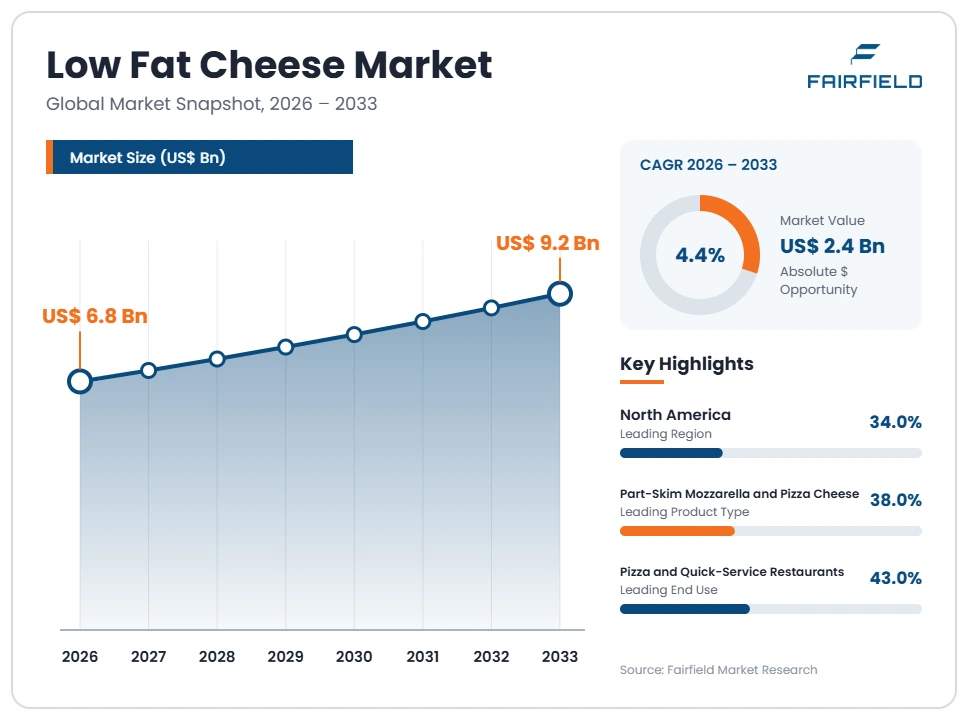
The global low fat cheese market size is expected to be valued at US$ 6.8 billion in 2026 and projected to reach US$ 9.2 billion by 2033, growing at a CAGR of 4.4% between 2026 and 2033.
The category expanded at roughly 3.6% a year between 2020 and 2025, closing near US$ 6.5 billion. Growth sits almost entirely on the commercial side of the trade. Pizza operators and food manufacturers buy part-skim cheese against written specifications for fat, moisture, stretch, melt and browning, then reorder to that document for years. Retail is weaker, as packaged-goods buyers in North America and Europe have shifted purchases back toward full-fat blocks and slices. Three things carry the forecast: foodservice volume in Asia Pacific, processed cheese and slice formats in emerging markets, and culture and texturising systems that narrow the eating-quality gap. Value growth therefore concentrates in specification-led supply rather than in branded retail lines.
Key Report Takeaways
- By Product Type: Part-Skim and Low-Moisture Part-Skim Mozzarella and Pizza Cheese held 38% share in 2026, while Low-Fat Processed Cheese and Slices is projected to expand at a 5.9% CAGR through 2033, driven by ambient-stable formats that travel well in hot-climate distribution.
- By Source Milk: Cow Milk held 89% share in 2026, while Goat Milk is projected to expand at a 6.3% CAGR through 2033, driven by smaller specialist makers whose natural composition sits closer to the reduced-fat compositional bands.
- By Distribution Channel: Foodservice and Institutional Distributors held 40% share in 2026, while Online Retail is projected to expand at a 7.0% CAGR through 2033, driven by chilled fulfilment networks reaching independent operators and smaller caterers.
- By End Use: Pizza and Quick-Service Restaurants held 43% share in 2026, while Industrial Food Manufacturing is projected to expand at a 5.6% CAGR through 2033, driven by recipe specifications written around declared fat thresholds on finished packs.
- By Geography: North America held 34% share in 2026, while Asia Pacific is projected to expand at a 7.2% CAGR through 2033, driven by chain pizza expansion and rapid growth in processed slice consumption.
Global Low Fat Cheese Market Trends and Insights
Drivers Impact Analysis
Two commercial forces account for most of the volume growth in this specification-led cheese category.
| Driver | Impact on CAGR Forecast | Geographic Relevance | Impact Timeline |
| Pizza and foodservice buying written to fat and moisture specifications | High | Global, strongest in North America and Asia Pacific | Short term ≤2 years |
| Manufactured food recipes built around declared fat thresholds | Medium | Europe, North America, export-oriented manufacturers | Medium term 2–4 years |
Pizza Chain Specification Buying Anchors Low Fat Cheese Volume
Specification buying by pizza operators and foodservice distributors is the largest single source of demand here, and it moves independently of retail shelf trends. Chains write cheese into build specifications by fat content, moisture, shred behaviour, melt and browning, then reorder against that document for years. Part-skim and low-moisture part-skim mozzarella sits inside those specifications across much of the quick-service pizza trade.
The mechanism is cost per unit of performance. Operators measure cheese by yield on the pie, shred flow, blister pattern and oil release under the oven, and they buy the composition that delivers those results at the lowest delivered cost. Lower-fat formulations release less free oil and handle better through shredding lines at volume. Codex Alimentarius Commission compositional categories expressed as fat in dry matter give buyer and supplier a shared vocabulary, so a specification written in one country can be sourced from another.
Manufactured Food Recipes Built to Declared Fat Thresholds Pull in Reduced-Fat Cheese
Food manufacturers are a second, quieter source of demand, and they buy cheese as an ingredient rather than as a product. Ready meals, sauces, filled pasta, bakery fillings and sandwich lines all carry a declared composition on the finished pack, and the cheese inclusion is one of the few levers a formulator can pull. Reduced-fat cheese enters these recipes as a compositional component, bought in block, shred, diced and powder formats.
The mechanism is labelling arithmetic rather than taste. Where a finished product must sit inside a stated compositional band, or must qualify for the wording conditions set by the European Union regulation on nutrition and health claims made on foods, the formulator recalculates the whole recipe. Cheese carries a high fat load per unit of weight, so substituting a reduced-fat grade changes the declared figure more than almost any other change available.
Restraints Impact Analysis
Two restraints limit both retail demand and the margin available to cheesemakers.
| Restraint | Impact on CAGR Forecast | Geographic Relevance | Impact Timeline |
| Eating-quality gap and weak repeat purchase at retail | High | North America, Europe, Latin America | Short term ≤2 years |
| Compositional standards and higher make-cost per kilogram | Medium | Global, strongest where standards of identity apply | Long term ≥4 years |
Texture, Melt and Flavour Loss Keeps Retail Repeat Purchase Low
The retail half of this category underperforms because fat does mechanical and sensory work inside cheese and removing it changes the product. Fat globules interrupt the casein network, so a lower-fat cheese has a denser protein matrix that eats firm and rubbery and fractures rather than bends. Melt is slower and less even, browning is harder to control, and flavour develops differently because many flavour compounds are fat-soluble.
The commercial consequence is a repeat-purchase problem. Trial is achievable, because the pack is explicit about what it is, but a shopper who finds the slice tough or the block crumbly does not return to it. Retailers in North America and Europe have responded by cutting facings, and several national grocery ranges now carry only one or two reduced-fat lines where they once carried a full set. Volume lost at retail is not recovered elsewhere.
Standards of Identity and Make-Cost Economics Squeeze Cheesemaker Margins
Compositional rules limit how far a cheesemaker can go, and the economics punish the attempt. In the United States the standards of identity administered by the US Food and Drug Administration fix what may be called cheddar, mozzarella or pasteurised process cheese and at what composition. Products formulated outside those limits must be renamed or must qualify under the separate rule covering modified-composition versions of standardised foods.
The cost is specific. Lower-fat vats need longer make times, gentler cooking and tighter moisture control; yields fall because fat retained in the curd is replaced with water that must be held in place; and fat replacers, exopolysaccharide-producing cultures and adjunct cultures all add ingredient and inventory cost. Component pricing compounds this: in most major dairy markets the cheesemaker pays for milk fat and protein separately, so diverting fat out of the vat changes the whole milk payment.
Market Opportunities
Emerging-Market Processed Cheese and Portion Formats Open a New Volume Pool
The clearest untapped pool is low-fat processed cheese sold in slices, portions and spreadable tubs across hot-climate markets. Processed cheese tolerates emulsifying salts, added protein and controlled moisture far better than a natural cheese does, which means the formulation problem that holds back reduced-fat cheddar is much easier to solve here. Ambient and semi-ambient distribution also suits markets where the retail cold chain is incomplete.
Local and regional processors are best placed to take it, supplying growing urban retail in Egypt, Saudi Arabia, Nigeria, Indonesia and Mexico, often from imported cheese powder, anhydrous milk fat and casein. Portion packs sold through convenience and traditional trade create the pull, and declared protein content on the pack gives brands a straightforward compositional statement to print. Lower unit price per serving makes the format accessible where a full block is not.
Culture and Texturising Ingredient Systems Create a Technology Revenue Pool
The engineering problem is itself a market. Suppliers of exopolysaccharide-producing starter cultures, adjunct cultures, coagulants, milk protein concentrates and starch and fibre-based fat replacers sell directly into this gap, and the value of that ingredient pool rises as cheesemakers try to close the quality difference. Exopolysaccharide cultures bind water inside the curd and restore some of the lubrication fat used to provide, which is the closest thing the category has to a technical solution.
Culture houses, dairy ingredient suppliers and equipment makers capture this, with cheesemakers and private-label manufacturers as the customers. Demand is strongest where a processor already holds a foodservice contract and must improve eating quality without changing the written specification. Pilot-scale make trials, stretch and melt instrumentation and shelf-life testing are sold alongside the ingredients, which turns a commodity culture sale into a technical service relationship.
Segment Analysis
- By Product Type: Pizza Cheese Leads While Processed Slices Gain Momentum
Part-Skim and Low-Moisture Part-Skim Mozzarella and Pizza Cheese held 38% share in 2026, the largest type by value, because the quick-service pizza trade buys it as a written specification and because low-moisture part-skim composition is the industry default for oven performance. Reduced-Fat and Low-Fat Hard and Semi-Hard Cheese follows at 29%, concentrated in cheddar, gouda and edam styles sold at retail and in sandwich manufacturing. Low-Fat Soft and Fresh Cheese, covering cottage cheese, quark and ricotta, accounts for 20%, helped by formats where high moisture is normal and the texture penalty is smaller. Low-Fat Processed Cheese and Slices is the fastest-growing type at a 5.9% CAGR through 2033, since emulsifying salts and added protein make composition easier to control. Type choice therefore follows how forgiving the process is.
- By Source Milk: Cow Milk Dominates Supply as Goat Milk Expands Quickest
Cow Milk supplied 89% of this market in 2026, an overwhelming lead that reflects the structure of the global dairy pool and the fact that every large-scale reduced-fat make procedure has been developed around bovine casein behaviour. Standardisation equipment, separators and component-pricing systems are all built for it. Sheep Milk and Buffalo Milk hold 3% and 2%, used mainly in regional specialities where composition is traditional rather than engineered. Goat Milk is the fastest-growing source at a 6.3% CAGR through 2033, because its smaller fat globules and softer curd give specialist makers a workable starting point for reduced-fat soft and semi-hard styles. Supply remains the limit, as herd numbers are small and seasonal. The implication is that source milk choice sets the make procedure before any formulation decision is taken.
- By Distribution Channel: Foodservice Distributors Lead While Online Chilled Supply Accelerates
Foodservice and Institutional Distributors accounted for 40% of trade in 2026, the leading channel, because pizza chains, caterers and contract feeders order to standing specifications in bulk block, shred and diced formats. Supermarkets and Hypermarkets take 37%, still the main retail route but with shrinking shelf space given to reduced-fat lines. Convenience and Discount Stores hold 15%, weighted toward slices and portion packs where price per pack governs the purchase. Online Retail is the fastest-growing channel at a 7.0% CAGR through 2033, as chilled fulfilment and cash-and-carry delivery platforms reach independent pizzerias, bakeries and small caterers that distributors have historically served expensively. The implication is that the channel mix is moving further toward buyers who order by specification, which rewards manufacturers with consistent analytical documentation.
- By End Use: Pizza Operators Take the Largest Volume While Industrial Users Grow Faster
Pizza and Quick-Service Restaurants represented 43% of consumption in 2026, the leading end use, because a single chain specification can move several thousand tonnes a year and because part-skim composition is written into most of those documents. Household Retail Consumption follows at 25% but is flat to declining in mature grocery markets. Institutional and Contract Catering holds 8%, driven by school, hospital and workplace tenders that state compositional limits in the contract itself. Industrial Food Manufacturing is the fastest-growing end use at a 5.6% CAGR through 2033, as ready meal, sauce, filled pasta and bakery manufacturers recalculate recipes around the figures declared on finished packs. The implication is that nearly all growth now comes from buyers who purchase against a written composition rather than a brand.
Geography Analysis
- Which Region Is Leading the Low Fat Cheese Market?
North America leads the low fat cheese market with 34% share in 2026, because the United States is both the largest producer of low-moisture part-skim mozzarella and the largest pizza foodservice economy. Regional growth of 3.3% is modest, since the retail side has been losing shelf space for several years while chain volume holds steady. The standards of identity administered by the US Food and Drug Administration shape what may be made and named, and the separate rule for modified-composition versions of standardised foods provides the route for reduced-fat variants. Canada adds a smaller, supply-managed base with its own compositional rules. Mexico is counted separately. The main change under way is consolidation of shredding and portioning capacity close to chain distribution centres, which lowers delivered cost on specification contracts.
- Europe Applies the Tightest Compositional Conditions to Cheese Labelling
Europe holds 31% share in 2026 and grows at 3.0%, led by Germany, France, the United Kingdom, the Netherlands and Poland. Its influence exceeds its volume because the compositional conditions attached to the terms low fat and reduced fat under the European Union regulation on nutrition and health claims made on foods set the thresholds that exporters elsewhere copy. Protected designation rules also matter: many traditional cheeses are defined by a compositional specification that leaves no room for a reduced-fat version under the same name, so makers must launch under separate brands. Retail reduced-fat ranges have narrowed in several national grocery markets. The clearest change is growth in industrial supply to ready meal and sandwich manufacturers, where composition is calculated rather than chosen.
- Which Region Is Growing Fastest in the Low Fat Cheese Market?
Asia Pacific is growing fastest at a 7.2% CAGR through 2033, from 21% share in 2026, as chain pizza and processed slice consumption expand together. China, India, Japan, South Korea, Australia and Indonesia all contribute, with India notable for a large processed cheese and slice trade built on domestic milk and imported ingredients. Quick-service pizza expansion is the strongest single pull, since each new outlet arrives with a cheese specification already written. Local manufacturers are adding mozzarella and processed cheese lines rather than importing finished product, which shortens the cold chain. The constraint is milk component availability, as fat is often worth more in other applications. Rising foodservice distribution capability is the main structural change supporting the forecast.
- Latin America Builds Volume Through Pizza and Processed Formats
Latin America accounts for 9% share in 2026 and grows at 5.4%, concentrated in Brazil, Mexico, Argentina, Chile and Colombia. Pizza is deeply established in Brazil and Argentina, which supports steady demand for part-skim mozzarella from domestic cheesemakers. Mexico adds a large processed cheese and slice trade sold through convenience and traditional retail. Front-of-pack labelling requirements adopted across several countries have made declared composition a visible formulation parameter for packaged cheese. The barriers are real: milk price volatility, currency exposure on imported ingredients, and uneven cold chain outside major cities. The opportunity is local manufacture of slices and spreadable portions, which substitutes for imports and suits the small-basket shopping patterns that dominate the region’s grocery trade.
- Middle East & Africa Depends on Imported Processed Cheese and Slices
Middle East & Africa holds 5% share in 2026 and grows at 5.8%, the smallest base but a structurally distinct one. Consumption concentrates in Saudi Arabia, the United Arab Emirates, Egypt and South Africa, with processed cheese triangles, jars, tubs and slices accounting for most of the volume. Much of it is made locally from imported cheese powder, anhydrous milk fat, casein and butter oil, which makes the regional industry a recombiner rather than a cheesemaker. The barriers are import dependence, currency and tariff exposure, limited chilled distribution and low domestic milk availability. The opportunity lies in ambient-stable portion formats, which tolerate heat, suit traditional retail and allow manufacturers to control composition tightly through the emulsification step rather than through the vat.
Competitive Landscape
The low fat cheese market is moderately concentrated. A small group of large dairy processors supplies most of the specification-led volume, while hundreds of regional cheesemakers compete for retail and local foodservice business. Leprino Foods Company occupies an unusual position as a dedicated pizza cheese manufacturer serving global chain accounts, and Groupe Lactalis, Saputo Inc., Arla Foods amba and Royal FrieslandCampina N.V. combine retail brands with substantial private-label and ingredient operations. Concentration is higher in mozzarella and pizza cheese than in reduced-fat retail blocks, where private label is strong and switching is easy.
Competition in the commercial half of the market is technical. Buyers test for fat in dry matter, moisture, stretch distance, melt area, browning, oil release and shred behaviour, and suppliers that hold those values consistently across seasons win multi-year contracts. Documentation, food safety audit history and the ability to ship to several plants on one specification matter as much as price. In retail, competition is about eating quality and price per pack, and here private-label manufacturers and discounters apply steady pressure on branded reduced-fat lines.
Strategic activity centres on capability rather than scale. Processors are investing in membrane filtration and milk standardisation, adopting exopolysaccharide-producing and adjunct cultures, extending shredding and portioning capacity near customer distribution centres, and building application laboratories that let a customer run oven trials before a specification is signed. Several large groups have also moved cheese ingredient production closer to growing foodservice demand rather than exporting finished product.
Vendor strategy is converging on two themes: making reduced-fat formats behave more like full-fat ones through culture and process work, and tying supply to written customer specifications that are hard for a competitor to displace. Bel Group, Savencia Fromage & Dairy and Glanbia plc illustrate the second approach through heavy exposure to portioned and ingredient formats.
Low Fat Cheese Industry Leaders
- Groupe Lactalis
- Saputo Inc.
- Leprino Foods Company
- Arla Foods amba
- Bel Group
Recent Industry Developments
- 1978: The Codex Alimentarius Commission adopted its general standard for cheese, classifying cheese by firmness and by fat in dry matter – it created the compositional vocabulary that reduced-fat specifications are still written in today.
- 1993: The US Food and Drug Administration issued its general rule for foods named by a nutrient content claim together with a standardised term – it opened the legal route for reduced-fat and low-fat versions of cheeses that are otherwise governed by a standard of identity.
- 2006: The Codex Alimentarius Commission adopted its standard for mozzarella, setting compositional provisions for both high-moisture and low-moisture varieties – it gave international pizza cheese contracts a reference specification independent of any single national rule.
- December 2006: The European Union adopted its regulation on nutrition and health claims made on foods, fixing the compositional conditions attached to the terms low fat and reduced fat – it defined the thresholds a cheese must meet before either term may appear on the pack.
Companies Covered in the Report
- Groupe Lactalis
- Saputo Inc.
- Leprino Foods Company
- Arla Foods amba
- Bel Group
- Savencia Fromage & Dairy
- Glanbia plc
- The Kraft Heinz Company
- Fonterra Co-operative Group Limited
- Dairy Farmers of America, Inc.
- Royal FrieslandCampina N.V.
- Sargento Foods Inc.
- Emmi AG
Low Fat Cheese Market Report Scope
| Metric | Value |
| Study Period | 2020–2033 |
| Market Size 2026 | US$ 6.8 Billion |
| Market Size 2033 | US$ 9.2 Billion |
| CAGR 2026–2033 | 4.4% |
| Absolute Dollar Opportunity | US$ 2.4 Billion |
| Largest Market | North America (34% share in 2026) |
| Fastest-Growing Market | Asia Pacific (7.2% CAGR 2026–2033) |
| Market Concentration | Medium |
| Major Players | Groupe Lactalis, Saputo Inc., Leprino Foods Company, Arla Foods amba, Bel Group |
Low Fat Cheese Market Segmentation
- Executive Summary
- Global Low Fat Cheese Market Snapshot
- Future Projections, 2026–2033
- Key Industry Highlights
- Regional Snapshot
- Market Overview
- Market Definition and Report Scope
- Historical Market Trends
- Market Dynamics
- Drivers
- Pizza Chain Specification Buying Anchors Low Fat Cheese Volume
- Manufactured Food Recipes Built to Declared Fat Thresholds Pull in Reduced-Fat Cheese
- Restraints
- Texture, Melt and Flavour Loss Keeps Retail Repeat Purchase Low
- Standards of Identity and Make-Cost Economics Squeeze Cheesemaker Margins
- Market Opportunities
- Emerging-Market Processed Cheese and Portion Formats Open a New Volume Pool
- Culture and Texturising Ingredient Systems Create a Technology Revenue Pool
- Drivers
- Global Low Fat Cheese Market Outlook, 2020–2033
- Global Low Fat Cheese Market Outlook, by Product Type, Value (US$ Billion), 2020–2033
- Reduced-Fat and Low-Fat Hard and Semi-Hard Cheese
- Part-Skim and Low-Moisture Part-Skim Mozzarella and Pizza Cheese
- Low-Fat Processed Cheese and Slices
- Low-Fat Soft and Fresh Cheese
- Global Low Fat Cheese Market Outlook, by Source Milk, Value (US$ Billion), 2020–2033
- Cow Milk
- Goat Milk
- Sheep Milk
- Buffalo Milk
- Global Low Fat Cheese Market Outlook, by Distribution Channel, Value (US$ Billion), 2020–2033
- Foodservice and Institutional Distributors
- Supermarkets and Hypermarkets
- Convenience and Discount Stores
- Online Retail
- Global Low Fat Cheese Market Outlook, by End Use, Value (US$ Billion), 2020–2033
- Pizza and Quick-Service Restaurants
- Industrial Food Manufacturing
- Household Retail Consumption
- Institutional and Contract Catering
- Global Low Fat Cheese Market Outlook, by Region, Value (US$ Billion), 2020–2033
- North America
- Europe
- Asia Pacific
- Latin America
- Middle East & Africa
- Global Low Fat Cheese Market Outlook, by Product Type, Value (US$ Billion), 2020–2033
- North America Low Fat Cheese Market Outlook, 2020–2033
- North America Low Fat Cheese Market Outlook, by Product Type, Value (US$ Billion), 2020–2033
- Reduced-Fat and Low-Fat Hard and Semi-Hard Cheese
- Part-Skim and Low-Moisture Part-Skim Mozzarella and Pizza Cheese
- Low-Fat Processed Cheese and Slices
- Low-Fat Soft and Fresh Cheese
- North America Low Fat Cheese Market Outlook, by Source Milk, Value (US$ Billion), 2020–2033
- Cow Milk
- Goat Milk
- Sheep Milk
- Buffalo Milk
- North America Low Fat Cheese Market Outlook, by Distribution Channel, Value (US$ Billion), 2020–2033
- Foodservice and Institutional Distributors
- Supermarkets and Hypermarkets
- Convenience and Discount Stores
- Online Retail
- North America Low Fat Cheese Market Outlook, by End Use, Value (US$ Billion), 2020–2033
- Pizza and Quick-Service Restaurants
- Industrial Food Manufacturing
- Household Retail Consumption
- Institutional and Contract Catering
- North America Low Fat Cheese Market Outlook, by Country, Value (US$ Billion), 2020–2033
- United States Low Fat Cheese Market Outlook, by Product Type, 2020–2033
- United States Low Fat Cheese Market Outlook, by Source Milk, 2020–2033
- United States Low Fat Cheese Market Outlook, by Distribution Channel, 2020–2033
- United States Low Fat Cheese Market Outlook, by End Use, 2020–2033
- Canada Low Fat Cheese Market Outlook, by Product Type, 2020–2033
- Canada Low Fat Cheese Market Outlook, by Source Milk, 2020–2033
- Canada Low Fat Cheese Market Outlook, by Distribution Channel, 2020–2033
- Canada Low Fat Cheese Market Outlook, by End Use, 2020–2033
- Mexico Low Fat Cheese Market Outlook, by Product Type, 2020–2033
- Mexico Low Fat Cheese Market Outlook, by Source Milk, 2020–2033
- Mexico Low Fat Cheese Market Outlook, by Distribution Channel, 2020–2033
- Mexico Low Fat Cheese Market Outlook, by End Use, 2020–2033
- North America Low Fat Cheese Market Outlook, by Product Type, Value (US$ Billion), 2020–2033
- Europe Low Fat Cheese Market Outlook, 2020–2033
- Europe Low Fat Cheese Market Outlook, by Product Type, Value (US$ Billion), 2020–2033
- Reduced-Fat and Low-Fat Hard and Semi-Hard Cheese
- Part-Skim and Low-Moisture Part-Skim Mozzarella and Pizza Cheese
- Low-Fat Processed Cheese and Slices
- Low-Fat Soft and Fresh Cheese
- Europe Low Fat Cheese Market Outlook, by Source Milk, Value (US$ Billion), 2020–2033
- Cow Milk
- Goat Milk
- Sheep Milk
- Buffalo Milk
- Europe Low Fat Cheese Market Outlook, by Distribution Channel, Value (US$ Billion), 2020–2033
- Foodservice and Institutional Distributors
- Supermarkets and Hypermarkets
- Convenience and Discount Stores
- Online Retail
- Europe Low Fat Cheese Market Outlook, by End Use, Value (US$ Billion), 2020–2033
- Pizza and Quick-Service Restaurants
- Industrial Food Manufacturing
- Household Retail Consumption
- Institutional and Contract Catering
- Europe Low Fat Cheese Market Outlook, by Country, Value (US$ Billion), 2020–2033
- Germany Low Fat Cheese Market Outlook, by Product Type, 2020–2033
- Germany Low Fat Cheese Market Outlook, by Source Milk, 2020–2033
- Germany Low Fat Cheese Market Outlook, by Distribution Channel, 2020–2033
- Germany Low Fat Cheese Market Outlook, by End Use, 2020–2033
- France Low Fat Cheese Market Outlook, by Product Type, 2020–2033
- France Low Fat Cheese Market Outlook, by Source Milk, 2020–2033
- France Low Fat Cheese Market Outlook, by Distribution Channel, 2020–2033
- France Low Fat Cheese Market Outlook, by End Use, 2020–2033
- United Kingdom Low Fat Cheese Market Outlook, by Product Type, 2020–2033
- United Kingdom Low Fat Cheese Market Outlook, by Source Milk, 2020–2033
- United Kingdom Low Fat Cheese Market Outlook, by Distribution Channel, 2020–2033
- United Kingdom Low Fat Cheese Market Outlook, by End Use, 2020–2033
- Netherlands Low Fat Cheese Market Outlook, by Product Type, 2020–2033
- Netherlands Low Fat Cheese Market Outlook, by Source Milk, 2020–2033
- Netherlands Low Fat Cheese Market Outlook, by Distribution Channel, 2020–2033
- Netherlands Low Fat Cheese Market Outlook, by End Use, 2020–2033
- Poland Low Fat Cheese Market Outlook, by Product Type, 2020–2033
- Poland Low Fat Cheese Market Outlook, by Source Milk, 2020–2033
- Poland Low Fat Cheese Market Outlook, by Distribution Channel, 2020–2033
- Poland Low Fat Cheese Market Outlook, by End Use, 2020–2033
- Europe Low Fat Cheese Market Outlook, by Product Type, Value (US$ Billion), 2020–2033
- Asia Pacific Low Fat Cheese Market Outlook, 2020–2033
- Asia Pacific Low Fat Cheese Market Outlook, by Product Type, Value (US$ Billion), 2020–2033
- Reduced-Fat and Low-Fat Hard and Semi-Hard Cheese
- Part-Skim and Low-Moisture Part-Skim Mozzarella and Pizza Cheese
- Low-Fat Processed Cheese and Slices
- Low-Fat Soft and Fresh Cheese
- Asia Pacific Low Fat Cheese Market Outlook, by Source Milk, Value (US$ Billion), 2020–2033
- Cow Milk
- Goat Milk
- Sheep Milk
- Buffalo Milk
- Asia Pacific Low Fat Cheese Market Outlook, by Distribution Channel, Value (US$ Billion), 2020–2033
- Foodservice and Institutional Distributors
- Supermarkets and Hypermarkets
- Convenience and Discount Stores
- Online Retail
- Asia Pacific Low Fat Cheese Market Outlook, by End Use, Value (US$ Billion), 2020–2033
- Pizza and Quick-Service Restaurants
- Industrial Food Manufacturing
- Household Retail Consumption
- Institutional and Contract Catering
- Asia Pacific Low Fat Cheese Market Outlook, by Country, Value (US$ Billion), 2020–2033
- China Low Fat Cheese Market Outlook, by Product Type, 2020–2033
- China Low Fat Cheese Market Outlook, by Source Milk, 2020–2033
- China Low Fat Cheese Market Outlook, by Distribution Channel, 2020–2033
- China Low Fat Cheese Market Outlook, by End Use, 2020–2033
- India Low Fat Cheese Market Outlook, by Product Type, 2020–2033
- India Low Fat Cheese Market Outlook, by Source Milk, 2020–2033
- India Low Fat Cheese Market Outlook, by Distribution Channel, 2020–2033
- India Low Fat Cheese Market Outlook, by End Use, 2020–2033
- Japan Low Fat Cheese Market Outlook, by Product Type, 2020–2033
- Japan Low Fat Cheese Market Outlook, by Source Milk, 2020–2033
- Japan Low Fat Cheese Market Outlook, by Distribution Channel, 2020–2033
- Japan Low Fat Cheese Market Outlook, by End Use, 2020–2033
- South Korea Low Fat Cheese Market Outlook, by Product Type, 2020–2033
- South Korea Low Fat Cheese Market Outlook, by Source Milk, 2020–2033
- South Korea Low Fat Cheese Market Outlook, by Distribution Channel, 2020–2033
- South Korea Low Fat Cheese Market Outlook, by End Use, 2020–2033
- Australia Low Fat Cheese Market Outlook, by Product Type, 2020–2033
- Australia Low Fat Cheese Market Outlook, by Source Milk, 2020–2033
- Australia Low Fat Cheese Market Outlook, by Distribution Channel, 2020–2033
- Australia Low Fat Cheese Market Outlook, by End Use, 2020–2033
- Indonesia Low Fat Cheese Market Outlook, by Product Type, 2020–2033
- Indonesia Low Fat Cheese Market Outlook, by Source Milk, 2020–2033
- Indonesia Low Fat Cheese Market Outlook, by Distribution Channel, 2020–2033
- Indonesia Low Fat Cheese Market Outlook, by End Use, 2020–2033
- Asia Pacific Low Fat Cheese Market Outlook, by Product Type, Value (US$ Billion), 2020–2033
- Latin America Low Fat Cheese Market Outlook, 2020–2033
- Latin America Low Fat Cheese Market Outlook, by Product Type, Value (US$ Billion), 2020–2033
- Reduced-Fat and Low-Fat Hard and Semi-Hard Cheese
- Part-Skim and Low-Moisture Part-Skim Mozzarella and Pizza Cheese
- Low-Fat Processed Cheese and Slices
- Low-Fat Soft and Fresh Cheese
- Latin America Low Fat Cheese Market Outlook, by Source Milk, Value (US$ Billion), 2020–2033
- Cow Milk
- Goat Milk
- Sheep Milk
- Buffalo Milk
- Latin America Low Fat Cheese Market Outlook, by Distribution Channel, Value (US$ Billion), 2020–2033
- Foodservice and Institutional Distributors
- Supermarkets and Hypermarkets
- Convenience and Discount Stores
- Online Retail
- Latin America Low Fat Cheese Market Outlook, by End Use, Value (US$ Billion), 2020–2033
- Pizza and Quick-Service Restaurants
- Industrial Food Manufacturing
- Household Retail Consumption
- Institutional and Contract Catering
- Latin America Low Fat Cheese Market Outlook, by Country, Value (US$ Billion), 2020–2033
- Brazil Low Fat Cheese Market Outlook, by Product Type, 2020–2033
- Brazil Low Fat Cheese Market Outlook, by Source Milk, 2020–2033
- Brazil Low Fat Cheese Market Outlook, by Distribution Channel, 2020–2033
- Brazil Low Fat Cheese Market Outlook, by End Use, 2020–2033
- Mexico Low Fat Cheese Market Outlook, by Product Type, 2020–2033
- Mexico Low Fat Cheese Market Outlook, by Source Milk, 2020–2033
- Mexico Low Fat Cheese Market Outlook, by Distribution Channel, 2020–2033
- Mexico Low Fat Cheese Market Outlook, by End Use, 2020–2033
- Argentina Low Fat Cheese Market Outlook, by Product Type, 2020–2033
- Argentina Low Fat Cheese Market Outlook, by Source Milk, 2020–2033
- Argentina Low Fat Cheese Market Outlook, by Distribution Channel, 2020–2033
- Argentina Low Fat Cheese Market Outlook, by End Use, 2020–2033
- Chile Low Fat Cheese Market Outlook, by Product Type, 2020–2033
- Chile Low Fat Cheese Market Outlook, by Source Milk, 2020–2033
- Chile Low Fat Cheese Market Outlook, by Distribution Channel, 2020–2033
- Chile Low Fat Cheese Market Outlook, by End Use, 2020–2033
- Colombia Low Fat Cheese Market Outlook, by Product Type, 2020–2033
- Colombia Low Fat Cheese Market Outlook, by Source Milk, 2020–2033
- Colombia Low Fat Cheese Market Outlook, by Distribution Channel, 2020–2033
- Colombia Low Fat Cheese Market Outlook, by End Use, 2020–2033
- Latin America Low Fat Cheese Market Outlook, by Product Type, Value (US$ Billion), 2020–2033
- Middle East & Africa Low Fat Cheese Market Outlook, 2020–2033
- Middle East & Africa Low Fat Cheese Market Outlook, by Product Type, Value (US$ Billion), 2020–2033
- Reduced-Fat and Low-Fat Hard and Semi-Hard Cheese
- Part-Skim and Low-Moisture Part-Skim Mozzarella and Pizza Cheese
- Low-Fat Processed Cheese and Slices
- Low-Fat Soft and Fresh Cheese
- Middle East & Africa Low Fat Cheese Market Outlook, by Source Milk, Value (US$ Billion), 2020–2033
- Cow Milk
- Goat Milk
- Sheep Milk
- Buffalo Milk
- Middle East & Africa Low Fat Cheese Market Outlook, by Distribution Channel, Value (US$ Billion), 2020–2033
- Foodservice and Institutional Distributors
- Supermarkets and Hypermarkets
- Convenience and Discount Stores
- Online Retail
- Middle East & Africa Low Fat Cheese Market Outlook, by End Use, Value (US$ Billion), 2020–2033
- Pizza and Quick-Service Restaurants
- Industrial Food Manufacturing
- Household Retail Consumption
- Institutional and Contract Catering
- Middle East & Africa Low Fat Cheese Market Outlook, by Country, Value (US$ Billion), 2020–2033
- Saudi Arabia Low Fat Cheese Market Outlook, by Product Type, 2020–2033
- Saudi Arabia Low Fat Cheese Market Outlook, by Source Milk, 2020–2033
- Saudi Arabia Low Fat Cheese Market Outlook, by Distribution Channel, 2020–2033
- Saudi Arabia Low Fat Cheese Market Outlook, by End Use, 2020–2033
- United Arab Emirates Low Fat Cheese Market Outlook, by Product Type, 2020–2033
- United Arab Emirates Low Fat Cheese Market Outlook, by Source Milk, 2020–2033
- United Arab Emirates Low Fat Cheese Market Outlook, by Distribution Channel, 2020–2033
- United Arab Emirates Low Fat Cheese Market Outlook, by End Use, 2020–2033
- Egypt Low Fat Cheese Market Outlook, by Product Type, 2020–2033
- Egypt Low Fat Cheese Market Outlook, by Source Milk, 2020–2033
- Egypt Low Fat Cheese Market Outlook, by Distribution Channel, 2020–2033
- Egypt Low Fat Cheese Market Outlook, by End Use, 2020–2033
- South Africa Low Fat Cheese Market Outlook, by Product Type, 2020–2033
- South Africa Low Fat Cheese Market Outlook, by Source Milk, 2020–2033
- South Africa Low Fat Cheese Market Outlook, by Distribution Channel, 2020–2033
- South Africa Low Fat Cheese Market Outlook, by End Use, 2020–2033
- Middle East & Africa Low Fat Cheese Market Outlook, by Product Type, Value (US$ Billion), 2020–2033
- Competitive Landscape
- Industry Leaders
- Recent Industry Developments
- Company Profiles
- Groupe Lactalis
- Saputo Inc.
- Leprino Foods Company
- Arla Foods amba
- Bel Group
- Savencia Fromage & Dairy
- Glanbia plc
- The Kraft Heinz Company
- Fonterra Co-operative Group Limited
- Dairy Farmers of America, Inc.
- Royal FrieslandCampina N.V.
- Sargento Foods Inc.
- Emmi AG
- Appendix
- Research Methodology
- Report Assumptions
- Acronyms and Abbreviations
Product Type
- Reduced-Fat and Low-Fat Hard and Semi-Hard Cheese
- Part-Skim and Low-Moisture Part-Skim Mozzarella and Pizza Cheese
- Low-Fat Processed Cheese and Slices
- Low-Fat Soft and Fresh Cheese
Source Milk
- Cow Milk
- Goat Milk
- Sheep Milk
- Buffalo Milk
Distribution Channel
- Foodservice and Institutional Distributors
- Supermarkets and Hypermarkets
- Convenience and Discount Stores
- Online Retail
End Use
- Pizza and Quick-Service Restaurants
- Industrial Food Manufacturing
- Household Retail Consumption
- Institutional and Contract Catering
Regions
- North America
- Europe
- Asia Pacific
- Latin America
- Middle East & Africa
Our Research Methodology
Considering the volatility of business today, traditional approaches to strategizing a game plan can be unfruitful if not detrimental. True ambiguity is no way to determine a forecast. A myriad of predetermined factors must be accounted for such as the degree of risk involved, the magnitude of circumstances, as well as conditions or consequences that are not known or unpredictable. To circumvent binary views that cast uncertainty, the application of market research intelligence to strategically posture, move, and enable actionable outcomes is necessary.
View Methodology
Quality Assured
Rigorous Validation Process

Confidentiality Assured
End-to-end Data Security

Custom Research Services
Tailored To Your Objectives
FAQs
The market is valued at US$ 6.8 billion in 2026, covering reduced-fat and low-fat cheeses sold through retail, foodservice and ingredient channels.
The market is projected to reach US$ 9.2 billion by 2033, a 4.4% CAGR and an absolute dollar opportunity of US$ 2.4 billion.
Part-Skim and Low-Moisture Part-Skim Mozzarella and Pizza Cheese leads with 38% share in 2026, because chain pizza specifications are written around that composition.
Asia Pacific grows fastest at a 7.2% CAGR through 2033, as chain pizza outlets and processed slice consumption expand across the region.
Concentration is medium: a few large processors hold most specification-led volume, while many regional cheesemakers compete at retail.
Related Reports
Margarine Market Size, Share, Insights, Competitive Landscape, and Forecast 2026 to 2033
The margarine market is projected to grow from US$23.5 billion in 2026 to US$27.0 billion by 2033 at a 2.0% CAGR.
Instant Beverage Premix Market Size, Share, Insights, Competitive Landscape, and Forecast 2026 to 2033
The global instant beverage premix market is valued at US$24.0 billion in 2026, reaching US$36.5 billion by 2033, growing at a 6.2% CAGR
Infant Nutrition Market Size, Share, Insights, Competitive Landscape, and Forecast 2026 to 2033
The global infant nutrition market is valued at US$103.18 billion in 2026, reaching US$153.09 billion by 2033, growing at a 5.8% CAGR
Yeast Protein Market Size, Share, Insights, Competitive Landscape, and Forecast 2026 to 2033
The global yeast protein market is valued at US$0.9 billion in 2026, reaching US$2.0 billion by 2033, growing at a 12.1% CAGR
Starch Derivatives Market Size, Share, Insights, Competitive Landscape, and Forecast 2026 to 2033
The global starch derivatives market is valued at US$62.5 billion in 2026, reaching US$88.0 billion by 2033, growing at a 5.0% CAGR
Quick Service Restaurants Market Size, Share, Insights, Competitive Landscape, and Forecast 2026 to 2033
The global quick service restaurants market is valued at US$1,090.0 billion in 2026, reaching US$1,556.0 billion by 2033, growing at a 5.2% CAGR