



Instant Beverage Premix Market
Instant Beverage Premix Market Size, Share, Insights, Competitive Landscape, and Forecast 2026 to 2033
Instant Beverage Premix Market Size and Trend Analysis
How Fast Will Instant Beverage Premix Demand Grow by 2033?
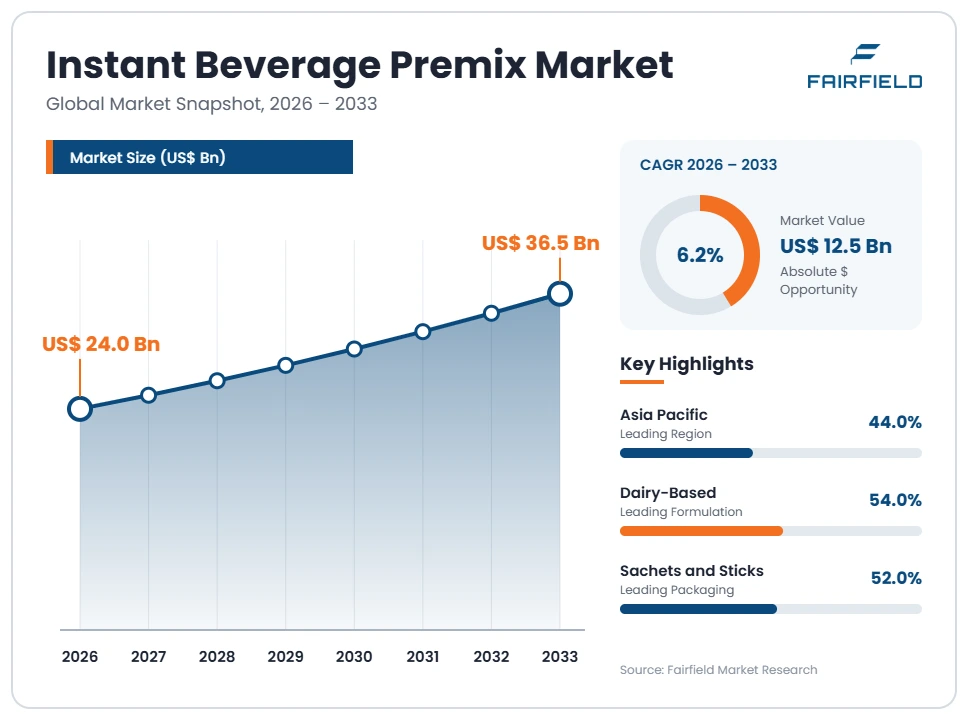
The global Instant Beverage Premix market size is expected to be valued at US$ 24.0 billion in 2026 and projected to reach US$ 36.5 billion by 2033, growing at a CAGR of 6.2% between 2026 and 2033.
The category grew at a 5.4% CAGR between 2020 and 2025, closing that period near US$ 22.8 billion. Growth rests on one operational fact: a premix turns a hot drink into a single-step job that needs no barista, no brewing equipment and no separate milk handling. That is why it dominates vending, office supply and institutional catering, and why it is strongest where sweetened milk-based hot drinks are the norm. Three factors carry the forecast: deeper single-serve sachet penetration in price-sensitive markets, the build-out of office coffee service and vending across Asia Pacific and the Gulf states, and the migration of electrolyte and protein formats into premix form. The direction is steady mid-single-digit expansion rather than acceleration.
Key Report Takeaways
- By Product Type: Instant coffee premixes held 38% share in 2026, while flavoured and functional powder drinks are projected to expand at a 9.4% CAGR through 2033, driven by electrolyte and protein formats moving into sachet and stick packaging.
- By Base Formulation: Dairy-based premixes accounted for 54% share in 2026, while non-dairy whitener-based premixes are projected to grow at an 8.6% CAGR through 2033, as ambient vegetable-fat creamers remove chilled handling from foodservice supply.
- By Packaging Format: Sachets and single-serve sticks held 52% share in 2026, while vending-compatible packs are projected to advance at a 7.8% CAGR through 2033, because operators buy by the machine canister rather than by the serve.
- By Distribution Channel: Convenience and traditional trade held 31% share in 2026, while e-commerce is projected to rise at a 9.8% CAGR through 2033, led by multipack and bulk jar purchasing that travels well without any cold chain.
- By Geography: Asia Pacific led with 44% share in 2026, while Middle East & Africa is projected to grow at an 8.0% CAGR through 2033, as vending estates and institutional catering expand across the Gulf states and Nigeria.
Global Instant Beverage Premix Market Trends and Insights
Drivers Impact Analysis
Two forces explain most of the incremental volume expected in powdered beverage mixes between 2026 and 2033.
| Driver | Impact on CAGR Forecast | Geographic Relevance | Impact Timeline |
| Single-step preparation that removes equipment, skill and water handling from beverage service | High | Global, led by Asia Pacific and Middle East & Africa | Short term ≤2 years |
| Sachet price points that put a hot sweetened drink within reach of low-income urban buyers | High | Asia Pacific, Latin America and Middle East & Africa | Medium term 2–4 years |
Single-Step Preparation Makes Premix the Default Format for Vending, Office and Institutional Supply
Operational simplicity is the largest single source of demand for instant drink powders. A premix carries coffee or tea solids, sweetener and whitener in one dose, so the server adds hot water and nothing else. No grinder, no brewer, no milk fridge and no trained operator are required. That removes equipment capital, cleaning labour and spoilage from the cost of a cup, which is why vending estates, office pantries, canteens and airline galleys standardise on it.
The mechanism is procurement arithmetic rather than taste. A facilities manager compares the fully loaded cost per cup, including machine servicing, milk wastage and staff time, against a fixed sachet or canister price. Premix wins because its cost is known in advance and its output does not vary with operator skill or water quality. Agglomerated and freeze-dried soluble coffee bases dissolve reliably in hard or lukewarm water, which matters in buildings with inconsistent supply.
Sachet Price Points Put a Hot Sweetened Drink Within Reach of Low-Income Urban Buyers
Small single-serve packs are what open the category in price-sensitive economies. A sachet priced at a few cents converts a jar purchase that a household cannot fund into a daily cash purchase it can. This is the entry format across India, Indonesia, Vietnam, the Philippines, Nigeria and much of Latin America, and it is why unit volumes in those markets rise far faster than value. Retailers stock sachets because they turn quickly and tie up almost no working capital.
The underlying change is urbanisation combined with the spread of modern small-format retail. Kiosks, tea stalls, convenience chains and mobile vendors now reach dense low-income districts where no brewing infrastructure exists. Two-in-one and three-in-one formats travel through that trade without refrigeration, survive heat and humidity in laminated film, and need no measurement. Volume growth therefore tracks retail density and pack price, not disposable income alone.
Restraints Impact Analysis
The binding constraints are the fiscal and labelling treatment of sweetened powders and the cost pressure landing on a fixed sachet price.
| Restraint | Impact on CAGR Forecast | Geographic Relevance | Impact Timeline |
| Sugar-sweetened beverage taxation and front-of-pack labelling reaching powdered concentrates | High | Latin America, Europe and Middle East & Africa | Short term ≤2 years |
| Green coffee, cocoa, sugar and dairy powder volatility against fixed sachet price points | High | Global, acute in Asia Pacific | Medium term 2–4 years |
Sugar Taxation and Front-of-Pack Labelling Force Reformulation Across Sweetened Premix Lines
Most premixes are sweetened, which places the category directly inside sweetened beverage policy. Several excise regimes are written on the reconstituted volume of the finished drink, so powders, syrups and concentrates are taxed alongside bottled products. Where that applies, the levy lands on a pack whose retail price is fixed by custom, and the manufacturer absorbs it or shrinks the dose. Front-of-pack warning and grading schemes add a second effect, because a sweetened powder can carry a high-sugar mark at shelf.
The cause is formulation. Sugar in a three-in-one sachet is not only a sweetener; it carries bulk, controls dissolution and masks the bitterness of soluble coffee and the note of vegetable-fat whitener. Cutting it changes flow, caking behaviour and mouthfeel at once. Reformulation therefore means re-engineering agglomeration and sweetener systems, revalidating shelf life, and refiling label declarations in every market served.
Commodity Pass-Through and Sachet Compliance Costs Compress Margin at a Fixed Price Point
Input volatility hits this category harder than most because the retail price of a sachet is close to immovable. Green coffee, cocoa, refined sugar and skimmed milk powder have all moved sharply in recent years, and a premix carries three or four of them at once. Raising a sachet above its customary coin price destroys volume, so producers absorb the move, cut grammage or thin the formulation. Margin, not price, takes the strain.
A second cost is now building on the same pack. Extended producer responsibility schemes charge fees by packaging weight and material, and multilayer laminates of plastic, aluminium and paper score badly under recyclability criteria because they cannot be separated in standard sorting. Mono-material and paper-based barrier films exist but cost more per unit and run slower on existing filling lines, so compliance arrives as a direct conversion cost.
Market Opportunities
Functional and Protein Premixes Open a Higher-Value Powder Drink Revenue Pool
Functional powder drinks are the clearest premium pool inside an otherwise value-driven category. Electrolyte sticks, protein-containing blends, fibre-fortified mixes and vitamin-fortified malt powders sell at several times the price per serve of a standard three-in-one sachet, while using the same blending, agglomeration and stick-pack assets. That lets a manufacturer raise revenue per kilogram of powder without new primary processing capacity.
Branded food groups with existing powder plants are best placed to capture it, alongside contract blenders selling capability to sports and nutrition brands that own no manufacturing. Demand comes from gym and sports retail, pharmacy chains, institutional and workplace wellbeing programmes, and online subscription buyers who want a shelf-stable sachet rather than a bottle. Nutrition labelling frameworks support the shift, because a declared protein or electrolyte content is verifiable on pack and travels across export markets without reformulation.
Vending Estates, Office Coffee Service and Non-Dairy Whiteners Create Recurring Bulk Revenue
Bulk supply to machines is a second revenue pool with economics unlike retail. Vending operators and office coffee service providers buy premix by the canister against multi-year contracts, which produces predictable volume, low marketing cost and almost no packaging spend per serve. Switching is slow once machine profiles are calibrated to a specific powder, so contracts renew. Non-dairy whitener-based bulk blends extend the same model into climates and buildings where chilled milk handling is impractical.
Ingredient suppliers, soluble coffee processors and regional blenders can capture this, because machine owners buy on dissolution behaviour, foam stability and price rather than brand. Demand comes from corporate campuses, hospitals, universities, airports, transport hubs and manufacturing sites across Asia Pacific, the Gulf states and Europe. Food contact compliance for canister liners and documented hygiene controls are the practical conditions of entry for institutional tenders.
Segment Analysis
- By Product Type: Instant Coffee Premixes Lead While Functional Powder Drinks Set the Pace
Instant coffee premixes held 38% share in 2026, because two-in-one and three-in-one sachets are the format that carried soluble coffee into Asian and African markets with no espresso culture. Instant tea premixes, including lemon tea, masala chai and milk tea blends, form the second block, followed by malt and chocolate drink premixes and by instant soup and savoury drink powders sold in the same sachet format. Flavoured and functional powder drinks are the fastest-growing product type at a 9.4% CAGR to 2033, expanding from a modest base as electrolyte and protein formats adopt stick packs. The commercial implication is a split in investment logic: coffee and tea premix capacity competes on blending cost and commodity coverage, while functional lines compete on formulation and claim substantiation, and the two rarely share a commercial team.
- By Base Formulation: Dairy-Based Blends Carry Volume as Non-Dairy Whiteners Expand Faster
Dairy-based premixes accounted for 54% share in 2026, because skimmed milk powder and dairy whitener deliver the body and flavour that sweetened milk-tea and milk-coffee drinkers expect. Water-based formulations, covering black tea, black coffee and savoury powders, take the next share. Non-dairy whitener-based premixes are the fastest-growing formulation at an 8.6% CAGR to 2033. Vegetable-fat creamers built on glucose syrup solids and refined palm or coconut fat are cheaper per kilogram than milk powder, far more stable in heat and humidity, and insulated from dairy price swings. They also serve institutional buyers who cannot manage chilled milk. The business implication is that formulation choice is now a procurement hedge as much as a recipe decision, and several producers maintain parallel dairy and non-dairy versions of the same brand for different channels and climates.
- By Packaging Format: Sachets Dominate Shelf While Vending-Compatible Packs Grow Quickest
Sachets and single-serve sticks held 52% share in 2026, a direct consequence of the cash-purchase economics that built the category in emerging markets. Jars and tubs serve household repeat buyers in higher-income markets, and bulk packs supply catering kitchens. Vending-compatible packs are the fastest-growing format at a 7.8% CAGR to 2033, as operators expand machine estates in offices, transport hubs and campuses and buy by the canister rather than the serve. Format also carries the category’s main policy exposure, because single-use multilayer sachets face extended producer responsibility fees and recyclability criteria that bulk and jar formats largely avoid. The implication for producers is that filling-line investment now has a compliance dimension: mono-material film and refill-oriented formats protect market access in regulated territories even where they raise unit cost.
- By Distribution Channel: Traditional Trade Holds Volume While E-Commerce Advances Fastest
Convenience and traditional trade held 31% share in 2026, reflecting the kiosks, tea stalls and independent grocers that sell most sachets in Asia Pacific, Latin America and Middle East & Africa. Supermarkets and hypermarkets follow, with foodservice and institutional catering, then vending and office coffee service, taking the remainder. E-commerce is the fastest-growing channel at a 9.8% CAGR to 2033, driven by multipack, jar and bulk purchasing that ships ambient in a standard parcel with no cold chain and no breakage risk. Quick-commerce platforms have also made single-serve sachet baskets viable in dense cities. The broader implication is that channel mix now determines pack strategy: traditional trade rewards the lowest possible coin price, while online rewards larger packs and subscription refills that lift basket value.
Geography Analysis
- Office Coffee Service and Added Sugars Labelling Shape North America’s Premix Trade
North America held 19% share in 2026 and is forecast to grow at a 4.3% CAGR to 2033, the slowest of the five regions. The United States and Canada buy premix mainly through institutional and workplace channels, where cappuccino, mocha and hot chocolate powders feed bean-to-cup and powdered-drink machines in offices, hospitals, schools and convenience foodservice. Household demand skews to hot chocolate, malted powders and flavoured coffee mixes rather than daily sachets, because brewed coffee and single-serve capsules own the morning occasion. The mandatory added sugars declaration on nutrition labels has made sugar load directly comparable at shelf, which has pushed reformulation and smaller serve sizes. The visible change is growth in electrolyte and protein stick packs, which has expanded the powdered drink aisle well beyond traditional hot beverage mixes.
- Capsule Competition and Packaging Rules Define Europe’s Powdered Drink Mix Demand
Europe accounted for 21% share in 2026 and is expected to grow at a 4.6% CAGR to 2033, the second slowest rate of the five regions. Demand is concentrated in vending and office coffee service, where machine estates in Germany, Italy, France, Poland and the United Kingdom consume bulk whitener, chocolate and soluble coffee powders. Household retail premix is comparatively small, because capsule systems and fresh brewing occupy the at-home occasion. Two regulatory forces define the commercial picture: packaging and packaging waste rules that penalise non-recyclable multilayer laminates through producer fees, and front-of-pack nutrition grading that exposes the sugar load of sweetened mixes. Türkiye is the clearest growth pocket, where sachet coffee mixes have built a substantial habit from a traditional tea and Turkish coffee base.
- Which Region Is Leading the Instant Beverage Premix Market?
Asia Pacific leads the instant beverage premix market with 44% share in 2026, growing at a 7.1% CAGR to 2033. The region combines the world’s largest sweetened milk-tea and milk-coffee drinking populations with the retail structure that suits sachets. India anchors tea and malt premix demand, Indonesia, Vietnam, Thailand and the Philippines carry three-in-one instant coffee volume, and China, Japan and Korea support stick coffee and milk tea formats at a higher price point. Local manufacturing is extensive, so freight and tariffs rarely limit supply. The region also hosts most global capacity for agglomerated and spray-dried soluble coffee. The change now shaping it is policy rather than demand: packaging waste rules targeting multilayer sachets are tightening in several national markets, which is pushing producers toward mono-material film and larger refill packs.
- Traditional Trade and Beverage Excise Rules Shape Latin America’s Premix Supply
Latin America represented 9% share in 2026 and is projected to grow at a 6.8% CAGR to 2033. Brazil, Mexico, Colombia, Peru and Chile account for most volume, sold largely through independent grocers, kiosks and open markets in single-serve formats. Soluble coffee production is well established in the region, which keeps input logistics short for coffee-based mixes. Two barriers stand out. Excise duties on flavoured drinks in several countries are calculated on the reconstituted volume, so powders and concentrates are taxed like bottled products, and front-of-pack warning labels on high-sugar items have reshaped pack design. Currency volatility also raises the local cost of imported dairy powder and laminate film. The opportunity sits in non-dairy whitener blends and in vending supply to offices and transport hubs in the larger cities.
- Which Region Is Growing Fastest in the Instant Beverage Premix Market?
Middle East & Africa is the fastest-growing region in the instant beverage premix market, advancing at an 8.0% CAGR to 2033 from 7% share in 2026. Growth comes from a small base and from two very different buyer groups. The Gulf states, led by Saudi Arabia and the United Arab Emirates, are expanding vending estates, office coffee service and institutional catering across corporate, healthcare and construction accommodation sites. Nigeria, Kenya, Ghana, Egypt and South Africa are adding sachet volume through dense informal retail, where a coin-priced three-in-one is the affordable hot drink. Barriers are real: import dependence on soluble coffee and dairy powder, foreign exchange scarcity in several African markets, and heat and humidity that demand robust laminates. The opportunity lies in local blending and filling under licence, which cuts freight and currency exposure.
Competitive Landscape
The instant beverage premix market is moderately concentrated, with a clear split between global branded groups and strong regional specialists. A handful of multinational food and beverage companies hold the largest aggregate share through soluble coffee, malt and tea brands distributed in dozens of countries. Beneath them sit powerful national players that often outsell the multinationals in their home markets, because sachet pricing, flavour calibration and traditional trade distribution are intensely local. A third tier of contract blenders and ingredient processors supplies private label, vending canisters and institutional tenders without consumer brands of their own. Consolidation is steady rather than dramatic, usually taking the form of regional brand acquisitions and capacity purchases in soluble coffee.
Competition rests first on landed cost per serve at a fixed retail price point. Winning in traditional trade depends on holding a coin price while commodity inputs move, which rewards scale buying in green coffee, cocoa, sugar and dairy powder, and rewards hedging capability. Beyond cost, vendors compete on dissolution and foam behaviour in hard or lukewarm water, flavour profiles tuned to local taste, sachet print and shelf visibility, distributor reach into small outlets, and reliability of supply during currency or freight disruption. In institutional and vending tenders the basis shifts to machine compatibility, documented food safety systems and contract service levels.
Strategic activity across the industry clusters on a few recurring themes. Producers are reformulating to cut declared sugar ahead of labelling and excise exposure, converting sachet laminates toward mono-material and paper-based structures to manage packaging fees, extending non-dairy whitener ranges to hedge dairy prices, and adding electrolyte and protein stick lines to lift revenue per kilogram.
Strategic direction is converging on cost resilience, packaging compliance and premium format extension, with vertical integration into soluble coffee processing as the main structural move.
Instant Beverage Premix Industry Leaders
Nestlé S.A.
Unilever PLC
Mondelez International, Inc.
Tata Consumer Products Limited
JDE Peet’s N.V.
Recent Industry Developments
- January 2014: Mexico brought into force an excise duty on flavoured beverages that applies to powders, syrups and concentrates on the basis of the reconstituted litre – it set the precedent that sweetened beverage taxation can reach premix formats, not only bottled drinks.
- October 2016: The World Health Organization published its report on fiscal policies for diet and the prevention of noncommunicable diseases, recommending taxation of sugar-sweetened beverages – it accelerated national levies that several governments later extended to powdered concentrates.
- June 2016: Chile began enforcing front-of-pack warning labels on foods and beverages high in sugars, calories, sodium or saturated fat – it created the template for warning-label schemes that now affect how sweetened premixes are packaged and marketed.
- January 2020: The United States mandatory declaration of added sugars on the Nutrition Facts label became enforceable for manufacturers with US$ 10 million or more in annual food sales – it made the sugar load of powdered drink mixes directly comparable at shelf.
- July 2021: The European Union market restrictions on certain single-use plastic products took effect across member states – it signalled the policy direction that now shapes extended producer responsibility fees on multilayer sachet laminates.
Companies Covered in the Report
- Nestlé S.A.
- Unilever PLC
- Hindustan Unilever Limited
- Tata Consumer Products Limited
- Mondelez International, Inc.
- JDE Peet’s N.V.
- Super Group Ltd
- PT Mayora Indah Tbk
- Ajinomoto AGF, Inc.
- ITC Limited
- CCL Products (India) Limited
- Olam Group Limited
- Trung Nguyen Legend Corporation
- Girnar Food & Beverages Pvt. Ltd
Instant Beverage Premix Market Report Scope
| Metric | Value |
| Study Period | 2020–2033 |
| Market Size 2026 | US$ 24.0 Billion |
| Market Size 2033 | US$ 36.5 Billion |
| CAGR 2026–2033 | 6.2% |
| Absolute Dollar Opportunity | US$ 12.5 Billion |
| Largest Market | Asia Pacific (44% share in 2026) |
| Fastest-Growing Market | Middle East & Africa (8.0% CAGR) |
| Market Concentration | Medium |
| Major Players | Nestlé S.A., Unilever PLC, Tata Consumer Products Limited, JDE Peet’s N.V., Super Group Ltd |
Instant Beverage Premix Market Segmentation
- Executive Summary
- Global Instant Beverage Premix Market Snapshot
- Future Projections, 2026-2033
- Key Market Trends
- Regional Snapshot
- Market Overview
- Market Definition and Report Scope
- Historical Market Trends
- Market Dynamics
- Drivers Impact Analysis
- Single-Step Preparation Makes Premix the Default Format for Vending, Office and Institutional Supply
- Sachet Price Points Put a Hot Sweetened Drink Within Reach of Low-Income Urban Buyers
- Restraints Impact Analysis
- Sugar Taxation and Front-of-Pack Labelling Force Reformulation Across Sweetened Premix Lines
- Commodity Pass-Through and Sachet Compliance Costs Compress Margin at a Fixed Price Point
- Market Opportunities
- Functional and Protein Premixes Open a Higher-Value Powder Drink Revenue Pool
- Vending Estates, Office Coffee Service and Non-Dairy Whiteners Create Recurring Bulk Revenue
- Drivers Impact Analysis
- Global Instant Beverage Premix Market Outlook, 2020-2033
- Global Instant Beverage Premix Market Outlook, by Product Type, Value (US$ Billion), 2020-2033
- Instant coffee premixes
- Instant tea premixes
- Malt and chocolate drink premixes
- Instant soup and savoury drink premixes
- Flavoured and functional powder drinks
- Global Instant Beverage Premix Market Outlook, by Base Formulation, Value (US$ Billion), 2020-2033
- Dairy-based premixes
- Non-dairy whitener-based premixes
- Water-based premixes
- Global Instant Beverage Premix Market Outlook, by Packaging Format, Value (US$ Billion), 2020-2033
- Sachets and single-serve sticks
- Jars and tubs
- Bulk packs
- Vending-compatible packs
- Global Instant Beverage Premix Market Outlook, by Distribution Channel, Value (US$ Billion), 2020-2033
- Supermarkets and hypermarkets
- Convenience and traditional trade
- Foodservice and institutional catering
- Vending and office coffee service
- E-commerce
- Global Instant Beverage Premix Market Outlook, by Region, Value (US$ Billion), 2020-2033
- North America
- Europe
- Asia Pacific
- Latin America
- Middle East & Africa
- Global Instant Beverage Premix Market Outlook, by Product Type, Value (US$ Billion), 2020-2033
- North America Instant Beverage Premix Market Outlook, 2020-2033
- North America Instant Beverage Premix Market Outlook, by Product Type, Value (US$ Billion), 2020-2033
- Instant coffee premixes
- Instant tea premixes
- Malt and chocolate drink premixes
- Instant soup and savoury drink premixes
- Flavoured and functional powder drinks
- North America Instant Beverage Premix Market Outlook, by Base Formulation, Value (US$ Billion), 2020-2033
- Dairy-based premixes
- Non-dairy whitener-based premixes
- Water-based premixes
- North America Instant Beverage Premix Market Outlook, by Packaging Format, Value (US$ Billion), 2020-2033
- Sachets and single-serve sticks
- Jars and tubs
- Bulk packs
- Vending-compatible packs
- North America Instant Beverage Premix Market Outlook, by Distribution Channel, Value (US$ Billion), 2020-2033
- Supermarkets and hypermarkets
- Convenience and traditional trade
- Foodservice and institutional catering
- Vending and office coffee service
- E-commerce
- North America Instant Beverage Premix Market Outlook, by Country, Value (US$ Billion), 2020-2033
- United States Instant Beverage Premix Market Outlook, by Product Type, 2020-2033
- United States Instant Beverage Premix Market Outlook, by Base Formulation, 2020-2033
- United States Instant Beverage Premix Market Outlook, by Packaging Format, 2020-2033
- United States Instant Beverage Premix Market Outlook, by Distribution Channel, 2020-2033
- Canada Instant Beverage Premix Market Outlook, by Product Type, 2020-2033
- Canada Instant Beverage Premix Market Outlook, by Base Formulation, 2020-2033
- Canada Instant Beverage Premix Market Outlook, by Packaging Format, 2020-2033
- Canada Instant Beverage Premix Market Outlook, by Distribution Channel, 2020-2033
- North America Instant Beverage Premix Market Outlook, by Product Type, Value (US$ Billion), 2020-2033
- Europe Instant Beverage Premix Market Outlook, 2020-2033
- Europe Instant Beverage Premix Market Outlook, by Product Type, Value (US$ Billion), 2020-2033
- Instant coffee premixes
- Instant tea premixes
- Malt and chocolate drink premixes
- Instant soup and savoury drink premixes
- Flavoured and functional powder drinks
- Europe Instant Beverage Premix Market Outlook, by Base Formulation, Value (US$ Billion), 2020-2033
- Dairy-based premixes
- Non-dairy whitener-based premixes
- Water-based premixes
- Europe Instant Beverage Premix Market Outlook, by Packaging Format, Value (US$ Billion), 2020-2033
- Sachets and single-serve sticks
- Jars and tubs
- Bulk packs
- Vending-compatible packs
- Europe Instant Beverage Premix Market Outlook, by Distribution Channel, Value (US$ Billion), 2020-2033
- Supermarkets and hypermarkets
- Convenience and traditional trade
- Foodservice and institutional catering
- Vending and office coffee service
- E-commerce
- Europe Instant Beverage Premix Market Outlook, by Country, Value (US$ Billion), 2020-2033
- Germany Instant Beverage Premix Market Outlook, by Product Type, 2020-2033
- Germany Instant Beverage Premix Market Outlook, by Base Formulation, 2020-2033
- Germany Instant Beverage Premix Market Outlook, by Packaging Format, 2020-2033
- Germany Instant Beverage Premix Market Outlook, by Distribution Channel, 2020-2033
- Italy Instant Beverage Premix Market Outlook, by Product Type, 2020-2033
- Italy Instant Beverage Premix Market Outlook, by Base Formulation, 2020-2033
- Italy Instant Beverage Premix Market Outlook, by Packaging Format, 2020-2033
- Italy Instant Beverage Premix Market Outlook, by Distribution Channel, 2020-2033
- France Instant Beverage Premix Market Outlook, by Product Type, 2020-2033
- France Instant Beverage Premix Market Outlook, by Base Formulation, 2020-2033
- France Instant Beverage Premix Market Outlook, by Packaging Format, 2020-2033
- France Instant Beverage Premix Market Outlook, by Distribution Channel, 2020-2033
- Poland Instant Beverage Premix Market Outlook, by Product Type, 2020-2033
- Poland Instant Beverage Premix Market Outlook, by Base Formulation, 2020-2033
- Poland Instant Beverage Premix Market Outlook, by Packaging Format, 2020-2033
- Poland Instant Beverage Premix Market Outlook, by Distribution Channel, 2020-2033
- United Kingdom Instant Beverage Premix Market Outlook, by Product Type, 2020-2033
- United Kingdom Instant Beverage Premix Market Outlook, by Base Formulation, 2020-2033
- United Kingdom Instant Beverage Premix Market Outlook, by Packaging Format, 2020-2033
- United Kingdom Instant Beverage Premix Market Outlook, by Distribution Channel, 2020-2033
- Türkiye Instant Beverage Premix Market Outlook, by Product Type, 2020-2033
- Türkiye Instant Beverage Premix Market Outlook, by Base Formulation, 2020-2033
- Türkiye Instant Beverage Premix Market Outlook, by Packaging Format, 2020-2033
- Türkiye Instant Beverage Premix Market Outlook, by Distribution Channel, 2020-2033
- Europe Instant Beverage Premix Market Outlook, by Product Type, Value (US$ Billion), 2020-2033
- Asia Pacific Instant Beverage Premix Market Outlook, 2020-2033
- Asia Pacific Instant Beverage Premix Market Outlook, by Product Type, Value (US$ Billion), 2020-2033
- Instant coffee premixes
- Instant tea premixes
- Malt and chocolate drink premixes
- Instant soup and savoury drink premixes
- Flavoured and functional powder drinks
- Asia Pacific Instant Beverage Premix Market Outlook, by Base Formulation, Value (US$ Billion), 2020-2033
- Dairy-based premixes
- Non-dairy whitener-based premixes
- Water-based premixes
- Asia Pacific Instant Beverage Premix Market Outlook, by Packaging Format, Value (US$ Billion), 2020-2033
- Sachets and single-serve sticks
- Jars and tubs
- Bulk packs
- Vending-compatible packs
- Asia Pacific Instant Beverage Premix Market Outlook, by Distribution Channel, Value (US$ Billion), 2020-2033
- Supermarkets and hypermarkets
- Convenience and traditional trade
- Foodservice and institutional catering
- Vending and office coffee service
- E-commerce
- Asia Pacific Instant Beverage Premix Market Outlook, by Country, Value (US$ Billion), 2020-2033
- India Instant Beverage Premix Market Outlook, by Product Type, 2020-2033
- India Instant Beverage Premix Market Outlook, by Base Formulation, 2020-2033
- India Instant Beverage Premix Market Outlook, by Packaging Format, 2020-2033
- India Instant Beverage Premix Market Outlook, by Distribution Channel, 2020-2033
- Indonesia Instant Beverage Premix Market Outlook, by Product Type, 2020-2033
- Indonesia Instant Beverage Premix Market Outlook, by Base Formulation, 2020-2033
- Indonesia Instant Beverage Premix Market Outlook, by Packaging Format, 2020-2033
- Indonesia Instant Beverage Premix Market Outlook, by Distribution Channel, 2020-2033
- Vietnam Instant Beverage Premix Market Outlook, by Product Type, 2020-2033
- Vietnam Instant Beverage Premix Market Outlook, by Base Formulation, 2020-2033
- Vietnam Instant Beverage Premix Market Outlook, by Packaging Format, 2020-2033
- Vietnam Instant Beverage Premix Market Outlook, by Distribution Channel, 2020-2033
- Thailand Instant Beverage Premix Market Outlook, by Product Type, 2020-2033
- Thailand Instant Beverage Premix Market Outlook, by Base Formulation, 2020-2033
- Thailand Instant Beverage Premix Market Outlook, by Packaging Format, 2020-2033
- Thailand Instant Beverage Premix Market Outlook, by Distribution Channel, 2020-2033
- Philippines Instant Beverage Premix Market Outlook, by Product Type, 2020-2033
- Philippines Instant Beverage Premix Market Outlook, by Base Formulation, 2020-2033
- Philippines Instant Beverage Premix Market Outlook, by Packaging Format, 2020-2033
- Philippines Instant Beverage Premix Market Outlook, by Distribution Channel, 2020-2033
- China Instant Beverage Premix Market Outlook, by Product Type, 2020-2033
- China Instant Beverage Premix Market Outlook, by Base Formulation, 2020-2033
- China Instant Beverage Premix Market Outlook, by Packaging Format, 2020-2033
- China Instant Beverage Premix Market Outlook, by Distribution Channel, 2020-2033
- Japan Instant Beverage Premix Market Outlook, by Product Type, 2020-2033
- Japan Instant Beverage Premix Market Outlook, by Base Formulation, 2020-2033
- Japan Instant Beverage Premix Market Outlook, by Packaging Format, 2020-2033
- Japan Instant Beverage Premix Market Outlook, by Distribution Channel, 2020-2033
- Korea Instant Beverage Premix Market Outlook, by Product Type, 2020-2033
- Korea Instant Beverage Premix Market Outlook, by Base Formulation, 2020-2033
- Korea Instant Beverage Premix Market Outlook, by Packaging Format, 2020-2033
- Korea Instant Beverage Premix Market Outlook, by Distribution Channel, 2020-2033
- Asia Pacific Instant Beverage Premix Market Outlook, by Product Type, Value (US$ Billion), 2020-2033
- Latin America Instant Beverage Premix Market Outlook, 2020-2033
- Latin America Instant Beverage Premix Market Outlook, by Product Type, Value (US$ Billion), 2020-2033
- Instant coffee premixes
- Instant tea premixes
- Malt and chocolate drink premixes
- Instant soup and savoury drink premixes
- Flavoured and functional powder drinks
- Latin America Instant Beverage Premix Market Outlook, by Base Formulation, Value (US$ Billion), 2020-2033
- Dairy-based premixes
- Non-dairy whitener-based premixes
- Water-based premixes
- Latin America Instant Beverage Premix Market Outlook, by Packaging Format, Value (US$ Billion), 2020-2033
- Sachets and single-serve sticks
- Jars and tubs
- Bulk packs
- Vending-compatible packs
- Latin America Instant Beverage Premix Market Outlook, by Distribution Channel, Value (US$ Billion), 2020-2033
- Supermarkets and hypermarkets
- Convenience and traditional trade
- Foodservice and institutional catering
- Vending and office coffee service
- E-commerce
- Latin America Instant Beverage Premix Market Outlook, by Country, Value (US$ Billion), 2020-2033
- Brazil Instant Beverage Premix Market Outlook, by Product Type, 2020-2033
- Brazil Instant Beverage Premix Market Outlook, by Base Formulation, 2020-2033
- Brazil Instant Beverage Premix Market Outlook, by Packaging Format, 2020-2033
- Brazil Instant Beverage Premix Market Outlook, by Distribution Channel, 2020-2033
- Mexico Instant Beverage Premix Market Outlook, by Product Type, 2020-2033
- Mexico Instant Beverage Premix Market Outlook, by Base Formulation, 2020-2033
- Mexico Instant Beverage Premix Market Outlook, by Packaging Format, 2020-2033
- Mexico Instant Beverage Premix Market Outlook, by Distribution Channel, 2020-2033
- Colombia Instant Beverage Premix Market Outlook, by Product Type, 2020-2033
- Colombia Instant Beverage Premix Market Outlook, by Base Formulation, 2020-2033
- Colombia Instant Beverage Premix Market Outlook, by Packaging Format, 2020-2033
- Colombia Instant Beverage Premix Market Outlook, by Distribution Channel, 2020-2033
- Peru Instant Beverage Premix Market Outlook, by Product Type, 2020-2033
- Peru Instant Beverage Premix Market Outlook, by Base Formulation, 2020-2033
- Peru Instant Beverage Premix Market Outlook, by Packaging Format, 2020-2033
- Peru Instant Beverage Premix Market Outlook, by Distribution Channel, 2020-2033
- Chile Instant Beverage Premix Market Outlook, by Product Type, 2020-2033
- Chile Instant Beverage Premix Market Outlook, by Base Formulation, 2020-2033
- Chile Instant Beverage Premix Market Outlook, by Packaging Format, 2020-2033
- Chile Instant Beverage Premix Market Outlook, by Distribution Channel, 2020-2033
- Latin America Instant Beverage Premix Market Outlook, by Product Type, Value (US$ Billion), 2020-2033
- Middle East & Africa Instant Beverage Premix Market Outlook, 2020-2033
- Middle East & Africa Instant Beverage Premix Market Outlook, by Product Type, Value (US$ Billion), 2020-2033
- Instant coffee premixes
- Instant tea premixes
- Malt and chocolate drink premixes
- Instant soup and savoury drink premixes
- Flavoured and functional powder drinks
- Middle East & Africa Instant Beverage Premix Market Outlook, by Base Formulation, Value (US$ Billion), 2020-2033
- Dairy-based premixes
- Non-dairy whitener-based premixes
- Water-based premixes
- Middle East & Africa Instant Beverage Premix Market Outlook, by Packaging Format, Value (US$ Billion), 2020-2033
- Sachets and single-serve sticks
- Jars and tubs
- Bulk packs
- Vending-compatible packs
- Middle East & Africa Instant Beverage Premix Market Outlook, by Distribution Channel, Value (US$ Billion), 2020-2033
- Supermarkets and hypermarkets
- Convenience and traditional trade
- Foodservice and institutional catering
- Vending and office coffee service
- E-commerce
- Middle East & Africa Instant Beverage Premix Market Outlook, by Country and Subregion, Value (US$ Billion), 2020-2033
- Gulf states Instant Beverage Premix Market Outlook, by Product Type, 2020-2033
- Gulf states Instant Beverage Premix Market Outlook, by Base Formulation, 2020-2033
- Gulf states Instant Beverage Premix Market Outlook, by Packaging Format, 2020-2033
- Gulf states Instant Beverage Premix Market Outlook, by Distribution Channel, 2020-2033
- Saudi Arabia Instant Beverage Premix Market Outlook, by Product Type, 2020-2033
- Saudi Arabia Instant Beverage Premix Market Outlook, by Base Formulation, 2020-2033
- Saudi Arabia Instant Beverage Premix Market Outlook, by Packaging Format, 2020-2033
- Saudi Arabia Instant Beverage Premix Market Outlook, by Distribution Channel, 2020-2033
- United Arab Emirates Instant Beverage Premix Market Outlook, by Product Type, 2020-2033
- United Arab Emirates Instant Beverage Premix Market Outlook, by Base Formulation, 2020-2033
- United Arab Emirates Instant Beverage Premix Market Outlook, by Packaging Format, 2020-2033
- United Arab Emirates Instant Beverage Premix Market Outlook, by Distribution Channel, 2020-2033
- Nigeria Instant Beverage Premix Market Outlook, by Product Type, 2020-2033
- Nigeria Instant Beverage Premix Market Outlook, by Base Formulation, 2020-2033
- Nigeria Instant Beverage Premix Market Outlook, by Packaging Format, 2020-2033
- Nigeria Instant Beverage Premix Market Outlook, by Distribution Channel, 2020-2033
- Kenya Instant Beverage Premix Market Outlook, by Product Type, 2020-2033
- Kenya Instant Beverage Premix Market Outlook, by Base Formulation, 2020-2033
- Kenya Instant Beverage Premix Market Outlook, by Packaging Format, 2020-2033
- Kenya Instant Beverage Premix Market Outlook, by Distribution Channel, 2020-2033
- Ghana Instant Beverage Premix Market Outlook, by Product Type, 2020-2033
- Ghana Instant Beverage Premix Market Outlook, by Base Formulation, 2020-2033
- Ghana Instant Beverage Premix Market Outlook, by Packaging Format, 2020-2033
- Ghana Instant Beverage Premix Market Outlook, by Distribution Channel, 2020-2033
- Egypt Instant Beverage Premix Market Outlook, by Product Type, 2020-2033
- Egypt Instant Beverage Premix Market Outlook, by Base Formulation, 2020-2033
- Egypt Instant Beverage Premix Market Outlook, by Packaging Format, 2020-2033
- Egypt Instant Beverage Premix Market Outlook, by Distribution Channel, 2020-2033
- South Africa Instant Beverage Premix Market Outlook, by Product Type, 2020-2033
- South Africa Instant Beverage Premix Market Outlook, by Base Formulation, 2020-2033
- South Africa Instant Beverage Premix Market Outlook, by Packaging Format, 2020-2033
- South Africa Instant Beverage Premix Market Outlook, by Distribution Channel, 2020-2033
- Middle East & Africa Instant Beverage Premix Market Outlook, by Product Type, Value (US$ Billion), 2020-2033
- Competitive Landscape
- Industry Leaders
- Recent Industry Developments
- Company Profiles
- Nestlé S.A.
- Unilever PLC
- Hindustan Unilever Limited
- Tata Consumer Products Limited
- Mondelez International, Inc.
- JDE Peet's N.V.
- Super Group Ltd
- PT Mayora Indah Tbk
- Ajinomoto AGF, Inc.
- ITC Limited
- CCL Products (India) Limited
- Olam Group Limited
- Trung Nguyen Legend Corporation
- Girnar Food & Beverages Pvt. Ltd
- Appendix
- Research Methodology
- Report Assumptions
- Acronyms and Abbreviations
Product Type
- Instant coffee premixes
- Instant tea premixes
- Malt and chocolate drink premixes
- Instant soup and savoury drink premixes
- Flavoured and functional powder drinks
Base Formulation
- Dairy-based premixes
- Non-dairy whitener-based premixes
- Water-based premixes
Packaging Format
- Sachets and single-serve sticks
- Jars and tubs
- Bulk packs
- Vending-compatible packs
Distribution Channel
- Supermarkets and hypermarkets
- Convenience and traditional trade
- Foodservice and institutional catering
- Vending and office coffee service
- E-commerce
Regions
- North America
- Europe
- Asia Pacific
- Latin America
- Middle East & Africa
Our Research Methodology
Considering the volatility of business today, traditional approaches to strategizing a game plan can be unfruitful if not detrimental. True ambiguity is no way to determine a forecast. A myriad of predetermined factors must be accounted for such as the degree of risk involved, the magnitude of circumstances, as well as conditions or consequences that are not known or unpredictable. To circumvent binary views that cast uncertainty, the application of market research intelligence to strategically posture, move, and enable actionable outcomes is necessary.
View Methodology
Quality Assured
Rigorous Validation Process

Confidentiality Assured
End-to-end Data Security

Custom Research Services
Tailored To Your Objectives
FAQs
The instant beverage premix market is valued at US$ 24.0 billion in 2026, covering dry coffee, tea, malt, chocolate, savoury and functional drink powders.
The market is projected to reach US$ 36.5 billion by 2033, expanding at a 6.2% CAGR and adding US$ 12.5 billion in absolute value.
Instant coffee premixes lead with 38% share in 2026, because two-in-one and three-in-one sachets carried soluble coffee into markets without brewing infrastructure.
Flavoured and functional powder drinks grow fastest among products at a 9.4% CAGR, while Middle East & Africa leads regional growth at an 8.0% CAGR.
Asia Pacific holds the largest share at 44% in 2026, supported by sweetened milk-tea and milk-coffee habits and dense sachet-friendly traditional retail.
Related Reports
Infant Nutrition Market Size, Share, Insights, Competitive Landscape, and Forecast 2026 to 2033
The global infant nutrition market is valued at US$103.18 billion in 2026, reaching US$153.09 billion by 2033, growing at a 5.8% CAGR
Yeast Protein Market Size, Share, Insights, Competitive Landscape, and Forecast 2026 to 2033
The global yeast protein market is valued at US$0.9 billion in 2026, reaching US$2.0 billion by 2033, growing at a 12.1% CAGR
Starch Derivatives Market Size, Share, Insights, Competitive Landscape, and Forecast 2026 to 2033
The global starch derivatives market is valued at US$62.5 billion in 2026, reaching US$88.0 billion by 2033, growing at a 5.0% CAGR
Quick Service Restaurants Market Size, Share, Insights, Competitive Landscape, and Forecast 2026 to 2033
The global quick service restaurants market is valued at US$1,090.0 billion in 2026, reaching US$1,556.0 billion by 2033, growing at a 5.2% CAGR
Plant Extracts Market Size, Share, Insights, Competitive Landscape, and Forecast 2026 to 2033
The global plant extracts market is valued at US$42.0 billion in 2026, reaching US$68.5 billion by 2033, growing at a 7.2% CAGR
Kombucha Market Size, Share, Insights, Competitive Landscape, and Forecast 2026 to 2033
The Kombucha Market is projected to grow from US$ 3.2 billion in 2026 to US$ 4.8 billion by 2033 at a 6.0% CAGR. Explore trends and leading segments.