



Infant Nutrition Market
Infant Nutrition Market Size, Share, Insights, Competitive Landscape, and Forecast 2026 to 2033
Infant Nutrition Market Size and Trend Analysis
How Fast Is the Infant Nutrition Market Growing?
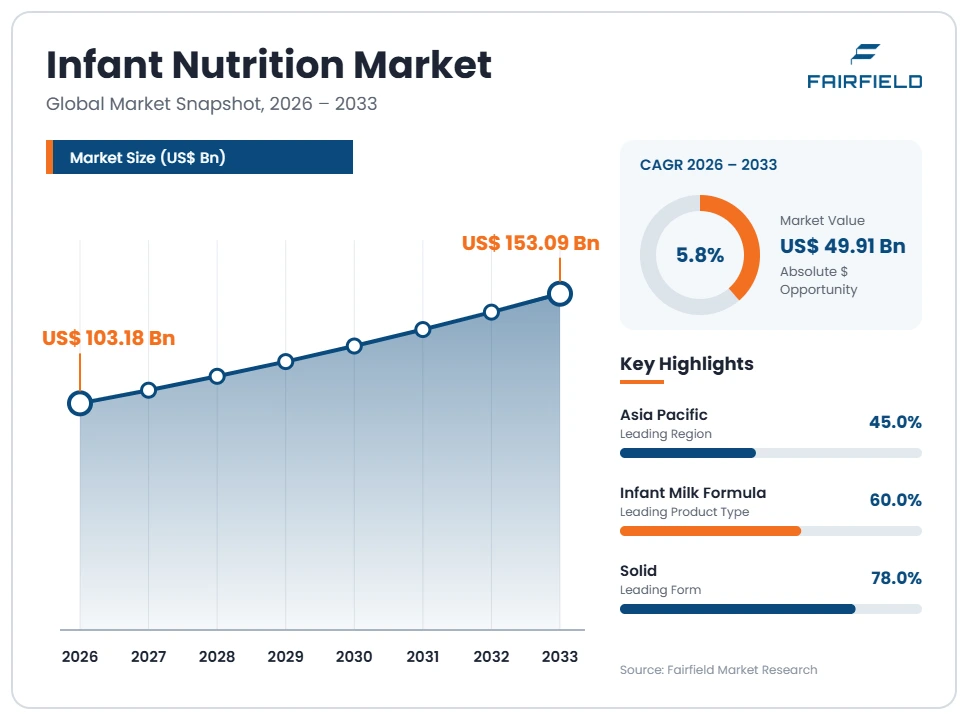
The global infant nutrition market size is expected to be valued at US$ 103.18 billion in 2026 and projected to reach US$ 153.09 billion by 2033, growing at a CAGR of 5.8% between 2026 and 2033.
Between 2020 and 2025, the market grew at a CAGR of about 4.9%, as panic buying lifted sales in 2020, a major United States formula shortage in 2022 exposed supply risks, and falling birth rates in China pushed brands toward premium products and older-child nutrition. The infant nutrition market covers infant formula for babies from birth, follow-on and growing-up milks, specialty and medical formulas for allergies and premature infants, baby food such as cereals, purees, snacks, and ready meals, and related supplements. Products are sold in powder and liquid forms through supermarkets, pharmacies, specialty stores, mother-and-baby stores, and online. Growth comes from rising incomes, more working mothers, urbanization, and demand for premium, organic, and science-based nutrition. In January 2026, Nestlé recalled batches of its SMA formula globally over possible toxin contamination, raising focus on safety.
Key Report Takeaways
- By Product Type: Infant Milk Formula held about 60% share in 2025, while Baby Food is projected to expand at a 6.7% CAGR through 2033, driven by demand for organic, convenient, and clean-label purees, snacks, and cereals among busy urban parents.
- By Form: Solid held about 78% share in 2025, while Liquid is projected to expand at a 7.1% CAGR through 2033, driven by ready-to-feed formula use in hospitals, travel convenience, and premium positioning in developed markets.
- By Sales Channel: Hypermarkets and Supermarkets held about 38% share in 2025, while Online Channels is projected to expand at an 8.9% CAGR through 2033, driven by subscriptions, cross-border shopping, and digital-first brands.
- By Region: Asia Pacific held about 45% share in 2025, while India is projected to expand at a 7.4% CAGR through 2033, driven by a large birth cohort, rising incomes, more working mothers, and expanding modern retail and online shopping.
Global Infant Nutrition Market Trends and Insights
Drivers Impact Analysis
Two drivers carry the strongest influence on infant nutrition market demand during the forecast period.
| Driver | Impact on CAGR Forecast | Geographic Relevance | Impact Timeline |
| Rising incomes, urbanization, and working mothers | High | Asia Pacific, Latin America, Middle East & Africa | Long term (≥4 years) |
| Premiumization and science-based nutrition | Medium | North America, Europe, Asia Pacific | Medium term (2-4 years) |
Rising Incomes Are Driving the Infant Nutrition Market
Rising incomes, urbanization, and working mothers are the strongest driver of the infant nutrition market. Families have more to spend.
The mechanism is changing family life in emerging economies. As incomes rise in India, Indonesia, Vietnam, Nigeria, and Brazil, more families can afford packaged infant formula and baby food. More women are working outside the home, and many return to work within months of giving birth, which increases reliance on formula and ready-to-eat foods. Moving to cities also means smaller families, less help from relatives, and more access to supermarkets and online stores. Parents in these markets often trust international and premium brands. Hospitals and doctors influence early choices, especially for specialty formulas. Even with breastfeeding promoted by health agencies, formula fills gaps when breastfeeding is not possible or is supplemented. These trends support long-term demand.
Premiumization Is Expanding the Infant Nutrition Market
Premiumization and science-based nutrition are expanding the infant nutrition market. Parents pay more for perceived quality.
The cause is parents’ focus on health and development. Brands are adding ingredients modeled on breast milk, such as human milk oligosaccharides, milk fat globule membrane, probiotics, lactoferrin, and DHA, and promoting benefits for immunity, gut health, and brain development. Organic, grass-fed, goat milk, A2 protein, and plant-based formulas attract parents willing to pay more. In China, falling birth rates have pushed brands to grow value through premium products. Specialty formulas for allergies, reflux, and premature babies are growing. Social media and parenting apps spread information about ingredients quickly, and parents research labels closely. Clear sourcing and traceability claims also help brands justify higher prices. These trends expand sales value even where birth numbers are flat.
Restraints Impact Analysis
Two restraints limit how quickly the infant nutrition market grows.
| Restraint | Impact on CAGR Forecast | Geographic Relevance | Impact Timeline |
| Falling birth rates in major markets | High | Asia Pacific, Europe, North America | Long term (≥4 years) |
| Product safety risks, recalls, and strict regulation | Medium | Global | Medium term (2-4 years) |
Falling Birth Rates Slow the Infant Nutrition Market
Falling birth rates in major markets slow the infant nutrition market. Fewer babies mean fewer buyers.
The specific causes are demographic changes. Birth numbers in China have fallen sharply over the past decade, shrinking the world’s largest formula market by volume, and Japan, South Korea, Germany, Italy, and the United States also have low or falling birth rates. Higher costs of raising children, later marriages, and changing attitudes reduce family sizes. Brands must compete harder for a smaller group of babies, leading to price promotions and heavy marketing spending. Some producers have closed factories or exited markets, and retailers have cut shelf space for formula. Growth in these countries depends on premium products and older-child nutrition rather than volume. These factors slow overall market growth.
Safety Concerns Restrict the Infant Nutrition Market
Product safety risks, recalls, and strict regulation restrict the infant nutrition market. Infant products face the highest standards.
The underlying causes are the vulnerability of babies and past incidents. Contamination with bacteria or toxins can cause serious illness, leading to recalls, factory shutdowns, lawsuits, and lost trust. In January 2026, Nestlé recalled batches of SMA formula in many countries over possible cereulide toxin, and botulism cases linked to formula in the United States led to recalls. New registration rules in China forced many brands to exit. Marketing rules based on the international code on breast milk substitutes limit promotion of formula for young babies in many countries. Testing, quality systems, and traceability add significant costs, and lawsuits over preterm formula in the United States add legal risk. Raw material problems at one supplier can affect many brands at once. These factors restrict growth.
Market Opportunities
Specialty and Medical Nutrition Open a Fast-Growth Revenue Pool
Specialty and medical nutrition open a fast-growth revenue pool in the infant nutrition market. More babies need special formulas.
Producers can capture this opportunity. Rising diagnosis of cow’s milk protein allergy, reflux, and digestive problems is increasing demand for extensively hydrolyzed and amino acid-based formulas, which sell at high prices and are often recommended by doctors. Premature babies need special formulas and breast milk fortifiers in hospitals, and survival rates for very small babies are improving. Demand for these products is growing in Europe, North America, and Asia Pacific, and specialty products are less affected by falling birth rates. Breast milk fortifiers and donor milk products are also growing in neonatal units. Companies with strong clinical evidence and relationships with hospitals can build loyal customers and win high margins.
Online and Cross-Border Sales Create a Growth Revenue Pool
Online and cross-border sales create a growth revenue pool in the infant nutrition market. Parents increasingly shop online.
Brands can capture this opportunity. Parents buy formula and baby food through e-commerce sites, subscription services, and social commerce, and online channels let them compare products, read reviews, and get home delivery. Cross-border e-commerce lets parents in China buy imported formula from Australia, New Zealand, and Europe. Direct-to-consumer brands in the United States have grown quickly, and livestreaming sales are popular in China and Indonesia. Brands must manage counterfeit risks online. Online channels also help smaller organic and specialty brands reach parents without large retail budgets. Subscription models lock in repeat purchases over many months. Companies with strong digital marketing and reliable delivery can gain share.
Segment Analysis
- By Product Type: Infant Milk Formula Leads While Baby Food Grows Fastest
Infant Milk Formula held about 60% share in 2025. Formula is the main source of nutrition for many babies in their first year, and it includes standard, premium, organic, specialty, and medical products. Large brands from Nestlé, Danone, Abbott, Reckitt, and Feihe dominate, and high prices for premium formulas support the segment’s value. Follow-on milk for older babies and growing-up milk for toddlers form important related categories.
Baby Food is the fastest-growing product type, expanding at a 6.7% CAGR through 2033. Parents want convenient, organic, and clean-label purees, pouches, cereals, snacks, and ready meals for babies who are starting solid foods. Brands focus on simple ingredients, no added sugar, and new flavors. Follow-on milk and other products form further segments. For the market, baby food growth adds new shopping occasions.
- By Form: Solid Leads While Liquid Grows Fastest
Solid held about 78% share in 2025. Powdered formula is the most common form worldwide because it is cheaper, lighter to ship, and lasts longer once opened. Cereals and dry snacks also fall into this segment. Most emerging-market sales are powders, sold in tins, boxes, and refill packs at different price points.
Liquid is the fastest-growing form, expanding at a 7.1% CAGR through 2033. Ready-to-feed and liquid concentrate formulas are convenient, sterile, and used widely in hospitals, especially for newborns and premature babies. Parents in developed markets use them for travel, daycare, and night feeds, and premium glass and plastic bottles support higher prices. Liquid baby foods such as pouches also grow. For the market, liquid growth adds premium value.
- By Sales Channel: Hypermarkets and Supermarkets Lead While Online Channels Grow Fastest
Hypermarkets and Supermarkets held about 38% share in 2025. These stores offer wide product ranges, promotions, and easy access, making them the main channel in North America, Europe, and Latin America. Pharmacies and medical stores are important for specialty and medical formulas, while mother-and-baby stores lead in China.
Online Channels is the fastest-growing sales channel, expanding at an 8.9% CAGR through 2033, with especially strong growth in China, India, and the United States. E-commerce, subscriptions, cross-border shopping, and social commerce make buying easy for busy parents. Specialty stores and others form further channels, with mother-and-baby stores offering advice and samples. For the market, online growth widens reach.
Geography Analysis
- Why Is North America Important to the Infant Nutrition Market?
North America is important to the infant nutrition market because of high spending per baby, strong regulation, and leading brands. The United States is home to Abbott, Mead Johnson, and Perrigo, along with fast-growing organic and direct-to-consumer brands. The 2022 formula shortage led to new suppliers, imports from Europe and Australia, and investment in local plants. The FDA is reviewing formula standards to improve safety and supply. Specialty and ready-to-feed formulas are widely used in hospitals. Canada adds premium and organic demand. Key barriers include falling birth rates and safety concerns. One change shaping the region is the push for more diverse, resilient supply.
- Europe Shapes the Infant Nutrition Market Through Quality and Exports
Europe is a major infant nutrition market. France, Germany, the Netherlands, the United Kingdom, Ireland, and Switzerland host major producers such as Nestlé, Danone’s Nutricia, FrieslandCampina, Lactalis, and HiPP. European formula and organic baby food are exported widely to Asia Pacific, Middle East & Africa, and North America. Strict rules on composition, labeling, and marketing set high standards, and organic baby food is popular in Germany and France. Key barriers include low birth rates and the impact of recalls on trust. One opportunity is specialty and organic products for export.
- Which Region Is Leading the Infant Nutrition Market?
Asia Pacific is leading the infant nutrition market with about 45% share in 2025, and India is the fastest-growing country, expanding at a 7.4% CAGR through 2033. China is the world’s largest formula market by value, where local brands such as Feihe compete with international players, and premium products offset falling births. India has a large birth cohort and rising use of packaged baby food. Indonesia, Vietnam, and the Philippines add strong growth, while Australia and New Zealand are major exporters. Key barriers include falling births in China, Japan, and South Korea. One change shaping the region is premium growth.
- Latin America Grows the Infant Nutrition Market Through Rising Incomes
Latin America is a growing infant nutrition market. Brazil and Mexico have large populations, more working mothers, and widespread modern retail, while Colombia, Argentina, Peru, and Chile add demand. Global brands such as Nestlé, Danone, Abbott, and Mead Johnson run local production and distribution. Government programs promote breastfeeding but also regulate formula quality, and pharmacies are an important channel in Mexico and Brazil. Online sales are growing in major cities. Key barriers include economic swings, price sensitivity, and currency changes that affect imported products. One opportunity is affordable, fortified products for middle-income families.
- Middle East & Africa Builds the Infant Nutrition Market Through Young Populations
Middle East & Africa is a growing infant nutrition market. Saudi Arabia, the United Arab Emirates, and Egypt have high birth rates and strong demand for imported premium formula. Nigeria, Kenya, Ethiopia, and South Africa have large and young populations, with rising urban incomes and growing supermarket chains. International brands lead, with growing local production in Egypt and Saudi Arabia. Key barriers include low incomes in many countries, price sensitivity, and limited cold chains. One opportunity is affordable fortified cereals and formula for growing urban families.
Competitive Landscape
The infant nutrition market is moderately consolidated. Nestlé, Danone, Abbott, Reckitt (Mead Johnson), and Feihe International are leading players, while FrieslandCampina, Lactalis, The a2 Milk Company, China Mengniu Dairy, HiPP, Perrigo, and The Kraft Heinz Company compete strongly. A few global companies control a large share of formula sales, while many regional brands, private labels, organic producers, and digital-first startups compete in baby food and specific countries.
Companies compete on brand trust, scientific research, product quality and safety, ingredient innovation, relationships with doctors and hospitals, distribution, and price. Because parents rarely switch formula once a baby is settled, winning early choices in hospitals and clinics matters. Strict registration rules, especially in China, and the high cost of clinical studies create strong barriers to entry.
Strategic moves show how competition is changing. In August 2025, The a2 Milk Company agreed to buy a formula plant in New Zealand from China Mengniu to expand China-label production. In January 2026, Nestlé recalled batches of SMA formula worldwide over possible toxin contamination. In February 2026, The a2 Milk Company said it would launch pediatric supplements in China. These moves show competition focused on safety, premium positioning, and new categories.
Three themes shape vendor strategy. First, companies are investing in breast milk-inspired ingredients and specialty formulas. Second, they are strengthening supply chain safety and testing after recalls. Third, they are expanding in India, Indonesia, and Middle East & Africa, where birth rates and incomes support growth.
Infant Nutrition Market Industry Leaders
Nestlé Danone Abbott Reckitt (Mead Johnson) Feihe International
Recent Industry Developments
- February 2026: The a2 Milk Company said it would launch four pediatric supplements in China under the a2 Zhi Yi brand in the third quarter of 2026 - extends premium brands beyond infant formula in the infant nutrition market.
- January 2026: Nestlé recalled specific batches of SMA infant and follow-on formula in many countries over possible cereulide toxin contamination - raises safety and supply chain scrutiny across the industry.
- August 2025: The a2 Milk Company agreed to buy Yashili New Zealand Dairy and its Pokeno plant from China Mengniu for about NZD 282 million - expands China-label formula production capacity.
Companies Covered in the Report
- Nestlé
- Danone
- Abbott
- Reckitt (Mead Johnson)
- Feihe International
- FrieslandCampina
- Lactalis
- The a2 Milk Company
- China Mengniu Dairy
- HiPP
- Perrigo
- The Kraft Heinz Company
Infant Nutrition Market Report Scope
| Metric | Value |
| Study Period | 2020-2033 |
| Market Size 2026 | US$ 103.18 Billion |
| Market Size 2033 | US$ 153.09 Billion |
| CAGR 2026-2033 | 5.8% |
| Absolute Dollar Opportunity | US$ 49.91 Billion |
| Largest Market | Asia Pacific |
| Fastest-Growing Market | India |
| Market Concentration | Moderately Consolidated |
| Major Players | Nestlé, Danone, Abbott, Reckitt (Mead Johnson), Feihe International |
Infant Nutrition Market Segmentation
- Executive Summary
- Global Infant Nutrition Market Snapshot
- Future Projections, 2026-2033
- Key Market Trends
- Regional Snapshot
- Market Overview
- Market Definition and Report Scope
- Historical Market Trends
- Market Dynamics
- Drivers Impact Analysis
- Rising Incomes Are Driving the Infant Nutrition Market
- Premiumization Is Expanding the Infant Nutrition Market
- Restraints Impact Analysis
- Falling Birth Rates Slow the Infant Nutrition Market
- Safety Concerns Restrict the Infant Nutrition Market
- Market Opportunities
- Specialty and Medical Nutrition Open a Fast-Growth Revenue Pool
- Online and Cross-Border Sales Create a Growth Revenue Pool
- Drivers Impact Analysis
- Global Infant Nutrition Market Outlook, 2020-2033
- Global Infant Nutrition Market Outlook, by Product Type, Value (US$ Billion), 2020-2033
- Infant Milk Formula
- Follow-on Milk
- Baby Food
- Others
- Global Infant Nutrition Market Outlook, by Form, Value (US$ Billion), 2020-2033
- Solid
- Liquid
- Global Infant Nutrition Market Outlook, by Sales Channel, Value (US$ Billion), 2020-2033
- Hypermarkets and Supermarkets
- Pharmacy and Medical Stores
- Online Channels
- Specialty Stores
- Others
- Global Infant Nutrition Market Outlook, by Region, Value (US$ Billion), 2020-2033
- North America
- Europe
- Asia Pacific
- Latin America
- Middle East & Africa
- Global Infant Nutrition Market Outlook, by Product Type, Value (US$ Billion), 2020-2033
- North America Infant Nutrition Market Outlook, 2020-2033
- North America Infant Nutrition Market Outlook, by Product Type, Value (US$ Billion), 2020-2033
- Infant Milk Formula
- Follow-on Milk
- Baby Food
- Others
- North America Infant Nutrition Market Outlook, by Form, Value (US$ Billion), 2020-2033
- Solid
- Liquid
- North America Infant Nutrition Market Outlook, by Sales Channel, Value (US$ Billion), 2020-2033
- Hypermarkets and Supermarkets
- Pharmacy and Medical Stores
- Online Channels
- Specialty Stores
- Others
- North America Infant Nutrition Market Outlook, by Country, Value (US$ Billion), 2020-2033
- United States Infant Nutrition Market Outlook, by Product Type, 2020-2033
- United States Infant Nutrition Market Outlook, by Form, 2020-2033
- United States Infant Nutrition Market Outlook, by Sales Channel, 2020-2033
- Canada Infant Nutrition Market Outlook, by Product Type, 2020-2033
- Canada Infant Nutrition Market Outlook, by Form, 2020-2033
- Canada Infant Nutrition Market Outlook, by Sales Channel, 2020-2033
- North America Infant Nutrition Market Outlook, by Product Type, Value (US$ Billion), 2020-2033
- Europe Infant Nutrition Market Outlook, 2020-2033
- Europe Infant Nutrition Market Outlook, by Product Type, Value (US$ Billion), 2020-2033
- Infant Milk Formula
- Follow-on Milk
- Baby Food
- Others
- Europe Infant Nutrition Market Outlook, by Form, Value (US$ Billion), 2020-2033
- Solid
- Liquid
- Europe Infant Nutrition Market Outlook, by Sales Channel, Value (US$ Billion), 2020-2033
- Hypermarkets and Supermarkets
- Pharmacy and Medical Stores
- Online Channels
- Specialty Stores
- Others
- Europe Infant Nutrition Market Outlook, by Country, Value (US$ Billion), 2020-2033
- France Infant Nutrition Market Outlook, by Product Type, 2020-2033
- France Infant Nutrition Market Outlook, by Form, 2020-2033
- France Infant Nutrition Market Outlook, by Sales Channel, 2020-2033
- Germany Infant Nutrition Market Outlook, by Product Type, 2020-2033
- Germany Infant Nutrition Market Outlook, by Form, 2020-2033
- Germany Infant Nutrition Market Outlook, by Sales Channel, 2020-2033
- Netherlands Infant Nutrition Market Outlook, by Product Type, 2020-2033
- Netherlands Infant Nutrition Market Outlook, by Form, 2020-2033
- Netherlands Infant Nutrition Market Outlook, by Sales Channel, 2020-2033
- United Kingdom Infant Nutrition Market Outlook, by Product Type, 2020-2033
- United Kingdom Infant Nutrition Market Outlook, by Form, 2020-2033
- United Kingdom Infant Nutrition Market Outlook, by Sales Channel, 2020-2033
- Ireland Infant Nutrition Market Outlook, by Product Type, 2020-2033
- Ireland Infant Nutrition Market Outlook, by Form, 2020-2033
- Ireland Infant Nutrition Market Outlook, by Sales Channel, 2020-2033
- Switzerland Infant Nutrition Market Outlook, by Product Type, 2020-2033
- Switzerland Infant Nutrition Market Outlook, by Form, 2020-2033
- Switzerland Infant Nutrition Market Outlook, by Sales Channel, 2020-2033
- Europe Infant Nutrition Market Outlook, by Product Type, Value (US$ Billion), 2020-2033
- Asia Pacific Infant Nutrition Market Outlook, 2020-2033
- Asia Pacific Infant Nutrition Market Outlook, by Product Type, Value (US$ Billion), 2020-2033
- Infant Milk Formula
- Follow-on Milk
- Baby Food
- Others
- Asia Pacific Infant Nutrition Market Outlook, by Form, Value (US$ Billion), 2020-2033
- Solid
- Liquid
- Asia Pacific Infant Nutrition Market Outlook, by Sales Channel, Value (US$ Billion), 2020-2033
- Hypermarkets and Supermarkets
- Pharmacy and Medical Stores
- Online Channels
- Specialty Stores
- Others
- Asia Pacific Infant Nutrition Market Outlook, by Country, Value (US$ Billion), 2020-2033
- India Infant Nutrition Market Outlook, by Product Type, 2020-2033
- India Infant Nutrition Market Outlook, by Form, 2020-2033
- India Infant Nutrition Market Outlook, by Sales Channel, 2020-2033
- China Infant Nutrition Market Outlook, by Product Type, 2020-2033
- China Infant Nutrition Market Outlook, by Form, 2020-2033
- China Infant Nutrition Market Outlook, by Sales Channel, 2020-2033
- Indonesia Infant Nutrition Market Outlook, by Product Type, 2020-2033
- Indonesia Infant Nutrition Market Outlook, by Form, 2020-2033
- Indonesia Infant Nutrition Market Outlook, by Sales Channel, 2020-2033
- Vietnam Infant Nutrition Market Outlook, by Product Type, 2020-2033
- Vietnam Infant Nutrition Market Outlook, by Form, 2020-2033
- Vietnam Infant Nutrition Market Outlook, by Sales Channel, 2020-2033
- Philippines Infant Nutrition Market Outlook, by Product Type, 2020-2033
- Philippines Infant Nutrition Market Outlook, by Form, 2020-2033
- Philippines Infant Nutrition Market Outlook, by Sales Channel, 2020-2033
- Australia Infant Nutrition Market Outlook, by Product Type, 2020-2033
- Australia Infant Nutrition Market Outlook, by Form, 2020-2033
- Australia Infant Nutrition Market Outlook, by Sales Channel, 2020-2033
- New Zealand Infant Nutrition Market Outlook, by Product Type, 2020-2033
- New Zealand Infant Nutrition Market Outlook, by Form, 2020-2033
- New Zealand Infant Nutrition Market Outlook, by Sales Channel, 2020-2033
- Japan Infant Nutrition Market Outlook, by Product Type, 2020-2033
- Japan Infant Nutrition Market Outlook, by Form, 2020-2033
- Japan Infant Nutrition Market Outlook, by Sales Channel, 2020-2033
- South Korea Infant Nutrition Market Outlook, by Product Type, 2020-2033
- South Korea Infant Nutrition Market Outlook, by Form, 2020-2033
- South Korea Infant Nutrition Market Outlook, by Sales Channel, 2020-2033
- Asia Pacific Infant Nutrition Market Outlook, by Product Type, Value (US$ Billion), 2020-2033
- Latin America Infant Nutrition Market Outlook, 2020-2033
- Latin America Infant Nutrition Market Outlook, by Product Type, Value (US$ Billion), 2020-2033
- Infant Milk Formula
- Follow-on Milk
- Baby Food
- Others
- Latin America Infant Nutrition Market Outlook, by Form, Value (US$ Billion), 2020-2033
- Solid
- Liquid
- Latin America Infant Nutrition Market Outlook, by Sales Channel, Value (US$ Billion), 2020-2033
- Hypermarkets and Supermarkets
- Pharmacy and Medical Stores
- Online Channels
- Specialty Stores
- Others
- Latin America Infant Nutrition Market Outlook, by Country, Value (US$ Billion), 2020-2033
- Brazil Infant Nutrition Market Outlook, by Product Type, 2020-2033
- Brazil Infant Nutrition Market Outlook, by Form, 2020-2033
- Brazil Infant Nutrition Market Outlook, by Sales Channel, 2020-2033
- Mexico Infant Nutrition Market Outlook, by Product Type, 2020-2033
- Mexico Infant Nutrition Market Outlook, by Form, 2020-2033
- Mexico Infant Nutrition Market Outlook, by Sales Channel, 2020-2033
- Colombia Infant Nutrition Market Outlook, by Product Type, 2020-2033
- Colombia Infant Nutrition Market Outlook, by Form, 2020-2033
- Colombia Infant Nutrition Market Outlook, by Sales Channel, 2020-2033
- Argentina Infant Nutrition Market Outlook, by Product Type, 2020-2033
- Argentina Infant Nutrition Market Outlook, by Form, 2020-2033
- Argentina Infant Nutrition Market Outlook, by Sales Channel, 2020-2033
- Peru Infant Nutrition Market Outlook, by Product Type, 2020-2033
- Peru Infant Nutrition Market Outlook, by Form, 2020-2033
- Peru Infant Nutrition Market Outlook, by Sales Channel, 2020-2033
- Chile Infant Nutrition Market Outlook, by Product Type, 2020-2033
- Chile Infant Nutrition Market Outlook, by Form, 2020-2033
- Chile Infant Nutrition Market Outlook, by Sales Channel, 2020-2033
- Latin America Infant Nutrition Market Outlook, by Product Type, Value (US$ Billion), 2020-2033
- Middle East & Africa Infant Nutrition Market Outlook, 2020-2033
- Middle East & Africa Infant Nutrition Market Outlook, by Product Type, Value (US$ Billion), 2020-2033
- Infant Milk Formula
- Follow-on Milk
- Baby Food
- Others
- Middle East & Africa Infant Nutrition Market Outlook, by Form, Value (US$ Billion), 2020-2033
- Solid
- Liquid
- Middle East & Africa Infant Nutrition Market Outlook, by Sales Channel, Value (US$ Billion), 2020-2033
- Hypermarkets and Supermarkets
- Pharmacy and Medical Stores
- Online Channels
- Specialty Stores
- Others
- Middle East & Africa Infant Nutrition Market Outlook, by Country, Value (US$ Billion), 2020-2033
- Saudi Arabia Infant Nutrition Market Outlook, by Product Type, 2020-2033
- Saudi Arabia Infant Nutrition Market Outlook, by Form, 2020-2033
- Saudi Arabia Infant Nutrition Market Outlook, by Sales Channel, 2020-2033
- United Arab Emirates Infant Nutrition Market Outlook, by Product Type, 2020-2033
- United Arab Emirates Infant Nutrition Market Outlook, by Form, 2020-2033
- United Arab Emirates Infant Nutrition Market Outlook, by Sales Channel, 2020-2033
- Egypt Infant Nutrition Market Outlook, by Product Type, 2020-2033
- Egypt Infant Nutrition Market Outlook, by Form, 2020-2033
- Egypt Infant Nutrition Market Outlook, by Sales Channel, 2020-2033
- Nigeria Infant Nutrition Market Outlook, by Product Type, 2020-2033
- Nigeria Infant Nutrition Market Outlook, by Form, 2020-2033
- Nigeria Infant Nutrition Market Outlook, by Sales Channel, 2020-2033
- Kenya Infant Nutrition Market Outlook, by Product Type, 2020-2033
- Kenya Infant Nutrition Market Outlook, by Form, 2020-2033
- Kenya Infant Nutrition Market Outlook, by Sales Channel, 2020-2033
- Ethiopia Infant Nutrition Market Outlook, by Product Type, 2020-2033
- Ethiopia Infant Nutrition Market Outlook, by Form, 2020-2033
- Ethiopia Infant Nutrition Market Outlook, by Sales Channel, 2020-2033
- South Africa Infant Nutrition Market Outlook, by Product Type, 2020-2033
- South Africa Infant Nutrition Market Outlook, by Form, 2020-2033
- South Africa Infant Nutrition Market Outlook, by Sales Channel, 2020-2033
- Middle East & Africa Infant Nutrition Market Outlook, by Product Type, Value (US$ Billion), 2020-2033
- Competitive Landscape
- Industry Leaders
- Recent Industry Developments
- Company Profiles
- Nestlé
- Danone
- Abbott
- Reckitt (Mead Johnson)
- Feihe International
- FrieslandCampina
- Lactalis
- The a2 Milk Company
- China Mengniu Dairy
- HiPP
- Perrigo
- The Kraft Heinz Company
- Appendix
- Research Methodology
- Report Assumptions
- Acronyms and Abbreviations
Product Type
- Infant Milk Formula
- Follow-on Milk
- Baby Food
- Others
Form
- Solid
- Liquid
Sales Channel
- Hypermarkets and Supermarkets
- Pharmacy and Medical Stores
- Online Channels
- Specialty Stores
- Others
Regions
- North America
- Europe
- Asia Pacific
- Latin America
- Middle East & Africa
Our Research Methodology
Considering the volatility of business today, traditional approaches to strategizing a game plan can be unfruitful if not detrimental. True ambiguity is no way to determine a forecast. A myriad of predetermined factors must be accounted for such as the degree of risk involved, the magnitude of circumstances, as well as conditions or consequences that are not known or unpredictable. To circumvent binary views that cast uncertainty, the application of market research intelligence to strategically posture, move, and enable actionable outcomes is necessary.
View Methodology
Quality Assured
Rigorous Validation Process

Confidentiality Assured
End-to-end Data Security

Custom Research Services
Tailored To Your Objectives
FAQs
The infant nutrition market is valued at US$ 103.18 billion in 2026, led by infant milk formula and Asia Pacific demand.
The market is projected to reach US$ 153.09 billion by 2033, growing at a 5.8% CAGR and adding US$ 49.91 billion.
Online channels are growing fastest at an 8.9% CAGR through 2033, driven by subscriptions, cross-border shopping, and digital-first brands.
India is growing fastest at a 7.4% CAGR through 2033, driven by a large birth cohort, rising incomes, and modern retail growth.
Asia Pacific holds the largest share at about 45% in 2025, supported by premium formula demand in China and large populations.
Related Reports
Instant Beverage Premix Market Size, Share, Insights, Competitive Landscape, and Forecast 2026 to 2033
The global instant beverage premix market is valued at US$24.0 billion in 2026, reaching US$36.5 billion by 2033, growing at a 6.2% CAGR
Yeast Protein Market Size, Share, Insights, Competitive Landscape, and Forecast 2026 to 2033
The global yeast protein market is valued at US$0.9 billion in 2026, reaching US$2.0 billion by 2033, growing at a 12.1% CAGR
Starch Derivatives Market Size, Share, Insights, Competitive Landscape, and Forecast 2026 to 2033
The global starch derivatives market is valued at US$62.5 billion in 2026, reaching US$88.0 billion by 2033, growing at a 5.0% CAGR
Quick Service Restaurants Market Size, Share, Insights, Competitive Landscape, and Forecast 2026 to 2033
The global quick service restaurants market is valued at US$1,090.0 billion in 2026, reaching US$1,556.0 billion by 2033, growing at a 5.2% CAGR
Plant Extracts Market Size, Share, Insights, Competitive Landscape, and Forecast 2026 to 2033
The global plant extracts market is valued at US$42.0 billion in 2026, reaching US$68.5 billion by 2033, growing at a 7.2% CAGR
Kombucha Market Size, Share, Insights, Competitive Landscape, and Forecast 2026 to 2033
The Kombucha Market is projected to grow from US$ 3.2 billion in 2026 to US$ 4.8 billion by 2033 at a 6.0% CAGR. Explore trends and leading segments.