



Nutritional Supplements Market
Nutritional Supplements Market Insights, Competitive Landscape, and Market Forecast - 2033
Global Nutritional Supplements Market: Strategic Analysis 2026-2033
Key Market Highlights
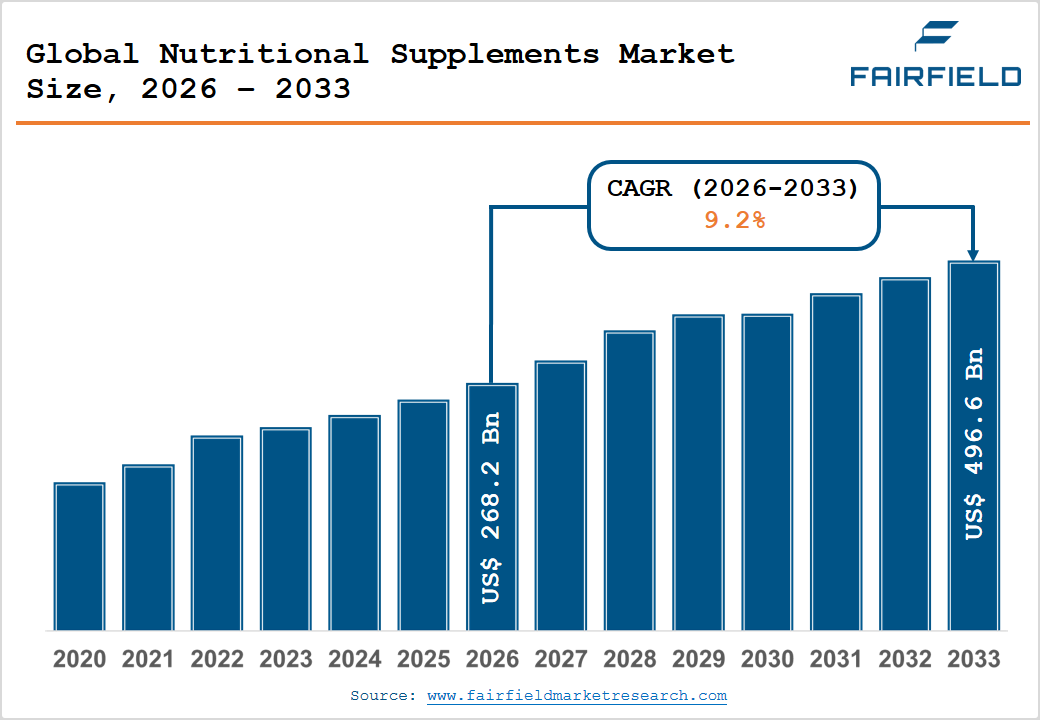
- The global Nutritional Supplements Market size is likely to be valued at US$268.2 billion in 2026 and is expected to reach US$496.6 billion by 2033, growing at a CAGR of 9.20% during the forecast period from 2026 to 2033.
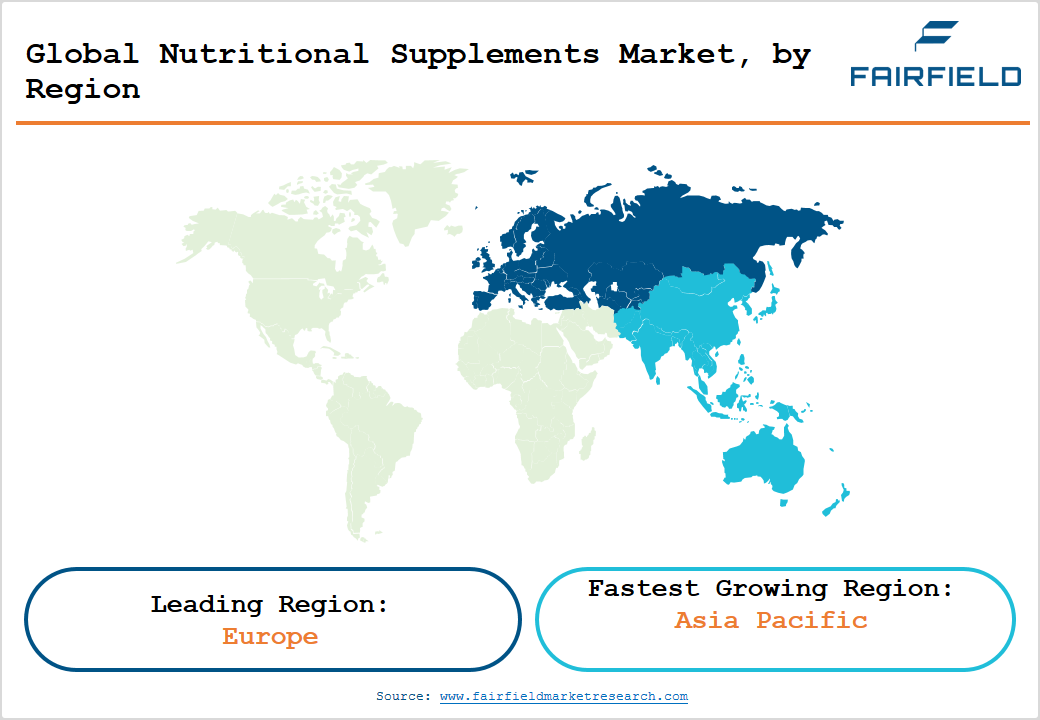
- North America dominates the global nutritional supplements market, supported by the mature U.S. industry generating over US$60 billion annually (CRN), robust e-commerce infrastructure, and a high supplement adoption rate exceeding 74% of adults.
- Asia Pacific is the fastest-growing region, propelled by China's "Healthy China 2030" initiative, India's rising sports nutrition adoption, and ASEAN's expanding functional food and beverage categories, driving strong double-digit demand.
- The Dietary Supplements product category leads with approximately 34% market share, driven by universal multivitamin consumption, broad demographic appeal, and strong clinical evidence base across vitamins, minerals, and amino acids.
- The Women's Health application segment is among the fastest-growing categories, fueled by rising awareness of prenatal nutrition, hormonal health, and PCOS management, supported by policy recommendations from the WHO and CDC.
- Personalized nutrition powered by AI and biomarker testing represents the most significant near-term opportunity, with companies like Thorne pioneering subscription-based customized supplement platforms validated by NIH-backed precision nutrition research.
Market Dynamics: Drivers, Restraints, and Opportunities
Market Drivers
- Surging Demand for Sports Nutrition and Performance Supplementation
The global sports nutrition segment has experienced explosive growth, fueled by increasing participation in fitness activities, competitive sports, and the broader "active lifestyle" consumer movement. According to the International Health, Racquet & Sportsclub Association (IHRSA), global gym memberships surpassed 184 million prior to the pandemic and have rebounded strongly, driving consistent demand for sports supplements, protein powders, and meal replacement products. The rise of social media fitness influencers and online fitness communities has further accelerated consumer adoption, particularly among millennials and Generation Z. Companies such as Glanbia PLC and GNC Holdings, LLC have expanded their sports nutrition portfolios substantially, responding to rising demand for whey protein, BCAAs, creatine, and pre-workout formulations across both professional athlete and recreational user segments.
- Growing Geriatric Population and Rising Prevalence of Nutritional Deficiencies
The global aging population represents one of the most consistent structural demand drivers for the nutritional supplements market. The United Nations projects that the global population aged 60 and above may reach 2.1 billion by 2050, up from approximately 1 billion in 2020. Elderly individuals face elevated risks of micronutrient deficiencies, osteoporosis, cardiovascular disease, and cognitive decline, creating sustained demand for calcium, Vitamin D, omega-3 fatty acids, and probiotics. The U.S. National Institutes of Health (NIH) highlights that Vitamin D deficiency affects over 40% of U.S. adults, particularly older demographics. This demographic megatrend is expected to generate sustained incremental demand for geriatric-specific nutritional formulations throughout the forecast period.
Market Restraints
- Stringent and Fragmented Regulatory Frameworks Across Geographies
The nutritional supplements industry faces increasingly complex and often inconsistent regulatory requirements across global markets. In the European Union, the European Food Safety Authority (EFSA) enforces strict nutrient reference values and health claim regulations under Regulation (EC) No 1924/2006, limiting permissible marketing claims for many supplements. In 2023 and 2024, multiple EU member states issued product withdrawal notices for non-compliant supplements. Such regulatory fragmentation increases compliance costs, product development timelines, and market entry barriers particularly for small and mid-sized manufacturers seeking simultaneous multi-market launches.
- Consumer Skepticism and Product Quality Concerns
Despite strong growth, the nutritional supplements market faces persistent challenges from product quality inconsistencies and consumer skepticism regarding efficacy claims. Multiple studies published in journals such as the Journal of the American Medical Association (JAMA) have documented instances of supplements containing lower-than-labeled ingredient concentrations or undisclosed contaminants. The U.S. FDA has issued hundreds of warning letters to supplement manufacturers for Good Manufacturing Practice (GMP) violations. Such incidents erode consumer trust and may suppress repeat purchases, particularly in sophisticated markets where scientific literacy is higher.
Market Opportunities
- Personalized Nutrition and AI-Driven Supplement Customization
The convergence of genomics, microbiome science, and artificial intelligence is creating a transformative opportunity in personalized nutrition one of the fastest-growing emerging segments within the nutritional supplements landscape. Companies such as Thorne have already launched scientifically validated personalized supplement subscription services leveraging biomarker testing and AI-driven recommendations. The National Institutes of Health (NIH) has committed significant funding to the Precision Nutrition Program under the All of Us Research Program, validating the scientific basis of individualized dietary supplementation. As consumer willingness to pay premiums for evidence-based, customized wellness solutions increases, companies that integrate digital health platforms with nutritional supplement delivery are well-positioned to capture a growing high-margin consumer segment across North America, Europe, and Asia Pacific.
- Expansion of Women's Health and Prenatal Nutrition Supplement Categories
The women's health supplement segment is emerging as a high-growth opportunity, driven by rising awareness of conditions such as polycystic ovary syndrome (PCOS), hormonal imbalances, perimenopause, bone density loss, and prenatal nutritional requirements. According to the Centers for Disease Control and Prevention (CDC), Mostly pregnant women in the U.S. use dietary supplements, with prenatal vitamins as the leading category. Globally, organizations such as the WHO recommend iron and folic acid supplementation for all pregnant women, creating a policy-backed demand base. The growing influence of femtech platforms, female wellness communities, and OB-GYN-endorsed supplement brands is accelerating consumer adoption, presenting significant commercial opportunities for companies investing in evidence-based women's health supplement formulations.
Regional Market Assessment: Strategic Geography
- North America Nutritional Supplements Market Trends
North America remains the global leader in the nutritional supplements market, underpinned by the U.S. mature regulatory environment, highly developed retail infrastructure, and innovation-oriented industry ecosystem. The FDA's Dietary Supplement Health and Education Act (DSHEA) framework has enabled a broad product ecosystem, while the Federal Trade Commission (FTC) ensures responsible marketing practices. The CRN reports that the U.S. dietary supplement industry generates annual sales exceeding US$ 60 Billion, with supplements consumed by over 3 in 4 American adults.
Innovation is a defining characteristic of the North American market, with companies such as Thorne, NOW Foods, and Herbalife International of America, Inc. investing in personalized nutrition platforms, third-party testing certifications, and NSF/USP-verified quality seals to differentiate their product offerings. Canada complements U.S. growth with a robust Natural Health Products framework under Health Canada, supporting continued market expansion across the region.
<
- Europe Nutritional Supplements Market Trends
Europe represents a significant and sophisticated market for nutritional supplements, with Germany, the United Kingdom, France, and Spain as the primary consumption markets. Germany leads European supplement sales, supported by a strong pharmaceutical tradition and high consumer health literacy. The EFSA continues to harmonize health claim regulations across member states under Regulation (EC) No 1924/2006, creating a more uniform product landscape albeit with stricter substantiation requirements.
The U.K. market has maintained strong growth post-Brexit, with the Food Standards Agency (FSA) overseeing supplement safety standards. France and Spain are witnessing growing consumer interest in plant-based supplements and probiotics. Across Europe, clean-label positioning, organic certification, and sustainability credentials are becoming key purchase drivers trends that manufacturers such as Nestlé Health Science and BASF SE are actively leveraging in their European supplement strategies.
- Asia Pacific Nutritional Supplements Market Trends
Asia Pacific is the fastest-growing regional market for nutritional supplements, driven by China's rapidly expanding middle class, India's growing wellness awareness, and Japan's well-established functional food culture. China's "Healthy China 2030" national strategy actively promotes dietary supplementation as part of preventive healthcare, generating significant policy-backed demand. The China Health Food Association (CHFA) reports consistent double-digit growth in domestic health food product registrations.
India's nutritional supplements sector is expanding rapidly, catalyzed by rising sports nutrition adoption among urban youth and growing awareness of protein deficiency. ASEAN markets including Indonesia, Thailand, and Vietnam are experiencing accelerated growth in functional food and beverage categories. The region also benefits from lower manufacturing costs and proximity to key raw material sources, making it a global hub for supplement ingredient production. Companies such as Amway Corp. and Herbalife have particularly strong direct-selling penetration across Southeast Asia.
Segmentation Analysis: Category-Wise Strategic Assessment
- By Product Analysis
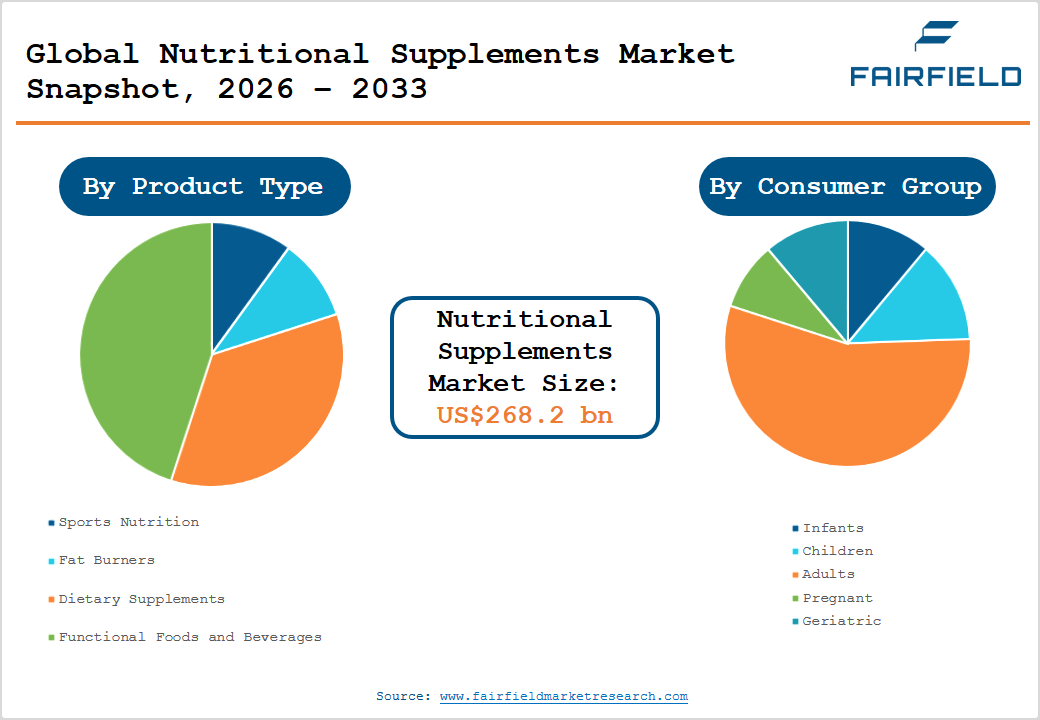
The Dietary Supplements sub-category encompassing vitamins, minerals, amino acids, enzymes, and conjugated linoleic acids holds the dominant share within the overall product landscape, accounting for approximately 34% of total market revenue. This leadership is underpinned by broad consumer familiarity, the universal applicability of vitamins and minerals across all age demographics, and robust clinical evidence supporting their efficacy. The Council for Responsible Nutrition (CRN) reports that over 74% of U.S. adults use dietary supplements, with multivitamins as the most consumed category. Regulatory frameworks such as DSHEA in the U.S. have facilitated a mature and well-structured product ecosystem. Vitamins particularly Vitamin D, Vitamin C, and B-complex variants remain consistently top-selling SKUs globally.
- By Consumer Group Analysis
The Adults consumer group represents the dominant demographic segment, accounting for an estimated 48% of total market share. Adults aged 18-64 are the primary consumers of sports nutrition, weight management supplements, and general wellness products. The CRN's 2023 Consumer Survey on Dietary Supplements confirms that supplement usage peaks in the 35–54 age group, driven by growing health consciousness and preventive healthcare priorities. Working adults increasingly turn to nutritional supplements for energy support, stress management (adaptogens), cognitive performance (nootropics), and immune health particularly following the heightened health awareness catalyzed by the COVID-19 pandemic. Digital-first marketing strategies by brands such as Thorne and NOW Foods are effectively reaching and retaining adult supplement consumers.
- By Formulation Analysis
The Capsules formulation segment leads the market with an estimated 30% share, favored for their versatility, ease of swallowing, and superior ingredient protection compared to tablets. Capsules both hard-shell gelatin and vegetarian (HPMC) variants accommodate a wide range of active ingredients including oils, powders, and granules, making them suitable across dietary supplement, pharmaceutical-grade nutrition, and functional ingredient applications. Their widespread use in omega-3 supplements, probiotic formulations, and herbal extracts reflects their technical advantages. The U.S. Pharmacopeia (USP) recognizes capsule formulations as a primary delivery standard for nutritional products. Growing consumer preference for vegetarian capsule options also aligns with the broader clean-label and plant-based wellness trends gaining prominence across North America and Europe.
- By Sales Channel Analysis
The E-commerce sales channel has emerged as the fastest-growing and increasingly dominant distribution route, now accounting for approximately 33% of total nutritional supplements sales globally. The U.S. Census Bureau has consistently reported double-digit annual growth in e-commerce retail across health and personal care categories. Platforms such as Amazon, iHerb, and brand-owned direct-to-consumer (DTC) websites have transformed supplement purchasing behavior, enabling price comparison, subscription models, and personalized recommendation engines. The COVID-19 pandemic permanently accelerated the shift from brick-and-mortar channels. Companies like The Vitamin Shoppe and GNC Holdings have invested significantly in omnichannel strategies to compete effectively with pure-play digital supplement retailers.
- By Application Analysis
The General Health application segment commands the largest share, estimated at approximately 27% of the market. This segment captures consumer demand for broad-spectrum vitamins, mineral supplements, and antioxidant formulations consumed without a specific therapeutic goal but oriented toward overall wellbeing maintenance. The universal appeal of general health supplements cuts across all age groups, genders, and geographies. The WHO's Global Action Plan for the Prevention and Control of Noncommunicable Diseases emphasizes micronutrient adequacy as a foundational health pillar, reinforcing consumer behavior. Post-pandemic immunity awareness has further bolstered this segment, with Vitamin C, Zinc, and Vitamin D supplements experiencing sustained elevated demand. Brands such as NOW Foods and Amway Corp. have particularly strong positioning in this broad-based general health supplementation category.
Competitive Landscape: Market Structure and Strategic Positioning
The global nutritional supplements market is highly fragmented at the formulation and retail levels, while moderately consolidated among ingredient suppliers. Market leaders including Amway Corp., Herbalife International, Nestlé Health Science, PepsiCo, and Glanbia PLC compete on brand equity, scientific validation, and distribution scale. Key differentiators include third-party certifications (NSF, USP, Informed Sport), personalized nutrition platforms, and omnichannel retail strategies. Sustainability commitments, clean-label formulations, and direct-to-consumer subscription models are increasingly pivotal strategic levers across the competitive landscape.
Key Players
- Amway Corp.
- PepsiCo
- Glanbia PLC
- Nestlé Health Science
- Herbalife International of America, Inc.
- The Vitamin Shoppe
- The Coca-Cola Company
- GNC Holdings, LLC
- Thorne
- NOW Foods
- Abbott Laboratories
- Pfizer Consumer Healthcare (Centrum)
- Bayer AG (One A Day)
- DSM-Firmenich
- Nature's Sunshine Products
- Jamieson Wellness Inc.
Key Market Developments
- February, 2025: Nestlé Health Science expanded its personalized nutrition portfolio by acquiring a minority stake in a digital health nutrition startup, strengthening its AI-driven supplement recommendation capabilities for direct-to-consumer markets.
- October, 2024: Glanbia PLC announced the expansion of its sports nutrition brand Optimum Nutrition into five new Asia Pacific markets, capitalizing on the region's rapidly growing sports performance supplement demand.
- March, 2024: The Coca-Cola Company launched a new line of functional beverages fortified with vitamins and minerals under its Powerade and Smartwater brands, targeting the convergence of hydration and nutritional supplement categories.
Global Nutritional Supplements Market Segmentation-
By Product
- Sports Nutrition
- Sports Supplements
- Sports Drinks
- Sports Foods
- Meal Replacement Products
- Weight Loss Product
- Fat Burners
- Green Tea
- Fiber
- Protein
- Green Coffee
- Others
- Dietary Supplements
- Vitamins
- Minerals
- Enzymes
- Amino Acids
- Conjugated Linoleic Acids
- Others
- Functional Foods and Beverages
- Probiotics
- Omega-3
- Others
By Consumer Group
- Infants
- Children
- Adults
- Pregnant
- Geriatric
By Formulation
- Tablets
- Capsules
- Powder
- Softgels
- Liquid
- Others
By Sales Channel
- Brick & Mortar
- Direct Selling
- Chemist/Pharmacies
- Health Food Shops
- Hyper Markets
- Super Markets
- E-commerce
By Application
- Sports & Athletics
- General Health
- Bone & Joint Health
- Brain Health
- Gastrointestinal Health
- Immune Health
- Cardiovascular Health
- Skin/Hair/Nails
- Sexual Health
- Women’s Health
- Anti-aging
- Weight Management
- Others
By Region
- North America
- Europe
- Asia Pacific
- Latin America
- Middle East & Africa
- Executive Summary
- Global Nutritional Supplements Market Snapshot
- Future Projections
- Key Market Trends
- Regional Snapshot, by Value, 2026
- Analyst Recommendations
- Market Overview
- Market Definitions and Segmentations
- Market Dynamics
- Drivers
- Restraints
- Market Opportunities
- Value Chain Analysis
- COVID-19 Impact Analysis
- Porter's Five Forces Analysis
- Impact of Russia-Ukraine Conflict
- PESTLE Analysis
- Regulatory Analysis
- Price Trend Analysis
- Current Prices and Future Projections, 2025-2033
- Price Impact Factors
- Global Nutritional Supplements Market Outlook, 2020 - 2033
- Global Nutritional Supplements Market Outlook, by Product, Value (US$ Bn), 2020-2033
- Sports Nutrition
- Sports Supplements
- Sports Drinks
- Sports Foods
- Meal Replacement Products
- Weight Loss Product
- Fat Burners
- Green Tea
- Fiber
- Protein
- Green Coffee
- Others
- Dietary Supplements
- Vitamins
- Minerals
- Enzymes
- Amino Acids
- Conjugated Linoleic Acids
- Others
- Functional Foods and Beverages
- Probiotics
- Omega-3
- Others
- Global Nutritional Supplements Market Outlook, by Consumer Group, Value (US$ Bn), 2020-2033
- Infants
- Children
- Adults
- Pregnant
- Geriatric
- Global Nutritional Supplements Market Outlook, by Formulation, Value (US$ Bn), 2020-2033
- Tablets
- Capsules
- Powder
- Softgels
- Liquid
- Others
- Global Nutritional Supplements Market Outlook, by Sales Channel, Value (US$ Bn), 2020-2033
- Brick & Mortar
- Direct Selling
- Chemist/Pharmacies
- Health Food Shops
- Hyper Markets
- Super Markets
- E-commerce
- Global Nutritional Supplements Market Outlook, by Application, Value (US$ Bn), 2020-2033
- Sports & Athletics
- General Health
- Bone & Joint Health
- Brain Health
- Gastrointestinal Health
- Immune Health
- Cardiovascular Health
- Skin/Hair/Nails
- Sexual Health
- Others
- Global Nutritional Supplements Market Outlook, by Region, Value (US$ Bn), 2020-2033
- North America
- Europe
- Asia Pacific
- Latin America
- Middle East & Africa
- Sports Nutrition
- Global Nutritional Supplements Market Outlook, by Product, Value (US$ Bn), 2020-2033
- North America Nutritional Supplements Market Outlook, 2020 - 2033
- North America Nutritional Supplements Market Outlook, by Product, Value (US$ Bn), 2020-2033
- Sports Nutrition
- Sports Supplements
- Sports Drinks
- Sports Foods
- Meal Replacement Products
- Weight Loss Product
- Fat Burners
- Green Tea
- Fiber
- Protein
- Green Coffee
- Others
- Dietary Supplements
- Vitamins
- Minerals
- Enzymes
- Amino Acids
- Conjugated Linoleic Acids
- Others
- Functional Foods and Beverages
- Probiotics
- Omega-3
- Others
- North America Nutritional Supplements Market Outlook, by Consumer Group, Value (US$ Bn), 2020-2033
- Infants
- Children
- Adults
- Pregnant
- Geriatric
- North America Nutritional Supplements Market Outlook, by Formulation, Value (US$ Bn), 2020-2033
- Tablets
- Capsules
- Powder
- Softgels
- Liquid
- Others
- North America Nutritional Supplements Market Outlook, by Sales Channel, Value (US$ Bn), 2020-2033
- Brick & Mortar
- Direct Selling
- Chemist/Pharmacies
- Health Food Shops
- Hyper Markets
- Super Markets
- E-commerce
- North America Nutritional Supplements Market Outlook, by Application, Value (US$ Bn), 2020-2033
- Sports & Athletics
- General Health
- Bone & Joint Health
- Brain Health
- Gastrointestinal Health
- Immune Health
- Cardiovascular Health
- Skin/Hair/Nails
- Sexual Health
- Others
- North America Nutritional Supplements Market Outlook, by Country, Value (US$ Bn), 2020-2033
- U.S. Nutritional Supplements Market Outlook, by Product, 2020-2033
- U.S. Nutritional Supplements Market Outlook, by Consumer Group, 2020-2033
- U.S. Nutritional Supplements Market Outlook, by Formulation, 2020-2033
- U.S. Nutritional Supplements Market Outlook, by Sales Channel, 2020-2033
- U.S. Nutritional Supplements Market Outlook, by Application, 2020-2033
- Canada Nutritional Supplements Market Outlook, by Product, 2020-2033
- Canada Nutritional Supplements Market Outlook, by Consumer Group, 2020-2033
- Canada Nutritional Supplements Market Outlook, by Formulation, 2020-2033
- Canada Nutritional Supplements Market Outlook, by Sales Channel, 2020-2033
- Canada Nutritional Supplements Market Outlook, by Application, 2020-2033
- BPS Analysis/Market Attractiveness Analysis
- Sports Nutrition
- North America Nutritional Supplements Market Outlook, by Product, Value (US$ Bn), 2020-2033
- Europe Nutritional Supplements Market Outlook, 2020 - 2033
- Europe Nutritional Supplements Market Outlook, by Product, Value (US$ Bn), 2020-2033
- Sports Nutrition
- Sports Supplements
- Sports Drinks
- Sports Foods
- Meal Replacement Products
- Weight Loss Product
- Fat Burners
- Green Tea
- Fiber
- Protein
- Green Coffee
- Others
- Dietary Supplements
- Vitamins
- Minerals
- Enzymes
- Amino Acids
- Conjugated Linoleic Acids
- Others
- Functional Foods and Beverages
- Probiotics
- Omega-3
- Others
- Europe Nutritional Supplements Market Outlook, by Consumer Group, Value (US$ Bn), 2020-2033
- Infants
- Children
- Adults
- Pregnant
- Geriatric
- Europe Nutritional Supplements Market Outlook, by Formulation, Value (US$ Bn), 2020-2033
- Tablets
- Capsules
- Powder
- Softgels
- Liquid
- Others
- Europe Nutritional Supplements Market Outlook, by Sales Channel, Value (US$ Bn), 2020-2033
- Brick & Mortar
- Direct Selling
- Chemist/Pharmacies
- Health Food Shops
- Hyper Markets
- Super Markets
- E-commerce
- Europe Nutritional Supplements Market Outlook, by Application, Value (US$ Bn), 2020-2033
- Sports & Athletics
- General Health
- Bone & Joint Health
- Brain Health
- Gastrointestinal Health
- Immune Health
- Cardiovascular Health
- Skin/Hair/Nails
- Sexual Health
- Others
- Europe Nutritional Supplements Market Outlook, by Country, Value (US$ Bn), 2020-2033
- Germany Nutritional Supplements Market Outlook, by Product, 2020-2033
- Germany Nutritional Supplements Market Outlook, by Consumer Group, 2020-2033
- Germany Nutritional Supplements Market Outlook, by Formulation, 2020-2033
- Germany Nutritional Supplements Market Outlook, by Sales Channel, 2020-2033
- Germany Nutritional Supplements Market Outlook, by Application, 2020-2033
- Italy Nutritional Supplements Market Outlook, by Product, 2020-2033
- Italy Nutritional Supplements Market Outlook, by Consumer Group, 2020-2033
- Italy Nutritional Supplements Market Outlook, by Formulation, 2020-2033
- Italy Nutritional Supplements Market Outlook, by Sales Channel, 2020-2033
- Italy Nutritional Supplements Market Outlook, by Application, 2020-2033
- France Nutritional Supplements Market Outlook, by Product, 2020-2033
- France Nutritional Supplements Market Outlook, by Consumer Group, 2020-2033
- France Nutritional Supplements Market Outlook, by Formulation, 2020-2033
- France Nutritional Supplements Market Outlook, by Sales Channel, 2020-2033
- France Nutritional Supplements Market Outlook, by Application, 2020-2033
- U.K. Nutritional Supplements Market Outlook, by Product, 2020-2033
- U.K. Nutritional Supplements Market Outlook, by Consumer Group, 2020-2033
- U.K. Nutritional Supplements Market Outlook, by Formulation, 2020-2033
- U.K. Nutritional Supplements Market Outlook, by Sales Channel, 2020-2033
- U.K. Nutritional Supplements Market Outlook, by Application, 2020-2033
- Spain Nutritional Supplements Market Outlook, by Product, 2020-2033
- Spain Nutritional Supplements Market Outlook, by Consumer Group, 2020-2033
- Spain Nutritional Supplements Market Outlook, by Formulation, 2020-2033
- Spain Nutritional Supplements Market Outlook, by Sales Channel, 2020-2033
- Spain Nutritional Supplements Market Outlook, by Application, 2020-2033
- Russia Nutritional Supplements Market Outlook, by Product, 2020-2033
- Russia Nutritional Supplements Market Outlook, by Consumer Group, 2020-2033
- Russia Nutritional Supplements Market Outlook, by Formulation, 2020-2033
- Russia Nutritional Supplements Market Outlook, by Sales Channel, 2020-2033
- Russia Nutritional Supplements Market Outlook, by Application, 2020-2033
- Rest of Europe Nutritional Supplements Market Outlook, by Product, 2020-2033
- Rest of Europe Nutritional Supplements Market Outlook, by Consumer Group, 2020-2033
- Rest of Europe Nutritional Supplements Market Outlook, by Formulation, 2020-2033
- Rest of Europe Nutritional Supplements Market Outlook, by Sales Channel, 2020-2033
- Rest of Europe Nutritional Supplements Market Outlook, by Application, 2020-2033
- BPS Analysis/Market Attractiveness Analysis
- Sports Nutrition
- Europe Nutritional Supplements Market Outlook, by Product, Value (US$ Bn), 2020-2033
- Asia Pacific Nutritional Supplements Market Outlook, 2020 - 2033
- Asia Pacific Nutritional Supplements Market Outlook, by Product, Value (US$ Bn), 2020-2033
- Sports Nutrition
- Sports Supplements
- Sports Drinks
- Sports Foods
- Meal Replacement Products
- Weight Loss Product
- Fat Burners
- Green Tea
- Fiber
- Protein
- Green Coffee
- Others
- Dietary Supplements
- Vitamins
- Minerals
- Enzymes
- Amino Acids
- Conjugated Linoleic Acids
- Others
- Functional Foods and Beverages
- Probiotics
- Omega-3
- Others
- Asia Pacific Nutritional Supplements Market Outlook, by Consumer Group, Value (US$ Bn), 2020-2033
- Infants
- Children
- Adults
- Pregnant
- Geriatric
- Asia Pacific Nutritional Supplements Market Outlook, by Formulation, Value (US$ Bn), 2020-2033
- Tablets
- Capsules
- Powder
- Softgels
- Liquid
- Others
- Asia Pacific Nutritional Supplements Market Outlook, by Sales Channel, Value (US$ Bn), 2020-2033
- Brick & Mortar
- Direct Selling
- Chemist/Pharmacies
- Health Food Shops
- Hyper Markets
- Super Markets
- E-commerce
- Asia Pacific Nutritional Supplements Market Outlook, by Application, Value (US$ Bn), 2020-2033
- Sports & Athletics
- General Health
- Bone & Joint Health
- Brain Health
- Gastrointestinal Health
- Immune Health
- Cardiovascular Health
- Skin/Hair/Nails
- Sexual Health
- Others
- Asia Pacific Nutritional Supplements Market Outlook, by Country, Value (US$ Bn), 2020-2033
- China Nutritional Supplements Market Outlook, by Product, 2020-2033
- China Nutritional Supplements Market Outlook, by Consumer Group, 2020-2033
- China Nutritional Supplements Market Outlook, by Formulation, 2020-2033
- China Nutritional Supplements Market Outlook, by Sales Channel, 2020-2033
- China Nutritional Supplements Market Outlook, by Application, 2020-2033
- Japan Nutritional Supplements Market Outlook, by Product, 2020-2033
- Japan Nutritional Supplements Market Outlook, by Consumer Group, 2020-2033
- Japan Nutritional Supplements Market Outlook, by Formulation, 2020-2033
- Japan Nutritional Supplements Market Outlook, by Sales Channel, 2020-2033
- Japan Nutritional Supplements Market Outlook, by Application, 2020-2033
- South Korea Nutritional Supplements Market Outlook, by Product, 2020-2033
- South Korea Nutritional Supplements Market Outlook, by Consumer Group, 2020-2033
- South Korea Nutritional Supplements Market Outlook, by Formulation, 2020-2033
- South Korea Nutritional Supplements Market Outlook, by Sales Channel, 2020-2033
- South Korea Nutritional Supplements Market Outlook, by Application, 2020-2033
- India Nutritional Supplements Market Outlook, by Product, 2020-2033
- India Nutritional Supplements Market Outlook, by Consumer Group, 2020-2033
- India Nutritional Supplements Market Outlook, by Formulation, 2020-2033
- India Nutritional Supplements Market Outlook, by Sales Channel, 2020-2033
- India Nutritional Supplements Market Outlook, by Application, 2020-2033
- Southeast Asia Nutritional Supplements Market Outlook, by Product, 2020-2033
- Southeast Asia Nutritional Supplements Market Outlook, by Consumer Group, 2020-2033
- Southeast Asia Nutritional Supplements Market Outlook, by Formulation, 2020-2033
- Southeast Asia Nutritional Supplements Market Outlook, by Sales Channel, 2020-2033
- Southeast Asia Nutritional Supplements Market Outlook, by Application, 2020-2033
- Rest of SAO Nutritional Supplements Market Outlook, by Product, 2020-2033
- Rest of SAO Nutritional Supplements Market Outlook, by Consumer Group, 2020-2033
- Rest of SAO Nutritional Supplements Market Outlook, by Formulation, 2020-2033
- Rest of SAO Nutritional Supplements Market Outlook, by Sales Channel, 2020-2033
- Rest of SAO Nutritional Supplements Market Outlook, by Application, 2020-2033
- BPS Analysis/Market Attractiveness Analysis
- Sports Nutrition
- Asia Pacific Nutritional Supplements Market Outlook, by Product, Value (US$ Bn), 2020-2033
- Latin America Nutritional Supplements Market Outlook, 2020 - 2033
- Latin America Nutritional Supplements Market Outlook, by Product, Value (US$ Bn), 2020-2033
- Sports Nutrition
- Sports Supplements
- Sports Drinks
- Sports Foods
- Meal Replacement Products
- Weight Loss Product
- Fat Burners
- Green Tea
- Fiber
- Protein
- Green Coffee
- Others
- Dietary Supplements
- Vitamins
- Minerals
- Enzymes
- Amino Acids
- Conjugated Linoleic Acids
- Others
- Functional Foods and Beverages
- Probiotics
- Omega-3
- Others
- Latin America Nutritional Supplements Market Outlook, by Consumer Group, Value (US$ Bn), 2020-2033
- Infants
- Children
- Adults
- Pregnant
- Geriatric
- Latin America Nutritional Supplements Market Outlook, by Formulation, Value (US$ Bn), 2020-2033
- Tablets
- Capsules
- Powder
- Softgels
- Liquid
- Others
- Latin America Nutritional Supplements Market Outlook, by Sales Channel, Value (US$ Bn), 2020-2033
- Brick & Mortar
- Direct Selling
- Chemist/Pharmacies
- Health Food Shops
- Hyper Markets
- Super Markets
- E-commerce
- Latin America Nutritional Supplements Market Outlook, by Application, Value (US$ Bn), 2020-2033
- Sports & Athletics
- General Health
- Bone & Joint Health
- Brain Health
- Gastrointestinal Health
- Immune Health
- Cardiovascular Health
- Skin/Hair/Nails
- Sexual Health
- Others
- Latin America Nutritional Supplements Market Outlook, by Country, Value (US$ Bn), 2020-2033
- Brazil Nutritional Supplements Market Outlook, by Product, 2020-2033
- Brazil Nutritional Supplements Market Outlook, by Consumer Group, 2020-2033
- Brazil Nutritional Supplements Market Outlook, by Formulation, 2020-2033
- Brazil Nutritional Supplements Market Outlook, by Sales Channel, 2020-2033
- Brazil Nutritional Supplements Market Outlook, by Application, 2020-2033
- Mexico Nutritional Supplements Market Outlook, by Product, 2020-2033
- Mexico Nutritional Supplements Market Outlook, by Consumer Group, 2020-2033
- Mexico Nutritional Supplements Market Outlook, by Formulation, 2020-2033
- Mexico Nutritional Supplements Market Outlook, by Sales Channel, 2020-2033
- Mexico Nutritional Supplements Market Outlook, by Application, 2020-2033
- Argentina Nutritional Supplements Market Outlook, by Product, 2020-2033
- Argentina Nutritional Supplements Market Outlook, by Consumer Group, 2020-2033
- Argentina Nutritional Supplements Market Outlook, by Formulation, 2020-2033
- Argentina Nutritional Supplements Market Outlook, by Sales Channel, 2020-2033
- Argentina Nutritional Supplements Market Outlook, by Application, 2020-2033
- Rest of LATAM Nutritional Supplements Market Outlook, by Product, 2020-2033
- Rest of LATAM Nutritional Supplements Market Outlook, by Consumer Group, 2020-2033
- Rest of LATAM Nutritional Supplements Market Outlook, by Formulation, 2020-2033
- Rest of LATAM Nutritional Supplements Market Outlook, by Sales Channel, 2020-2033
- Rest of LATAM Nutritional Supplements Market Outlook, by Application, 2020-2033
- BPS Analysis/Market Attractiveness Analysis
- Sports Nutrition
- Latin America Nutritional Supplements Market Outlook, by Product, Value (US$ Bn), 2020-2033
- Middle East & Africa Nutritional Supplements Market Outlook, 2020 - 2033
- Middle East & Africa Nutritional Supplements Market Outlook, by Product, Value (US$ Bn), 2020-2033
- Sports Nutrition
- Sports Supplements
- Sports Drinks
- Sports Foods
- Meal Replacement Products
- Weight Loss Product
- Fat Burners
- Green Tea
- Fiber
- Protein
- Green Coffee
- Others
- Dietary Supplements
- Vitamins
- Minerals
- Enzymes
- Amino Acids
- Conjugated Linoleic Acids
- Others
- Functional Foods and Beverages
- Probiotics
- Omega-3
- Others
- Middle East & Africa Nutritional Supplements Market Outlook, by Consumer Group, Value (US$ Bn), 2020-2033
- Infants
- Children
- Adults
- Pregnant
- Geriatric
- Middle East & Africa Nutritional Supplements Market Outlook, by Formulation, Value (US$ Bn), 2020-2033
- Tablets
- Capsules
- Powder
- Softgels
- Liquid
- Others
- Middle East & Africa Nutritional Supplements Market Outlook, by Sales Channel, Value (US$ Bn), 2020-2033
- Brick & Mortar
- Direct Selling
- Chemist/Pharmacies
- Health Food Shops
- Hyper Markets
- Super Markets
- E-commerce
- Middle East & Africa Nutritional Supplements Market Outlook, by Application, Value (US$ Bn), 2020-2033
- Sports & Athletics
- General Health
- Bone & Joint Health
- Brain Health
- Gastrointestinal Health
- Immune Health
- Cardiovascular Health
- Skin/Hair/Nails
- Sexual Health
- Others
- Middle East & Africa Nutritional Supplements Market Outlook, by Country, Value (US$ Bn), 2020-2033
- GCC Nutritional Supplements Market Outlook, by Product, 2020-2033
- GCC Nutritional Supplements Market Outlook, by Consumer Group, 2020-2033
- GCC Nutritional Supplements Market Outlook, by Formulation, 2020-2033
- GCC Nutritional Supplements Market Outlook, by Sales Channel, 2020-2033
- GCC Nutritional Supplements Market Outlook, by Application, 2020-2033
- South Africa Nutritional Supplements Market Outlook, by Product, 2020-2033
- South Africa Nutritional Supplements Market Outlook, by Consumer Group, 2020-2033
- South Africa Nutritional Supplements Market Outlook, by Formulation, 2020-2033
- South Africa Nutritional Supplements Market Outlook, by Sales Channel, 2020-2033
- South Africa Nutritional Supplements Market Outlook, by Application, 2020-2033
- Egypt Nutritional Supplements Market Outlook, by Product, 2020-2033
- Egypt Nutritional Supplements Market Outlook, by Consumer Group, 2020-2033
- Egypt Nutritional Supplements Market Outlook, by Formulation, 2020-2033
- Egypt Nutritional Supplements Market Outlook, by Sales Channel, 2020-2033
- Egypt Nutritional Supplements Market Outlook, by Application, 2020-2033
- Nigeria Nutritional Supplements Market Outlook, by Product, 2020-2033
- Nigeria Nutritional Supplements Market Outlook, by Consumer Group, 2020-2033
- Nigeria Nutritional Supplements Market Outlook, by Formulation, 2020-2033
- Nigeria Nutritional Supplements Market Outlook, by Sales Channel, 2020-2033
- Nigeria Nutritional Supplements Market Outlook, by Application, 2020-2033
- Rest of Middle East Nutritional Supplements Market Outlook, by Product, 2020-2033
- Rest of Middle East Nutritional Supplements Market Outlook, by Consumer Group, 2020-2033
- Rest of Middle East Nutritional Supplements Market Outlook, by Formulation, 2020-2033
- Rest of Middle East Nutritional Supplements Market Outlook, by Sales Channel, 2020-2033
- Rest of Middle East Nutritional Supplements Market Outlook, by Application, 2020-2033
- BPS Analysis/Market Attractiveness Analysis
- Sports Nutrition
- Middle East & Africa Nutritional Supplements Market Outlook, by Product, Value (US$ Bn), 2020-2033
- Competitive Landscape
- Company Vs Segment Heatmap
- Company Market Share Analysis, 2025
- Competitive Dashboard
- Company Profiles
- Amway Corp.
- Company Overview
- Product Portfolio
- Financial Overview
- Business Strategies and Developments
- PepsiCo
- Glanbia PLC
- Nestlé Health Science
- Herbalife International of America, Inc.
- The Vitamin Shopee
- The Coca-Cola Company
- GNC Holdings, LLC
- Thorne
- NOW Foods
- Amway Corp.
- Appendix
- Research Methodology
- Report Assumptions
- Acronyms and Abbreviations
|
BASE YEAR |
HISTORICAL DATA |
FORECAST PERIOD |
UNITS |
|||
 |
2025 |
 |
2019 - 2024 |
 |
2026 - 2033 |
Value: US$ Million |
|
REPORT FEATURES |
DETAILS |
|
By Product |
|
|
By Consumer Coverage |
|
|
Geographical Coverage |
|
|
Leading Companies |
|
|
Report Highlights |
Key Market Indicators, Macro-micro economic impact analysis, Technological Roadmap, Key Trends, Driver, Restraints, and Future Opportunities & Revenue Pockets, Porter’s 5 Forces Analysis, Historical Trend (2019-2024), Market Estimates and Forecast, Market Dynamics, Industry Trends, Competition Landscape, Category, Region, Country-wise Trends & Analysis, COVID-19 Impact Analysis (Demand and Supply Chain) |
Our Research Methodology
Considering the volatility of business today, traditional approaches to strategizing a game plan can be unfruitful if not detrimental. True ambiguity is no way to determine a forecast. A myriad of predetermined factors must be accounted for such as the degree of risk involved, the magnitude of circumstances, as well as conditions or consequences that are not known or unpredictable. To circumvent binary views that cast uncertainty, the application of market research intelligence to strategically posture, move, and enable actionable outcomes is necessary.
View Methodology
Quality Assured
Rigorous Validation Process

Confidentiality Assured
End-to-end Data Security

Custom Research Services
Tailored To Your Objectives
FAQs
The Nutritional Supplements market size is USD 441.74 billion in 2026.
The Nutritional Supplements market is projected 6.95% CAGR by 2035.
The Nutritional Supplements market growth drivers include health consciousness, aging populations, and e-commerce expansion.
Asia Pacific is the dominating region for Nutritional Supplements market.
Nestlé Health Science, Unilever, Bayer AG, Abbott Laboratories, and Kirin Holdings are some leading industry players in the Nutritional Supplements market.
Related Reports
Pea Protein Ingredient Market Size, Share, Insights, Competitive Landscape, and Forecast 2026 to 2033
Explore the pea protein ingredient market, reaching US$ 5.4 billion by 2033 at 11.0% CAGR, with product, regional and competitive insights.
Curcumin Market Size, Share, Insights, Competitive Landscape, and Forecast 2026 to 2033
Curcumin market to reach US$ 1.5 billion by 2033 at 7.6% CAGR. Explore product types, applications, regional trends and key companies.
Whey Protein Market Size, Share, Insights, Competitive Landscape, and Forecast 2026 to 2033
Whey protein market to reach US$ 19.8 billion by 2033 at 6.4% CAGR. Explore product types, applications, regions and key companies.
Food Grade Gases Market Size, Share, Insights, Competitive Landscape, and Forecast 2026 to 2033
The global food grade gases market is valued at US$8.2 billion in 2026, reaching US$12.4 billion by 2033, growing at a 6.1% CAGR
Corn Flour Market Size, Share, Insights, Competitive Landscape, and Forecast 2026 to 2033
The global corn flour market is valued at US$18.5 billion in 2026, reaching US$26.5 billion by 2033, growing at a 5.3% CAGR
Wheat Starch Market Size, Share, Insights, Competitive Landscape, and Forecast 2026 to 2033
The global wheat starch market is valued at US$4.6 billion in 2026, reaching US$6.4 billion by 2033, growing at a 4.8% CAGR