



Oncology Molecular Diagnostic Market
Oncology Molecular Diagnostic Market Size, Share, Insights, Competitive Landscape, and Forecast 2026 to 2033
Oncology Molecular Diagnostic Market Size and Trend Analysis
What Is the Growth Outlook for Oncology Molecular Diagnostics?
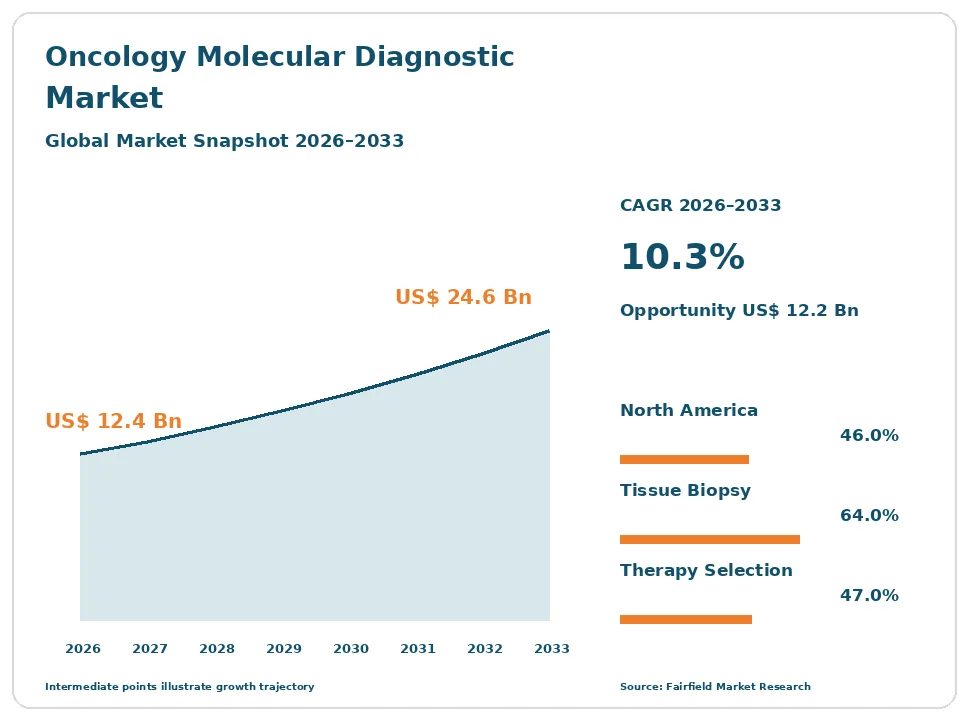
The global oncology molecular diagnostic market size is expected to be valued at US$ 12.4 billion in 2026 and projected to reach US$ 24.6 billion by 2033, growing at a CAGR of 10.3% between 2026 and 2033. The figure covers assays, kits, instruments, reagents and laboratory testing services that detect tumour-associated molecular alterations. Between 2020 and 2025 the category compounded at about 9.4% annually, as sequencing panel prices fell and the list of alterations tied to targeted therapies lengthened. Three factors carry the forecast. Payer coverage decisions determine which tests are ordered at scale. Inclusion of a biomarker in widely used treatment guidelines converts availability into routine volume. Biopharma demand for companion diagnostics funds assay development directly. Growth is healthy and broad-based rather than explosive, because reimbursement expands in increments rather than in steps.
Key Report Takeaways
- By Technology: Next-Generation Sequencing Panels held 38.0% share in 2026, while Methylation and Multi-Cancer Early Detection Assays are projected to expand at an 18.5% CAGR through 2033, albeit from a small base and against an unsettled evidentiary bar.
- By Sample Type: Tissue Biopsy held 64.0% share in 2026, while Liquid Biopsy is projected to expand at a 15.8% CAGR through 2033, driven by cases where archived tissue is insufficient for a full panel.
- By Application: Therapy Selection and Companion Diagnostics held 47.0% share in 2026, while Recurrence Monitoring and Minimal Residual Disease is projected to expand at a 17.2% CAGR through 2033, because monitoring repeats across a patient pathway.
- By End User: Central and Reference Laboratories held 41.0% share in 2026, while Hospital and Academic Laboratories are projected to expand at an 11.6% CAGR through 2033, as institutions bring panel testing in-house to control turnaround time.
- By Geography: North America held 46.0% share in 2026, while Asia Pacific is projected to expand at a 13.4% CAGR through 2033, led by national cancer genomics programmes in China, Japan and South Korea.
Global Oncology Molecular Diagnostic Market Trends and Insights
Drivers Impact Analysis
| Driver | Impact on CAGR Forecast | Geographic Relevance | Impact Timeline |
| Payer coverage determinations and laboratory fee schedule policy | High | North America, Europe, Japan | Long term ≥4 years |
| Inclusion of biomarkers in widely used clinical practice guidelines | High | Global | Medium term 2–4 years |
Two access mechanisms, not two technologies, explain most of the forecast growth in tumour molecular testing.
Coverage Determinations Decide Whether an Oncology Molecular Test Is Ordered at All
Reimbursement, rather than assay capability, sets the volume ceiling for tumour molecular testing. A laboratory can validate a comprehensive panel and still see low order rates until a payer issues a positive coverage decision and a payable rate exists. In the United States, the national coverage determination covering next-generation sequencing in cancer and the MolDX programme operated by Medicare administrative contractors function as the practical gate on reimbursable volume.
The causal mechanism runs through ordering behaviour. Oncologists and pathology services order what will be paid, because an unreimbursed send-out becomes an institutional cost or a patient bill. When a coverage article is published for a test category, order volumes follow within quarters, and laboratories expand capacity accordingly. The Protecting Access to Medicare Act reform of the Clinical Laboratory Fee Schedule sets the rates themselves, so fee schedule policy directly shapes laboratory investment decisions.
Clinical Guideline Inclusion Turns a Tumour Biomarker Into Routine Testing Volume
Guideline inclusion functions as market access for a biomarker. Once a widely used oncology treatment guideline lists a molecular alteration as part of the diagnostic workup for a tumour type, testing becomes expected practice, audited by cancer programmes and used by payers as the basis for coverage. The guideline cycle therefore drives volume more reliably than the publication cycle does.
The mechanism is institutional. Cancer centres build order sets, pathology protocols and reflex testing rules around guideline tables, and accreditation and quality programmes measure conformance against them. Laboratories update panel content to match. Because professional guideline bodies revise tumour-specific recommendations on regular schedules, assay suppliers now plan content releases around those revisions. Each added alteration broadens the panel a laboratory must run, which raises reagent consumption per case even where case numbers are flat.
Restraints Impact Analysis
| Restraint | Impact on CAGR Forecast | Geographic Relevance | Impact Timeline |
| Coverage and payment uncertainty for comprehensive panels and newer assay categories | High | Global | Long term ≥4 years |
| Tissue sample quantity and quality limits, and turnaround time pressure | Medium | Global | Medium term 2–4 years |
Two constraints hold back conversion of clinical interest into billed oncology testing volume.
Payment Uncertainty for Comprehensive Panels and Newer Assay Categories Limits Laboratory Investment
Unresolved payment is the single largest brake on this market. Comprehensive genomic profiling is frequently reimbursed only for defined tumour types and clinical settings, and liquid biopsy coverage varies between payers and between countries. Laboratories hesitate to build capacity for a test whose payable rate may be revised downward, and commercial laboratories carry significant denied-claim exposure on panels already performed.
The cost source is specific. A comprehensive panel consumes high-value reagents, flow cell capacity, and skilled pathology and bioinformatics review time, so an unpaid case is an expensive loss rather than a marginal one. For multi-cancer early detection the position is unsettled: proponents argue that stage-shift data supports screening use, while payers and several assessment bodies hold that outcome evidence from prospective studies is still being generated. Both positions are currently held, and coverage remains limited while that debate continues.
Sample Quantity, Quality and Turnaround Time Constrain Panel Completion Rates
A meaningful share of ordered oncology molecular tests cannot be completed as requested, and that failure rate suppresses realised revenue. Small biopsy specimens, fine-needle aspirates and heavily processed archival blocks frequently yield insufficient nucleic acid for a full panel, so laboratories must cancel, reduce scope, or request a repeat procedure that may not be clinically feasible.
The causes are procedural and chemical. Formalin fixation fragments nucleic acid and introduces sequence artefacts, and block age compounds the problem, so extraction yield varies widely between referring sites. Turnaround time adds a second constraint, because treatment decisions are made within defined windows and a result arriving late is clinically unusable even when technically valid. Transport to a distant reference laboratory, batching economics and bioinformatics queues all extend that interval, which is a principal reason institutions are reconsidering send-out arrangements.
Market Opportunities
Minimal Residual Disease Monitoring Converts One-Off Testing Into Recurring Assay Revenue
Minimal residual disease monitoring changes the revenue shape of molecular oncology from a single diagnostic event to a repeating series. A therapy selection panel is typically ordered once. A monitoring assay is ordered at intervals across surveillance, which multiplies lifetime assay consumption per patient without requiring a new customer. That recurrence is the most attractive unit economic available in this market.
Laboratories and kit suppliers with validated circulating tumour DNA workflows are positioned to capture it, supported by oncology practices managing long post-treatment follow-up. Demand concentrates in colorectal, breast, lung and haematological pathways where surveillance is already structured. The commercial requirement is operational rather than scientific: predictable turnaround, straightforward ordering within existing pathways, and clear payer pathways for repeat billing. Suppliers building subscription-style contracts with health systems are the natural beneficiaries.
Companion Diagnostic Co-Development With Biopharma Funds Assay Programmes Before Launch
Companion diagnostic co-development supplies revenue that arrives before any clinical testing volume does. Therapeutic developers need an authorised test to identify the biomarker-defined population for a targeted therapy, and the US Food and Drug Administration co-development framework expects the diagnostic and the drug to progress together. That creates milestone-based development income, trial testing volume and a launch-day installed position.
Diagnostic firms with regulatory submission experience and validated platforms capture this pool, because biopharma partners select on the ability to clear a premarket pathway on schedule. Demand comes from oncology pipelines concentrated in targeted and immuno-oncology assets. The distinction between an approved companion diagnostic and a laboratory developed test matters commercially here, since a labelled companion diagnostic travels with the therapy into every market where the drug is approved, extending the contract beyond a single country.
Segment Analysis
By Technology: Sequencing Panels Lead While Methylation and Early Detection Assays Climb Fastest
Next-generation sequencing panels held 38.0% of 2026 revenue. Comprehensive genomic profiling consolidates many single-gene questions into one run, which suits the expanding list of guideline-referenced alterations and makes efficient use of limited specimen material. Polymerase chain reaction and real-time PCR assays retain 26.0%, favoured for defined, high-throughput single-marker questions, while immunohistochemistry used as a biomarker test and in situ hybridisation together hold a substantial remainder.
Methylation and multi-cancer early detection assays are the fastest-growing technology at an 18.5% CAGR, though from a small base. Growth reflects commercial launch activity and study enrolment rather than settled reimbursement, and the evidentiary requirements for screening claims remain contested between developers, payers and assessment bodies. For suppliers, the implication is a two-speed portfolio: sequencing and PCR deliver current revenue, while methylation platforms absorb development spending against uncertain payment timelines.
By Sample Type: Tissue Testing Dominates as Liquid Biopsy Expands Around Its Limits
Tissue biopsy specimens accounted for 64.0% of 2026 oncology molecular testing revenue. Tissue remains the default input because pathology workflows, accreditation requirements and most guideline-referenced testing algorithms are built around it, and because a block supports morphology and molecular work from one specimen.
Liquid biopsy is the fastest-growing sample type at a 15.8% CAGR to 2033. Its commercial expansion is driven less by preference than by circumstance: where archived tissue is exhausted, insufficient or unavailable, a plasma-based circulating tumour DNA assay is the only route to a molecular result. Repeat sampling is also simpler, which underpins monitoring applications. Bone marrow and other specimens remain essential in haematological malignancies. The business implication is that laboratories increasingly need both workflows accredited under ISO 15189 and CLIA, because a single-sample-type menu now loses referrals.
By Application: Therapy Selection Leads While Residual Disease Monitoring Grows Fastest
Therapy selection and companion diagnostics represented 47.0% of 2026 application revenue. This is the application with the clearest reimbursement logic, because a test result determines eligibility for a specific therapy and payers can tie coverage to that decision. Prognosis and risk stratification testing adds a steady secondary pool.
Recurrence monitoring and minimal residual disease testing is the fastest-growing application at a 17.2% CAGR. The driver is frequency: surveillance assays repeat across months or years rather than running once, so each enrolled patient generates multiple billable events. Early detection and screening grows from the smallest base and faces the least settled payment environment. Suppliers are consequently restructuring commercial models around longitudinal contracts with health systems rather than per-case send-out pricing, which changes how sales forces are organised and how capacity is forecast.
By End User: Reference Laboratories Hold Scale While Hospital Laboratories Insource Fastest
Central and reference laboratories held 41.0% of 2026 end-user revenue. Scale economics favour them: high throughput spreads instrument and bioinformatics cost across many cases, and national accreditation and proficiency testing programmes, including those run by the College of American Pathologists, make large validated menus commercially defensible.
Hospital and academic laboratories are growing fastest at an 11.6% CAGR. Institutions are insourcing panel testing to compress turnaround time, retain specimen control and capture the technical component of the fee. Benchtop sequencers and pre-configured in vitro diagnostic kits have lowered the validation burden enough to make modest volumes viable. Cancer specialty centres and pharmaceutical and biotechnology companies complete the mix, the latter buying trial testing rather than clinical service. The implication for kit suppliers is that the addressable customer count is rising even as individual order sizes fall.
Geography Analysis
Which Region Is Leading the Oncology Molecular Diagnostic Market?
North America leads the oncology molecular diagnostic market with 46.0% share in 2026, chiefly because its reimbursement architecture is the most developed. The United States supplies most of that revenue, with Canada adding provincially funded testing programmes. Centers for Medicare & Medicaid Services policy, including the national coverage determination for next-generation sequencing in cancer and the MolDX programme, provides a published route from validated assay to payable test that few other systems match. The Protecting Access to Medicare Act governs the rates attached to that route. Laboratories operate under CLIA certification with College of American Pathologists accreditation and proficiency testing, which supports payer confidence. Biopharma headquarters concentration also places most companion diagnostic co-development contracts here. The main change underway is pressure on panel pricing as payers scrutinise comprehensive profiling claims more closely.
Europe Advances Under Stricter In Vitro Diagnostic Rules and Nationally Funded Testing
Europe held 25.0% of oncology molecular diagnostic revenue in 2026, with Germany, France, the United Kingdom, Italy and Spain contributing most of it. The defining feature is regulatory: the In Vitro Diagnostic Regulation classifies most cancer molecular tests in higher risk classes, requiring notified body involvement and substantially more clinical evidence than the previous directive. Compliance cost has narrowed supplier menus and pushed some niche assays out of the market. Funding is nationally determined, so adoption varies widely, with centrally commissioned genomic testing services in some countries and slower regional funding elsewhere. Laboratory accreditation to ISO 15189 is close to universal. The region’s notable change is consolidation of molecular testing into designated genomic laboratory hubs, which concentrates purchasing power and favours suppliers able to support large validated panels.
Which Region Is Growing Fastest in the Oncology Molecular Diagnostic Market?
Asia Pacific is growing fastest in the oncology molecular diagnostic market at a 13.4% CAGR between 2026 and 2033, expanding from 21.0% share in 2026. China contributes the largest absolute increase, supported by domestic sequencing manufacturers, provincial reimbursement expansion and a very large diagnosed cancer population. Japan pairs national health insurance listing of comprehensive genomic profiling with designated hospital networks, which gives it unusually predictable volumes. South Korea combines high screening participation with strong laboratory capacity, while India is expanding private reference laboratory networks and Australia funds selected biomarker testing nationally. Singapore and Taiwan operate smaller but advanced programmes. The region’s defining change is the construction of national cancer genomics capacity, which shifts testing from imported send-outs to domestic laboratories and creates tenders that favour local manufacturing partnerships.
Latin America Expands Private Testing Capacity Against Funding and Logistics Barriers
Latin America accounted for 5.0% of 2026 oncology molecular diagnostic revenue, with Brazil and Mexico providing the bulk and Argentina, Chile and Colombia adding established private networks. Growth is concentrated in private insurance and self-pay testing, because public cancer programmes fund molecular panels unevenly and approval of new reimbursed tests is slow. Barriers are practical as well as financial: specimen transport over long distances degrades sample quality, national registration adds delay for imported kits, and currency movement affects reagent pricing. Trained molecular pathology staff remain scarce outside major cities. The clearest regional change is investment by large private laboratory groups in centralised sequencing hubs, which lowers per-test cost and reduces dependence on cross-border send-outs that previously extended turnaround time well beyond treatment decision windows.
Middle East & Africa Builds Capacity From Hospital Networks and National Genomics Programmes
Middle East & Africa represented 3.0% of 2026 revenue, the smallest regional pool, with demand concentrated in the United Arab Emirates, Saudi Arabia, Israel, Qatar and South Africa. Gulf states are investing in national genomics and precision oncology programmes attached to flagship hospitals, which creates well-funded but small-volume tenders. South Africa operates the most developed laboratory network on the continent, serving regional referrals. Barriers are substantial: limited molecular pathology workforce, fragmented registration requirements across many jurisdictions, and public funding that prioritises communicable disease and basic oncology care over molecular profiling. Cold-chain logistics constrain liquid biopsy programmes. The notable change is the arrival of international laboratory operators under partnership agreements, which transfers accreditation know-how and gradually replaces overseas send-out testing with local capacity.
Competitive Landscape
The oncology molecular diagnostic market is moderately concentrated, with a different structure in each layer. Instruments and sequencing chemistry are concentrated among a small group of platform suppliers, because manufacturing scale and installed base create strong incumbency. Assay kits are more contested, with large diagnostics groups competing against focused specialists on panel content and regulatory status. Laboratory services are the most fragmented layer, where national reference laboratories, hospital networks and specialist oncology testing providers compete on menu, turnaround and payer contracts. Consolidation has been steady, with platform owners acquiring content and service businesses to secure consumable pull-through.
Competition turns on reimbursement capability as much as on assay performance. The practical differentiators are the breadth of published coverage for a test, the ability to bill cleanly across payers, regulatory status as an authorised companion diagnostic versus a laboratory developed test, turnaround time against treatment decision windows, and the depth of biopharma co-development relationships. Panel content currency matters because guideline revisions change what laboratories must offer. New approaches entering the field include decentralised sequencing packaged as kitted in vitro diagnostic products for hospital laboratories, methylation-based assay developers pursuing screening indications, and domestic manufacturers in China and India competing on landed cost in public tenders.
Strategic activity concentrates on securing content and access rather than on raw sequencing capability. Platform suppliers pursue partnerships that convert clinical content into instrument placements, service laboratories pursue payer contracts and health system agreements that lock in longitudinal testing, and diagnostics groups build regulatory affairs capacity to clear higher In Vitro Diagnostic Regulation risk classes in Europe. Co-development agreements with therapeutic developers remain the most sought-after commercial relationship, because they fund development and carry the assay into every market where the paired therapy is approved.
The common strategic direction is a shift from selling assays to selling reimbursable testing programmes, with regulatory and payer capability treated as core commercial infrastructure.
Oncology Molecular Diagnostic Industry Leaders
- F. Hoffmann-La Roche Ltd
- Thermo Fisher Scientific Inc.
- Illumina, Inc.
- QIAGEN N.V.
- Guardant Health, Inc.
Recent Industry Developments
- March 2024: The United States Congress again delayed private-payer data reporting under the Protecting Access to Medicare Act and extended the limit on Clinical Laboratory Fee Schedule payment reductions – postponing scheduled rate cuts for molecular pathology codes and stabilising laboratory revenue planning.
- July 2024: An amending regulation extended the transitional periods of the EU In Vitro Diagnostic Regulation and introduced a phased roll-out of the European Database on Medical Devices – giving cancer assay manufacturers additional time to complete notified body conformity assessment.
- December 2025: The transition deadline for medical laboratories to the 2022 edition of ISO 15189 took effect – requiring accredited oncology testing laboratories to demonstrate revised risk management and competence arrangements to retain accreditation.
Companies Covered in the Report
- F. Hoffmann-La Roche Ltd
- Thermo Fisher Scientific Inc.
- Illumina, Inc.
- QIAGEN N.V.
- Guardant Health, Inc.
- Exact Sciences Corporation
- Natera, Inc.
- Agilent Technologies, Inc.
- Danaher Corporation
- Abbott Laboratories
- Bio-Rad Laboratories, Inc.
- Myriad Genetics, Inc.
- NeoGenomics, Inc.
- Laboratory Corporation of America Holdings
- Quest Diagnostics Incorporated
Oncology Molecular Diagnostic Market Report Scope
This study covers assays, kits, instruments, reagents and laboratory services that detect tumour-associated molecular alterations across solid tumours and haematological malignancies. The variant interpretation and reporting software layer is covered in a separate study and is excluded here, as are therapeutics and imaging. The base year is 2025, with a forecast period of 2026 to 2033. All values are reported in US$ Billion.
Technology
- PCR and Real-Time PCR Assays
- Next-Generation Sequencing Panels
- In Situ Hybridisation
- Immunohistochemistry-Based Biomarker Testing
- Methylation and Multi-Cancer Early Detection Assays
Sample Type
- Tissue Biopsy
- Liquid Biopsy
- Bone Marrow and Other Specimens
Application
- Therapy Selection and Companion Diagnostics
- Recurrence Monitoring and Minimal Residual Disease
- Early Detection and Screening
- Prognosis and Risk Stratification
End User
- Central and Reference Laboratories
- Hospital and Academic Laboratories
- Cancer Specialty Centres
- Pharmaceutical and Biotechnology Companies
Regions
- North America
- Europe
- Asia Pacific
- Latin America
- Middle East & Africa
Key Questions Answered in the Report
How large is the oncology molecular diagnostic market in 2026?
The oncology molecular diagnostic market is valued at US$ 12.4 billion in 2026, covering assays, kits, instruments, reagents and laboratory testing services worldwide.
What is the oncology molecular diagnostic forecast and CAGR to 2033?
The market is projected to reach US$ 24.6 billion by 2033 at a 10.3% CAGR, adding US$ 12.2 billion in absolute dollar opportunity.
Which technology segment holds the largest share?
Next-generation sequencing panels lead with 38.0% share in 2026, because one run answers many guideline-referenced questions from a single limited specimen.
Which oncology molecular diagnostic segment is growing fastest?
Recurrence monitoring and minimal residual disease testing grows fastest at a 17.2% CAGR, because surveillance assays repeat across a patient pathway.
Which region leads the oncology molecular diagnostic market?
North America leads with 46.0% share in 2026, mainly because its coverage determination and fee schedule framework provides a published route to payable testing.
1. Executive Summary
1.1. Global Oncology Molecular Diagnostic Market Snapshot
1.2. Future Projections
1.3. Key Report Takeaways
1.4. Regional Snapshot
2. Market Overview
2.1. Market Definition and Report Scope
2.2. Historical Trends 2020–2025
2.3. Market Dynamics
2.3.1. Drivers
2.3.1.1. Coverage Determinations Decide Whether an Oncology Molecular Test Is Ordered at All
2.3.1.2. Clinical Guideline Inclusion Turns a Tumour Biomarker Into Routine Testing Volume
2.3.2. Restraints
2.3.2.1. Payment Uncertainty for Comprehensive Panels and Newer Assay Categories Limits Laboratory Investment
2.3.2.2. Sample Quantity, Quality and Turnaround Time Constrain Panel Completion Rates
2.3.3. Market Opportunities
2.3.3.1. Minimal Residual Disease Monitoring Converts One-Off Testing Into Recurring Assay Revenue
2.3.3.2. Companion Diagnostic Co-Development With Biopharma Funds Assay Programmes Before Launch
3. Global Oncology Molecular Diagnostic Market Outlook, 2020–2033
3.1. Global Oncology Molecular Diagnostic Market Outlook, by Technology, Value (US$ Billion), 2020–2033
3.1.1. PCR and Real-Time PCR Assays
3.1.2. Next-Generation Sequencing Panels
3.1.3. In Situ Hybridisation
3.1.4. Immunohistochemistry-Based Biomarker Testing
3.1.5. Methylation and Multi-Cancer Early Detection Assays
3.2. Global Oncology Molecular Diagnostic Market Outlook, by Sample Type, Value (US$ Billion), 2020–2033
3.2.1. Tissue Biopsy
3.2.2. Liquid Biopsy
3.2.3. Bone Marrow and Other Specimens
3.3. Global Oncology Molecular Diagnostic Market Outlook, by Application, Value (US$ Billion), 2020–2033
3.3.1. Therapy Selection and Companion Diagnostics
3.3.2. Recurrence Monitoring and Minimal Residual Disease
3.3.3. Early Detection and Screening
3.3.4. Prognosis and Risk Stratification
3.4. Global Oncology Molecular Diagnostic Market Outlook, by End User, Value (US$ Billion), 2020–2033
3.4.1. Central and Reference Laboratories
3.4.2. Hospital and Academic Laboratories
3.4.3. Cancer Specialty Centres
3.4.4. Pharmaceutical and Biotechnology Companies
3.5. Global Oncology Molecular Diagnostic Market Outlook, by Region, Value (US$ Billion), 2020–2033
3.5.1. North America
3.5.2. Europe
3.5.3. Asia Pacific
3.5.4. Latin America
3.5.5. Middle East & Africa
4. North America Oncology Molecular Diagnostic Market Outlook, 2020–2033
4.1. North America Oncology Molecular Diagnostic Market Outlook, by Technology, Value (US$ Billion), 2020–2033
4.1.1. PCR and Real-Time PCR Assays
4.1.2. Next-Generation Sequencing Panels
4.1.3. In Situ Hybridisation
4.1.4. Immunohistochemistry-Based Biomarker Testing
4.1.5. Methylation and Multi-Cancer Early Detection Assays
4.2. North America Oncology Molecular Diagnostic Market Outlook, by Sample Type, Value (US$ Billion), 2020–2033
4.2.1. Tissue Biopsy
4.2.2. Liquid Biopsy
4.2.3. Bone Marrow and Other Specimens
4.3. North America Oncology Molecular Diagnostic Market Outlook, by Application, Value (US$ Billion), 2020–2033
4.3.1. Therapy Selection and Companion Diagnostics
4.3.2. Recurrence Monitoring and Minimal Residual Disease
4.3.3. Early Detection and Screening
4.3.4. Prognosis and Risk Stratification
4.4. North America Oncology Molecular Diagnostic Market Outlook, by End User, Value (US$ Billion), 2020–2033
4.4.1. Central and Reference Laboratories
4.4.2. Hospital and Academic Laboratories
4.4.3. Cancer Specialty Centres
4.4.4. Pharmaceutical and Biotechnology Companies
4.5. North America Oncology Molecular Diagnostic Market Outlook, by Country, Value (US$ Billion), 2020–2033
4.5.1. United States Oncology Molecular Diagnostic Market Outlook, by Technology, 2020–2033
4.5.2. United States Oncology Molecular Diagnostic Market Outlook, by Sample Type, 2020–2033
4.5.3. United States Oncology Molecular Diagnostic Market Outlook, by Application, 2020–2033
4.5.4. United States Oncology Molecular Diagnostic Market Outlook, by End User, 2020–2033
4.5.5. Canada Oncology Molecular Diagnostic Market Outlook, by Technology, 2020–2033
4.5.6. Canada Oncology Molecular Diagnostic Market Outlook, by Sample Type, 2020–2033
4.5.7. Canada Oncology Molecular Diagnostic Market Outlook, by Application, 2020–2033
4.5.8. Canada Oncology Molecular Diagnostic Market Outlook, by End User, 2020–2033
5. Europe Oncology Molecular Diagnostic Market Outlook, 2020–2033
5.1. Europe Oncology Molecular Diagnostic Market Outlook, by Technology, Value (US$ Billion), 2020–2033
5.1.1. PCR and Real-Time PCR Assays
5.1.2. Next-Generation Sequencing Panels
5.1.3. In Situ Hybridisation
5.1.4. Immunohistochemistry-Based Biomarker Testing
5.1.5. Methylation and Multi-Cancer Early Detection Assays
5.2. Europe Oncology Molecular Diagnostic Market Outlook, by Sample Type, Value (US$ Billion), 2020–2033
5.2.1. Tissue Biopsy
5.2.2. Liquid Biopsy
5.2.3. Bone Marrow and Other Specimens
5.3. Europe Oncology Molecular Diagnostic Market Outlook, by Application, Value (US$ Billion), 2020–2033
5.3.1. Therapy Selection and Companion Diagnostics
5.3.2. Recurrence Monitoring and Minimal Residual Disease
5.3.3. Early Detection and Screening
5.3.4. Prognosis and Risk Stratification
5.4. Europe Oncology Molecular Diagnostic Market Outlook, by End User, Value (US$ Billion), 2020–2033
5.4.1. Central and Reference Laboratories
5.4.2. Hospital and Academic Laboratories
5.4.3. Cancer Specialty Centres
5.4.4. Pharmaceutical and Biotechnology Companies
5.5. Europe Oncology Molecular Diagnostic Market Outlook, by Country, Value (US$ Billion), 2020–2033
5.5.1. Germany Oncology Molecular Diagnostic Market Outlook, by Technology, 2020–2033
5.5.2. Germany Oncology Molecular Diagnostic Market Outlook, by Sample Type, 2020–2033
5.5.3. Germany Oncology Molecular Diagnostic Market Outlook, by Application, 2020–2033
5.5.4. Germany Oncology Molecular Diagnostic Market Outlook, by End User, 2020–2033
5.5.5. France Oncology Molecular Diagnostic Market Outlook, by Technology, 2020–2033
5.5.6. France Oncology Molecular Diagnostic Market Outlook, by Sample Type, 2020–2033
5.5.7. France Oncology Molecular Diagnostic Market Outlook, by Application, 2020–2033
5.5.8. France Oncology Molecular Diagnostic Market Outlook, by End User, 2020–2033
5.5.9. United Kingdom Oncology Molecular Diagnostic Market Outlook, by Technology, 2020–2033
5.5.10. United Kingdom Oncology Molecular Diagnostic Market Outlook, by Sample Type, 2020–2033
5.5.11. United Kingdom Oncology Molecular Diagnostic Market Outlook, by Application, 2020–2033
5.5.12. United Kingdom Oncology Molecular Diagnostic Market Outlook, by End User, 2020–2033
5.5.13. Italy Oncology Molecular Diagnostic Market Outlook, by Technology, 2020–2033
5.5.14. Italy Oncology Molecular Diagnostic Market Outlook, by Sample Type, 2020–2033
5.5.15. Italy Oncology Molecular Diagnostic Market Outlook, by Application, 2020–2033
5.5.16. Italy Oncology Molecular Diagnostic Market Outlook, by End User, 2020–2033
5.5.17. Spain Oncology Molecular Diagnostic Market Outlook, by Technology, 2020–2033
5.5.18. Spain Oncology Molecular Diagnostic Market Outlook, by Sample Type, 2020–2033
5.5.19. Spain Oncology Molecular Diagnostic Market Outlook, by Application, 2020–2033
5.5.20. Spain Oncology Molecular Diagnostic Market Outlook, by End User, 2020–2033
6. Asia Pacific Oncology Molecular Diagnostic Market Outlook, 2020–2033
6.1. Asia Pacific Oncology Molecular Diagnostic Market Outlook, by Technology, Value (US$ Billion), 2020–2033
6.1.1. PCR and Real-Time PCR Assays
6.1.2. Next-Generation Sequencing Panels
6.1.3. In Situ Hybridisation
6.1.4. Immunohistochemistry-Based Biomarker Testing
6.1.5. Methylation and Multi-Cancer Early Detection Assays
6.2. Asia Pacific Oncology Molecular Diagnostic Market Outlook, by Sample Type, Value (US$ Billion), 2020–2033
6.2.1. Tissue Biopsy
6.2.2. Liquid Biopsy
6.2.3. Bone Marrow and Other Specimens
6.3. Asia Pacific Oncology Molecular Diagnostic Market Outlook, by Application, Value (US$ Billion), 2020–2033
6.3.1. Therapy Selection and Companion Diagnostics
6.3.2. Recurrence Monitoring and Minimal Residual Disease
6.3.3. Early Detection and Screening
6.3.4. Prognosis and Risk Stratification
6.4. Asia Pacific Oncology Molecular Diagnostic Market Outlook, by End User, Value (US$ Billion), 2020–2033
6.4.1. Central and Reference Laboratories
6.4.2. Hospital and Academic Laboratories
6.4.3. Cancer Specialty Centres
6.4.4. Pharmaceutical and Biotechnology Companies
6.5. Asia Pacific Oncology Molecular Diagnostic Market Outlook, by Country, Value (US$ Billion), 2020–2033
6.5.1. China Oncology Molecular Diagnostic Market Outlook, by Technology, 2020–2033
6.5.2. China Oncology Molecular Diagnostic Market Outlook, by Sample Type, 2020–2033
6.5.3. China Oncology Molecular Diagnostic Market Outlook, by Application, 2020–2033
6.5.4. China Oncology Molecular Diagnostic Market Outlook, by End User, 2020–2033
6.5.5. Japan Oncology Molecular Diagnostic Market Outlook, by Technology, 2020–2033
6.5.6. Japan Oncology Molecular Diagnostic Market Outlook, by Sample Type, 2020–2033
6.5.7. Japan Oncology Molecular Diagnostic Market Outlook, by Application, 2020–2033
6.5.8. Japan Oncology Molecular Diagnostic Market Outlook, by End User, 2020–2033
6.5.9. South Korea Oncology Molecular Diagnostic Market Outlook, by Technology, 2020–2033
6.5.10. South Korea Oncology Molecular Diagnostic Market Outlook, by Sample Type, 2020–2033
6.5.11. South Korea Oncology Molecular Diagnostic Market Outlook, by Application, 2020–2033
6.5.12. South Korea Oncology Molecular Diagnostic Market Outlook, by End User, 2020–2033
6.5.13. India Oncology Molecular Diagnostic Market Outlook, by Technology, 2020–2033
6.5.14. India Oncology Molecular Diagnostic Market Outlook, by Sample Type, 2020–2033
6.5.15. India Oncology Molecular Diagnostic Market Outlook, by Application, 2020–2033
6.5.16. India Oncology Molecular Diagnostic Market Outlook, by End User, 2020–2033
6.5.17. Australia Oncology Molecular Diagnostic Market Outlook, by Technology, 2020–2033
6.5.18. Australia Oncology Molecular Diagnostic Market Outlook, by Sample Type, 2020–2033
6.5.19. Australia Oncology Molecular Diagnostic Market Outlook, by Application, 2020–2033
6.5.20. Australia Oncology Molecular Diagnostic Market Outlook, by End User, 2020–2033
6.5.21. Singapore Oncology Molecular Diagnostic Market Outlook, by Technology, 2020–2033
6.5.22. Singapore Oncology Molecular Diagnostic Market Outlook, by Sample Type, 2020–2033
6.5.23. Singapore Oncology Molecular Diagnostic Market Outlook, by Application, 2020–2033
6.5.24. Singapore Oncology Molecular Diagnostic Market Outlook, by End User, 2020–2033
6.5.25. Taiwan Oncology Molecular Diagnostic Market Outlook, by Technology, 2020–2033
6.5.26. Taiwan Oncology Molecular Diagnostic Market Outlook, by Sample Type, 2020–2033
6.5.27. Taiwan Oncology Molecular Diagnostic Market Outlook, by Application, 2020–2033
6.5.28. Taiwan Oncology Molecular Diagnostic Market Outlook, by End User, 2020–2033
7. Latin America Oncology Molecular Diagnostic Market Outlook, 2020–2033
7.1. Latin America Oncology Molecular Diagnostic Market Outlook, by Technology, Value (US$ Billion), 2020–2033
7.1.1. PCR and Real-Time PCR Assays
7.1.2. Next-Generation Sequencing Panels
7.1.3. In Situ Hybridisation
7.1.4. Immunohistochemistry-Based Biomarker Testing
7.1.5. Methylation and Multi-Cancer Early Detection Assays
7.2. Latin America Oncology Molecular Diagnostic Market Outlook, by Sample Type, Value (US$ Billion), 2020–2033
7.2.1. Tissue Biopsy
7.2.2. Liquid Biopsy
7.2.3. Bone Marrow and Other Specimens
7.3. Latin America Oncology Molecular Diagnostic Market Outlook, by Application, Value (US$ Billion), 2020–2033
7.3.1. Therapy Selection and Companion Diagnostics
7.3.2. Recurrence Monitoring and Minimal Residual Disease
7.3.3. Early Detection and Screening
7.3.4. Prognosis and Risk Stratification
7.4. Latin America Oncology Molecular Diagnostic Market Outlook, by End User, Value (US$ Billion), 2020–2033
7.4.1. Central and Reference Laboratories
7.4.2. Hospital and Academic Laboratories
7.4.3. Cancer Specialty Centres
7.4.4. Pharmaceutical and Biotechnology Companies
7.5. Latin America Oncology Molecular Diagnostic Market Outlook, by Country, Value (US$ Billion), 2020–2033
7.5.1. Brazil Oncology Molecular Diagnostic Market Outlook, by Technology, 2020–2033
7.5.2. Brazil Oncology Molecular Diagnostic Market Outlook, by Sample Type, 2020–2033
7.5.3. Brazil Oncology Molecular Diagnostic Market Outlook, by Application, 2020–2033
7.5.4. Brazil Oncology Molecular Diagnostic Market Outlook, by End User, 2020–2033
7.5.5. Mexico Oncology Molecular Diagnostic Market Outlook, by Technology, 2020–2033
7.5.6. Mexico Oncology Molecular Diagnostic Market Outlook, by Sample Type, 2020–2033
7.5.7. Mexico Oncology Molecular Diagnostic Market Outlook, by Application, 2020–2033
7.5.8. Mexico Oncology Molecular Diagnostic Market Outlook, by End User, 2020–2033
7.5.9. Argentina Oncology Molecular Diagnostic Market Outlook, by Technology, 2020–2033
7.5.10. Argentina Oncology Molecular Diagnostic Market Outlook, by Sample Type, 2020–2033
7.5.11. Argentina Oncology Molecular Diagnostic Market Outlook, by Application, 2020–2033
7.5.12. Argentina Oncology Molecular Diagnostic Market Outlook, by End User, 2020–2033
7.5.13. Chile Oncology Molecular Diagnostic Market Outlook, by Technology, 2020–2033
7.5.14. Chile Oncology Molecular Diagnostic Market Outlook, by Sample Type, 2020–2033
7.5.15. Chile Oncology Molecular Diagnostic Market Outlook, by Application, 2020–2033
7.5.16. Chile Oncology Molecular Diagnostic Market Outlook, by End User, 2020–2033
7.5.17. Colombia Oncology Molecular Diagnostic Market Outlook, by Technology, 2020–2033
7.5.18. Colombia Oncology Molecular Diagnostic Market Outlook, by Sample Type, 2020–2033
7.5.19. Colombia Oncology Molecular Diagnostic Market Outlook, by Application, 2020–2033
7.5.20. Colombia Oncology Molecular Diagnostic Market Outlook, by End User, 2020–2033
8. Middle East & Africa Oncology Molecular Diagnostic Market Outlook, 2020–2033
8.1. Middle East & Africa Oncology Molecular Diagnostic Market Outlook, by Technology, Value (US$ Billion), 2020–2033
8.1.1. PCR and Real-Time PCR Assays
8.1.2. Next-Generation Sequencing Panels
8.1.3. In Situ Hybridisation
8.1.4. Immunohistochemistry-Based Biomarker Testing
8.1.5. Methylation and Multi-Cancer Early Detection Assays
8.2. Middle East & Africa Oncology Molecular Diagnostic Market Outlook, by Sample Type, Value (US$ Billion), 2020–2033
8.2.1. Tissue Biopsy
8.2.2. Liquid Biopsy
8.2.3. Bone Marrow and Other Specimens
8.3. Middle East & Africa Oncology Molecular Diagnostic Market Outlook, by Application, Value (US$ Billion), 2020–2033
8.3.1. Therapy Selection and Companion Diagnostics
8.3.2. Recurrence Monitoring and Minimal Residual Disease
8.3.3. Early Detection and Screening
8.3.4. Prognosis and Risk Stratification
8.4. Middle East & Africa Oncology Molecular Diagnostic Market Outlook, by End User, Value (US$ Billion), 2020–2033
8.4.1. Central and Reference Laboratories
8.4.2. Hospital and Academic Laboratories
8.4.3. Cancer Specialty Centres
8.4.4. Pharmaceutical and Biotechnology Companies
8.5. Middle East & Africa Oncology Molecular Diagnostic Market Outlook, by Country, Value (US$ Billion), 2020–2033
8.5.1. United Arab Emirates Oncology Molecular Diagnostic Market Outlook, by Technology, 2020–2033
8.5.2. United Arab Emirates Oncology Molecular Diagnostic Market Outlook, by Sample Type, 2020–2033
8.5.3. United Arab Emirates Oncology Molecular Diagnostic Market Outlook, by Application, 2020–2033
8.5.4. United Arab Emirates Oncology Molecular Diagnostic Market Outlook, by End User, 2020–2033
8.5.5. Saudi Arabia Oncology Molecular Diagnostic Market Outlook, by Technology, 2020–2033
8.5.6. Saudi Arabia Oncology Molecular Diagnostic Market Outlook, by Sample Type, 2020–2033
8.5.7. Saudi Arabia Oncology Molecular Diagnostic Market Outlook, by Application, 2020–2033
8.5.8. Saudi Arabia Oncology Molecular Diagnostic Market Outlook, by End User, 2020–2033
8.5.9. Israel Oncology Molecular Diagnostic Market Outlook, by Technology, 2020–2033
8.5.10. Israel Oncology Molecular Diagnostic Market Outlook, by Sample Type, 2020–2033
8.5.11. Israel Oncology Molecular Diagnostic Market Outlook, by Application, 2020–2033
8.5.12. Israel Oncology Molecular Diagnostic Market Outlook, by End User, 2020–2033
8.5.13. Qatar Oncology Molecular Diagnostic Market Outlook, by Technology, 2020–2033
8.5.14. Qatar Oncology Molecular Diagnostic Market Outlook, by Sample Type, 2020–2033
8.5.15. Qatar Oncology Molecular Diagnostic Market Outlook, by Application, 2020–2033
8.5.16. Qatar Oncology Molecular Diagnostic Market Outlook, by End User, 2020–2033
8.5.17. South Africa Oncology Molecular Diagnostic Market Outlook, by Technology, 2020–2033
8.5.18. South Africa Oncology Molecular Diagnostic Market Outlook, by Sample Type, 2020–2033
8.5.19. South Africa Oncology Molecular Diagnostic Market Outlook, by Application, 2020–2033
8.5.20. South Africa Oncology Molecular Diagnostic Market Outlook, by End User, 2020–2033
9. Competitive Landscape
9.1. Market Concentration and Industry Leaders
9.2. Competitive Differentiation
9.3. Strategic Moves and Market Direction
9.4. Recent Industry Developments
9.5. Company Profiles
9.5.1. F. Hoffmann-La Roche Ltd
9.5.2. Thermo Fisher Scientific Inc.
9.5.3. Illumina, Inc.
9.5.4. QIAGEN N.V.
9.5.5. Guardant Health, Inc.
9.5.6. Exact Sciences Corporation
9.5.7. Natera, Inc.
9.5.8. Agilent Technologies, Inc.
9.5.9. Danaher Corporation
9.5.10. Abbott Laboratories
9.5.11. Bio-Rad Laboratories, Inc.
9.5.12. Myriad Genetics, Inc.
9.5.13. NeoGenomics, Inc.
9.5.14. Laboratory Corporation of America Holdings
9.5.15. Quest Diagnostics Incorporated
10. Appendix
10.1. Research Methodology
10.2. Report Assumptions
10.3. Acronyms and Abbreviations
| Technology | PCR and Real-Time PCR Assays, Next-Generation Sequencing Panels, In Situ Hybridisation, Immunohistochemistry-Based Biomarker Testing, Methylation and Multi-Cancer Early Detection Assays |
| Sample Type | Tissue Biopsy, Liquid Biopsy, Bone Marrow and Other Specimens |
| Application | Therapy Selection and Companion Diagnostics, Recurrence Monitoring and Minimal Residual Disease, Early Detection and Screening, Prognosis and Risk Stratification |
| End User | Central and Reference Laboratories, Hospital and Academic Laboratories, Cancer Specialty Centres, Pharmaceutical and Biotechnology Companies |
| Regions | North America, Europe, Asia Pacific, Latin America, Middle East & Africa |
Our Research Methodology
Considering the volatility of business today, traditional approaches to strategizing a game plan can be unfruitful if not detrimental. True ambiguity is no way to determine a forecast. A myriad of predetermined factors must be accounted for such as the degree of risk involved, the magnitude of circumstances, as well as conditions or consequences that are not known or unpredictable. To circumvent binary views that cast uncertainty, the application of market research intelligence to strategically posture, move, and enable actionable outcomes is necessary.
View Methodology
Quality Assured
Rigorous Validation Process

Confidentiality Assured
End-to-end Data Security

Custom Research Services
Tailored To Your Objectives
FAQs
The oncology molecular diagnostic market is valued at US$ 12.4 billion in 2026, covering assays, kits, instruments, reagents and laboratory testing services worldwide.
The market is projected to reach US$ 24.6 billion by 2033 at a 10.3% CAGR, adding US$ 12.2 billion in absolute dollar opportunity.
Next-generation sequencing panels lead with 38.0% share in 2026, because one run answers many guideline-referenced questions from a single limited specimen.
Recurrence monitoring and minimal residual disease testing grows fastest at a 17.2% CAGR, because surveillance assays repeat across a patient pathway.
North America leads with 46.0% share in 2026, mainly because its coverage determination and fee schedule framework provides a published route to payable testing.
Related Reports
Ultrasound Needle Guides Market Size, Share, Insights, Competitive Landscape, and Forecast 2026 to 2033
Explore the ultrasound needle guides market, projected to reach US$0.7 billion by 2033 at 8.3% CAGR, with product, application and regional insights.
Mechanical Ventilators Market Size, Share, Insights, Competitive Landscape, and Forecast 2026 to 2033
The global mechanical ventilators market is valued at US$4.80 billion in 2026, reaching US$6.58 billion by 2033, growing at a 4.6% CAGR
Drugs of Abuse Testing Market Size, Share, Insights, Competitive Landscape, and Forecast 2026 to 2033
The global drugs of abuse testing market is valued at US$6.80 billion in 2026, reaching US$14.60 billion by 2033, growing at an 11.5% CAGR
Brain Health Devices Market Size, Share, Insights, Competitive Landscape, and Forecast 2026 to 2033
The global brain health devices market is valued at US$8.60 billion in 2026, reaching US$13.10 billion by 2033, growing at a 6.2% CAGR
Biohazard Bags Market Size, Share, Insights, Competitive Landscape, and Forecast 2026 to 2033
The global biohazard bags market is valued at US$380.4 million in 2026, reaching US$660.4 million by 2033, growing at an 8.2% CAGR
Biohacking Market Size, Share, Insights, Competitive Landscape, and Forecast 2026 to 2033
The global biohacking market is valued at US$27.50 billion in 2026, reaching US$84.53 billion by 2033, growing at a 17.4% CAGR